# AI Visibility vs SEO: What Actually Changed
URL: https://www.rankinaioverview.com/blog/ai-visibility-vs-seo-what-changed
Published: 2026-08-26
## Key Highlights
* On ranking-style queries, the domains AI engines consult barely overlap with Google's top results, which means the two systems are drawing from different pools rather than the same one ranked differently.
* The core shift is from optimising a page to hold a position toward earning trust as the source an answer is built from, and that is a change of goal, not just of tactics.
* Most SEO fundamentals still hold, because AI answers are layered on existing ranking systems, so the honest picture is addition rather than replacement.
* The genuinely new work is answer engineering, entity building and cross-engine measurement, none of which classic keyword-first SEO ever taught.
* Measurement changes shape entirely: there is no single rank to watch, so you track presence and share across many prompts and engines over time.
* The failure mode is treating this as either total revolution or business as usual, because both readings lead you to spend effort in the wrong place.
Experienced SEOs are living with a strange mix of confidence and confusion. They know optimisation deeply, and yet the ground has shifted beneath the work in ways that are hard to name. AI visibility looks like SEO, it uses similar inputs, and then it behaves differently in ways that resist a tidy explanation. That disorientation is real and it deserves a clear account rather than either hype or panic.
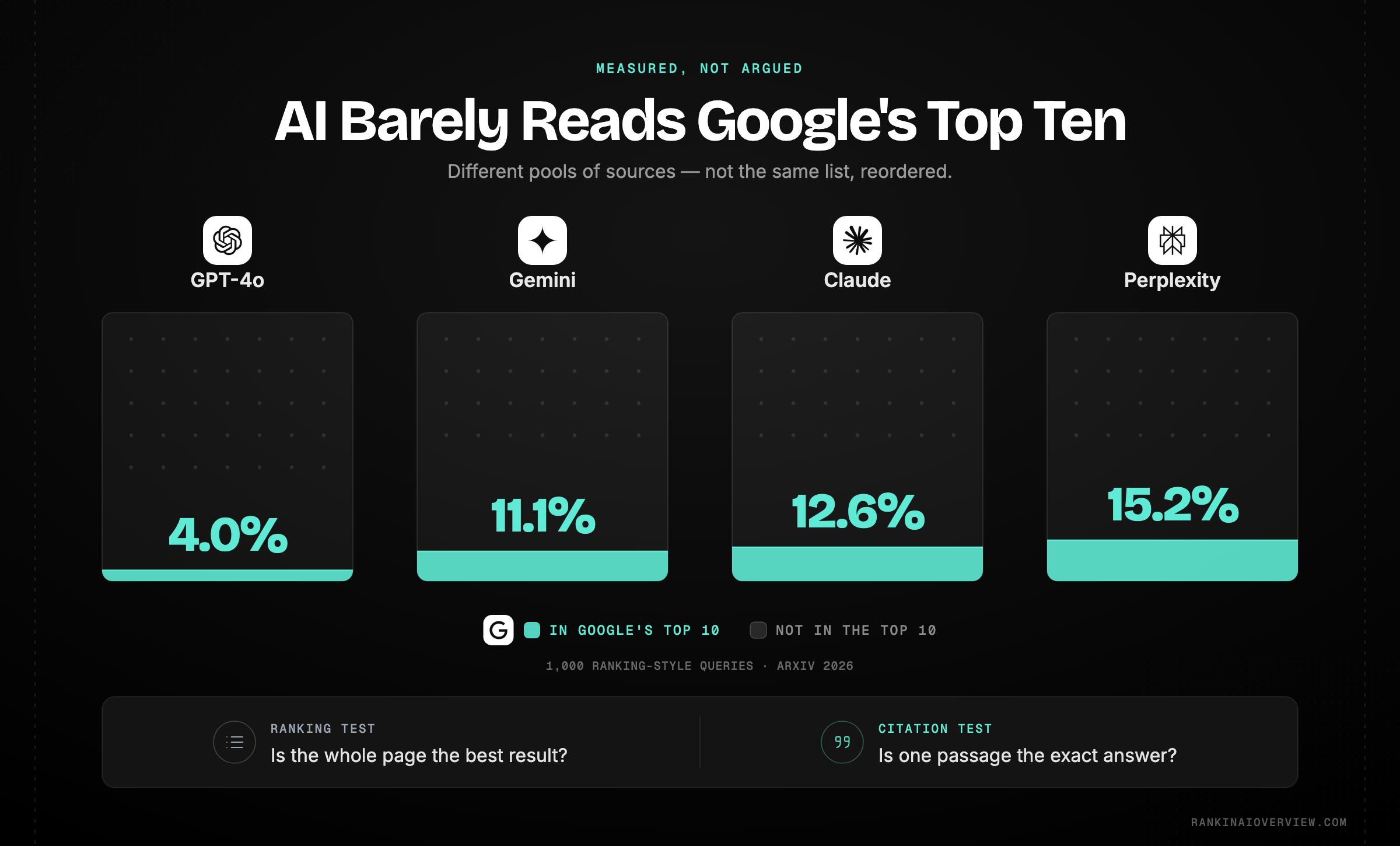
According to a large-scale comparison of Google Search and generative AI services [published on arXiv](https://arxiv.org/abs/2601.16858), researchers ran 1,000 ranking-style queries and measured how much each AI engine's set of consulted domains overlapped with Google's top ten results. The overlap was strikingly low: 4.0% for GPT-4o, 11.1% for Gemini, 12.6% for Claude and 15.2% for Perplexity. In other words, on these queries the AI systems were mostly drawing on a different set of sources than the ones Google ranks, not simply reordering the same list. That single result reframes the whole SEO-versus-AI question.
This guide gives you a mental model built on that finding rather than on slogans. It covers the fundamental difference between SEO and AI visibility, how the goal of content optimisation changed, which old principles still apply, what new skills the work now demands, and how measurement differs. For the wider strategic picture, our overview of [why AI search optimisation is a different game from SEO](https://www.rankinaioverview.com/blog/ai-vs-seo) covers the paradigm shift in more depth.
## What Is the Fundamental Difference Between SEO and AI Visibility?
Different pools, not the same list reordered.
The fundamental difference is what you are competing for. SEO optimises a page to rank in a list a person then chooses from. AI visibility optimises content to be trusted enough that a system builds its answer out of it. One earns a position a user clicks; the other earns inclusion in the response the user actually reads, often without any list appearing at all.
That shift changes who you are really optimising for. In SEO you optimise for a ranking system and then for a human who picks among results. In AI visibility you optimise for a system that decides whether you are credible enough to fold into its own synthesised answer. The bar moves from being relevant enough to appear toward being trusted enough to be quoted, which is a higher and materially different standard to clear.
The overlap data is why this feels so foreign to seasoned practitioners. If AI answers simply reflected Google's rankings, then good SEO would automatically deliver AI visibility, and nobody would feel disoriented. But when the shared-domain figure sits between 4% and 15% on ranking-style queries, the two systems are demonstrably selecting sources by different logic. The mechanics rhyme, yet the objective and the pool of eligible sources have both moved. Our explainer on [what ranking means in AI search](https://www.rankinaioverview.com/blog/what-does-ranking-mean-in-ai-search) unpacks that redefinition in practical terms.
## How Has the Goal of Content Optimisation Changed?
The goal moved from ranking pages for keywords toward being cited as a trusted answer to specific questions and entities. Optimisation now centres on clear question-and-answer passages, thorough entity coverage and verifiable trust signals, rather than keyword density and a page-level position target. You are engineering citable passages, not just rankable pages.
Here is the shift broken into its two biggest pieces.
### From Ranking a Page to Being Cited as an Answer
Success used to be a page reaching a position. Now success is a passage being lifted cleanly into a synthesised answer. That reframes optimisation around extractable, self-contained answers rather than whole-page ranking. A page can rank perfectly well and still lose the citation because its answer is buried three paragraphs down, which almost never cost you anything in classic SEO but frequently does now.
The practical consequence is structural. Direct answers, clear formatting and question-shaped headings matter more because they are what an engine can extract and attribute. This is not a cosmetic change. It reorders how you draft a page, because the unit of value has shifted from the ranking page to the quotable passage inside it, and the two are optimised differently.
A concrete way to feel the difference is to imagine the same page judged by both systems. A ranking system asks whether the whole page is the most relevant, authoritative result for a query and rewards it accordingly. A generative engine asks a narrower question: within this page, is there a clean, self-contained passage I can lift to answer exactly what was asked. A page can pass the first test comfortably and fail the second because its best answer is spread across three paragraphs, hedged, or introduced only after a long preamble. Writing for citation means writing so that the second test is passed on your most important questions, without sacrificing the depth that wins the first.
### From Keywords to Entities and Questions
The old brief obsessed over keywords and density. The new brief thinks in entities and in the real questions people ask. Covering a topic's entities thoroughly and answering genuine questions directly aligns your content with how these systems understand and retrieve information. Entity coverage replaces keyword targeting as the organising principle of a page.
This is a real skill shift rather than a rebrand of the old one. Instead of counting keyword occurrences, you map the concepts, relationships and questions that surround a topic, then cover them cleanly and completely. It rewards depth and clarity over repetition, and it tends to reward the writers who actually understand the subject rather than those who merely instrument it for a search algorithm.
## Which Traditional SEO Principles Still Apply in the AI Era?
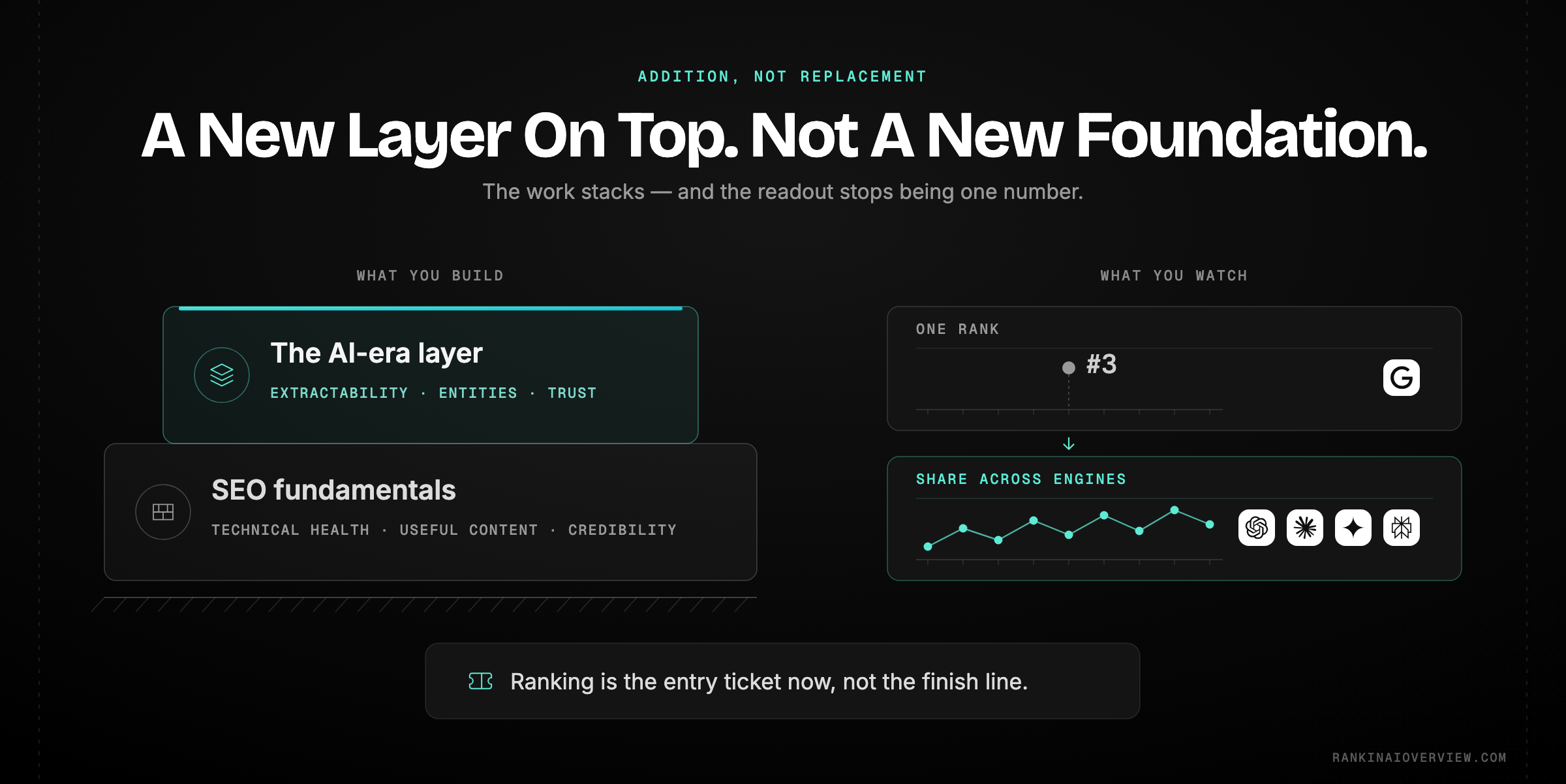
Most core SEO principles still apply: genuinely useful content, technical health, clear structure, credibility and real helpfulness all remain essential. AI answers are built on top of existing ranking systems, so strong fundamentals are the base the AI layer sits on rather than something it discards. Abandoning them does not free you; it removes your foundation.
Google has been explicit that AI Overviews draw on its existing ranking systems and the same helpful, people-first content standards. So the fundamentals you already know, technical soundness, useful content and demonstrable credibility, are not obsolete. They are the prerequisite for everything the AI layer adds on top, which is why teams that treat AI visibility as a replacement for the basics tend to go backwards.
What changes is emphasis, not abandonment. You still need sound SEO, and then you add a layer focused on extractability, entity strength and trust. The low overlap with Google's results does not mean rankings are irrelevant; it means ranking well is necessary but no longer sufficient, because a strong page still has to be selected by a second system that chooses sources on its own terms.
## What Completely New Skills Does AI Visibility Require?
AI visibility requires new capabilities in answer engineering, entity building, cross-engine measurement and reputation work. You have to structure content so it can be extracted, build recognisable and consistent entity signals a model can verify, and track citations across several AI engines at once, none of which keyword-first SEO ever taught you to do.
The genuinely new capabilities are these:
* Answer engineering: writing self-contained, extractable answers to specific questions.
* Entity building: creating recognisable, consistent brand signals a model can corroborate.
* Cross-engine measurement: tracking citation and presence across ChatGPT, Perplexity, Gemini and Google.
* Reputation work: earning the mentions and credibility that actually drive inclusion.
Answer engineering is the clearest of them. It is the discipline of writing a self-contained answer and structuring the page so a system can lift it without ambiguity, and it is closer to editorial clarity than to keyword craft. It is entirely learnable with practice, and it is where most teams see their first movement because it addresses extraction directly.
Entity and reputation work is the other major addition, and it is the slower one. Because the source-selection logic rewards recognisable, corroborated entities, building a brand a model can verify, through consistent data, credible mentions and earned media, becomes core strategy rather than a side project. The domain-overlap finding hints at why: AI answers lean on domain types, such as earned media, that a page-level ranking strategy tends to under-invest in. Our piece on [why AI engines cite pages that do not rank on Google](https://www.rankinaioverview.com/blog/non-google-ai-citations) digs into that selection gap.
> "AI-generated answers and web search results diverge significantly in their consulted source domains, the typology of these domains (e.g., earned media vs. owned, social), query intent, and the freshness of the information provided." **Mahe Chen, Xiaoxuan Wang, Kaiwen Chen and Nick Koudas**, authors, *Navigating the Shift: A Comparative Analysis of Web Search and Generative AI Response Generation*. Source: [arXiv](https://arxiv.org/abs/2601.16858)
That framing matters because it names the axes on which the two ecosystems part ways. It is not only which domains get consulted but the type of domain, the intent behind the query and how fresh the information is. A strategy tuned entirely to owned-page ranking is optimising along one axis while the AI layer selects along several, which is a concrete reason strong pages can still be passed over.
## Why Do Pages That Rank Well Still Get Passed Over by AI?
A strategic mismatch, not a quality problem — and improving the page will not fix it.
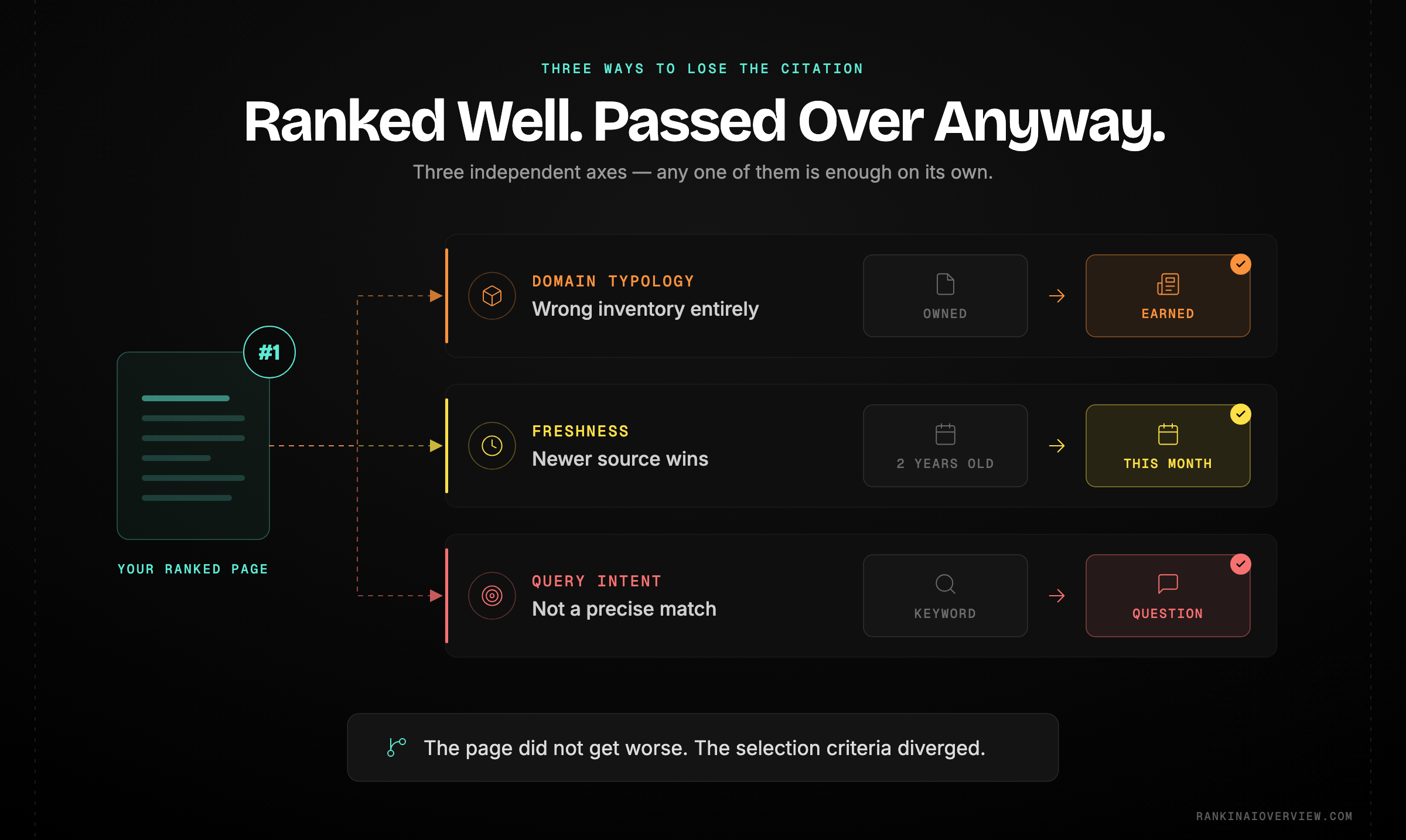
Strong pages get passed over because the AI layer selects sources on axes a ranking strategy tends to ignore: the type of domain, the freshness of the information and the specific intent behind the query, not just topical relevance. A page can be the best-ranked result and still be the wrong shape, age or provenance for the answer an engine is assembling, which is exactly how a top position and a missing citation coexist.
Consider the domain-type axis first. The research behind this guide found the two ecosystems diverge not only in which domains they consult but in the typology of those domains, contrasting earned media against owned and social sources. Traditional SEO invests heavily in owned pages, because owned pages are what you rank. If an engine leans toward earned media for a given question, a portfolio of well-optimised owned pages can be almost entirely the wrong inventory, no matter how well each individual page ranks. That is a strategic mismatch, not a quality problem, and it will not resolve by improving the pages you already have.
Freshness is the second axis, and it cuts across everything. If a query has an implicit recency requirement and your best-ranking page is two years old, the ranking system may still reward it on accumulated authority while the AI layer, sensitive to how current the information is, reaches for something newer. The page has not got worse. The selection criteria have simply diverged from the ones that earned its ranking, and the citation follows the newer source.
Query intent is the third. A page can rank for a phrase while answering a subtly different question than the one a user actually posed to an assistant, where questions arrive in fuller, more conversational form. The ranking match was close enough for a results list a human scans, but not close enough for a system that needs a precise, self-contained answer to a specific question. Diagnosing which of these three axes is costing you a citation is the real work, and it is genuinely different from the work of improving a rank.
## What Should an SEO Team Actually Change First?
The first move is an audit, not an edit.
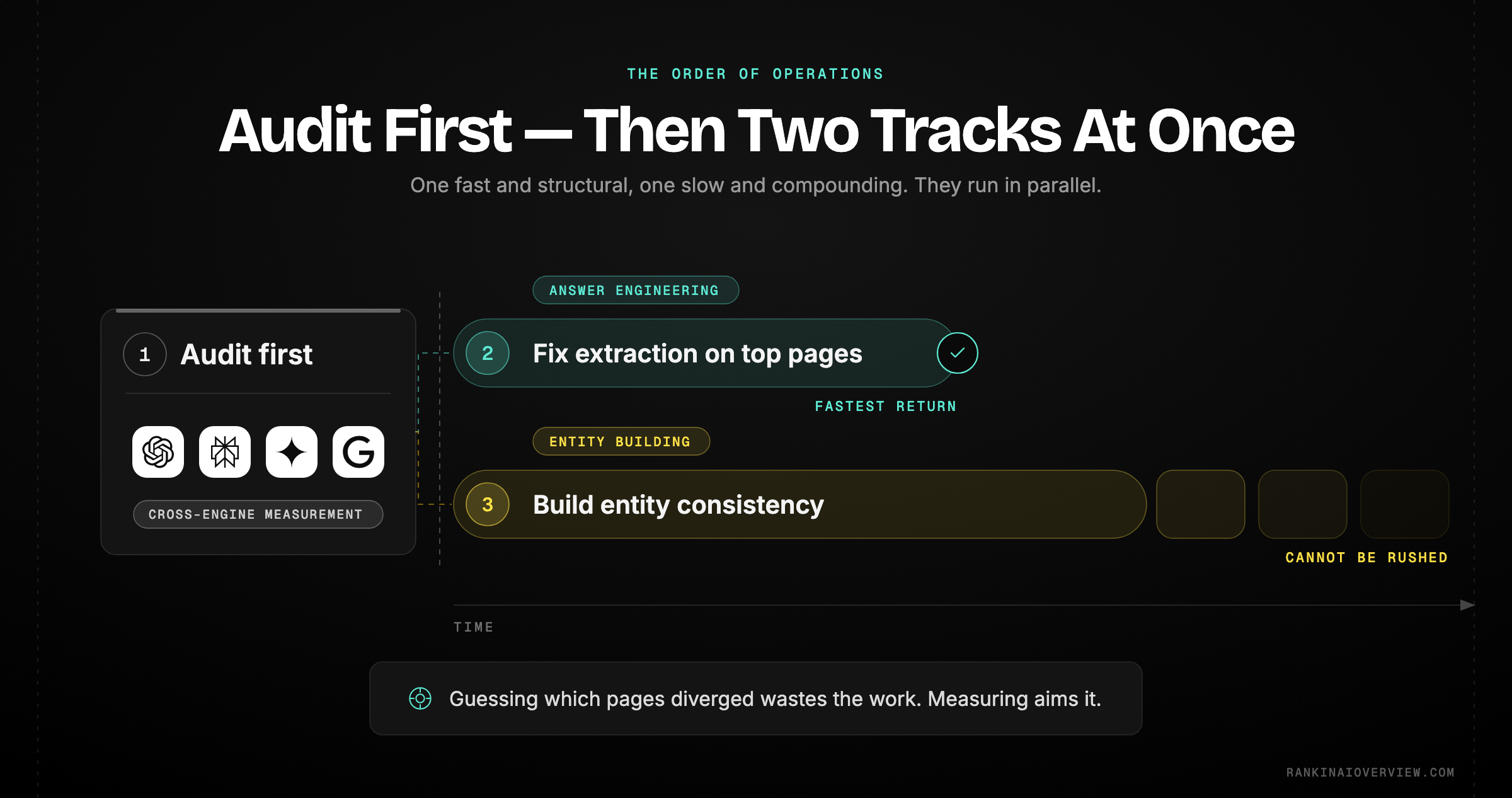
Start by finding out which of your pages already get cited and which get ignored, because that gap tells you where the ranking-first approach is failing and where it is quietly working. Then fix extraction on your highest-value pages, build entity consistency across the web, and add cross-engine tracking, in that order, so you spend the first effort where it pays back fastest.
The first move is an audit, not an edit. Before changing anything, map your important queries and record whether ChatGPT, Perplexity, Gemini and Google's AI answers currently cite you. That baseline turns a vague anxiety about AI search into a concrete list of pages that rank but are not cited, which is the exact population where the two systems have diverged for you specifically. Guessing at this wastes the effort; measuring it aims it.
The second move is to fix extraction on the pages that matter most. Surface the direct answer near the top, shape headings as the questions people actually ask, and make each answer self-contained enough to lift without surrounding context. This is the fastest-returning work because it addresses the mechanical half of the problem, and it often recovers citations on pages that were being ignored simply because their answer was buried rather than absent.
The third move is the slow, compounding one: build a consistent, verifiable entity across the web, earn credible mentions, and keep your factual details aligned everywhere they appear. This is what shifts you into the source pool the AI layer prefers over time, and unlike the extraction fixes it cannot be rushed. Running the fast structural work and the slow entity work in parallel, measured against the baseline you established, is how a team moves from ranking well to being cited consistently.
## How Do You Measure AI Visibility Compared to Traditional SEO?
You measure AI visibility with citation share, competitor citation comparison, branded search and AI referral traffic, rather than keyword rankings. The signals are fuzzier and harder to attribute than a rank position, so tracking trends across many prompts over time matters far more than any single reading on any single day.
Traditional SEO offered clean, concrete metrics: this keyword, this position, checked and repeatable. AI visibility is messier by nature. There is no fixed rank to watch, so you track presence and share across a set of prompts and across several engines, which demands different tooling and a different reporting mindset. Our guide to the [AI visibility metrics that matter](https://www.rankinaioverview.com/blog/ai-visibility-metrics) lays out which numbers genuinely count and which are noise dressed up as progress.
Cadence and coverage matter more here than precision on any single check. Because the same prompt can return different sources on different runs and across different engines, a one-off reading tells you almost nothing, while the same set of prompts tracked on a schedule reveals a trend you can actually act on. The divergence data reinforces this: with each engine drawing on its own source pool, you cannot infer your Perplexity presence from your ChatGPT presence, so coverage across engines is not optional if you want an honest picture. Measure a stable prompt set, on a regular cadence, across every engine that matters to your audience, and let the trend rather than the snapshot drive decisions.
The honest challenge is attribution. Citation rate is harder to tie directly to revenue than a ranking once was, and comparing the two disciplines like for like is its own exercise, which we cover in [SEO benchmarking versus AI visibility benchmarking](https://www.rankinaioverview.com/blog/seo-vs-ai-visibility-benchmarking). The way through is to track a small set of outcome-linked metrics over time rather than chasing a single number, and to accept that the question of [whether rankings still matter once answers replace results](https://www.rankinaioverview.com/blog/rankings-future-seo) is now a live part of measurement strategy rather than a settled assumption. Establishing a baseline first, before you change anything, is what makes any later movement legible.
## If AI Barely Uses Google's Rankings, Is Ranking Still Worth the Investment?
Ranking is necessary and no longer sufficient — both halves are true at once.
Yes, because ranking well remains necessary even though it is no longer sufficient. A low overlap between AI sources and Google's results does not mean rankings stopped mattering; it means ranking is now the entry ticket rather than the finish line. Pages still need the authority, technical health and relevance that ranking demands before the AI layer will consider them at all, and organic search itself still sends real traffic.
The mistake would be reading the 4% figure as permission to neglect fundamentals. Two things are true at once. Traditional organic results continue to drive substantial visits for most sites, so abandoning SEO would cost you traffic you currently have. And the same signals that earn a strong ranking, credible content, sound structure and genuine authority, are largely the same signals that make you eligible for citation, even though the final selection is made by a different mechanism. Starving the fundamentals to chase AI visibility tends to weaken both at once.
The productive reading is one of layering. Keep investing in the SEO that earns rankings and traffic, then add the answer-engineering, entity and measurement work that converts a well-ranked, authoritative page into a cited one. The divergence data tells you where the extra effort has to go; it does not tell you to stop doing the thing that gets you into the running. Teams that hold both truths at once, ranking as the prerequisite and citation as the new prize, allocate their effort far more sensibly than those who pick a side and defend it.
There is also a timing argument for staying invested. The systems are young and their source-selection logic is still shifting, so the safest position is a strong, authoritative, well-structured presence that performs whichever way the mechanics move next. That is exactly what good SEO has always built. The AI era changes what you add to it, not whether the foundation is worth having.
## Conclusion
AI visibility is neither the death of SEO nor business as usual, and the data settles the argument better than either slogan. When AI engines and Google share as little as 4% of their source domains on ranking-style queries, the goal has clearly shifted from ranking a page toward being trusted as the source an answer is built from, the organising idea has moved from keywords to entities and questions, and source selection now follows its own logic. The fundamentals still form the base beneath all of it.
Adapt by keeping what works and adding what is genuinely new. Hold on to quality, structure and technical health, then build the answer-engineering, entity and measurement skills the AI era actually demands. That combination, rather than a wholesale reinvention or a stubborn refusal to change, is what earns visibility now. The teams that thrive are the ones who treat the shift as a widening of the craft rather than a threat to it, extending what they already do well into a discipline that is broader, fuzzier and more interesting than the ranking game alone ever was. Want to see how your current strategy performs in AI search? [Run a free AI visibility audit with Rank in AI Overview](https://www.rankinaioverview.com/) and get a clear read on your citation share across engines.