# Are Backlinks Still a Ranking Factor in 2026? The Honest Answer
URL: https://www.rankinaioverview.com/blog/are-backlinks-still-a-ranking-factor
Published: 2026-09-01
## Key Highlights
* Backlinks are not dead, but their job changed: they help a page qualify as a credible candidate rather than winning the citation on their own.
* Citation research on real AI answers found on-page quality, not off-page link volume, most strongly predicts which pages actually get cited.
* A handful of genuinely trusted, relevant links now outweighs large volumes of mediocre ones for both ranking and AI citation, and the gap keeps widening.
* Unlinked brand mentions carry real authority weight, so a link-only strategy is no longer the whole of reputation building.
* The right investment is a small amount of high-quality, editorial link earning paired with entity and content work, not a link-volume target.
* Treating link building as one input to reputation rather than the engine of it is the shift that separates budgets that pay off from budgets that leak.
Few SEO debates are as durable as the backlink question, and AI search has reopened it with fresh urgency. One camp declares backlinks dead. The other insists nothing has changed. Both overstate their case, and the confusion leaves teams unsure whether to keep funding link building at all or to redirect that budget somewhere it might work harder.
According to an audit of AI answer-engine citation behaviour [published on arXiv](https://arxiv.org/abs/2509.10762), researchers analysed 1,702 citations across three engines and 1,100 unique URLs, and found that overall on-page quality was a strong predictor of whether a page got cited, with on-page signals showing the strongest associations with citation. In other words, when these systems chose what to cite, the decisive factors sat on the page itself rather than in an off-page link graph. That does not make backlinks worthless, but it does move them out of the driver's seat they occupied for two decades of classic ranking.
This guide gives a definitive, updated verdict. It covers the traditional role of backlinks, whether AI search has changed how they are valued, what backlinks actually do in AI search now, which link types still matter in 2026, whether unlinked mentions really count, whether link building still makes sense as an investment, and what should complement it. For the broader trust picture underneath all of it, our piece on [reputation-driven SEO](https://www.rankinaioverview.com/blog/reputation-seo) is a useful companion.
## What Was the Traditional Role of Backlinks in SEO?
Traditionally, backlinks acted as votes of confidence that drove PageRank and helped pages rank higher. More quality links generally meant more authority and better positions, which made links among the strongest ranking signals in classic search and turned building them into a central SEO activity for decades.
The logic was simple and, for its time, sound. A link was an endorsement, and endorsements from trusted sites signalled that your content was credible and worth ranking above alternatives. Because that signal was hard to fake at scale in the early web, it worked well enough to become foundational, sometimes to the point of obsession, and it spawned an entire industry of outreach, guest posting and, at the murkier end, link buying and private networks.
That model is not gone, but it is no longer the whole picture, and treating it as though it were is where a lot of wasted budget begins. The web got much better at detecting manipulated links, the value of a low-quality link collapsed toward zero, and a second system, the AI answer layer, arrived with its own logic for choosing sources. Understanding where the old model still holds and where it has quietly shifted is the key to spending your effort wisely in 2026 rather than defaulting to habits that may no longer pay.
## Have AI Search Systems Changed How Backlinks Are Valued?
Yes. AI search has shifted backlinks from primarily driving page position toward serving as one trust and eligibility signal among several. Links still contribute to credibility, but AI systems weigh the quality and source of a link, and even unlinked brand mentions, far more heavily than raw link volume, and the citation itself is decided largely by the page.
The change is one of emphasis and of stage. In classic search the question was substantially "how many quality links point here." In AI search the more useful question is "is this page a credible, relevant candidate the system can trust enough to build its answer from." A link from a genuinely authoritative source still helps answer that, because it is real evidence of credibility. A thousand low-quality links answer it barely at all, and can actively look manipulative, which is the opposite of what you want when trust is the currency.
The citation research reinforces this. When on-page quality is the strongest predictor of which pages get cited, the link graph is demoted from the thing that wins to one of several things that help you qualify to compete. That is a meaningful reframing rather than a death notice. Backlinks moved from being the engine of visibility to being part of the credential check you pass before the on-page contest even begins, which we develop further in our look at how [AI cites sources well beyond Google's link-based ranking](https://www.rankinaioverview.com/blog/non-google-ai-citations).
## What Do Backlinks Actually Do in AI Search Now?
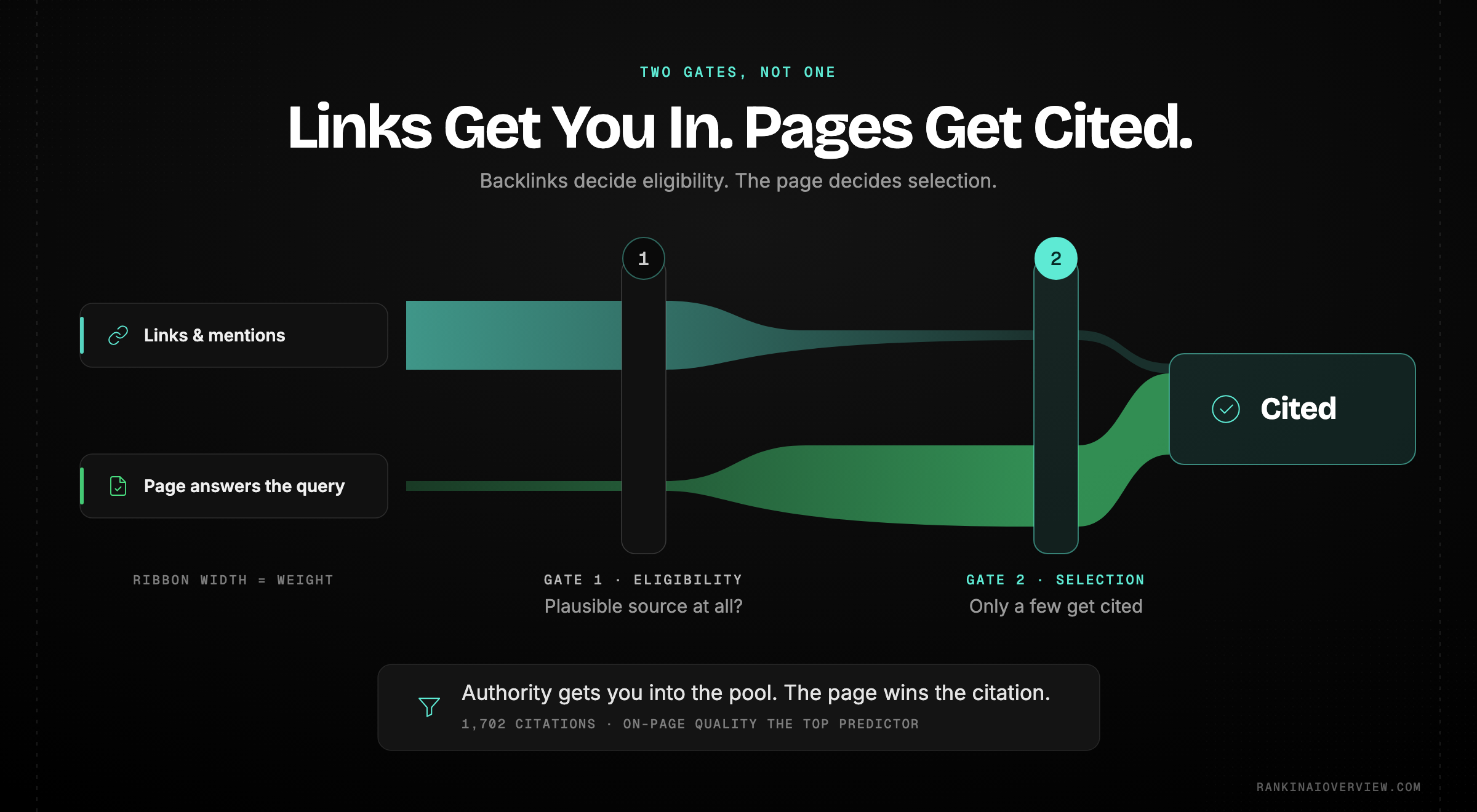
Links get you in the room. The page wins the citation.
In AI search, backlinks mainly help a page enter and stay in the pool of trusted candidates an engine will consider, rather than directly winning the citation. They contribute to the authority and recognition that make you eligible, while on-page quality, relevance and clarity do most of the work of getting you actually selected from that pool.
This two-stage way of thinking resolves most of the confusion. There is an eligibility stage, where trust and authority signals, including credible links and mentions, determine whether you are even a plausible source for a given question. Then there is a selection stage, where the engine picks a small handful of sources to cite, and that choice leans heavily on how well the specific page answers the specific question. Backlinks do real work in the first stage and much less in the second, which is exactly why link volume feels less potent than it used to: it was never going to win the stage that now matters most.
It is worth being precise about what "eligibility" means here, because it is where backlinks retain genuine value. To be considered at all, a source generally needs to be known, indexed and trusted enough that the system treats it as a credible option rather than background noise. Credible links and mentions are part of how a domain earns that standing over time. A brand-new site with no external validation has a harder time being treated as a trustworthy candidate, however good an individual page might be, which is one reason authority still matters even in a citation-first world. Backlinks help build the standing that gets your pages into the consideration set; they simply do less once the pages are there and competing.
That model also explains why strong, well-linked domains still sometimes fail to get cited on a given query. Their authority earned them a place in the candidate pool, but a competitor's page answered the question more cleanly and won the citation slot. Because engines cite only a few sources per answer, selection is a genuine bottleneck, and passing the eligibility check is necessary but not sufficient. The practical lesson is to earn enough credibility to be in the room, then win on the page. Our guide to [whether AI-generated content can rank without backlinks](https://www.rankinaioverview.com/blog/can-ai-generated-content-rank-without-backlinks) pushes on the same question from the opposite direction.
## What Types of Backlinks Still Matter in 2026?
A relevant link from a respected voice in your field beats a bigger number from an unrelated site.
The links that still matter are high-authority editorial links, references from genuinely trusted institutions, and increasingly brand mentions whether linked or not. Quality and source credibility now decisively outweigh quantity, because a single credible endorsement moves the trust signal that both ranking and AI citation actually respond to.
Here is what carries weight and what no longer does.
### High-Authority Editorial Links
Genuine editorial links from respected publications remain valuable, because they are real evidence that a credible source chose to vouch for you. They support both traditional ranking and the AI trust layer, and a handful of them outperforms large volumes of low-quality links by a wide and widening margin. Ten strong editorial links beat a thousand mediocre directory or comment links, and the difference is no longer marginal but categorical, because the mediocre links have collapsed to near zero value.
### Trusted Institutional and Reference Citations
References from deeply trusted sources such as major reference works and academic material carry outsized weight for the trust layer, where genuinely warranted. These platforms are heavily relied upon and feed the entity signals AI systems use to decide who is credible on a topic. A single well-sourced reference of this kind can strengthen your entity more than a typical commercial link, precisely because it is hard to obtain and therefore hard to fake.
### Relevance Over Raw Authority
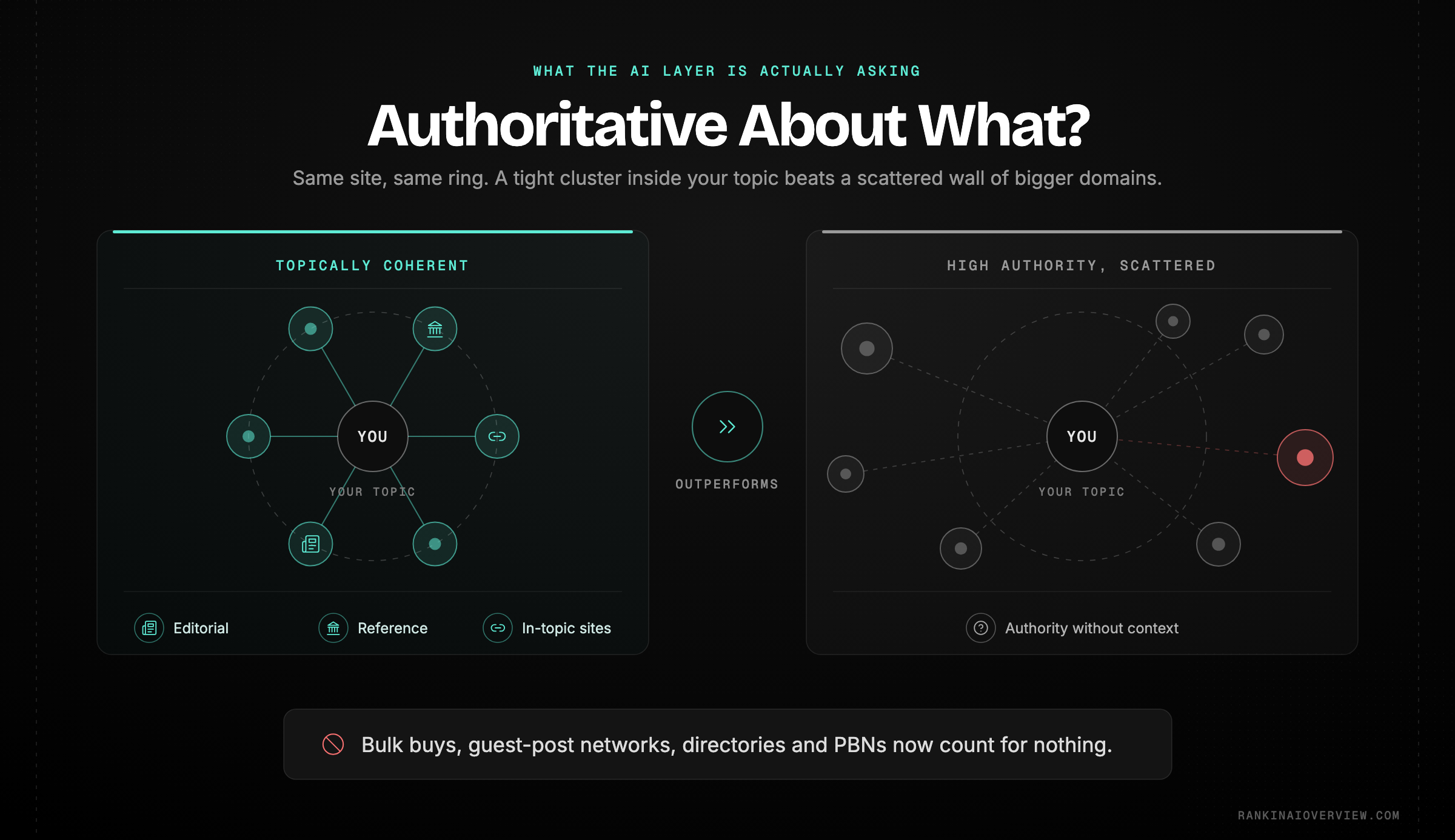
A newer subtlety is that topical relevance of the linking source matters more than its raw authority score alone. A relevant link from a respected voice in your specific field often does more for how systems associate you with a topic than a higher-authority link from an unrelated site. The old habit of chasing the biggest domain authority number regardless of context is one of the clearest places where classic link thinking now misfires.
This matters because the AI layer is trying to work out what you are authoritative about, not merely whether you are authoritative in the abstract. A cluster of relevant links and mentions inside your topic tells a coherent story about your area of expertise, and coherence is exactly what helps a system confidently associate you with the questions you want to be cited on. A scattering of high-authority but unrelated links tells a weaker, noisier story. In practice this means a smaller, more topically focused set of endorsements can outperform a larger, more prestigious but incoherent one, which is close to the opposite of how link acquisition was often scored in the past.
## Do Unlinked Brand Mentions Really Count as Authority?
Increasingly, yes. AI systems appear to value co-occurrence, your brand being discussed alongside a topic, even when no hyperlink is present. That widens authority beyond the traditional link graph into something closer to reputation across the whole web, and it means earning a mention can matter almost as much as earning a link.
The mechanism is association rather than link equity. When your brand is repeatedly named in credible discussions of a subject, the systems build a stronger connection between you and that subject, which supports both recognition and trust. A hyperlink strengthens that connection, but the naming itself already does real work, which is a genuine departure from a model where value flowed only through the link. This is why digital PR and being genuinely talked about have become authority tactics, not just awareness tactics, a shift our piece on [why branded websites rank better in AI search](https://www.rankinaioverview.com/blog/brand-entity-ai-visibility) examines in depth.
It helps to see why co-occurrence works without a link at all. These systems build their understanding of the world partly from patterns in vast amounts of text, and repeated association between your brand and a topic is exactly the kind of pattern that shapes what a model believes about who is authoritative on what. A hyperlink is one signal of association, but the plain fact of being named, in context, again and again, is itself a powerful one. That is a genuinely different mechanism from link equity flowing through a graph, and it rewards being genuinely present in the discourse rather than technically present in a link database.
The practical implication is that you should stop measuring reputation solely by your backlink profile. A brand that is widely and credibly mentioned but modestly linked can carry more authority in the AI layer than a brand with a larger link count but little genuine presence in the conversation. Earning mentions, being quotable, and showing up wherever your topic is seriously discussed now belong in the same budget line as link building, and often ahead of it. The [trust signals AI systems recognise](https://www.rankinaioverview.com/blog/ai-trust-signals) are broader than links by design.
## Does Link Building Still Make Sense as an Investment in 2026?
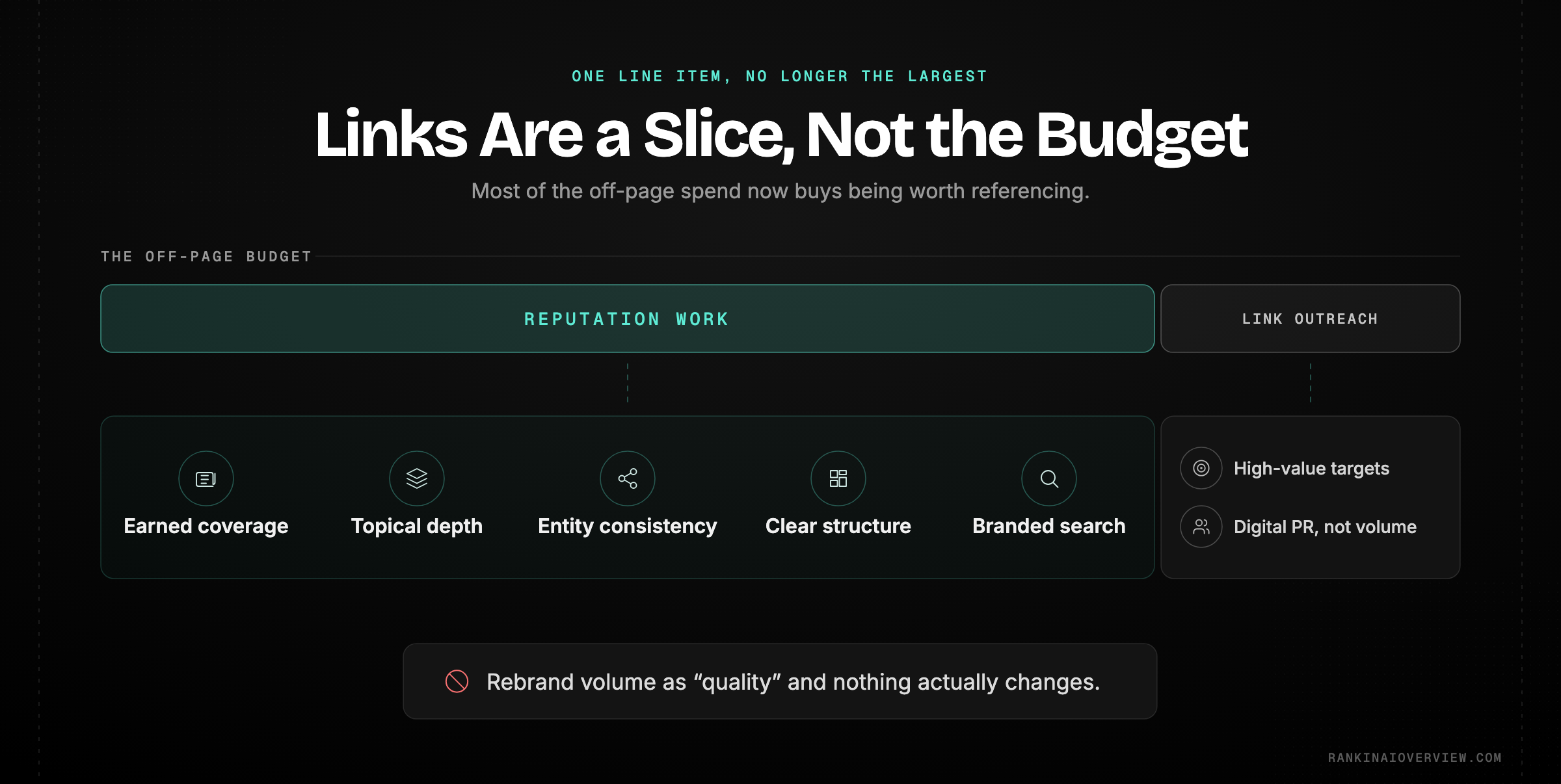
The days when link building could consume most of an off-page budget are over.
Yes, but with a decisive shift toward quality and relevance over volume. Earning a small number of high-authority, genuinely relevant links and mentions is a sound investment that still pays in both ranking and AI trust. Chasing large quantities of low-quality links is not, because they add little authority now and can actively harm you.
The recalibration is from a volume target to an editorial one. Instead of aiming for a number of links per month, aim for a few credible, relevant endorsements and mentions from sources your audience and the AI layer both trust. That is a different kind of work, closer to digital PR and genuine relationship building than to the transactional link building of the past, and it tends to be done by different people with different skills. Teams that simply rebrand their old volume outreach as quality outreach without changing what they actually pursue rarely see the benefit.
There is also a portfolio way to think about the budget. A sensible split in 2026 puts most of the reputation budget into earning genuine coverage, building topical depth and strengthening your entity, and only a modest slice into deliberate link outreach aimed at a handful of high-value, relevant targets. The exact ratio depends on your field, but the days when link building could reasonably consume the majority of an off-page budget are over for most sites. If a proposed programme is mostly about acquiring links and only incidentally about being worth referencing, it is built for the wrong era.
Think of link building as one part of reputation building now, not the whole of it. Pursued for quality and relevance, it still earns its place in the budget. Pursued for volume, it wastes money that would work harder on entity strength, content depth and earned mentions, which are the inputs AI search increasingly rewards. The honest test for any proposed link is simple: would you want it if AI search did not exist and it sent you zero direct traffic. If the answer is no, it is probably not worth chasing in 2026 either.
## What Backlink Tactics Are Now a Waste of Money in 2026?
The clearest wastes are buying links at volume, mass directory and comment links, low-quality guest-post networks, and any tactic that optimises for a link count rather than a genuine endorsement. These added thin value even in classic search and add almost none now, while carrying real risk of looking manipulative to systems built to detect exactly that pattern.
Bulk link buying is the most expensive mistake. It targets a number, quantity of links acquired, that no longer maps to authority in either ranking or the AI trust layer, and it leaves a footprint that increasingly marks you as a source to distrust rather than cite. The money spent acquiring a hundred cheap links would do far more work funding one genuine piece of research or earned coverage that credible sources actually want to reference. The arithmetic that once justified volume link buying simply no longer holds.
Low-quality guest posting on networks that exist only to place links is the next clear waste. The value was always in reaching a real, relevant audience through a respected outlet, and a post on a site nobody reads, placed purely for a link, delivers neither the audience nor the trust signal. Directory submissions, forum signature links and comment links fall in the same bucket: mechanical, easy to acquire, and therefore worth almost nothing to systems that reward exactly what is hard to fake. Reciprocal link schemes and private blog networks add outright risk on top of low value.
The underlying rule is that if a link is easy to get at scale, it is probably not worth getting. Value now tracks difficulty and genuineness, because those are what the systems use as proxies for a real endorsement. Any tactic that promises many links quickly is, almost by definition, promising the kind of links that no longer count. Redirect that budget to the harder, slower work that does.
## What Should Complement Backlink Building in an AI Search Strategy?
Complement backlink building with brand and entity building, earned mentions, topical depth and clean, extractable content structure. In AI search, being a recognised, trusted entity that credible sources reference, linked or not, and that answers questions cleanly, drives citation more reliably than a link graph alone ever could.
A modern authority strategy pairs a modest, quality-first link effort with several other inputs. Build a consistent, verifiable entity through aligned data, clear authorship and credible mentions. Earn media and unlinked references across the trusted platforms where your topic is discussed. Develop genuine topical depth through connected, useful content rather than scattered one-off pages. Structure that content so the answer is easy to extract, because the citation research shows the page itself does most of the work of getting selected. And grow branded search, which is a strong human trust signal the systems can observe.
> "Logistic models with domain clustered standard errors indicate that overall page quality is a strong predictor of citation." **Arlen Kumar and Leanid Palkhouski**, authors, *AI Answer Engine Citation Behavior: An Empirical Analysis of the GEO16 Framework*. Source: [arXiv](https://arxiv.org/abs/2509.10762)
That finding is worth holding onto, with its limits in view. The study is observational and focused on English-language B2B SaaS pages, and its framework measures on-page signals rather than directly testing backlinks, so it is evidence about what correlates with citation rather than a controlled verdict on links. But the direction is clear and consistent with the wider picture: the page you publish carries more of the citation decision than the links pointing at it. Treat that as licence to rebalance, not to abandon links entirely, and pair it with the [AI ranking factors that matter in 2026](https://www.rankinaioverview.com/blog/ai-ranking-factors-2026) for the fuller list.
The goal is reputation, not just a backlink profile. Links remain part of it, but the winning strategy is broader, steadier and harder to fake, which is precisely why it holds up as the systems keep changing.
## Conclusion
The honest answer in 2026 is that backlinks are neither dead nor unchanged. Their role shifted from driving page position toward being one trust and eligibility signal, and quality now decisively beats quantity. Citation research on real AI answers found on-page quality, not the link graph, most strongly predicts which pages get cited, which tells you where the leverage has moved.
Keep building links, but build them for quality and relevance, and treat them as one part of a broader reputation strategy rather than its engine. Pair them with entity building, earned mentions, topical depth and clean structure, and let the page do the work of winning the citation once your credibility has got you into the running. That combination, not link volume, is what earns authority and citations in the AI search era, and it is the version of the strategy that keeps working as the systems and their signals continue to evolve. Want to see how your authority translates into AI visibility? [Run a free AI visibility audit with Rank in AI Overview](https://www.rankinaioverview.com/) and find out where you genuinely stand across every major engine.