# How to Build a Stronger Digital Presence for AI Search
URL: https://www.rankinaioverview.com/blog/build-stronger-digital-presence-ai-search
Published: 2026-09-04
## Key Highlights
* In AI search, presence means being a recognised entity that trusted, independent sources mention, not just a website that ranks for keywords.
* Research shows brand-owned pages make up a small share of AI citations, because engines lean heavily on third-party, earned sources over anything you publish about yourself.
* Startups without legacy authority win by going deep on one topic, earning credible mentions, and building founder-led expertise under a real name.
* The tactics that measurably lift AI visibility are citing sources, adding data and quoting evidence, while keyword stuffing has effectively stopped working.
* Durable presence compounds over months, so the right approach is consistent, off-site reputation building rather than a burst of shallow publishing.
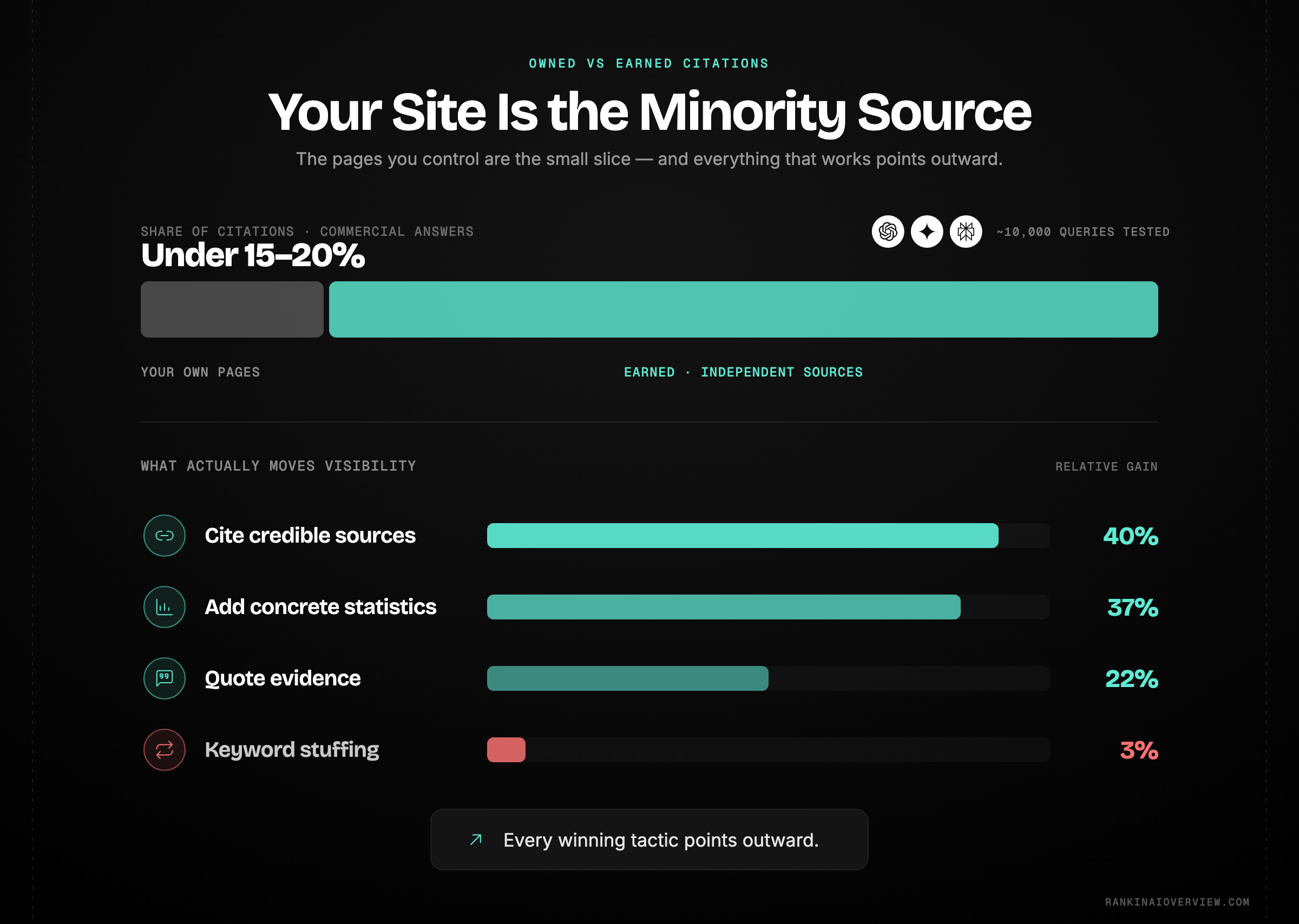
According to [a 2026 analysis of generative search engines](https://arxiv.org/abs/2603.12282), brand-owned pages account for fewer than 15 to 20% of the citations in commercial recommendation answers, because AI systems lean heavily on independent, third-party sources rather than on what a brand says about itself. That single finding reframes the whole task. For a new brand, the instinct is to pour everything into your own website, yet the evidence says most of the citations that build your presence will come from everywhere else.
For a new brand, AI search can feel rigged. The engines keep citing the same established names, and your carefully built site barely registers. You have the product and the expertise, but not the legacy authority these systems seem to reward. It is a real disadvantage, and pretending otherwise helps no one trying to break through. The picture is not hopeless, though, because the rules of digital presence have shifted, and some of that shift genuinely favours focused challengers.
This guide reframes what presence means in an AI-driven landscape, then lays out how a brand with limited legacy authority builds it. It covers why earned media now outweighs your own pages, what presence actually consists of, the startup playbook, the platforms that matter most, the mistakes that slow brands down, and how long the work realistically takes. For the entity side of the story, our piece on [why brands that rank on Google can still be invisible to AI](https://www.rankinaioverview.com/blog/brand-entity-ai-visibility) is a strong companion.
## How Is AI Search Different From Traditional Google Search for Brand Visibility?
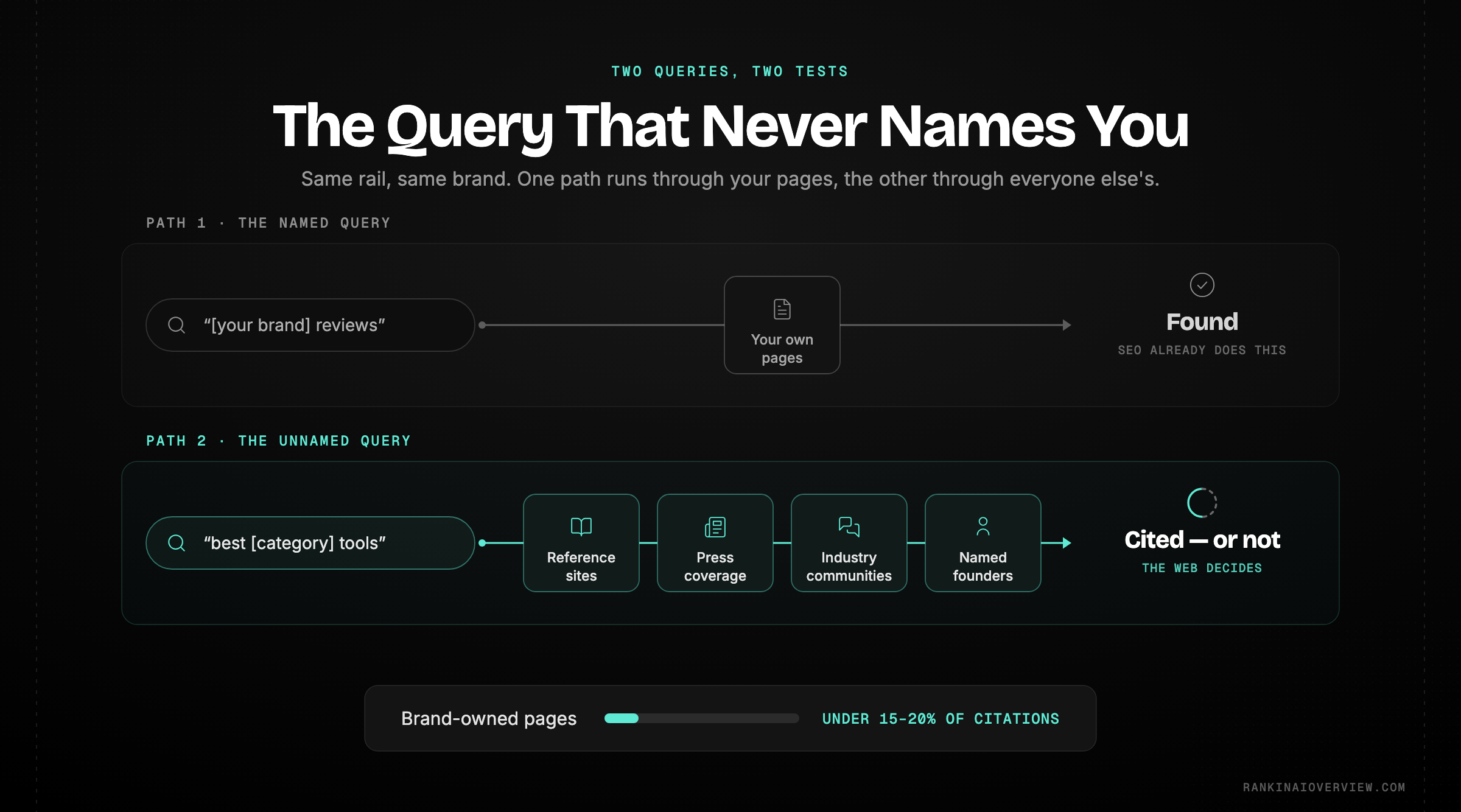
Being found when named is easy. Being surfaced when unnamed is the real test.
AI search differs by rewarding recognised entities and trusted mentions rather than keyword-tuned pages. Traditional search ranked your pages against each other. AI search decides whether your brand is credible enough to include in a synthesised answer, which makes off-site reputation and a clear brand entity far more important than on-page tweaks ever were.
The unit of visibility changed. In classic SEO a page ranked; in AI search a brand gets cited or left out. That shift moves the centre of gravity away from on-page optimisation and toward everything that makes you a known, trustworthy source across the web. It is a broader, more reputation-led game, and it is one where the number of pages you own counts for surprisingly little.
For brand building, this is a meaningful change in kind, not just degree. You are no longer only competing for positions on a results page. You are competing to be recognised at all, which rewards depth, consistency and reputation over sheer volume. The scale advantage that incumbents enjoy on page count shrinks when the real contest is about trust within a specific subject.
It also changes where impressions form. A growing share of your audience now meets your category inside an AI answer rather than on a list of links, and often without ever naming you in their question. That means your brand has to be present in the sources the engine consults before the user has typed your name, which is a very different challenge from ranking for a query someone already knows to search. This is why so many pages that rank on Google still never surface in AI, a gap we unpack in [why AI engines cite pages that don't rank on Google](https://www.rankinaioverview.com/blog/non-google-ai-citations).
There is a hard distinction hiding inside this shift, and it is the one that matters most for a newcomer. Being recognised when someone names your brand is relatively easy; being surfaced when they ask a category-level question and never mention you is the real test of presence. The first depends on your own pages being findable. The second depends entirely on whether the wider web has established you as one of the entities worth mentioning for that topic. Traditional SEO could carry you through the first. Only genuine, earned recognition carries you through the second, and that is the visibility worth building for.
## Why Does Earned Media Matter More Than Your Own Website Now?
Every winning tactic points outward. Keyword density barely registers.
Earned media matters more because generative engines treat independent, third-party sources as more trustworthy than anything you publish about yourself. Your own site is one voice with an obvious interest, so it carries limited weight on its own. Mentions from credible outlets, communities and reference sources are what build the recognition an engine acts on.
The data behind that pattern is refreshingly concrete. In the analysis behind the opening statistic, across roughly 10,000 queries on ChatGPT, Gemini and Perplexity, brand-owned domains supplied only a small minority of the citations, while the engines reached repeatedly for earned, third-party material. That is not a quirk of one engine or one sector; it is a consistent preference for sources that are not the brand talking about itself. The researcher was explicit about the reason, and it is worth sitting with the implication for how you spend your effort.
> "Brand-owned content, by its nature, presents a single perspective and is therefore assigned lower retrieval priority compared to independent sources."
> **Julen Oruesagasti**, author of the generative-search brand-notability study
The same study also measured which tactics actually moved visibility, and the ranking is instructive. Citing credible sources produced roughly a 40% relative gain, adding concrete statistics about 37%, and quoting evidence around 22%, while keyword stuffing managed a statistically insignificant 3%. The pattern is unmistakable: the things that read as genuine authority help, and the old density tricks have effectively stopped working. It is a data-backed version of the wider truth that [AI engines rank reputation, not keywords](https://www.rankinaioverview.com/blog/reputation-seo).
Notice what the winning tactics have in common. Citing sources, adding statistics and quoting evidence all point outward, to facts and voices beyond your own assertion. They work precisely because they mirror what the engines already do when they build an answer: assemble corroborated claims from independent material. In other words, the page-level tactics that help are the ones that behave like earned media in miniature, backing every claim with something a reader, or a model, can verify. That is the same instinct scaled down from your footprint to your paragraph, and it is why the two levels reinforce each other.
None of this makes your website pointless. It relocates its job. Your site becomes the clear, consistent anchor that explains who you are and backs your claims, while the citations that build presence are earned elsewhere. So the practical shift is to stop treating your domain as the whole strategy and start treating it as one node in a much larger, reputation-driven footprint.
## What Does Presence Actually Mean in an AI-Driven Search Landscape?
Presence in AI search means being a recognised entity that appears, consistently and credibly, across the places AI systems trust. It combines entity recognition, topical depth and repeated mentions on reputable platforms, so the engine both knows who you are and trusts what you say about your subject.
This is far broader than a website. Your presence includes how you are described on reference sites, in press coverage, in industry communities and by your own named founders. An AI system assembles a picture of you from all of it at once, and the coherence of that picture, whether every source describes the same clear brand, is what turns scattered mentions into recognition.
That is why consistency does so much quiet work. If your brand name, category and positioning are described the same way wherever they appear, the engine can resolve you into a single, confident entity. If they vary, the signal fragments, and a fragmented entity is far harder to cite. Coherence across your footprint often matters more than polish on any single page.
The useful mental move is to stop thinking about your site and start thinking about your footprint. Presence is the sum of every credible place your brand shows up, described the same way, reinforced by every new mention. A startup that grasps this early stops obsessing over its own pages and starts deliberately shaping how the rest of the web talks about it, which is where the real recognition is built.
## How Do You Build AI Search Presence as a Startup Without Legacy Authority?
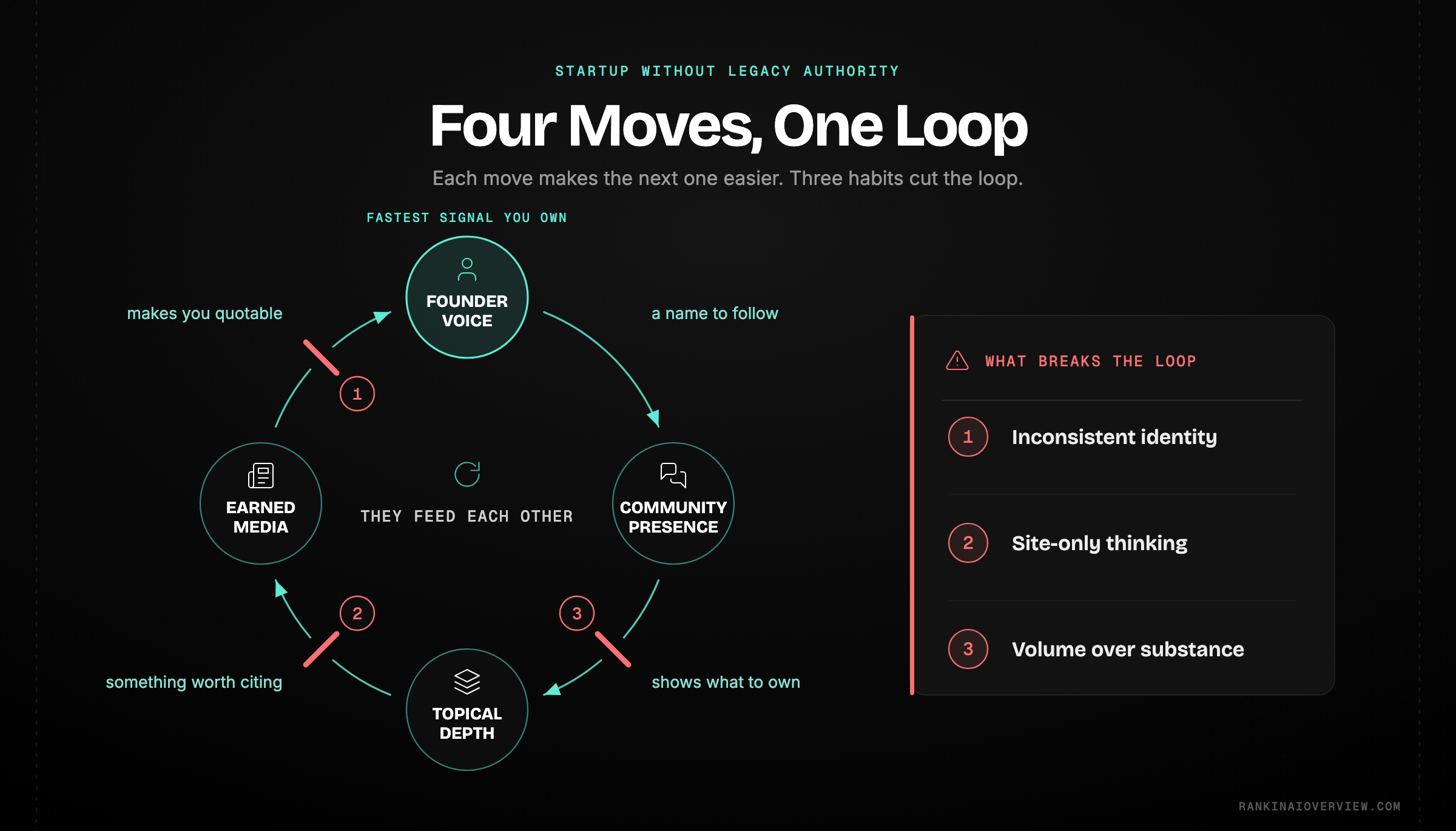
Run all four and they feed each other. That reinforcement is the strategy.
Build it by concentrating on depth, earned media, founder-led expertise and consistent entity signals rather than trying to match big brands on scale. Own one topic completely, get referenced by trusted third parties, put a real person's name and viewpoint behind your content, and make sure your brand is described identically everywhere it appears.
Four moves carry most of the value, and a small brand can execute all of them.
### Earned Media and Digital PR
Because engines favour third-party sources, credible coverage now does double duty. Beyond awareness, each mention in a respected publication feeds the entity signals that make citation more likely. A handful of strong, relevant placements outperforms a flood of low-quality ones, so target outlets your audience and the engines already trust, and aim to be quoted as a genuine source rather than merely listed. This connects directly to the [trust signals AI recognises](https://www.rankinaioverview.com/blog/ai-trust-signals) when it decides who to cite.
### Founder Thought Leadership
Publishing original perspectives under a real founder's name creates authorship and entity signals that anonymous content cannot. It gives an AI system a real person and a point of view to attach to your brand, which strengthens trust and makes your expertise legible. Named, consistent expertise is a startup advantage worth using aggressively, because it is one of the few authority signals you can build quickly and entirely on your own terms. It also compounds off-site: a founder who is genuinely known for a topic gets quoted, invited and referenced by others, which converts personal credibility into exactly the earned mentions the engines reward. The person becomes a second entity that reinforces the brand, and the two rise together.
### Community Presence and Brand Mentions
Getting your name into the conversations where your audience already gathers is now a core visibility tactic, not a soft one. Genuine, helpful participation in niche communities builds the repeated, unlinked mention patterns AI systems learn from. The goal is to be a useful, recognised voice rather than to drop links, which the systems increasingly discount. This is a channel where a nimble startup can simply outwork a slower incumbent.
### Topical Depth Over Breadth
Depth beats breadth in AI search. Covering one subject thoroughly, with connected and genuinely useful pieces, signals that you are a go-to source on it. A startup that owns a narrow topic completely can be cited above much larger competitors who cover it shallowly. Resist the urge to be everywhere on everything, and instead become the obvious authority on the one thing you can credibly claim.
Run these four together and they compound. Earned coverage makes your founder more quotable, a quotable founder attracts more coverage, community presence seeds both, and topical depth gives every source something substantial to point at. That reinforcement, not any single tactic, is what builds durable presence.
## Which Platforms Matter Most for AI Search Presence?
The platforms that matter most are credible industry publications, reference and knowledge platforms, active niche communities, and your own deep content as the anchor. Presence across these, described consistently, gives AI systems multiple trusted touchpoints that reinforce your brand as a real, citable entity rather than a single self-interested source.
No individual platform is a silver bullet, and chasing one is a common misstep. The strength comes from coherence across several. When your press coverage, your community footprint, your reference-layer entries and your own site all describe the same clear brand, recognition builds quickly, because each new mention corroborates the last instead of adding noise.
Prioritise by where your audience and your credibility actually live. A respected niche community and two authoritative industry publications can easily outperform a scattershot presence spread thinly across a dozen channels. Concentration is not timidity; it is how you make the signal strong enough for an engine to notice, and it suits a small team's limited time far better than trying to be everywhere at once.
Give your own site the specific job it is good at. It is where you state plainly who you are, define your category, and back your claims with evidence a third party can later cite. Treat it as the reference point the rest of your footprint links back to, not as the place you expect the citations to come from, and it will pull its weight without carrying an unrealistic load.
## What Slows Brands Down When Building AI Presence?
Brands slow themselves down with inconsistency, shallow content and a site-only mindset. Describing your brand differently across platforms, spreading thin across many topics, or ignoring off-site reputation all weaken the entity signals AI relies on, which delays recognition and pushes citations toward competitors who kept their signal clean.
Inconsistency is the quiet killer. If your brand name, description and positioning vary across your site, your profiles and your press, an AI system struggles to resolve you into one clear entity, and an unresolved entity rarely gets cited. Fixing this is unglamorous but high-impact, and it costs little beyond attention: pick one description and one positioning, then make everything match.
The second trap is impatience that turns into volume over substance. Publishing lots of thin content to look active actively hurts, because it dilutes the topical authority you are trying to concentrate. The strategy data makes the point starkly, since the density-led tactics that padding relies on barely moved visibility at all. Brands that resist the urge and stay deep and consistent build presence faster, a pattern our look at whether [AI search visibility is generating revenue](https://www.rankinaioverview.com/blog/smb-ai-revenue) bears out for smaller brands specifically.
The third is treating your website as the whole plan. Given that owned pages supply only a minority of citations, a site-only mindset caps your presence before you start. The fix is to deliberately invest beyond your domain, in the earned coverage, community presence and named expertise that actually build recognition. None of these mistakes is expensive to correct, but each quietly delays the moment your brand becomes citable, so catching them early is worth far more than it costs.
## How Long Does It Take to Build AI Search Presence?
Building AI search presence typically takes several months to a year, because entity recognition and credible mentions accumulate gradually. Early signals such as rising branded search or the occasional citation can appear within weeks, but durable presence is a compounding effort rather than a quick win, and the curve rewards consistency over intensity.
Expect a slow start followed by acceleration. The first mentions and content pieces do little on their own; they are laying groundwork the engines have not yet connected. As they stack and reinforce each other, an AI system's recognition of your brand crosses a threshold, and citations begin to appear more often and across more queries. The progress is not linear, which is exactly why early patience matters so much.
Set expectations by tactic, because they mature at different speeds. Consistency fixes, such as aligning how your brand is described everywhere, can help within weeks. Earned coverage and community presence build over months. Founder-led authority and genuine topical depth are the slowest to compound but the most durable once they do. Sequencing the quick, cheap fixes first keeps momentum while the slower assets mature underneath.
The important thing is not to mistake the slow early phase for failure. Brands that abandon the effort just before the compounding kicks in are the ones who conclude, wrongly, that AI presence is unwinnable for a newcomer. Those who keep the work consistent through the flat part of the curve are the ones who later find themselves cited as the recognised authority they patiently became. The timeline feels long partly because you are not just producing content, you are waiting for independent sources to notice, reference and corroborate you, and that third-party validation moves on its own schedule rather than yours. Accepting that rhythm, and keeping the inputs consistent while the recognition catches up, is most of the discipline this work demands.
## How Do You Measure Whether Your Presence Is Growing?
Measure presence by tracking your citation share across AI engines over time, alongside branded search volume and AI referral traffic. Rising trends across these signals indicate that recognition is building, not just that you are publishing more. The goal is to watch whether the engines increasingly reach for you, unprompted, on the queries you care about.
Start with citation share, because it maps most directly to presence. Keep a small library of the questions your customers actually ask, check how often each engine mentions or cites you on them, and watch that frequency over weeks and months. A rising share on unbranded, category-level questions, where the user never names you, is the strongest sign your presence is real rather than merely self-reported.
Pair that with the supporting indicators. Branded search volume shows whether awareness is translating into people looking you up by name, and AI referral traffic shows whether citations are sending real visits. Neither is sufficient alone, but together with citation share they triangulate a trend you can trust, and they keep you focused on recognition rather than raw output.
Reviewing these regularly does more than track progress; it tells you where to push next. If citation share lags on a topic you thought you owned, that is a signal to deepen your content or chase more earned coverage there. If a competitor keeps appearing where you do not, study which third-party sources the engine is citing for them, because that list is effectively a map of the earned mentions you still need to win. Presence is built by responding to what the measurements reveal, not by publishing on a fixed schedule and hoping, so let the trend line, not your content calendar, direct the work.
## Conclusion
AI search rewrote what digital presence means. It is no longer a matter of ranking your own pages for keywords. It is being a recognised, trusted entity that credible, independent sources reference and that real people begin to search for by name. That change is daunting for a newcomer, but it also opens a door, because depth and consistency are things a focused challenger can actually build faster than a sprawling incumbent.
The evidence points the way. Your own site supplies only a slice of the citations, earned and third-party signals supply the rest, and the tactics that genuinely help are the ones that read as real authority rather than keyword density. So own a topic completely, earn credible mentions, lead with named expertise, keep your brand consistent everywhere, and measure recognition rather than output. Presence built this way compounds, and it holds up as the engines evolve.
Want to see how strong your brand presence is in AI search today? [Run a free AI-visibility audit with Rank in AI Overview](https://www.rankinaioverview.com/) to find where your recognition is building and where to focus next.