# How Do I Build Trust Signals That AI Recognises?
URL: https://www.rankinaioverview.com/blog/build-trust-signals-ai-recognises
Published: 2026-09-02
## Key Highlights
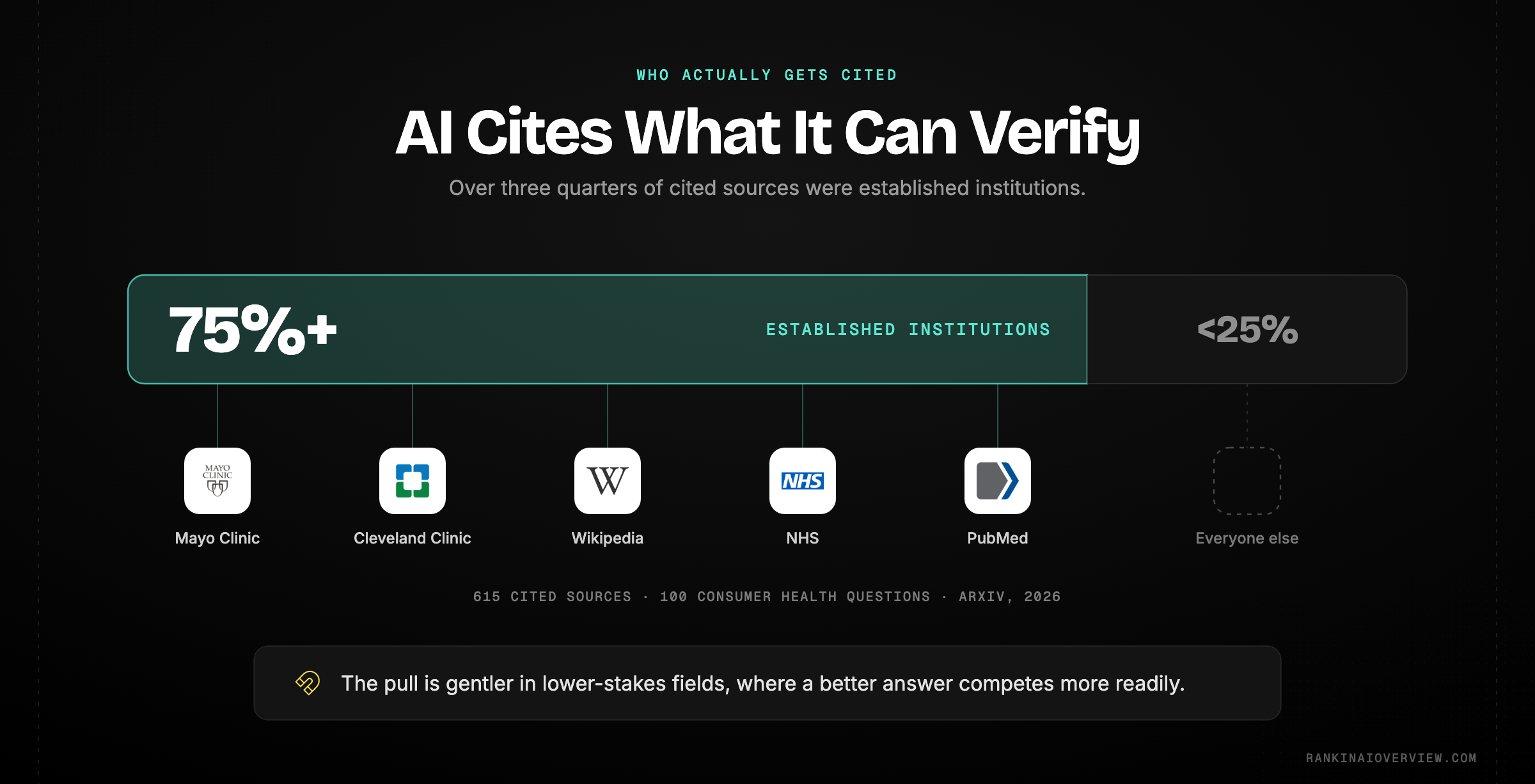
* AI leans heavily on visible authority: in one study of ChatGPT's health answers, over 75% of cited sources were established institutions rather than anonymous or alternative sites.
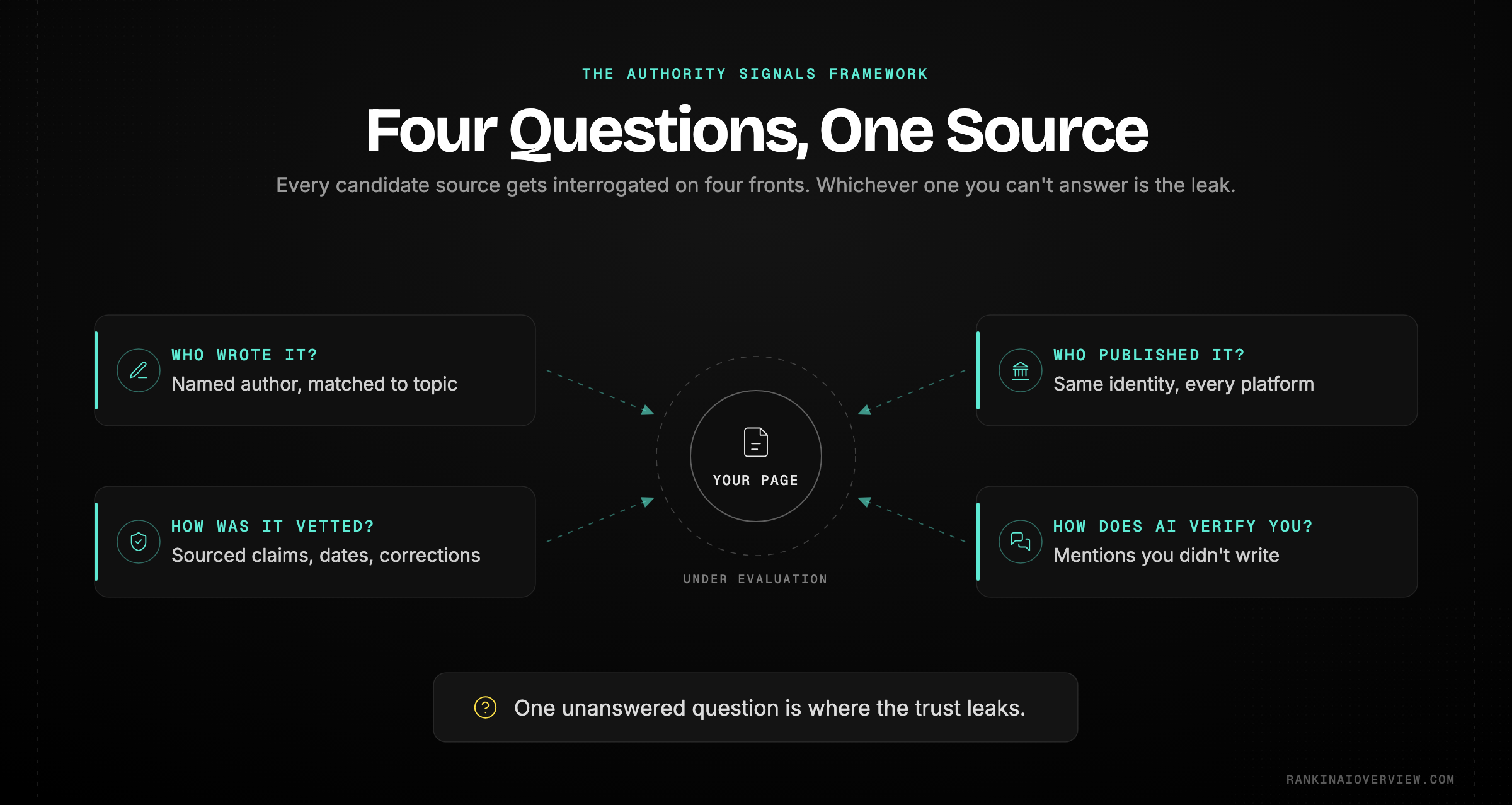
* Trust is a pattern, not a single tag, and it answers four questions: who wrote it, who published it, how it was vetted, and how AI can find and verify it.
* The signals divide cleanly into ones you control directly, like authorship and consistency, and ones you must earn, like credible mentions and branded recognition.
* AI detects trust through corroboration across independent sources, so the goal is many signals agreeing, not one signal perfected.
* You cannot fake it durably, because manipulation rarely corroborates cleanly and tends to be discounted rather than rewarded.
* Fix the signals you control in weeks, then invest in the earned recognition that compounds over months, because that is where most of the citation weight sits.
Everyone in AI search talks about trust signals, but few make them concrete enough to act on. It is easy to nod along to "AI rewards trust" and still have no idea what to actually do on Monday morning. This guide turns the idea into a practical framework, so you can build trust signals deliberately rather than hoping they materialise on their own.
According to a study of ChatGPT's health citations [published on arXiv](https://arxiv.org/abs/2601.17109), researchers put 100 consumer health questions to the model and coded the 615 sources it cited, finding that over 75% came from established institutional sources such as Mayo Clinic, Cleveland Clinic, Wikipedia, the National Health Service and PubMed, with the rest from alternative sources that lacked that institutional backing. That is a striking concentration. When the model chose whom to cite, it overwhelmingly reached for sources carrying visible marks of authority, which tells you exactly what building trust signals is really about: making those marks visible and verifiable for your own brand.
This guide makes trust signals actionable. It covers what AI systems actually recognise, then works through a four-part framework, who wrote it, who published it, how it was vetted, and how AI finds and verifies it, before explaining how AI detects these signals, how long they take to build, and why you cannot shortcut the process. For the foundational concept beneath the tactics, our piece on [whether AI visibility is more about trust than rankings](https://www.rankinaioverview.com/blog/ai-trust-signals) pairs closely with this guide.
## What Trust Signals Do AI Systems Actually Recognise?
A system trying hard not to cite something wrong reaches for what it can verify.
AI systems recognise trust as a pattern of corroborating evidence: a verifiable entity, clear authorship, credible external references, consistent data and genuine topical depth all pointing to the same conclusion. No single signal proves credibility, but many independent signals agreeing does, which is why trust building is about breadth of evidence rather than one perfected tag.
The health-citation finding makes the underlying preference concrete. A model faced with many possible sources leans toward the ones it can recognise and verify, which in that study meant established institutions with obvious authority markers. That is not a quirk of the health domain, though it is strongest there; it is the general logic of a system trying hard not to cite something wrong. Trust signals are simply the evidence that tips a citation decision your way, and without them even genuinely excellent content struggles to be selected, because the system has no way to tell your excellence from anyone else's confident claim.
This reframes the goal in a useful way. You are not optimising a single page for a hidden trust score. You are shaping how your entire brand appears across everything the AI can see, so that every touchpoint reinforces the same credible, verifiable entity. The four questions that follow, drawn from the framework in that research, are a practical way to organise that work, and together they map closely to what our guide to the [AI ranking factors that matter in 2026](https://www.rankinaioverview.com/blog/ai-ranking-factors-2026) identifies as increasingly decisive.
## How Do You Build Author-Credential Signals (Who Wrote It)?
Four questions a cautious system asks. A missing answer is where your trust leaks.
Build author-credential signals by attaching real, named, credentialed authors to your content and making their expertise verifiable. Show who wrote each piece, what qualifies them, and how that expertise connects to the topic, because first-hand, credentialed authorship is one of the clearest marks of trust a system can read, and anonymity is one of the clearest marks against it.
Start with visible bylines on every substantive page. A named author with a genuine biography, relevant credentials and a track record on the subject tells the system a real, accountable person stands behind the content. That accountability is exactly what an anonymous, generic page cannot offer, and it is one of the most common reasons otherwise capable sites fail to earn citations. The fix is not cosmetic: it means genuinely having qualified people write, or meaningfully review and sign, what you publish, so the credential reflects reality rather than decoration.
It is worth being honest about what "credentials" means here, because it is easy to reach for the wrong kind. The signal is not a string of letters after a name for its own sake; it is verifiable evidence that the author genuinely knows the subject. For a medical topic that might be clinical qualifications; for a niche software tool it might be years of demonstrable hands-on work and a visible track record of writing about it. The system is trying to confirm relevant expertise, so the credential that matters is the one that actually maps to the topic, and a real practitioner with an established body of work can carry more authority than a formally qualified but topically unconnected name.
Then make the expertise verifiable beyond your own site. An author whose name, credentials and affiliations appear consistently across their own profiles, professional listings and the places they are cited becomes an entity the system can corroborate rather than merely a name you asserted. Link authors to their bodies of work, keep their details consistent everywhere, and connect them to the institutions and topics they are genuinely associated with. The aim is that when a system asks "who wrote this," the answer is a person it can independently confirm is a real authority on the subject.
## How Do You Build Institutional and Publisher Signals (Who Published It)?
Build publisher-level signals by making your organisation itself a recognisable, verifiable entity: consistent name and description everywhere, a clear presence in reference and knowledge sources, and evident association with your field. Who published it matters as much as who wrote it, because the study found institutional backing was the single strongest common thread among cited sources.
The foundational work here is entity consistency. When your organisation's name, description, focus and key details are described the same way across your own site, your profiles, industry directories and reference platforms, the system can resolve all of it into one coherent entity it recognises. Fragmented or contradictory information does the opposite, splintering your presence into several weak, uncorroborated fragments. Aligning that data is quiet, unglamorous work, but it is high-impact, because it is the substrate every other signal attaches to, a point our guide to [why branded, recognisable entities earn AI visibility](https://www.rankinaioverview.com/blog/brand-entity-ai-visibility) develops in depth.
Beyond consistency, work toward genuine presence in the sources that carry institutional weight. Being accurately represented in the major knowledge and reference layers, where genuinely warranted, and being associated with credible bodies in your field, tells the system your organisation is an established participant rather than an unknown. You cannot and should not manufacture this, but you can make sure that wherever your organisation legitimately appears, the representation is accurate, current and consistent, so that the institutional signal you do have is working at full strength rather than being undercut by neglect.
## How Do You Show Your Content Was Vetted (Quality Assurance)?
Show that your content was vetted by making your standards and process visible: cite credible sources, show review and update dates, correct errors openly, and demonstrate genuine accuracy and depth. The question "how was it vetted" is about evidence of care, and content that visibly references authoritative sources and maintains itself reads as more trustworthy than content that simply asserts.
The most direct move is to source your own claims well. Content that links its factual statements to authoritative references signals that it was researched rather than invented, and it lets the system see the credible company your page keeps. Pair that with visible signals of maintenance, clear publication and update dates, evidence that figures and claims are current, and a willingness to correct and revise. A page that is demonstrably kept accurate over time carries a stronger vetting signal than one that was published once and abandoned, particularly on topics where currency matters.
Accuracy itself is the signal underneath all of this, and it is worth stating plainly. A page that is demonstrably correct, that gets its facts right and does not contradict what trusted sources establish, is the strongest vetting signal of all, because the systems increasingly cross-check claims against what they can corroborate elsewhere. Content that quietly conflicts with the established consensus on a topic gives a cautious system a concrete reason to look past you, however well presented it is. Getting the substance right, and keeping it right as things change, is not separate from trust-signal building; it is the core of it.
Topical depth is the other half of demonstrated quality. Covering your core subject thoroughly, with connected pieces that genuinely reference and build on each other, shows the system you are an authority who has done the work rather than a site that touched the topic once for traffic. Depth compounds, because each strong, well-sourced piece reinforces the credibility of the others around it, and the cluster as a whole reads as a serious body of work. This is closely tied to what our analysis of [the content that actually ranks in AI search](https://www.rankinaioverview.com/blog/what-content-ranks-in-ai-search) found separates cited sources from ignored ones.
## How Do You Build Digital Authority Signals (How AI Finds and Verifies You)?
Build digital authority by earning the external signals you do not fully control: credible mentions across trusted sites, consistent references to your brand, and growing branded search. This is the "how does AI find and verify you" domain, and it carries outsized weight because third-party recognition is exactly what you cannot fabricate about yourself.
The most powerful signals here are the ones others create. A mention in a credible publication, a reference on a trusted platform, or a rising volume of people searching your brand by name all tell the system that others independently recognise and vouch for you. That external validation is what trust ultimately rests on, which is why earning genuine coverage and being genuinely talked about has become central rather than peripheral, a theme our guide to [reputation-driven SEO](https://www.rankinaioverview.com/blog/reputation-seo) treats as foundational. Unlinked mentions count here too, because the association itself, your brand named credibly alongside your topic, is a signal the system can read.
Consistency ties the whole domain together. When every external reference describes the same coherent brand, each mention reinforces the others and the entity grows sharper and more verifiable. When references contradict each other, the signal blurs and the system cannot confidently resolve who you are. So part of digital authority is simply ensuring that wherever you legitimately appear, you appear as one consistent entity, which quietly strengthens every other mention and connects to how AI weighs credibility even in [citations that originate well beyond Google](https://www.rankinaioverview.com/blog/non-google-ai-citations).
> "This study introduces an Authority Signals Framework, organized in four domains that reflect key components to health information seeking, starting with 'Who wrote it?' (Author Credentials), followed by 'Who published it?' (Institutional Affiliation), 'How was it vetted?' (Quality Assurance), and 'How does AI find it?' (Digital Authority)." **Erin Jacques, Erela Datuowei, Vincent Jones II, Corey Basch, Celeta Vanderpool, Nkechi Udeozo and Griselda Chapa**, authors, *Authority Signals in AI Cited Health Sources*. Source: [arXiv](https://arxiv.org/abs/2601.17109)
It is worth reading the study's domain caveat into how you apply the framework. The research looked specifically at health questions, a high-stakes area where the pull toward established institutional authority is strongest, so the exact 75% concentration should be treated as the sharpest end of the spectrum rather than a universal constant. In lower-stakes fields the preference for visible authority is gentler, and a smaller or less institutional source can compete more readily on the strength of a genuinely better answer. But the direction is consistent across domains: verifiable authority signals help you get selected, and their absence hurts. Treat the framework as general and the precise numbers as domain-dependent, weighting the authority work most heavily wherever your topic touches health, finance, safety or other consequential areas.
Those four questions are a genuinely useful checklist precisely because they are the questions a cautious system is implicitly asking of every candidate source. If your brand has a clear, verifiable answer to each, who wrote it, who published it, how it was vetted, and how the system can find and confirm you, then you present as exactly the kind of source it prefers to cite. If any answer is missing or muddled, that is where your trust signal is leaking, and it points you straight at the work to do.
## Which Trust Signals Should You Prioritise First?
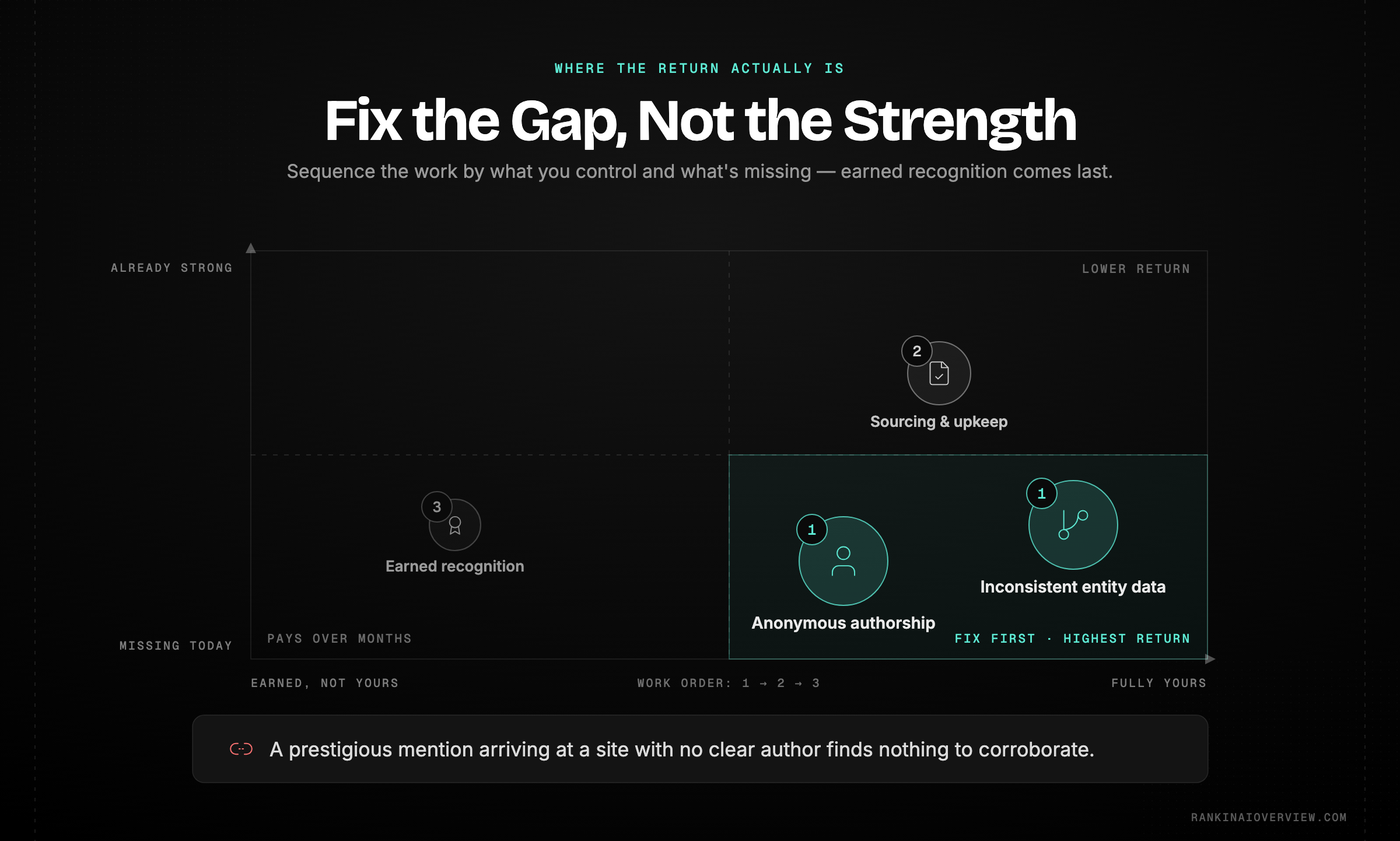
A gap is worth more to close than a strength is worth to polish.
Prioritise the signals you fully control and that are currently missing, because a gap is worth more to close than a strength is worth to polish. In practice that usually means fixing anonymous authorship and inconsistent entity data first, then improving how well your content is sourced and maintained, and only then investing in the slower earned recognition that compounds over months.
The logic is about marginal return, not about which signal is theoretically strongest. If your content is genuinely good but published anonymously, adding real, credentialed authorship removes a glaring reason not to trust you and can move things quickly, because you went from a missing answer to a clear one on "who wrote this." Likewise, if your brand is described five different ways across the web, consolidating that into one consistent entity closes a gap that was quietly weakening every mention you already have. These are high-return fixes precisely because they repair a broken signal rather than marginally strengthening an intact one.
Sequence the earned work after the controlled work for a practical reason: external recognition takes months, so you want the signals you control to be solid before that slower investment starts paying off, not lagging behind it. There is little point earning a prestigious mention that sends a system to a site with no clear authorship and contradictory entity data, because the mention arrives and finds nothing coherent to corroborate. Get your own house in order first, so that when the harder-won external signals do arrive, they land on a foundation that reinforces them rather than undercutting them. A simple audit of your most important pages, checking each against the four questions, will usually make the priority order obvious.
## How Do AI Systems Detect and Weigh These Signals?
AI systems detect trust by aggregating evidence across the web and looking for corroboration: consistent entity data, credible mentions, verifiable authorship and topical depth all converging on the same source. When independent signals agree, the system treats you as trustworthy, and when they conflict or are absent, it does not, however good any single page might be.
The mechanism is pattern recognition across many sources rather than a lookup of one score. No single page, tag or mention proves you are credible, but a consistent web of mutually reinforcing evidence does, and that is what the system weighs. This is exactly why manipulating any one signal fails: a lone manufactured mention does not corroborate with anything, so it adds little and can even stand out as anomalous. The systems favour entities that many independent, trusted sources describe the same way, because agreement among sources that have no reason to collude is genuinely hard to fake.
Detection also rewards durability, which shapes how you should build. Signals that have existed and been reinforced steadily over time read as more trustworthy than a cluster that appeared suddenly, which can look like a coordinated push. Steady, genuine accumulation therefore beats a rushed burst, both because it corroborates more cleanly and because it matches the pattern of real authority, which is earned gradually rather than switched on. That preference for durability is not an obstacle to game around; it is a direct reflection of how real trust actually forms.
## How Long Does It Take, and Why Can't You Shortcut It?
Building AI trust signals typically takes several months to a year, because the earned, external signals that carry the most weight accumulate gradually. The signals you control directly can be fixed in days or weeks, but the recognition that most influences citation depends on other people and platforms, and that cannot be rushed into existence.
Split the timeline honestly. The on-site work, clear authorship, well-sourced and maintained content, consistent entity data, is largely within your control and can be substantially improved quickly. The off-site work, credible mentions, reference-layer presence and branded search growth, takes months to build meaningfully, because it depends on earning genuine recognition rather than on your own effort alone. Expect a slow start that accelerates as signals begin to stack and reinforce one another, and judge the effort over quarters rather than weeks. The brands that win are the ones that started early and stayed consistent, because trust rewards persistence more than intensity.
The reason you cannot shortcut it is structural, not merely a matter of enforcement. The whole value of a trust signal is that it is hard to fabricate, so anything easy to fake is, almost by definition, not worth much. Anyone can claim authority; real authority shows up as independent, credible third parties referencing you in ways that corroborate, and that is exactly what manipulation cannot manufacture convincingly. Purchased or manufactured signals rarely agree cleanly with everything else, so they tend to be discounted rather than rewarded, and the effort spent building them is effort not spent on the genuine recognition that actually works. The honest path is not merely the ethical one here; it is the only durable one.
## Conclusion
Trust signals stop being a mystery once you make them concrete. AI recognises trust as a pattern of corroboration, and you can build that pattern deliberately by answering four questions clearly: who wrote it, who published it, how it was vetted, and how AI can find and confirm you. The health-citation research is a blunt reminder of the stakes, with over three quarters of cited sources carrying visible institutional authority.
Build the signals you control now, clear authorship, well-sourced and maintained content, and consistent entity data, then invest patiently in the external recognition that compounds over months. You cannot fake it, and that is precisely the point: the same properties that make trust signals hard to manufacture are what make them worth having. Become a genuinely recognised, verifiable authority that a cautious system can confirm from several directions at once, and the trust signals, and the citations that depend on them, follow. Want to know how strong your trust signals look to AI right now? [Run a free AI visibility audit with Rank in AI Overview](https://www.rankinaioverview.com/) and see where you stand across every major engine.