# Do AI Citations Replace Backlinks? What the Shift Actually Means
URL: https://www.rankinaioverview.com/blog/do-ai-citations-replace-backlinks
Published: 2026-09-03
## Key Highlights
* AI citations do not replace backlinks because the two are different kinds of thing: a backlink is a durable asset you own, while a citation is an ephemeral, per-query decision you do not.
* Research across nearly 56,000 queries found 37% of AI-cited domains never appear in traditional search, so the citation economy overlaps with the link economy but is not the same one.
* Being cited is not automatically a credibility endorsement the way a hard-won editorial link is, because AI engines were found not to outperform traditional search on credibility or neutrality.
* A citation does not pass authority to anyone else or persist as a referenceable record, so it cannot function as the transferable currency backlinks became.
* Citations are better understood as the outcome you now measure and links as one input that helps produce it, rather than as rivals for the same budget line.
* The right response is to build one reputation that earns both, then track citations as a result while continuing to earn the links and mentions that make them likelier.
As AI answers reshape search, a provocative question keeps surfacing: are backlinks being replaced by AI citations? It is a natural thing to ask. If being cited in an AI answer now drives visibility, perhaps the decades-old obsession with links is finally ending. The reality is more structural than the headline suggests, and getting it wrong sends real budget in the wrong direction, either abandoning links prematurely or dismissing the citation shift entirely.
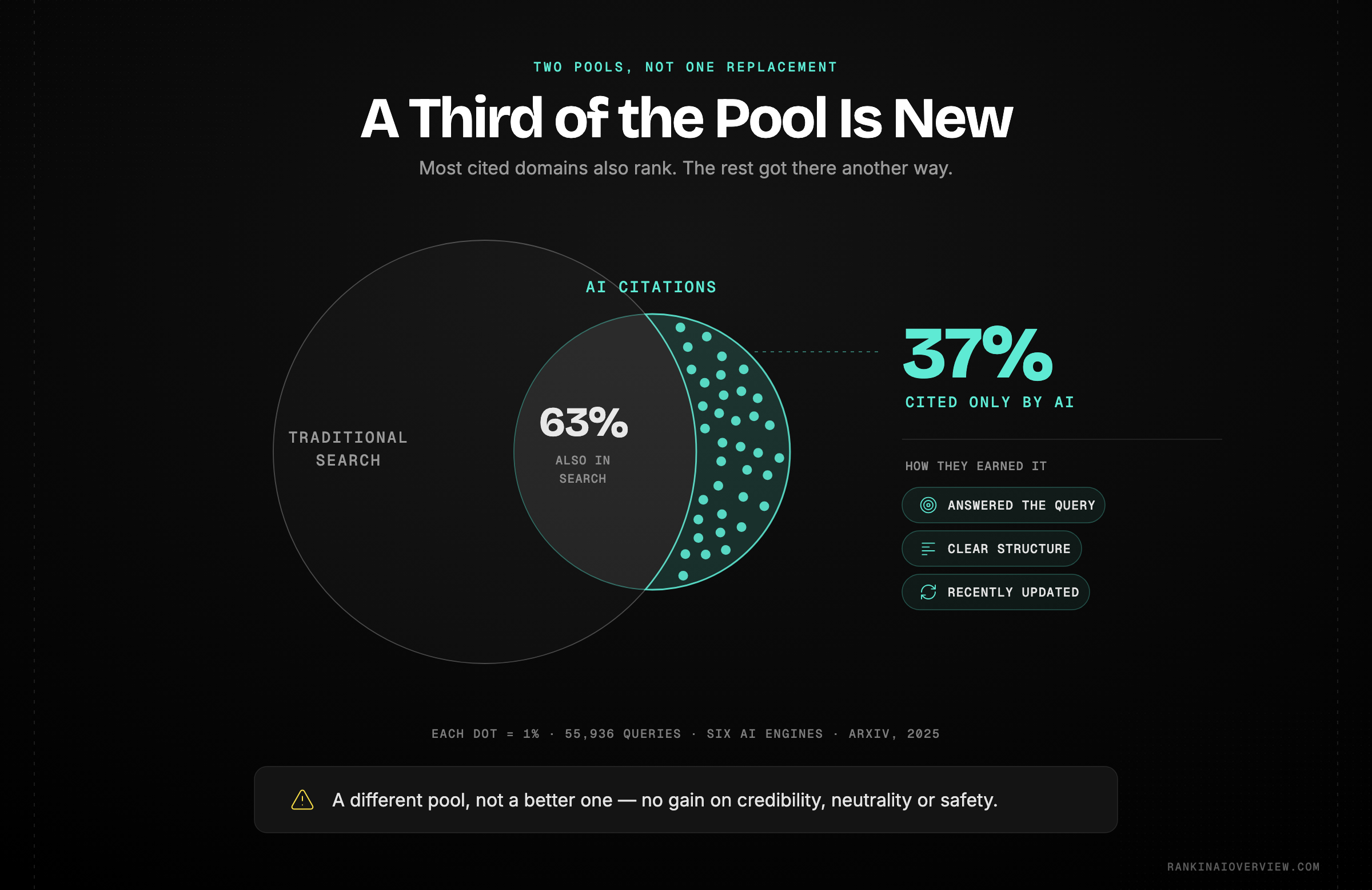
According to a large-scale study of AI and traditional search [published on arXiv](https://arxiv.org/abs/2512.09483), researchers analysed 55,936 queries across six AI-based search engines and two traditional ones, and found that AI engines cite a more diverse set of domains, with 37% of cited domains unique to the AI engines and never surfaced by traditional search at all. That single figure reframes the whole question. If more than a third of what AI cites never appears in the link-and-ranking world, then citations are not simply replacing backlinks; they are drawing partly on a different pool by a different logic, which is a very different claim from "citations are the new links."
This guide examines whether AI citations replace backlinks in any meaningful sense. It covers what each one actually signals, why citations are not "the new backlinks" structurally, whether the two even draw on the same sources, whether being cited builds authority the way a link does, whether citations are becoming the metric that matters more, and how to build toward both without confusing them. For the broader authority picture underneath it all, our piece on [reputation-driven SEO](https://www.rankinaioverview.com/blog/reputation-seo) is a useful companion.
## What Do Backlinks and AI Citations Each Actually Signal?
A backlink signals that another site chose to vouch for you, and it does so durably, as a standing endorsement recorded on the web. An AI citation signals that an engine judged your page the best available source for one specific question at one specific moment. Both involve trust, but one is a lasting structural vote and the other is a momentary selection.
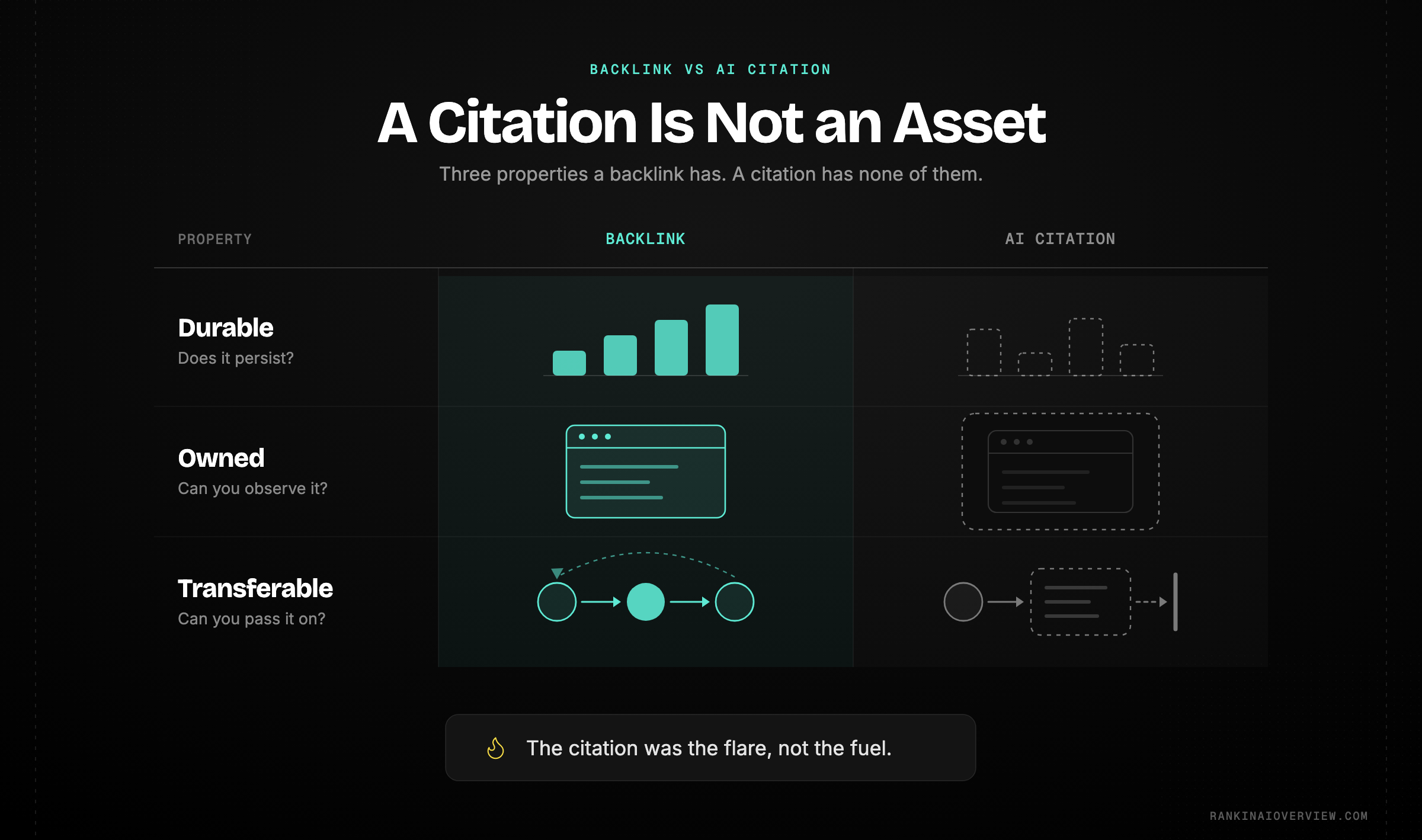
That distinction is the heart of the matter, and it is easy to skate past. A backlink, once earned, sits there. It keeps pointing at you, keeps being discoverable, keeps contributing to how systems understand your standing, and it does all of that whether or not anyone runs a particular search today. It is an asset in the ordinary sense: acquired once, held over time, working in the background. A citation has none of those properties. It exists only in the answer to a query, for the duration of that answer, and it may or may not recur the next time a similar question is asked.
A useful test is to ask what you still have a year later. Earn a strong editorial link today and, absent the publisher removing it, you still have it in a year, still working, still contributing to how systems read your standing. Earn a citation today and in a year you have a memory of having been cited, but no persisting object, no entry in any ledger you control, nothing you can point to as still yours. What you may have instead is a stronger underlying reputation that keeps earning fresh citations, but that reputation was built by the durable inputs, not by the citation itself. The citation was the flare, not the fuel.
So the two signals sit at different points in the chain. A backlink is an input to your authority, accumulated and owned. A citation is an output of your authority meeting a specific question at a specific time. Treating an output as though it were a replacement for an input is a category error, and it is the quiet mistake underneath most "citations replace links" arguments. They are related, because authority feeds both, but they are not the same species of thing, and the differences turn out to matter enormously for strategy.
## Why Are AI Citations Not Simply "The New Backlinks"?
You can bank a link. You cannot bank a citation.
AI citations are not the new backlinks because they lack the three properties that made backlinks a currency: they are not durable, not owned, and not transferable. A link persists, belongs to you once earned, and passes authority onward. A citation is fleeting, controlled entirely by the engine, and passes nothing to anyone else.
Consider durability first. The backlink economy worked because links accumulate into a lasting profile. You could earn a strong link once and benefit from it for years, and the sum of those durable links became a measurable authority asset. Citations do not accumulate in the same way. There is no growing, ownable stock of citations sitting on the web that you build over time; there is only your ongoing likelihood of being selected, which is re-decided every time someone asks. You cannot bank a citation the way you bank a link.
Consider ownership and control next. A link lives on someone else's page, but once placed it is stable and observable, and it is genuinely yours in the sense that it persists until that publisher changes it. A citation is decided entirely inside a system you do not control, on criteria that shift, with results that vary run to run. You can influence your chances, but you own nothing. And consider transferability: a backlink famously passes authority from the linking site to you, which is the whole basis of the link graph. A citation passes nothing onward. Being cited does not let you, in turn, confer authority on another page. The mechanism that made links a currency, the flow of authority through a graph, simply has no equivalent in citations. That is why calling them the new backlinks misdescribes what they are.
## Do Backlinks and AI Citations Even Draw on the Same Sources?
A different pool is not an empty one.
Only partly. The research behind this guide found that 37% of domains cited by AI engines never appeared in traditional search results at all, which means a large slice of the citation economy operates outside the familiar link-and-ranking world. The overlap is real but far from complete, so the two are adjacent economies rather than one replacing the other.
That partial overlap explains a lot of confusing real-world behaviour. Some of what gets cited is exactly what you would expect from a link-authority view: well-established, heavily referenced domains that also rank and attract links. But a substantial minority is not. Pages and domains with modest link profiles surface in AI answers because they happened to answer a specific question cleanly, structurally and freshly, in ways the link graph never measured. If citation simply mirrored backlinks, that 37% would not exist. Its existence is direct evidence that a different selection logic is at work.
That 37% is also a useful corrective to a common piece of wishful thinking. Some teams hear "different source pool" and assume it means the barriers are gone, that the citation economy is a wide-open frontier where authority no longer counts and anyone can win. The data does not support that hope. A different pool is not an empty one, and the fact that AI cites some low-link pages does not mean it cites random ones. Those pages earned selection by answering specific questions cleanly and credibly, which is its own kind of merit, just a different kind from link authority. The frontier is open in the sense that link count is not destiny, but it is not open in the sense that quality and trust stopped mattering. If anything they matter more, because there are fewer crude proxies standing in for them.
It is worth being careful here rather than triumphant, though. The same study found that AI engines did not outperform traditional search on credibility, political neutrality or safety. So the more diverse citation pool is not automatically a higher-quality or more trustworthy one; it is simply different, and different in ways that carry their own risks. The honest reading is not that citations found a better class of source than links did, but that they draw on a partly separate set by partly separate criteria, with no guarantee of superior credibility. Our look at [why AI engines cite sources well beyond the Google link graph](https://www.rankinaioverview.com/blog/non-google-ai-citations) develops where that separate pool comes from.
## Does Being Cited Build Authority the Way a Link Does?
Not directly. A backlink builds authority by passing a durable signal into the systems that rank and trust you. A citation, by contrast, is largely a consequence of authority you already hold rather than a mechanism that adds to it, and because it passes nothing onward and leaves no persistent record, it does not compound into a standing asset the way links do.
There may be indirect, second-order effects, and it is fair to acknowledge them. Being cited in AI answers can raise your visibility, which can lead a human who saw the citation to write about you, mention you or link to you, and those downstream links do build authority in the ordinary way. So a citation can seed authority indirectly, through the human reactions it provokes, but it does so only by eventually producing the older currency. The citation itself is not the authority-building act; the link or mention it might inspire is. That is a meaningful difference from a backlink, which builds authority the moment it is placed, with no further steps required.
The direction of the flow is the whole point. Link authority flows outward and onward: a strong site links to you, lifts you, and you in turn can lift others you link to, which is what made the link graph a genuine economy with a circulating currency. Citation authority does not circulate at all. It terminates in the answer. Nothing you do with a citation you received can be passed to a third party, because there is no token to pass, only the fact that an engine chose you this once. An economy needs a currency that moves between participants, and citations have no such currency, which is a structural reason they cannot simply step into the role backlinks played.
This is why treating citation counts as a direct replacement for a link-authority scorecard is misleading. A high citation rate is a wonderful sign that your authority and clarity are working, but it is a reading of your current standing, not a deposit into it. You cannot cite your way to authority the way sites once linked their way to it, because the flow simply does not run in that direction. Understanding this keeps you from the error of chasing citations as if each one were a durable brick in a wall, when it is really a snapshot of how the wall you have already built is performing today.
## Are AI Citations Becoming the Metric That Matters More?
In one specific sense, yes: citations are becoming the more direct measure of AI-era visibility, because they capture whether you actually appear in the answers users read. But that makes them the better outcome to track, not a replacement for links as an input. The sensible framing is citations as the result you measure and links as one of the things that help produce it.
The shift in what to measure is genuine and worth acting on. For a growing share of informational queries, ranking and its link-driven authority are increasingly a means to an end, and the end is being present in the synthesised answer. So a modern visibility scorecard should absolutely foreground citation share and presence across engines, because those track the thing you now actually care about. In that reporting sense, citations have moved to the centre and a link count has moved to the periphery, and our guide to the [AI visibility metrics that matter](https://www.rankinaioverview.com/blog/ai-visibility-metrics) lays out how to build that scorecard properly.
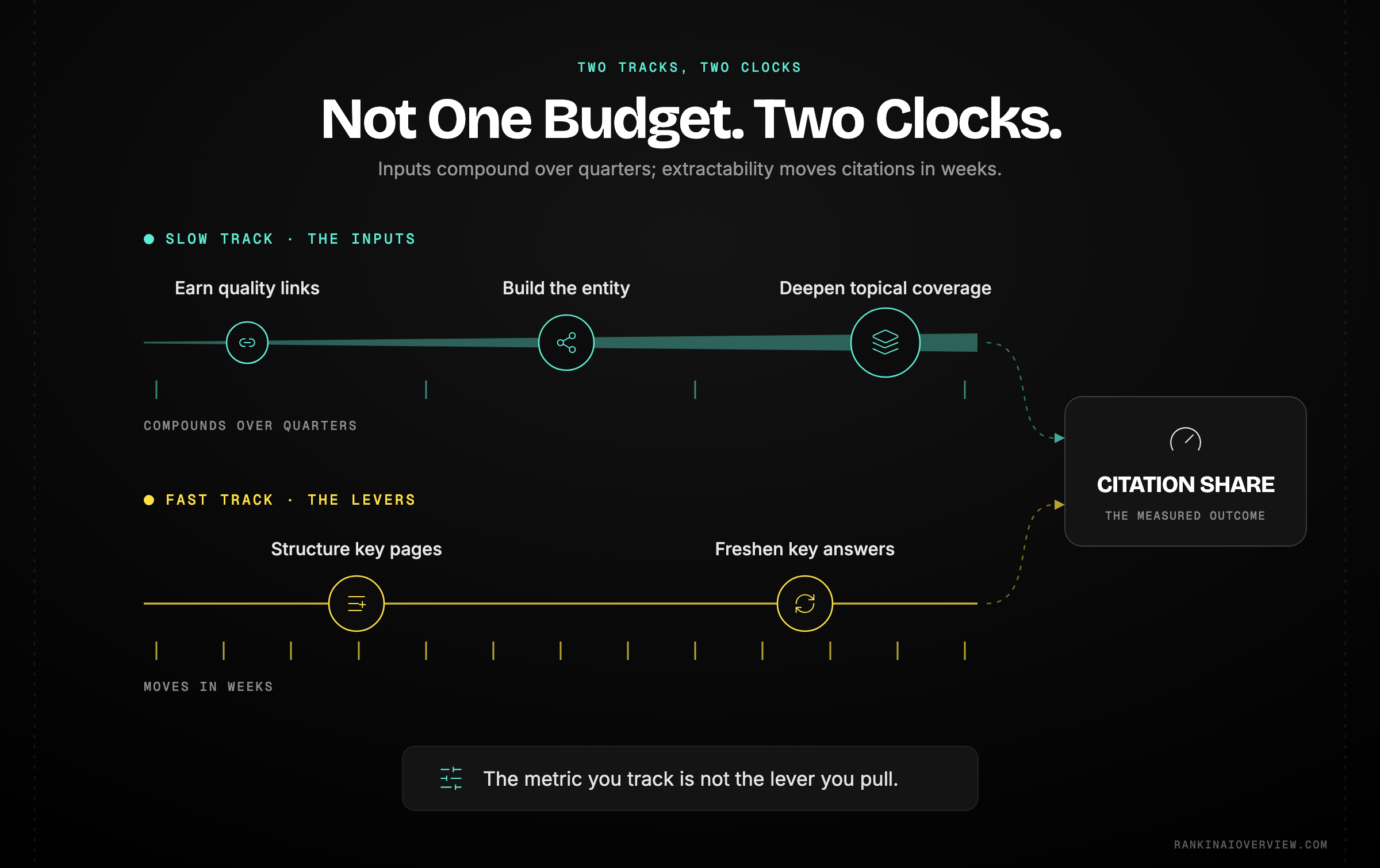
But elevating citations as the headline metric is not the same as saying they replaced links as a lever. You measure the outcome and you invest in the inputs, and those are different activities. Links, mentions and entity strength remain among the inputs that raise your citation likelihood, even as citation becomes the number on the dashboard you watch. Confusing the metric you track with the levers you pull is how teams end up staring at a citation figure with no idea how to move it, which our discussion of why [Google ranking is becoming less important](https://www.rankinaioverview.com/blog/google-ranking-less-important) helps put in proportion.
## What Are the Risks of Treating Citations Like Backlinks?
The main risks are building your strategy on an asset you cannot own or defend, mistaking a volatile signal for a stable one, and optimising for a number you cannot reliably move. Because a citation is ephemeral and engine-controlled, treating it as though it were a durable, ownable link leads to fragile plans and false confidence in equal measure.
The defensibility problem is the sharpest one. A strong backlink profile is genuinely hard for a competitor to replicate quickly, which is part of why it held value: it was a moat built over time. Citations offer no such moat. Your presence in an answer can vanish the moment the engine updates, a competitor publishes a cleaner answer, or the same query simply resolves differently on the next run. If your visibility rests on citations you treat as permanent, you have built on ground that can shift without warning, and you will have no accumulated asset to fall back on when it does. That is not an argument against pursuing citations; it is an argument against mistaking them for something they are not.
There is also a concentration risk that link thinking tends to hide. With links, value is spread across many durable endorsements, so losing any one matters little. With citations, a large share of your AI visibility for a topic can depend on being selected for a handful of high-volume queries, and losing those selections can remove a disproportionate slice of your presence at once. The volatility that makes citations exciting when they swing your way is exactly what makes them dangerous to depend on when they swing away.
Finally, there is the measurement trap. Because a citation feels like a concrete win, it is tempting to treat a rising citation count as an authority balance growing like a link profile. It is not a balance; it is a live reading. Managing it like an accumulating asset, rather than a fluctuating outcome that reflects work done elsewhere, leads to celebrating snapshots and neglecting the durable inputs that actually produced them. The discipline is to enjoy citations as evidence while investing in the things that are genuinely yours to keep.
## How Do You Build Toward Both Without Treating Them as the Same?
Invest in the inputs. Measure the outcome. They are different activities.
Build one reputation that serves both, then act on each according to its nature. Earn durable links and mentions as the accumulating authority asset they are, and earn citations by making your best content the clearest, freshest, most extractable answer to specific questions. Treat links as an owned input you compound and citations as an outcome you monitor and optimise.
The unifying foundation is genuine authority made easy to use. A credible, well-linked, well-mentioned entity is more likely to sit in the candidate pool an engine trusts, and a clear, well-structured, current page is more likely to be selected from that pool for a given question. So the work divides cleanly once you stop conflating the two. On the input side, keep earning quality links and building the entity, because that is what accumulates and persists. On the outcome side, structure and freshen your key pages, and measure whether the citations actually follow. Strengthening the [trust signals AI systems recognise](https://www.rankinaioverview.com/blog/ai-trust-signals) serves the input side, while answer engineering serves the outcome.
It helps to assign each kind of work its proper time horizon, because they pay back on different clocks. The durable input work, earning links, building the entity, deepening topical coverage, compounds slowly and rewards patience, and you should judge it over quarters rather than weeks. The outcome work, sharpening and freshening specific answers, can move citations relatively quickly, because it addresses the selection stage directly. Running both with the right expectations stops you from abandoning the slow authority work because citations did not jump this week, and from assuming a good citation month means the underlying reputation is finished. One is a foundation you pour; the other is a light you can switch on and off far faster, and confusing their timescales is a reliable way to misjudge both.
The practical discipline is to resist the either-or instinct entirely. Do not abandon links because citations feel newer, and do not ignore citation dynamics because links feel familiar. Fund the durable authority work and the extractable-answer work as two complementary investments in a single reputation, and let citations be the result that tells you the reputation is landing in the answers that matter. That is how the brands that win AI visibility actually operate, and it is closer to how [branded, well-recognised entities earn their standing](https://www.rankinaioverview.com/blog/brand-entity-ai-visibility) than to any quick swap of one tactic for another.
## Conclusion
AI citations do not replace backlinks, because they are a different kind of thing altogether. A backlink is a durable, owned asset that passes authority through a graph; a citation is a fleeting, engine-controlled selection that passes nothing onward and leaves no persistent record. Research showing 37% of AI-cited domains never appear in traditional search confirms that citations draw on a partly separate economy rather than swapping in for the link one.
The winning strategy refuses the either-or. Keep earning durable links and mentions as the accumulating authority they are, make your best content the clearest and freshest answer so it gets selected, and track citations as the outcome that tells you the whole system is working. Links remain a durable lever you compound, citations become the live measure you watch, and beneath both sits the same unchanging thing: being a genuinely trusted, genuinely useful source that answers the question better than anyone else. Want to see how your authority converts into AI citations today? [Run a free AI visibility audit with Rank in AI Overview](https://www.rankinaioverview.com/) and find out where you stand across every major engine.