# How SEO Agencies Are Adapting Their Services for AI Search
URL: https://www.rankinaioverview.com/blog/how-seo-agencies-are-adapting-ai-search
Published: 2026-09-09
## Key Highlights
* The measured erosion of click traffic to ranked pages is the concrete reason the agency deliverable had to change, from winning a position to earning presence inside AI answers.
* Leading agencies are folding GEO and AEO audits, AI citation monitoring and entity strategy into their core offering as the new baseline, not as an upsell.
* Reporting is being reframed from ranking reports to visibility reports, which resets the entire client conversation from positions to presence and business impact.
* Pricing is moving toward value-based models, because the work is now more research-led and consultative than commodity retainer execution.
For an SEO agency, AI search is both a threat and an opening at the same time. Clients are asking why their traffic is changing, competitors are pitching shiny new AI services, and the familiar promise to get a site to page one no longer captures the work that actually moves the needle. Agencies that ignore the drift risk looking dated within a year. Agencies that adapt are winning new business off the back of it, and the gap between the two groups is widening quickly.
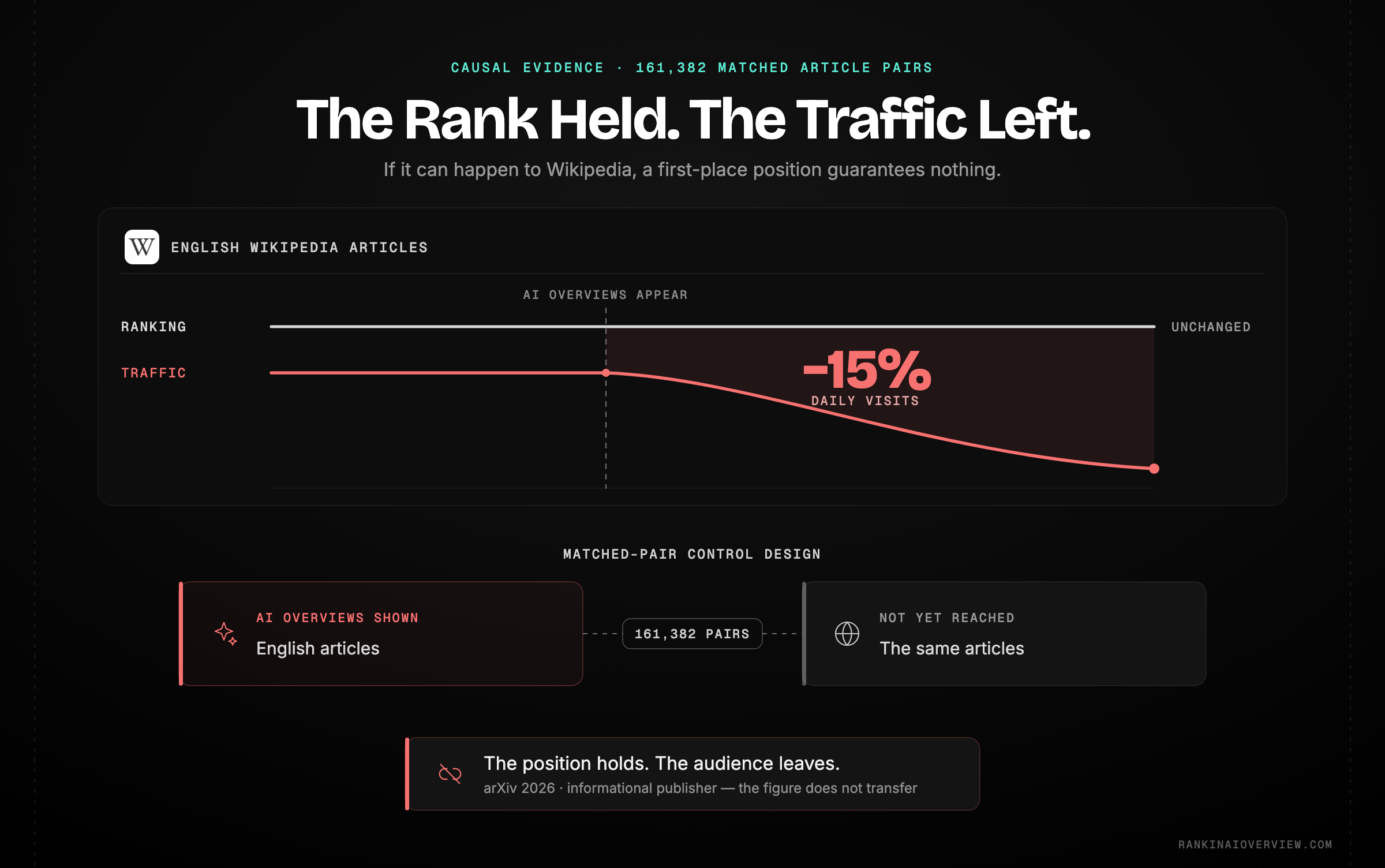
The reason the ground has genuinely moved is not hype, it is measurable. According to [a 2026 causal study of Google's AI Overviews](https://arxiv.org/abs/2602.18455), exposure to AI Overviews reduced daily traffic to English Wikipedia articles by roughly 15% across 161,382 matched article pairs, using a design that compared exposed English pages against the same articles in language editions the feature had not yet reached. When even one of the best-ranked, most authoritative resources on the web loses that much traffic to answer-first summaries, the message for agencies is unambiguous: a ranking is no longer the same thing as an audience.
This guide lays out how leading SEO agencies are actually adapting, not in theory but in the shape of their services, reports and pricing. It covers what has changed in the work, why a rankings-only service is no longer enough, the new service lines taking hold, how firms are repackaging and repricing, how they educate clients who still equate SEO with Google, and what the agency of the next few years looks like. For the underlying shift in the discipline itself, our overview of [why AI visibility is a different game from SEO](https://www.rankinaioverview.com/blog/ai-vs-seo) is a useful companion.
## What Has Actually Changed in SEO Agency Work Since AI Search Arrived?
The core change is that agencies now optimise for citation and visibility inside AI answers, not only for position in a results list. The work has expanded from on-page and links toward entity building, trust signals and measuring presence across multiple AI engines, which reshapes both the strategy that is delivered and the way results are reported to clients.
The old deliverable was a position on a page. The new deliverable is presence, meaning whether AI systems actually mention and cite the client across the queries that matter to their business. That is a broader and frankly fuzzier target. It demands more upfront research, a wider view of where a brand appears, and a different way of proving value, and many agencies are still learning to articulate that value in terms a client immediately grasps.
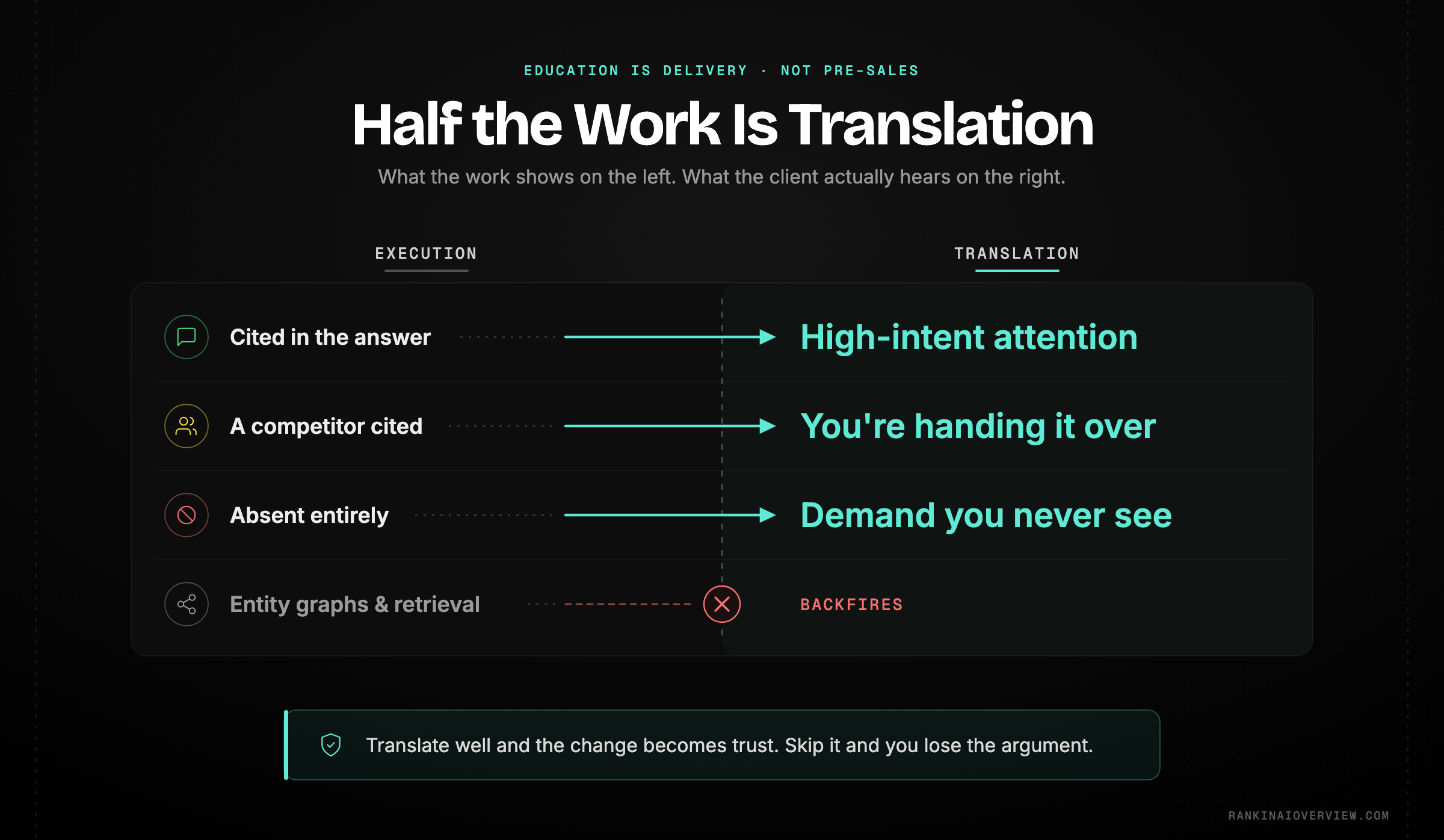
Client education has quietly become part of the job rather than a side task. Because a large share of the buying audience still believes SEO means Google page one, agencies now spend real time explaining what AI visibility is, why it matters commercially, and how it relates to the rankings the client already understands. Half the modern engagement is technical execution. The other half is translation, turning an abstract shift into something a client can see, believe and act on. Firms that do the translation well convert the change into trust, and firms that skip it tend to lose the argument to a competitor who explained it better.
The skill mix inside agencies is shifting to match. Where a delivery team once needed keyword research, on-page optimisation and link acquisition, it now also needs people who understand how answer engines retrieve and synthesise content, how to shape a brand as a recognisable entity, and how to read citation data across several platforms at once. Some of that is new hiring, but much of it is retraining existing specialists to think in terms of presence rather than position. The agencies adapting fastest treat this as a deliberate capability build, not something they hope their team will pick up on the side, because the analytical habits that AI visibility rewards are genuinely different from those that classic ranking work rewarded.
## Why Is the Old Rankings-Only Service No Longer Enough?
If it can happen to Wikipedia, a first-place ranking guarantees nothing.
A rankings-only service is no longer enough because a top ranking increasingly fails to deliver the traffic it once did. AI answers now sit above the links and satisfy many queries outright, so an agency that sells only positions is selling a metric that has partly decoupled from the audience and revenue the client actually cares about.
The Wikipedia finding is worth sitting with, because it makes the abstract concrete. Wikipedia is not a weak site fighting for scraps, it is one of the most authoritative, best-ranked domains on the entire web, and AI Overviews still pulled roughly 15% of its traffic away by answering queries before the click. If that can happen to Wikipedia, a client ranking first for a commercial term has no guarantee that the ranking still converts into visits. The position can hold while the audience quietly leaves, which is exactly the scenario an agency selling positions is blind to.
> "These findings provide early causal evidence that generative-answer features in search engines can materially reallocate attention away from informational publishers, with implications for content monetization, search platform design, and policy."
> **Mehrzad Khosravi and Hema Yoganarasimhan**, authors of the causal study on AI Overviews and Wikipedia traffic.
It is worth being precise about what this evidence does and does not show. The study measured Wikipedia, an informational publisher, not a commercial store or a lead-generation site, so the exact 15% will not transfer cleanly to every client. But the mechanism it isolates, causally and cleanly, is the one every agency now has to reckon with: answer-first features reallocate attention away from the ranked page. That is the structural reason the deliverable had to change from a position to a presence, and it reframes ranking as one input into visibility rather than the whole of it. It is the same reallocation that leaves some agencies fearing for their client base, a worry we examine directly in [whether SEO agencies are losing clients to AI search](https://www.rankinaioverview.com/blog/seo-agencies-losing-clients-ai-search).
## What New Services Are Leading SEO Agencies Offering?
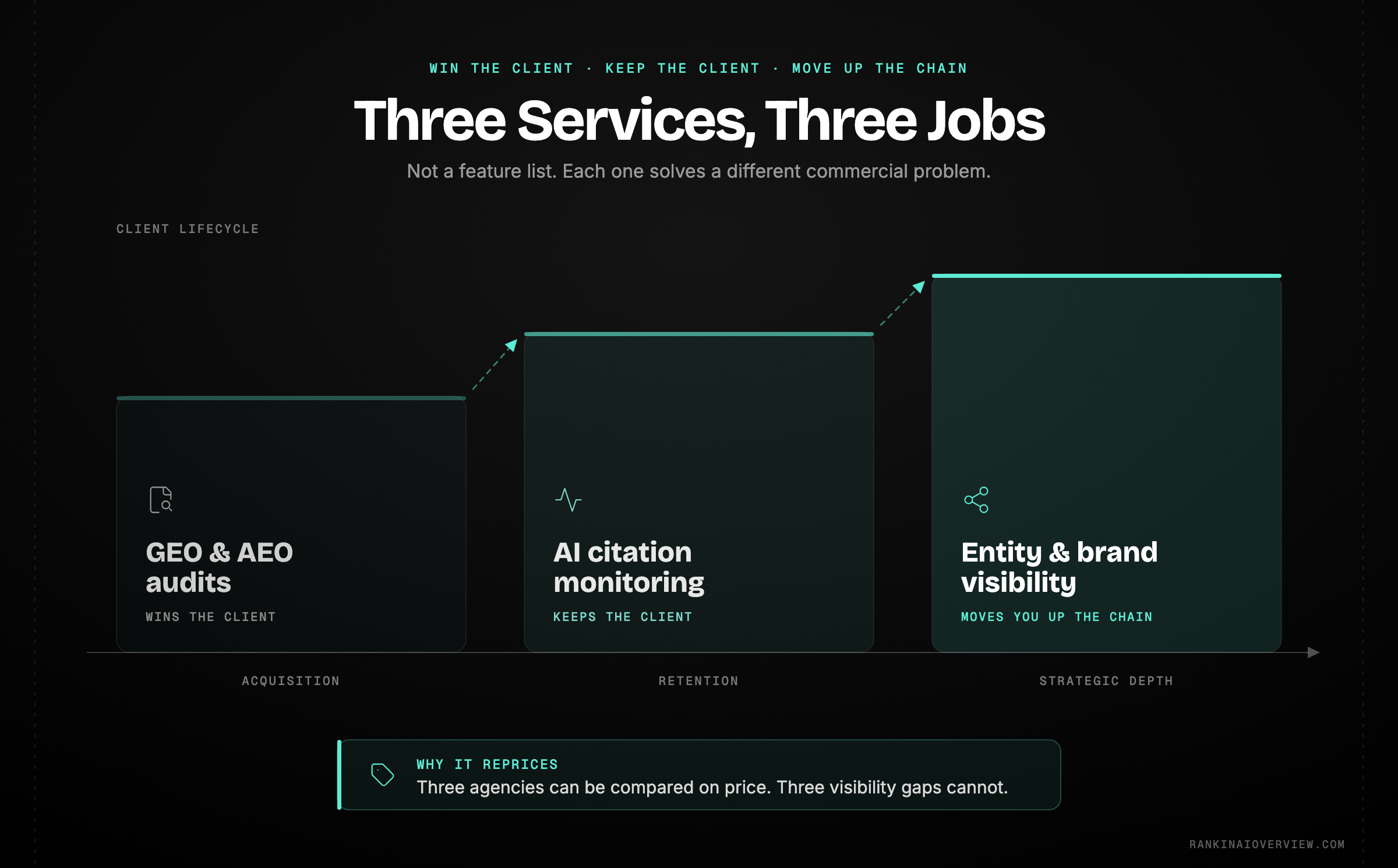
One wins the client, one keeps the client, one moves the agency up the value chain.
Leading agencies are adding GEO and AEO audits, AI citation monitoring, and entity and brand visibility strategy to their offering. These services target how AI systems perceive, trust and cite a brand across engines, complementing traditional SEO rather than replacing it, and they give the agency a credible answer to the question of what it does that a rankings-only firm cannot.
None of these is a gimmick bolted on to look current. Each answers a real gap that the traffic shift has opened up. What follows is each new service line in turn, with what it does for the client and why it strengthens the engagement.
### GEO and AEO Audits
Generative engine optimisation and answer engine optimisation audits assess how well a client's content is set up to be understood and cited by AI. They examine answer structure, schema, topical depth, sourcing and trust signals, then produce a concrete roadmap of what to fix and in what order. Many agencies now build this audit straight into onboarding, because it reframes the entire engagement from the first conversation.
The audit is powerful precisely because it makes the invisible visible. Instead of opening with a keyword report the client has seen a hundred times, the agency shows them exactly where they stand in AI answers, where competitors are being cited instead, and what it will take to close the gap. That is a far more compelling starting point, and it positions the agency as a guide to a new landscape rather than a vendor of an old one.
It also produces a prioritised body of work that justifies the engagement in its own right. A good audit does not just diagnose, it sequences, showing which fixes will move citation likelihood soonest and which are longer plays. That sequencing is what converts a client's vague anxiety about AI into a concrete, fundable plan, and it gives the agency a defensible reason for the scope and shape of the retainer that follows. Delivered well, the audit is often the moment a prospect becomes a long-term client.
### AI Citation Monitoring
Ongoing monitoring of whether and where AI engines cite the client has become a genuine differentiator. It turns AI visibility from a vague, anxious question into a tracked metric, complete with trends over time and competitor comparisons that justify continued investment. This is where the abstract shift becomes a number the client can watch move, and our guide to [how to measure AI search visibility](https://www.rankinaioverview.com/blog/ai-visibility-metrics) sets out the metrics that matter most.
Monitoring also solves a retention problem quietly. It gives the agency a recurring, evidence-based reason to report progress every month, which keeps the value of the engagement visible rather than assumed. An agency that can show a client their citation share rising, or catch it slipping before the client does, has a far stickier relationship than one reporting positions that no longer map cleanly to traffic.
### Entity and Brand Visibility Strategy
Because AI systems reward recognised, well-defined entities, agencies now offer strategy work around entity building: consistent brand data across the web, credible third-party mentions, and the authority signals that make a brand safe for an AI to cite. This is the deepest of the new services and the one that moves an agency furthest up the value chain, from tactical execution toward brand-level strategy that commands higher fees and closer client relationships. It draws on the same principle we cover in [why AI search rewards reputation, not keywords](https://www.rankinaioverview.com/blog/reputation-seo).
The reason this work matters is that entity strength is what an AI leans on when it decides who to trust. An agency that can shape how a brand is recognised, described and corroborated across the web is influencing the layer beneath every individual citation, which is a more durable and more valuable service than optimising one page at a time. It is also work that compounds, since each credible mention and each consistent signal makes the next citation slightly more likely, so the client who invests early tends to pull steadily further ahead of a rival who waits.
## How Are Agencies Repackaging and Repricing for AI Search?
Agencies are folding AI work into their core offering and shifting toward value-based pricing, because AI search optimisation demands more research and strategy than commodity execution ever did. Many have replaced ranking-focused retainers with visibility-focused engagements whose scope, from entity strategy to cross-engine measurement, reflects a broader and more consultative remit than the old monthly deliverable.
Much of the repackaging is really a reframing of what the client is buying. The monthly ranking report becomes a visibility report, and the conversation shifts from positions to presence, citations and business impact. That single change quietly resets client expectations toward the new reality, because it changes the question the report is answering, from where do I rank to where does my brand actually show up when buyers ask. Agencies that make this reframing early tend to find the pricing conversation follows more easily.
On price itself, the extra research and strategy involved is pushing firms away from flat retainers and toward models tied to value. When the deliverable is brand-level visibility across engines rather than a keyword position, pricing anchored to strategic outcomes fits far better than a commodity retainer rate, and it protects margins as the work becomes more consultative. This mirrors the broader measurement rethink we explore in [SEO versus AI visibility benchmarking](https://www.rankinaioverview.com/blog/seo-vs-ai-visibility-benchmarking), where the unit of value moves from a rank to a presence. The firms handling this best are transparent with clients about why the scope, and therefore the price, has grown.
There is a positioning benefit to the shift as well as a margin one. A commodity retainer invites commodity comparison, where a prospect simply lines up three agencies and picks the cheapest for the same list of ranking deliverables. A value-based, visibility-led engagement is much harder to compare like for like, because it is built around the client's specific competitive gaps and business outcomes rather than a standard menu. That makes the agency less substitutable and the relationship more durable, which is precisely what firms need as the underlying work grows more strategic and less mechanical. The move away from flat retainers is therefore as much about defending the relationship as it is about pricing the extra effort.
## How Should Agencies Educate Clients Who Only Care About Google Rankings?
Half the engagement is execution. The other half is translation.
Educate by reframing the goal from rankings to visibility, showing concrete AI citation data, and tying it directly to business outcomes. Use an audit and ongoing monitoring to make the abstract tangible, and lead every conversation with what AI visibility means for the client's traffic and revenue, not with the technical mechanics they neither need nor want.
Start with a baseline the client can see with their own eyes. An AI-visibility audit that shows where they appear, where competitors appear, and where they are simply absent makes the shift real in a way that no amount of explanation achieves. Seeing a direct competitor cited in their own category, in an answer they themselves would trust, is a motivator that theory cannot match, and it reframes the client from sceptic to participant almost immediately.
Then keep every conversation outcome-focused. Clients do not need to understand entity graphs or retrieval mechanics, and pushing that detail at them tends to backfire. What they need to understand is that being cited by AI drives high-intent attention and awareness, while being absent quietly hands it to a competitor. Translate the technical into the commercial at every step, and client education stops feeling like a lecture and becomes a natural sales conversation about protecting and growing their share of attention.
## What Does the Future SEO Agency Look Like?
The future SEO agency is a visibility partner that spans traditional search and AI search together, blending content, technical work, entity strategy and cross-engine measurement into one practice. It sells presence and trust rather than positions, prices for strategic value rather than commodity execution, and treats client education as part of the service rather than an afterthought.
The agencies that win will be integrated rather than bolted together. They will not treat AI as a separate add-on but as part of a single visibility practice that covers Google, AI Overviews and answer engines as one connected surface. That integration is what clients increasingly expect once they understand the shift, and it is what separates a modern agency from one still quietly selling last decade's service under a lightly updated name. The tie between how a brand is recognised as an entity and whether it gets cited, which we unpack in [why brands that rank can still be invisible to AI](https://www.rankinaioverview.com/blog/brand-entity-ai-visibility), sits at the centre of that integrated practice.
The direction of travel is clear, and the agencies moving now are setting the standard others will be measured against. Those that build AI visibility into their core offering, their reporting and their pricing today are the ones clients will trust as the shift accelerates and as more of the old ranking traffic reallocates to answers. The window to lead rather than follow is open now, and it is the early movers who will define what clients come to expect as normal.
## What Mistakes Are Agencies Making as They Adapt?
The common mistakes are treating AI as a cosmetic add-on, overpromising precise AI rankings that do not exist, and abandoning traditional SEO in the rush toward the new. Each undermines client trust: the bolt-on looks superficial, the false precision invites disappointment, and dropping the fundamentals removes the base that AI visibility is still built on.
The most frequent error is bolting an AI service onto an unchanged process and calling it transformation. Clients can tell the difference between an agency that has genuinely rebuilt its practice around visibility and one that has added a slide about GEO to the same old ranking deck. Superficial adoption tends to be exposed the first time a client asks a probing question, so the credible move is to change the work, the reporting and the pricing together, not just the vocabulary.
A subtler mistake is overpromising certainty in a landscape that does not offer it. AI answers vary between engines, shift over time and cannot be guaranteed the way a ranking sometimes could, so an agency that sells a fixed AI position is setting up a disappointment. The stronger position is honesty about variability paired with a credible process for improving citation likelihood over time. Clients respond better to a firm that explains the odds and shows steady movement than to one that promises a guarantee and then has to explain why it slipped. Equally, abandoning traditional SEO is a mistake, because strong fundamentals still feed the entity strength and content quality that AI systems draw on. The agencies getting this right treat AI visibility as an expansion of the discipline, not a replacement for it.
A final mistake worth naming is neglecting measurement discipline while chasing the new services. It is tempting to sell AI audits and monitoring without first agreeing what will be tracked, how often, and against which competitors, but a monitoring service without a clear methodology quickly becomes noise the client cannot act on. The agencies that avoid this define their measurement approach up front, keep it consistent month to month, and report the trend rather than the occasional flattering snapshot. That rigour is what turns AI citation monitoring from a talking point into a genuine reason for a client to stay, and it is the difference between a service that merely sounds modern and one that actually earns its retainer.
## Conclusion
AI search is reshaping the SEO agency, not ending it. The firms pulling ahead are the ones that folded GEO and AEO into their core offering, reframed their reports around visibility, repriced for strategy, and made client education a genuine part of the work. The deliverable has changed from a position to a presence, driven by the measurable reallocation of attention away from ranked pages, and the agencies that embraced that change early are compounding the advantage.
The opportunity is real for any agency willing to move rather than wait. Sell visibility and trust, prove it with citation data the client can watch over time, price for the strategic value you actually provide, and be honest about a landscape that rewards process over guarantees. That is what the leading agencies are already doing, and the gap between them and the firms still selling positions alone is widening every quarter.
Want a data-backed way to show clients exactly where they stand in AI search? [Run a free AI-visibility audit with Rank in AI Overview](https://www.rankinaioverview.com/) and start the visibility conversation with evidence rather than assertion.