# How to Get Your Local Business Into AI Search Results
URL: https://www.rankinaioverview.com/blog/local-business-ai-search-strategies
Published: 2026-09-10
## Key Highlights
* For local queries, AI leans on validated business signals, your Google Business Profile, reviews and directory data, far more than on your website alone, because it has to confirm a real, active business at a real place.
* Freshness and consistency are the levers most local owners underuse. Stale hours, a half-filled profile or a mismatched address quietly tell AI you may not be current, and it recommends a competitor instead.
* Genuinely local content depth, an active review habit and a handful of credible local mentions build the recognition AI needs to include you in a nearby answer.
* Track it by running your real local queries through AI engines on a schedule and recording who gets cited, then close the gaps the results expose.
A customer opens their phone, asks for the best option nearby, and an AI answer replies with a short, confident shortlist. The businesses on that list get the visit. The ones left off effectively vanish, and their owners never even see the query that passed them by. For a local business, that is not an abstract shift in search behaviour. It is footfall walking to the shop three doors down.
The frustration for most local owners is not effort, it is uncertainty about which effort counts. Local marketing already means juggling a profile, directory listings, reviews and a website. AI adds a fresh layer on top, and it is genuinely unclear which of the old habits still matter, which new ones move the needle, and which are noise. Guessing wrong wastes the one thing a small business never has enough of, which is time.
This guide cuts to what actually works for local AI visibility. It covers why AI treats local queries differently, the highest-impact strategies to earn a local citation, whether local PR helps, how a small business with no legacy authority should start, how to track your visibility, and the mistakes that keep local businesses invisible. Because local and general tactics overlap, our [local SEO guide for AI search](https://www.rankinaioverview.com/blog/how-to-rank-your-website-in-ai-search-results-a-local-seo-guide-for-2026) is the natural companion once you have the fundamentals in place.
## How Do AI Overviews Change Local Search Compared With Organic Search?
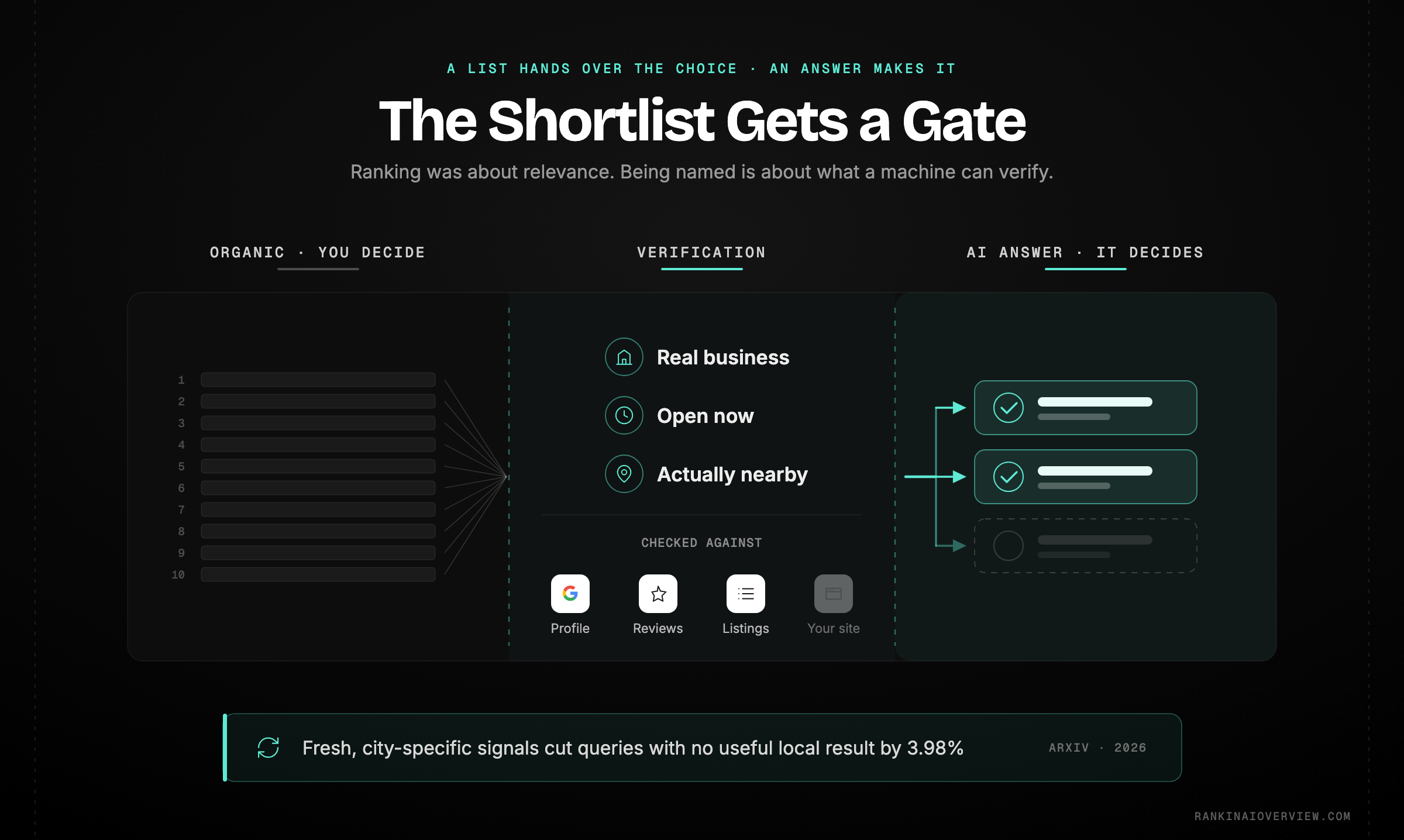
A ranked list hands over the decision. A local AI answer makes it.
AI Overviews summarise and recommend businesses directly for local queries, pulling from Google Business Profiles, reviews and consistent directory data rather than only ranked web pages. Visibility therefore depends heavily on validated business signals and profile completeness, not just on where your website ranks in a traditional list.
The difference comes down to what the answer is for. A classic organic result hands the searcher a page and lets them decide. A local AI answer does the deciding, naming a small set of businesses it judges real, relevant and trustworthy for that place. That compresses ten blue links into two or three names, and being absent from those names is a far harder problem than ranking on page two.
To make that judgement, AI needs to verify things a ranked list never had to. Are you a genuine business? Are you open? Are you actually located where the searcher is looking? For those checks it draws on structured business data, reviews and cross-referenced directory listings, so your website becomes one input among several, and frequently not the decisive one. This is a real reallocation of effort for owners who have spent years focused almost entirely on their site.
The practical takeaway is that a strong website still helps, but a complete, current Google Business Profile and consistent business data across the web often matter more for getting named in a local answer. The businesses winning local AI visibility are not always the ones with the best pages. They are the ones an AI can most confidently confirm are real, active and nearby.
## Why Does AI Treat Local Queries Differently From Ordinary Searches?
Local queries are tied to a specific place and moment, so AI has to confirm a business is real, currently operating and correctly located before it recommends it. That reliance on fresh, validated local signals is why stale or inconsistent business data suppresses a local business far more sharply than it would a general informational page.
The evidence that current local data matters is more concrete than most owners assume. According to [a 2026 study of large language model systems built for local-life services](https://arxiv.org/abs/2603.04946), injecting fresh, city-specific business signals into the model, rather than leaning on historically popular results, cut the share of queries that returned no useful local result by 3.98%, precisely because systems that lack current local awareness surface stale or locally invalid recommendations. The researchers were candid that a model without live local context produces suggestions that are out of date the moment a business opens, moves or closes.
That is the whole game for a local owner, stated in a research finding. A local recommendation is only as good as the freshness of the data behind it. If your listed hours are wrong, your address is inconsistent, or your profile has not been touched in a year, you are exactly the kind of stale signal these systems are built to filter out. The businesses that stay visible are the ones whose local data is unmistakably current.
> "This allows the model to adapt to changing city preferences, such as merchant openings or closures, while reducing stale or locally invalid suggestions."
> **Jinwen Chen and co-authors**, authors of the LocalSUG study on large language model query systems for local-life services.
It is worth being clear about what this does and does not prove. The study looked at a query-suggestion system, not a public AI answer engine, so it is evidence about the mechanism rather than a measurement of ChatGPT or Google's AI Overviews. But the mechanism transfers directly. Any system that recommends local businesses has to solve the same problem, which is telling a real, current business from a stale record, and it solves it by trusting the sources that look most validated and most up to date. That is a reason to obsess over freshness and consistency, not over clever wording. It reinforces the broader pattern we cover in [why AI search rewards reputation, not keywords](https://www.rankinaioverview.com/blog/reputation-seo), applied to the local case.
## What Are the Most Effective Strategies to Get a Local Business Into AI Answers?
Disciplined local marketing, pointed at the signals AI now weighs.
The most effective local strategies are keeping your Google Business Profile complete and current, making your business data identical across every directory, building genuinely local landing-page content, and running an active review habit. Together these confirm a real, active, correctly located business and give AI trustworthy local signals it can confidently cite.
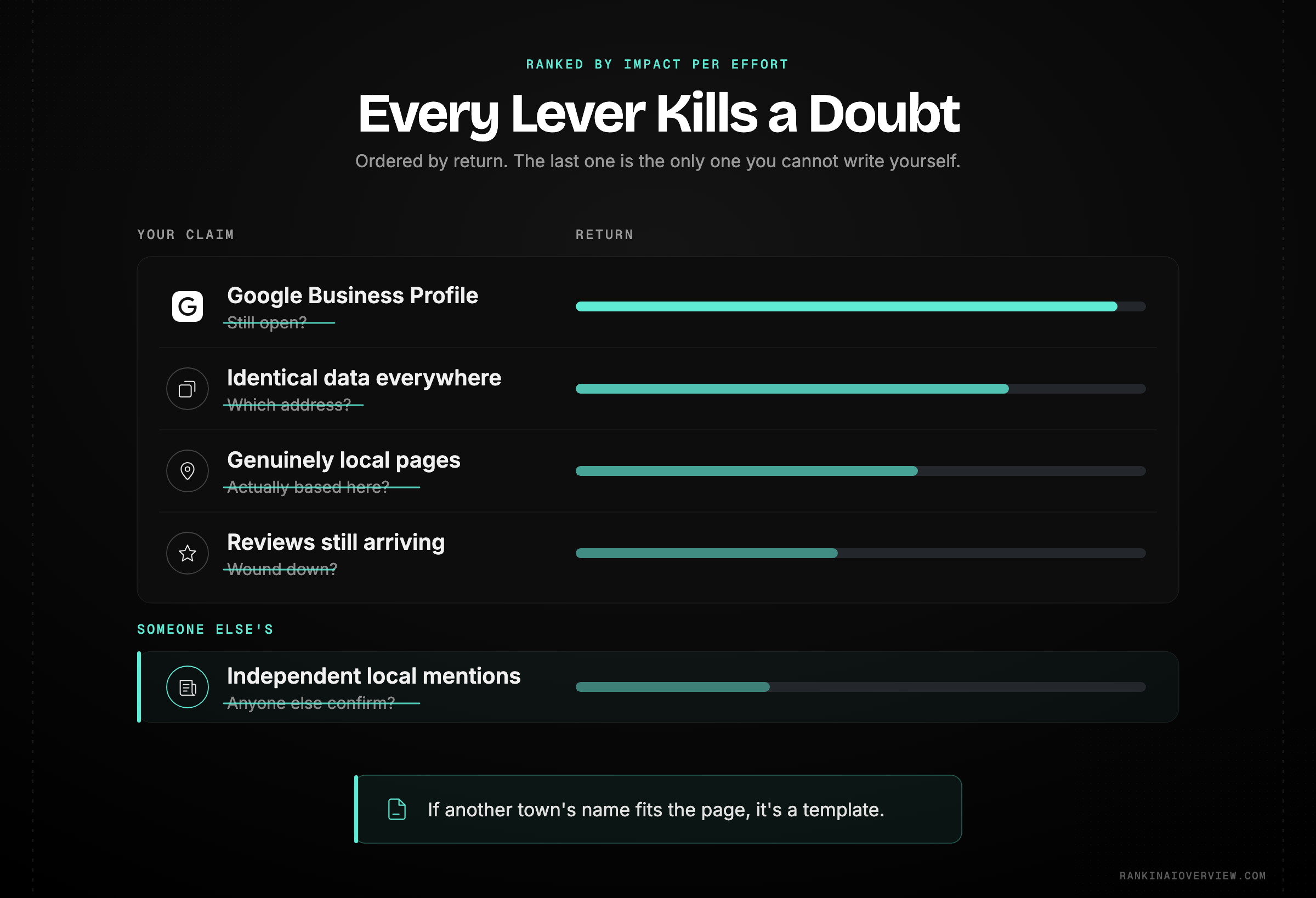
None of these is exotic. They are disciplined local marketing pointed at the specific signals AI now weighs. What follows is each lever in turn, ordered roughly by impact for the effort involved.
### Keep Your Google Business Profile Complete And Current
A complete, actively maintained Google Business Profile is the single strongest lever most local owners control, because AI draws on it heavily for local queries and because freshness is exactly what it is looking for. Fill every field, keep hours accurate, refresh photos, post updates and answer questions in the Q\&A section. Each of those is a signal that a real person is running a real, current business.
The mistake is treating the profile as a one-time setup. An outdated or half-filled profile reads as an inactive or unreliable business, and the study above shows precisely why that hurts: stale local data is the first thing a local recommendation system learns to distrust. Treat the profile as a living asset you touch most weeks, because it costs nothing but attention and it is often the most influential thing you own for local AI visibility.
### Make Your Business Data Identical Everywhere
Consistent name, address and phone details across every directory matter more than ever, because AI cross-references those signals to confirm you are a single, legitimate entity. When your name, suite number or phone format varies between listings, the system cannot confidently reconcile them into one business, and that doubt suppresses citation. Audit your major listings and make them match exactly, down to punctuation and abbreviations.
This is unglamorous work, and it is also some of the highest-return work available to a local business. Each inconsistency is a small reason for AI to hesitate, and local answers have no room for hesitation when only two or three names make the cut. Fixing discrepancies removes friction from the one job AI is trying to do, which is verifying that you are exactly who and where you claim to be. It is closely tied to how AI recognises you as a distinct entity, which we unpack in [why some brands stay invisible to AI](https://www.rankinaioverview.com/blog/brand-entity-ai-visibility).
### Build Genuinely Local Content, Not Generic Location Pages
Landing pages with real local substance, specific neighbourhoods, nearby landmarks, local context and detail only someone who operates there would know, get cited over interchangeable location templates. Depth and specificity tell AI a page is authentically about that place, which supports the local relevance and trust it needs before naming you. A page that swaps one town name for another is a page AI has little reason to prefer.
The bar here is authenticity, not word count. Write about the area as a business that genuinely serves it, mention the things locals actually reference, and answer the questions people in that place actually ask. That is the kind of substance AI can extract and stand behind, and it echoes what we see more broadly in [what type of content ranks in AI search](https://www.rankinaioverview.com/blog/what-content-ranks-in-ai-search). Generic pages built to tick a box tend to earn exactly the invisibility they deserve. A useful test is whether a page would still make sense if you pasted a different town's name over yours. If it would, it is a template, and AI can tell. If it plainly could not, because the detail is too specific to lift and reuse, you have written the kind of page that marks you out as genuinely local.
### Run An Active, Well-Managed Review Habit
Encouraging reviews and responding to them feeds both AI trust signals and traditional local ranking, so it is a genuine dual-purpose asset. A steady stream of recent reviews, and thoughtful responses to them, signals an engaged business that real customers are actually using right now. Recency matters as much as volume here, because a wall of reviews that all stopped eighteen months ago reads as a business that may have wound down.
Do not treat reviews as something that either happens or does not. Ask satisfied customers at the natural moment, make it easy, and reply to what comes in, the critical alongside the glowing. That ongoing activity is one more current, validated signal that you are a live, trusted local business, which is exactly the profile AI wants to recommend.
## Does Local PR And Community Presence Help AI Search Visibility?
Yes. Mentions in local news, community sites and local organisations increase your likelihood of being cited, because they build the external, third-party recognition AI uses to validate a local business. A handful of credible local mentions can strengthen your position more than an equivalent effort spent on generic link building or on your own website.
Local coverage does more than raise awareness with human readers. Each credible mention from a source AI already trusts reinforces that you are a real, recognised entity in your area, which is the exact thing AI is trying to confirm before it names you. When a local paper, a community organisation or a well-known local blog references you, that is independent corroboration of your existence and standing, and independent corroboration is worth far more than another claim on your own site.
Community presence counts in the same way. Being discussed and referenced where local people actually gather, from neighbourhood groups to local event listings, adds to the pattern of recognition that marks you out as an established part of the area. You do not need national press. You need to be visibly, repeatedly present in the local conversation, because that is the footprint AI reads as legitimacy. This is the local expression of the broader principle in our guide to [the trust signals AI actually recognises](https://www.rankinaioverview.com/blog/ai-trust-signals).
There is a sequencing point worth making. Earned local recognition compounds, so a few genuine relationships with local media and organisations, tended over time, outperform a burst of one-off outreach. Sponsor the thing you would sponsor anyway, contribute the local expertise you genuinely have, and let the mentions accumulate. The businesses that look most established to AI are usually the ones that have been quietly, consistently present in their community for a while.
## How Should A Small Local Business Without Authority Get Started?
Start with the fundamentals you fully control, a complete and current Google Business Profile and identical business data everywhere, because those are free, fast and exactly what AI checks first. Then layer on genuine local content and an active review habit, and only after that reach for local PR. Fix the foundations before chasing the harder, slower signals.
The reassuring part for a small business is that the highest-impact levers are also the cheapest and the most within reach. You do not need a marketing budget to make your profile complete, your hours accurate and your address consistent across listings. That work alone moves many local businesses from invisible to citable, because it resolves the exact doubts that were causing AI to skip them. Do it first, and do it properly, before spending on anything more ambitious.
From there, build in the order that respects your time. A small number of genuinely local pages beats a large number of thin ones. A steady review habit beats a one-off review drive. A few real local relationships beat a scattershot outreach campaign. Each layer adds another current, validated signal, and they compound. A local business that gets the fundamentals right and then adds depth patiently ends up looking, to an AI, exactly like the established, trustworthy operator it is trying to become, which also happens to be the surest route to the revenue upside we examine in [is AI search visibility generating revenue](https://www.rankinaioverview.com/blog/smb-ai-revenue).
The trap to avoid is skipping the boring foundations to chase the exciting tactics. Local PR and clever content do very little for a business whose profile is half-empty and whose address does not match across directories, because the basic verification AI needs still fails. Sequence matters. Get confidently verifiable first, then get notable.
## How Do You Track Your Local AI Search Visibility?
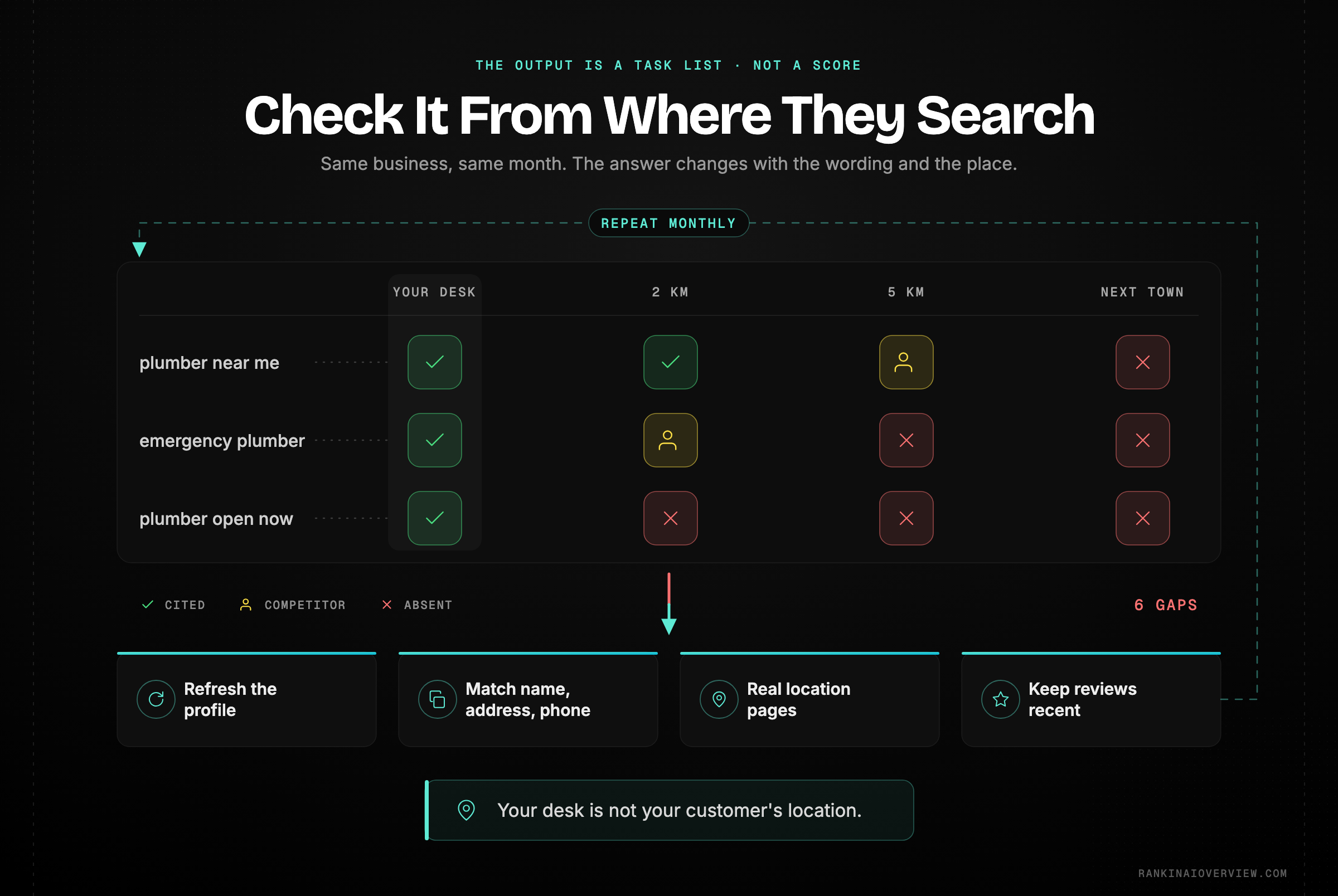
Check from your target area. A result seen from your desk is not the one your customer sees.
Track local AI visibility by running the local queries your customers actually use through AI engines and Google AI Overviews, recording whether your business is cited, and repeating on a fixed schedule. Watch competitor citations alongside your own, and check from your target area where you can, because local answers vary by location.
Begin with the real queries, phrased the way a local customer would phrase them, and note who the AI recommends today. Record where you appear, where competitors appear, and where you are simply absent. Those absences are not failures to feel bad about, they are a prioritised task list. A gap on one query points straight at the profile field, the piece of local content or the review habit that will close it.
Because local results genuinely differ by location, check from your target area whenever possible, since an answer generated elsewhere may not reflect what your actual customers see. Distance, the searcher's own history and the exact phrasing all nudge the shortlist, so a result you see from your desk is not necessarily the result a customer sees standing outside your competitor's door. Where you can, sample a few phrasings of the same intent and a couple of nearby locations, because a business that shows up for one wording and vanishes for another has a specific, fixable gap rather than a general visibility problem.
Repeat the check on a schedule rather than once, because local AI answers shift as your data, your reviews and your competitors change. A monthly pass is enough to catch movement early and to confirm that the fixes you made are actually landing you in the answer. Keep a simple record of which queries cite you over time, since the trend matters more than any single snapshot, and a citation that appears one month and disappears the next is usually pointing at a signal that slipped, such as an outdated post or a lapsed run of reviews. Watching that trend turns tracking from a worry into a steady, improving loop.
## What Mistakes Keep Local Businesses Out of AI Answers?
The mistakes that keep local businesses invisible are a half-finished or outdated Google Business Profile, inconsistent business data across directories, generic location pages and neglected reviews. Each one weakens the validation AI needs to confirm a real, current, correctly located business, so it quietly recommends a competitor whose signals are cleaner.
The most common and most costly mistake is treating the Google Business Profile as set-and-forget. An outdated or half-filled profile tells AI you may not be an active, reliable business, and the local-services research is blunt about the consequence: stale local data is the first thing these systems learn to distrust. Keeping the profile current is high-impact and low-cost, which makes neglecting it the single easiest own goal in local AI visibility.
Inconsistency across directories is the other frequent trap, and it is deceptively damaging. When your name, address or phone number varies between listings, AI cannot confidently reconcile them into one business, so it hesitates, and in a local answer with room for only a few names, hesitation means omission. Fixing these discrepancies is tedious and directly effective, because it removes the doubt that was quietly costing you the citation.
The subtler mistakes are chasing volume over substance and treating any single signal as a silver bullet. A dozen thin location pages, or a one-off burst of reviews that then stops, or a scramble for local mentions on top of a broken profile, all fail for the same reason: they do not add up to the current, consistent, corroborated picture AI is looking for. Local AI visibility rewards a coherent, well-maintained presence, not a pile of disconnected tactics.
## Conclusion
Local AI search rewards the business that looks unmistakably real, current and correctly located. A complete and actively maintained Google Business Profile, business data that matches everywhere, genuinely local content and an active review habit are the levers that get you named in a local answer, because together they resolve the exact question AI is asking, which is whether you are a real, active business right here, right now.
Add local PR and a consistent community presence, and you build the independent recognition that turns a verifiable business into a recommended one. None of it is exotic and none of it needs a big budget. It is disciplined local marketing aimed squarely at the signals AI now weighs, sequenced so the free fundamentals come first and the slower, compounding signals follow. Do it with that discipline, and you show up where local customers increasingly begin their search.
Want to know whether AI recommends your business to nearby customers today? [Run a free AI-visibility audit with Rank in AI Overview](https://www.rankinaioverview.com/) and see exactly where you stand in local AI answers, and which gap to close first.