# Rankscale Review 2026: Is It Worth It for AI Visibility Tracking?
URL: https://www.rankinaioverview.com/blog/rankscale-review
Published: 2026-10-21
## Key Highlights
* Rankscale tracks your brand across 17+ AI engines, including ChatGPT, Perplexity, Claude, Gemini and Google AI Overviews.
* Its core features are a visibility dashboard, AI rank tracker, citation and sentiment analysis, page audits, and prompt research.
* Pricing is credit-based: Essentials from $20 a month, Pro at $99, Growth at $385, and Enterprise at $780, with a 7-day free trial.
* Its biggest strengths are broad engine coverage, deep page audits, and a flexible credit model that scales.
* Its main limits are a learning curve, credit-based costs that can climb with heavy use, and its youth as a 2025 product.
* It suits agencies and mid-market brands that need multi-engine tracking, less so tiny sites wanting a simple free check.
AI search is expanding faster than most brands realise. According to MIT researchers Sinan Aral, Haiwen Li and Rui Zuo, who ran 24,000 queries across 243 countries, exposure to Google AI Overviews [expanded from 7 countries to 229 between 2024 and 2025](https://arxiv.org/abs/2602.13415). When answers are being generated at that scale, knowing whether AI engines mention and cite your brand stops being optional. That is the gap tools like Rankscale exist to fill, and the reason the whole category has grown so quickly.
The problem is choosing one. The AI visibility category barely existed in 2023 and now holds well over a dozen competing platforms, each promising to show you where you stand inside AI answers. They differ sharply on engine coverage, depth, and price, and the marketing rarely makes those differences clear. Rankscale is one of the names that comes up most often in that crowded field, which is why it is worth a close, honest look rather than a quick glance at its feature list.
This Rankscale review cuts through that. It covers exactly what Rankscale tracks, its real pricing, where it excels, where it falls short, and how it stacks up against alternatives like [Profound](https://tryprofound.com/), [Peec AI](https://peec.ai/) and [Otterly.ai](https://otterly.ai/). By the end you will know whether it fits your workflow or whether another tool suits you better.
## What is Rankscale and what does it do?
Rankscale is an AI visibility tracker that monitors how your brand appears across generative search engines and helps you improve that presence. It tracks mentions, citations, rankings and sentiment across [ChatGPT](https://chatgpt.com/), [Perplexity](https://www.perplexity.ai/), Claude, Gemini and Google AI Overviews, then reports where you show up and where competitors beat you.
The core promise is coverage. Rankscale advertises tracking across 17 or more engines, including [ChatGPT](https://chatgpt.com/), [Perplexity](https://www.perplexity.ai/), Claude, Gemini, Google AI Overviews, DeepSeek, Grok, Copilot, Mistral, and Google's AI Mode. For a brand trying to understand its full AI footprint, that breadth is the headline feature.
It is also a young, fast-growing product. Rankscale was founded in October 2024 and launched publicly in July 2025, and already reports over 1,000 active users and named clients including Bosch, UBS, Cartier, and agencies such as Dentsu. That traction is worth noting in a category where many tools are barely months old, a question we dig into in [whether AI rank tracker tools actually work](https://www.rankinaioverview.com/blog/do-ai-rank-tracker-tools-actually-work).
> "We found a rapid global expansion of AI search and key trends that reflect important, previously hidden, policy decisions by AI companies that impact human exposure to AI search worldwide." **Sinan Aral, Haiwen Li and Rui Zuo**, authors, "The Rise of AI Search: Implications for Information Markets and Human Judgement at Scale". Source: [arXiv](https://arxiv.org/abs/2602.13415)
## What does Rankscale track and what are its main features?
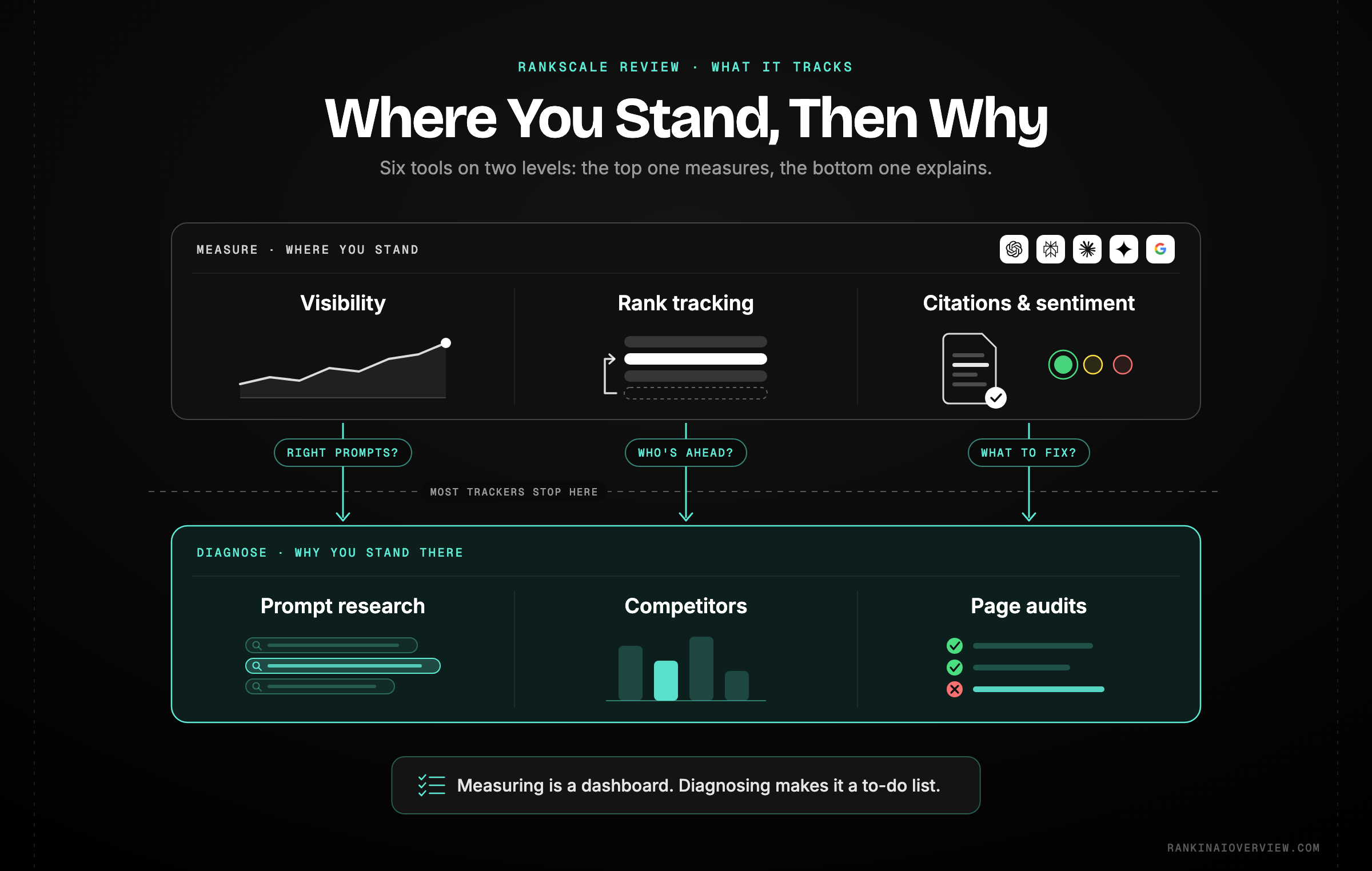
Rankscale's six capabilities sit on two levels: measure, then diagnose.
Rankscale offers six main capabilities: a brand visibility dashboard, an AI rank tracker, citation and sentiment analysis, page audits, competitor analysis, and prompt research. Together they move from measuring where you stand to diagnosing why, which is more than many trackers attempt.
Each feature targets a different part of the AI visibility problem, and the value comes from using them together rather than in isolation.
### Brand visibility dashboard and rank tracker
The dashboard is the home base, showing how often your brand appears across engines and how that trends over time. The AI rank tracker follows your position for specific prompts, so you can see movement rather than a single snapshot. Because AI answers vary, this longitudinal view matters more than a one-off check, a point we cover in [how to measure AI search visibility](https://www.rankinaioverview.com/blog/ai-visibility-metrics).
### Citation and sentiment analysis
Beyond whether you appear, Rankscale records whether you are cited as a source and how you are described. Citation analysis shows which of your pages engines actually reference, and sentiment analysis flags whether the framing is positive, neutral or negative. This is the difference between a mention that helps you and one that quietly harms you.
### Page audits and prompt research
Rankscale's page audits check content against a large set of factors, advertised at over 200 signals and 94 technical checkpoints, to suggest what to fix. Prompt research helps you find the real questions buyers ask AI, so you track the queries that matter. Competitor analysis then benchmarks all of this against rivals, turning your data into a relative standing rather than an isolated score.
The audit feature is where Rankscale goes further than a pure tracker. Many tools tell you that you are absent from an answer but not why. By checking your pages against a structured list of signals, Rankscale points to concrete changes, which turns monitoring into a to-do list. That link between measurement and action is what makes a tracker worth paying for, rather than a dashboard you glance at and forget.
Prompt research deserves a mention too. Because AI answers hinge on how a question is phrased, tracking the wrong prompts gives a false read. Rankscale's prompt tools help you build a query set that mirrors how buyers actually ask, so your visibility data reflects real demand. This matters more than it sounds, since a tracker is only as good as the questions you feed it, a theme we explore in [benchmarking SEO against AI visibility](https://www.rankinaioverview.com/blog/seo-vs-ai-visibility-benchmarking).
## How much does Rankscale cost?
Rankscale uses credit-based pricing across four tiers, from Essentials at $20 a month to Enterprise at $780 a month, with a 7-day free trial on the Pro plan. Credits renew monthly and unused ones roll over, and paying annually saves around 15%. The model scales with usage rather than locking you into fixed query limits.
The table below sets out the current tiers.
| Plan | Price (monthly) | Monthly credits | Brand dashboards | Notable inclusions |
| ----- | ----- | ----- | ----- | ----- |
| Essentials | From $20 | Basic allocation | Entry level | Core tracking, all engines |
| Pro | $99 | 1,200 | 10 | 50 page audits, unlimited search terms, 7-day free trial |
| Growth | $385 | 5,500 | 50 | 200 page audits, REST API, white-label dashboards |
| Enterprise | $780 | 12,000 | 100 | 200 page audits, dedicated partner support |
The credit system is the key thing to understand. Every scan, audit and query draws credits, so your real cost depends on how heavily you use the tool rather than a flat seat price. Light users can start cheaply on Essentials, while agencies running many brands will land on Growth or Enterprise. The 7-day free trial on Pro lets you test the workflow before committing.
It helps to estimate your usage before choosing a tier. A single brand tracked on a handful of prompts across a few engines uses far fewer credits than an agency auditing dozens of client sites weekly. Because unused credits roll over, up to two to three times your monthly allocation depending on tier, occasional heavy months are cushioned by quieter ones. Still, the safest approach is to start one tier lower than you think you need, watch your credit burn during the trial, and upgrade only once the data shows you consistently running out. That keeps you from overpaying for headroom you never touch.
## What does Rankscale do well?
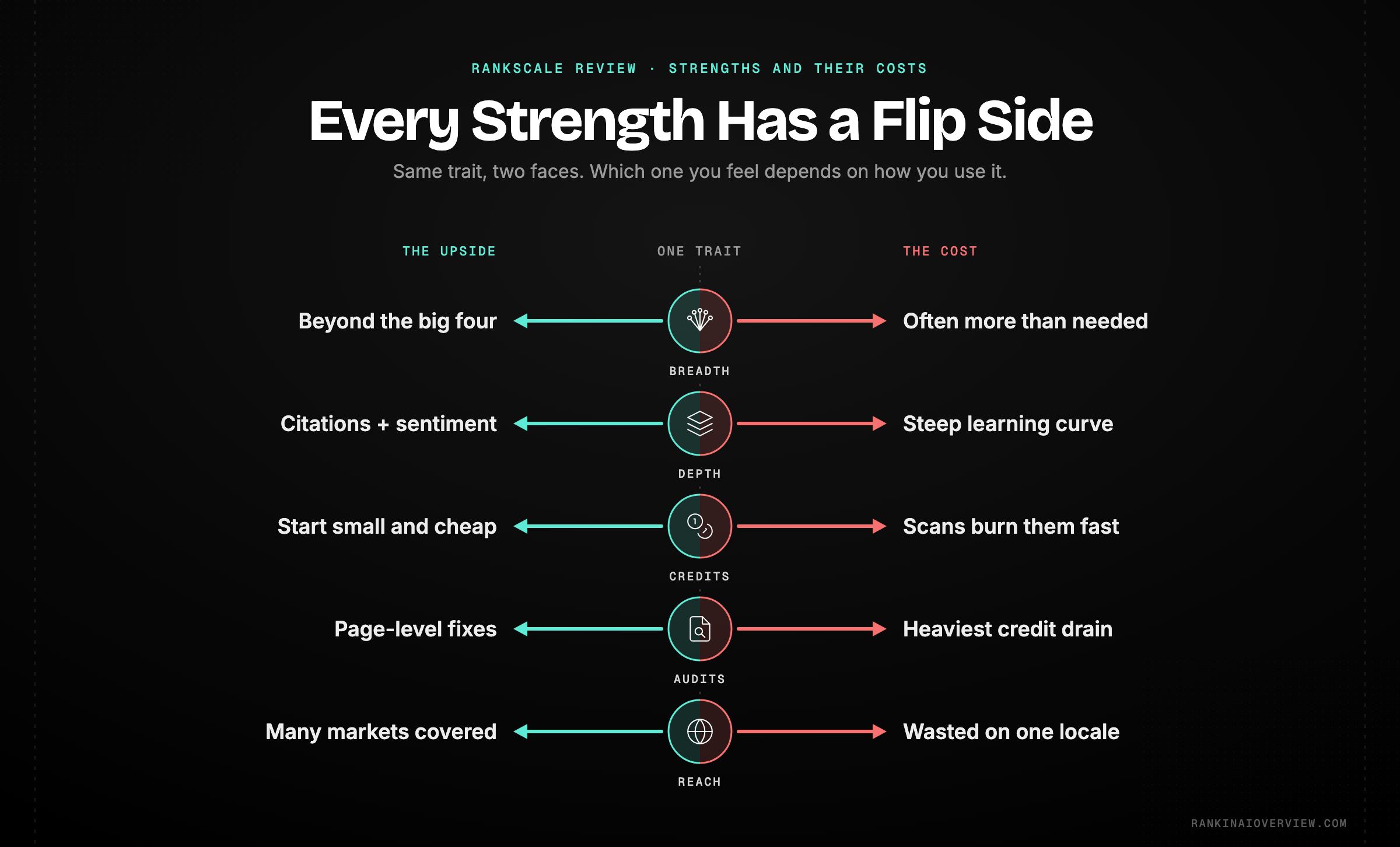
Every Rankscale strength has a paired cost — the same trait, seen from the other side.
Rankscale's strengths are its broad engine coverage, its depth of analysis, and its flexible pricing. Few tools in the category combine 17-plus engines with citation, sentiment and page-level auditing in one dashboard. For teams that want breadth and diagnosis together, that combination is genuinely useful.
The engine coverage is the standout. Tracking DeepSeek, Grok, Mistral and Google AI Mode alongside the big four means you see your footprint across emerging engines, not just the obvious ones. As AI search fragments across more platforms, that breadth ages well, because the engine that barely matters today can become a real traffic source within months, and you will already have baseline data on it.
* **Depth of analysis:** citation and sentiment data, not just presence counts, so you learn how you are represented.
* **Actionable audits:** page-level checks that point to specific fixes rather than vague scores.
* **Flexible scaling:** the credit model lets small users start cheap and heavy users buy more, without a rigid plan.
* **Agency features:** white-label dashboards and API access on higher tiers suit client work and reporting at scale.
* **Global coverage:** tracking across 240 or more regions and languages suits brands operating in several markets at once.
The enterprise client list also signals reliability. When brands like UBS and Cartier and agencies like Dentsu are on board, the product has cleared a level of scrutiny that many newer tools have not.
Coverage of regions and languages is another quiet strength. Rankscale advertises tracking across 240 or more regions and languages, which matters for brands operating in multiple markets. AI answers differ by country and language, so a tool that only checks one locale can miss where you are winning or losing abroad. For international teams, that global view is a practical advantage over narrower trackers. It also fits the wider reality that AI search is now a genuinely global surface, not a single-market one, as the expansion from 7 to 229 countries makes clear.
## Where does Rankscale fall short?
Rankscale's weaknesses are a real learning curve, credit costs that can climb with heavy use, and its youth as a product. The breadth that makes it powerful also makes it more complex than a simple checker, and newcomers can find the volume of data and settings overwhelming at first.
The credit model cuts both ways. It is flexible, but heavy auditing and frequent scans burn credits quickly, so an ambitious agency can move up tiers faster than expected. Budgeting requires understanding your likely credit consumption, which is not obvious until you have used it for a while.
Its age is the other caveat. Launched in mid-2025, Rankscale has less independent, long-term review coverage than older tools, so buyers are partly trusting a young track record. The metrics themselves also inherit the instability of AI answers, which vary run to run, so no tool including this one delivers perfectly stable numbers. That limitation is inherent to the category, not unique to Rankscale, and it is worth understanding before you read any AI visibility score as gospel.
There is also a breadth-versus-focus tension. Tracking 17 or more engines sounds comprehensive, but many brands only care about two or three engines their buyers actually use. If you only need ChatGPT and Perplexity coverage, some of Rankscale's breadth is capacity you pay for and never use. That is not a flaw so much as a mismatch to watch for: the tool rewards teams who genuinely want wide coverage, and slightly overserves those who do not. Weigh how many engines you realistically need before paying for all of them.
## How does Rankscale compare to alternatives?
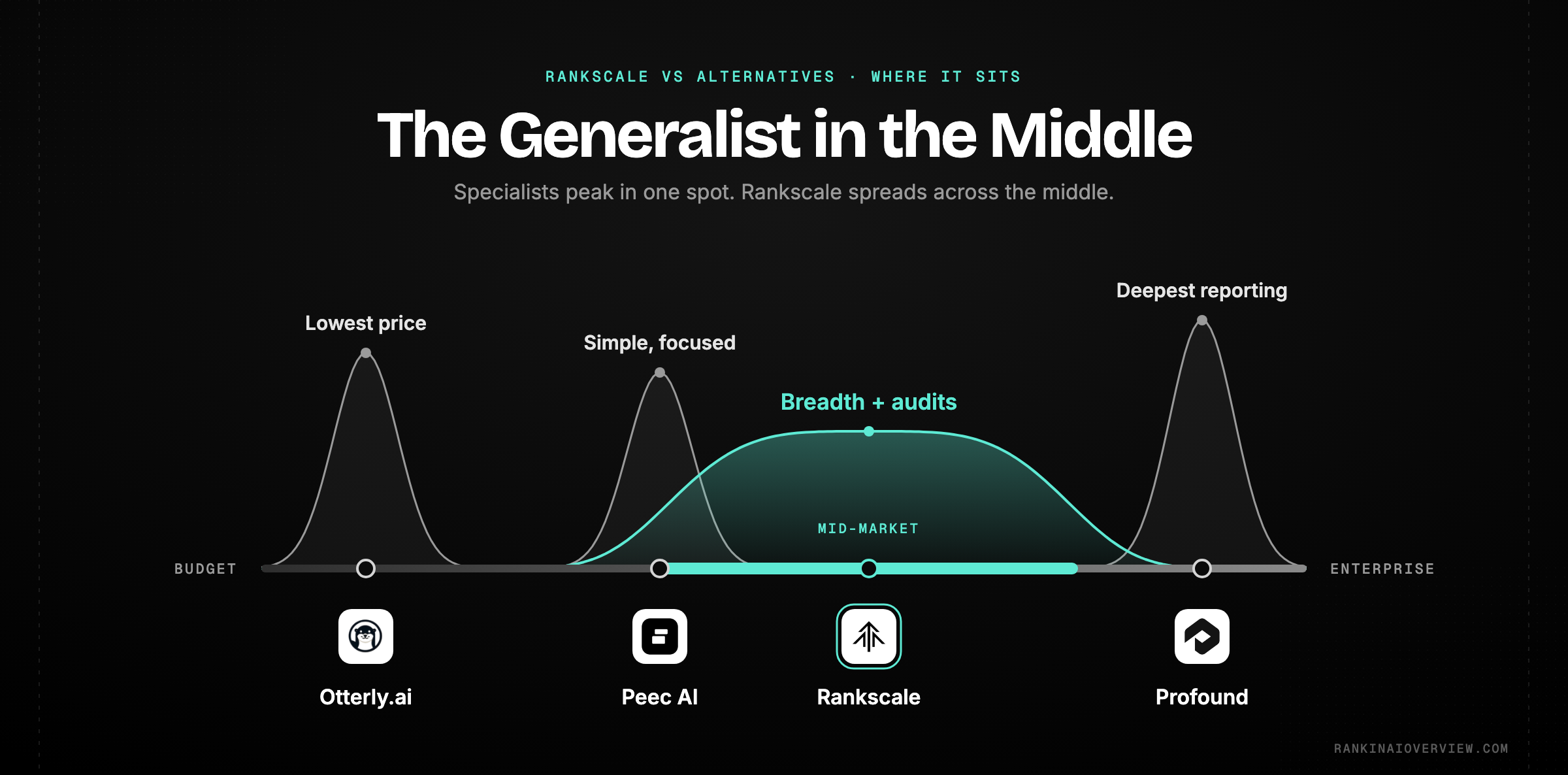
Rankscale is the mid-market generalist — broader than budget tools, cheaper than enterprise ones.
Rankscale sits in the mid-market, broader than budget tools like Otterly.ai and cheaper than enterprise platforms like Profound. Its main trade-off against rivals is breadth and depth for a moderate price, versus either simpler cheap tools or premium enterprise suites. The right choice depends on your scale and budget.
The table below positions it against three common alternatives.
| Tool | Positioning | Best for |
| ----- | ----- | ----- |
| Rankscale | Broad engine coverage, mid-market credit pricing | Agencies and mid-market brands wanting depth |
| [Profound](https://tryprofound.com/) | Premium, enterprise-focused | Large enterprises with big budgets |
| [Peec AI](https://peec.ai/) | Streamlined, mid-range | Teams wanting a simpler focused tracker |
| [Otterly.ai](https://otterly.ai/) | Budget, entry level | Small sites and first-time trackers |
Against [Profound](https://tryprofound.com/), Rankscale is far more affordable while still covering many engines, though Profound carries deeper enterprise features and reporting. Against [Otterly.ai](https://otterly.ai/), Rankscale offers more depth and coverage for a higher price. And against [Peec AI](https://peec.ai/), the two are closest, with Rankscale leaning toward breadth and auditing. For a wider field, our roundup of [the best AI rank trackers](https://www.rankinaioverview.com/blog/best-ai-rank-trackers) maps the full landscape.
The honest summary is that Rankscale is a generalist that does a lot well rather than a specialist that does one thing best. If your priority is the deepest enterprise reporting, Profound may edge it. If your priority is the lowest price for a single site, Otterly wins. But if you want the widest engine coverage plus auditing at a price a mid-market team can justify, Rankscale is hard to beat. That generalist strength is exactly why it appears on so many shortlists, even though it rarely tops a single narrow category.
**Also read:** [What actually gets cited across 500 AI answers](https://www.rankinaioverview.com/blog/500-ai-search-citations-analyzed)
## Who should use Rankscale, and who should choose a different tool?
Rankscale suits agencies and mid-market brands that need multi-engine tracking with real depth, and it is less suited to tiny sites wanting a quick free check. If you manage several brands or clients and want citation, sentiment and audit data in one place, it is a strong fit. If you just want to know whether ChatGPT mentions you once a month, it is more than you need.
Choose Rankscale if you value breadth of engine coverage, want page-level audits alongside tracking, and can use the credit model to match spend to usage. Its white-label and API features make it especially practical for agencies reporting to clients, since a branded dashboard and exportable data turn raw tracking into something you can put in front of a client without extra work.
Look elsewhere if your budget is tiny, your needs are simple, or you want a long, established review history before buying. A budget tool may serve a single small site better, while a large enterprise may prefer a premium platform's deeper reporting. Matching the tool to your actual scale matters more than any single feature, and it helps to be clear on [what ranking even means in AI search](https://www.rankinaioverview.com/blog/why-ai-search-does-not-have-ranking) before you commit.
## Conclusion
Rankscale is one of the more complete AI visibility trackers available in 2026, pairing broad coverage of 17-plus engines with citation, sentiment and page-audit depth at mid-market prices. Its credit model scales from a $20 entry point to enterprise use, and its early client list lends credibility to a product barely a year old. The trade-offs are a learning curve and costs that grow with heavy use, both manageable once understood.
For agencies and mid-market brands, it earns a place on the shortlist, and the 7-day Pro trial makes testing it low-risk. [Rank in AI Overview](https://www.rankinaioverview.com/) publishes independent research on how AI engines choose and credit sources, and is building an AI visibility tool that is coming soon. [Get your free AI visibility audit](https://www.rankinaioverview.com/) to see how AI engines represent your brand today, whichever tracker you choose.