# What Is Citation Rate in AI Search Monitoring?
URL: https://www.rankinaioverview.com/blog/what-is-citation-rate-ai-search
Published: 2026-10-16
## Key Highlights
* Citation rate is the share of your tracked prompts where an AI answer uses your page as a cited source, expressed as a percentage.
* The calculation is trivial, prompts cited divided by prompts tracked, but the meaning depends entirely on which prompts and engines you count.
* A raw citation rate quietly overcounts, because a large fraction of real citations distort their source or come from the wrong kind of page, so not every citation is load-bearing.
* Citation rate is not mention rate: one records that your URL was used as evidence, the other only that your name appeared in the text.
* Used well, citation rate is segmented by intent, compared against competitors, and read as a trend rather than a single headline figure.
Citation rate has quietly become one of the standard numbers in AI search monitoring, quoted in leadership decks and used to argue that a strategy is working. Yet it is often used without a shared definition, which makes it slippery. If you cannot state exactly what your citation rate counts, and just as importantly what it does not, you cannot trust it or act on it, and you certainly cannot defend it when someone senior pushes back.
The metric deserves that scrutiny precisely because it has become load-bearing. A number that steers budget and effort should have a plain definition, an honest account of what it misses, and a calculation method anyone on the team can reproduce. Get those three things right and citation rate earns its place in the monitoring set. Get them wrong and it becomes another figure that looks authoritative while pointing you in the wrong direction.
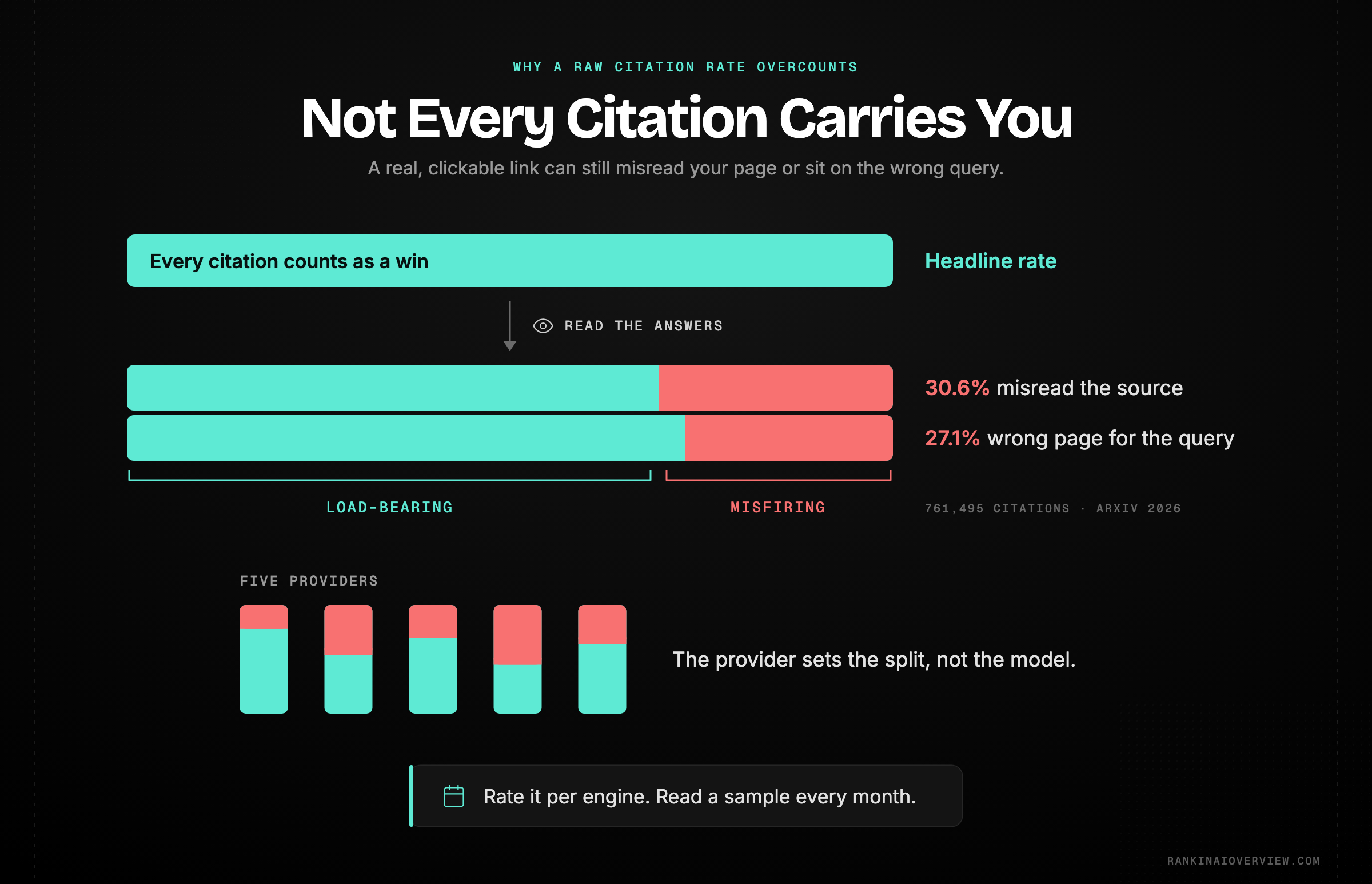
According to CITETRACE, a 2026 study that traced 761,495 citation pairs from 11,200 real queries across ten models and five providers, [30.6% of citations distort their sources and 27.1% come from domain-inappropriate pages, with up to 96% of users encountering at least one structurally misleading citation](https://arxiv.org/abs/2605.28565). That finding sits underneath everything that follows, because it means a citation is not automatically a good citation. This guide defines citation rate plainly, shows how to calculate it, explains why the raw figure overcounts, separates it from mention rate, and sets out how to use it well. For where it fits among the other numbers, our guide to [AI visibility metrics](https://www.rankinaioverview.com/blog/ai-visibility-metrics) gives the wider frame.
## What Does Citation Rate Actually Measure?
Citation rate measures how often an AI answer uses your page as a cited source across a defined set of tracked prompts, expressed as a percentage. It captures the share of the queries you care about where your content is referenced as evidence, rather than where your brand is merely named in passing or absent altogether.
The important word is cited. A citation means your URL was attached to an answer as a source the model is pointing to, which is a stronger claim than a passing reference. It says the engine reached for your page when it needed something to stand behind a statement, and that is closer to real value than a name-check, because a cited link can be followed, clicked, and credited. Our explainer on [what ranking means in AI search](https://www.rankinaioverview.com/blog/why-ai-search-does-not-have-ranking) unpacks why being the referenced source, rather than just appearing, is the outcome that carries weight.
Citation rate is also a scoped metric, tied entirely to the prompt set you choose. There is no universal citation rate for a brand, only a citation rate against a particular list of queries on particular engines. Swap the prompts and the number moves, which is why the discipline of defining and freezing your tracked set matters at least as much as the arithmetic. A citation rate quoted without its prompt set is a number with no units.
It helps to be clear about what the metric deliberately leaves out, too. Citation rate says nothing about where in an answer you appear, how prominently you are framed, or whether the surrounding text presents you favourably. It is a presence-or-absence count at the prompt level, and that simplicity is both its strength and its blind spot. The strength is that it is unambiguous and easy to reproduce. The blind spot is that two brands with the identical citation rate can be experiencing very different treatment inside the answers, one cited as the definitive source and the other buried in a list. Knowing what the number ignores keeps you from asking it to carry more meaning than it can.
## How Is Citation Rate Calculated?
A citation rate quoted without its prompt set is a number with no units.
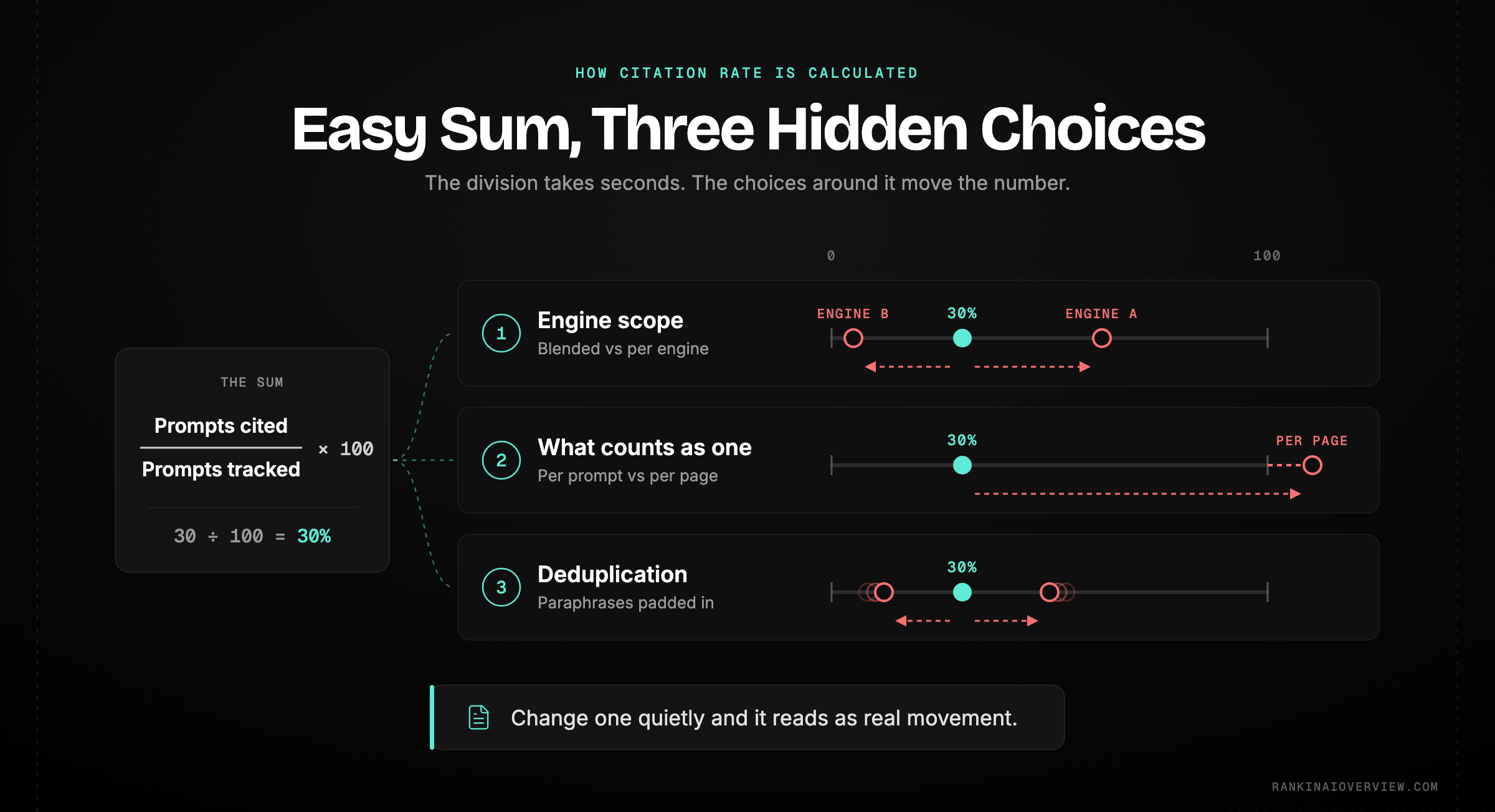
Citation rate is calculated by dividing the number of tracked prompts where your page is cited by the total number of prompts tracked, then multiplying by one hundred. Cited on thirty of a hundred tracked prompts gives a citation rate of thirty per cent. The formula is simple, so the care goes into what you feed it.
The steps are straightforward to describe:
* Define the set of prompts you will track, for example one hundred buyer-intent queries in your category.
* Run each prompt through the AI engines you care about and record whether your page is cited as a source.
* Count the prompts where your content appears as a citation, not merely as a mention.
* Divide that count by the total prompts tracked and multiply by one hundred.
So thirty citations across a hundred prompts is a thirty per cent rate, and the sum takes seconds. What it means, though, depends completely on the inputs. A thirty per cent rate measured on high-intent commercial prompts tells a very different story from the same figure measured across idle informational queries, and the two should never be quoted as if they were the same achievement. The calculation is honest only when the prompt set behind it is stated alongside the number.
Consistency is the other half of a usable calculation. Use the identical prompt set and the identical engines each period, so a change in the rate reflects a change in reality rather than a change in what you measured. The moment you quietly add or drop prompts between checks, your trend stops meaning anything, because you are no longer comparing like with like. Our look at whether [Google rankings are still the most important SEO metric](https://www.rankinaioverview.com/blog/why-ai-search-does-not-have-ranking) makes the same point about keeping any metric comparable over time.
A few decisions inside that simple formula quietly shape the result, and they are worth settling once and writing down. The first is engine scope: a citation rate blended across several engines can hide a strong showing on one and near-invisibility on another, so it is usually better to compute a separate rate per engine and only blend deliberately, if at all. The second is what counts as one citation. If a single answer cites two of your pages, do you score that prompt once or twice? Scoring per prompt keeps the metric bounded between zero and one hundred per cent and is the cleaner default, but whichever rule you pick, apply it every time. The third is deduplication across near-identical prompts, because a tracked set padded with paraphrases of the same question will inflate whichever way the engine happens to lean on that topic. None of these choices is right or wrong in the abstract, but an undocumented change to any of them will masquerade as a real movement in your rate.
## Why Does a Raw Citation Rate Overcount?
Read your citation rate as an upper bound on influence, not a measure of it.
A raw citation rate overcounts because it treats every citation as equally valid, when a large share are not. Research on deployed AI search systems finds that many real, clickable citations either distort the source they point to or come from a domain that is inappropriate for the query, so being counted as cited is not the same as being genuinely used well.
This is the part of citation rate that almost no dashboard captures, and it is why the CITETRACE finding above deserves a section of its own. The study scored each citation on three things: whether it matched the intent behind the query, whether the source was suitable for that kind of question, and whether the answer actually stayed faithful to what the source said. The pattern it surfaced, which the authors call verified misguidance, is that models routinely cite real and accessible pages yet still fail on one of those dimensions. Almost a third of citations misrepresented their source, and more than a quarter came from the wrong kind of page for the question being asked.
> "Models cite real, accessible sources yet fail along one or more dimensions, producing a fidelity-suitability trade-off in which faithful models select inappropriate sources and vice versa."
> **Yongsik Seo** and colleagues, *Verified Misguidance: Measuring Structural Citation Failures in Search-Augmented LLMs* (arXiv, 2026\)
There is a further wrinkle that matters for how you read your own number. The same study found that provider-level differences explained the overwhelming majority of the variation in citation quality, far more than the individual model. In plain terms, whether your citations tend to be faithful or broken depends heavily on which engine is doing the citing, not just on how good your page is. That means a low-quality citation is often a property of the system that cited you, something outside your control, which is one more reason to compute and read citation rate per engine rather than as a single blended figure that averages very different behaviours together.
For anyone reporting a citation rate, the implication is uncomfortable but useful. When your page is cited, that citation might be load-bearing, the model leaning on your content to support an aligned claim, or it might be one of the broken ones, your URL attached to an answer that misreads it or that never should have used it. A headline rate blends the two together and quietly flatters you. The mature move is to treat citation rate as an upper bound on genuine influence rather than a direct measure of it, and to spot-check a sample of your citations for whether the answer actually reflects your page. A smaller rate made of faithful, on-topic citations is worth far more than a larger one padded with misfires, and it is the version that will survive contact with a sceptical stakeholder.
This does not mean you should abandon the metric or drown it in caveats until it is useless. It means adding one lightweight quality step to an otherwise automatic number. Once a month, pull a small random sample of the prompts where you were cited, read the answers, and ask a plain question of each: did the response actually use my page to support the point it was making, on a query my page belongs on? The proportion that pass gives you a rough quality multiplier you can hold against the headline rate. You do not need to audit every citation, only enough to know roughly what fraction of your rate is real. Over a few months that quality ratio tends to be fairly stable for a given engine, so the check gets cheaper the longer you run it.
## How Is Citation Rate Different From Mention Rate?
Citation rate counts prompts where your URL is used as a source. Mention rate counts prompts where your brand name simply appears in the answer text, with no link back to your page. Citation rate is the higher-value metric, because a citation can be followed and credited, whereas a mention may register awareness without ever sending anyone your way.
The gap between the two is diagnostic. A high mention rate sitting on top of a low citation rate tells you the engine knows your brand but is not reaching for your content when it needs a source. That is a specific and fixable situation, and a different one from being unknown entirely. In the first case you have recognition without referenced authority, so the work is to make your pages the thing the model cites; in the second you are not on the radar at all. Reading a single blended figure would hide which problem you actually have.
So track both, but weight citation rate more heavily and never let a healthy mention rate lull you. Mentions build familiarity, and familiarity has value, but citations are what tie visibility to trust and to traffic you can measure. Confusing the two is one of the easiest ways to misread your real standing in AI answers, and it is worth being strict about the definitions before either number reaches a report. If you want a sense of how sparingly some engines cite at all, our piece on [how often ChatGPT actually cites sources](https://www.rankinaioverview.com/blog/how-often-chatgpt-cites-sources) is a useful reality check on the ceiling you are working under.
The relationship between the two rates is also worth watching as a leading indicator. When mention rate climbs first and citation rate follows a few periods later, that sequence often reflects a brand becoming familiar enough that engines start reaching for its pages as sources, which is roughly the order you would hope to see. When the two diverge and stay diverged, with mentions high and citations stubbornly low, that is a sign the model treats you as a known name but not as a reference, and the remedy sits on your pages rather than in your brand awareness. Reading them as a pair, rather than as two isolated figures, tells you more than either does alone.
## What Counts as a Good Citation Rate, and Can You Benchmark It?
There is no universal good citation rate, because the number is defined against your own prompt set and engines. A rate is good only relative to two things: where your competitors sit on the same prompts, and where you sat last period. An impressive-looking absolute figure means little without one of those reference points to anchor it.
This trips up teams who want a single target to hit. A forty per cent citation rate could be excellent or mediocre, and nothing about the number itself tells you which. If rivals on the identical prompts are cited ten per cent of the time, forty is dominant. If they are at sixty-five, the same forty is a warning. The only honest benchmark is a relative one, which is why competitor comparison is not an optional garnish on citation rate but part of what makes it interpretable at all. The temptation to declare a round number the goal, and then celebrate crossing it, is exactly the vanity trap the whole metric is meant to help you avoid.
The second anchor is your own history. Because AI answers shift between readings for reasons that have nothing to do with you, the most reliable read on a citation rate is its direction over several consistent periods, not any single snapshot. A rate that climbs steadily on your priority prompts while competitors hold flat is a real signal even if the absolute number looks modest. For a fuller treatment of why single readings deceive and how to measure movement credibly, the wider companion guide to the AI visibility metrics that matter is the place to go, and it sets the reliability rules this metric inherits.
It is worth resisting the urge to import a benchmark from someone else's case study. A citation rate quoted in a conference talk or a vendor deck was measured on a different prompt set, in a different category, on different engines, at a different time, and possibly under a different counting rule. Lifting that figure as a target for your own programme compares two numbers that only look alike. The honest comparisons are the two you can control: you against your rivals on the exact same prompts today, and you against yourself over time. Any target you set should be expressed in those terms, for instance closing the gap with the category leader on buying-intent prompts by a set amount, rather than reaching some abstract percentage borrowed from elsewhere.
## How Do You Use Citation Rate Well?
A rate that is high everywhere except the prompts that pay is not a success.
Use citation rate well by computing several of them rather than one, segmenting by intent, comparing against competitors on the same prompts, and reading the trend over time. A rate for high-intent buying queries, a separate rate for informational queries, and a competitor comparison together say something a single blended number never can.
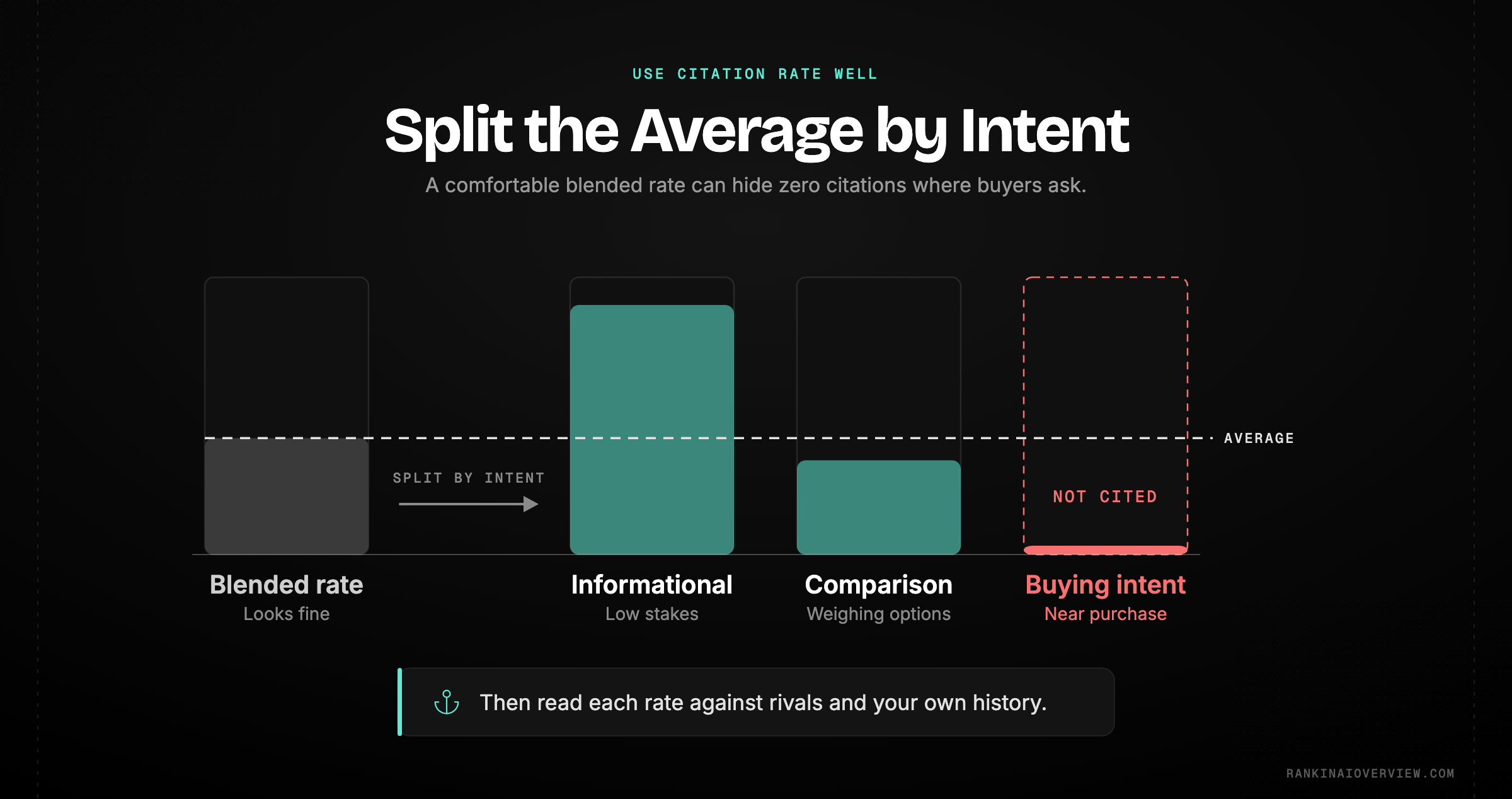
The single most valuable habit is segmentation by intent. A blended rate across every prompt you track can look strong while you quietly lose every query that sits near a purchase, because a pile of citations on low-stakes informational prompts props the average up. Splitting the metric so that your buying-intent prompts have their own rate exposes exactly that failure, and it is usually the segment that matters most to revenue. One number for the queries that convert beats one number for everything.
Segmentation does not have to be elaborate to be effective. Even a simple three-way split, buying-intent prompts, comparison and consideration prompts, and broad informational prompts, will usually surface where you are strong and where you are quietly absent. The point is to make sure the segment that carries commercial weight can never be hidden inside a comfortable average. Once the segments exist, you can also weight your effort sensibly, pouring content and authority work into the prompts where a citation is worth the most rather than spreading it evenly across queries that will never convert. A citation rate that is high everywhere except the prompts that pay is not a success, and only segmentation makes that visible.
Then layer competitor comparison and a faithfulness check on top. Track your high-intent rate against rivals on identical prompts, watch the direction over consistent periods, and periodically sample your own citations to confirm they genuinely reflect your pages rather than misreading them. That combination turns citation rate from a vanity score into intelligence you can act on. Choosing a tool from our [best AI rank trackers](https://www.rankinaioverview.com/blog/best-ai-rank-trackers) roundup that computes segmented, competitor-aware rates makes the routine practical, and our view on whether [AI rank tracker tools actually work](https://www.rankinaioverview.com/blog/do-ai-rank-tracker-tools-actually-work) is worth reading before you commit to one.
## Conclusion
Citation rate is now easy to state precisely: the share of your tracked prompts where an AI answer cites your page as a source, calculated as citations divided by prompts tracked. Defined that way, it captures something real, how often engines reach for your content when they need evidence, which is a stronger and more valuable signal than a passing mention.
The catch is that the raw number flatters you. A meaningful share of citations distort their source or come from the wrong kind of page, so counting every citation equally overstates your genuine influence. Read citation rate as an upper bound, segment it by intent, anchor it against competitors and your own history, and sample your citations for whether they truly reflect your pages. Handled with that discipline, it stops being a vanity score and becomes one of the more honest numbers in your monitoring set. Skip the discipline and you are left with a confident percentage that measures less than it appears to, which is precisely the kind of figure that gets a whole channel questioned when results are examined.
Want your citation rate computed with intent segmentation and competitor context from the start? [Rank in AI Overview](https://www.rankinaioverview.com/) runs a free AI-visibility audit that shows the rate that actually matters, not just the flattering headline figure.