# Why Does Google AI Overview Appear in Different Positions?
URL: https://www.rankinaioverview.com/blog/why-ai-overview-appears-in-different-positions
Published: 2026-10-01
## Key Highlights
* Google AI Overviews do not hold a fixed slot. Where one lands depends on the query and on which other page features fire alongside it, so the position shifts from search to search.
* The results page is a stack of independently triggered surfaces, and the AI Overview is only one of them. It can appear beside a Featured Snippet, a map pack or ads, and it can even contradict them.
* Informational, question-shaped queries tend to push the Overview high; commercial and local queries often drop it below ads or a map.
* Because position is emergent rather than assigned, the durable response is to earn presence across the answer surfaces, not to chase one slot.
You run two similar searches and the layout refuses to sit still. One time Google's AI Overview fills the top of the screen. The next time it hides halfway down, under ads or a map, with organic links poking out above it. For anyone trying to plan around AI Overviews, that shape-shifting feels arbitrary, and it makes the page genuinely hard to strategise against with any confidence.
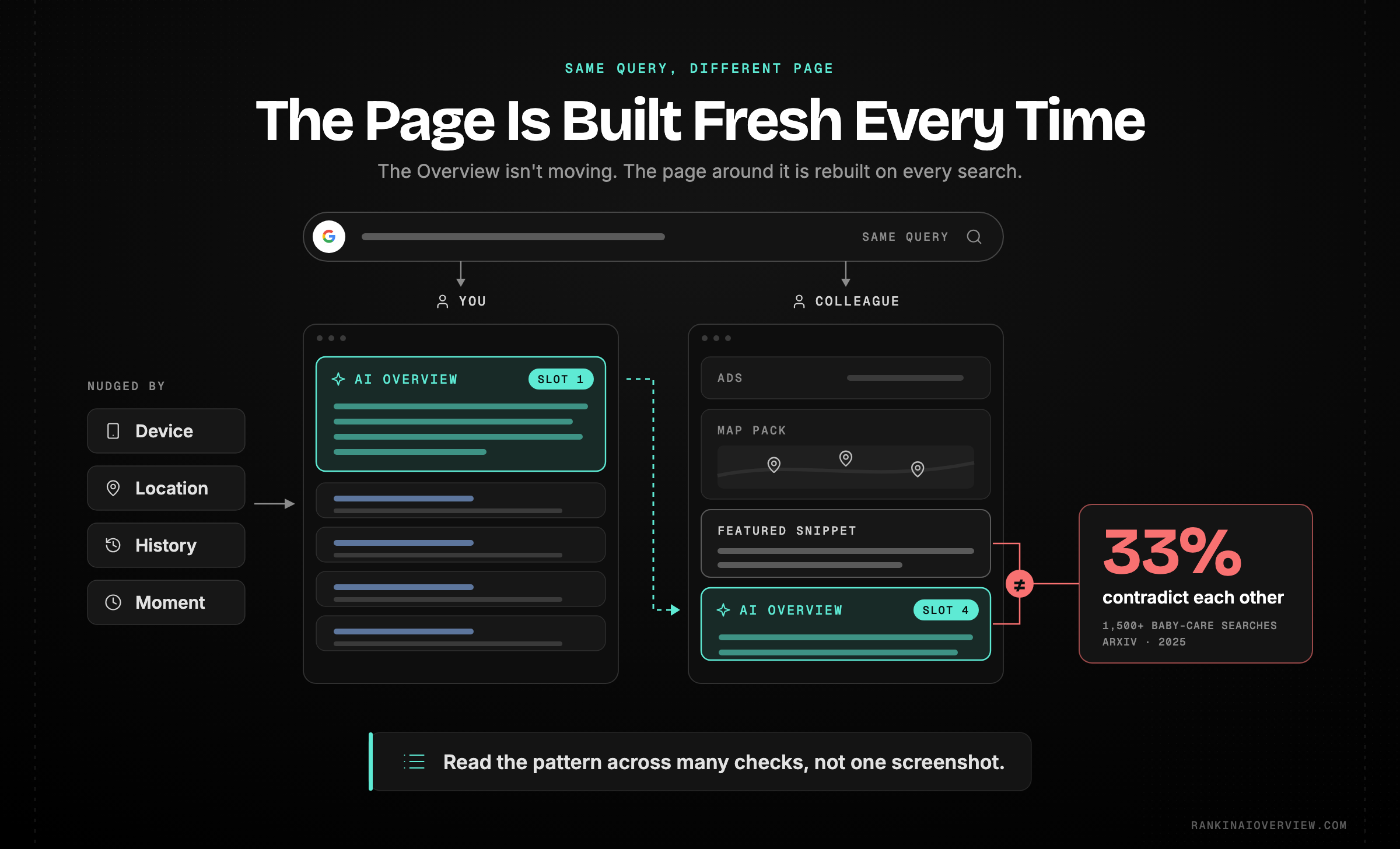
According to a large-scale algorithm audit of more than 1,500 real Google searches, the AI Overview and the Featured Snippet shown on the very same results page [contradicted each other in 33% of cases](https://arxiv.org/abs/2511.12920), which tells you something important about the layout. These are not one unified answer block. They are separate surfaces, triggered by their own logic, that happen to share a page, and they are independent enough to disagree a third of the time. Once you see the page as a stack of surfaces rather than a fixed template, the position of any one of them stops looking random.
This guide breaks down AI Overview placement with that lens. It covers whether the Overview always sits at the top, what actually decides its position, why the same query can show it in different spots, what placement means for your organic clicks, how much of the variation is Google testing, and how to respond without chasing a moving target. For a related angle on how these surfaces differ, our comparison of [Google AI Mode versus regular search](https://www.rankinaioverview.com/blog/google-ai-mode-vs-regular-search) is a useful companion.
## Does Google AI Overview Always Appear at the Top of Results?
No. Google AI Overview does not always sit at the top. It frequently leads the page for informational queries, but on commercial or local searches it often appears lower, beneath ads, a map pack, or other features. Placement moves with query type and the mix of elements competing for space.
The top-of-page assumption is common and wrong. Google treats the AI Overview as one feature among several and slots it where it fits the query and the surrounding elements. That is why the same person can see it high on one search and buried on the next, which catches out teams expecting a stable layout they can design around once and forget.
For planning, this means you cannot assume the Overview always buries your organic result, nor that it always leaves you room. Sometimes it dominates the fold. Sometimes your listing sits clearly above it. Placement is contextual, so your read on its impact has to be contextual too, judged query by query rather than as a single blanket rule.
## What Determines Where an AI Overview Is Placed in the SERP?
Placement is set mainly by query intent and by which other surfaces the query triggers. Informational queries tend to push the Overview to the top; commercial and local queries drop it lower to make room for ads, map packs and Featured Snippets. The final position is an outcome of the whole page composition, not a fixed rank.
None of these drivers is published as a rule, but the pattern is consistent enough to anticipate. Here is how each one shapes where the Overview ends up.
### Query Intent Sets the Baseline Position
Intent is the strongest single driver. When someone wants a direct answer, an informational or question-shaped query, the Overview usually leads because that is where it is most useful. When the query is commercial and Google has paid demand to serve, ads keep the prime top slot and the Overview slides beneath them. Local queries frequently place it after the map pack, because the map is what that intent is really asking for. Match your expectation to the intent and most of the apparent randomness disappears.
### Competing Surfaces Rearrange the Stack
The Overview does not lay itself out in isolation. It competes for vertical space with ads, a map pack, a Featured Snippet, and other rich results, in a rough and shifting hierarchy. When several of those fire at once, the Overview gets pushed down or reshaped to fit around them. This is why two near-identical queries can look completely different: the difference is not the Overview itself but the other surfaces each query happened to trigger. The audit evidence that the Overview and Featured Snippet can appear together, and disagree, is a direct reminder that these are separate elements stacking on the same page.
### Topic Sensitivity Can Suppress It Entirely
There is also a triggering layer beneath placement: on some queries the Overview does not appear at all. Sensitive, fast-moving, or high-risk topics often suppress it, so the same phrasing that summons an Overview in one niche returns none in another. That off switch is part of the variance too, and it is worth knowing which of your queries reliably trigger an Overview before you plan around its position. Our breakdown of [why page-one pages still miss AI Overviews](https://www.rankinaioverview.com/blog/why-page-1-not-in-ai-overview) covers the eligibility side of this in more depth.
## What Are the Common AI Overview Placement Patterns by Query Type?
Match your expectation to the intent and most of the apparent randomness disappears.
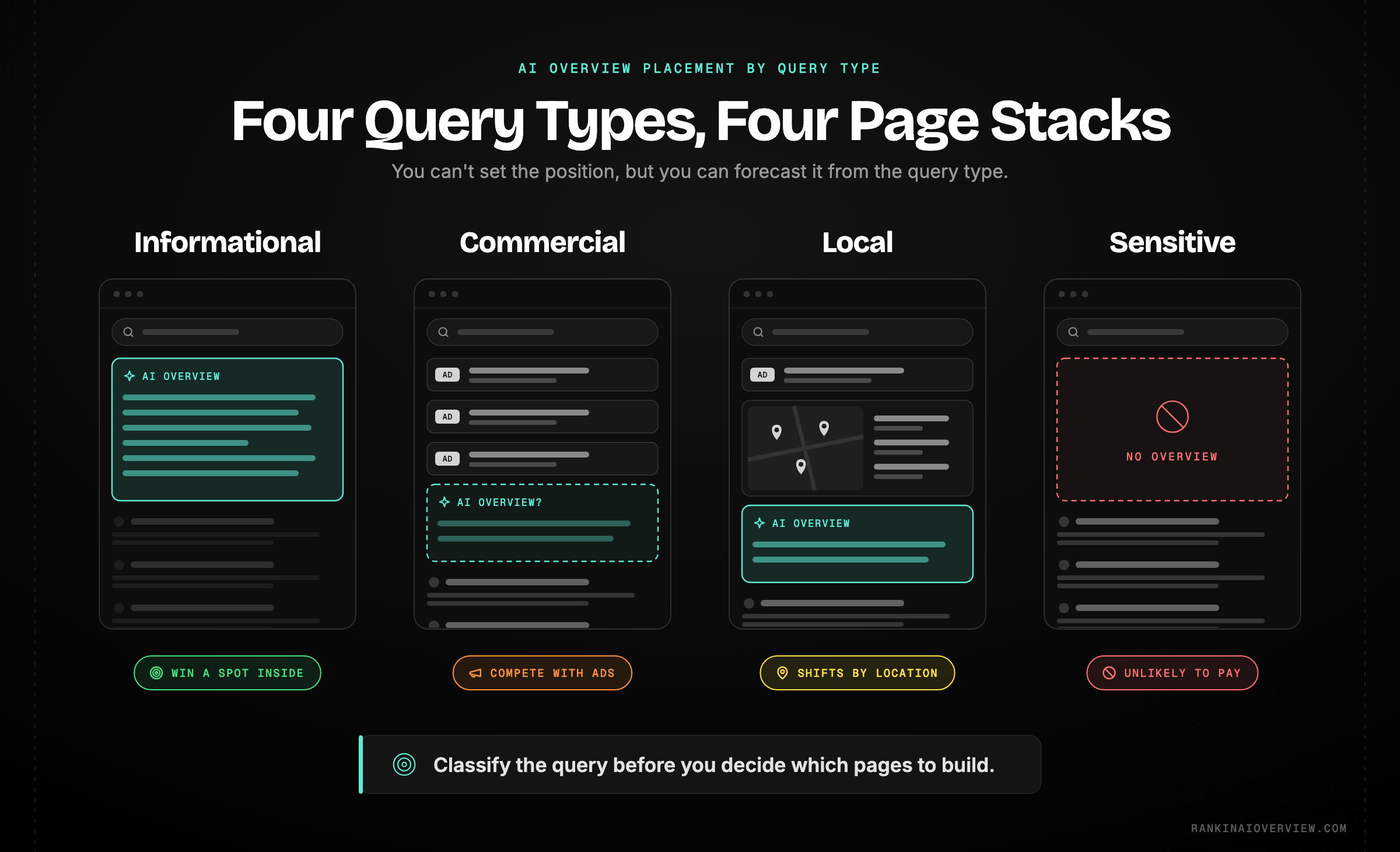
Placement clusters into a few recognisable patterns. Informational and definitional queries usually put the Overview at or near the very top. Commercial and transactional queries push it below the ad block. Local queries drop it under the map pack. Sensitive or fast-moving topics often suppress it altogether. Knowing your query's type tells you roughly where to expect it.
These are tendencies rather than guarantees, but they are stable enough to plan around, and seeing them named makes the variance far less mysterious. Walk through the four you will meet most often.
**Informational and how-to queries** are where the Overview is strongest and highest. A search phrased as a real question, or one seeking a definition, explanation or set of steps, is precisely the case the Overview was built to serve, so it tends to lead the page and take the most vertical space. These are also the queries where it hits organic clicks hardest, because a complete synthesised answer can end the search before a link is needed.
**Commercial and transactional queries** behave differently because money is on the page. When someone is comparing products or ready to buy, Google has paid demand to serve, and the ad stack claims the top. The Overview, where it appears at all, usually sits beneath the ads, and on the most commercial terms it may not fire at all. Here the competition for attention is with the ads as much as with the Overview.
**Local queries** almost always centre on the map pack, so an Overview on a local search tends to appear after it, in service of an intent the map answers more directly. Placement on these also varies by the searcher's location, which adds another layer of movement that has nothing to do with the query wording itself.
**Sensitive, medical, financial or rapidly changing queries** are the pattern people forget: the Overview frequently does not appear at all. On these, Google is more cautious about surfacing a synthesised answer, so the exact same phrasing that triggers a prominent Overview in a low-risk niche can return none at all in a high-stakes one. That suppression is as much a part of the placement story as any position on the page.
## Why Does the Same Query Show the Overview in Different Positions?
The Overview has no reserved altitude — only a place in whatever stack this query produced.
Because the results page is assembled fresh from independently triggered surfaces, and small differences change which ones fire. The Overview, Featured Snippet, ads and local pack each have their own triggering logic, so the exact stack, and therefore the Overview's position, can shift between two runs of a very similar query.
This is the heart of why placement feels unstable. You are not watching one component move up and down a fixed page. You are watching a page get composed from scratch each time, where the presence or absence of any other surface reshuffles everything below it. Add a Featured Snippet and the Overview may drop. Trigger a map pack and it drops further. Remove the ads and it can jump back up. The Overview has no reserved altitude, only a place in whatever stack this particular query produced.
The audit finding sharpens the point. If the Overview and the Featured Snippet were really one coordinated answer, they would not contradict each other on a third of the pages where they appear together. That level of disagreement is only possible because they are generated and placed independently, as distinct surfaces that Google assembles side by side. When two answer surfaces on the same page can tell you different things, it should be no surprise that where each one sits also varies from query to query.
There is a practical upside to accepting this. Once you stop expecting a fixed position, you stop over-reading any single screenshot. A colleague seeing the Overview lower than you did is not evidence of a change you need to react to. It is usually just a different stack, driven by a slightly different query, location, or moment, and the right unit of analysis becomes the pattern across many checks rather than the one in front of you.
Personalisation and context add still more movement. The device someone searches on, their location, their history, and the exact moment of the query can all nudge which surfaces fire and how tall each one is, so two people running word-for-word the same search can genuinely see different pages. This is why a single check from your own logged-in browser is such a weak signal, and why teams that rely on eyeballing the SERP from their own desk consistently misjudge how their audience actually sees the page. The only reliable read comes from sampling the same query repeatedly, ideally from clean sessions and the locations your users are in.
## Can You Predict AI Overview Placement Before You Publish?
Partly. You cannot control the Overview's position, but you can predict its likely band from the query's intent and competitive context before you commit to a page. Classify the query as informational, commercial, local or sensitive, check what other surfaces already fire for it, and you can forecast roughly where an Overview will land and how hard it will press on clicks.
The value of forecasting is that it changes what you build, not where the Overview sits. If a target query is plainly informational, expect a prominent top Overview and plan to win a place inside it, because ranking below a dominant answer box will earn thin traffic on its own. If the query is commercial with a heavy ad stack, expect the Overview lower or absent, and weigh whether organic effort or paid presence is the better bet for that term. The placement forecast becomes an input to keyword selection, not an afterthought.
A quick, repeatable way to do this is to sample each priority query a handful of times before you invest, noting whether an Overview fires, roughly where it lands, and which other surfaces share the page. That small amount of upfront checking tells you which queries are worth a citation-focused page, which are better served by a different format such as a Featured Snippet play, and which are so dominated by ads or suppressed Overviews that organic content is unlikely to pay. Predicting the band, rather than the exact pixel, is enough to make better calls about where to spend.
## What Does AI Overview Placement Mean for Your Organic Clicks?
Placement changes how much attention reaches your listing before a decision is made. A top-placed Overview pushes organic results down the page and absorbs attention that would have scanned them, while a lower-placed Overview leaves your result visible above or beside it, preserving more of the chance to be clicked.
The mechanism is simply where the eye lands first. When the Overview leads, many users read the synthesised answer and stop, so your organic listing competes for whatever attention survives the summary. That pressure is real, and it is heaviest on exactly the informational queries where the Overview tends to sit highest. Planning for it means being honest that a top Overview on a pure-answer query will dampen clicks, whichever position you hold organically.
Lower placement changes the calculation, and not always for the worse. When the Overview sits beneath ads or a map, users scroll past your organic result on their way to it, giving your listing a genuine chance to catch the eye in passing. A lower Overview is not automatically bad news for your traffic, which is exactly why placement is worth understanding rather than simply fearing. The position tells you how hard the Overview is likely to hit a given query, and that lets you set realistic click expectations query by query, a theme we pick up in [Google \#1 ranking versus the AI answer box](https://www.rankinaioverview.com/blog/why-ranking-1-on-google-doesn-t-guarantee-ai-visibility).
It also matters whether you are cited inside the Overview or merely ranking beneath it. A page that is a source in the Overview earns a visible slot at the top of attention regardless of where the box itself sits, and it captures interest from readers who trust the synthesised answer. A page that only ranks below an unrelated Overview gets the worst of both worlds: pushed down the page and excluded from the answer people actually read. That gap is why the position of the Overview matters less, in the end, than whether your content is inside it, and why placement analysis should always feed back into a citation strategy rather than stopping at a click forecast.
## Is Inconsistent AI Overview Placement Part of Google Testing?
Partly, yes. Google continually experiments with live search layouts, so some placement variation reflects ongoing tests of what holds attention and what users act on. Layered on top of query intent and surface composition, that experimentation helps explain why placement can look inconsistent even across near-identical queries.
Google has a long record of trialling interface changes on real traffic rather than in a lab. AI Overviews are new and still evolving, so it is reasonable to expect continued experimentation with where they appear, how large they are, and when they fire at all. A share of the variation you notice is that testing in motion, not a settled rule you can pin down, which is why a layout you screenshot today may quietly differ next week.
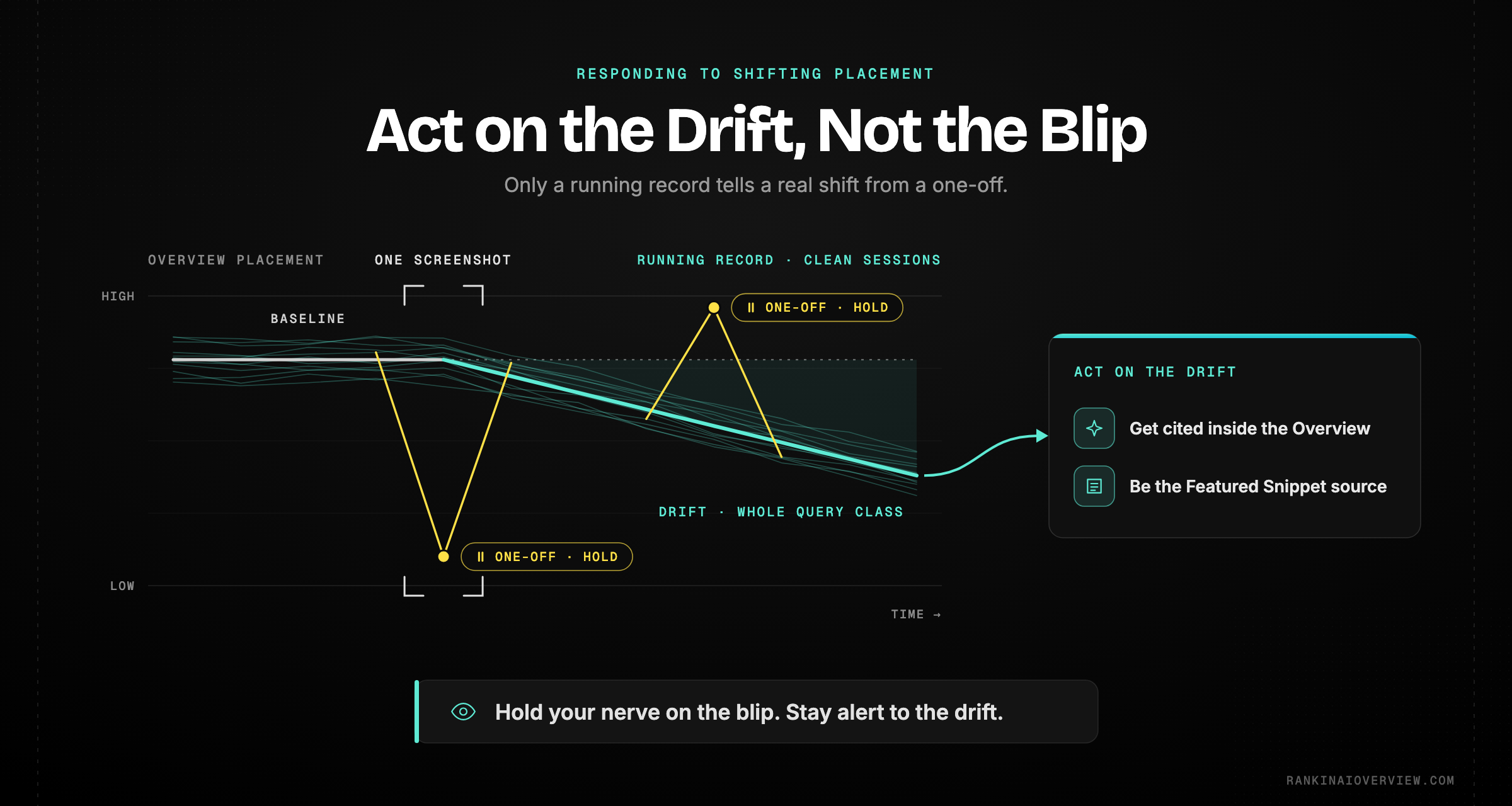
The practical response is to avoid over-indexing on any single observation. Treat one search as a data point, not a verdict, and watch how placement behaves across many checks over time. That way you separate a durable pattern, which is worth planning around, from a transient test, which is not, echoing the wider truth that AI-driven layouts are a moving surface rather than a fixed one.
It helps to distinguish two kinds of change you will see. A gradual, consistent drift in where the Overview lands for a whole class of queries is probably a real shift in how Google composes those pages, and it deserves a strategic response. A one-off oddity, where a single query suddenly shows the Overview somewhere unusual and then reverts, is far more likely to be a live experiment or a personalised quirk, and reacting to it wastes effort. The skill is holding your nerve on the second while staying alert to the first, and only a running record of placement across many queries gives you the baseline to tell them apart. Without that baseline, every screenshot looks like a trend, and you end up chasing noise.
## How Should You Respond to Variable AI Overview Placement?
Without a baseline, every screenshot looks like a trend.
Optimise to be present within the answer surfaces regardless of where they land, and track placement patterns for your priority queries rather than reacting to single searches. Because a lower Overview leaves room for your organic result and a cited Overview puts you inside the answer itself, both routes protect your visibility as the layout shifts.
The most durable move is to earn a place inside the Overview, because a cited source benefits whether the Overview sits high or low. That comes from leading with a clear, direct answer, structuring the page so it is easy to extract, and building the trust that makes Google willing to draw on you, as our guide to [how Google picks its AI Overview sources](https://www.rankinaioverview.com/blog/rank-in-google-ai-overviews) sets out. Presence inside the answer is the one form of visibility that does not depend on winning a position race you cannot control.
Because the page hosts several answer surfaces, spread the same effort across them rather than betting on one. Being the source behind both the Overview and the Featured Snippet, where each fires, hedges you against their independence and their disagreements. And underneath both, keep tracking: monitor whether the Overview appears for each priority query, roughly where it lands, and how that moves your clicks, so you invest where citation actually pays. A simple placement log, or a visibility tool that watches many queries at once, turns the noise into a trend you can act on. Our overview of [the metrics that measure AI search visibility](https://www.rankinaioverview.com/blog/ai-visibility-metrics) shows what to record.
> "Our results reveal concerning gaps in information consistency, with information in AIO and FS displayed on the same search result page being inconsistent with each other in 33% of cases."
> **Desheng Hu** and colleagues, *Auditing Google's AI Overviews and Featured Snippets: A Case Study on Baby Care and Pregnancy* (arXiv, 2025\)
## Conclusion
AI Overview placement looks inconsistent because the results page is not a fixed template. It is a stack of independently triggered surfaces, the Overview among them, assembled fresh for every query. Intent sets the baseline height, competing features rearrange the stack, topic sensitivity can switch the Overview off entirely, and live testing adds a further layer of movement. Position is an outcome, not an assignment.
That reframing is what makes the variance manageable. Instead of chasing a slot you cannot control, judge each query on its own stack, earn a place inside the answer surfaces so you benefit whichever way they land, and track the pattern rather than the screenshot. Do that and shifting placement becomes something you plan around rather than something that plans around you. The teams that stay calm about position are the ones that have already moved their real goal from ranking near the Overview to being cited within it.
Want to see where AI Overviews are landing for your most important queries, and whether you appear inside them? [Rank in AI Overview](https://www.rankinaioverview.com/) offers a free AI-visibility audit that shows your real position across AI-driven results, so you know which queries to prioritise.