# Why Branded Websites Rank Better in AI Search
URL: https://www.rankinaioverview.com/blog/why-branded-websites-rank-better-in-ai-search
Published: 2026-08-24
## Key Highlights
* AI answer engines lean toward entities they can recognise and verify, so an unknown site can lose to a weaker but recognised brand on the same question.
* The advantage comes from being a verifiable entity in the knowledge layer, not from fame itself, and the difference between those two matters more than most guides admit.
* New measurement shows recognition is not automatically protective: the most familiar brands returned more fabricated citations, not fewer, which changes what you should actually build toward.
* The failure mode for small brands is invisibility from weak knowledge-graph presence, which is a fixable infrastructure problem rather than a popularity contest.
* Consistency of your entity data across the web does more quiet work than any single mention, because corroboration is the mechanism these systems actually use.
* Brand signals compound slowly and cannot be faked, which is precisely why they hold up as the models change.
You publish genuinely better material than the brand that keeps getting named above you. Your research is deeper, your writing is clearer, and the AI answer still cites them. It feels unfair, and it runs against everything traditional SEO trained you to expect, because the page that wins is not the best page. The source that wins is the one the system can recognise.
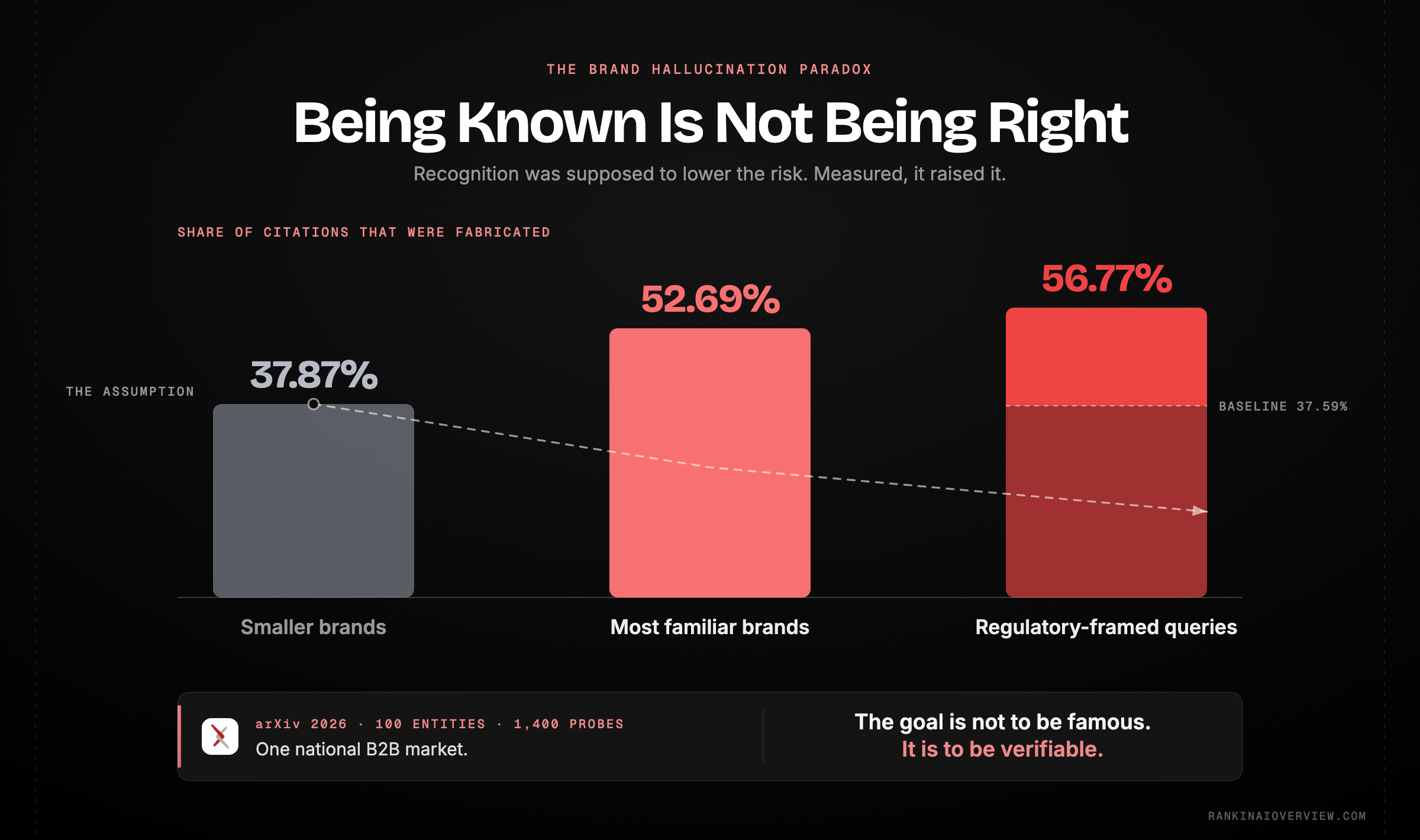
According to a per-entity study of AI brand visibility [published on arXiv](https://arxiv.org/abs/2606.21595), across 100 business entities and 1,400 probe runs the researcher found that entities with weak knowledge-graph presence suffered outright invisibility, while recognition brought its own distinct failure: the most familiar brands returned 52.69% fabricated citations against 37.87% for smaller ones, a gap the paper calls the Brand Hallucination Paradox. So recognition decides whether you appear at all, and separately it fails to guarantee that what the system says about you is even true.
That two-sided finding is the spine of this guide. It explains why building a recognisable brand genuinely does improve your standing in AI answers, and it corrects the lazy version of that advice, which treats fame as the goal. What follows covers what a brand signal actually is to a machine, why unknown entities disappear, why being big is not a free pass, how these systems detect and verify a brand, whether a small player can still compete, and the concrete work that builds the signal. For the broader entity picture, our piece on [brand entity building for AI visibility](https://www.rankinaioverview.com/blog/brand-entity-ai-visibility) goes deeper on the fundamentals.
## What Does a Brand Signal Actually Mean to an AI System?
A brand signal is any evidence that tells an AI system your brand is a real, verifiable entity: a knowledge-graph or Wikidata entry, consistent business data across the web, branded search demand, and repeated mentions on sources the system already trusts. Together they let the system recognise and place you.
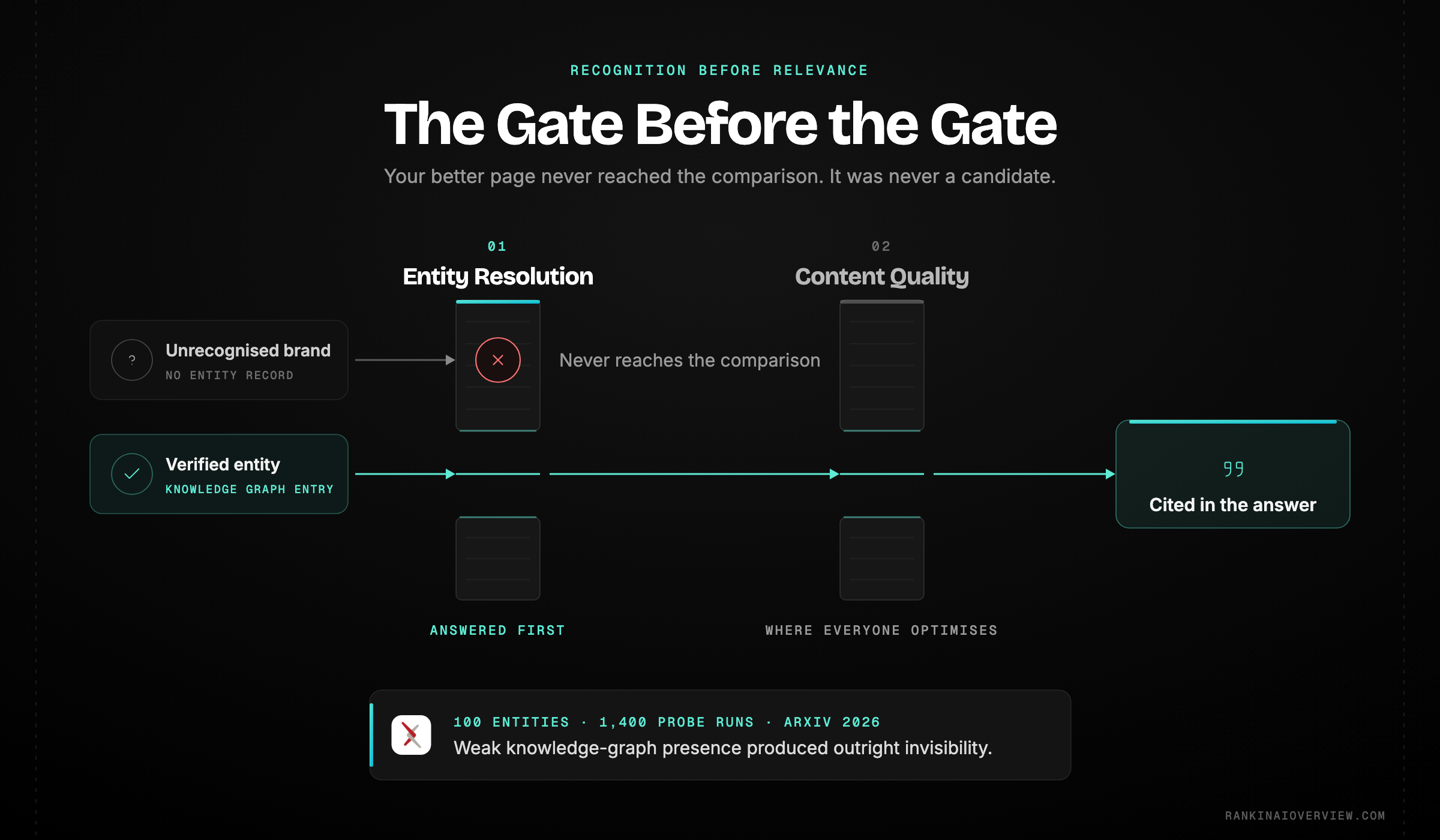
Traditional SEO framed authority as links and domain metrics. AI answer engines add a prior question underneath relevance: do we know who this is, and can we resolve them to a single, real thing we already understand. Brand signals are how a machine answers that question, and it is answered before your content quality is ever weighed.
The useful mental model is the difference between a stranger and someone with references. A stranger can say something perfectly true, but a source with a track record, a recognisable name and independent corroboration is one a cautious system can cite with less risk. Answer engines behave like that cautious system, preferring the entity they can verify over the one they cannot, even when the unverifiable one wrote a better page.
The important refinement, and the one the new research forces, is that recognition and verification are not the same thing. A model can be very familiar with a brand and still hold wrong information about it. So the signal that helps you is not raw familiarity, it is being a well-structured, corroborated entity whose facts are pinned down in the places these systems check. That distinction shapes everything practical later in this guide.
## Why Do Unrecognised Brands Stay Invisible in AI Answers?
The system is not rejecting your page. It never had you as an entity.
Because the system has nothing to anchor them to. When a brand has weak or no presence in the knowledge graph and little consistent corroboration across the web, an answer engine cannot resolve it into a known entity, so it defaults to sources it can place. Invisibility here is a recognition failure, not a content failure.
This is the failure mode that most frustrates good small publishers, and it is worth being precise about the mechanism rather than blaming it on unfairness. The study behind this guide identifies weak knowledge-graph presence specifically as the driver of invisibility for underrepresented entities. The system is not judging your page and rejecting it. It often never considers you as a nameable source, because it does not have you as an entity in the first place.
> "Underrepresented entities suffer invisibility due to weak knowledge graph presence... model familiarity creates stronger surfaces for plausible but incorrect completions." **Zoltan Varga**, author, *Per-Entity Bias Mapping for AI Visibility*. Source: [arXiv](https://arxiv.org/abs/2606.21595)
Read as a diagnosis, that first clause is oddly encouraging, because invisibility from weak knowledge-graph presence is an infrastructure problem, and infrastructure can be built. It is a far more tractable position than being locked out by entrenched competitors on merit. The path out is to become resolvable: to give the system consistent, corroborated facts about who you are, so that when a relevant question arises you are a candidate it can name.
One honest caveat about the evidence belongs here so the numbers are not over-claimed. This study examined 100 business entities in a specific national B2B market across 1,400 probe runs. The mechanism it isolates, recognition determining whether you can be cited, is general and matches what other measurement shows. The exact percentages are local to that sample, so treat the direction as solid and the magnitude as something to verify in your own category rather than import wholesale.
**Also read:** [Why AI engines cite pages that do not rank on Google](https://www.rankinaioverview.com/blog/non-google-ai-citations), which shows how entity recognition can override conventional ranking in source selection.
## Does Being a Big, Familiar Brand Guarantee Accurate Citation?
Familiarity gives a model more material from which to generate plausible falsehoods.
No, and this is the finding that overturns the simple version of brand advice. The same research found the most familiar brands produced more fabricated citations than smaller ones, 52.69% against 37.87%, because model familiarity creates confident surfaces for plausible but wrong completions. Fame raises visibility and, separately, raises the risk of confident error.
The Brand Hallucination Paradox is worth sitting with, because it inverts an assumption almost everyone holds. The intuition is that a big, well-known brand is safe, that the system knows it and will represent it correctly. What the measurement shows is that heavy familiarity gives a model more material from which to generate plausible-sounding claims, and some of those claims are false. The very familiarity that makes a brand easy to mention makes it easy to misdescribe with confidence.
There are two practical consequences, and they matter regardless of your size. First, visibility and accuracy are different goals that need to be pursued and measured separately. Being mentioned more does not mean being represented correctly, and a program that optimises only for mention frequency can raise your exposure while leaving misinformation about you unaddressed. Second, the fix is not less recognition but tighter verification: pinning down your facts in the authoritative places so the system has a correct anchor to reach for instead of an invented one.
This is where regulated or high-stakes categories should pay particular attention. The study found that regulatory-framed queries pushed fabrication higher still, to 56.77% from a 37.59% baseline. If your category touches compliance, eligibility, pricing or safety, the cost of a confident fabrication is not reputational vanity, it is a materially wrong answer reaching a user who trusts it. Monitoring how you are described becomes a genuine risk control rather than a marketing nicety.
The reframing to carry forward is that the goal is not to be famous, it is to be verifiable. Recognition without verification buys you visibility and a fabrication surface. Recognition with verification buys you visibility and a correct anchor, which is the actual objective.
## How Do AI Systems Detect and Verify a Brand Entity?
They aggregate corroborating evidence across independent sources: knowledge-graph and [Wikidata](https://www.wikidata.org/) entries, consistent business data, branded search patterns, authorship signals, and repeated mentions on trusted platforms. No single item proves you are real, but convergence across many does, and that convergence is what the system trusts.
Corroboration is the whole mechanism, and understanding it changes how you spend effort. These systems are not looking for one authoritative declaration that you exist. They are looking for many independent sources describing the same entity the same way, because agreement across sources that have no reason to coordinate is hard to fake and therefore trustworthy. Your job is to make that agreement easy to find and hard to misread.
This is exactly why fragmentation is so damaging, and why it is the most common self-inflicted wound. If your name, description, category or core details differ across your own site, your profiles, directories and press, the system cannot cleanly resolve those into one entity. The signals do not add up, they partly cancel, and a brand that should be recognisable reads as several weak, half-matching things instead of one strong one.
The corollary is that consistency is a higher-leverage investment than volume. Ten sources describing you identically do more for entity resolution than fifty describing you inconsistently. Tightening how you are described everywhere is unglamorous, close to free, and one of the few brand-signal moves with an almost immediate effect on how resolvable you are. It feeds directly into the broader [trust signals AI recognises](https://www.rankinaioverview.com/blog/ai-trust-signals).
There is a retrieval-versus-memory wrinkle worth knowing, because it explains delays that otherwise look like failure. A model's built-in parametric knowledge updates on a slow cycle, while its live retrieval sees the current web, and the research names this divergence directly as a lag between the two update cycles. So a fact you fixed last week may show up correctly when the system browses and incorrectly when it answers from memory, and both can be true of the same brand in the same week.
The practical reading of that asymmetry is patience plus placement. Patience, because a correction you make now will reach the parametric layer only on its own slow schedule, so an immediate re-check that still shows the old answer is not evidence your fix failed. Placement, because the retrieval layer is the one you can influence quickly, which means correcting your entity data in the authoritative, retrievable sources is the fastest lever you have. Assuming the model simply knows you, and doing nothing to the retrievable record, leaves both layers to drift.
## Can a New or Small Brand Still Compete?
Yes, because the barrier is verifiability rather than size. AI systems reward clearly resolved entities with focused topical authority, so a small, consistent, well-corroborated brand can be cited above a larger one within a niche it genuinely owns. The work is different from big-brand strategy, not harder in principle.
The route in is depth plus clarity, and the two reinforce each other. You will not win on scale, so you win by being unmistakably the recognised authority on one specific subject. Cover that subject more thoroughly than anyone, and make your entity identical everywhere it appears, and recognition within that narrow lane builds faster than a broad, shallow footprint ever could. A tightly defined small entity is easier to resolve than a sprawling vague one.
Small brands also have an advantage the paradox hands them, which is rarely stated. Because they are less swamped by model familiarity, they carry less of the confident-fabrication risk that dogs large brands, so a correct, well-structured entity presence translates more cleanly into correct representation. Getting the fundamentals right pays off more predictably at small scale than at large.
The concrete groundwork is unglamorous and effective: a complete and consistent business profile, matching details across every directory and platform, an accurate [Wikidata](https://www.wikidata.org/) entry where genuinely warranted, and steady, real mentions within your niche. One team's account of [getting a brand cited first on ChatGPT](https://www.rankinaioverview.com/blog/chatgpt-rank1) is largely a story of resolving these entity basics before anything clever. Done consistently, they compound into recognition well above your apparent size.
## What Steps Build a Verifiable Brand Entity AI Trusts?
The order matters: consistency first, because it makes every later signal count.
Strengthen your entity infrastructure, earn independent corroboration, and grow genuine branded demand, while keeping every description of your brand consistent. The aim is to be a resolvable, correctly described entity that trusted sources reference and real people seek out by name.
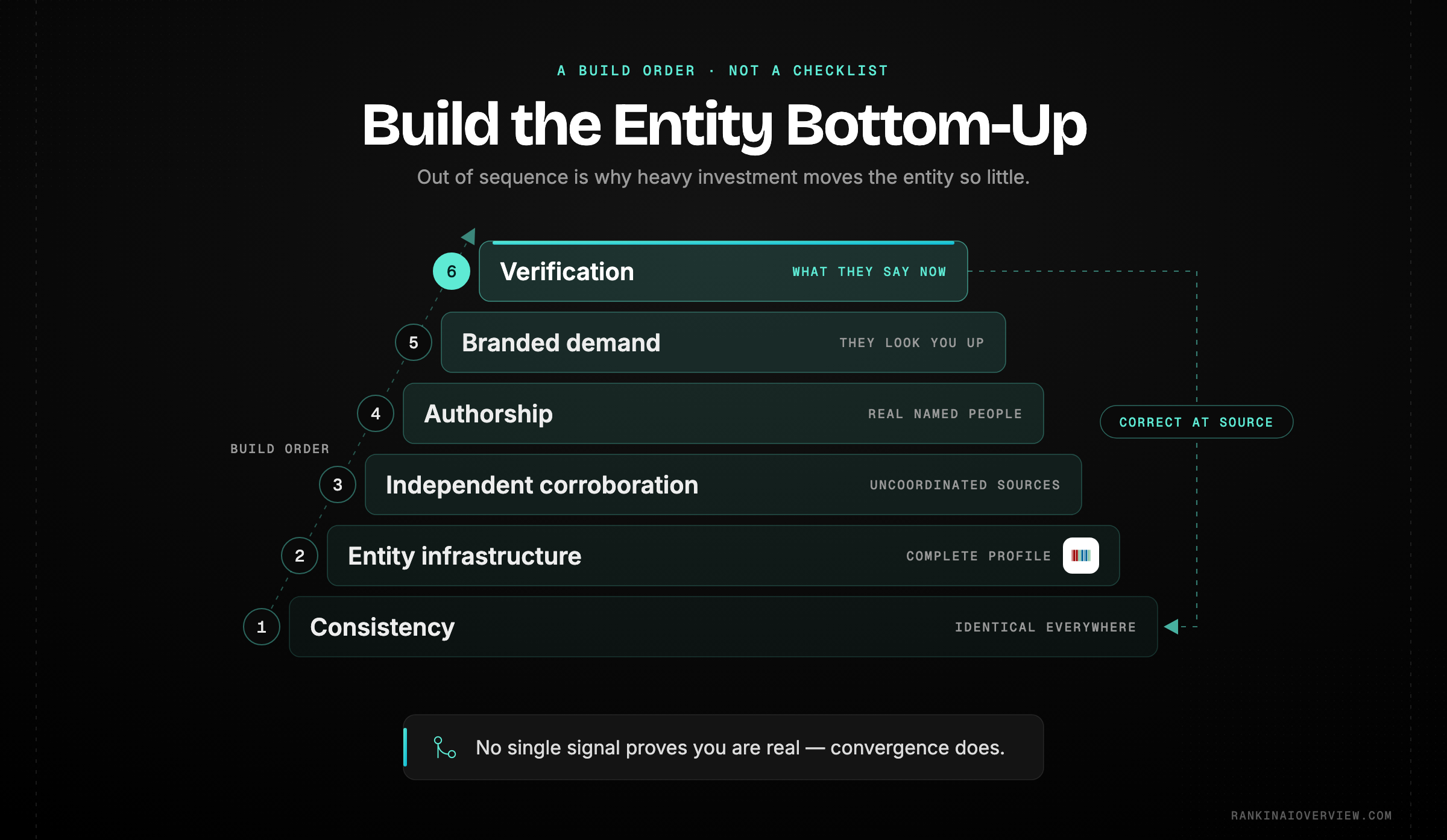
**A practical build order, from foundation upward:**
* Fix consistency first: identical brand name, description, category and core details across your site, profiles, directories and listings, so the entity resolves cleanly.
* Establish entity infrastructure: a complete business profile and, where genuinely notable, a [Wikidata](https://www.wikidata.org/) entry and a well-sourced presence in the reference layer of your niche.
* Earn independent mentions on credible industry sources, not just links, so corroboration comes from places with no reason to coordinate.
* Publish named, founder-led or expert-led work so authorship signals attach real people to the entity.
* Grow branded search with work that makes people look you up directly, which is a trust signal that is genuinely hard to fabricate.
* Verify what the systems already say about you, and correct fabrications at the source rather than assuming visibility equals accuracy.
None of these are hacks, which is the point. They are the slow, real work of becoming an entity a machine can recognise and describe correctly, and that is exactly why they survive algorithm changes while manipulative shortcuts decay. Notice too that the last step, verification, is the one the older version of this advice always omitted, and the new research shows it is not optional.
The ordering matters as much as the list. Consistency comes first because it makes every later signal count instead of partly cancelling. Corroboration comes next because it is the mechanism the system actually trusts. Branded demand comes later because it compounds slowly and rests on the foundation beneath it. Doing these out of order, chasing mentions before fixing consistency, is why some brands invest heavily and see little entity movement.
**Also read:** [Reputation-driven SEO](https://www.rankinaioverview.com/blog/reputation-seo), which covers how credible mentions and reputation translate into the co-occurrence patterns these systems rely on.
## How Long Does It Take, and How Do You Measure It?
A rising mention rate with persistent factual errors is a larger surface for misinformation, not success.
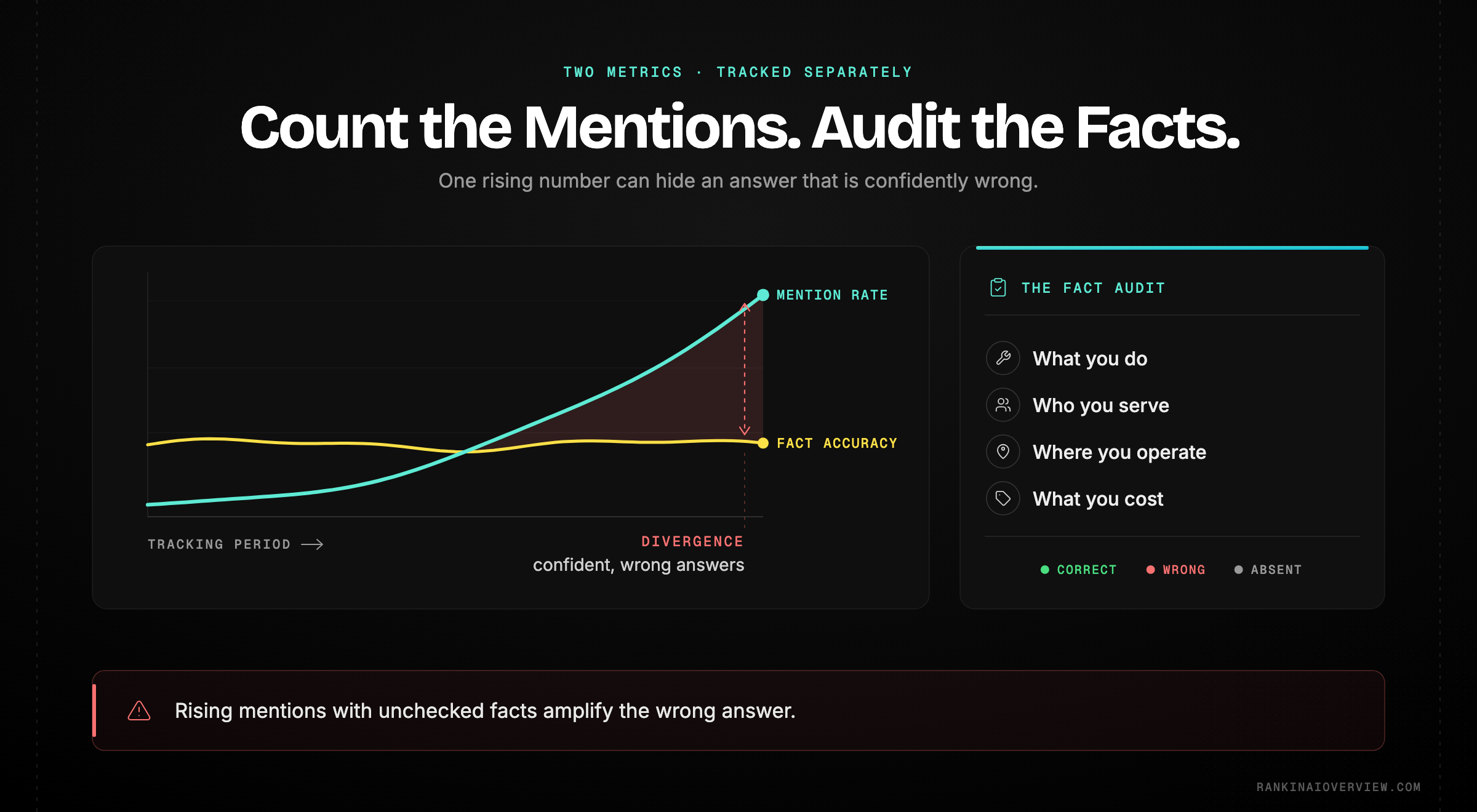
Expect several months to a year of consistent effort, because entity recognition, corroboration and branded demand accumulate slowly rather than switching on. Measure two things separately over time: how often AI systems cite or mention you, and how accurately they describe you, since the research shows those can diverge.
Treat progress as compounding, not linear. The first consistency fixes and entity entries do little visible work alone. As independent sources converge on the same description, recognition crosses a threshold and citations begin appearing more often. The brands that win are the ones that started early and kept the signals consistent, not the ones expecting a fast return and abandoning the effort when week three looks flat.
Measure visibility and accuracy as two distinct metrics, because collapsing them hides the exact problem the paradox describes. Track how frequently you appear across engines, and separately audit whether what they say about you is correct. A rising mention rate paired with persistent factual errors is not success, it is a larger surface for confident misinformation, and you will only see it if you measure the two apart.
Keep a fixed set of questions and a fixed set of facts, and re-check both on a schedule, because these systems vary between runs and single checks mislead in both directions. Note which competitors are recognised alongside you and how each of you is described, since that comparison tells you whether the gap is recognition, accuracy, or both, and those need different fixes.
Build the fact audit deliberately, because it is the half most teams skip. List the core claims about your brand that must be right, such as what you do, who you serve, where you operate and what you cost, then check what each engine actually asserts against that list. Record not just whether a claim appears but whether it is correct, because a confident wrong answer is worse than an absence and will not show up in any mention-counting metric. If you would rather begin from a prepared baseline than assemble one by hand, Rank in AI Overview provides a free AI visibility check that shows how often the major engines currently recognise your brand and how they represent it.
## What Mistakes Weaken a Brand Signal?
The costliest mistakes are inconsistent entity data across the web, chasing mention volume while ignoring accuracy, relying on domain authority alone, and assuming familiarity protects you. Each either prevents clean entity resolution or leaves confident misinformation about you unchallenged.
Inconsistency is the single biggest self-inflicted wound, because it undermines every other signal at once. Describing your brand differently across your own properties and third-party sources stops the system resolving you into one entity, so effort spent earning mentions is partly wasted on signals that do not add up. Fixing this is cheap and comes before anything else is worth doing.
Optimising for mention volume alone is the mistake the new evidence exposes most sharply. Raising how often you are mentioned, without checking how you are described, can increase your exposure to exactly the confident fabrications the paradox produces. Volume without verification is not a neutral half-measure, it can actively amplify wrong claims about you, which is why accuracy has to be a tracked goal in its own right.
Leaning on domain authority as though AI search were traditional search is the subtler error, and it explains a lot of confused strategy. Authority contributes to being retrieved, but entity recognition and correct description are separate layers on top, which is why a lower-authority but clearly resolved brand can outperform a high-authority but poorly resolved one. Our look at [what actually affects AI search visibility](https://www.rankinaioverview.com/blog/ai-myth-busting) separates the signals with evidence behind them from the ones that merely persist by repetition.
## Conclusion
Branded sites do get cited more in AI search, but the honest reason is narrower and more useful than fame. Answer engines favour entities they can recognise and verify, and an unknown brand loses mostly to invisibility rather than to a fair contest of quality. That is an infrastructure gap you can close, not a verdict on your content.
The newer lesson is that recognition is not the finish line, because familiarity without verification produces confident errors as readily as correct answers. So the real objective is to be a verifiable entity: consistent everywhere, corroborated by independent sources, correctly described in the places these systems check, and monitored for accuracy as closely as for visibility. Build a recognisable, verifiable brand rather than merely a good website, and answer engines will both cite you more and describe you correctly.
[Rank in AI Overview](https://www.rankinaioverview.com/) studies how answer engines recognise, cite and represent the brands they draw on, and is building an AI visibility tool launching soon. To see how clearly the major engines recognise your brand today, and how accurately they describe it, [start with a free AI visibility audit](https://www.rankinaioverview.com/).