Is Ranking Still the Goal in SEO? Why AI Visibility Is the New Metric That Matters
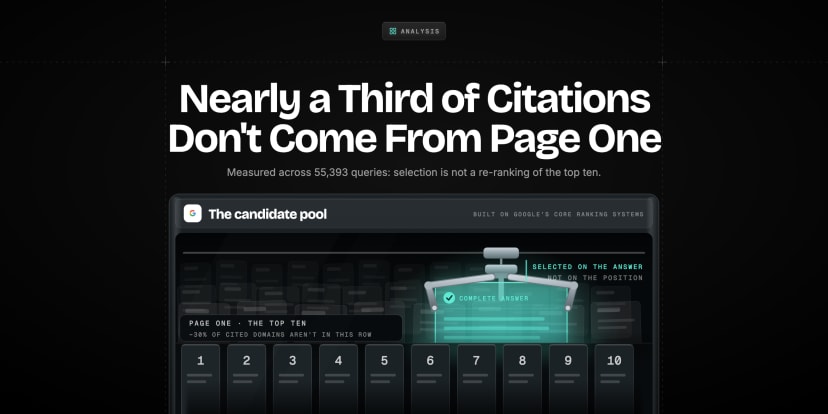
47% of AI citations come from pages ranking below #5. A #1 ranking no longer predicts visibility.

SummaryFor 20 years, ranking #1 on Google defined SEO success. In 2026 that metric is breaking — AI Overviews answer questions without a click, and a #1 ranking no longer predicts AI citation or traffic. The new scorecard is AI citation frequency, branded search growth, share of voice in AI answers, and entity recognition; rankings drop from the goal to a baseline health check.
Read moreShow less
Introduction
For two decades, one metric defined SEO success: rank number one on Google. A first-page position meant traffic. Traffic meant revenue. But in 2026, this equation is deteriorating. Rankings no longer reliably translate to traffic. AI Overviews answer questions before users click. ChatGPT, Perplexity, and Gemini intercept millions of searches that used to flow to Google. The goal of SEO needs a fundamental rethink.
The question SEO teams face today isn't "Did we rank #1?" It's "Are we cited in ChatGPT?" One SEO manager told their clients directly: "I've stopped reporting position 1 wins, they ask 'are we in ChatGPT?' now." This shift represents more than a measurement change. It represents a complete reorientation of what success means when search itself is being redefined by AI systems.
This guide reframes SEO success for 2026 and beyond. You'll understand why rankings alone are insufficient, what metrics actually predict business outcomes now, and how to restructure your strategy to compete in an AI-first search landscape. By the end, you'll have a practical framework for measuring SEO success when visibility no longer depends on position.
Why Rankings Became the Default SEO Goal?
The history of SEO rankings as the primary metric is surprisingly recent. When Google introduced PageRank in 1998, ranking position became the visible proxy for Google's trust in a page. According to Search Engine Journal's historical analysis of SEO evolution, the industry standardized on rankings as the primary KPI because they were measurable, trackable, and, for 20 years, predictive of business outcomes.
For most of the internet's existence, ranking first for a high-intent keyword reliably delivered traffic and revenue. Ahrefs' historical data on keyword ranking impact shows that position one averaged 28–35% click-through rates. This relationship was so consistent that agencies built entire business models around improving positions, and clients learned to expect monthly rankings reports showing progress.
The metric persisted because it was simple, measurable, and predictive. Ranking tracking tools like Semrush and Ahrefs built multibillion-dollar businesses around monitoring keyword positions. Clients understood positions. Stakeholders expected rankings reports. The entire industry infrastructure became built on this one metric. Breaking this habit required proof that positions no longer meant what they used to.
What's Changed in 2026: The Three Cracks in the Rankings Model
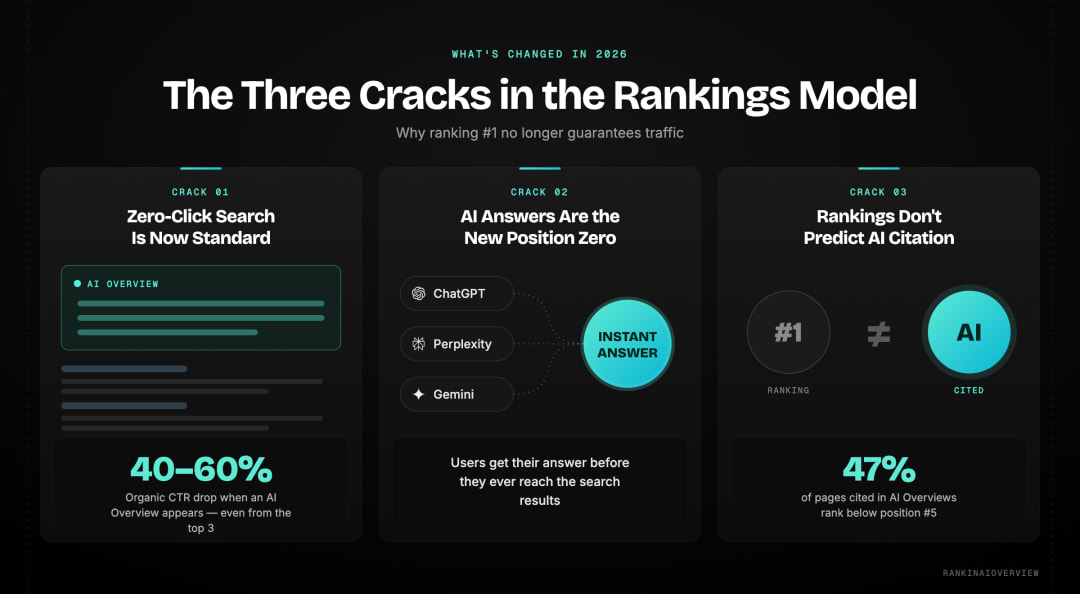
Three fundamental shifts in search behavior have broken the traditional ranking-to-traffic equation. These aren't future predictions, they're happening now and reshaping SEO completely.
Below is a detailed breakdown of each shift:
Crack 1 – Zero-Click Search Has Normalized

Zero-click search used to be an anomaly. Now it's standard. AI Overviews answer questions directly on the Google search results page, eliminating any reason for users to click to external sites. According to Semrush's 2025 research on AI Overview prevalence, AI Overviews appear in approximately 48% of Google searches. Data from Moz analyzing click-through rates shows that organic click-through rates drop by 40–60% when an AI Overview appears for a query, even when you rank in the top three positions.
One SEO professional described the impact directly: "Traffic from AIO is way down even when we're cited. Zero-click is real." Ranking first means nothing if the user's question gets answered on the search results page itself.
Crack 2 – AI Answers Are the New Position Zero
Position zero used to refer to featured snippets. Now it refers to AI-generated answers from ChatGPT, Perplexity, Gemini, and other answer engines. These systems intercept informational queries before users ever navigate to a Google search results page. According to OpenAI's usage data and industry reports, millions of users now ask ChatGPT their questions instead of using Google Search.
For informational queries especially, the largest category of searches, AI answers now serve as the first information source. Users find answers without visiting any website. Traditional ranking position becomes irrelevant when the user's question is resolved before they see the organic results.
Crack 3 – Rankings Don't Predict AI Citation

This is perhaps the most disruptive shift. Research from Ahrefs analyzing AI Overview citations found that 47% of pages cited in AI Overviews rank below position five in traditional search. A page ranking first in Google is frequently not the source cited in the AI-generated answer.
AI citation depends on different signals: semantic completeness, E-E-A-T verification (expertise, experience, authority, trustworthiness), entity recognition, and factual accuracy. These factors don't correlate with traditional ranking position. A number-one ranking no longer guarantees visibility in the systems now determining search discovery.
What Should Replace Rankings as Your Primary KPI?

The metrics that predict success in 2026 are different from traditional rankings. They measure actual visibility in AI-mediated discovery, brand recognition, and conversion quality. These five metrics together create a comprehensive picture of SEO performance in an AI-first world.
Below is how each metric works and why it matters:
Metric 1 – AI Citation Frequency

AI citation frequency measures how often your content or brand appears in AI-generated answers across platforms. This is the direct replacement for ranking position because it measures actual visibility in the new discovery channels. Pages cited in AI Overviews receive 35% more organic clicks than non-cited competitors, even with lower ranking positions. Citation frequency is predictive: it indicates that AI systems trust your content, and it correlates directly with increased traffic and visibility.
How to track it: Use Semrush's AI Overview tracking tool or Ahrefs' AI citation monitoring for automated tracking. For free manual tracking, search your top 20 target keywords in Google AI Overviews, ChatGPT, Perplexity, and Gemini weekly. Note which content gets cited and track month-over-month trends.
Metric 2 – Share of Voice in AI Responses
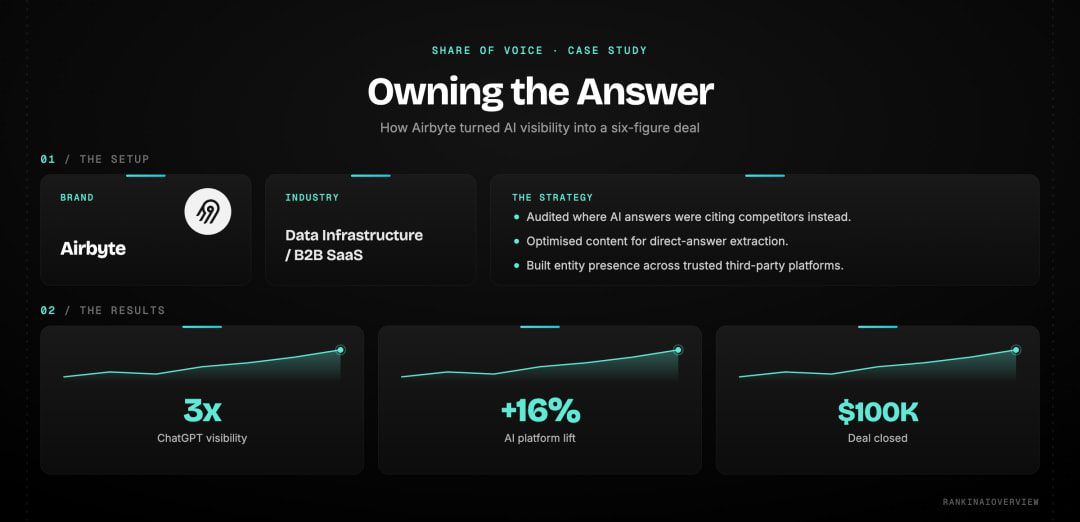
Beyond how often you're cited, measure how often your brand appears relative to competitors. If five AI-generated answers cite your company and only three cite a major competitor, you're winning share of voice in that channel. This metric shows dominance in the new discovery space and tracks your competitive position.
How to track it: For each target topic, search in multiple AI systems (Google AI Overviews, ChatGPT, Perplexity, Gemini). Count how many results mention your brand versus competitors. Calculate your percentage. Track monthly to demonstrate improvement and competitive advantage.
Metric 3 – Branded Search Volume Growth
When an AI system mentions your brand or cites your company, users often follow up with a branded search. According to Moz's research on branded search as an authority signal, rising branded search volume is one of the strongest indicators of brand awareness and trust built through AI visibility.
How to track it: Use Google Search Console or Google Analytics to track searches for your brand name and variations. Month-over-month growth shows whether AI visibility is translating to direct intent signals and whether brand awareness is growing.
Metric 4 – Traffic Quality Over Volume

AI-referred traffic behaves differently than traditional search traffic. Users who discover you through an AI citation often have higher intent and convert at better rates. Rather than optimizing for traffic volume alone, segment your analytics by source and compare conversion rates.
How to track it: In Google Analytics, create a custom segment for AI referral traffic (ChatGPT, Perplexity, etc.). Compare conversion rates for AI traffic versus organic search traffic. If AI users convert at 18% while organic averages 10%, AI citation is more valuable per visitor despite lower volume.
Metric 5 – Entity Recognition Score

Search engines and AI systems recognize brands as entities in their knowledge graphs. According to Google's documentation on entity recognition, entity recognition influences how often and confidently systems recommend your brand. A strong entity score means search systems recognize you as an authority, which increases citation likelihood across AI platforms.
How to track it: Assess entity strength by checking: Does Google's Knowledge Graph show your entity when you search your brand? How often do reputable sources mention your brand by name (unlinked mentions)? Does your Wikipedia entry exist and link properly? Are you mentioned in industry publications as a known entity?
New Primary Metrics | Old Primary Metric | Why It Changed |
|---|---|---|
AI citation frequency | Ranking position | AI visibility now matters more than SERP position |
Rank vs competitors | Competitive standing in AI discovery | |
Branded search growth | Traffic volume | Brand awareness converting to intent |
Conversion rate by source | Click volume | Quality matters more than volume |
Domain authority | AI relies on entity signals, not link metrics |
But Rankings Still Matter: Here's Why

Rankings are not irrelevant in 2026. They're just not the primary goal anymore. Understanding their new role is essential.
Below is why rankings remain important and how their role has changed:
Rankings as the Eligibility Filter
Ranking position is often a prerequisite for AI citation. According to Ahrefs' analysis of AI-cited pages, 76% of pages cited in AI Overviews rank in the top 10 of traditional search results. Ranking in the top 10 is frequently necessary for AI systems to even consider your content. Think of ranking as the eligibility requirement, not the finish line. You need to rank well enough for AI systems to discover and evaluate your content. But ranking alone no longer guarantees the AI will cite you.
The Shared Foundation: Authority and Quality
Both traditional rankings and AI citation depend on the same underlying foundation: demonstrated expertise, authority, and trustworthiness. Google's official guidance on E-E-A-T signals applies to both ranking position and AI citation decisions. Build strong E-E-A-T signals through author credentials, citations from reputable sources, and verified expertise, and you improve both metrics simultaneously. The difference is that traditional rankings reward E-E-A-T when combined with keyword match and backlink profile, while AI citation weighs E-E-A-T much more heavily as a percentage of the overall ranking algorithm.
Demoting Rankings From Goal to Health Metric
Instead of asking "Did we rank first for our target keywords?" ask "Are we ranking well enough to be eligible for AI citation, and are we actually getting cited?" Ranking becomes a baseline health metric that you monitor but don't chase. If you're ranking in positions 4–8 but getting cited in AI Overviews, you've succeeded. If you're ranking position 1 but not cited, something else is missing (often semantic completeness or content freshness). This reframing changes how you allocate resources and report success to stakeholders.
The New SEO Reporting Framework for 2026
Your reporting structure should reflect what actually drives business outcomes. This framework separates metrics by strategic importance, helping you prioritize where to focus effort.
Below is how to organize your dashboard:
Primary Metrics (What Success Actually Looks Like)
These are the metrics that directly predict business outcomes in 2026:
-
AI Citation Frequency: How many times your content or brand appears in AI-generated answers for target topics. Target: 5–15 citations per week across all AI platforms.
-
Branded Search Growth: Month-over-month increase in searches for your brand name. Target: 10–20% growth monthly (varies by industry and starting point).
-
Share of Voice in AI: Your brand mentions divided by total competitor mentions for that topic across AI systems. Target: 30–50% share depending on market competition.
-
Conversion Rate by Source: Percentage of AI referral traffic that converts compared to other sources. Target: Aim for 15%+ if possible (typically better than traditional organic average).
Secondary Metrics (Supporting Indicators)
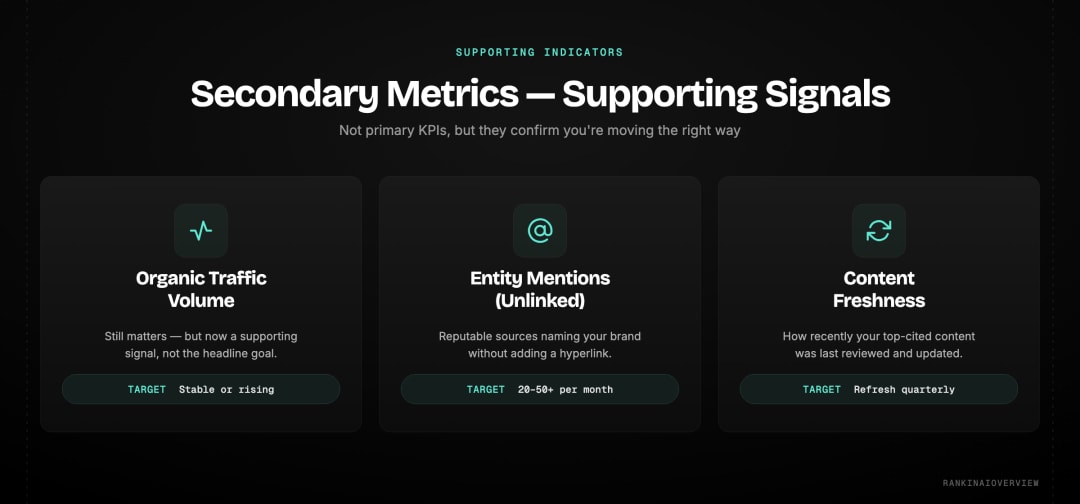
These show whether you're moving in the right direction:
-
Organic Traffic Volume: Still important, but secondary. AI citation often improves CTR from traditional organic results through increased brand trust and recognition.
-
Entity Mentions (Unlinked): How many times reputable sources mention your brand without linking. Target: 20–50+ brand mentions per month from authoritative sources.
-
Content Freshness Score: How recently your top-cited content was updated. Target: Update quarterly minimum to maintain citation eligibility.
Baseline Metrics (Foundation Checks)

These ensure your foundation is solid but aren't primary success indicators:
-
Ranking Position: Monitor top 20 positions for target keywords. Not the goal, but the floor. Use this as an eligibility check, not a success metric.
-
Core Web Vitals: Google's page experience signal. Maintain "good" scores across largest contentful paint, first input delay, and cumulative layout shift. Don't obsess over marginal improvements.
-
Crawl Health: Ensure Google can crawl and index your site properly. Check monthly but focus effort on AI citation optimization instead.
-
Backlink Profile: Monitor quality more than quantity. A few high-authority links matter more than volume, and they matter less than they used to relative to AI signals.
The Real Shift: From Position to Visibility
One SEO professional captured the shift perfectly: "Visibility without clicks is still visibility. Awareness stage matters." This sentence encapsulates why rankings no longer define success. Traditional metrics focused on clickthrough.
AI-mediated discovery focuses on brand awareness, trust, and entity recognition. A mention in ChatGPT builds brand awareness even if it doesn't drive immediate clicks. That awareness converts to branded search. That branded search drives intent-based traffic that converts better.
This isn't the death of SEO. It's the evolution of what SEO means. You're no longer optimizing for position. You're optimizing to become the source AI systems trust, cite, and recommend. You're building a brand that users recognize when an AI mentions it. You're becoming an entity search engines and AI systems confidently surface.
Conclusion
It is worth asking the direct version too: is Google ranking becoming less important as AI search grows?
If the goal itself is shifting, it helps to see why the old scoreboard is gone — why AI search doesn't have rankings at all.
Ranking isn't dead. It's just no longer the finish line. In 2026, the goal of SEO is to become the source AI trusts and cites, the brand users recognize when an AI mentions it, and the entity search engines confidently surface. Rankings remain important as a foundation, they're the floor, not the ceiling.
The professionals succeeding now are those who've made this mental shift. They monitor rankings as a health check. They maintain technical excellence. But they're not chasing position one like it still means what it did in 2005.
They're building for AI discovery. They're measuring AI citation frequency. They're tracking branded search growth. They're reporting conversion rates by source. They're optimizing for entity recognition.
The question isn't "Can we rank first?" anymore. The question is "Will an AI system trust us enough to recommend us?" Answer that question, and ranking becomes secondary. Ignore it, and even position one won't save you.
Frequently asked questions
Should I Stop Tracking Keyword Rankings Entirely?+
No. Continue monitoring rankings as a health check, but reframe what they represent. Track top 20 positions for your 50 most important keywords monthly. If rankings drop significantly, investigate why (may indicate an algorithm update or technical issue). But if rankings hold steady while AI citations increase, you're succeeding even if position numbers change. Stop making rankings your primary reporting metric to clients and leadership.
How Do I Report AI Visibility to Clients?+
Reframe the conversation around business outcomes. Instead of saying "We ranked you number one," say "AI systems are now citing your content for these topics, driving 35% more clicks than competitors." Show the new metrics dashboard: AI citations, branded search growth, conversion rate by source, and share of voice. When clients understand that AI citation drives more qualified traffic than traditional position one, they'll embrace the new framework immediately.
What Tools Track AI Citation Frequency?+
**Paid tools:** [Semrush AI Overview tracking](https://www.semrush.com/ai-tracking), [Ahrefs AI citation monitor](https://www.ahrefs.com/blog/ai-monitor), [SE Ranking AI tracking](https://www.seranking.com/ai-tracking). **Free method:** Manually search your target keywords in Google AI Overviews, ChatGPT, Perplexity, and Gemini weekly. Create a simple spreadsheet tracking which content gets cited. This takes 30 minutes weekly for 20 keywords.
How Do I Optimize Content for AI Citation Instead of Just Rankings?+
Focus on semantic completeness (write 134–167 word self-contained answers), E-E-A-T signals (author credentials, recent citations from reputable sources), content freshness (update quarterly), entity optimization (consistent terminology, knowledge graph alignment), and schema markup (FAQ and Article schema). These factors correlate with AI citation much more than with traditional ranking position. One professional summarized the shift: "The goal is brand recall. If someone hears your name from an AI, that's the win."
Is Organic Traffic Dying?+
No, but it's changing. Traffic quality often improves because users discovering you through AI citation are more qualified. They've been pre-screened by an AI summary. The volume may decrease but conversion rates often increase, making the traffic more valuable per visitor even with lower numbers.
Why Rank High But Not Get Cited in AI?+
This signals an optimization gap. Common reasons include: your answer isn't self-contained (requires additional context or clicks to fully understand), your E-E-A-T signals are weak (no author credentials or citations from reputable sources), your content is outdated (failing fact-check filters), or your entity signals are unclear (inconsistent terminology confuses AI systems). Audit these areas and update the content.
Is ranking still important for SEO in 2026?+
Yes, as a prerequisite and health metric. 76% of AI-cited pages rank in the top 10. But ranking first no longer guarantees visibility or traffic. AI citation and entity recognition now matter more than ranking position.
What are the new SEO KPIs replacing rankings?+
The five new primary KPIs are AI citation frequency (how often you're cited), share of voice in AI responses (your mentions vs competitors), branded search growth (awareness converting to intent), conversion rate by source (quality of AI referral traffic), and entity recognition score (whether you're recognized as a trusted entity).
How do I optimize for AI Overviews instead of rankings?+
Focus on semantic completeness (write self-contained 134–167 word answers), E-E-A-T signals (demonstrate expertise and authority), content freshness (update quarterly), entity optimization (consistent terminology), and schema markup (FAQ and Article schema). These factors correlate with AI citation more than with ranking position.
Will traditional SEO still work in 2026?+
Yes, but with different goals. Technical SEO, authority building, and content quality still matter. These tactics now serve the goal of improving AI citation rather than ranking position. The foundations remain; the destination changes.
Why am I ranked high but not cited in AI Overviews?+
Common reasons include semantic incompleteness (your answer needs more context), weak E-E-A-T signals (lack author credentials or recent reputable source citations), outdated content (failing fact-checks), or unclear entity signals (inconsistent terminology). Audit and update addressing these factors.
Should I stop optimizing for Google and focus only on AI answers?+
No. Google still drives most search traffic. The shift is reframing Google optimization: optimize for AI Overviews within Google, optimize for other AI systems, and optimize for brand building in all channels. Google remains the starting point; AI citation becomes the goal.
Explore with AI
Share this