How to Rank in Google AI Overviews in 2026: What Actually Works
Organic CTR drops 61% when AI Overviews trigger. Here's what gets cited instead.
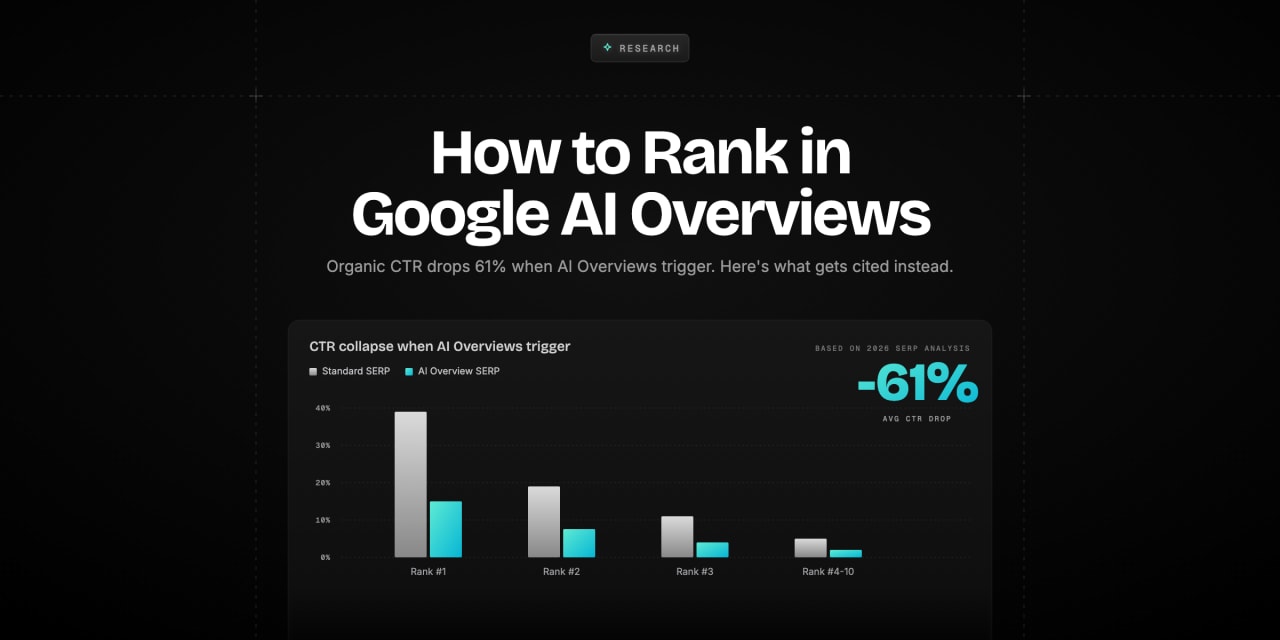
SummaryOrganic CTR drops 61% on searches that trigger an AI Overview — from 1.76% to 0.61%. But pages cited inside the Overview earn 35% more organic clicks and 91% more paid clicks than uncited competitors. Domain Authority has collapsed to near-zero correlation (r=0.18), and 47% of AI citations now come from pages ranking below #5 — position alone no longer guarantees visibility.
Read moreShow less
Introduction
AI Overviews now appear in over 60% of all searches as of 2025, appearing on approximately 48% of all tracked queries by February 2026, representing a 58% increase year over year. For content marketers and SEO professionals adapting to AI-driven search, this creates an urgent question: how to rank in AI overview when AI summaries appear above traditional search results?
Content scoring 8.5/10 or higher on semantic completeness is 4.2 times more likely to be cited than content scoring below 6.0/10. Traditional ranking factors like backlinks, keyword placement, and domain age no longer predict citation. Instead, AI systems evaluate meaning, completeness, and trustworthiness. You can rank number one and still be invisible in AI Overviews.
In this guide, you’ll learn exactly how to rank in AI Overviews even as traditional rankings lose impact following seven proven ranking factors that determine whether Google's AI systems cite your content.
What Are The 7 AI Overview Ranking Factors?

Understanding these factors is critical. AI prioritizes passages that fully answer queries in 134 to 167 word self-contained units, and each factor below directly influences whether your content makes the cut.
Factor 1: Why Is Semantic Completeness the #1 Ranking Factor for AI Overviews?
Semantic completeness has been identified as the strongest predictor of AI Overview selection (r = 0.87, p < 0.001), with analysis of 15,847 AI Overview results showing that content scoring 8.5/10+ on semantic completeness is 4.2× more likely to be cited.
What Semantic Completeness Actually Means:
Semantic completeness measures whether your content provides a self-contained answer requiring no external context or additional clicks to understand. AI systems evaluate completeness at two levels:
-
Passage Level – Does a single paragraph fully explain the concept without external dependencies?
-
Page Level – Does your content address all angles of the query comprehensively?
Why AI Systems Prioritize It:
AI Overviews tend to pull answers in chunks of approximately 130–160 words, which usually contains enough context and evidence to be self-contained. This passage length isn't arbitrary. It represents the sweet spot where an idea is explained fully, evidence is present, and the excerpt makes sense in isolation.
When an AI system extracts a passage from your page, it must work without your URL's surrounding context. If readers could misunderstand the passage without seeing your full article, the AI won't extract it. If the passage requires them to click through to make sense, it fails the semantic completeness test.
How to Implement Semantic Completeness:
-
Write 134–167 word self-contained explanations of key concepts.
-
Each paragraph should answer its implied question completely.
-
Include supporting evidence (data, examples, case studies) within the answer block.
-
Avoid references to other sections ("as mentioned above" or "see the table below").
-
Structure each answer so a reader could understand it if printed in isolation.
Real Example:
Instead of:
"Domain authority matters for SEO. See the factors below."
Write:
"Domain authority measures the overall authority and trustworthiness of a domain, calculated by analyzing the number, quality, and relevance of backlinks pointing to that domain. A site with domain authority of 60+ is considered highly authoritative. For example, major news publications like the New York Times have domain authority scores above 90 because thousands of high-quality sites link to them. In 2026, domain authority correlation to AI citations dropped from 0.23 to 0.18, meaning raw authority matters less than other signals."
Factor 2: How Does Multimodal Content Boost AI Overview Visibility?
Multi-modal content integration, combining text, images, videos, and structured data in a unified content experience where each element supports and enhances the others, is the #1 new ranking factor in 2025 with a 92% correlation to AI Overview selection.
This shift represents a fundamental change in how AI systems evaluate content. Traditional web content relied on text alone. AI systems now evaluate information density across multiple formats.
Why Multimodal Content Works:
AI systems process images, videos, and text as interdependent information streams. When these formats work together, they provide:
-
Redundancy – Users can understand concepts through text or visuals.
-
Verification – Videos of a product in action verify written claims.
-
Completeness – Complex processes explained through both words and flowcharts.
-
Engagement Signals – Multimodal content produces higher dwell time, which AI systems monitor.
Pages that mix different formats (text, video, and visuals) have a 317% higher selection rate than text-only pages.
Implementation Strategy:
For How-To Content:
-
Step 1: Written explanation (150 words)
-
Step 2: Supporting image or diagram
-
Step 3: Optional short video (30–60 seconds)
-
Add structured data (HowTo schema)
For Product Reviews:
-
Written comparison (150–200 words)
-
Product image or gallery
-
Optional unboxing or demo video
-
Specifications table (structured data)
For Data-Heavy Content:
-
Primary narrative (150 words)
-
Data visualization (chart, infographic)
-
Downloadable raw data or interactive tool
-
Comparison table (structured data)
Factor 3: What Role Does E-E-A-T Play in AI Overview Rankings?
Experience, Expertise, Authoritativeness, and Trustworthiness signals show an r=0.81 correlation with AI Overview selection, with 96% of AI Overview content coming from verified authoritative sources.
E-E-A-T is not a direct ranking factor. Google's human quality raters use E-E-A-T to evaluate content, and those evaluations inform how Google trains its algorithms, it's an indirect but powerful influence on rankings. In 2026, however, the indirect effect has become the dominant effect.
In 2025, E-E-A-T verification became 27% stricter than 2024, with the evolution showing that E-E-A-T started as Google's content quality guideline but in 2025 became an active AI filtering mechanism, content lacking clear E-E-A-T signals gets filtered out before consideration.
Breaking Down Each Component for AI Systems:
E-E-A-T Component | What It Means | How AI Systems Evaluate It | Implementation Priority |
|---|---|---|---|
Experience | Author has personal, first-hand involvement with the topic | Language patterns indicating direct involvement; case studies; original photos/video; "what we tested" sections | HIGHEST – Hardest to replicate with AI |
Expertise | Deep knowledge through credentials, education, or proven track record | Content depth; citation of primary sources; nuanced understanding; credentials in byline | HIGH – Differentiated in saturated topics |
Authoritativeness | Recognition from credible independent sources | Backlinks from authoritative sites; brand mentions; media coverage; industry citations | MEDIUM – Built over time |
Trustworthiness | Content is accurate, transparent, and secure | HTTPS; clear author bio; contact information; transparent correction processes; fact-checking signals | CRITICAL FOUNDATION – Non-negotiable |
Trust is the Foundation:
Google's Search Quality Rater Guidelines explicitly state that "Trust is the most important member of the E-E-A-T family because untrustworthy pages have low E-E-A-T no matter how Experienced, Expert, or Authoritative they may seem".
Without trust, experience and expertise become less relevant in AI citation decisions. This trust is highly dependent on:
-
Comprehensive author attribution with verifiable credentials
-
Transparent contact information and business verification
-
Regular content accuracy audits and correction processes
-
Security infrastructure, including HTTPS as a baseline expectation
Building E-E-A-T Signals for AI Visibility:
Experience Signals:
-
Include author byline with specific experience (e.g., "tested 40+ AI tools in 2025")
-
Add original case studies with real results
-
Include photos from actual work or testing
-
Create "what we learned" sections showing hands-on involvement
Expertise Signals:
-
Cite primary research and peer-reviewed studies (not aggregators)
-
Build comprehensive topic clusters showing depth
-
Answer nuanced questions in FAQ sections
-
Reference advanced concepts naturally (showing deep understanding)
Authoritativeness Signals:
-
Earn backlinks from industry-recognized publications
-
Publish original research others want to cite
-
Develop relationships with industry experts
-
Contribute guest articles to authoritative platforms
Trustworthiness Signals:
-
Create detailed About pages explaining who runs the site
-
Include author bios with headshots and credentials on every article
-
Publish clear editorial standards and correction processes
-
Implement Organization and Person schema markup
-
Maintain transparent business information
AI systems scan for language patterns that show real, direct involvement with the subject matter, which is why experience has emerged as a valuable differentiator in saturated content.
Factor 4: How Does Verification and Fact-Checking Impact AI Citations?
Real-time fact-checking signals can increase AI Overview selection probability by about 89%, making verification a major gatekeeper rather than an optional enhancement, and content decay has become one of the most common silent causes of lost AI Overview visibility as facts, entities, and sources age out of trust.
Why Verification Became Critical:
Google's AI systems increasingly emphasize verification before citation, with your claims not just evaluated for relevance but checked for accuracy against trusted sources, if key claims fail verification, you're far less likely to be cited regardless of rankings or domain authority.
This represents a paradigm shift. Traditional SEO was about relevance and authority. AI-powered citation depends on factual accuracy. A perfectly written, well-sourced article will be filtered out if its claims don't verify against reference sources.
Implementation Strategy:
Citation Best Practices:
-
Link to primary sources (academic papers, government data) not aggregators
-
Quote statistics directly with sources clearly attributed
-
Update outdated statistics when new data becomes available
-
Cross-reference multiple independent sources for controversial claims
Fact-Checking Integration:
-
Use fact-check schema markup for claims-heavy content
-
Create internal fact-checking processes and document them
-
Include "last updated" timestamps on all content
-
Maintain a corrections page documenting errors caught and fixed
Content Freshness: Content freshness score is a major ranking factor across seven AI models: GPT-4o, GPT-4, GPT-3.5, LLaMA-3 8B/70B, and Qwen-2.5 7B/72B.
Review your content quarterly. Update statistics, examples, and case studies. Add "updated \\\\\\\\\\\\\\\[date\\\\\\\\\\\\\\\]" notices when changes are made. AI systems track content age and assign lower trust to stale information.
Factor 5: What Schema Markup Strategies Work Best for AI Overviews?

Structured data implementation shows a 73% selection boost, with properly structured content showing 73% higher selection rates compared to unmarked content.
Schema markup is not optional for AI visibility. It's the machine-readable signal that tells AI systems exactly what your content contains and how it's structured.
Critical Schema Types for AI Visibility:
Schema Type | Best For | Implementation Notes | Impact |
|---|---|---|---|
FAQ | Question-answer pairs | Implement for 5+ distinct questions | High |
HowTo | Step-by-step processes | Include image or video for each step | High |
Article | Blog posts and news | Include author, publication date, headline | Medium |
Product | Product reviews and comparisons | Include ratings, price, availability | High |
Claim | Fact-heavy content requiring verification | Use for controversial or complex claims | Very High |
Person | Author and expert profiles | Include credentials, social profiles, verified facts | Medium |
Organization | Business information | Include contact, address, verified business registration | Medium |
BreadcrumbList | Site navigation and hierarchy | Shows topical relationships and structure | Low |
VideoObject | Embedded videos | Include duration, publication date, transcript | Medium |
Implementation Priority:
-
First (Mandatory): FAQ and Article schema on all content
-
Second (High Impact): Product and HowTo for relevant content types
-
Third (Authority Building): Person and Organization schema on author/business pages
-
Fourth (Emerging): Claim schema for fact-heavy or controversial content
Real Implementation Example:
Instead of just writing:
"Semantic completeness is the strongest AI ranking factor."
Implement Claim schema:
{
  "@context": "https://schema.org",
  "@type": "Claim",
  "claimInterpreter": {
    "@type": "Organization",
    "name": "Rank in AI Overview"
  },
  "claimSubject": "Semantic completeness as an AI ranking factor",
  "text": "Semantic completeness shows r=0.87 correlation with AI Overview selection",
  "firstAppearance": "https://rankinaioverviews.com/ai-factors",
  "url": "https://wellows.com/blog/google-ai-overviews-ranking-factors/",
  "datePublished": "2026-02-15"
}
This tells AI systems exactly what you're claiming, where it appears, who's making it, and where evidence comes from.
Factor 6: How Can You Build Authority Specifically for AI Overviews?
Traditional authority signals (backlinks, domain age) show minimal correlation to AI citation. AI systems evaluate authority differently, prioritizing verification and recognition across multiple platforms.
Authority Building for AI Systems:
Original Research & Data: Publish industry studies, surveys, or proprietary data analysis. Original research gets cited by others, building your authority, even small-scale studies (100 respondents) can generate citations if insights are valuable. When other websites cite your research, AI systems recognize this as third-party validation of your expertise.
Cross-Platform Presence: Brands with strong AI search visibility across multiple platforms see 3.2x higher citation rates compared to those present on only one platform. Build visibility on:
-
Google AI Overviews (primary)
-
ChatGPT Search (secondary)
-
Perplexity (secondary)
-
Claude/other LLM interfaces (emerging)
Monitor your brand mentions across these platforms using AI citation tracking tools.
Industry Visibility:
-
Publish in industry publications (earned media)
-
Speak at conferences (generates backlinks and mentions)
-
Appear on podcasts (builds brand recognition)
-
Contribute expert commentary to news stories
-
Build relationships with journalists covering your industry
Consistency Across Signals: Consistent business information across platforms strengthens authority, geographic location, company name, contact details, leadership team, and business registration all contribute. Inconsistent information (different phone numbers on different sites) weakens trust signals and confuses AI systems.
Factor 7: Why Are Entity Signals Critical for AI Systems?

Entity knowledge graph density shows r=0.76 correlation with AI Overview selection, with content containing 15+ connected entities showing 4.8× higher selection probability.
Entities are specific, recognizable concepts: people (Elon Musk), companies (Google), locations (New York), products (ChatGPT), concepts (semantic completeness). AI systems rely on entity recognition to understand content meaning.
How Entity Signals Work:
When your content mentions consistent, recognized entities, AI systems:
-
Understand what your content is about
-
Connect your content to authoritative knowledge sources
-
Relate your content to similar topics
-
Verify claims against entity databases
Implementation Strategy:
Use Named Entities Consistently:
-
Refer to the same concept with the same name throughout
-
Avoid switching between "AI Overviews," "AIO," and "Google's AI answer summaries"
-
Use formal entity names for companies: "Google" not "the search giant"
Link Entities to Knowledge Graph:
-
When mentioning recognized entities, link to their Wikipedia pages or official sources
-
This signals to Google that you're referring to the verified entity, not a homonym
-
Build internal links connecting related entities
Include Entity Relationships: Structure content to show how entities relate:
"Semantic completeness (concept) is evaluated by Google's AI models (company) including Gemini (product) and MUM (product) using machine learning systems (concept) to rank content (concept) higher in AI Overviews (feature)."
This shows Google: Semantic completeness → connected to → Google, Gemini, MUM, ML systems, content ranking, AI Overviews.
Add Schema for Key Entities: Implement BreadcrumbList or structured data showing entity relationships:
{
  "@context": "https://schema.org",
  "@type": "BreadcrumbList",
  "itemListElement": [
    {
      "@type": "ListItem",
      "position": 1,
      "name": "Search",
      "item": "https://schema.org/Search"
    },
    {
      "@type": "ListItem",
      "position": 2,
      "name": "AI Overviews",
      "item": "https://schema.org/ArtificialIntelligence"
    },
    {
      "@type": "ListItem",
      "position": 3,
      "name": "Semantic Completeness",
      "item": "https://rankinaioverviews.com/semantic-completeness"
    }
  ]
}

How to Build Authority Specifically for AI Overviews?

AI systems evaluate authority differently than traditional SEO. Backlinks matter less. Verification and multi-platform presence matter more.
Strategy 1: Create Original Research
Original research gets cited by others, building your authority. Even small-scale studies with 100 respondents can generate citations if insights are valuable.
Implementation:
-
Publish one industry study or survey quarterly
-
Conduct original research on your specific topic
-
Share findings across social platforms
-
Reach out to journalists who cover your industry
Strategy 2: Build Cross-Platform Authority

Brands with strong AI search visibility across multiple platforms see 3.2 times higher citation rates compared to those present on only one platform.
Where to Build Presence:
-
Google AI Overviews (primary)
-
ChatGPT Search (secondary)
-
Perplexity (secondary)
-
Claude, Gemini (emerging)
How to Monitor: Use brand mention tracking across all AI platforms. Most AI citation tools now support multiple platforms.
Strategy 3: Earn Industry Visibility
-
Publish in industry publications (earned media)
-
Speak at conferences (generates backlinks plus mentions)
-
Appear on podcasts (brand recognition)
-
Contribute expert commentary to news stories
-
Build relationships with industry journalists
Where Do Google AI Overviews Get Their Sources?
AI Overviews pull their supporting links from the same Search index as ordinary Google results. According to Google Search Central's AI features documentation, a page must be indexed and eligible to show with a snippet before it can appear as a supporting link. There is no separate index, no submission form and no special sitemap tag. AI Mode runs on the same mechanism, so the same foundation applies to both.
That makes plain technical SEO the first gate. A page that is invisible in normal results has no path into an AI Overview. Google says there are no extra requirements to appear in AI Overviews beyond the normal Search eligibility bar. Fix crawl errors, remove accidental noindex tags and confirm a clean canonical setup before working on any of the seven factors above.
How Closely Do Rankings and Citations Line Up?
The link is real but moderate. Analysts at Ahrefs studied close to two million citations from one million AI Overviews. Most cited pages ranked inside the top ten, a smaller share ranked further down, and a notable minority did not appear in the top 100 at all. A follow-up study of over four million AI Overview URLs, using a refined method, found a lower overlap figure. The relationship holds, but it moves as measurement improves and as Google's systems change.
The same research found that the first link cited in an AI Overview tends to rank near the very top, with a median organic position of around two. Later citations spread further down the results. As Ahrefs' Si Quan Ong put it, the chance that ranking higher gets you cited is "a coin flip at best".
What This Means for Strategy:
-
Chasing the top citation slot is like chasing position one: high reward, heavy competition.
-
The second or third citation slot is often a faster, more realistic win for a page that already ranks respectably.
-
A page sitting on page five or six rarely gets cited, however well it is structured, because it has not cleared the ranking bar yet.
What Is Query Fan-Out and Why Does It Matter?
Query fan-out is how Google's AI features split one search into several related sub-queries before writing an answer. Google confirms both AI Overviews and AI Mode use it. John Mueller has described it as Google running "a whole bunch of searches for you" behind the scenes, as reported by Search Engine Land.
This is why "I rank in blue links but not in AI Overviews" is a flawed comparison. The AI Overview may be citing pages that answer sub-queries your page never covered.
What Fan-Out Looks Like in Practice
Take a search for the best ergonomic office chair. Behind it, Google's AI features may run sub-queries on lumbar support, weight limits, price ranges and chair height adjustment. A product page that only repeats "ergonomic office chair" is unlikely to surface for any of them, even if it ranks well for the main keyword. A page that answers each sub-topic in its own short section has far more entry points into the same AI Overview.
Implementation:
-
List the sub-questions around your main keyword before you write.
-
Answer them on the same page instead of splitting each into a thin separate page.
-
Give each sub-question its own heading and a self-contained answer.
Researchers also tested whether pages cited from beyond page one simply rank for more fan-out-style keywords. The pattern did not hold. Pages cited from outside the top ten ranked for fewer total keywords on average, which suggests freshness and formatting play a bigger role than raw keyword volume.
Citation Is Not the Same as Being Named
Research led by SEO analyst Kevin Indig, using the Semrush AI Visibility Toolkit, found that roughly six in ten AI citations are "ghost citations". The source link appears, but the brand is never mentioned in the answer text.
Platforms differ sharply here. Gemini named the brand in the answer 83.7% of the time but cited it as a formal source only 21.4% of the time. ChatGPT showed the reverse: an 87% citation rate against a 20.7% mention rate.
The fix is simple. Put your brand name inside key facts and answers, not only in bylines and footers.
What Did Google's Own AI Optimization Guide Confirm?
In May 2026, Google published a consolidated guide, Optimizing your website for generative AI features on Google Search. It mostly restates existing advice in one place rather than revealing a new algorithm. It does not give a weighted list of signals, and Google has not said it plans to. What it does give is a clear list of things you don't need to do.
Which Popular Tactics Does Google Say You Don't Need?
Popular Claim | What Google's Guide Says |
|---|---|
You need an llms.txt file | Not needed. Standard crawling and indexing rules already apply. |
Content must be chunked into fixed-length passages | No required passage length is mentioned. Write clearly; don't engineer to a number. |
Rewrite all content specifically for AI | Not required. Content that serves human readers well also serves AI features. |
Seek inauthentic mentions to build authority | Explicitly discouraged. Authority should come from genuine recognition. |
Structured data is the single biggest lever | Don't overfocus on structured data specifically. |
This changes how you should read the factors above. The 134 to 167 word passage range and the schema selection figures describe patterns seen in citation studies, not rules Google has published. Use them as a guide to writing complete answers, not as word counts to hit. Schema still helps AI systems understand what a page contains. It just shouldn't be your only lever.
What Does "One Level Deeper" Content Look Like?
Nick Fox, Google's senior vice president of Knowledge and Information, added a layer in an interview at Google Marketing Live 2026. He said the content most likely to perform goes "one level deeper, two levels deeper" than the AI's own surface answer, built on real first-hand experience.
His example: someone researching a purchase doesn't just want the AI's summary. They want to hear from someone who actually used the product, including what went wrong and which accessories they needed. "As humans we want to hear from humans," Fox said (source).
That is the Experience signal from Factor 3 in plain terms. Restating manufacturer specs does not clear this bar.
Do Local and Ecommerce Pages Follow Different Rules?
Yes. Google's guide gives ecommerce and local pages their own section. The focus there is keeping business details such as hours, locations and product availability accurate and consistently structured, because AI features pull that kind of fact directly.
Informational content is judged more on depth and first-hand experience. Transactional and local content is judged more on accuracy and consistency. Running one playbook for both misreads what Google's own guidance separates out.
How Should You Write Each Section So AI Can Extract It?
AI engines extract passages, not pages. Every section has to work as a stand-alone, citable unit. Five editing habits make that happen, and most need no new budget, only rewriting.
Habit 1: Lead With the Answer
The first 40 to 60 words under each H2 should answer the heading's question completely. Context and detail come after. To test it, cover everything below the first two sentences and ask whether a reader already has the answer. If not, rewrite the opening.
Instead of:
"Understanding topical authority is essential for any modern SEO strategy. In this section, we explore what it means, why it matters, and how the concept has evolved as AI search has become more prevalent."
Write:
"Topical authority is the degree to which a website is recognised as a reliable reference point for a specific subject area, measured by the depth and consistency of its published content on that topic. Sites with high topical authority on a subject are cited by AI engines more frequently than sites with isolated pieces on the same subject."
Habit 2: Turn Headings Into Questions
When someone asks ChatGPT or Perplexity a question, retrieval looks for headings that match it. "What Are the Benefits of FAQ Schema Markup for AI Visibility?" matches a real query better than "The Benefits of FAQ Schema Markup." Pull the exact phrasing from your Google Search Console queries and the People Also Ask box.
Habit 3: Strip Sales Language From Informational Sections
AI engines avoid citing content that reads like a pitch. Read the first 300 words of each target page and flag sentences that start with "We offer" or "Our unique approach", pricing mentions, and testimonials placed before any information.
-
Flag: "Our AI visibility tool tracks every citation across the web in real time."
-
Rewrite: "AI visibility tracking platforms monitor citation frequency across ChatGPT, Perplexity, and Google AI Overviews by running automated prompt tests and logging results."
Move the pitch into a separate section near the end of the page.
Habit 4: Write FAQs in Real User Language
Add five to ten FAQ pairs to each long-form piece. Source the questions from People Also Ask, Search Console query data and Perplexity's follow-up questions. Keep each answer to 30 to 50 words. "What is the ROI of AI content optimization?" is real user phrasing. "How does AI content optimization drive business value and competitive advantage?" is marketing copy.
Habit 5: Share Summaries Off-Site
For each major piece, find two or three relevant Reddit communities or Quora topics where it answers a real question. Post a 200 to 400 word summary that is useful on its own, not just a link. Perplexity cites Reddit as one of its most frequently retrieved domains, so this builds a corroboration layer that works independently of your Google ranking.
Where to Start: Answer-first openings and question headings come first. They take 15 to 60 minutes per page and one practitioner on r/DigitalMarketing reported that restructuring 20 pages to answer one question per section doubled AIO pickups within the first month. FAQ sections with schema come next. Sales-language cleanup, author signals and off-site work take longer to pay back.
How Is Ranking in AI Overviews Different From GEO?
Three terms get mixed up. AIO means Google's AI Overviews specifically. GEO (generative engine optimization) covers every AI platform that cites content, including ChatGPT, Perplexity, Gemini, Microsoft Copilot and Claude. The term comes from research by Princeton, Georgia Tech and the Allen Institute for AI. AEO (answer engine optimization) is the formatting approach, answer-first structure and FAQ blocks, that serves both.
Roughly 80% of the work overlaps: direct-answer content, E-E-A-T signals, schema markup and topical depth. The split comes in two places.
Dimension | Google AI Overviews | ChatGPT and Perplexity |
|---|---|---|
Eligibility | Needs a Google ranking. About 97% of AIO citations come from Google's top 20 results | Perplexity runs its own crawler and index. ChatGPT Search uses Bing's index for live retrieval |
Heaviest Signals | Traditional Google ranking signals, freshness, FAQ and HowTo schema | Off-site entity signals: Reddit, review platforms, industry publication mentions |
First Move | Rank in Google's top 20 for the target query | Submit to Bing Webmaster Tools; build Reddit and review profiles |
Two Practical Takeaways:
-
New sites: Perplexity is the most accessible channel. A page with no meaningful Google ranking can still be cited there if it is well structured and relevant.
-
ChatGPT: Sites that have not been submitted to Bing Webmaster Tools are invisible to ChatGPT's live search layer.
Princeton's GEO research found that adding statistics, quotations and clear formatting raised AI citation probability by 30 to 40 percent. That is why the data and verification advice in Factors 1 and 4 pays off on every platform, not only Google.
How Do You Track Your AI Overview Visibility?
Standard rank trackers weren't built for citations. Search Console's Performance report lets you filter for AI Overview appearances, but it doesn't show your position inside the Overview, which sources appeared beside you, or why one page was chosen. Manual spot checks and a dedicated AI visibility tool fill that gap.
Channel | Primary Tracking Tool | Secondary Tool | What to Measure |
|---|---|---|---|
Google AI Overviews | Google Search Console (AI Overview filter) | SE Ranking AI Tracker | Impression count, citation frequency, query coverage |
Perplexity | Rankscale or Peec AI | Manual testing (20 runs per query) | Citation frequency, share of voice vs competitors |
ChatGPT Search | Rankscale or Profound | Bing Webmaster Tools (crawl verification) | Citation frequency, URL citation rate |
All platforms combined | Google Search Console (branded search) | GA4 AI referral segment | Branded search volume growth as downstream proxy |
Free Starter Stack:
-
Search Console for AI Overview appearances and branded search volume
-
Manual tests of 20 to 30 target queries in ChatGPT and Perplexity each week, logged in a spreadsheet
-
A GA4 custom channel group filtered on source and medium for known AI domains, since AI referrals otherwise blend into generic referral traffic
Track citation rate and brand mention rate separately. Citation rate is the share of tracked queries where your page appears as a cited source. Tools such as Ahrefs' Brand Radar and the Semrush AI Visibility Toolkit are built to split the two. Review both monthly alongside your usual ranking report. Citations can be lost quickly when a competitor publishes a clearer, more recently updated answer, so a longer review cycle risks missing the drop.
Conclusion: From Ranking to Citation
For proof it works in practice, here is a step-by-step case study of earning consistent AI Overview citations.
Chasing a fixed position here can mislead you, because AI search has no ranking in the traditional sense.

The era of single-metric SEO is ending. Ranking number one no longer guarantees visibility. The metric that matters now is citation. This is whether AI systems trust your content enough to recommend it to users.
The good news: citation follows predictable signals. Semantic completeness shows r=0.87 correlation with selection. E-E-A-T signals show r=0.81 correlation. These aren't random. They're levers you can pull.
Teams winning in 2026 ask "How do I get cited?" instead of "How do I rank?" They build content for AI extraction. They prove authority systematically. They update constantly. They measure citation as rigorously as traditional ranking.
Your next step: Audit one high-traffic keyword for semantic completeness. Rewrite the answer block. Add supporting data. Implement schema. Track the change in AI citations over 30 days.
Then repeat for your next 20 keywords. The compounding effect is powerful. And it's measurable.
Frequently asked questions
Will ranking number one guarantee I appear in AI Overviews?+
No. 76.1% of URLs cited in AI Overviews also rank in the top 10 of Google search results. However, if your website ranks first on SERP results, there's a 33.07% chance that it will also appear in AI Overviews. This means 2 out of 3 number one ranking pages don't appear in AI Overviews. Position alone doesn't guarantee citation.
Can I rank in Google AI Overviews without traditional Google rankings?+
Yes, though it's uncommon. 47% of AI citations now come from pages ranking below position number five. If your content is semantically complete and highly relevant, AI systems will cite it even if it doesn't rank traditionally.
How long does optimization take to show rank in Google AI Overviews?+
Visibility changes typically appear within 2 to 4 weeks after publishing or updating content. However, AI systems show more volatility than traditional search. Consistent, comprehensive content outperforms sporadic optimization efforts.
Do different AI platforms cite different sources?+
Significantly. ChatGPT Search primarily cites lower-ranking pages (position 21 and above) about 90% of the time, while just 10% of ChatGPT's short-tail query results overlap with Google SERPs. Different systems have different source preferences based on training data and evaluation criteria.
Does traditional SEO still matter?+
Yes. AI Overviews have the strongest correlation with traditional search rankings. Strong E-E-A-T signals, technical SEO, Core Web Vitals, and user experience still matter. Traditional ranking improves visibility through position. AI optimization improves visibility through citation. Both work together.
Why does Google AI Overview ignore my site even when I rank on page 1?+
Query fan-out is often the reason. Google's AI features run several related sub-queries behind the scenes, so a page can rank for the main query yet miss every fan-out sub-query the AI Overview actually cites.
What is citation rate and how is it calculated in AI search monitoring?+
Citation rate is the percentage of tracked prompts or queries where a brand's page appears as a cited source in an AI-generated answer. It is usually calculated separately for each AI platform, since citation behaviour varies widely between them.
Is GEO the same as AEO?+
GEO and AEO overlap significantly but have different scope. AEO focuses on any interface that generates direct answers, including featured snippets, voice assistants, and AI chatbots. GEO specifically covers AI-powered generative platforms that synthesise answers from retrieved web content. In practice, the content formatting tactics for both are nearly identical: answer-first structure, FAQ sections, schema markup. The main distinction is that GEO adds an off-site entity building dimension that AEO does not emphasise as strongly.
Can I optimise for GEO without a strong Google ranking?+
Yes, for Perplexity specifically. Perplexity has its own independent crawler and does not require strong Google rankings for citation eligibility. For Google AI Overviews, a top-20 Google ranking is effectively a prerequisite. For ChatGPT, Bing indexing matters more than Google ranking. The practical implication: a new site can start building Perplexity GEO citations through off-site entity building and structured content before it achieves strong Google rankings, while working on both simultaneously.
Does restructuring for AI hurt traditional Google rankings?+
No. [Google's official guidance on AI-generated content](https://developers.google.com/search/blog/2023/02/google-search-and-ai-content) confirms that helpful, well-structured content is what its systems reward regardless of production method or structural format. Answer-first structure improves featured snippet eligibility. Question-format headers improve match to conversational queries. FAQ schema enables rich results. All three of these changes improve Google ranking signals alongside AI citation probability. Practitioners consistently report zero negative ranking impact from AI content optimisation, with many reporting ranking improvements alongside AI citation improvements.
How many FAQ items should I include per post?+
Five to ten FAQ pairs per long-form article is the practical range. Fewer than five FAQ pairs produces a section that lacks enough coverage to serve users effectively. More than fifteen creates a FAQ section that is unwieldy and may dilute the signal quality by including questions that are only marginally relevant to the primary topic. The questions should be authentic user queries from People Also Ask, Google Search Console, and Perplexity follow-up suggestions. Each answer should be 30 to 50 words.
Is there an official Google AI Overview ranking factors list?+
Not as a weighted list. Google has published guidance describing the categories that matter, helpfulness, E-E-A-T, technical structure, but has not disclosed how heavily each one is weighted in selection.
Do I need an llms.txt file to appear in AI Overviews?+
No. Google's own May 2026 guide explicitly states this isn't needed. Standard crawling, indexing and robots rules already govern how AI features access a site's content.
Explore with AI
Share this