Are Google Rankings Still the Most Important SEO Metric in 2026?
Rankings used to be the number one SEO KPI. In 2026, that is changing fast. Here is the modern SEO metrics stack your reporting should be built around instead.
SummaryKeyword rankings still matter, but they are no longer the best measure of SEO success. In 2026, the most important metrics are business outcomes, AI visibility, and branded search growth, with rankings serving as a health and eligibility signal.
The modern SEO reporting stack prioritizes revenue, leads, AI citations, and share of voice before keyword positions, reflecting how buyers increasingly discover brands through AI-powered search experiences.
Read moreShow less
Ask any SEO agency what their most-reported metric is and the answer is almost always rankings. Ask their clients what they care about in 2026 and the answer is increasingly: are we in ChatGPT? According to Gartner's February 2024 press release projecting a 25% drop in traditional search volume by 2026, the gap between what rankings measure and what matters to business performance is widening every quarter. SEO metrics that matter 2026 are not the same list they were in 2022\.
The tension this creates is real. Practitioners know that rankings tell only part of the story. A page that holds position one but is not cited in AI Overviews for the same query is underperforming in a way that the ranking number does not reveal. A brand with declining rankings but rising AI citation frequency and branded search growth is outperforming its score. Report SEO without rankings as the primary headline, and the strategy conversation changes immediately.
This guide gives you the complete modern SEO metrics stack for 2026, explains exactly where rankings belong in that stack, and gives you the client communication framework to make the transition without losing confidence or credibility. By the end, you will know what to track, in what order, and how to talk about it in terms that stakeholders understand.
Why Did Rankings Become the Default KPI in the First Place?
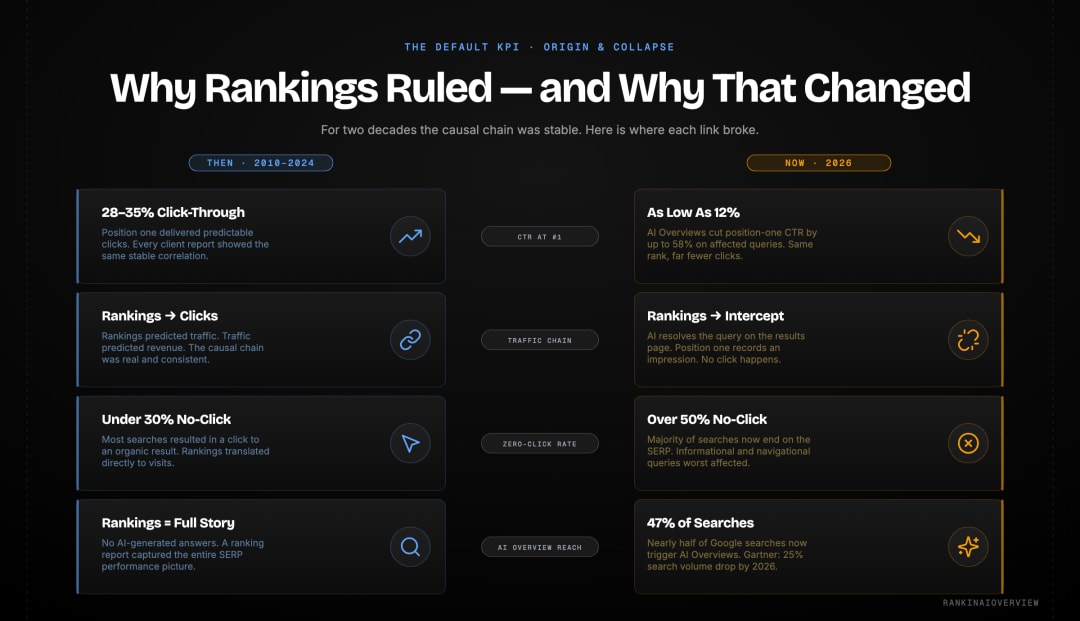
Rankings became the default SEO KPI because they were the most legible proxy for an otherwise invisible process. A stable Google algorithm meant that position one today predicted position one next week. Traffic followed rankings reliably. Revenue followed traffic. The metric worked because the causal chain it represented was real and consistent. That chain is now broken for a significant portion of queries. |
|---|
For twenty years, the relationship between ranking position and organic traffic was stable enough to build reporting frameworks around. Position one delivered approximately 28 to 35 percent click-through rate. Position two delivered 15 to 20 percent. Every position lower delivered meaningfully less. This predictability made rankings a reliable leading indicator for traffic and a usable proxy for revenue potential.
Rank tracking tools like Ahrefs and Semrush built their core products around this metric and educated an entire generation of marketers and clients to evaluate SEO performance through ranking reports. Monthly ranking updates became the standard agency deliverable. The metric was simple, comparable across time, and legible to non-practitioners. These are genuinely valuable properties for a reporting KPI.
The problem is not that rankings became the default KPI. Going beyond keyword rankings is a response to a real structural change: zero-click searches now account for more than half of all queries. AI Overviews appear in up to 47% of Google searches, reducing click-through rates for position one by up to 58% on affected queries. Position one still predicts position one next week. It no longer reliably predicts the traffic it used to.
What Can Rankings Still Tell You in 2026?
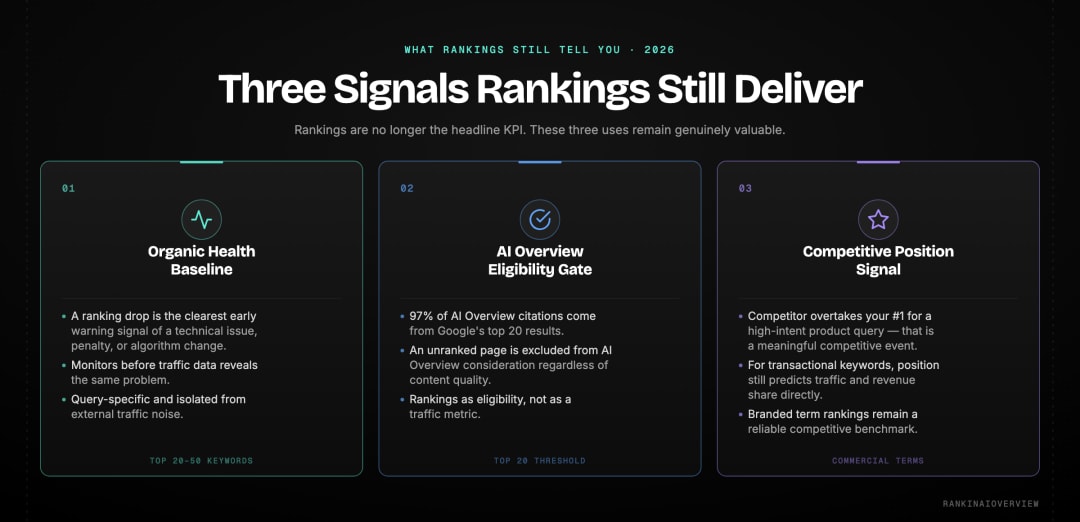
Rankings remain genuinely useful as a diagnostic and eligibility signal. They are just no longer sufficient as the primary success metric for most content types. Understanding exactly what rankings do and do not tell you is the starting point for building a reporting stack that serves both the SEO professional and the client. |
|---|
Rankings as Organic Health Baseline
A significant ranking drop is still one of the clearest signals that something is wrong. A technical issue, an algorithm penalty, a backlink profile problem, or a competitor surge can all manifest as a ranking decline before they manifest in traffic data. Monitoring ranking position for your top 20 to 50 target keywords monthly provides an early warning system that pure traffic monitoring misses because traffic can be volatile for unrelated reasons.
This is the enduring value of rankings as a health metric: they track a stable, query-specific signal isolated from external traffic factors. Ranking for "project management software comparison" is a specific, measurable fact about your page's authority for that query. Losing that ranking tells you something precise happened that warrants investigation. New SEO KPIs do not provide this specific diagnostic value, which is why the new SEO KPIs framework keeps rankings as a health metric rather than eliminating them entirely.
Rankings as Retrieval Eligibility Signal
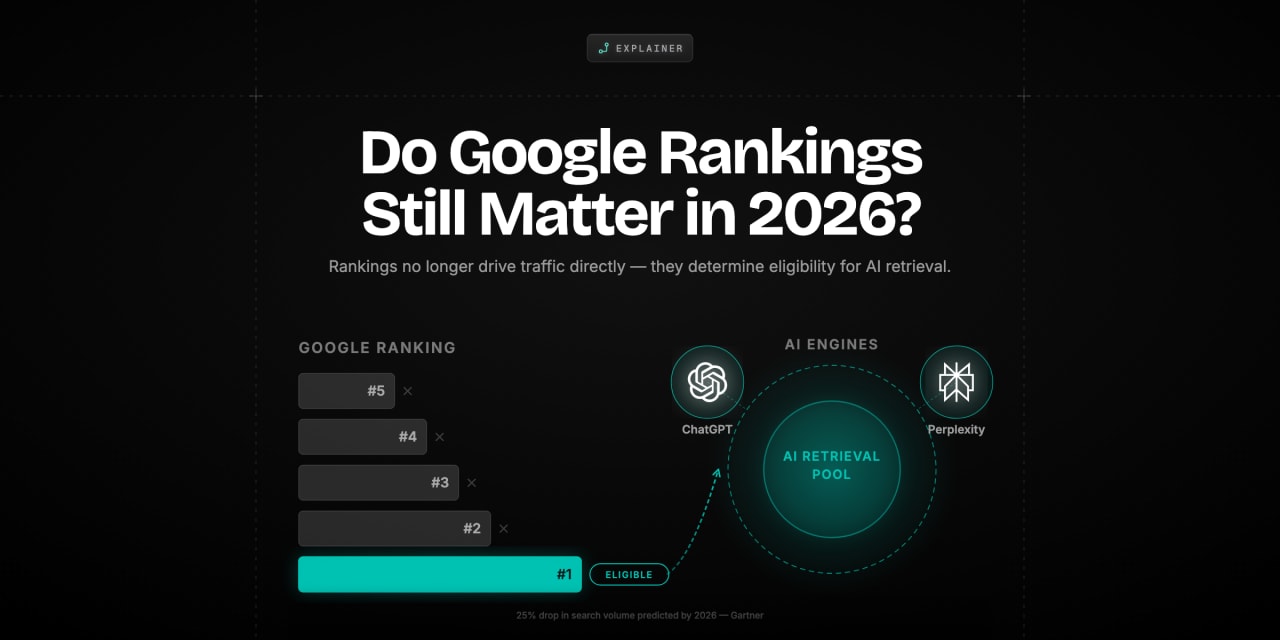
Beyond keyword rankings as a pure traffic metric, ranking position determines AI Overview retrieval eligibility. Google's official documentation confirms that AI-generated answers pull from the same index that powers traditional search. Approximately 97% of AI Overview citations come from Google's top 20 results. A page not ranking in the top 20 is effectively excluded from Google AI Overview citation, regardless of how well-structured its content is. Rankings as AI eligibility signal is a new use for an old metric.
Rankings as Competitive Position Indicator
Ranking position for commercial and branded terms still provides a reliable competitive benchmark. If a competitor overtakes your position one ranking for a high-intent product query, that is a meaningful competitive event regardless of the zero-click dynamic affecting informational queries. For transactional keywords where clicks still occur at high rates, ranking position remains a direct predictor of traffic and revenue share.
What Do Rankings Fail to Tell You in 2026?

Three specific blind spots in ranking-only reporting are causing practitioners to misread performance and present an incomplete picture to clients. Each blind spot represents a dimension of search visibility that is now commercially significant but entirely invisible in a traditional ranking report. |
|---|
Whether You Appear in AI-Generated Answers
A page can hold position one for a target keyword and receive zero AI Overview citations for the same query. The two signals are evaluated by different systems using different criteria. Google's ranking algorithm evaluates backlinks, keyword relevance, and technical health. Google's AI Overview retrieval evaluates content extractability, entity clarity, E-E-A-T signals, and semantic completeness. A perfect ranking report can coexist with complete AI invisibility.
This is the most commercially significant blind spot in ranking-only reporting for informational content. When a user searches an informational query and receives an AI Overview that does not cite your brand, your ranking is still recorded as a win in your tracking tool. But the user never sees your page. The traffic that your position one used to deliver is intercepted and resolved on the search results page. AI visibility metrics for clients are the measurement layer that reveals this gap.
Whether Zero-Click Behaviour Is Eroding Your Traffic
Rankings and organic impressions can remain stable while organic clicks decline. AI Overviews resolve a growing share of informational queries before users reach the organic results. A brand holding position one for a definition query may see its impressions hold steady in Google Search Console while clicks from that query fall significantly. The ranking report shows no change. The traffic report tells a different story.
Separating impression data from click data in Google Search Console is the free diagnostic for this problem. Filter your top 20 queries by impressions and sort by click-through rate change over a 12-month period. Queries with stable or rising impressions and falling click-through rates are the ones where AI Overviews are intercepting your traffic. These are the pages where ranking maintenance is not enough and AI citation optimisation is the right next investment.
Whether Your Brand Is Being Recommended Across AI Discovery
Ranking reports do not measure whether your brand is cited in ChatGPT or Perplexity. A brand with strong Google rankings but no Reddit presence, no G2 reviews, and no Wikipedia entry can be virtually absent from the AI citation layer that is increasingly shaping buyer consideration in B2B and professional services. The ranking report shows green. The AI visibility audit shows red. Only one of them reflects how your buyers are actually discovering your brand.
“ The problem is clients still want to see rankings. Educating them is the hard part. I now report on organic traffic, AI mentions, branded search growth, and conversion. Rankings are number four. SEO practitioner r/AISEOInsider community, Reddit 2026 Source: Reddit: Are Rankings Still What Matters in SEO? |
|---|
What Is the Modern SEO Metrics Stack?

The modern SEO metrics stack uses three tiers in order of strategic importance. Business outcomes sit at the top because they are what SEO ultimately serves. Visibility KPIs sit in the middle because they predict business outcomes. Health metrics including rankings sit at the bottom because they predict visibility KPI performance. Each tier informs the next. Reporting in this sequence changes what clients ask about and how SEO investment gets justified. |
|---|
Primary KPIs: Business Outcomes
Every SEO report should lead with business outcomes. For e-commerce, this is organic revenue and organic conversion rate. For lead generation, this is organic leads and cost per organic lead. For brand growth programmes, this is new user acquisition from organic and non-branded traffic growth. These are the SEO metrics that matter 2026 at the executive level: the ones a CFO or CEO can evaluate without understanding search and use to justify the investment.
The practical implementation: create a one-page executive summary that shows three to four business outcome metrics at the top of every report. Revenue from organic. Leads from organic. Organic conversion rate. These numbers should be year-over-year comparisons, not month-over-month, to smooth out seasonal variation. Everything else in the report supports these numbers.
Visibility KPIs: Search Presence
Visibility KPIs are the leading indicators for future business outcome performance. They measure your brand's presence across the discovery channels your buyers use. In 2026, SEO metrics that matter here include: AI citation frequency (how often your brand or URL appears in AI-generated answers for target queries), share of voice in AI responses (your brand mentions versus competitors for a defined query set), and branded search volume growth from Google Search Console (the downstream signal that AI mentions are creating brand awareness that converts to direct intent).
For AI citation frequency and share of voice tracking, the tool options in 2026 are clearer than they were twelve months ago. For agencies needing affordable multi-brand tracking with share of voice reporting, this is where investing in a dedicated AI visibility monitoring tool like Rankscale or Peec AI pays off. For teams that are not yet ready to invest, manual testing in ChatGPT and Perplexity across twenty to thirty target queries weekly produces baseline data without any subscription cost.
Organic click-through rate by query type is the bridge metric between the visibility and business outcome tiers. It shows where AI Overviews are eroding the click value of rankings you are maintaining. Segmenting queries into informational, commercial, and branded groups in Google Search Console and tracking click-through rate trends separately for each group is a fifteen-minute monthly analysis that reveals exactly where your rankings are still delivering clicks and where they are not.
Health Metrics: Operational Signals
Health metrics including keyword rankings belong in the third tier, not the first. They are diagnostic and operational. They tell your team when something needs investigation. They do not tell your client whether SEO is working. Report on SEO without rankings as the headline by moving them to an appendix or a dedicated health section that practitioners review but clients do not need to discuss at every meeting.
The health metrics tier includes: keyword ranking position for top 20 to 50 target terms (reviewed monthly for significant changes), Core Web Vitals (reviewed monthly to ensure technical health baseline), indexed page count and coverage errors from Google Search Console (reviewed monthly), and backlink profile quality (reviewed quarterly rather than monthly). These metrics require attention when they change negatively. They do not require the same executive attention as business outcomes or visibility KPIs.
Tier | Metric | Review Frequency | Who Reviews It | Primary Purpose |
|---|---|---|---|---|
1: Business Outcomes | Organic revenue / leads | Monthly (YoY) | Client \+ practitioner | Justify investment, demonstrate ROI |
1: Business Outcomes | Organic conversion rate by source | Monthly | Client \+ practitioner | Quality assessment of organic traffic |
2: Visibility KPIs | AI citation frequency | Weekly | Practitioner, shared monthly | Lead indicator for brand awareness |
2: Visibility KPIs | Share of voice in AI responses | Weekly | Practitioner, shared monthly | Competitive positioning in AI discovery |
2: Visibility KPIs | Branded search volume growth | Monthly | Client \+ practitioner | Downstream proof that AI visibility is working |
2: Visibility KPIs | Organic CTR by query type | Monthly | Practitioner | Zero-click erosion diagnostic |
3: Health Metrics | Keyword rankings (top 20-50) | Monthly | Practitioner only | Early warning system for technical issues |
3: Health Metrics | Core Web Vitals | Monthly | Practitioner only | Technical health baseline |
3: Health Metrics | Indexed pages and coverage | Monthly | Practitioner only | Crawl and indexing health |
How Do You Transition Your Client Reporting to This Stack?

The transition happens in three steps over three months. Step one is additive: add AI visibility as a new section to existing reports without removing rankings. Step two is reordering: move business outcomes to the top of reports and AI visibility to the second section. Step three is repositioning: explicitly describe rankings as a health and eligibility metric in the report itself, using language that explains why they have moved to the third section. |
|---|
Step one is the lowest-risk starting point. Add a single paragraph to your next monthly report headed "AI Search Visibility Update." Include the number of AI Overview citations you tracked for your top ten keywords, whether your brand appeared in ChatGPT or Perplexity for three to five category queries, and the week-over-week trend in branded search volume. This addition does not threaten the existing report structure. It adds a new data layer that most clients will find immediately interesting.
Step two reorders the report around the three-tier framework. Business outcomes lead. AI visibility and organic traffic follow. Rankings and technical health appear in the appendix or a clearly labelled "site health" section. This reordering signals to clients that the way performance is measured has evolved. It also changes what they ask about at monthly meetings. Clients who used to open every review asking "what are our rankings?" will start opening them asking "how is our organic revenue?" That question is more useful for both parties.
Step three explicitly frames rankings in the context of their new role. A single sentence in the health metrics section is enough: "Keyword rankings are monitored as an eligibility signal for AI Overviews and as an early warning system for technical issues. They are not reported as a primary success indicator because click-through rates from top rankings vary significantly depending on whether AI Overviews are present for those queries." Most clients accept this framing quickly once they understand the mechanism.
How Do You Explain AI Visibility to a Sceptical Client?
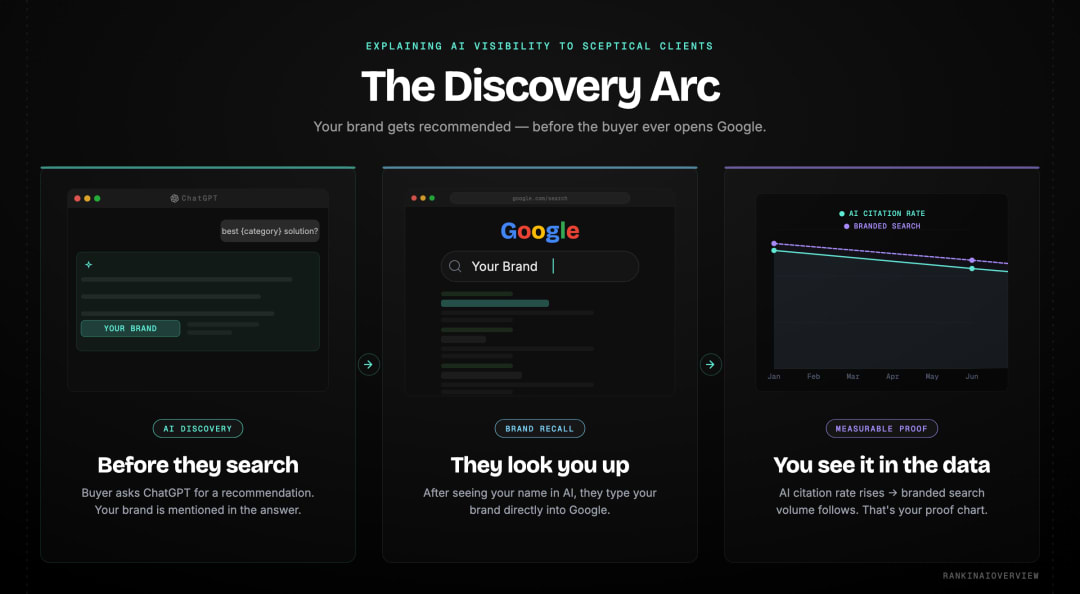
The most effective explanation connects AI visibility directly to a business outcome the client already cares about. Abstract explanations about citation frequency and generative engines create more confusion than clarity. The explanation that works: "When your buyers research this category in ChatGPT, your brand being mentioned there is like having a trusted colleague recommend you before the buyer ever visits your website. We are now tracking how often that happens." |
|---|
Avoid technical language in the first explanation. Terms like RAG, citation frequency, and generative engine optimisation confuse rather than persuade. The explanation that lands is relational: "There are now two places your buyers can discover you before they ever reach Google. We need to be present in both. Google rankings get us considered when they search. AI answers get us considered before they search."
The PR analogy is the most consistently effective framing for non-technical clients. Google ranking is like having the best shelf position in a bookshop: you are visible when someone comes in looking. AI search visibility is like being recommended in a review in a trusted magazine: people encounter your brand before they even decide to visit the bookshop. Both matter. They work at different stages of the discovery journey. New SEO KPIs that measure AI visibility are how we track the magazine coverage.
Connecting AI visibility to a number the client already reviews is the final step. Branded search volume from Google Search Console is the most legible downstream proxy. When AI mentions your brand, some proportion of those users follow up with a branded Google search. Show the client the correlation between months where your AI citation rate improved and months where branded search volume grew. That correlation makes the abstract AI visibility metrics for clients concrete and credible in a single chart.
Conclusion
Rankings still matter. They just do not belong at the top of the report anymore. The modern SEO metrics stack leads with business outcomes, follows with AI visibility and organic presence, and uses rankings as the health and eligibility baseline they have become. When you report SEO without rankings at the headline, both your strategic decisions and your client relationships improve.
Beyond keyword rankings is not a destination you arrive at overnight. It is a transition that happens in stages, with client education at each step. Start by adding AI visibility metrics for clients to your existing reports. Reorder the sections over the following months. Explain the new role of rankings in one clear sentence. The metrics that matter in 2026 are the ones that connect to business outcomes. RANK IN AI OVERVIEW covers how AI engines evaluate and cite brands across all major platforms in depth across its content library.
Internal Linking Recommendations
-
Link from "AI visibility vs Google rankings" article using anchor text: "SEO metrics that matter 2026"
-
Link from "AI rank tracker tools" article using anchor text: "AI visibility metrics for clients"
-
Link from "is ranking still the goal" article using anchor text: "new SEO KPIs"
-
Link from "rankings and AI search future" article using anchor text: "beyond keyword rankings"
Frequently asked questions
Should I stop reporting keyword rankings to clients?+
No, but you should demote them from the headline to the health section. Rankings remain genuinely useful as an organic health baseline and as a proxy for AI Overview retrieval eligibility. Removing them entirely creates a monitoring gap that your team will miss. The change is not what you track but where it appears in the report and what role you explain it is playing. Rankings move from the primary KPI to the diagnostic layer.
What tool gives the most complete picture of SEO success in 2026?+
No single tool covers all three tiers of the modern reporting stack. Google Search Console gives you organic performance, branded search, and click-through rate trends at no cost. Ahrefs or Semrush gives you keyword ranking position and backlink health. A dedicated AI visibility tool such as Rankscale, Peec AI, or Profound gives you citation frequency and share of voice in AI responses. The complete 2026 reporting stack requires at least three tools across the three tiers.
How do I explain AI search visibility to a sceptical client?+
Connect it to a business outcome they already recognise. The clearest version: "When your buyers ask ChatGPT to recommend a solution in your category, we want your brand mentioned in that answer. We now track how often that happens. It is the equivalent of earned media, except it happens in the moment of active research rather than weeks before. And we can see it improving in the data." Then show the branded search growth correlation. Numbers that move in the right direction are more persuasive than any explanation.
Explore with AI
Share this