
Does AI-Generated Content Hurt or Help Your SEO Rankings in 2026?
Does Google penalise AI-generated content? Does it rank? We give you the definitive, evidence-based answer on AI content and SEO in 2026\.
Key Highlights
-
AI generated content SEO 2026 is not a binary question of penalty or no penalty. Google's position is clear: the test is helpfulness and E-E-A-T, not production method. AI content that is helpful, expert, and original ranks. Generic, mass-produced AI content does not
-
Does AI content rank on Google? Yes, when it passes the helpfulness test. No, when it is thin, generic, and devoid of the Experience signals that Google's Search Quality Rater Guidelines require
-
Google AI content penalty applies to content designed to manipulate rankings, not to content created with AI assistance that genuinely serves users. This distinction is made explicit in Google's official guidance
-
AI writing and SEO combine most effectively through a three-part framework: AI drafts the structure and outline, a human expert adds the experience layer, and an SEO review finalises keyword optimisation and internal links
-
Use AI for blog posts ranking requires the human expertise layer that raw AI output lacks. First-person experience, specific named examples, unique data, and verifiable author credentials are the signals that differentiate high-performing AI-assisted content from thin AI content
-
To use AI for blog posts ranking effectively, treat AI as a structural accelerator and treat the experience layer as the non-negotiable editorial standard that no AI tool can substitute for
-
Teams that use AI for blog posts ranking at scale need a documented editorial workflow that specifies exactly what the human expert must add to each AI draft before publication
-
The ironic finding: AI engines like ChatGPT and Perplexity are somewhat less likely to cite pure AI-generated content because they prioritise sources that demonstrate human expertise and lived experience
-
AI detection tools are unreliable and should not guide editorial decisions. Focus on quality signals, E-E-A-T compliance, and genuine helpfulness rather than on detection avoidance
Every content team in 2026 is using AI to write, or is considering it. The question is not whether to use AI but how much editing the output requires and what quality the result achieves. Google's official position on AI generated content SEO 2026 is nuanced and frequently misrepresented. According to Google's official guidance on AI-generated content, the production method is not the determining factor. The determining factor is whether the content is "helpful, reliable, people-first" content that demonstrates Experience, Expertise, Authoritativeness, and Trustworthiness. AI content that meets this standard ranks. AI content that does not, whether or not it was written with AI assistance, does not.
The anxiety in the content marketing community is understandable. Teams that built content programmes on AI output at scale have seen inconsistent results. Some AI-heavy programmes rank competitively. Others have been devalued in core updates. The difference between those outcomes is not the presence of AI in the writing process. It is the presence or absence of genuine human expertise, specific experience signals, and original insight in the output.
This guide gives you the definitive answer on AI writing and SEO in 2026, including what Google's guidance actually says, what is happening in search results, the three-part framework for AI content that ranks, how AI-generated content performs in AI search citation, and the practical guidelines for using AI in your content programme without compromising quality signals.
What Is Google's Official Position on AI-Generated Content?
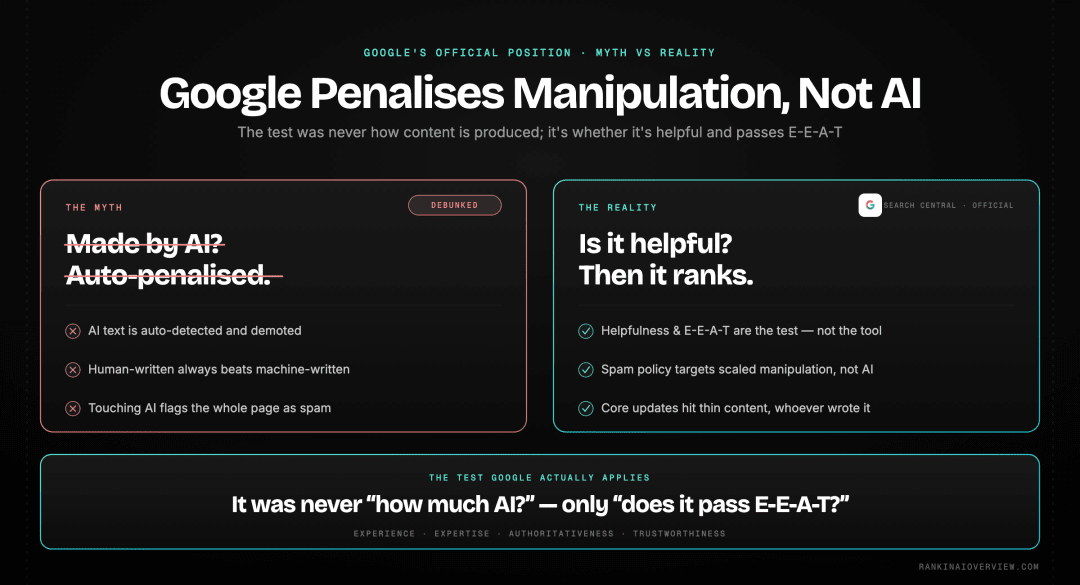
Google does not ban AI-generated content. Google bans content that is created primarily to manipulate search rankings, regardless of whether AI was involved in its creation. The test is helpfulness and E-E-A-T compliance. Content that is genuinely helpful, demonstrates real expertise, and serves users rather than algorithms can rank whether it was written by a human, assisted by AI, or drafted entirely by AI and edited by a human expert.
Google's official guidance states this explicitly: "Our focus on the quality of content, rather than how content is produced, is a useful guide." The guidance further confirms that using AI to generate content is not itself a violation of Google's spam policies. What is a violation is using automation, including AI, "to generate content with the primary purpose of manipulating rankings in Search." This distinction matters enormously for editorial policy: AI-assisted content that genuinely serves users is not subject to any Google AI content penalty. Mass-produced AI spam targeting rankings without serving users is.
Google's Search Quality Rater Guidelines define Experience, Expertise, Authoritativeness, and Trustworthiness as the primary quality evaluation framework. These guidelines inform the machine learning signals that Google's ranking algorithm applies. The E-E-A-T framework does not ask who or what produced the content. It asks whether the content demonstrates real expertise and lived experience, whether the author is credible and verifiable, and whether the content is trustworthy as a source of information. These are properties that AI alone cannot produce but that AI-assisted human writing can achieve.
The practical implication: the question "does Google penalise AI content?" is the wrong question. The right question is "does my content pass the E-E-A-T test?" No Google AI content penalty applies when content is genuinely helpful. A Google AI content penalty is triggered by spam behaviour: mass-produced, low-quality content generated primarily to manipulate rankings. Content that passes the E-E-A-T test has no Google AI content penalty risk regardless of how much AI was involved in its production.
What Is Actually Happening in Search Results With AI Content?
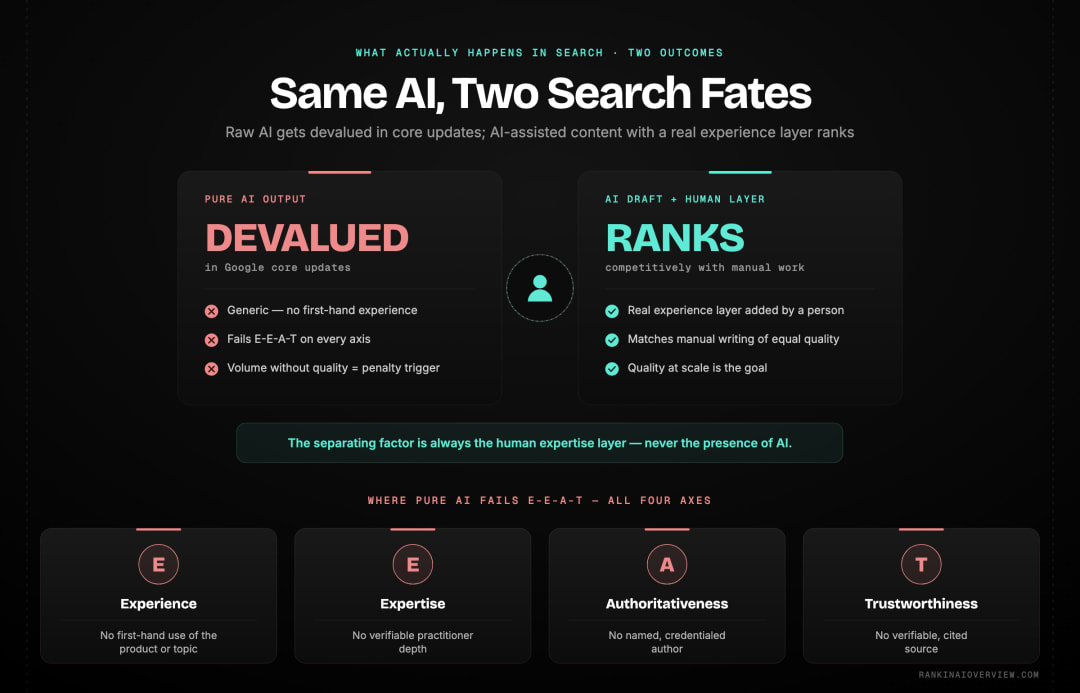
Search result data in 2026 shows two distinct patterns for AI-generated content. Thin, generic AI content without human expertise signals is consistently being devalued in core updates and manual reviews. AI-assisted content where a human expert has added first-person experience, specific data, and original perspective is ranking competitively alongside manually written content of equivalent quality. The separating factor is always the human expertise layer, not the presence of AI in the workflow.
Raw AI Content: The Evidence Against It
Generic AI content without a human expertise layer fails the E-E-A-T test on the Experience dimension alone. AI cannot have first-hand experience with the products, services, or situations it is describing. Content that says "many users find that this tool helps with their workflow" is a statement that could have been written without any direct experience. Content that says "after testing this tool across twelve client accounts over six months, I found three specific patterns that consistently improve workflow efficiency" is a statement that requires lived experience to produce.
Google's core updates since 2023 have consistently reduced rankings for sites with high proportions of generic, thin AI content. The pattern in the practitioner community is consistent: sites that published large volumes of AI content without adding specific experience signals, named examples, or original data saw ranking declines during core updates. Sites that published AI-assisted content with strong experience layers maintained or improved rankings during the same updates. The differentiating variable is experience layer depth, not AI involvement.
The mass-production risk is the most significant concern for teams using AI at scale. A team publishing 50 AI-assisted articles per month where each article passes the E-E-A-T test is building a strong content programme. A team publishing 200 AI-generated articles per month where most lack experience signals is building a large liability. Volume without quality is the Google AI content penalty trigger. Quality at scale is what use AI for blog posts ranking programmes require.
AI-Assisted Content With Human Expertise: The Evidence For It
Practitioner case studies consistently show that AI-assisted content with strong experience layers ranks competitively with manually written content. The mechanism is straightforward: if the output meets Google's E-E-A-T criteria, Google's ranking algorithm does not distinguish it from manually written content that meets the same criteria. AI writing and SEO are fully compatible when the human expertise layer is treated as the non-negotiable editorial standard, not an optional enhancement.
The pattern in high-performing AI-assisted content is consistent. AI generates the structural outline and initial draft. A subject-matter expert reviews the draft and adds: at least one first-person experience claim with specific detail, at least one named example or case study drawn from direct experience, and any unique data or perspective that only someone with direct knowledge could produce. An SEO review finalises keyword integration, meta tags, and internal links. The result is content that passes the E-E-A-T test and ranks competitively.
“ Google does not care how you made it. They care if it is helpful. Full stop. AI content plus personal experience added in ranks as well or better than manual writing. The risk is not the AI. It is the lack of originality and unique insights. Content marketing practitioner r/DigitalMarketingHack community, Reddit 2026 Source: Reddit: Does AI-Generated Content Affect SEO Rankings in 2026?
What Is the 3-Part Framework for AI Content That Ranks?
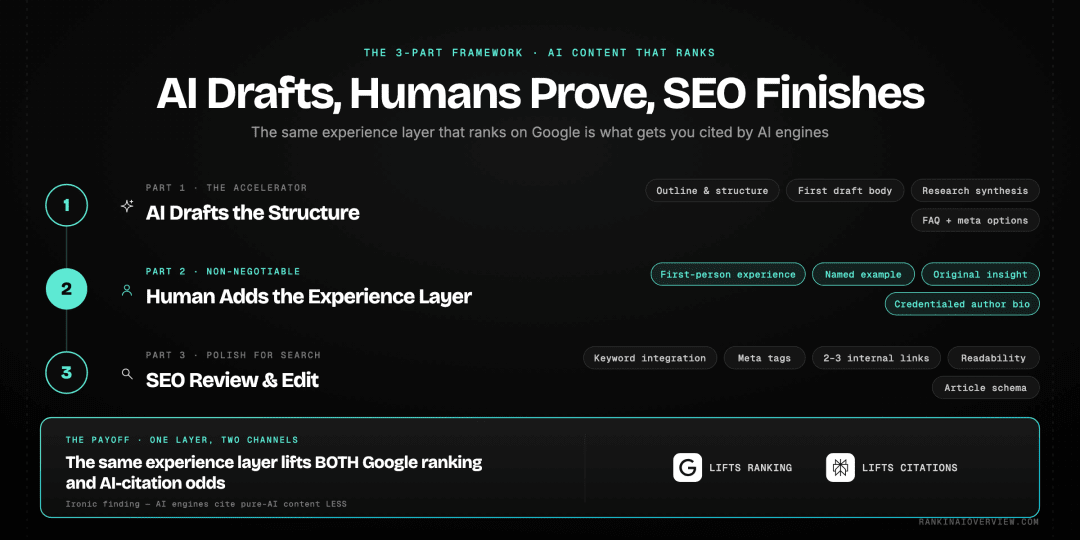
The three-part framework that produces AI-assisted content with competitive ranking performance treats AI as the structural accelerator, human expertise as the non-negotiable editorial layer, and SEO review as the optimisation pass. Each part has a specific function and a specific quality standard. Skipping or underinvesting in any of the three produces a content type that either lacks structure, lacks experience signals, or lacks keyword alignment.
Part 1: AI Drafts the Structure
AI is most effective at the structural and synthesis stage: producing an article outline, generating an initial draft that covers the key topics in the correct order, synthesising research from multiple sources into a coherent narrative, and drafting meta descriptions, FAQ questions, and section headings. These are tasks where AI produces useful material faster than most human writers and where the quality of the AI output is a reasonable starting point for expert editing.
-
AI drafts: full article outline with H2 and H3 structure
-
AI generates: initial draft covering all sections with factual baseline content
-
AI synthesises: research findings from multiple source documents into a coherent narrative
-
AI produces: FAQ questions based on the topic and target queries
-
AI writes: meta descriptions and title tag options for editorial selection
The quality check at this stage: is the structural outline comprehensive? Does it cover the full scope of what a genuinely helpful article on this topic would address? Is any section thin or vague in a way that would require substantial expansion? The AI draft is a starting point, not a finished product. Teams that publish at the AI draft stage without editorial intervention are producing the thin, generic content that underperforms in rankings.
Part 2: Human Adds the Experience Layer
The human expertise layer is the non-negotiable editorial stage that transforms AI draft into E-E-A-T-compliant content. This stage requires a subject-matter expert who has direct experience with the topic: a practitioner who has tested the tools being compared, a specialist who has worked with the specific situation being addressed, or an analyst who has studied the data being discussed. The experience layer cannot be faked, and attempts to simulate it produce the "many users find" and "experts recommend" language that Google's quality raters identify as thin content.
-
Experience claim: "After testing this approach across 15 client projects over 8 months, I consistently found..."
-
Named example: "A B2B SaaS company we worked with in Q1 2026 reduced their review cycle by 34% by applying this specific tactic"
-
Original insight: a perspective on the topic that requires direct experience to produce, not just synthesis of existing sources
-
Author bio: a named author with specific credentials relevant to the topic, visible at the top or bottom of the article
-
Credential signal: "As a compliance consultant who has audited over 200 financial services firms, I have observed..."
Part 3: SEO Review and Edit
The SEO review stage ensures keyword integration, meta optimisation, internal link placement, and readability standards. This stage is separable from the experience layer because it requires different skills: keyword research knowledge, site architecture understanding, and search intent awareness. The SEO review should not be the stage where experience signals are added. If the SEO reviewer is the only person who has reviewed the AI draft before publication, the experience layer has been skipped and the content is at high risk of E-E-A-T failure.
-
Keyword integration: ensure the primary keyword and secondary keywords are used naturally throughout without forced repetition
-
Meta tags: finalise the title tag and meta description based on the AI-generated options and target query intent
-
Internal links: add at least two to three relevant internal links to related content in the same topic cluster
-
Readability: check sentence length, paragraph length, and heading frequency meet the site's editorial standards
-
Schema markup: add Article schema with the named author and publication date before publishing
What Is the E-E-A-T Problem With Pure AI Content?
Pure AI content fails the E-E-A-T test on all four dimensions simultaneously. On Experience: AI has no first-hand experience. On Expertise: AI cannot verify credentials or demonstrate practitioner-level knowledge from direct engagement. On Authoritativeness: content without a named human author lacks author-level authority signals. On Trustworthiness: content with no verifiable author and no external corroboration of its claims is treated as low-trust. These four failures explain why raw AI content underperforms regardless of its factual accuracy.
The Experience failure is the most fundamental. Google's 2022 addition of the first E (Experience) to the E-A-T framework was a direct response to the growth of AI-generated content. Experience means first-hand, direct involvement with the subject. AI engines have read about every topic but have not experienced any topic. Content that claims "I found this approach to be significantly more effective in practice" without any verifiable first-hand involvement is a claim AI can generate but not honestly make.
The Authoritativeness failure is the most structurally significant for rankings. A named author with verifiable credentials, a linked biographical page, and a professional track record in the relevant field builds author-level authority signals that feed into Google's topical authority evaluation. Anonymous content or content attributed to a generic "editorial team" loses all of this signal. AI writing and SEO are compatible when authorship is real and attributed. They are incompatible when authorship is fictitious or absent.
Does AI-Generated Content Affect AI Search Citation Likelihood?
In a somewhat ironic finding, AI engines are somewhat less likely to cite pure AI-generated content than content with strong human experience signals. The reason is the same mechanism that determines Google ranking: AI engines prioritise sources that demonstrate genuine expertise and lived experience. A Perplexity response that cites a practitioner sharing first-hand results is more trustworthy than one citing a generic overview that could have been produced without any direct subject knowledge.
The same quality layer that helps Google ranking also helps AI citation probability. A post that opens with "In my eighteen months testing AI search tools across forty client accounts, I found three consistent patterns" is both more likely to rank on Google and more likely to be cited by Perplexity than a post that opens with "AI search tools are becoming increasingly important for modern businesses." The first claims direct experience. The second claims nothing that requires experience to produce.
This convergence means the investment in the human experience layer serves both channels simultaneously. AI generated content SEO 2026 strategies that include a genuine experience layer outperform in both traditional search and AI citation because both systems evaluate content through the same trust lens. The experience layer is not just an E-E-A-T checkbox. It is the signal that distinguishes original, citable content from generic, skippable content across every search and citation system simultaneously.
Practical Guidelines: How Much AI Is Too Much?
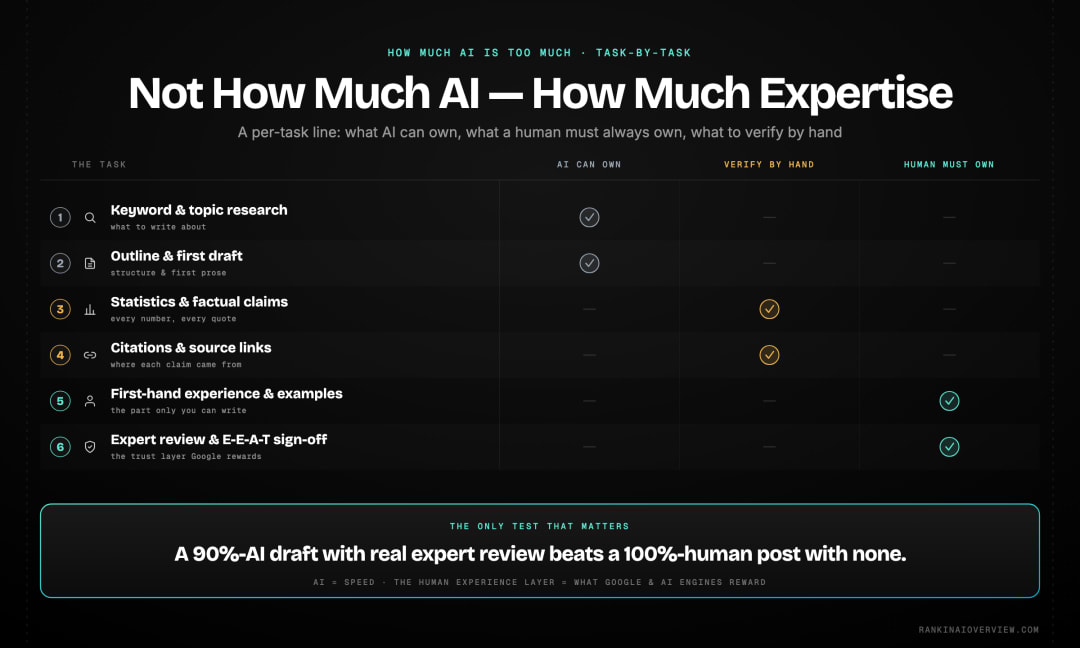
The correct question is not "how much AI?" but "how much human expertise?" The volume of AI involvement in the writing process is irrelevant. The depth of human experience and expertise in the final output is the only measure that matters. A post that was 90% AI-drafted and 10% expert-reviewed can outperform a post that was 100% human-written if the expert review adds substantive experience signals that the human-only version lacks.
| Content Task | Use AI | Require Human | Why |
|---|---|---|---|
| Article outline and structure | Yes. AI produces comprehensive outlines efficiently | Human review for gaps | AI outlines are good starting points but may miss nuance |
| Initial draft body content | Yes. AI synthesises factual content well | Expert review required | AI cannot add experience signals. Expert must insert these |
| First-person experience claims | Never | Always | AI cannot have first-hand experience. This must be human-authored |
| Named examples and case studies | No. AI fabricates or uses generic examples | Always | Real named examples require real direct experience |
| Statistics and data points | Review carefully. AI can fabricate statistics | Human verification required | Verify every statistic against the named primary source before publishing |
| Meta descriptions and title tags | Yes. AI produces good options quickly | Human selection and edit | Choose the option that best matches target query intent |
| FAQ questions | Yes. AI produces relevant question sets | Human review for authenticity | Use People Also Ask and GSC data to verify these are real questions |
| Author bio | Never | Always | Author bio must reflect a real person with real credentials |
The red flag test: read your AI-assisted article and ask whether it could have been written by anyone without direct experience in the topic. If yes, the experience layer is insufficient. A post about project management software that does not mention specific situations the author encountered, specific outcomes they measured, or specific limitations they discovered in practice could have been written by anyone who spent an hour reading about project management software. That is the thin content that underperforms.
Conclusion
Does AI content rank? This is the headline question, and the answer is yes with conditions. Does AI content rank when it passes the E-E-A-T test? Yes, consistently and competitively with manually written content. Does AI content rank when it is generic and thin? No. Does AI content rank when it has a genuine human experience layer? Yes. The production method is not the variable. The quality standard is.
AI content is not a Google penalty. It is a quality opportunity. The brands using AI as an accelerator for experienced, expert writing are producing more content faster with competitive ranking performance. The brands publishing raw AI output at volume without expert review are underperforming in core updates and failing the E-E-A-T test at scale.
The differentiator is always the human expertise layer. AI generates the structure. A subject-matter expert adds the experience signals that neither AI nor any writer without direct knowledge can produce. An SEO review finalises the optimisation. That three-part workflow produces AI generated content SEO 2026 results that are indistinguishable from the best manually written content because the quality test is identical. RANK IN AI OVERVIEW covers how AI engines evaluate content quality and what drives citation across all major platforms in depth across its content library.
Frequently asked questions
Will Google eventually penalise all AI-generated content?+
No, based on Google's consistent position since 2023\. Google has explicitly stated that its focus is on content quality, not production method. The direction of AI search development is toward better identification of helpfulness and E-E-A-T signals, not toward penalising AI tools. Teams that use AI as an accelerator for genuinely expert, helpful content are building in the direction Google rewards. Teams that use AI to scale generic content at low cost are building in the direction Google penalises. The tool itself is not the issue.
How do I add experience signals to AI-written content?+
Five specific additions transform generic AI content into E-E-A-T-compliant content. First, add a named author bio with specific credentials relevant to the article topic. Second, include at least one first-person experience claim with specific detail: time period, context, outcome. Third, include at least one named example drawn from direct experience rather than hypothetical. Fourth, add a section or paragraph that contains a specific opinion or conclusion that only someone with direct experience could reach. Fifth, verify every factual claim against a named primary source and link to it. These additions typically take 30 to 60 minutes per article and produce the E-E-A-T signals that differentiate high-performing AI-assisted content.
Does word count of AI content affect its ranking performance?+
Not directly. Google's ranking systems do not reward word count as a metric. What they reward is comprehensive topic coverage, which often correlates with word count but is not the same thing. A 1,200 word AI-assisted article that covers its topic completely with specific experience signals and original data outperforms a 3,500 word AI-generated article that pads its length with generic context-setting and vague tips. Write until you have fully covered the topic with specific, verifiable, experience-based information. Stop when the topic is covered. Word count is a by-product, not a goal.
Explore with AI
Share this


