AI Rank Checker: How to Check If AI Search Cites Your Brand
Learn how an AI rank checker works, how to check your brand in ChatGPT, Perplexity and Google AI Overviews for free, and how to turn citation gaps into a plan.
Key Highlights
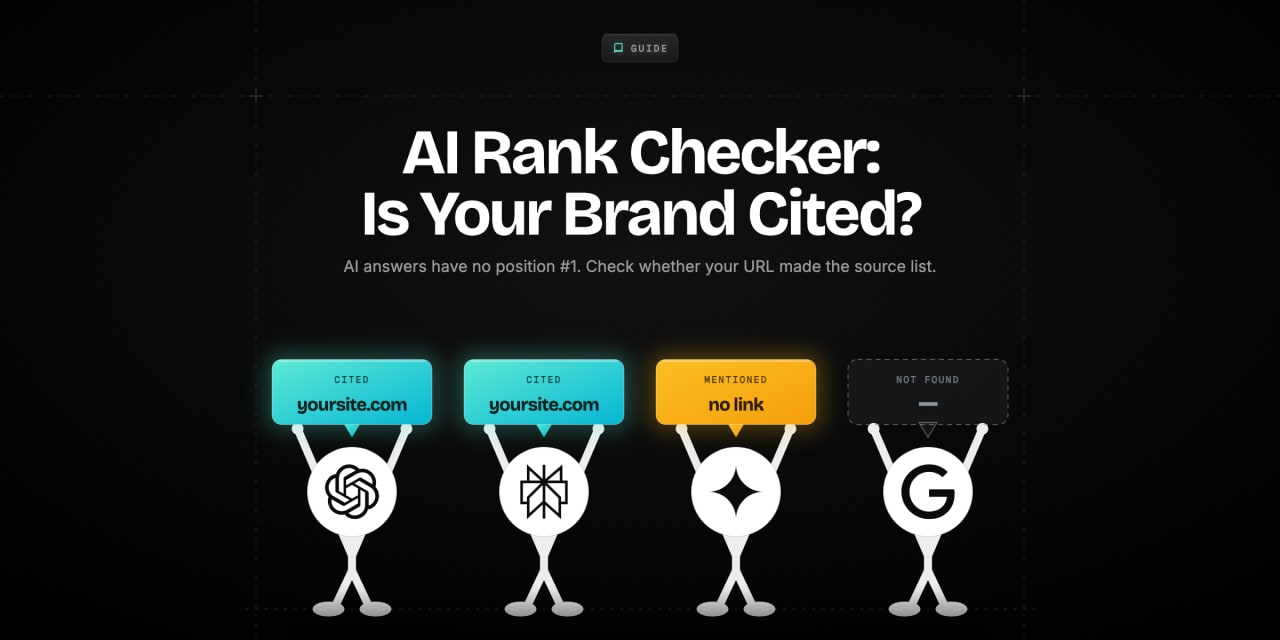
- An AI rank checker shows whether ChatGPT, Perplexity, Gemini and Google AI Overviews mention or cite your brand when buyers ask questions in your niche.
- AI answers have no fixed positions, so an AI rank checker measures citation and mention share, not a number from one to ten.
- You can check manually for free by running your key questions through each engine, then move to a tool once scale makes manual work impractical.
- Citations matter more than mentions, because a cited URL confirms your content was used and can earn a click.
- Academic research shows targeted content changes can lift visibility in AI answers by up to 40%.
- RANK IN AI OVERVIEW publishes research on this shift, offers a free AI visibility audit, and is building an AI visibility tool that is coming soon.
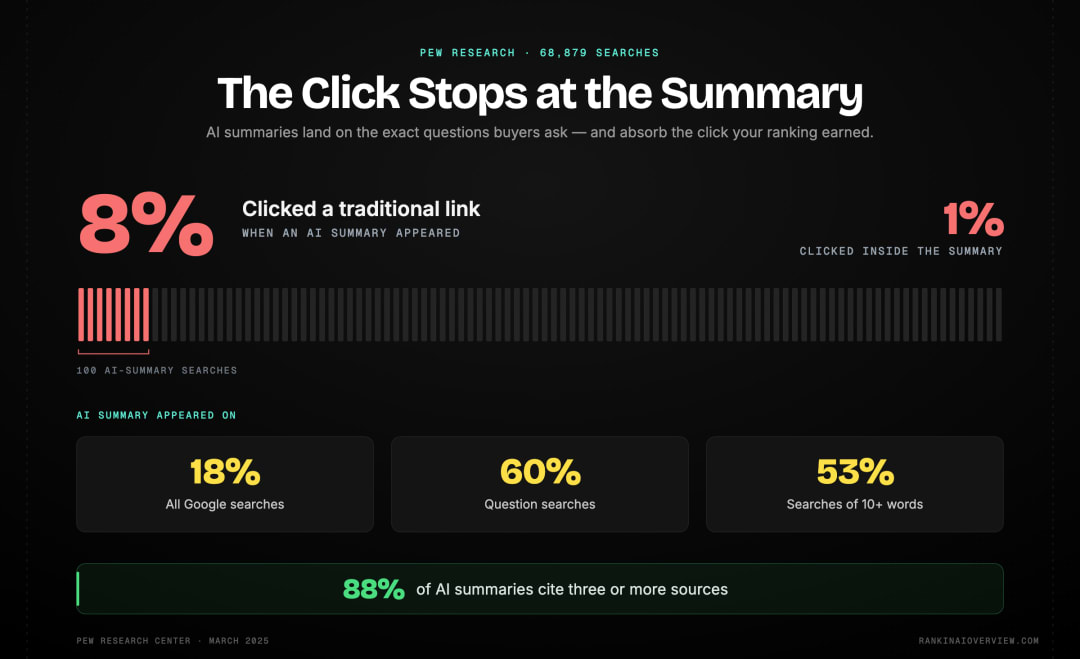
Most brands still check a Google position and stop there. Meanwhile a large share of their audience never sees a ranked list. According to Pew Research Center's analysis of 68,879 searches from 900 US adults, around 18% of Google searches in March 2025 produced an AI summary, and users clicked a traditional link in just 8% of those searches. A rank check on Google cannot see any of that.
That gap is exactly what an AI rank checker closes. It answers a question your normal tools cannot. When a customer asks an answer engine about your category, do you appear at all? And if you do, are you a passing mention or a cited source that can actually send a visitor? These are very different outcomes, and only an AI rank checker separates them.
This guide shows you how to check your AI rankings, both by hand and with tools. It explains what "rank" means when there is no ranked list, the free method you can run today, the metrics that matter, and how to turn a citation gap into a content plan. Read it as a practical playbook, not a theory piece.
What Is an AI Rank Checker?
An AI rank checker is a tool or process that checks whether AI search engines mention or cite your brand in their answers. It runs your questions through engines like ChatGPT, Perplexity, Gemini and Google AI Overviews, then records your presence, your citations and how you compare to rivals.
A traditional rank checker looks up your position for a keyword in a list of blue links. An AI rank checker does something different, because AI answers have no numbered list. It checks presence and citation instead, telling you whether you are part of the answer and whether your URL is used as a source.
Think of it as a visibility check for the answer era. Instead of "where do I rank for this keyword", it asks "when someone asks this question, am I in the response, and is my link cited". That reframing is the whole point, and it is why checking AI visibility needs a different method from checking rankings.
Why Do You Need to Check Your AI Rankings Now?
You need to check AI rankings because a growing share of search now ends inside an AI answer, where classic rank tracking is blind. Checking reveals whether AI engines trust your content enough to surface it, and where rivals win answers you should own.
The audience has already moved. Pew's data shows that AI summaries are not a rare edge case. Question-based searches produced an AI summary 60% of the time, and longer searches of ten or more words triggered one in 53% of cases. These are exactly the research questions where buyers form a view of your category, and they often resolve without a click.
The behaviour behind the numbers is stark. According to the same Pew Research study, only 1% of AI summary views led to a click on a link inside the summary, and users ended their browsing session 26% of the time after seeing an AI summary, against 16% without one. A strong Google position means less when the click never happens.
There is an upside worth checking for too. The typical AI summary cited three or more sources in 88% of cases, so the answer names several brands rather than a single winner. That matters because it means citation is not a zero-sum race for one slot. Being one of those cited brands is winnable, and an AI rank checker tells you whether you are.
"We continue to send billions of clicks to the web every day and are committed to prioritising the web in our AI experiences in Search." Liz Reid, VP and Head of Google Search. Source: Google's official Search blog
What Does "Rank" Mean in AI Search?
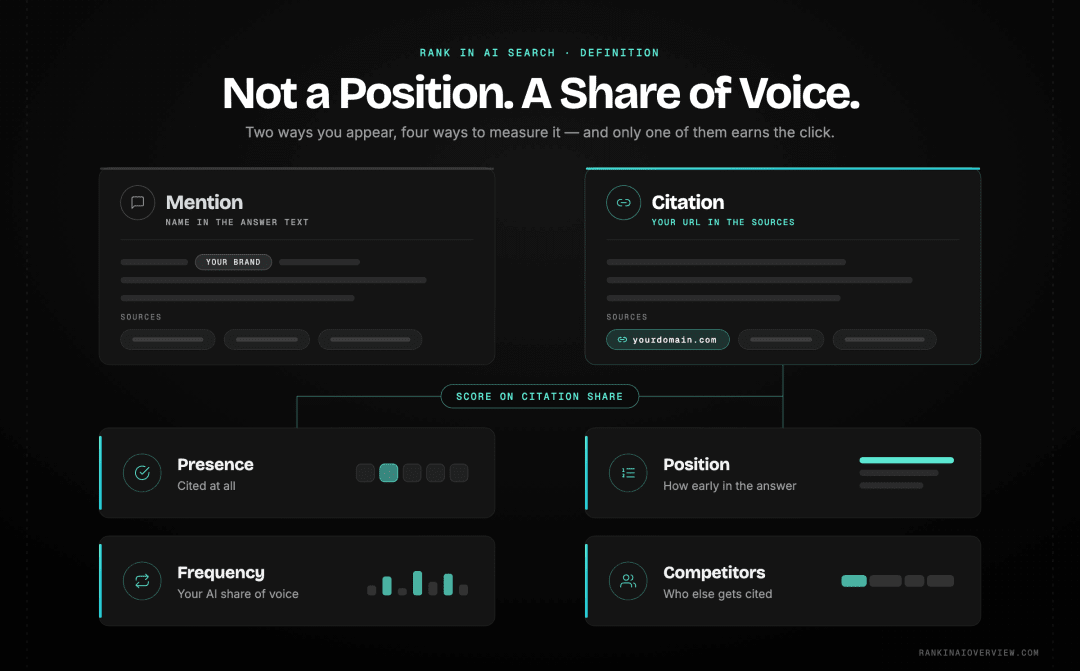
In AI search, "rank" does not mean a fixed position. It means how often you are mentioned or cited across the answers an engine gives to relevant questions. Your rank is really a share of voice: your presence and citations compared to rivals over many prompts. If a rankless ranking still feels strange, our explainer on what ranking means in AI search unpacks the shift in full.
The distinction between the two things you are checking matters more than any single score. Get this right and the rest of your measurement falls into place.
Mentions: When AI Names Your Brand
A mention is when your brand name appears in the answer text. It builds awareness and signals that the model associates you with the topic. Mentions are valuable for recall, but they do not always include a link, so a mention alone may not send a visitor.
Mentions still matter as a leading signal. When an engine names you without linking, it shows the model already connects your brand to the subject. That association is the groundwork that citations are built on, so track mentions as an early indicator, not a final goal.
Citations: When AI Uses Your Page as a Source
A citation is when your URL is listed as a source the engine used. Citations are higher value, because they confirm your content was referenced and they can produce a click. When you check your AI rank, citations are the outcome to prioritise, since they tie visibility to traffic.
This is why a good AI rank checker weights citations above mentions. Being named is pleasant. Being cited is what moves a visitor from the answer to your site. Measure both, but judge success on citation share for the questions that sit closest to a buying decision.
How Do You Check Your AI Rankings for Free?
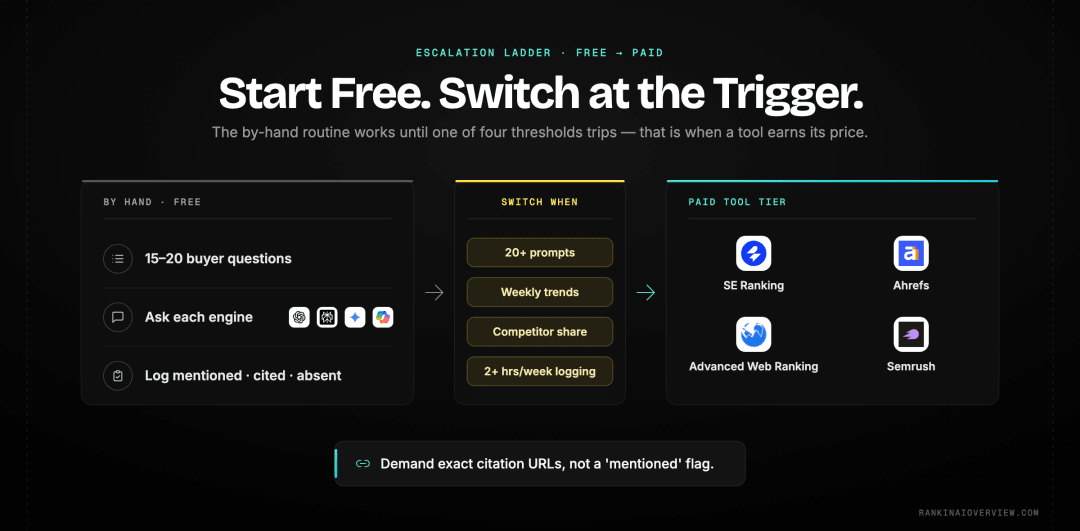
You can check your AI rankings for free by running your key questions through each AI engine yourself and recording whether you are mentioned or cited. It costs nothing but time, and it works well for a small, focused set of prompts.
The manual method also teaches you how the engines behave in your niche, which makes you a far smarter buyer if you later choose a tool. Follow a fixed routine so your results stay comparable from month to month.
The Step-By-Step Manual Check
Start with a tight, representative prompt set rather than a sprawling list. Quality of prompts beats quantity here, because you will run them repeatedly.
- List 15 to 20 questions real buyers ask about your category, in their own words.
- Include your brand name, your main product categories and a few competitor comparison questions.
- Ask each question in ChatGPT, Perplexity, Gemini and Microsoft Copilot.
- Record whether your brand is mentioned, cited or absent for each one.
- Note which rivals appear, and how often, for the same questions.
Run prompts in a fresh or signed-out session where possible, so personalisation does not skew results. Try two or three phrasings of the same question, because answers change with wording.
Why One Check Is Never Enough
AI engines generate non-deterministic answers, so a single check is unreliable. A query that cites you today might not cite you tomorrow, even with no change on your side. This is the single biggest mistake first-time checkers make.
The fix is repetition. Run your prompt set on a fixed schedule, monthly at minimum, and compare the pattern rather than any one result. A trend across several runs is trustworthy in a way that a snapshot never is, which is why tracking eventually beats manual spot checks.
What Metrics Should an AI Rank Check Measure?
An AI rank check should measure citation presence, citation position, citation frequency and competitor position. Together these turn scattered observations into a share-of-voice picture you can manage, rather than a vague sense of whether you show up.
The four metrics work as a set. Presence tells you if you appear at all. Position tells you how prominently. Frequency tells you your overall share across prompts and engines. Competitor position tells you the gap you need to close.
- Citation presence: is your domain cited for a given query at all.
- Citation position: if cited, where in the answer your source appears, with earlier being more valuable.
- Citation frequency: how often your domain is cited across all tracked queries and engines, which is your AI share of voice.
- Competitor position: where rivals appear for the same questions, so you can see who to overtake.
Weight these toward the prompts closest to a buying decision. Ten citations on high-intent questions are worth more than a hundred on trivia, so a small set of buyer-focused prompts gives a truer read than a broad, low-intent list. For a deeper breakdown, our guide to the AI visibility metrics that actually matter separates the signal from the vanity numbers.
Also read: The best AI rank trackers, compared for citation tracking
What Are the Best AI Rank Checker Tools?
The best AI rank checker tools automate what manual checking cannot: many prompts, exact citation URLs, competitor comparison and multiple regions on a schedule. They range from free previews to full monitoring suites, so match the tool to your scale.
Manual checking is fine for a handful of prompts in one market. Once you need dozens of prompts, several regions and week-over-week trends, a tool costs less in money than the manual routine costs in hours.
| Tool | What it checks | Best for |
|---|---|---|
| SE Ranking AI Search Toolkit | AI answers tied to tracked prompts, plus linked and unlinked brand references | Teams wanting AI tracking beside traditional rankings |
| Advanced Web Ranking AI Brand Mentions | How often your brand is named, linked or cited in AI summaries | Adding an AI column to existing keyword reports |
| Ahrefs AI Visibility Checker | A limited free preview of brand mentions across major AI platforms | A quick first read before committing budget |
| Semrush AI search visibility tools | Brand presence across AI answers and prompts | Marketers already inside the Semrush suite |
Whatever you choose, confirm the tool captures exact citation URLs, not just a "you were mentioned" flag. The URL is what tells you which page earned the reference, which is the difference between a report and an action list. If you are weighing whether a paid tool is worth it at all, our honest look at whether AI rank tracker tools actually work is a useful gut check.
When Should You Use a Tool Instead of Checking Manually?
Use a tool once manual checking eats too much time or misses too much. Tools track many prompts automatically, capture exact citation URLs, monitor rivals, cover multiple regions and alert you when your visibility shifts, which manual checks cannot do at scale.
There are clear signs you have outgrown the manual routine. Once any of these is true, the spreadsheet becomes the bottleneck.
- You are tracking more than 20 prompts, or several markets.
- You need week-over-week trends, not one-off snapshots.
- You want competitor share of voice, not just your own presence.
- Logging results by hand takes more than a couple of hours a week.
When you evaluate tools, prioritise citation-URL capture, competitor data and consistent scheduling over a long feature list. A tool that reliably answers "who is cited for my buyer questions, and how is that changing" is worth more than one with a busier dashboard.
How Do You Improve Your AI Rankings After Checking?
You improve your AI rankings by fixing the content behind questions where you are absent. Answer directly, structure content so machines can extract it, add credible data and quotations, and build the trust signals AI engines use to choose sources.
The good news is that the levers are known and measurable. Research from Princeton University, Georgia Tech, the Allen Institute for AI and IIT Delhi tested this directly. Their GEO study on arXiv found that targeted methods, led by citing sources, adding quotations and adding statistics, boosted a page's visibility in generative answers by up to 40% across a benchmark of thousands of queries.
What Actually Moves Citations
Translate that research into a short, repeatable checklist. Each item maps to how engines extract and trust content.
- Lead each section with a direct, complete answer, then expand.
- Add specific statistics and credible quotations, which the GEO study identified as top-performing changes.
- Structure content with clear question-style headings and short paragraphs.
- Keep content current, since freshness helps citation on evolving topics.
- Earn credible mentions elsewhere so engines recognise your brand as a trusted source.
Prioritise the fixes by intent and effort. Start with the buyer-focused prompts where you are absent, and with the fastest structural changes, since leading with a direct answer costs little and often flips a page from ignored to cited. Slower work, such as earning credible mentions and building topical depth, compounds underneath and protects the gains once you have them. Running both tracks together is what turns a single check into steady progress rather than a one-off spike.
After you make changes, re-run your check. The point of an AI rank checker is not a one-time score. It is a loop: measure, improve the weak prompts, then measure again to confirm your citations grew. That loop, repeated, is what steadily lifts your share of voice.
What Is the Difference Between Checking and Tracking AI Rankings?
Checking is a one-time snapshot of whether AI engines cite you right now. Tracking is the ongoing, scheduled version that reveals trends. Checking answers "where am I today", and tracking answers "am I improving", which is the more useful question.
A single check is a fine starting point, but AI answers fluctuate as models update and content changes. Without repeating the check on a schedule, you cannot separate a real gain from normal noise. Tracking turns scattered snapshots into a trend you can act on and defend to a stakeholder.
For most brands the path is simple. Check manually first to learn the landscape, then move to tracking once you want to prove that your optimisation works. The two are stages of the same discipline, not competing choices.
How Do AI Engines Differ When You Check Them?
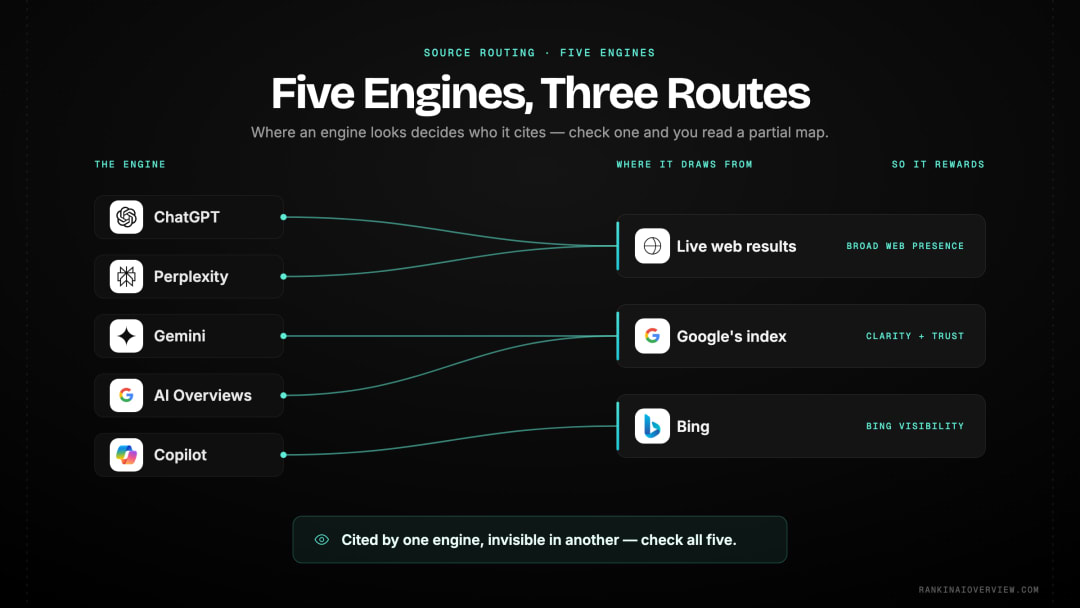
AI engines differ in how they retrieve and cite, so a full AI rank check covers several. ChatGPT and Perplexity lean on live web results and show sources, Gemini and Google AI Overviews draw partly on Google's index, and Microsoft Copilot leans on Bing.
These differences change where you appear. A page cited by Perplexity may be absent from Gemini, because each engine selects sources on its own signals. Checking only one engine gives you a partial and often misleading read, so treat cross-engine coverage as part of the check, not an optional extra.
The differences also shape your fixes. Google AI Overviews reward the same clarity and trust that help you rank, while ChatGPT and Perplexity reward broad web presence and clean, citable passages. A single content improvement can lift you across several engines at once, but only if you know which engines are ignoring you today. That is why the manual routine and every serious tool run the same prompts across multiple engines rather than one.
Also read: How Google AI Overviews actually choose their sources
Coverage matters for another reason. Buyers do not all use the same engine, so a blind spot on one engine is a blind spot for a real segment of your audience. Checking each engine in turn shows you which segments you are already reaching and which you are missing entirely.
What Mistakes Should You Avoid When Checking AI Rankings?
The common mistakes are checking once, tracking too many low-intent prompts, ignoring the mention-versus-citation split, and letting personalisation skew results. Each produces a misleading read that sends your optimisation effort in the wrong direction.
Checking once is the biggest error. Because answers are non-deterministic, a single result can flatter or alarm you for no real reason. Always judge the pattern across several runs on a fixed schedule, and never make a decision from one screenshot.
The second trap is measuring the wrong prompts. A long list of low-intent questions inflates your apparent presence while hiding losses on the queries that drive revenue. Keep your prompt set focused on buyer-intent questions, and weight your reporting toward those.
The third is treating a mention as a win. A mention without a citation builds awareness but may send no traffic, so a checker that only counts brand names overstates your progress. Separate the two metrics, and hold yourself to citation share on the questions that matter most to revenue. Avoid these four mistakes and your AI rank check becomes a reliable instrument for real decisions rather than a source of false comfort.
Conclusion
Checking a Google position alone now leaves out a large, high-intent slice of your audience. An AI rank checker fills that blind spot by showing whether ChatGPT, Perplexity, Gemini and Google AI Overviews actually surface your brand. Start manually and for free, then scale to a tool once the work outgrows a spreadsheet.
Remember what you are really measuring. Not a number from one to ten, but your share of mentions and citations across the answers your buyers see. Citations are the prize, because they tie visibility to traffic, and improving them is a repeatable loop of check, fix and re-check.
Build the habit into your monthly routine. Run a fixed prompt set across each engine, record citation share against your rivals, fix the weakest questions, then check again. Done consistently, an AI rank checker stops being a curiosity and becomes the earliest warning system you have for how AI search sees your brand.
For deeper research on how AI engines evaluate and cite brands, RANK IN AI OVERVIEW covers this space across its content library, and its dedicated AI visibility tool is coming soon.
Ready to see how AI engines represent your brand? Here is your free AI visibility audit.
Frequently asked questions
What is an AI rank checker?+
An AI rank checker is a tool or process that checks whether engines like ChatGPT, Perplexity and Google AI Overviews mention or cite your brand in their answers. It measures presence and citations rather than a numbered search position.
Can I check my AI rankings for free?+
Yes. Ask your key questions in each AI engine and record whether you are mentioned or cited. It works well for a small prompt set but does not scale to many prompts, markets or trends, where a tool becomes worthwhile.
How is checking AI rank different from checking Google rank?+
Google rank checking returns a numbered position in a results list. AI rank checking measures whether you appear in generated answers and whether your URL is cited, because AI engines produce answers rather than a fixed list of ranked links.
How often should I check my AI rankings?+
Check monthly at minimum, since AI answers shift as models and content change. Competitive topics may warrant weekly checks. Regular checking lets you catch a drop in visibility before it costs you meaningful traffic.
Do mentions or citations matter more in AI search?+
Citations matter more, because they confirm your URL was used as a source and can send a click. Mentions build awareness but may not include a link. A good AI rank check tracks both and weights citations higher.
Why does my brand rank on Google but not appear in AI answers?+
Ranking on Google does not guarantee AI citation. Engines choose sources on clarity, structure, depth and trust, not only your Google position. Pages that rank well can still be too dense or unfocused for an engine to cite.
Explore with AI
Share this


