What Actually Affects AI Search Visibility? Separating Fact from Fiction in 2026
The AI SEO space is full of unsubstantiated claims and vendor hype. Here is an evidence-based breakdown of what genuinely affects AI search visibility and what does not.

Key Highlights
-
AI search visibility factors 2026: the most well-evidenced ones are Google top-20 ranking for AIO, structured data, topical authority, and Reddit and UGC platform presence. Evidence for everything else varies
-
The AI search visibility factors 2026 list is shorter than most vendor content implies. Four factors are strongly supported. Three are partially supported. The rest warrant scepticism
-
Understanding which AI search visibility factors 2026 have controlled experimental backing versus which are marketing claims is the core skill this guide develops
-
GEO tactics that work: content directness, FAQPage schema, entity consistency, and genuine off-site community participation. These have consistent practitioner confirmation and academic support
-
GEO tactics that work are almost all derivable from the Princeton GEO paper: add statistics, add citations, add quotations, use clear structure, and ensure comprehensive topic coverage
-
GEO tactics that work consistently across platforms are those rooted in trust building. Platform-specific tactics have more variable evidence bases and warrant site-specific testing
-
Evidence-based AI SEO starts with the Princeton GEO research (2023, updated 2024) as the academic baseline and layers in controlled practitioner experiments and multi-site studies
-
Generative SEO myth busting: prompt-stuffing content to match AI query phrasing has no evidence base. Most vendor-specific ranking factor claims without supporting data should be treated as marketing
-
Generative SEO myth busting requires asking four questions about every claim: what is the data, how was it collected, what was the sample size, and has it been independently replicated
-
Generative SEO myth busting is a competitive advantage in a market where most teams implement every new claim without testing. Calibrated scepticism saves investment and directs effort more precisely
-
The most important generative SEO myth busting insight: most GEO tactics described online are good content strategy with new terminology. The principle is old. The context is new
-
What affects AI citation most reliably: content structure that enables passage-level extraction, entity clarity across the web, and third-party corroboration in sources AI engines already trust
-
Healthy scepticism is a strategic advantage in a field two to three years old where most best practices are based on pattern observation rather than controlled experiments
-
The practitioners winning in AI search right now are the ones experimenting carefully on their own sites rather than implementing every new claim without testing
Vendors want to sell you their tool. Agencies want to sell you their service. Everyone has a hot take on what makes AI search visibility work. The problem is that most of it is not backed by evidence. This guide takes a more critical approach, examining what the data and practitioner experience actually supports versus what is hype, extrapolation, or wishful thinking. According to Princeton and Georgia Tech's generative engine optimisation research, published at NeurIPS 2024, seven specific content interventions were tested in controlled conditions and found to improve AI visibility by measurably different amounts. This is the academic baseline. Everything else in the AI search visibility factors 2026 conversation should be evaluated against a similarly rigorous standard.
The AI SEO field is two to three years old. Most of what is presented as established best practice is based on practitioner pattern observation across relatively small sample sets, not controlled experiments with statistically significant results. This is not a criticism: the field is moving faster than academic research can follow. But it does mean that practitioners need to apply a consistent standard of evidence when deciding what to implement.
This guide organises the available evidence into three tiers: strongly supported claims where multiple independent data sources agree, partially supported claims where evidence exists but is mixed or limited, and largely unsubstantiated claims that are presented confidently but lack backing data. For each tier, we explain what the evidence shows, where it comes from, and how confident you should be before committing investment.
How Should You Evaluate AI SEO Claims?
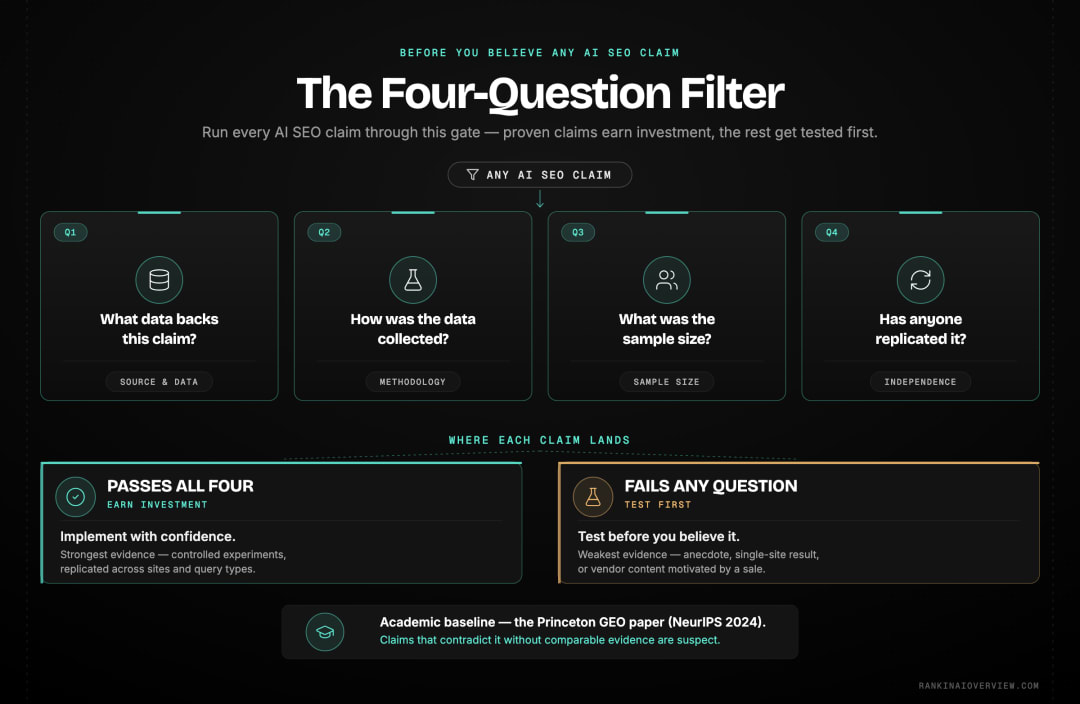
Not all evidence is equal. The strongest evidence comes from controlled experiments with defined variables and measurable outcomes, replicated across multiple sites and query types. The weakest evidence comes from anecdote, single-site observation, or vendor-produced content that is motivated by a product sale. Most AI SEO content falls somewhere between these two poles. The first question to ask of any claim: what data supports this, and how was it collected?
The three-tier evaluation framework below applies a consistent standard: Strongly Supported means multiple independent studies or large-scale practitioner experiments confirm the factor with measurable effect sizes. Partially Supported means some evidence exists but is correlational, limited in scale, or not yet replicated. Largely Unsubstantiated means the claim appears in published content without supporting data, or the supporting data is produced by parties with a commercial interest in the claim.
The primary academic source in this field is the "Generative Engine Optimization" paper by Aggarwal, Bowman, and Feng et al. from Princeton, Georgia Tech, and the Allen Institute for AI. It tested seven content interventions in controlled conditions and measured their effect on AI citation probability. It is the closest thing to a controlled experiment the field has produced at scale. Any claim that contradicts its findings without comparable evidence warrants significant scepticism. Evidence-based AI SEO begins with this paper.
What Is Strongly Supported by Evidence?

Four factors have strong, multi-source evidence supporting their role in AI search visibility. Google top-20 ranking for AI Overview citation is documented across multiple large-scale studies. Structured data reducing AI parsing ambiguity has both academic support and consistent practitioner confirmation. Topical authority increasing citation rate has strong community consensus and supporting data. Reddit and UGC platform presence in AI citations is documented across multiple platform analyses.
Google Top-20 Ranking Is Required for AI Overview Citation
The evidence here is strong and consistent. Research across multiple data sets finds that approximately 97% of Google AI Overview citations come from pages in the top 20 organic results. Google's own AI Overviews documentation confirms that AI-generated answers pull from the same index that powers traditional organic search. This is the AI search visibility factor 2026 with the most authoritative backing: it comes from Google itself and is confirmed by independent multi-site analyses.
Verdict: Strongly Supported Multiple independent studies confirm this finding. Google's own documentation corroborates it. Invest in traditional SEO as the retrieval eligibility baseline for AI Overview citation. This is not in dispute.
Structured Data Improves AI Content Extraction
The Princeton GEO research found that content with clear structural signals was cited more consistently than equivalent content without those signals. FAQPage schema specifically labels question-and-answer content as directly extractable, reducing the interpretive work AI systems must do to identify citable passages. Community practitioner experience is consistent with this finding: schema implementation is the single most frequently cited "quick win" across AI SEO discussions, with measurable improvements reported within four to six weeks of correct implementation.
Verdict: Strongly Supported Academic evidence plus strong community consensus. The mechanism is clear: schema reduces AI parsing ambiguity. Validate with Google Rich Results Test after implementation. This is a reliable investment.
Topical Authority Increases Citation Rate
Community data consistently finds that sites with complete topic clusters are cited at higher rates than sites with isolated content pieces on the same topics. The mechanism is logical: AI engines evaluating whether to cite a source prefer sources that demonstrate deep, consistent coverage of a topic over sources that have touched a topic once. GEO tactics that work at the content architecture level are almost entirely about building the cluster rather than optimising individual pages.
Verdict: Strongly Supported Strong community consensus across practitioner communities. The Princeton paper's finding that "completeness" of topic coverage correlated with higher citation rates supports this. Build the cluster before optimising individual pages.
Reddit and UGC Platforms Are Heavily Cited by AI Engines
Reddit appears consistently as one of the most-cited domains across AI platform analyses. Analyses of Perplexity citations find Reddit among the top sources regardless of category. ChatGPT training data heavily incorporates Reddit content. This is what affects AI citation for brands pursuing community-based visibility: authentic Reddit presence produces AI citation signals independently of organic ranking, making it uniquely valuable as an off-site channel.
Verdict: Strongly Supported Documented across multiple independent analyses of AI citation sources. Reddit is consistently one of the highest-cited domains on Perplexity. This is a channel worth investing in, specifically for Perplexity citation.
What Is Partially Supported by the Available Evidence?
Three factors have some evidence behind them but not enough to treat as established best practice. Content length, backlinks as an independent AI citation signal, and social proof are all plausible but the direct causal relationship with AI citation has not been cleanly isolated from confounding factors. Invest in these only after completing the strongly supported interventions.
Content Length Correlation
There is no strong direct evidence that longer content is cited more frequently by AI engines. What the evidence does support is that comprehensive topic coverage correlates with higher citation rates. These are related but not identical: a 5,000 word article that covers a topic superficially is not equivalent to a 1,500 word article that covers every dimension of that topic with specific detail. The causal factor is completeness, not length. Length is a proxy that sometimes correlates with completeness and sometimes does not.
Verdict: Partially Supported Length has not been shown to be a direct causal factor. Completeness has. Write to cover the topic fully, not to hit a word count. If achieving completeness requires 3,000 words, publish 3,000 words. If 1,200 words covers it fully, do not pad to 3,000.
Backlinks as an Independent AI Citation Signal
Backlinks correlate with Google ranking, which correlates with AI Overview citation eligibility. The question is whether backlinks have an independent causal relationship with AI citation, separate from their effect on ranking. The honest answer is that this has not been cleanly isolated. Most evidence showing a correlation between domain authority and AI citation is measuring the proxy effect through ranking rather than a direct effect.
Verdict: Partially Supported Invest in backlinks as a Google ranking input, which is itself an AI Overview eligibility prerequisite. Do not treat backlinks as a direct AI citation signal independent of ranking. The causal chain is real but indirect.
Social Proof and Review Platform Signals
The logical case for review platform signals is strong: AI engines evaluate corroboration across independent sources, and review platforms provide exactly that. But the direct causal evidence for G2 or Trustpilot review volume as an AI citation factor, isolated from other signals, is limited. Practitioner community data suggests that brands with strong review profiles are cited more consistently, but the confounding factor is that brands with strong review profiles tend to also have better off-site presence generally.
Verdict: Partially Supported Build review platform presence as part of the broader off-site corroboration programme. Treat it as one component of a multi-platform trust-building strategy rather than as a standalone AI visibility lever.
“ Treat every claim about AI ranking factors with scepticism unless there is data behind it. The evidence for structured data being an AIO factor is strong. Everything else is less clear. A lot of GEO tactics are just good content strategy repackaged with new terminology. GEO practitioner community r/GenerativeSEOstrategy, Reddit 2026 Source: Reddit: What Actually Affects AI Search Visibility?
What Is Largely Unsubstantiated? Be Sceptical of These Claims
Two categories of AI SEO advice have significant community traction but lack supporting evidence. Prompt-stuffing content to match AI query phrasing is the most widely repeated unsupported tactic. Vendor-specific ranking factor lists presented without data methodology or sample sizes should be treated as marketing content until independently verified. Applying the same scepticism you would apply to any marketing claim is the right standard.
Prompt-Stuffing Your Content
The claim is that writing content to match the exact phrasing of AI prompts, rather than writing for users, improves citation rate. There is no controlled evidence for this. The practitioner community that has tested this approach reports mixed results at best. The AIO case study documented earlier in this series explicitly found that keyword-optimised FAQ question phrasing was ignored by AI engines in favour of authentic user-phrased questions. This is the inverse of the prompt-stuffing hypothesis.
Verdict: Largely Unsubstantiated No controlled evidence supports writing for AI prompts over writing for users. The practitioner evidence that does exist points in the opposite direction. Write for the human asking the question. AI engines extract answers that satisfy human information needs, not answers that pattern-match AI system queries.
Most Vendor-Specific Ranking Factor Claims
Every tool company in the AI SEO space publishes content describing what affects AI citation. Some of this content is well-researched. Much of it is not. What affects AI citation cannot be evaluated from vendor content alone. The key questions to ask before acting on any claim: what was the sample size? What variables were controlled? Was the data collected by the vendor itself or by an independent third party? Was the finding replicated across multiple sites or reported from a single client?
Generative SEO myth busting requires applying this standard consistently. A vendor that has analysed 10,000 AI citation events with a documented methodology is producing useful data. A vendor that reports "we found X factor increased AI visibility by Y%" without explaining the methodology or sample is producing marketing content. The distinction is not about the finding itself but about the evidence quality behind it.
Verdict: Evaluate individually. Treat as marketing until independently verified Ask for methodology and sample size before implementing any vendor-specific AI ranking factor claim. The best vendors publish their research methods. The rest should be treated with proportional scepticism.
What Is the Honest State of AI SEO Knowledge in 2026?
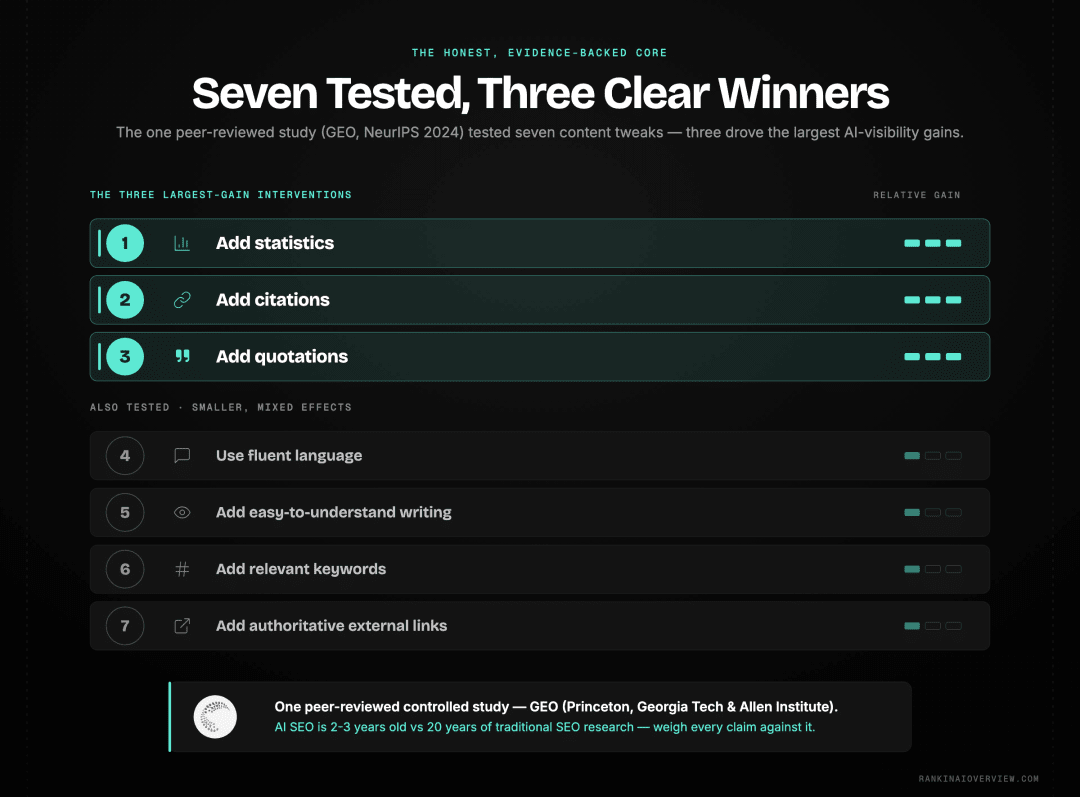
AI search as a discipline is two to three years old. The field has produced one peer-reviewed academic study of controlled interventions, a growing body of multi-site observational research, and substantial community practitioner experience. This is a meaningful evidence base, but it is significantly thinner than the equivalent evidence base for traditional SEO, which has twenty years of academic and practitioner research behind it.
The Princeton GEO paper is the anchor point for evidence-based AI SEO. Its seven tested interventions include: adding statistics, adding citations, adding quotations, using fluent language, adding easy-to-understand writing, adding relevant keywords, and adding authoritative external links. The paper found that adding statistics, quotations, and citations produced the largest improvements in AI visibility. These are the interventions with the strongest controlled experimental support.
Community practitioner research adds observational scale that the academic paper cannot match. Studies of tens of thousands of AI citation events across multiple platforms produce consistent findings about what factors correlate with citation frequency. These findings align with the academic evidence on content structure and extend it into off-site signals that the controlled study did not address. Google's Search Quality Rater Guidelines provide the authoritative framing for trust signal evaluation that applies to both Google AI Overviews and, by extension, to the broader AI search ecosystem.
The honest practitioner position in 2026 is: I am confident in the strongly supported factors, reasonably confident in the partially supported ones, and sceptical of everything else until I have tested it on my own site. This is not a position of uncertainty. It is a position of calibrated confidence that prevents over-investment in unsubstantiated tactics.
How Do You Build an Evidence-Based AI Visibility Strategy?
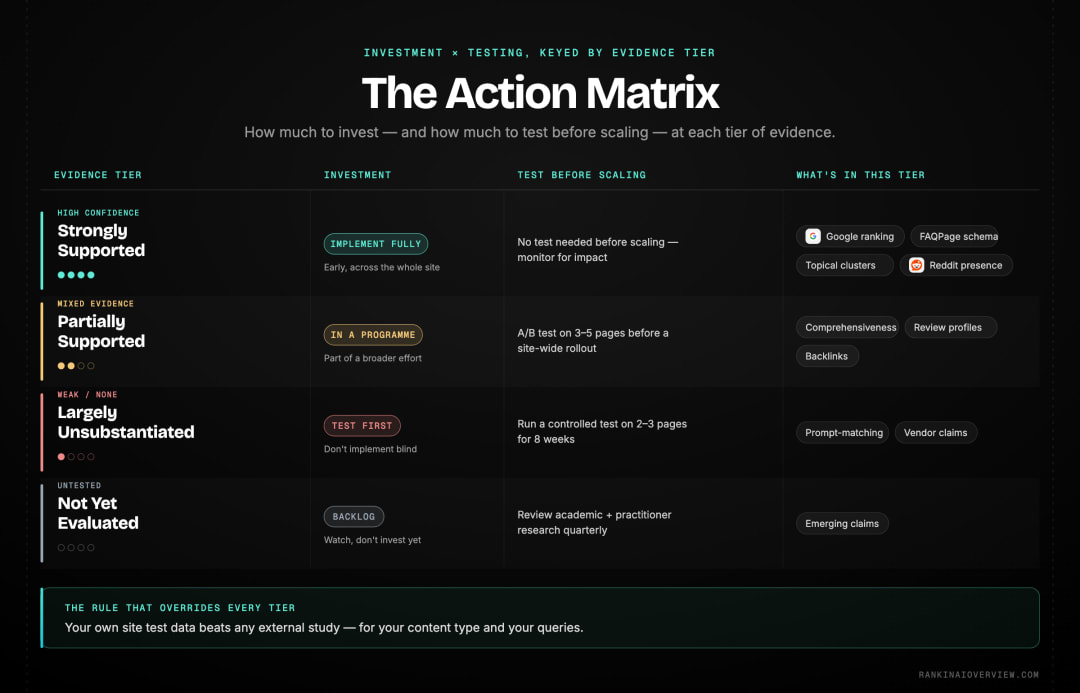
Evidence-based AI SEO strategy starts with the strongly supported factors and adds the partially supported ones only after the foundation is in place. It tests new claims on a small scale before scaling investment. It distinguishes between correlation and causation in reported findings. And it maintains a testing cadence that produces its own site-specific evidence rather than relying entirely on external reports.
| Claim Category | Investment Approach | Testing Requirement | Example Factors |
|---|---|---|---|
| Strongly Supported | Implement fully and early. No testing required before scaling | Monitor for impact confirmation | Google ranking, FAQPage schema, topical clusters, Reddit presence |
| Partially Supported | Implement as part of broader programme. Test before scaling | A/B test on 3-5 pages before site-wide rollout | Content comprehensiveness, review platform profiles, backlink strategy |
| Largely Unsubstantiated | Do not implement without site-specific test | Run controlled test on 2-3 pages for 8 weeks before any further investment | Prompt-matching content, vendor-specific ranking factor claims |
| Not Yet Evaluated | Add to testing backlog. Evaluate when evidence emerges | Monitor academic publications and practitioner research quarterly | New platform-specific signals, emerging AI search features |
Testing on your own site is the most valuable evidence you can produce. A controlled experiment, even on a small scale, tells you what works for your specific content type, your specific industry, and your specific target queries. External research tells you what worked for other sites in other categories. Your own test data is more directly applicable than any published study.
Conclusion
The AI SEO space rewards critical thinkers. The practitioners winning in AI search right now are the ones who start with what is well-evidenced, test everything else before scaling, and apply the same evidence standards to AI SEO claims that they would apply to any investment decision. Evidence-based AI SEO is not cautious or slow. It is efficient: it concentrates investment on factors that actually move the needle rather than on the latest hot take.
Build the strongly supported foundation: Google ranking for retrieval eligibility, FAQPage schema for extractability, topical authority for citation frequency, and Reddit presence for Perplexity coverage. Test the partially supported factors on a small scale before scaling. Ignore the unsubstantiated ones until controlled evidence emerges. RANK IN AI OVERVIEW tracks the evidence behind AI search visibility claims as the field develops in depth across its content library.
Frequently asked questions
How do I evaluate AI SEO advice I read online?+
Ask four questions before acting on any AI SEO claim. What data supports it? How was the data collected? What was the sample size? Has it been replicated independently? Claims backed by large-scale multi-site analysis with documented methodology deserve more weight than claims from single-site observations or vendor-produced content. The Princeton GEO paper is the academic baseline: any claim that contradicts its controlled findings without comparable evidence should be treated with significant scepticism.
What is the most evidence-backed change I can make for AI visibility?+
Implementing [FAQPage schema](https://schema.org/FAQPage) correctly on long-form content pages, combined with rewriting page openings to lead with a direct 40 to 60 word answer, has the strongest combined evidence base of any single-category investment. Both interventions are supported by the Princeton GEO research, consistent community practitioner experience, and Google's own documentation. Both can be implemented in under two hours per page. Both produce measurable improvements within four to six weeks of implementation and validation.
Are there academic studies on AI search ranking factors?+
Yes. The primary peer-reviewed study is ["Generative Engine Optimization" by Aggarwal et al.](https://arxiv.org/abs/2311.09735), published at NeurIPS 2024 by researchers from Princeton, Georgia Tech, and the Allen Institute for AI. It remains the most rigorous controlled study of AI citation factors published to date. A NeurIPS 2024 paper on LLM self-preference bias by Panickssery, Bowman, and Feng at [arXiv 2404.13076](https://arxiv.org/abs/2404.13076) provides the academic baseline for understanding AI citation selection behaviour. Both papers are freely available and should be read before investing in any AI visibility programme.
Explore with AI
Share this