Best Pro Rank Tracker Alternatives in 2026: 8 Tools Compared
Looking for a Pro Rank Tracker alternative? Compare eight AI visibility and rank tracking tools on depth, price and fit, and pick the one that suits you.

Key Highlights
- Pro Rank Tracker is a dependable traditional tracker, but teams centred on AI citations often need a deeper, purpose-built alternative.
- The strongest alternatives split into dedicated AI visibility platforms, AI-aware SEO suites and other affordable trackers.
- Peec AI and Profound lead on AI analytics depth, while Nightwatch and SE Ranking pair traditional rankings with AI tracking.
- Otterly.ai and LLM Pulse suit smaller teams that want citation monitoring without enterprise pricing.
- The right choice depends on whether your work is anchored in Google positions or in AI citation share.
- RANK IN AI OVERVIEW studies how brands earn AI citations, offers a free AI visibility audit, and has a scoring tool arriving soon.
Pro Rank Tracker earned its reputation on one thing: reliable daily positions. That is still valuable, yet the reason so many teams now search for a Pro Rank Tracker alternative sits outside traditional search entirely. According to Stanford HAI's AI Index, 78% of organisations reported using AI in at least one business function in 2024, up from 55% a year earlier, with generative AI adoption reaching roughly 70% of organisations. Buyers now research inside AI, and a tracker built for blue links only sees part of that.
That is the itch this guide scratches. A traditional rank tracker with a light AI layer is enough for some teams and a poor fit for others, and the difference decides whether you should switch, add a second tool, or stay put. Choosing badly wastes budget on features you will not use or leaves a blind spot exactly where your buyers are forming opinions.
This comparison looks at eight Pro Rank Tracker alternatives across three groups: dedicated AI visibility platforms, AI-aware SEO suites, and other affordable trackers. For each you get a plain assessment of what it does, where it shines, and who it suits, followed by a side-by-side table and a simple way to choose. The goal is a decision you can defend, not a longer shopping list.
Why Look for a Pro Rank Tracker Alternative?
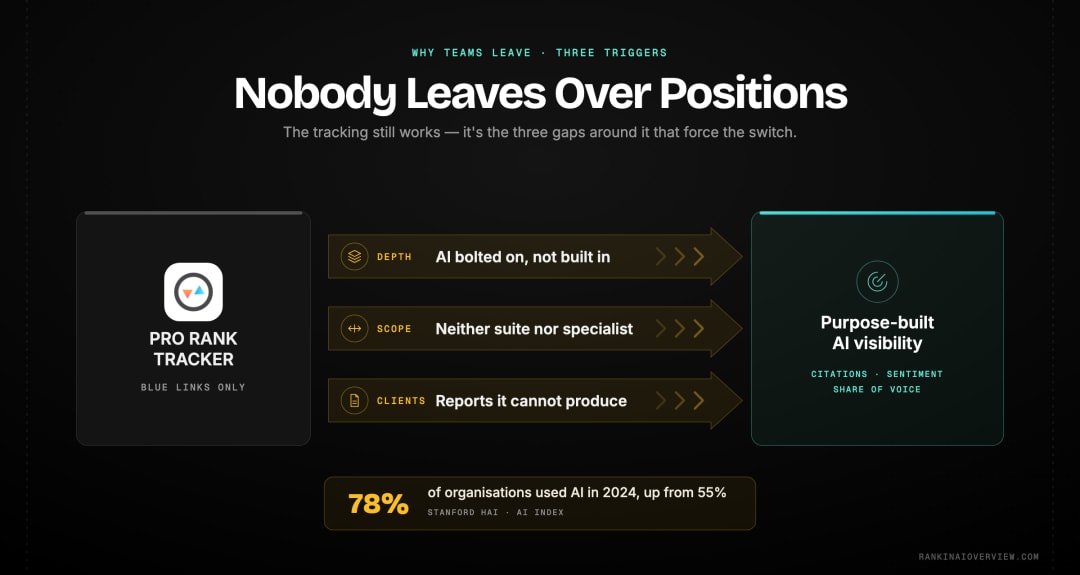
You look for a Pro Rank Tracker alternative when your programme needs deeper AI citation analysis, broader engine coverage, or optimisation features that a traditional tracker does not prioritise. Pro Rank Tracker is strong on accurate positions and reporting, but AI-first work often demands more than it was built to give.
The most common trigger is depth. Pro Rank Tracker added AI rank tracking, yet a tool designed around Google positions approaches AI differently from a platform built solely to measure citations, sentiment and share of voice. When those AI signals become central to your reporting, the gap starts to show.
A second trigger is scope. Some teams want AI visibility woven into an all-in-one SEO suite, others want a specialist that does nothing but AI. Pro Rank Tracker sits between those poles, so buyers at either end often prefer an alternative that leans fully one way. If you are still deciding how much AI depth you actually need, our guide to the AI visibility metrics that matter is a useful starting point.
A third trigger is client expectation. As more buyers describe how they found a brand through an AI answer, agencies feel pressure to report AI visibility formally, not anecdotally. A traditional tracker cannot produce that report at the depth a data-literate client now asks for, so the agency either upgrades the tracker's AI features or adds a dedicated tool. This is often the quiet reason a switch gets approved: the client asked a question the current tool could not answer, and no one wants to say the data does not exist.
What Should a Pro Rank Tracker Alternative Do?
A strong alternative should capture exact citation URLs, cover the AI engines your buyers use, compare you against rivals, and refresh often enough to catch movement. The best options turn scattered AI answers into share-of-voice trends rather than a single, unstable position.
The reason this matters is that AI answers behave nothing like a ranked list. They regenerate, personalise and shift, so any tool reporting a fixed "AI position" is selling a number that changes on every run. What you want instead is the percentage of answers in which you appear, tracked across many prompts and engines.
"You're not going to see traffic from AI unless you're measuring brand mentions and sentiment in those answers. It's billboard SEO now." Barry Schwartz, founder of Search Engine Roundtable. Source: Search Engine Roundtable
Schwartz's framing captures the shift neatly. AI visibility often works like a billboard: the impression forms inside the answer, whether or not a click follows. An alternative worth paying for measures that impression, its sentiment and its share, not just a position you can screenshot.
Before you shortlist, hold each option against a short set of non-negotiables. These are the capabilities that separate a genuine AI visibility tool from a traditional tracker with a badge stuck on it.
- Captures the exact citation URLs an engine shows, not just a mention flag.
- Covers the specific AI engines your buyers actually use, across the markets you serve.
- Reports share of voice against named competitors, not your presence in isolation.
- Refreshes often enough to catch movement, and shows trends rather than one snapshot.
- Separates a passing brand mention from a genuine source citation, since the two carry very different value.
A tool that clears all five is measuring AI visibility properly. A tool that clears only one or two is really a rank tracker wearing an AI label, which is exactly the gap that sends teams looking beyond Pro Rank Tracker in the first place.
What Are the Best Pro Rank Tracker Alternatives?
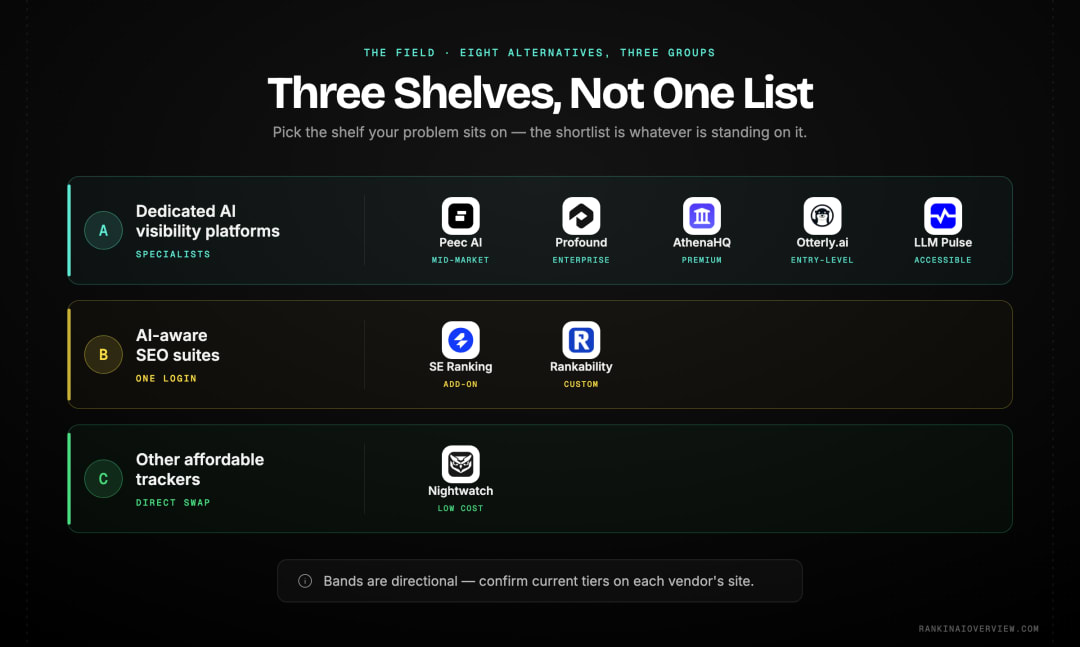
The best Pro Rank Tracker alternatives are Peec AI, Profound, AthenaHQ, SE Ranking, Nightwatch, Rankability, Otterly.ai and LLM Pulse. Each leans toward a different need, from deep enterprise analytics to affordable citation monitoring, so match the tool to where your work sits.
The eight fall into three natural groups. Reading them by group makes the choice clearer than treating them as one long list.
Dedicated AI Visibility Platforms
These tools exist only to measure AI visibility, so they go furthest on citations, sentiment and share of voice.
Peec AI is a mid-market analytics platform that tracks how often AI answers name and cite you, with sentiment and competitor comparison. It suits growing teams that want genuine depth without enterprise pricing, and its self-serve model means no sales call to get started. The honest limitation is that it excels at diagnosis rather than fixes, so it tells you where you stand without walking you through the content changes that close the gap. For teams comfortable acting on their own insight, that is a fair trade for the price.
Profound is the enterprise heavyweight, running structured prompts across engines daily and adding crawler-level insight most tools lack. It fits large organisations that treat AI visibility as a formal programme and need governance to match. The catch is cost and complexity: meaningful coverage sits on higher tiers, and enterprise deployments carry an enterprise price. A solo consultant will find it overpowered, but a Fortune 500 marketing team will find little that goes deeper.
AthenaHQ stands out by tying AI visibility to revenue through analytics integrations, with geographic breakdowns for global brands. It suits commercial teams that need to connect citations to sales rather than track them in isolation. Its entry price is premium and there is no free trial, so you commit before testing, which makes it a poor fit for lean teams but a strong one for brands that must prove AI visibility drives revenue.
Otterly.ai is the accessible entry point, offering citation monitoring across engines at a low starting price. It is a sensible first step for smaller brands that want to measure AI visibility before committing to a heavier platform. Its limits show as you scale, since entry tiers cap prompts and the analytics are lighter than a full platform, but as a first tool it removes the excuse of not measuring at all.
LLM Pulse focuses tightly on citation intelligence, recording the source URLs engines display. It suits teams whose single most important question is which pages get cited, rather than a broad analytics spread. Because its scope is narrow by design, teams wanting sentiment, revenue and broad brand data will need more, but for pure citation tracking on a budget it is hard to fault.
AI-Aware SEO Suites
These pair traditional rankings with AI tracking, which appeals to teams that want both in one login.
SE Ranking adds an AI search toolkit to a full SEO suite, tracking AI answers alongside keyword positions. It fits teams that want Google rankings and AI visibility together and already value an all-in-one platform. The trade-off is that AI features sit behind an add-on, so the real monthly cost climbs once you switch it on, and a suite feature is rarely as deep as a dedicated tool. For teams already living inside the suite, though, that convenience is worth a lot.
Rankability goes a step further by pairing AI visibility tracking with content optimisation, so findings flow straight into the work. It suits agencies that want to act on gaps, not just observe them, which is exactly where pure monitors leave you stranded. The reservation is that a broader content platform can be more than a team wanting a lightweight monitor actually needs, so weigh whether you will use the optimisation side or just the tracking.
Other Affordable Trackers
For teams that mainly want dependable positions with a modern AI touch, a lighter tracker can be the closest like-for-like swap.
Nightwatch is a traditional rank tracker that added LLM tracking, monitoring both AI answers and the searches behind them. It is an affordable, integrated option for teams reporting on Google and AI without running two separate tools, and it is arguably the closest like-for-like swap for Pro Rank Tracker itself. Because it is SEO-first, its AI analytics are lighter than a dedicated platform, so treat it as a modern tracker with a useful AI layer rather than a full AI visibility suite.
Also read: The best AI rank trackers of 2026, compared in depth
How Do the Pro Rank Tracker Alternatives Compare?
The alternatives compare best when grouped by depth and price. Dedicated platforms like Peec and Profound offer the richest AI analytics, suites like SE Ranking and Rankability blend AI with traditional SEO, and Nightwatch and Otterly keep things affordable.
| Tool | Group | Approx. entry price | Standout strength |
|---|---|---|---|
| Peec AI | Dedicated AI platform | Mid-market | Deep analytics, self-serve pricing |
| Profound | Dedicated AI platform | Enterprise | Deepest analytics and crawler insight |
| AthenaHQ | Dedicated AI platform | Premium | Revenue attribution, geo breakdown |
| Otterly.ai | Dedicated AI platform | Entry-level | Affordable citation monitoring |
| LLM Pulse | Dedicated AI platform | Accessible | Citation-URL focus |
| SE Ranking | AI-aware SEO suite | Mid-market add-on | SEO plus AI in one suite |
| Rankability | AI-aware SEO suite | Custom | AI visibility plus optimisation |
| Nightwatch | Affordable tracker | Low | Combined Google and AI tracking |
Confirm current pricing on each vendor's site, since tiers change often in this fast-moving category. Treat the table as a shortlist builder, then test one or two against your own prompts before committing.
Which Pro Rank Tracker Alternative Fits Which Need?
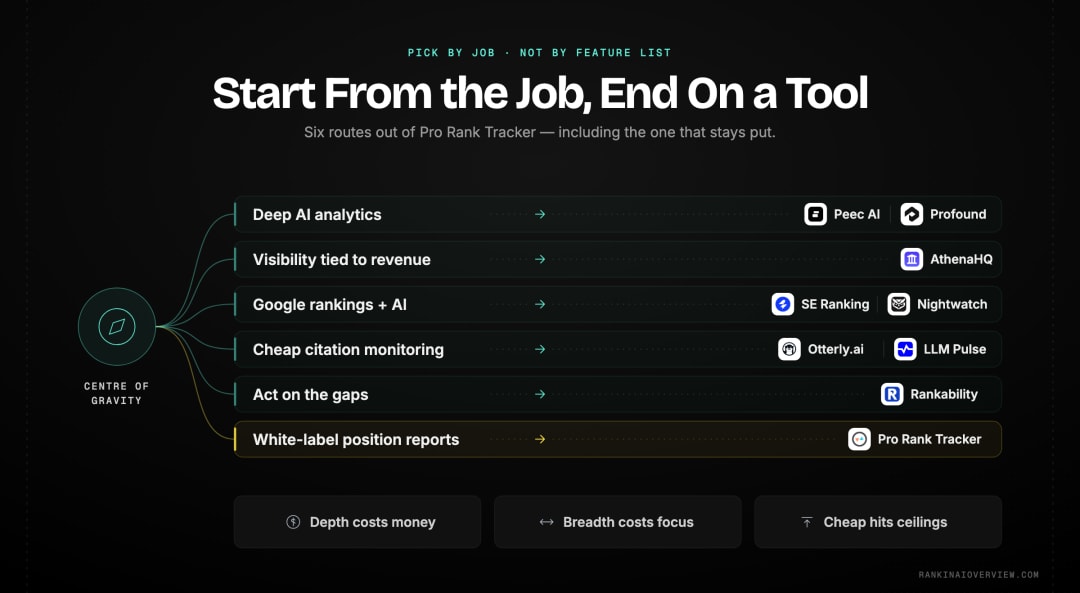
The fit depends on your centre of gravity. For deep AI analytics choose Peec or Profound, for revenue-linked visibility choose AthenaHQ, for combined SEO and AI choose SE Ranking or Nightwatch, and for affordable citation monitoring choose Otterly or LLM Pulse.
Start by naming the job you are hiring the tool to do. If AI visibility is your core metric, a dedicated platform earns its keep, and the choice narrows to how much scale and analytics you need. If traditional rankings still anchor your reporting, an AI-aware tracker or suite keeps everything in one place.
Budget and team size then break the tie. A solo consultant or small brand is well served by Otterly, LLM Pulse or Nightwatch, while an enterprise with a formal programme will get more from Profound or AthenaHQ. Comparing the two disciplines side by side, as we do in SEO versus AI visibility benchmarking, makes the trade-offs easier to weigh before you commit.
When Is Pro Rank Tracker Still the Better Choice?
Pro Rank Tracker is still the better choice when accurate Google positions and clean white-label reporting are your priority, and AI visibility is a nice-to-have rather than the core metric. Switching for the sake of switching wastes a tool that already does its job well.
Plenty of teams do not need a dedicated AI platform yet. If your reporting revolves around keyword positions, your clients expect branded rank reports, and your AI needs are still exploratory, a traditional tracker with a light AI layer is proportionate. Moving to an enterprise AI platform in that situation buys depth you will not use and adds cost you cannot justify.
Budget reinforces the point. Pro Rank Tracker's term-based pricing is friendly to agencies and small teams, and its accuracy is genuinely well regarded. An alternative only earns the switch when it closes a gap you actually feel, such as shallow AI citation data, missing engines, or the lack of optimisation features. Absent that gap, the honest advice is to keep what works and revisit as your AI needs grow.
The deciding question is simple. Is AI visibility becoming a metric you report on and act against, or is it still background curiosity? If it is becoming central, an alternative pays for itself. If it is not yet, Pro Rank Tracker remains a sensible, affordable home for your tracking.
How Do You Choose the Right Pro Rank Tracker Alternative?
Choose by matching depth, coverage and price to your programme, then trialling your shortlist on real prompts. Prioritise citation-URL capture, multi-engine coverage and competitor data over a long feature list, since those decide whether the tool answers the questions you actually have.
A short, disciplined process beats endless comparison. Define your must-have engines and prompts, set a realistic budget, and shortlist two tools that fit both. Then run the same buyer questions through each and see which surfaces citation share and competitor data most usefully. Give the trial at least a couple of weeks, because AI answers fluctuate and a single day of results tells you almost nothing reliable about a tool's real accuracy or coverage.
Whatever you pick, judge it on decisions rather than dashboards. A tool that tells you which pages get cited, on which engines, and how that is trending is worth more than one with a busier interface. Our honest assessment of whether AI rank tracker tools actually work is a useful gut check before you sign up.
What Trade-Offs Should You Weigh Between These Alternatives?
Every alternative trades something for something else, so the smart move is to name the trade-off you can live with. Depth costs money and complexity, breadth costs focus, and low price costs scale. There is no free lunch, only a fit that matches your programme.
The clearest trade-off is depth versus cost. Profound and AthenaHQ offer the richest analytics, but their pricing and setup suit organisations with a formal AI visibility programme, not a solo consultant. Pay for that depth only if you will use it, since an unused enterprise feature is just an expensive line item.
The second trade-off is breadth versus focus. An AI-aware suite like SE Ranking keeps SEO and AI in one login, which is convenient, but a specialist like Peec AI or LLM Pulse will usually go deeper on the AI side alone. If AI visibility is a small slice of your work, the suite wins on convenience; if it is the main event, the specialist wins on depth.
The third trade-off is price versus scale. Affordable options like Otterly.ai and Nightwatch are excellent starting points, but heavy programmes with many prompts, engines and markets will eventually hit their ceilings. Buying for today's needs while leaving room to grow avoids both overspending now and a painful migration later.
How Do You Move From Pro Rank Tracker to an Alternative Without Losing History?
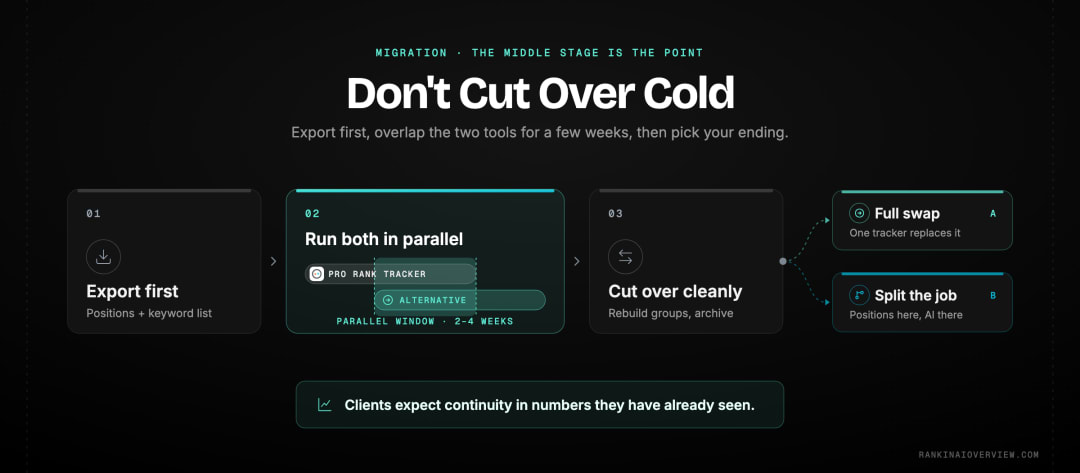
You move without losing history by exporting your Pro Rank Tracker data first, running the new tool in parallel for a period, and only then switching your reporting over. A staged migration protects your trend data and gives you a clean comparison between the two tools.
Start by exporting your existing position history and keyword list from Pro Rank Tracker, so your past trends are preserved outside the platform. This matters because ranking history is hard to reconstruct, and clients or stakeholders often expect continuity in the numbers they have been shown.
Next, run the alternative alongside Pro Rank Tracker for a few weeks. Track the same terms and prompts in both, and compare accuracy, coverage and reporting on your own data rather than on a vendor demo. This parallel period is the single best way to confirm the new tool earns the switch before you rely on it.
Finally, cut over deliberately. Once you trust the alternative's data, move your reporting across, rebuild your term groups cleanly, and archive the Pro Rank Tracker export for reference. If the alternative is a dedicated AI tool rather than a direct tracker replacement, keep Pro Rank Tracker for positions and let the new tool own AI visibility, so nothing is lost on either side.
Also read: What ranking really means in AI search, and why citation share matters
Conclusion
Pro Rank Tracker remains a dependable traditional tracker, and for teams whose work is still anchored firmly in Google positions and client reporting, it may well remain the right tool for the job. But the reason to consider an alternative is clear: as buyers research inside AI, measuring citations, sentiment and share of voice becomes a job a traditional tracker was never built to do at full depth.
Match the alternative to your centre of gravity. Peec and Profound go deepest on AI analytics, SE Ranking and Nightwatch keep SEO and AI together, and Otterly and LLM Pulse make citation monitoring affordable. Shortlist two, trial them on your own prompts, and judge by the decisions they enable rather than the features they advertise. In the end, the best tool is simply the one that reliably answers the questions your buyers and stakeholders are already asking about AI.
RANK IN AI OVERVIEW digs into how answer engines pick and cite the brands they trust, publishes that research in the open, and has an AI visibility scoring tool arriving soon.
Not sure whether AI engines cite your brand at all? Grab your free AI visibility audit and find out.
Frequently asked questions
What is the best alternative to Pro Rank Tracker?+
It depends on your priority. Peec AI and Profound lead for deep AI analytics, SE Ranking and Nightwatch suit combined SEO and AI tracking, and Otterly.ai fits affordable citation monitoring. Match the tool to whether you need depth, breadth or low cost.
Why switch from Pro Rank Tracker?+
Teams switch when they need deeper AI citation analysis, broader engine coverage, or optimisation features a traditional tracker does not prioritise. Pro Rank Tracker is strong on positions and reporting, but AI-first programmes often need a purpose-built platform.
Is there a cheaper Pro Rank Tracker alternative?+
Yes. Otterly.ai and LLM Pulse offer affordable AI citation monitoring, and Nightwatch combines Google and AI tracking at a low price. Each suits smaller teams that want modern coverage without enterprise cost.
Which alternative is best for AI citation tracking?+
Dedicated platforms like Peec AI, Profound and LLM Pulse go deepest on citations, capturing the exact source URLs engines display. If citation share is your core metric, a purpose-built AI tool beats a traditional tracker with an AI add-on.
Can I use Pro Rank Tracker and an alternative together?+
Yes, and many teams do. They keep Pro Rank Tracker for reliable Google positions and reporting, then add a dedicated AI tool for citation-level analysis. This split covers both measurement problems without overstretching one tool.
Do these alternatives track more than Google?+
Most do. Dedicated AI platforms track answers across engines like ChatGPT, Perplexity and Gemini, while AI-aware suites add AI coverage to Google positions. Confirm the exact engines each tool supports before choosing.
Explore with AI
Share this