How I Built 6 AI Agents That Sell Web Services Around the Clock (Full Breakdown)
A detailed breakdown of how one solopreneur built 6 AI agents that handle lead gen, content creation, outreach, and fulfilment for a web services business. Running 24/7, without a team.

Key Highlights
-
AI agents for business automation turn a solo web services operation into a system that generates leads, qualifies prospects, sends personalised outreach, creates content, handles client queries, and reports on performance without a team
-
AI agent passive income is achievable for web services businesses: six agents built over four months generated revenue from AI-sourced leads of USD 8,000 to 12,000 per month at a monthly stack cost of USD 600 to 800
-
AI agent passive income requires active maintenance. Agents that produce passive income need prompt tuning every two to four weeks. You are trading active selling time for active maintenance time
-
The AI agent passive income model is not fully hands-free. It is a system that multiplies what one person can do, not a system that eliminates human involvement from the revenue process
-
AI agent passive income becomes more stable over time as prompt configurations are refined, escalation rules are tightened, and ICP signals are improved based on actual conversion data
-
The realistic AI agent passive income timeline: budget for two months of higher cost and lower revenue while the system is being tuned. Assess ROI only after four weeks of stable, debugged operation
-
Automate web services with AI by starting with a single agent that solves a specific bottleneck (outreach or content) and proving its ROI before adding the next agent. Multi-agent systems built all at once are harder to debug and maintain
-
To automate web services with AI at the outreach layer, the starting investment is approximately USD 350 per month for Clay, LinkedIn Sales Navigator, and Instantly.ai at the entry tier
-
The correct sequence to automate web services with AI: outreach first, prospect research second, lead discovery third. This order ensures that the revenue-generating agent is working before you build the agents that feed it
-
AI sales agent setup requires more maintenance than most practitioners expect. Agents need prompt tuning every two to four weeks as API behaviour, platform interfaces, and prospect patterns evolve
-
AI sales agent setup that performs consistently requires a human-handled reply layer. No AI sales agent setup should handle prospect replies without escalation to a human immediately
-
The AI sales agent setup that produces 8 to 12 percent reply rates uses a research agent as its input. Generic outreach without personalisation produces the industry average of 3 to 5 percent
-
Passive income with AI tools is real but not hands-free. Human oversight at quality review points, escalation handling, and strategy decisions keeps the system trustworthy and prevents the off-brand outputs that unchecked agents produce
-
Passive income with AI tools compounds over time. After four months of operation and tuning, the system generates 65 to 75% of total monthly revenue without active daily involvement from the solo operator
-
Passive income with AI tools for web services businesses is most accessible through the outreach and content automation layers. Lead discovery and client communication are the layers that require the most maintenance before producing reliable passive income
-
The six-agent architecture covers: lead discovery, prospect research, outreach and follow-up, content production, client communication, and reporting and analytics
-
Most technical skills required to build this system are learnable within a few weeks using no-code or low-code platforms. Writing effective prompts is the most important skill, not coding
This is the solopreneur dream: a business that generates revenue while you sleep. AI agents for business automation have made this genuinely achievable in a way that traditional automation tools never quite delivered. AI agents for business automation do not replace a team. They replace the repetitive, time-consuming processes that prevent a solo operator from scaling. I built six agents over four months that together handle lead generation, prospect research and outreach, content creation, client communication, and performance reporting for my web services business.
I want to be clear about what this system is and what it is not. It is a system that multiplies what a solo operator can do. It is not a fully autonomous revenue machine that runs without any human involvement. Every agent in my stack has a point where human review or decision-making is required. The agents handle the volume and the repetitive processes. A human handles the strategy, the quality review, and the exceptions. That combination is what makes the system trustworthy and sustainable.
The system I describe here has been running for four months and generating consistent results. The specific revenue figures and tool costs reflect my experience with this particular business and stack. Your results will vary based on your niche, your ICP, your existing brand presence, and how well you configure and maintain the agents. What you can take from this post is the architecture, the tool selection logic, the cost framework, and the hard lessons that I learned so you do not have to.
What Is the Architecture? How Do 6 AI Agents Work Together?
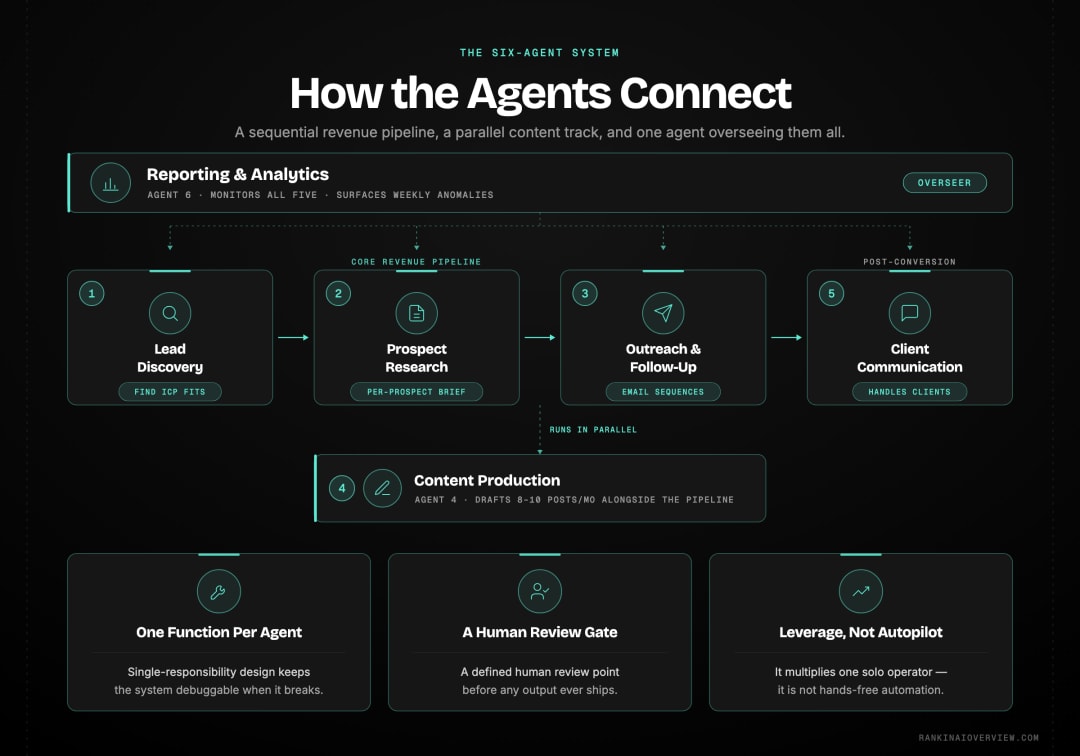
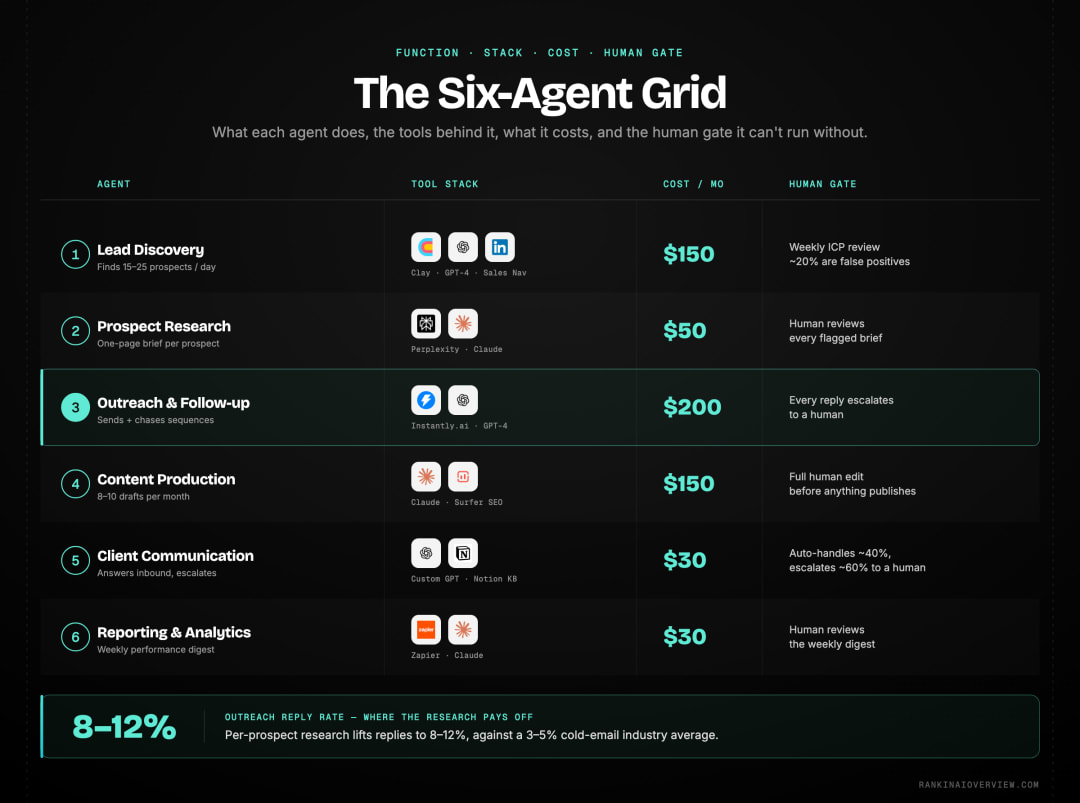
The six agents are organised as a sequential pipeline with feedback loops. Agent 1 (lead discovery) feeds Agent 2 (prospect research), which feeds Agent 3 (outreach). Agent 4 (content production) runs in parallel to the pipeline. Agent 5 (client communication) handles post-conversion clients. Agent 6 (reporting) monitors all five agents and surfaces anomalies and performance data weekly. Each agent handles one clear function. The single-function principle is what makes the system debuggable when something breaks.
| Agent | Function | Primary Tools | Monthly Cost | Human Touch Required |
|---|---|---|---|---|
| 1. Lead Discovery | Scans LinkedIn, Reddit, and Google for new prospects matching ICP | Clay + GPT-4 API + LinkedIn Sales Navigator | USD 150 | Weekly ICP review and quality audit |
| 2. Prospect Research | Builds one-page brief on each prospect before outreach | Perplexity API + Claude for synthesis | USD 50 | Review flagged briefs before outreach sends |
| 3. Outreach and Follow-up | Sends personalised cold emails, LinkedIn DMs, follow-up sequences | Instantly.ai + GPT-4 personalisation layer | USD 200 | Daily inbox review. Escalates all replies to human |
| 4. Content Production | Creates SEO blog posts, LinkedIn posts, and case study drafts | Claude API + Surfer SEO integration | USD 150 | Full human review and edit before publication |
| 5. Client Communication | Handles FAQ responses, status updates, and change requests | Custom GPT + Notion knowledge base | USD 30 | Escalates complex or sensitive requests immediately |
| 6. Reporting and Analytics | Generates weekly performance report across all five agents | Zapier + Claude for narrative summary | USD 30 (Zapier) | Human reviews weekly digest and sets priorities |
Agent 1: How Does Lead Discovery Work?
Agent 1 scans LinkedIn, Reddit, and Google for new prospects that match the ideal customer profile. It runs daily, identifies qualifying signals such as job postings, technology stack mentions, and company growth indicators, and adds qualifying prospects to a lead list with initial context. This agent saves approximately ten hours per week of manual prospecting and produces a consistent, qualified lead flow without requiring active attention.
Tools: Clay for orchestrating the data enrichment workflow, GPT-4 API for ICP matching and initial qualification scoring, and LinkedIn Sales Navigator for LinkedIn prospect discovery. Clay is the central tool in this agent: it integrates with over 100 data sources and allows you to build waterfall enrichment workflows where each data source fills in the gaps the previous one left.
-
ICP signals the agent looks for: company size (10 to 200 employees), specific job titles recently hired (indicating budget allocation in relevant areas), technology stack mentions in job postings, and recent funding announcements
-
Output per day: 15 to 25 qualifying prospects added to the research queue
-
False positive rate: approximately 20% of identified prospects do not qualify after human audit. The weekly ICP review adjusts the scoring prompts to reduce this over time
The weekly human review of ICP scoring criteria is the maintenance task that keeps this agent productive. As my understanding of which prospects actually convert into clients has improved over four months, I have updated the ICP criteria five times. Each update improved lead quality. Agents tuned once and left are agents whose quality degrades over time.
Agent 2: How Does Prospect Research Work?
Agent 2 takes each qualified prospect from Agent 1's output and builds a one-page research brief. The brief includes a company summary, recent news and activity, likely pain points based on ICP signals, and three to five personalisation hooks for the outreach agent. This brief is what enables Agent 3 to send outreach that reads as specifically researched rather than generic.
Tools: Perplexity API for live web research on each prospect and Claude API for synthesis and brief generation. The Perplexity API is the right tool here because it retrieves current information from the live web rather than relying on training data that may be outdated. For a prospect research agent that needs to surface recent company news, job postings, and executive changes, live retrieval is essential.
The output brief has a structured format: company description (two to three sentences), recent notable activity (one to two data points), inferred pain points (two to three based on their profile and ICP signals), and personalisation hooks (three to five specific details that can be referenced in outreach to demonstrate prior research). Agent 3 reads this brief when generating each outreach message.
Agent 3: How Does Outreach and Follow-Up Work?
Agent 3 is the AI sales agent setup that most solopreneurs want to build first. It takes each prospect brief from Agent 2 and generates a personalised cold email and LinkedIn connection request. It also manages follow-up sequences for prospects who do not respond to the initial message. Human oversight of the daily inbox is the non-negotiable guardrail: all replies go to a human immediately.
Tools: Instantly.ai for email sending infrastructure and deliverability management, and GPT-4 API for the personalisation layer that generates unique opening lines and body text for each prospect based on the research brief. Instantly.ai handles the critical technical details: domain warming, sending schedule throttling, and spam filter avoidance. These are the factors that determine whether your outreach reaches inboxes or spam folders.
-
Reply rate achieved: 8 to 12% on cold email versus an industry average of 3 to 5%
-
Why the rate is higher: each email opens with a specific reference to something the prospect actually did or published recently. Generic openers produce generic reply rates
-
Follow-up sequence: three follow-ups at four-day, eight-day, and fourteen-day intervals. Each follow-up generated freshly rather than using a template
-
Critical guardrail: all replies, both positive and negative, route immediately to a human inbox. No agent is involved in reply handling. This is what kept the system trustworthy after week three, when the outreach agent sent five off-brand messages that required direct human recovery
Agent 4: How Does Content Production Work?
Agent 4 produces first drafts of SEO blog posts, LinkedIn posts, and case study outlines. It is not a replacement for human editing and judgment. Every piece Agent 4 produces requires human review before publication. The value is speed: producing a complete first draft in 20 minutes versus two to four hours of human writing time. The human review layer is what gives the content the experience signals that AI-generated content alone lacks.
Tools: Claude API for content generation and Surfer SEO integration for keyword optimisation guidance. Claude is specifically chosen for long-form content generation because its outputs require less heavy editing than GPT-4 for this specific content type. Surfer SEO integration provides the target keyword density and topical coverage guidance that makes the content competitive for search rankings alongside its AI search citation potential.
Output per month: eight to ten pieces of content at first-draft stage. Of these, six to eight reach publication after human editing. Two to three are significantly rewritten after review, which is expected. The agent's most consistent failure mode is producing content that is factually accurate but lacks any first-person experience signal. Every piece requires adding at least one specific example drawn from direct experience before publication.
This agent directly supports the AI search visibility strategy that this site covers in depth. Content produced by Agent 4 and reviewed by a human with genuine expertise in AI search produces blog content for AI search that serves both Google ranking and AI citation goals. The agent handles structure and keyword framework. The human adds the experience layer that neither AI citation nor Google ranking will reward without.
Agent 5: How Does Client Communication Work?
Agent 5 handles FAQ responses, project status update requests, and minor change requests from existing clients. It reads from a Notion knowledge base that contains standard responses to common queries, project status information, and service delivery guidelines. It escalates immediately to a human for anything outside standard parameters, anything emotionally charged, and anything involving scope changes or pricing.
Tools: A custom GPT configured with instructions for tone, escalation criteria, and knowledge base access, plus a Notion knowledge base containing project documentation, standard responses, and delivery templates. The custom GPT is connected to the Notion knowledge base via API so responses reflect current project status rather than static training data.
The escalation rules are the most important configuration decision in this agent. The rules I use: escalate any message expressing frustration or disappointment (even mildly), escalate any scope discussion regardless of how minor it appears, escalate any timeline query where the client has not received a status update in the last 48 hours, and escalate any message containing the words "contract," "refund," "competitor," or "cancel." This aggressive escalation policy means the agent handles approximately 40% of client messages and humans handle 60%. The trade-off is correct: the 40% the agent handles are the ones where a human response would be interchangeable. The 60% that escalate are the ones where human judgment matters.
Agent 6: How Does Reporting and Analytics Work?
Agent 6 generates a weekly performance digest covering all five other agents. The digest includes key metrics for each agent, anomalies flagged for human review, and a narrative summary generated by Claude that contextualises the numbers. This agent is what gives a solo operator visibility across the whole system without spending hours in dashboards.
Tools: Zapier for pulling metrics from each agent's tool (Clay, Instantly.ai, Notion, and the content publishing platform) into a weekly summary, and Claude API for generating the narrative context that makes the raw numbers interpretable. The report arrives in my email every Monday morning at 7am and takes approximately 15 minutes to review.
The most valuable section of the weekly report is the anomalies section. If the lead discovery agent adds fewer than ten prospects in a week (down from the usual 15 to 25), that is flagged for investigation. If the outreach reply rate drops below 6%, that is flagged for prompt review. If the content agent produces fewer than four first-drafts in a week, that flags a possible API issue or credit exhaustion. The anomaly detection prevents problems from compounding silently over multiple weeks before being noticed.
“ The "selling 24/7" claim is real. I have a simpler version and it genuinely closes deals while I sleep. But the maintenance cost of AI agents is underrated. They need constant prompt tuning. You are trading active selling time for active maintenance time. Solopreneur community practitioner r/passive_income community, Reddit 2026 Source: Reddit: I Set Up 6 AI Agents That Sell Web Services 24/7
What Is the Total Stack Cost and Revenue Impact?
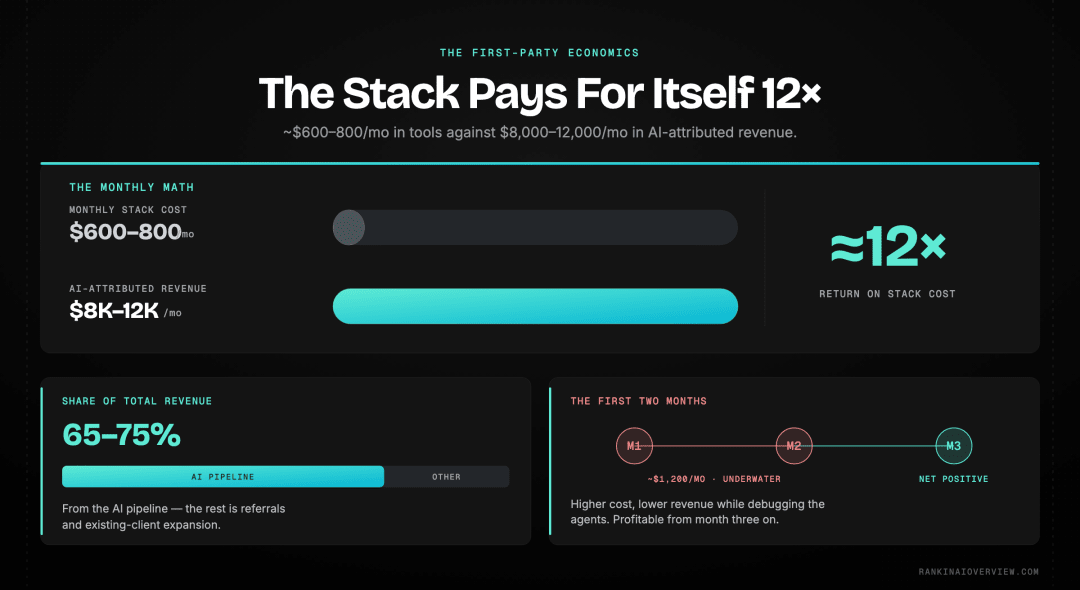
The total monthly stack cost for the six-agent system is approximately USD 600 to 800, depending on API usage volume. Revenue attributed to leads sourced by the AI agent pipeline is USD 8,000 to 12,000 per month at current performance. The net ROI is approximately 12x on the stack cost. These figures reflect four months of operation after the system was fully configured and debugged. The first two months had significantly higher costs and lower revenue as the system was being tuned.
The first two months of running this system cost approximately USD 1,200 per month because I was debugging prompts, fixing integration failures, and replacing tools that did not perform as expected. The system became profitable in month three. This timeline is realistic for anyone building a comparable system from scratch. Budget for a higher initial cost period and do not assess ROI until the system has been running in a stable, debugged state for at least four weeks.
The revenue attribution model I use: any client who first entered the pipeline through an AI-sourced lead is counted as AI-attributed revenue. Clients who came through referrals, direct inbound, or pre-existing relationships are not counted. By this measure, the AI agent pipeline is responsible for approximately 65 to 75% of my total monthly revenue, with the remainder coming from referrals and existing client expansions. This attribution makes the ROI calculation meaningful rather than inflated.
What Are the Hard Lessons?
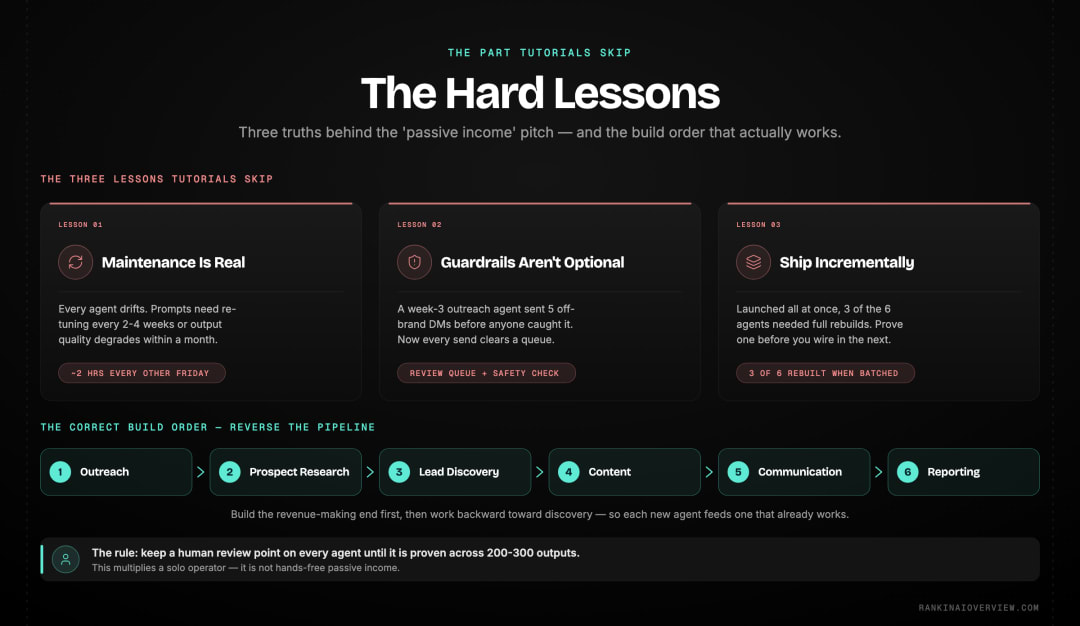
Three specific lessons from building and running this system are worth documenting because they are not captured in most AI agent tutorials. Maintenance is real and non-trivial. Guardrails are not optional. And the best AI agent setup is one you build incrementally, not one you build all at once.
Maintenance is more demanding than most practitioners expect. Every agent requires prompt review and adjustment every two to four weeks as API behaviour evolves, platform interfaces change, and prospect patterns shift. An agent tuned in month one will produce degrading results by month three if not revisited. I schedule two hours every other Friday specifically for prompt review and agent quality audit. If I do not do this, performance degrades within a month.
Guardrails matter more than efficiency. In week three, the outreach agent sent five messages that were off-brand: they were overly formal, misattributed company details from the wrong prospect brief, and included a reference to a case study I had not approved for use in outreach. None of these would have happened with tighter guardrails. My response was to add a 24-hour review queue for the first ten outreach messages from any new prospect segment and to implement a mandatory "brand safety check" prompt step before any message is sent. This slowed the agent slightly. It prevented comparable incidents from recurring.
Build incrementally, not all at once. I spent eight weeks building all six agents simultaneously and launched them together. Three of the six had significant problems that required rebuilds. If I had built Agent 3 (outreach) first, proven its ROI, then built Agent 1 (lead discovery) to feed it, I would have had a working revenue-generating system in week eight instead of week ten and a much clearer understanding of each agent's failure modes. The correct build order is: outreach first, then prospect research, then lead discovery, then content, then communication, then reporting.
Conclusion
Six AI agents will not eliminate the need for human judgment. They will multiply what a solo operator can do. The system works because each agent handles one clear function, the agents are connected in a logical sequence, and humans stay in the loop for quality review, exception handling, and strategic direction. The compounding effect of a well-built AI agent system is real: the pipeline that generates USD 8,000 to 12,000 per month in attributed revenue would require three to four full-time staff to replicate through manual processes.
Start with one agent. Build the outreach agent, prove its ROI over four to six weeks, then add the prospect research agent to improve its input quality. Every subsequent agent you add should have a clear function, a defined output, and a specified human review point. Passive income with AI tools is achievable for web services businesses with this architecture. The path to it runs through disciplined, incremental agent development, not through trying to build everything at once. RANK IN AI OVERVIEW covers how AI tools are reshaping content, visibility, and business operations across the modern web in depth across its content library.
Frequently asked questions
What is the best starting AI agent for a solo web services business?+
The outreach agent is the highest-ROI starting point for most web services solopreneurs. It directly generates revenue-producing conversations without requiring a complete multi-agent pipeline. A single well-configured outreach agent using Instantly.ai for email infrastructure and GPT-4 for personalisation can produce a meaningful reply rate improvement within two weeks of launch. Start with this agent, run it for a month, measure the reply rate and pipeline impact, then build the prospect research agent to improve its input quality. Do not build all six agents before you have proven that the core revenue-generating agent works.
How much technical skill do you need to build these agents?+
Less than most people assume. The tools in this stack, specifically Clay, Instantly.ai, and Zapier, are designed for non-engineers. The primary skill required is prompt engineering: the ability to write clear, specific instructions that produce the output you want from an AI model. This skill is learnable within two to four weeks of deliberate practice. What you do need is comfort with API keys, webhook integrations, and troubleshooting when integrations break. If you have used Zapier or Make.com before, you have the foundation. If not, expect an additional two to four weeks of learning.
What is the biggest mistake when building AI agents for business?+
The biggest mistake is removing human oversight too early in pursuit of full automation. Every agent in a revenue-affecting pipeline needs a human review point until you have seen that agent perform reliably across a minimum of 200 to 300 outputs. Agents that look reliable at 50 outputs often have failure modes that only emerge at scale or in edge cases. The practitioners who report their AI agent systems going badly off the rails are almost always practitioners who removed the human review layer before establishing that the agent was consistently reliable. Automate web services with AI progressively: add automation, verify reliability, then expand automation.
Explore with AI
Share this