Best Peec AI Alternatives in 2026: 8 Tools That Go Further
Peec AI diagnoses your AI visibility but rarely fixes it. Compare eight Peec AI alternatives by depth, action and price, and find the one that closes your gap.

Key Highlights
- Peec AI is a well-rated diagnosis tool, but it tells you where you stand without walking you through the fix.
- The strongest alternatives either add optimisation, widen engine coverage, or cut the price for smaller teams.
- Rankability and Scrunch turn AI visibility findings into action, the biggest thing Peec leaves undone.
- Profound and AthenaHQ go deeper and broader for enterprises, while Otterly and LLM Pulse suit lean budgets.
- Choose by naming the exact gap you feel with Peec, then pick the tool built to close it.
- RANK IN AI OVERVIEW researches how brands earn AI citations, runs a free AI visibility audit, and has a scoring tool on the way.
Peec AI has earned genuine fans for one reason: it shows, clearly, how often AI answers name and cite you. Yet the reason teams start searching for a Peec AI alternative usually sits one step past that. Measurement is only useful if you can act on it, and buyers are now forming views inside AI at a pace that makes acting quickly matter. According to Pew Research Center, roughly 64% of US teenagers already use AI chatbots, and more than half of those users turn to them for searching information. The next generation of buyers is being shaped inside AI answers today.
That is where the frustration begins. Peec is excellent at diagnosis, telling you a rival appears more often than you, but it rarely tells you why or what to change. For teams that want the fix as well as the finding, or that need wider coverage or a lower price, the honest answer is to look elsewhere. Choosing the wrong replacement, though, means paying for depth you will not use or losing the clarity Peec did well.
This guide compares eight Peec AI alternatives, grouped by the specific gap each one closes: optimisation, enterprise depth, combined SEO, and affordable monitoring. For each you get a straight read on what it does and who it suits, then a table and a simple way to decide. The aim is to match a tool to your actual problem, not to hand you a longer list to wade through.
Why Look for a Peec AI Alternative?
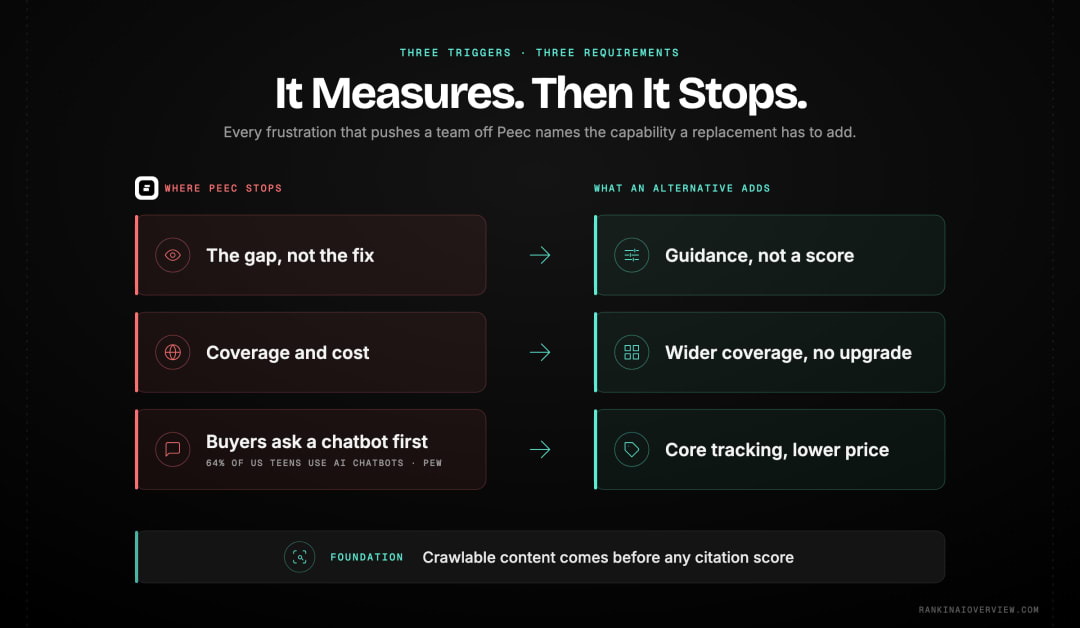
You look for a Peec AI alternative when you need more than diagnosis: the ability to act on findings, wider engine coverage, or a price that fits a smaller team. Peec is strong on measurement, but it stops short of guiding the content changes that turn a visibility gap into a citation.
The most common trigger is the gap between knowing and doing. Peec will show you that you appear in 30% of relevant answers while a competitor appears in 60%, which is genuinely useful. What it will not do is walk you through the structural and trust changes that close that gap, so teams without their own optimisation expertise feel stranded at the insight.
A second trigger is coverage and cost. Peec caps how many engines each plan tracks, and reserves some engines for its enterprise tier, which frustrates teams that need broad coverage on a mid-market budget. Others simply want a cheaper entry point than Peec offers. If you are still working out which signals to prioritise, our guide to the AI visibility metrics that matter is a good place to sharpen your requirements first.
A third trigger is the shape of the buyer journey you serve. If your audience skews younger or more AI-native, your visibility gaps compound faster, because those buyers reach for a chatbot before a search box. The Pew data on teenage chatbot use is a preview of that shift, and it raises the cost of a measurement tool that shows the problem without helping you solve it. For teams facing that pressure, an alternative that shortens the distance between insight and action is not a luxury but a practical necessity.
Also read: Which AI visibility metrics actually matter, and which are vanity
What Should a Peec AI Alternative Do Better?
A strong alternative should either turn insight into action, widen engine and market coverage, or deliver core citation tracking at a lower price. The best options fix Peec's specific weakness for your team rather than simply matching its feature list.
The deciding capability for many teams is action. Being crawlable and cited is a technical and editorial job, and a tool that only reports the score leaves the hard part to you. Aleyda Solís, one of the most respected voices in AI search, makes the foundational point plainly.
"You need to allow AI crawlers to access your content. The rules you set might need to be different depending on your context." Aleyda Solís, international SEO consultant and founder of Orainti. Source: Humans of Martech podcast, episode 202
Her point sits underneath every measurement tool. Before Peec or any alternative can report your citation share, your content has to be reachable and citable in the first place. The alternatives that add optimisation help you act on both fronts, the technical access and the editorial quality, which is exactly where a pure diagnosis tool runs out of road. A tool that reports a low score without helping you improve crawlability, structure and trust is only doing half of a job that has two halves.
What Are the Best Peec AI Alternatives?
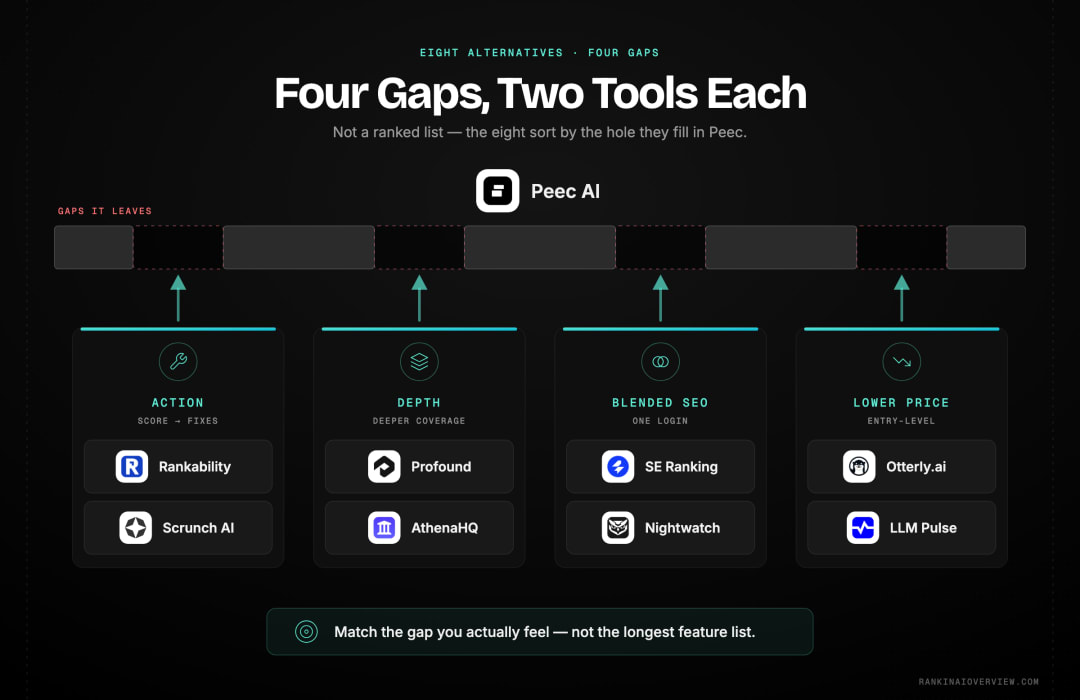
The best Peec AI alternatives are Rankability, Scrunch AI, Profound, AthenaHQ, SE Ranking, Nightwatch, Otterly.ai and LLM Pulse. Each answers a different weakness in Peec, from turning findings into fixes to widening coverage or lowering the entry price.
Reading them by the gap they close makes the shortlist obvious. Start with the group that matches your frustration.
Tools That Turn Findings Into Action
This is the group that most directly answers Peec's diagnosis-only limitation.
Rankability pairs prompt-level AI visibility tracking with content optimisation, so a gap you spot flows straight into the work that closes it. For teams that felt stuck at Peec's insight, this is the natural upgrade, though its broader content platform is more than a team wanting a lightweight monitor needs.
Scrunch AI approaches the same problem from the enterprise side, focusing on how AI systems interpret your brand and how to shape that interpretation. It suits large organisations that want structured control over their AI presence rather than a dashboard of scores, with a price and learning curve to match that ambition.
Tools That Go Deeper and Broader
If your issue with Peec is coverage or scale rather than action, these platforms stretch further.
Profound is the enterprise benchmark, running structured prompts across many engines daily and adding crawler-level insight. It goes past Peec's engine caps comfortably, but its depth and price suit a formal programme rather than a lean team testing the waters.
AthenaHQ widens the lens toward revenue, tying AI visibility to sales through analytics integrations and adding regional breakdowns. It answers Peec's coverage limits and adds a commercial dimension, though its premium entry price and lack of a free trial ask for commitment up front.
Tools That Blend AI With Traditional SEO
For teams that want AI visibility beside their Google positions, a suite or hybrid tracker fits better than a pure AI monitor.
SE Ranking folds an AI search toolkit into a full SEO platform, so rankings and AI answers live in one login. It suits teams that want both, accepting that a suite add-on is rarely as deep on AI as a specialist like Peec.
Nightwatch is a traditional rank tracker with LLM tracking added, monitoring AI answers and the searches behind them at an affordable price. It is a sensible option for teams that value combined reporting over deep AI analytics.
Tools That Cost Less Than Peec
When the sticking point is price, these keep citation monitoring accessible.
Otterly.ai offers entry-level citation monitoring across engines at a low starting price, making it a gentler on-ramp than Peec for smaller brands. Its analytics are lighter and its prompt limits tighter, but it removes the excuse of not measuring at all.
LLM Pulse narrows in on citation intelligence, recording the source URLs engines display, and does it affordably. Teams wanting sentiment and broad brand data will need more, but for pure citation tracking on a budget it is a clean fit.
Also read: Do AI rank tracker tools actually work, and when to trust them
Which Peec AI Alternative Closes Its Biggest Gap?
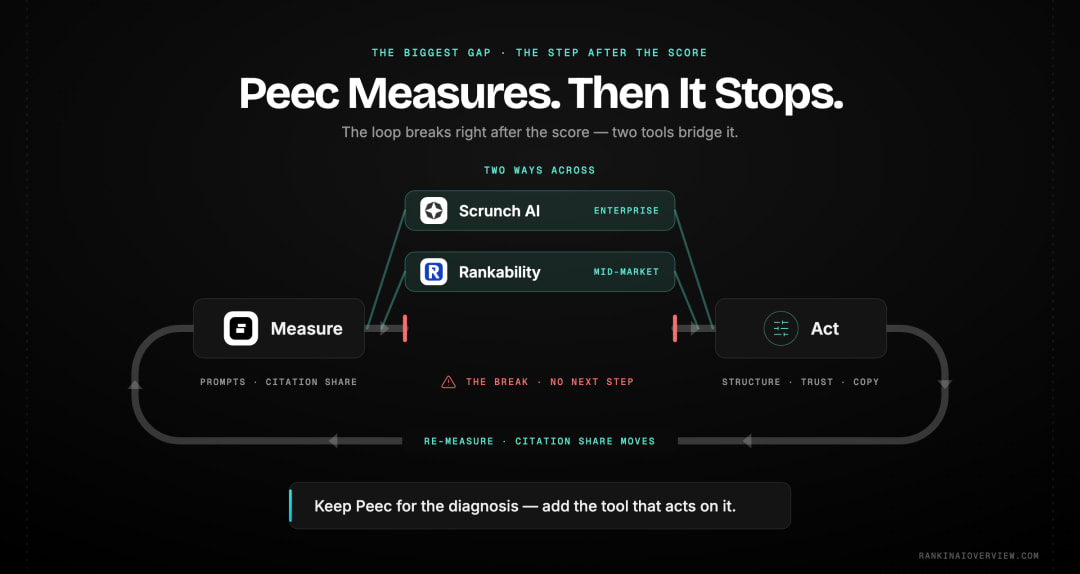
The alternative that closes Peec's biggest gap is one that turns findings into action, which points to Rankability for mid-market teams or Scrunch AI for enterprises. Both move past diagnosis into the optimisation work that actually lifts your citation share.
Peec's defining strength and its defining limit are the same thing: it measures beautifully and stops there. So the single most valuable upgrade for many teams is not more data but a path from data to change. Rankability builds that path into a mid-market platform, while Scrunch builds it into an enterprise one.
If your team already has strong optimisation skills, this gap may not bother you, and a deeper measurement tool like Profound could serve you better. But if you have felt the frustration of a clear score with no clear next step, an action-oriented alternative is the one that pays for itself. Understanding what ranking really means in AI search helps you judge which changes will move the number.
There is a sequencing point worth making too. An action-oriented tool is most valuable once you already know where your gaps are, so some teams start with Peec's clean diagnosis, learn their weak prompts, and only then bring in an optimisation platform to fix them. Read that way, the choice is not always Peec versus an alternative but Peec first, then the tool that turns its findings into a repeatable improvement loop. Either path beats measuring endlessly while your citation share stays flat.
How Do the Peec AI Alternatives Compare?
The alternatives compare best by the gap they close: action, depth, breadth or price. Rankability and Scrunch add optimisation, Profound and AthenaHQ add scale, SE Ranking and Nightwatch blend SEO with AI, and Otterly and LLM Pulse keep costs low.
| Tool | Gap it closes vs Peec | Best for |
|---|---|---|
| Rankability | Action, not just diagnosis | Mid-market teams wanting fixes |
| Scrunch AI | Action at enterprise scale | Large brands shaping AI perception |
| Profound | Depth and engine coverage | Formal enterprise programmes |
| AthenaHQ | Coverage plus revenue link | Commercial teams proving ROI |
| SE Ranking | SEO and AI in one suite | Teams wanting both together |
| Nightwatch | Affordable combined tracking | Reporting on Google and AI |
| Otterly.ai | Lower entry price | Smaller brands starting out |
| LLM Pulse | Cheap citation focus | Citation-first teams on a budget |
Confirm current pricing and engine coverage on each vendor's site, since both change often. Then trial one or two against your own prompts before you switch, because a tool's real value only shows on your data.
When Is Peec AI Still the Better Choice?
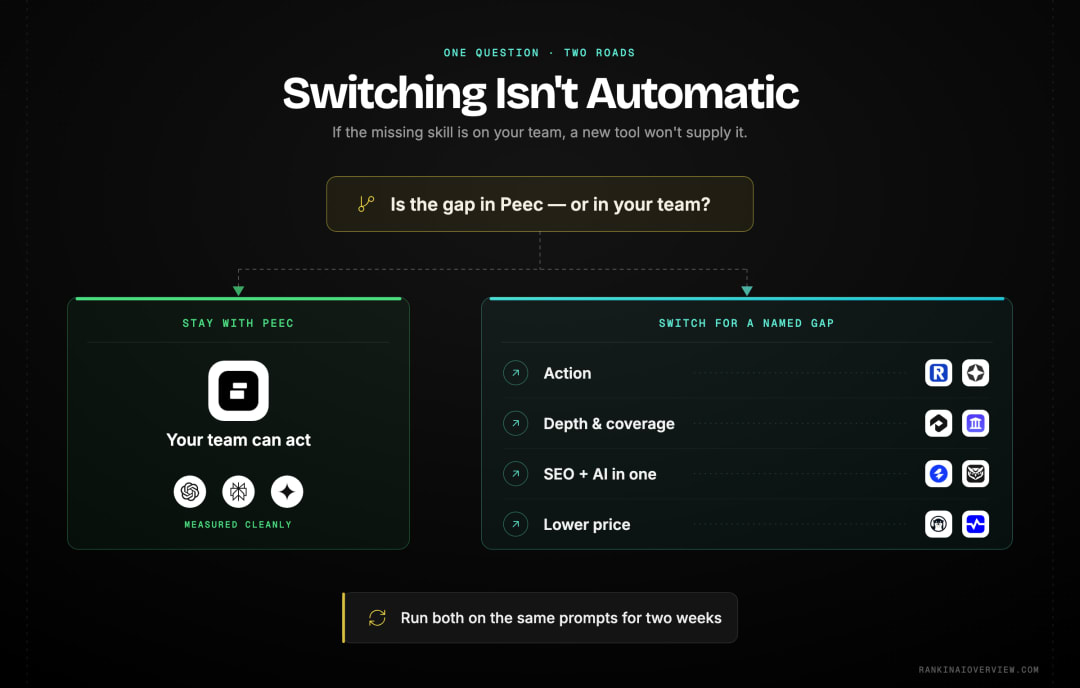
Peec AI is still the better choice when your team has its own optimisation skills and simply needs clean, trustworthy measurement across ChatGPT, Perplexity and Gemini. If the diagnosis is all you were ever going to act on yourself, switching adds cost without adding value.
Many capable teams do not need a tool to tell them how to fix a citation gap; they need a tool to tell them the gap exists, accurately, and Peec does that well. Its self-serve pricing, responsive support and high user ratings make it a comfortable home for teams that treat measurement and action as separate jobs owned by different people.
The size and stage of your programme matter here too. A mid-market marketing team with an in-house SEO who can translate a visibility score into content changes gets most of Peec's value with none of the overhead a heavier platform adds. For that team, an enterprise tool like Profound would be overpowered, and an optimisation platform like Rankability might duplicate skills they already have.
So the switch is not automatic. Before you move, ask whether your frustration is really with Peec or with a missing skill on your own team. If it is the skill, an action-oriented alternative helps. If your team can already act, Peec's focused measurement may be exactly the right amount of tool. Our roundup of the best AI rank trackers puts Peec in context against the wider field.
How Do You Choose the Right Peec AI Alternative?
Choose by naming the exact gap Peec leaves for you, then picking the tool built to close it. For action choose Rankability or Scrunch, for depth choose Profound or AthenaHQ, for combined SEO choose SE Ranking or Nightwatch, and for a lower price choose Otterly or LLM Pulse.
The mistake is shopping on features rather than on your frustration. Peec is a good tool, so you are not replacing it because it is bad; you are replacing it because it stops where your needs continue. Naming that stopping point turns a long comparison into a short one.
Then trial before you commit. Run the same buyer prompts through your shortlist over a couple of weeks, and judge which surfaces both the score and the path to improve it. Comparing AI visibility against traditional search, as we do in SEO versus AI visibility benchmarking, also helps you set realistic expectations for what any tool can prove.
Conclusion
Peec AI is a genuinely good measurement tool, and if clean diagnosis is all you need, it may still be the right fit. But the reason to consider an alternative is consistent: measurement without a route to action leaves the hardest part undone, and as buyers increasingly research inside AI, closing that gap quickly matters more each month.
Match the alternative to the gap you feel. Rankability and Scrunch add action, Profound and AthenaHQ add depth, SE Ranking and Nightwatch blend SEO with AI, and Otterly and LLM Pulse keep it affordable. Name your stopping point, shortlist two tools that move past it, and trial them on your own prompts before you commit a budget to either one.
RANK IN AI OVERVIEW digs into the mechanics of how answer engines pick and cite brands, publishes what it learns, and is putting the finishing touches on an AI visibility tool due soon.
Want to know which AI answers already mention you, and which ignore you? Start with a free AI visibility audit.
Frequently asked questions
What is the best alternative to Peec AI?+
It depends on the gap you feel. Rankability and Scrunch add the action Peec lacks, Profound and AthenaHQ add depth and coverage, and Otterly.ai offers a cheaper entry point. Match the tool to your specific frustration with Peec.
Why do teams switch from Peec AI?+
Teams switch mainly because Peec diagnoses without guiding the fix. Others want broader engine coverage beyond its plan caps, or a lower entry price. Peec measures well, but many teams need action, coverage or affordability it does not fully provide.
Which Peec alternative helps me act on findings?+
Rankability pairs AI visibility tracking with content optimisation for mid-market teams, and Scrunch AI does the same at enterprise scale. Both move past diagnosis into the work that lifts your citation share, which is Peec's main limitation.
Is there a cheaper Peec AI alternative?+
Yes. Otterly.ai and LLM Pulse offer affordable citation monitoring, and Nightwatch adds AI tracking to traditional rankings at a low price. Each suits smaller teams that want coverage without Peec's mid-market cost.
Do Peec alternatives cover more AI engines?+
Some do. Profound and AthenaHQ track a wide range of engines without Peec's plan caps, which is a common reason teams move up. Always confirm the exact engines each tool covers on the plan you are considering.
Can I keep Peec AI and add another tool?+
Yes. Some teams keep Peec for its clean measurement and add an optimisation tool like Rankability to act on the findings. Pairing a strong diagnostic with an action tool can cover both jobs without abandoning what Peec does well.
Explore with AI
Share this