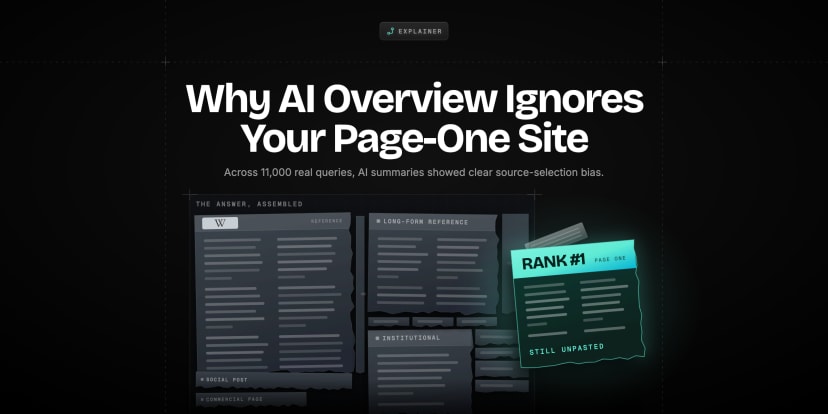
Why Most Companies Are Getting AI Search Optimization Wrong (And What to Do Instead)
Most brands are applying old-school SEO logic to AI search and getting poor results. Here are the fundamental AI search strategy mistakes and the 3 strategic shifts that fix them.
Key Highlights
-
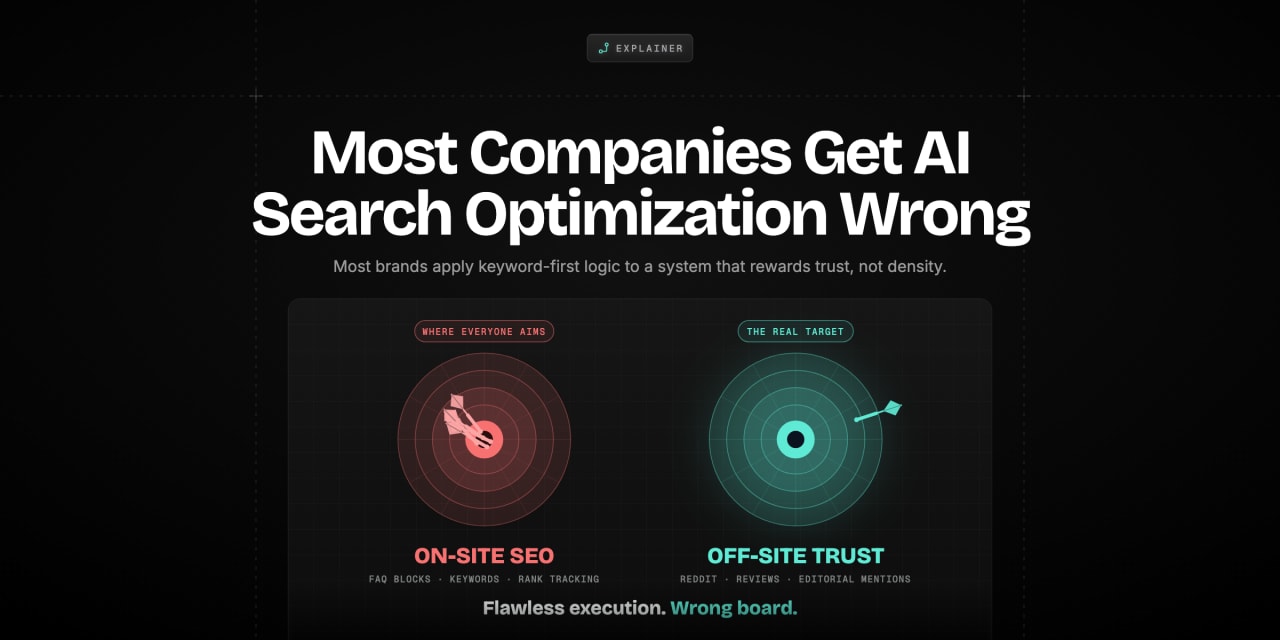
AI search strategy mistakes are almost universal. Most brands are applying keyword-first SEO logic to a system that evaluates trust and corroboration, not keyword density
-
The wrong approach to AI SEO looks like: adding FAQ sections to every page without improving the underlying content, publishing AI-written posts without expert oversight, and reporting AI "rankings" as a primary KPI
-
GEO optimization mistakes concentrate at the off-site layer. AI citation signals live primarily off your website. Brands investing in on-site tactics while neglecting Reddit, reviews, and editorial mentions are solving the wrong problem
-
GEO optimization mistakes are costly because they consume real budget and produce confidence: the team feels they are executing AI search optimisation while the actual citation gap widens
-
The most common GEO optimization mistakes are: treating it as a content formatting discipline, tracking single-run AI responses as rankings, and publishing AI-generated content without expert oversight
-
Correcting GEO optimization mistakes does not require abandoning existing SEO investment. The three strategic shifts in this guide are additive layers, not replacements for traditional SEO infrastructure
-
How to actually rank in AI search: three strategic shifts. From on-page optimisation to off-site reputation. From keyword targeting to topic authority. From position tracking to trust signal building
-
Brand trust for AI citation is earned through corroboration across independent sources. No amount of on-site optimisation substitutes for third-party community mentions, verified reviews, and editorial coverage in sources AI engines already trust
-
The companies winning in AI search are investing in authentic community presence, original research, editorial brand mentions, and entity recognition infrastructure. None of these require finding a new trick
-
The 90-day reset plan at the end of this guide gives you a sequenced programme to correct the most common AI search strategy mistakes without abandoning existing SEO investment
Walk into any marketing meeting in 2026 and ask how your team is optimising for AI search, and you will hear one of three things: "we are adding FAQ sections," "we are using AI to write more content faster," or "we are tracking our rankings in ChatGPT." All three are responses to the right question with the wrong answer. These are the AI search strategy mistakes that are consuming budget, time, and credibility without producing measurable AI citation improvements.
The misalignment is structural, not executional. According to Princeton and Georgia Tech's generative engine optimisation research, AI citation probability improves most through trust signals: authoritative citations, specific data points, and clear structural formatting. It improves least through the surface-level optimisation tactics that most AI SEO guides recommend. The teams executing those surface-level tactics flawlessly are still underperforming the teams that have understood what AI engines actually evaluate.
This guide identifies the root mistake driving the wrong approach to AI SEO, articulates the three strategic shifts required to correct it, and gives you a 90-day reset plan. The wrong approach to AI SEO is not just ineffective. It actively crowds out investment in the activities that do work, because it feels like AI SEO and satisfies stakeholders in the short term while producing no real citation authority. The shift is uncomfortable. It is also unavoidable.
What Is the Root Mistake in Most AI Search Strategies?
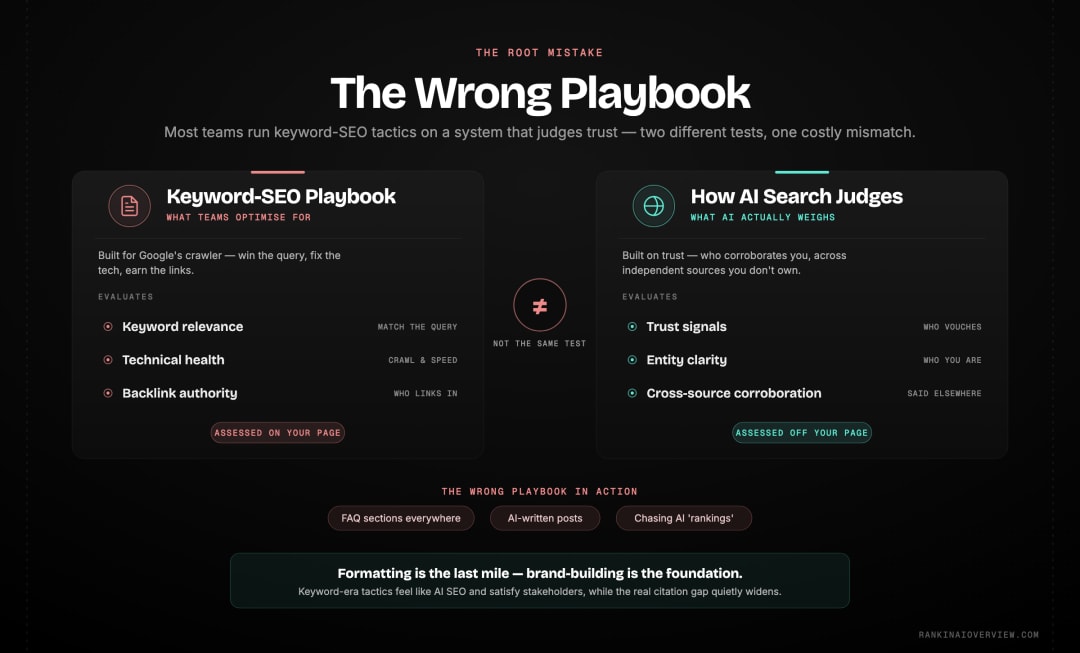
The root mistake is treating AI search like a newer version of traditional keyword SEO. Traditional SEO optimises pages for an algorithm that evaluates keyword relevance, technical health, and backlink authority. AI search evaluates trust, entity clarity, and corroboration across independent sources. These are different assessments requiring different investments. Applying the old playbook to the new game produces the same results as preparing for a job interview by studying the application form instead of developing genuine expertise.
The specific manifestation of this mistake looks similar across companies of all sizes. The marketing team identifies AI search as a strategic priority. They brief the content team to "optimise content for AI." The content team adds FAQ sections to existing pages, rewrites introductions to be more "direct," and starts tracking ChatGPT responses for brand mentions. The SEO team sets up an AI rank tracker. The results are disappointing and the team does not understand why.
The reason is that none of these actions address the signals that AI engines actually evaluate when deciding what to cite. AI engines are not running a keyword matching algorithm on your content. They are asking whether your brand has been independently verified as a trustworthy source by the communities and publications they already trust. That verification is built off your website, not on it. Every hour invested in on-page AI optimisation tactics while neglecting off-site trust building is an hour investing in the wrong problem.
This is the GEO optimization mistake most brands make: they treat it as a content formatting discipline when it is primarily a brand-building discipline. Content formatting and structure matter and they are covered comprehensively in this series. But they are the last mile of AI citation eligibility, not the foundation. A brand with no off-site presence can have perfectly structured content and still receive zero AI citations because it has given AI engines no independent evidence that it is trustworthy in its category.
What Are the 3 Strategic Shifts Required for AI Search Success?
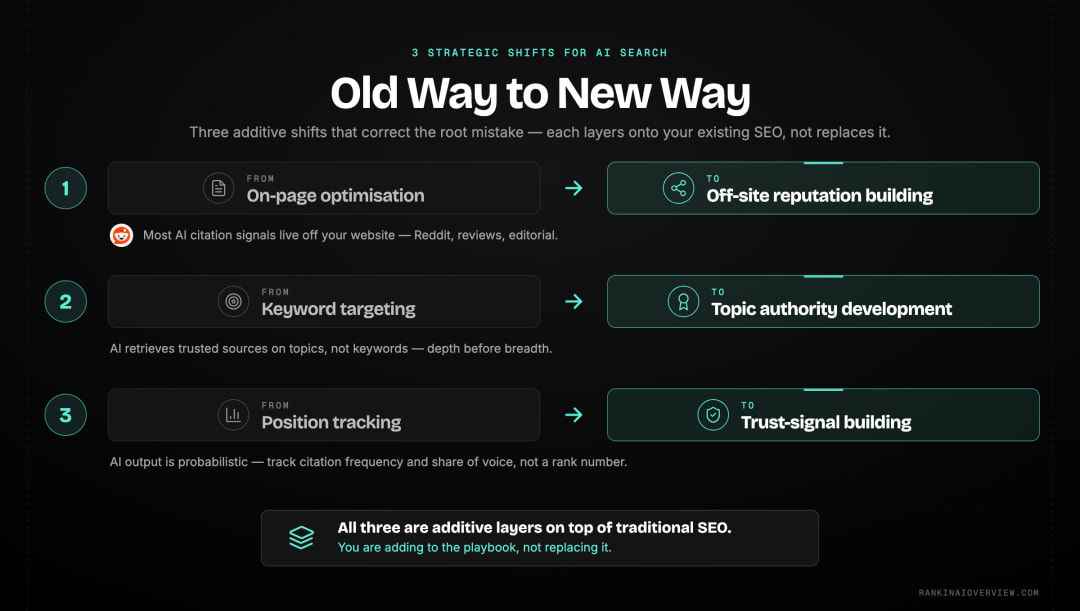
Three strategic shifts correct the fundamental wrong approach to AI SEO. First, from on-page optimisation to off-site reputation building: most AI citation signals live off your website. Second, from keyword targeting to topic authority development: AI does not retrieve keywords, it retrieves trusted sources on topics. Third, from position tracking to trust signal building: AI rankings are the wrong KPI. Citation frequency and share of voice are the right ones.
Shift 1: From On-Page Optimisation to Off-Site Reputation Building
The most significant AI search strategy mistake for established brands is not the tactics they are using on their websites. It is the signal layer they are missing entirely: off-site corroboration. AI engines build trust by aggregating brand mentions across independent sources. A brand mentioned by real practitioners on Reddit, reviewed on G2 with experience-specific detail, featured in industry publications, and discussed in community forums has built multi-source corroboration that AI engines treat as verification.
The audit action for this shift: search your brand name on Reddit, on your primary B2B review platform, and in the publications that AI engines cite for your category. If your brand appears in fewer than five genuine community discussions, fewer than twenty substantive reviews, and fewer than three editorial features in the last twelve months, you have identified your highest-priority AI visibility gap. This gap is worth addressing before any on-page AI optimisation work, because on-page work compounds with off-site presence and produces negligible results without it.
The three highest-priority off-site investments for most brands: authentic Reddit participation in two to three relevant communities, a complete and review-rich profile on your primary review platform, and two editorial brand mentions in publications that AI engines already cite when generating answers in your category. These three investments are available to any brand regardless of budget and produce measurable Perplexity citation improvements within eight to twelve weeks of consistent execution.
Shift 2: From Keyword Targeting to Topic Authority Development
How to actually rank in AI search at the content level requires abandoning keyword targeting as the primary content strategy framework. AI engines do not retrieve keywords. They retrieve sources they have identified as authorities on specific topics. A site with thirty interconnected articles covering every dimension of a specific subject is treated as an authority on that subject. A site with one article on each of thirty different subjects is treated as a generalist with no deep authority in any category.
The strategic implication is the most direct answer to how to actually rank in AI search at the content level: build ten to twenty pieces on your three most important topics before expanding to any other subject area. Concentrate content investment before broadening it. How to actually rank in AI search through content is about cluster depth, not keyword breadth. The brands cited most consistently for category queries have published the most substantive content on the narrowest topic sets.
The brands getting AI citation right in competitive B2B categories are not the ones publishing the most content across the broadest keyword set. They are the ones that have published the most substantive content on the narrowest topic set and earned the reputation of being the reference point for that topic among practitioners in their space. Brand trust for AI citation is built through depth before breadth. Breadth without depth produces no citation authority.
Shift 3: From Position Tracking to Trust Signal Building
Reporting "AI rankings" as a primary KPI is both a measurement mistake and a strategic mistake. It is a measurement mistake because AI outputs are probabilistic: a brand "ranked" first on Monday may be mentioned third on Tuesday and absent on Wednesday with no changes to its content or signals. Reporting a rank number misrepresents the nature of AI visibility as a deterministic position when it is a citation frequency measure across many probabilistic outputs.
It is a strategic mistake because optimising for a rank metric pushes teams toward tactics that produce the appearance of citation improvement rather than the underlying trust signals that produce sustained citation frequency. A team trying to rank higher in ChatGPT will try different prompt phrasings, different FAQ structures, and different content angles in a search for what moves the metric. A team trying to build trust signals will invest in Reddit community contributions, editorial mentions, and entity recognition infrastructure. The second team builds durable assets. The first team builds noise.
The correct measurement framework uses citation frequency as the primary metric (tracked across many prompt runs per week, not a single snapshot) and branded search volume in Google Search Console as the downstream proxy that connects AI visibility improvements to real brand awareness. Share of voice versus named competitors is the strategic KPI for quarterly reporting. These metrics tell a true story about AI visibility trends. A rank number does not.
“ The companies winning at AI search are investing in brand building, not prompt hacking. You cannot shortcut trust. Most content being optimised for AI is just keyword-stuffed blog posts with FAQ sections tacked on. The real work is off-site: Reddit, reviews, PR, third-party citations. That is what AI trusts. Marketing practitioner r/AskMarketing community, Reddit 2026 Source: Reddit: Most Companies Approaching AI Search Are (Missing the Point)
What Are Companies Getting AI Search Right Actually Doing?
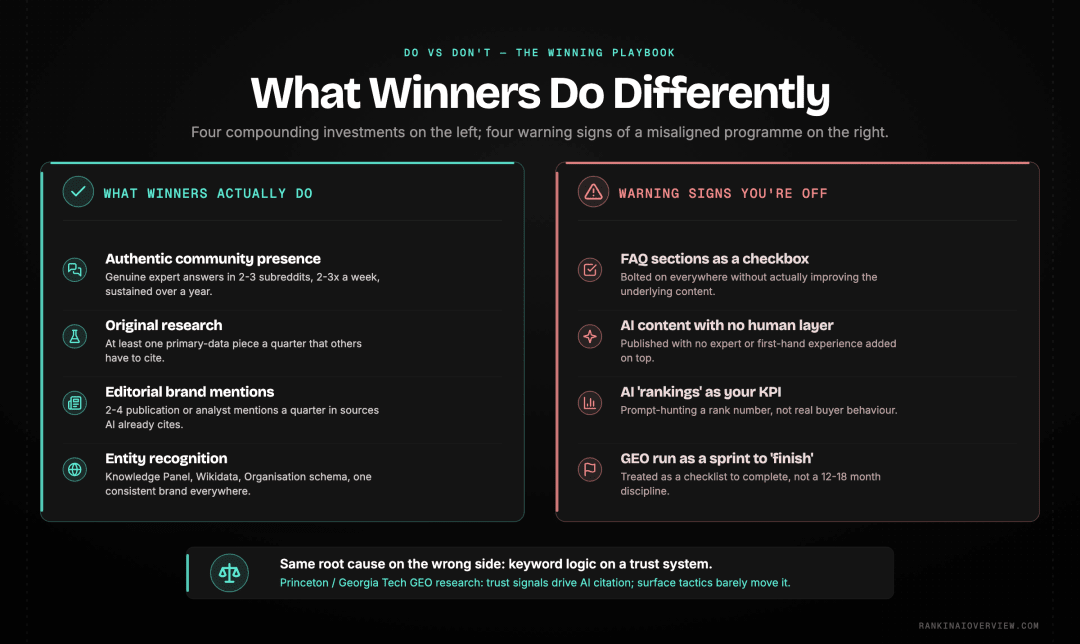
The pattern across brands with strong, consistent AI citation rates is not a proprietary tool or a secret tactic. They have invested consistently in four activities over twelve to eighteen months: authentic community presence on Reddit and Quora, original research that other sources cite, editorial brand mentions through PR and expert contributions, and entity recognition infrastructure through Knowledge Panel, Wikidata, and schema consistency. None of these is a shortcut. All of them compound over time.
-
Authentic community presence: contributing genuine expert answers to relevant Reddit communities two to three times per week over twelve months, building the community-verified brand recognition that AI engines treat as independent corroboration
-
Original research production: publishing at least one piece of primary research per quarter that contains data no other source has, giving AI engines a unique citable data point that requires referencing the brand as its source
-
Editorial brand mentions: earning two to four mentions per quarter in industry publications and analyst reports that AI engines already cite when generating answers in the brand's category
-
Entity recognition infrastructure: Knowledge Panel claimed and optimised, Wikidata entry created with complete and accurate information, Organisation schema implemented and validated, brand name and description standardised across all external profiles
The unifying property of all four activities is that they produce independent evidence that the brand is trustworthy, category-relevant, and citable. Brand trust for AI citation is not a technical property. It is a social one: the aggregate of what independent sources say about a brand across the platforms AI engines treat as reliable. Brand trust for AI citation built through these four activities compounds in a way that on-page optimisation tactics cannot replicate because it is distributed across many independent sources.
What Are the Warning Signs You Are Doing AI Search Wrong?
Four specific behavioural patterns are reliable indicators that an AI search strategy is fundamentally misaligned. Each pattern is a symptom of the root mistake: applying keyword SEO logic to a trust-based system. Recognising these patterns in your own programme is the first step to redirecting investment toward what actually produces AI citation improvements.
Warning Sign 1: Adding FAQ sections to every page without improving the actual content FAQ sections improve AI citation only when they contain authentic user-phrased questions with 30 to 50 word self-contained answers. FAQ sections added as a formatting checkbox with marketing-language questions and hedged answers produce no citation improvement and can actively signal low-quality content structure.
Warning Sign 2: Publishing AI-generated content without any human expertise layer AI-generated content without first-person experience signals, specific named examples, or original data fails the E-E-A-T trust test that AI engines apply before citing. Volume of AI-generated content is not a GEO strategy. It is a way to produce more content that does not get cited.
Warning Sign 3: Reporting AI rankings as a primary KPI A team spending time finding prompts that produce their brand citation is running a measurement exercise that does not reflect real buyer behaviour. The useful question is not "can we get ChatGPT to mention us by phrasing a prompt a specific way?" It is "how often does ChatGPT mention us when a buyer asks the questions buyers actually ask?"
Warning Sign 4: Treating GEO as a checklist to complete, not a brand-building discipline GEO is not a set of technical changes that can be completed in a sprint and considered done. Entity recognition, off-site community presence, and editorial coverage all require sustained investment over twelve to eighteen months. A team that declares their AI search optimisation "complete" after implementing schema and FAQ sections has made the root mistake in a specific form.
What Is the 90-Day Reset Plan?
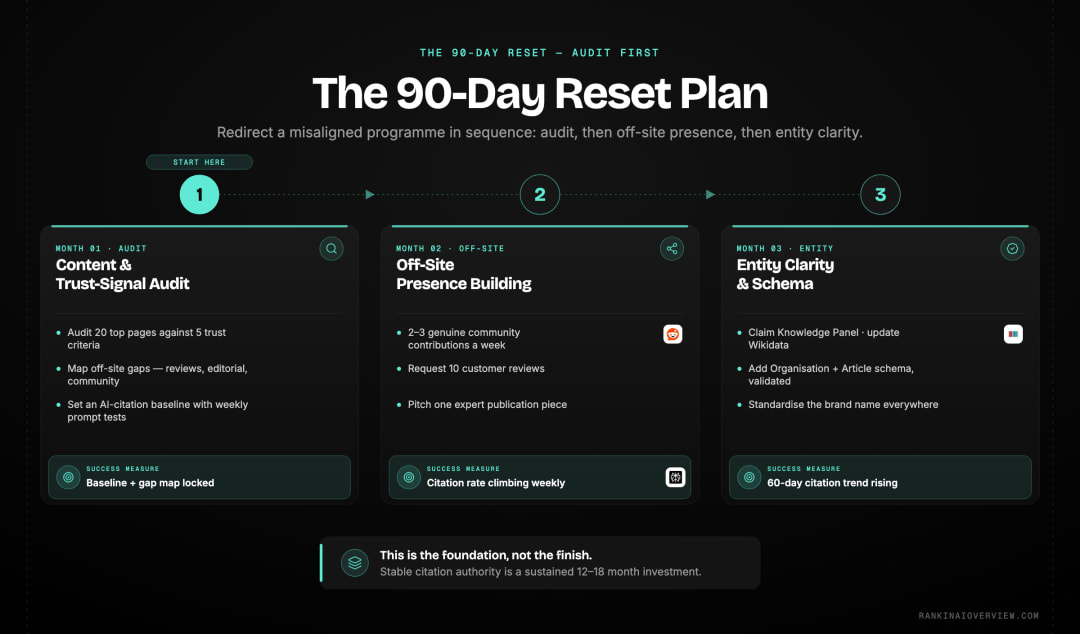
The 90-day reset plan below corrects the most common AI search strategy mistakes without abandoning existing SEO investment. Month one focuses on auditing what is currently working and what is not. Month two builds the off-site presence that most brands are missing. Month three standardises the entity signals that enable AI engines to aggregate brand mentions into confident citations.
| Month | Focus | Specific Actions | Success Measure |
|---|---|---|---|
| Month 1 | Content and trust signal audit | Identify your 20 highest-traffic pages. Audit each against the 5 criteria (direct answer opening, FAQ section, author credentials, specific data, no promotional language). Map off-site presence gaps: Reddit mentions, review volume, editorial coverage | Audit complete. Priority gaps identified. AI citation baseline established via weekly manual prompt testing |
| Month 2 | Off-site presence building | Start Reddit participation: 2-3 genuine contributions per week in 2-3 relevant communities. Request reviews from 10 customers using the 3-question framework. Pitch 1 expert contribution to an industry publication that AI engines cite in your category | First Reddit contributions published. Review request programme active. Publication pitch submitted. Perplexity citation rate checked weekly against baseline |
| Month 3 | Entity clarity and schema | Claim and optimise Google Knowledge Panel. Create or update Wikidata entry. Implement Organisation schema on homepage and Article schema on all content. Standardise brand name, description, and category across all external profiles | All entity signals consistent. Schema validated with Google Rich Results Test. Knowledge Panel verified. 60-day citation rate trend showing directional improvement |
The reset plan is not a substitute for the long-term investment described throughout this guide. Twelve to eighteen months of consistent off-site presence building, original research production, and editorial mention accumulation is what produces strong, stable AI citation authority. The 90-day reset corrects the most damaging wrong approach to AI SEO behaviours and establishes the foundation for sustained progress. Start here before considering any AI-specific tools or AI-generated content programmes.
Conclusion
The companies winning in AI search are not hacking it. They are being genuinely trustworthy across the web, and AI engines are citing them as a result. AI search strategy mistakes are almost always the same mistake in different forms: applying old-school SEO logic to a trust-based system. The three strategic shifts in this guide, off-site reputation over on-page optimisation, topic authority over keyword targeting, and trust signal building over position tracking, correct that mistake at its root.
The shift from optimisation to authenticity is uncomfortable for teams trained in traditional SEO because authenticity scales slowly and does not produce a dashboard metric that looks impressive in week three. It is also the only thing that works. Brand trust for AI citation is earned through consistent, genuine investment in being the brand that practitioners trust, recommend, and reference across the platforms that AI engines treat as reliable. Start that investment today. RANK IN AI OVERVIEW covers how AI engines evaluate brand trust and what drives citation across all major platforms in depth across its content library.
Frequently asked questions
Can you fake your way into AI citations with clever optimisation?+
No, sustainably. Prompt engineering and content formatting tricks can occasionally surface a brand in a specific AI response to a specific prompt phrasing. This is not AI search visibility. It is finding edge cases in a probabilistic system. The brand cited across thousands of real buyer prompts per month is the brand that has built genuine trust through community presence, editorial coverage, and entity clarity. Optimisation tricks do not produce that citation frequency because they do not address the underlying trust signals AI engines evaluate when generating answers for real users.
How do I explain this strategic shift to my CMO?+
The most effective framing is the investment horizon comparison. Traditional SEO produces ranking improvements in three to six months from technical and content investment. AI search visibility produces citation improvements in six to eighteen months from trust-building investment. The activities required, Reddit community presence, editorial coverage, review platform building, are things PR and brand teams have understood for years. The channel is new. The strategy is not. Brands that invest in genuine credibility across the web will compound AI search authority in a way that prompt optimisation tricks cannot replicate because tricks do not produce the off-site corroboration evidence AI engines evaluate.
Is it too late to build AI search visibility from scratch?+
No. AI search is two to three years old as a meaningful commercial channel. The competitive field for AI citation signals is significantly less developed than the competitive field for Google rankings. A brand starting its Reddit community presence and editorial mention programme in mid-2026 is not late to a closed market. It is early enough to build meaningful category authority before AI citation becomes as competitive as traditional keyword ranking. The brands that delay this investment by twelve more months will face a more competitive field. The brands that start now will have twelve months of compounding trust signals before that competition intensifies.
Explore with AI
Share this