How Often Does ChatGPT Actually Cite Sources?
Most ChatGPT citation stats floating around contradict each other. Here is what a 730,000-conversation study actually found about citation frequency.

Key Highlights
-
Only about 18% of ChatGPT conversations trigger a live web search at all, a rate that held steady across three months of tracked usage.
-
Opening questions are roughly 2.5 times more likely to trigger a citation than a tenth follow-up message, and nearly 4 times more likely than a twentieth.
-
Wikipedia appears in close to one in six cited ChatGPT conversations, acting as a default factual layer rather than a single dominant winner.
-
Citations tend to arrive in clusters. ChatGPT often cites several competing sources side by side rather than picking one definitive answer.
-
Only around 12% of URLs cited by ChatGPT also rank in Google's top 10 for the matching query, a far weaker overlap than most marketers assume.
-
The wildly different citation-rate figures circulating online, from under 20% to over 85%, usually measure different things entirely, not the same number reported inconsistently.
Ask how often ChatGPT actually cites sources and you will get a confusing range of answers. According to Profound's analysis of roughly 730,000 ChatGPT conversations, only about 18% of conversations trigger a live web search at all, a rate that stayed steady across three full months of tracked usage. That is a much smaller number than most marketers expect, and it sits at the centre of why citation behaviour feels so unpredictable.
That single number changes how the rest of this topic should be read. If a brand assumes ChatGPT is constantly scanning the live web and weighing every page against every competitor, almost every optimisation decision will be aimed at the wrong target. The real picture is narrower and, in some ways, more workable: a defined, trackable slice of conversations where citation is even possible, sitting inside a much larger pool where it never was.
If you have read several articles on this topic and come away with three different percentages, that frustration makes sense. One source says ChatGPT cites something in the high 80s. Another says under 20%. A third focuses only on whether your specific brand gets named. These numbers are not contradicting each other by accident; they are usually measuring different stages of the same process and getting reported as if they were the same thing. Sorting out which stage each number describes is most of the work needed to use any of this data sensibly.
This guide untangles that confusion using the most detailed first-party usage study available: how often ChatGPT searches the web at all, where in a conversation citations actually land, which sources dominate when a citation does happen, and how much a Google ranking really predicts a ChatGPT citation.
How Often Does ChatGPT Actually Search the Web?
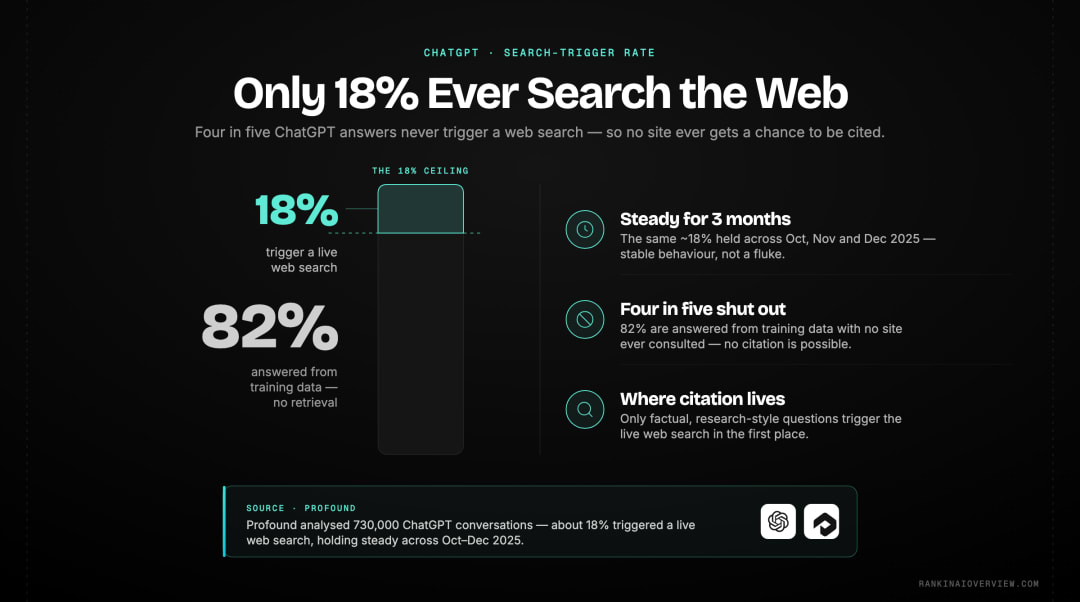
Roughly 18% of ChatGPT conversations trigger at least one live web search, according to Profound's analysis of 730,000 real conversations. The other 82% are answered entirely from the model's training data, with no live retrieval and no citation opportunity at all.
This is the number most discussions about ChatGPT citations skip entirely. Before a brand can be cited, ChatGPT has to decide a question needs fresh, external information rather than an answer it already has encoded from training. Profound's study found this 18% trigger rate held steady across October, November and December 2025, suggesting it reflects a stable behaviour pattern rather than a temporary setting.
The practical implication is blunt. Roughly four in five ChatGPT conversations never give any website a chance to be cited, regardless of how well-optimised that website is. Citation strategy only matters for the smaller slice of conversations where a live search actually happens, which is why factual, research-style questions matter far more than casual or creative prompts.
This also reframes what counts as a failure. A brand that tests ten prompts and gets cited in only two of them has not necessarily been overlooked by the model. Some of those untested prompts may never have triggered a search at all, meaning no website on the internet was in contention for that particular answer. Separating a true citation loss from a conversation that was never going to cite anything is the first step toward reading this data correctly.
Does ChatGPT Cite a Source Every Time It Triggers a Search?
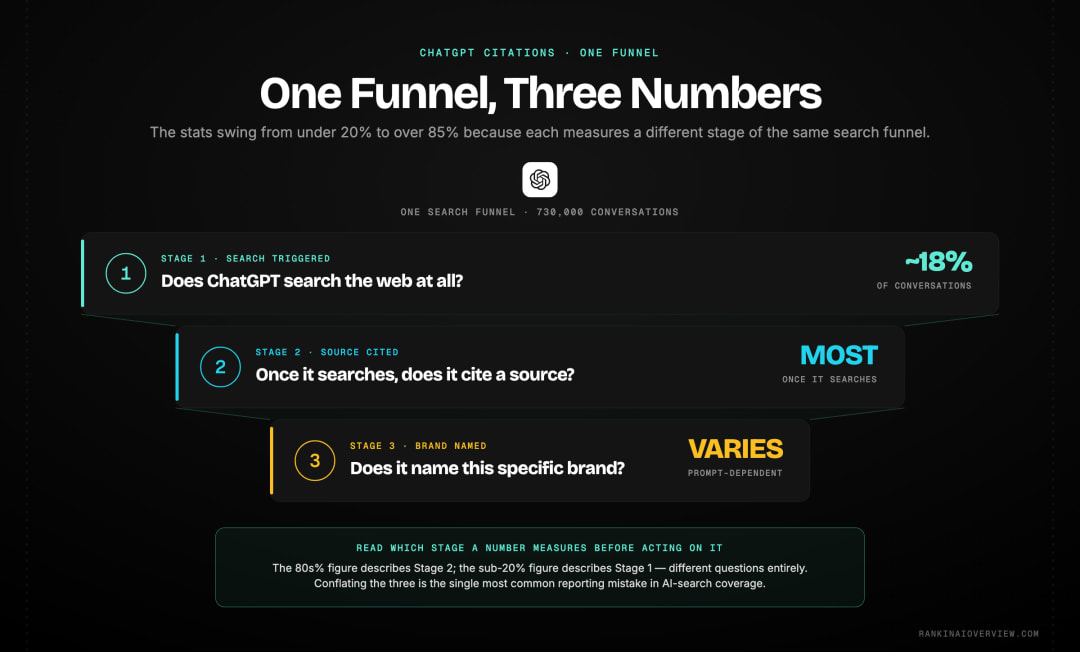
Not always, but most of the time. When ChatGPT does run a live web search, it typically cites at least one source rather than searching silently and answering unattributed. The confusion in published statistics comes from conflating this step with the earlier, much rarer step of triggering a search in the first place.
This distinction explains most of the conflicting numbers you will see quoted elsewhere. A high citation rate, sometimes reported in the 80s, usually describes what happens once a search has already been triggered: ChatGPT rarely searches and then cites nothing. A low number, like the 18% figure above, describes how often that search happens at all. Treat any single citation-rate statistic with caution until you know which of these two steps it is actually measuring. Neither number is more correct than the other; they simply belong to different parts of the funnel.
A third, separate number, how often a specific brand gets named, is smaller again and depends entirely on the prompt set being tested. None of these three numbers is wrong on its own. They simply answer three different questions, and most articles that quote one of them do not say which one they mean.
Laying the three out side by side makes the confusion easier to avoid. Each one is a real, measurable stage of the same process, but they describe very different odds, and conflating them is the single most common mistake in casual reporting on this topic.
| What's Being Measured | Typical Range | Why It's Often Misquoted |
|---|---|---|
| Does ChatGPT search the web at all for this conversation | Around 18% | Often dropped entirely, leaving only the higher numbers below |
| Once it searches, does it cite at least one source | Most of the time | Reported as the overall citation rate without the 18% context |
| Does it cite this specific brand for this specific prompt | Highly variable | Depends entirely on the prompt set and category tested |
Does It Matter Where in a Conversation You Get Cited?
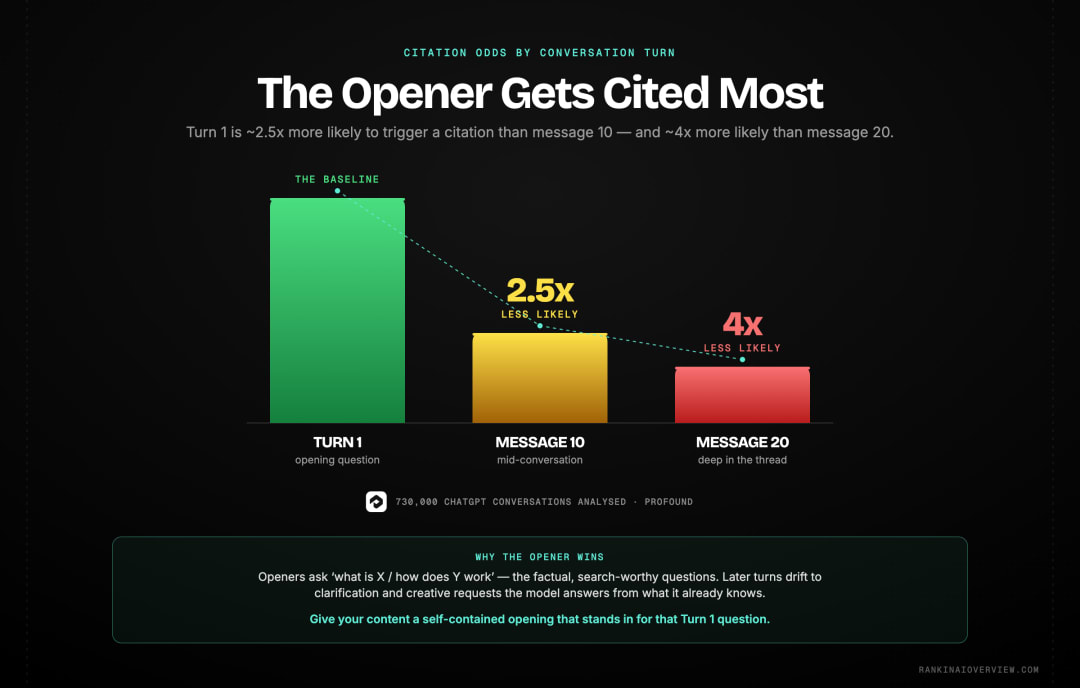
Yes, significantly. The opening question in a ChatGPT conversation is roughly 2.5 times more likely to trigger a citation than the tenth message in that same conversation, and nearly 4 times more likely than the twentieth.
Why Does the First Question Matter So Much?
Opening questions tend to ask for factual grounding, things like “what is X” or “how does Y work”, which is exactly the kind of question that benefits from a live search. Profound's research found this pattern held consistently: as a conversation continues, follow-up messages shift toward clarification, deeper exploration, or creative requests that do not need fresh web data, so the model leans on what it already knows rather than searching again.
This means the content most likely to get cited is whatever answers the question someone asks first, before they have refined their thinking. A detailed comparison page aimed at a buyer's fifth follow-up question is competing for a much smaller pool of citation opportunities than a page answering the broad, opening version of the same topic.
This does not mean deep, detailed content has no value. It means that content needs a clear, self-contained opening section that can stand in for the Turn 1 question on its own, rather than assuming a reader, or a model, will already have worked through several earlier messages of context to get there.
Is Wikipedia Really ChatGPT's Default Source?
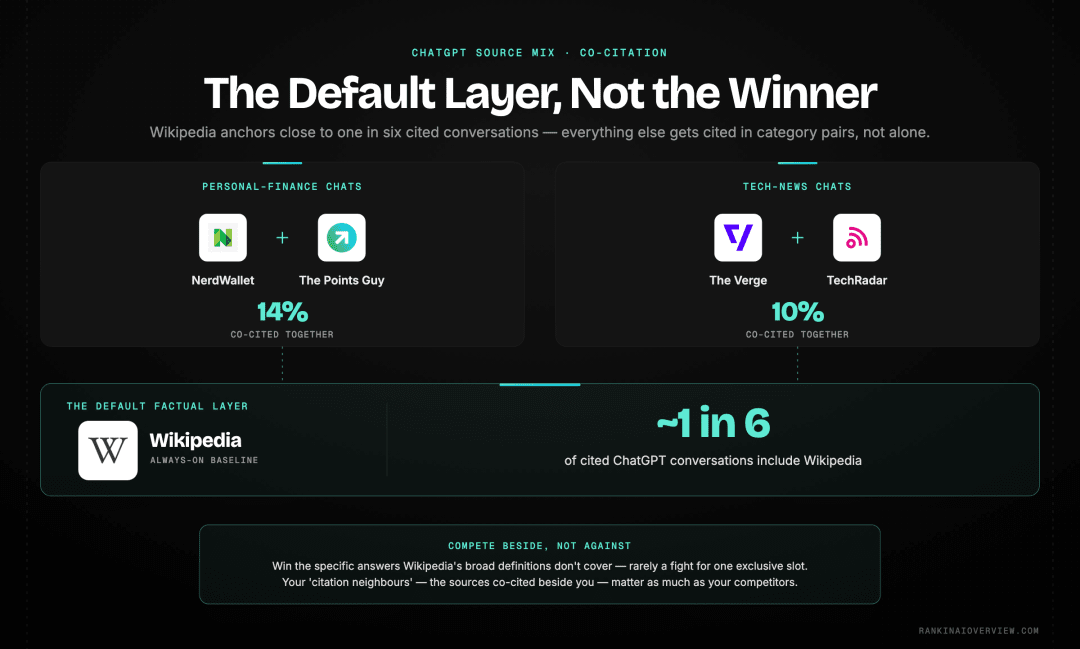
Largely yes, but not exclusively. Wikipedia appears in close to one in six ChatGPT conversations that contain a citation, making it the platform's most consistent single source. It functions as a baseline factual layer rather than the only source the model is willing to cite.
This matters less as competition and more as context. A brand publishing a glossary-style definition page is not realistically going to outrank Wikipedia for a broad factual question, and trying to do so wastes effort. The more useful position is to be the source ChatGPT reaches for immediately after Wikipedia, answering the more specific question Wikipedia's neutral, encyclopaedic tone is not built to address.
That division of labour shows up clearly in practice. Wikipedia tends to win on breadth and neutrality, covering the baseline definition of a topic. Sources like Reddit and niche forums win on specificity and lived experience, the kind of detail a neutral encyclopaedia entry intentionally leaves out. A brand competing for the second slot in that pairing needs a genuinely different kind of content to the brand trying, and usually failing, to compete for the first.
Do Citations Come One at a Time, or in Clusters?
In clusters. ChatGPT frequently cites several competing sources side by side in the same conversation rather than selecting one definitive winner, which means a brand is rarely competing for an exclusive slot.
Domains tend to travel in predictable pairs by category. The same Profound dataset found NerdWallet and The Points Guy co-cited in 14% of personal finance conversations that cited either one, and The Verge and TechRadar co-cited in 10% of tech news conversations. Knowing your “citation neighbours”, the other sources ChatGPT reaches for in the same breath, matters as much as knowing your direct competitors.
"You can't focus on just one source or one channel."
— Alisa Scharf, VP of SEO and AI, Seer Interactive (Ahrefs, Aug 2025)
Scharf's point lines up with the clustering data closely. A brand that only tracks whether it personally got cited misses half the picture; the more useful question is which other sources keep showing up beside it, since those are the sources ChatGPT treats as part of the same trusted answer set for that topic.
This also changes what a missed citation actually means. If a brand's usual citation neighbours all appeared in an answer and the brand did not, that is a specific, investigable gap. If none of the usual cluster showed up at all, the conversation likely never triggered a search in the first place, and the absence says nothing about content quality.
Does Ranking on Google Predict a ChatGPT Citation?
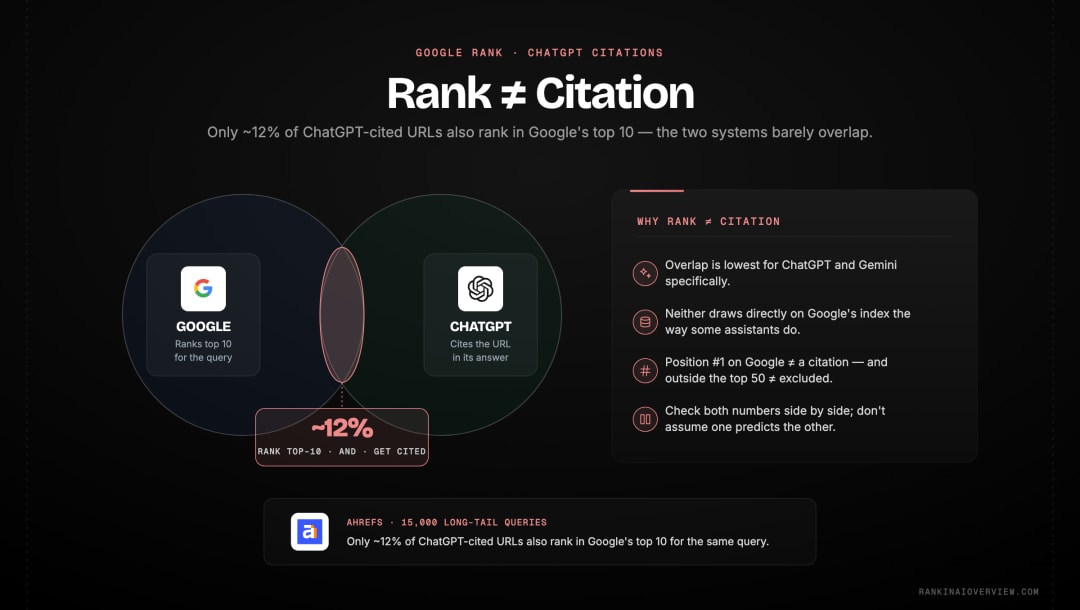
Weakly. Only around 12% of URLs cited by ChatGPT also rank in Google's top 10 for the matching query, according to Ahrefs' analysis comparing search engine rankings with AI citations. Ranking well still helps, but it is far from a reliable predictor on its own.
Ahrefs tested this directly by searching 15,000 long-tail queries and comparing the results against what ChatGPT and other assistants cited for the same questions. The overlap with Google's top 10 results was lowest for ChatGPT and Gemini specifically, since neither draws directly on Google's own index the way some other assistants do. We've covered the broader mechanics behind this gap separately, but the short version is that ChatGPT's retrieval layer runs on different infrastructure with its own ranking logic, so a page's Google position is informative, not decisive.
"Search rankings don't directly dictate AI citations."
— John Fairley, SVP of Marketing Operations, Seer Interactive (PYMNTS, 2025)
Fairley's framing is the most useful way to hold this finding. Good SEO fundamentals, clear structure, crawlable pages, genuine expertise, still feed into whether ChatGPT trusts a page enough to cite it. What does not transfer cleanly is the specific position number. A page sitting at Google position one carries no guarantee of a ChatGPT citation, and a page outside Google's top 50 is not automatically excluded from one either.
The more useful exercise is checking both numbers side by side for the same query, rather than assuming one predicts the other. A brand that ranks first on Google but never appears in ChatGPT's answer for the same question has a real, specific gap worth investigating, since the absence is not explained by ranking weakness alone.
What Actually Increases the Odds of Being Cited?
None of the items below promise a guaranteed citation, since no single tactic overrides the 18% search-trigger ceiling discussed above. What they do is improve the odds within the slice of conversations where a citation was always going to be possible, which is the only place any content decision can realistically move the number.
-
Answer the opening version of a question, not just the deep follow-up. Turn 1 citations dominate; later turns rarely trigger a fresh search.
-
Write the specific, narrow answer Wikipedia cannot give. Compete next to the default source, not against it directly.
-
Know your citation neighbours. Check which other sources keep appearing alongside yours for the same topic, not just whether you appear at all.
-
Treat Google ranking as a contributing signal, not a guarantee. Strong fundamentals still matter even where the overlap with ChatGPT citations is thin.
-
Test factual, research-style prompts specifically. Casual and creative prompts rarely trigger a search in the first place, so they are the wrong place to measure citation performance.
How Can You Measure Your Own Citation Frequency?
Run a fixed set of factual, opening-style prompts across ChatGPT on a recurring schedule and log whether a citation appears, rather than relying on a single occasional check, which any of the three numbers above can make look misleadingly high or low.
A single test prompt tells you almost nothing on its own, given that roughly four in five conversations never trigger a search in the first place. A small, fixed library of 20 to 30 prompts, phrased the way a real opening question would be asked rather than as a keyword, gives a far more honest read on actual citation frequency over several weeks.
Keep the prompt set stable rather than rotating it. Comparing the same questions over time is the only way to separate a genuine shift in citation behaviour from the normal variation in any single response, since the same prompt asked twice can return different results even within the same week.
Phrase prompts the way the first question in a real conversation would actually sound, rather than as a search-style keyword string. Given how heavily Turn 1 dominates citation behaviour, testing a phrase nobody would naturally type as an opening question risks measuring a scenario that rarely happens in practice.
Conclusion
Citation frequency is the theory; for the lived version, here is what actually happened when I got a brand to rank #1 on ChatGPT.
Citation frequency is only half the picture — we also logged what actually gets cited across 500 real AI search results.
How often does ChatGPT actually cite sources? Less often than the headline statistics suggest, and in a far more structured way than most of those statistics imply. Roughly 18% of conversations ever reach the point where a citation is possible, that opportunity is concentrated heavily in opening questions, and the sources that do get cited tend to arrive in competing clusters rather than as a single winner.
None of this makes citation strategy pointless. It makes it more specific. The right question is no longer simply asking whether ChatGPT cites a brand, since that single yes or no answer hides three separate, more useful questions underneath it: whether a search happened at all, whether the brand sat in the small group cited once it did, and how it compared to the citation neighbours it was sitting alongside.
The practical shift this calls for is straightforward: stop chasing a single citation-rate number, and start asking which specific stage of this process a statistic actually describes before acting on it. For deeper research on how AI engines evaluate brand authority and citability, RANK IN AI OVERVIEW covers this space across its content library.
Frequently asked questions
How often does ChatGPT actually search the web?+
Roughly 18% of ChatGPT conversations trigger a live web search, based on analysis of 730,000 real conversations. The remaining majority are answered from training data alone, with no citation opportunity.
Does ChatGPT cite Wikipedia more than any other source?+
Yes, by a clear margin. Wikipedia appears in close to one in six cited conversations, more than any single competing source, though it does not appear in every citation.
Why does ChatGPT cite different sources than Google?+
ChatGPT's retrieval system runs on separate infrastructure from Google's index, so it weighs authority and relevance differently. Only a small share of ChatGPT citations also rank in Google's top 10 for the same query.
Does ChatGPT cite the same source twice in one answer?+
Rarely for the exact same fact, but it commonly cites several different sources within one conversation, often two or three competing sites for the same general topic rather than just one.
Which question types make ChatGPT cite a source at all?+
Factual, research-style opening questions trigger citations most reliably. Casual conversation, creative writing requests, and later follow-up questions in a long conversation rarely prompt a fresh web search.
Explore with AI
Share this