Is AI Search Visibility More About Trust Than Rankings? The Evidence Says Yes
The data increasingly shows that AI search citation is driven by trust signals, not just ranking signals. Here is what that means for your strategy and how to build the right kind of authority.

SummaryTrust, not rankings, is increasingly the deciding factor for AI citations. Brands earn visibility in ChatGPT, Perplexity, and AI Overviews by demonstrating third-party corroboration, expert authorship, factual accuracy, entity consistency, and objective content. Rankings help with retrieval, but trust determines whether AI engines choose to cite you.
Read moreShow less
There is a growing consensus among AI search practitioners: the brands getting cited most consistently are not always the ones with the most backlinks or the highest domain authority. They are the ones AI engines trust. According to Princeton and Georgia Tech's generative engine optimisation research, AI citation probability increases by 30 to 40 percent when content includes authoritative citations, statistical data, and clear structural signals that allow AI engines to verify claims independently. These are trust signals, not ranking signals. The two categories overlap but they are not the same thing.
The practical implications of this distinction are significant. An SEO team that invests exclusively in backlink acquisition and keyword optimisation is building ranking signals. If those ranking signals do not also produce the trust signals that AI engines evaluate, the team is building Google ranking without building AI citation eligibility. The investment is partially wasted relative to the channels that matter in 2026\.
This guide examines the evidence that trust is the primary AI citation driver, defines each of the five trust signals that AI engines evaluate, compares the trust-building approach to the traditional rankings approach, and gives you a practical action plan for building the kind of authority that earns AI citations rather than just organic positions.
What Does Trust Mean to an AI Search Engine?
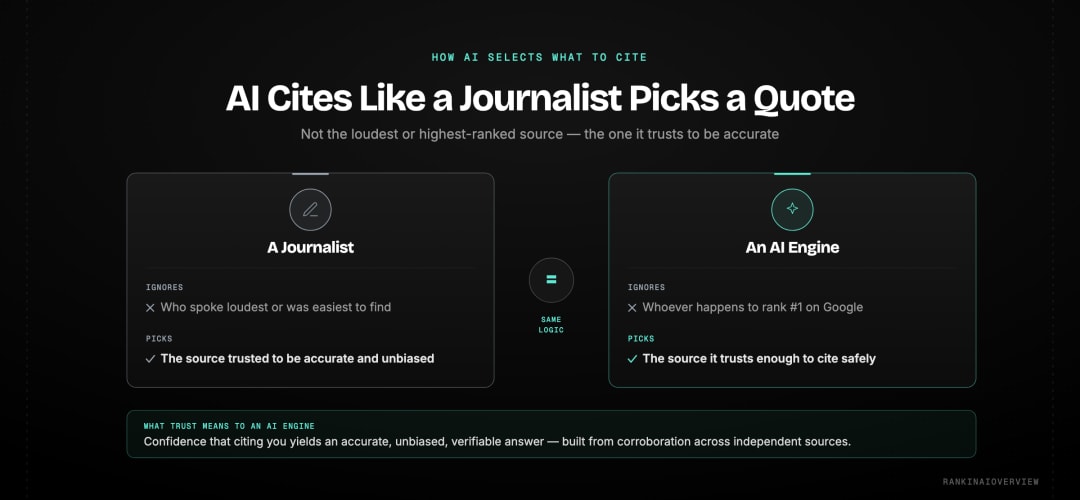
Trust, for an AI search engine, is the confidence that citing a particular source will produce an accurate, unbiased, and verifiable answer. AI engines are risk-averse systems. They have strong incentives not to produce incorrect information because incorrect AI answers damage user trust in the platform itself. This risk-aversion makes trust signals more important than proximity to the top of a results page. |
|---|
The journalist analogy from the practitioner community captures this precisely. When a journalist selects a source for a quote, they do not pick the person who spoke most clearly or the one who was easiest to find. They pick the source they trust to be accurate, unbiased, and credible to their audience. A journalist would rather quote a less prominent expert with a strong track record than a high-profile commentator who has previously been inaccurate. AI engines apply the same selection logic.
AI trust is built from corroboration. When an AI engine encounters a claim or a brand recommendation, it asks whether that claim is supported by multiple independent sources it already trusts. A claim that appears in your own content alone is unverified. A claim that appears in your content and is corroborated by an independent review, a community discussion, and an industry publication is verified. The corroboration is what transforms the claim from potentially self-serving to reliably accurate.
This risk-management model explains why AI search trust signals diverge from traditional ranking signals. Google ranking rewards consistency and authority within the link graph. AI trust rewards consistency and corroboration across the entire information ecosystem, including sources that do not link to you at all. Google's Search Quality Rater Guidelines define Trustworthiness explicitly as a dimension of quality that goes beyond technical signals to include accuracy, transparency, and clear sourcing. These are the same properties AI engines evaluate when deciding what to cite.
What Is the Evidence That Trust Outperforms Ranking for AI Citation?


Three categories of evidence consistently show that trust signals predict AI citation more reliably than ranking position. Research data shows that off-site corroboration is more predictive of citation than domain authority. Platform behaviour shows that Perplexity prioritises Reddit and review platforms over brand-owned content regardless of ranking. And practitioner observation consistently finds that promotional content is skipped by AI engines even when it holds position one on Google. |
|---|
The research evidence is clear. Princeton and Georgia Tech's GEO research tested seven specific content interventions and found that adding statistics, quotations, and authoritative citations produced the largest visibility improvements, outperforming improvements to writing quality, keyword density, and structural formatting. The interventions that improved AI citation the most were all trust signals rather than traditional SEO signals. The research found that content with authoritative citation integration improved AI visibility by 30 to 40 percent relative to equivalent content without it.
The platform behaviour evidence is equally compelling. Perplexity cites Reddit as one of its top sources across all query categories. Reddit content has no domain authority in the traditional SEO sense. Reddit threads do not acquire backlinks. But Reddit content is trusted because it represents authentic community knowledge with no commercial motivation. This is trust vs ranking for AI in its most observable form: Perplexity prioritises authentic community trust over ranking authority every time.
The practitioner observation evidence is consistent across the community. Pages with promotional content are routinely skipped by AI Overviews even when they hold high ranking positions. Pages with aggressive lead generation calls to action in the opening section fail the trust test regardless of their domain authority. Pages written by unnamed "editorial teams" without author credentials fail the expertise dimension of trust regardless of their backlink profile. Trust vs ranking for AI is not a theoretical distinction. It is the operating reality that practitioners encounter every week.
What Are the 5 Trust Signals That Drive AI Citation?

Five specific trust signals determine whether AI engines will cite a source. Each one is observable, measurable, and improvable. None of them require abandoning traditional SEO investment. All five serve Google ranking and AI citation simultaneously because the trust evaluation frameworks overlap significantly. The fastest improvement comes from signals one and two, which can be addressed on-page within days. |
|---|
Trust Signal 1: Third-Party Corroboration
Third-party corroboration is the most important AI search trust signal because it is the one that most directly answers the AI engine's core question: can this claim be verified independently? A brand with positive Reddit mentions, G2 reviews, industry publication features, and community forum discussions has multiple independent sources corroborating its claims and its category positioning. A brand with only its own content has no corroboration.
The practical implication is that off-site presence on platforms that AI engines trust is more valuable for AI citation than additional on-site content production. A genuine Reddit answer that helps a real user with a real question produces an AI trust signal that a thousand words of on-site content cannot replicate. This is the clearest evidence that trust vs ranking for AI requires a fundamentally different investment allocation from traditional SEO.
Trust Signal 2: Content Objectivity
AI engines are trained to identify promotional content patterns: benefit statements before facts, pricing references before answers, testimonials before information delivery, calls to action in educational sections. These patterns signal that the content's primary goal is conversion rather than information, which makes it less safe to cite. Google's Search Quality Rater Guidelines explicitly identify pages with Ads, Supplementary Content, or Main Content that are unhelpful or deceptive as low-quality. AI engines apply the same filter when evaluating what is safe to cite. Objective, educational content that serves the reader before serving the brand is consistently cited at higher rates than equivalent content with promotional framing.
Trust Signal 3: Author Expertise and Credentials
E-E-A-T for AI visibility operates most directly through the Experience and Expertise dimensions. A named author with verifiable credentials, a linked biographical page showing their professional background, and inline demonstrations of direct experience with the subject builds the author-level trust signal that AI engines use to evaluate content credibility. Anonymous content published by "the editorial team" fails this evaluation.
The practical requirement is specific: a name, a credential, and a demonstration of direct experience in the text itself. "I tested forty SEO tools over twelve months and these are my specific findings" is an experience signal. "Our team has reviewed many tools" is not. The difference in AI citation probability between these two framings is measurable and significant. E-E-A-T for AI visibility operates most precisely at the author level: the Experience and Expertise dimensions require the most visible implementation work.
Trust Signal 4: Entity Consistency
Entity consistency is the systematic trust signal that most established brands fail without realising it. If your brand name appears as three variants across directories, your founding date is listed as two different years across platforms, and your product category description changes between your website and your G2 profile, AI engines cannot aggregate these signals into a single coherent entity. Inconsistency reads as unreliability in AI trust evaluation.
The fix is an entity audit: identify every external platform where your brand appears and ensure that the canonical name, description, founding date, category, and official website match exactly across all of them. Google's structured data documentation confirms that entity understanding is central to how its AI systems evaluate content credibility. Consistent entity signals reduce ambiguity and increase the confidence with which AI engines can cite your brand.
Trust Signal 5: Factual Accuracy and Verifiability
AI engines verify claims by cross-referencing them against other sources they trust. Content that makes specific, sourced, verifiable claims builds factual trust. Content that makes broad, unverifiable claims or that contradicts established information fails the verifiability test. AI search credibility signals at the factual level include: inline citations to primary sources, specific statistics with their sources named, named examples rather than abstract claims, and dates and timeframes that allow temporal verification.
The practical implication is that every significant claim in AI-facing content should be either from primary research you conducted or linked to a primary source. Claims attributed to "studies show" or "research suggests" without a specific source are lower-trust than claims attributed to a specific named study or official documentation. The more verifiable your claims, the stronger your AI search credibility signals and the more confidently AI engines can cite the content containing them.
“ Think of it like a journalist picking a quote source. They go with who they trust, not who ranks. AI is asking: is this safe to cite? Not: what is the rank? That single reframe changes everything about how you should be investing in search visibility. SEO community practitioner r/seogrowth community, Reddit 2026 Source: Reddit: Is AI Visibility More About Trust Than Rankings? |
|---|
How Does Building Trust Compare to Building Rankings?

Trust-building and ranking-building overlap significantly on the content quality dimension but diverge sharply on the off-site investment dimension. Traditional SEO optimises off-site investment for backlink acquisition. AI trust-building optimises off-site investment for community presence, editorial mentions, and review platform profiles. Understanding how AI chooses citation sources at the off-site level reveals the clearest divergence from traditional SEO. |
|---|
Dimension | Traditional Ranking Approach | AI Trust-Building Approach | Overlap |
|---|---|---|---|
On-site content | Keyword-optimised, comprehensive, well-structured | Objective, expert-authored, answer-first, verifiable claims | High. Quality content serves both goals simultaneously |
Off-site signals | Backlink acquisition from authoritative domains | Community presence on Reddit, Quora; review platforms; editorial mentions | Low. Different platforms, different investment models |
Author signals | Authorship metadata for Google crawling | Named expert with verifiable credentials and experience signals in text | Medium. Both require author markup; trust needs more explicit experience signals |
Entity signals | Brand consistency for local SEO; schema for rich results | Complete entity profile: Wikidata, Knowledge Panel, consistent brand identity everywhere | Medium. Both benefit from schema; trust requires broader entity verification |
Technical signals | Core Web Vitals, crawlability, indexing | Crawlability by AI bots, Bing Webmaster Tools submission, schema markup | High. Technical health serves both channels with minor additions for AI |
Timeline | Rankings improvements: 3 to 6 months | Trust improvements: 4 to 8 months for community and editorial signals | Similar timelines; trust is slightly slower but more durable |
What Is Your Trust-Building Action Plan?

The trust-building action plan below is sequenced for maximum impact per week invested. Week one focuses on on-site changes that serve both Google E-E-A-T and AI trust simultaneously. Weeks two and three focus on entity and off-site signals. Weeks four through twelve focus on the community and editorial presence that compounds over time. Each stage produces measurable improvements before the next stage begins. |
|---|
Week one: Content objectivity audit. Read the opening 200 words of your five most important pages. Remove every benefit statement, feature claim, pricing reference, and call to action from the opening section. Rewrite to lead with a direct, factual answer. Add a named author bio with specific credentials and a sentence demonstrating direct experience with the topic. These changes alone produce measurable Perplexity citation improvements within two to four weeks.
Weeks two and three: Entity and technical audit. Implement Organisation schema on your homepage with complete, accurate information. Verify your Google Knowledge Panel. Audit every external profile where your brand appears and standardise the name, description, and category to match your Organisation schema exactly. Submit your site to Bing Webmaster Tools for ChatGPT Search eligibility. Validate all schema implementations using the Google Rich Results Test.
Weeks four through twelve: Off-site presence building. Identify the three platforms where your category buyers spend the most time: for B2B, typically Reddit, LinkedIn, and your primary review platform. For consumer categories, typically Reddit, Quora, and specialist forums. Commit to two to three genuine expert contributions per week on each platform. After eight weeks, evaluate whether your AI citation frequency has increased using manual prompt testing in ChatGPT and Perplexity. The correlation between community presence and Perplexity citation frequency typically becomes visible within eight to twelve weeks of consistent contribution.
Ongoing: Editorial mention strategy. Identify five to ten industry publications, analyst firms, or podcast programmes whose audiences overlap with your buyer category. Develop a point of view on a specific dimension of your industry that no one else is publicly arguing. Pitch this perspective as a contributed article or expert comment. One to two editorial placements per quarter in well-regarded publications produces an AI search credibility signal that compounds over time as subsequent articles reference and cite the earlier coverage.
Why Do Source and Sentiment Matter as Much as Volume?
Being mentioned is not enough on its own. AI engines weigh who is talking about a brand and what they are saying. One mention in a trusted, independent source counts for more than many mentions on low-authority sites, and a steady run of negative mentions works against citation rather than for it. |
|---|
Not all mentions carry the same weight. A brand mentioned in a relevant Reddit community, an industry publication, an analyst report, Wikipedia or an established review platform earns more than the same brand listed in a low-authority directory. Google paid Reddit USD 60 million for content access, and Perplexity treats Reddit as one of its most-cited domains. Reddit is valued because the content comes from users, not brands. A brand that several Reddit users recommend across several threads has earned the kind of independent backing that ten more blog posts on its own site cannot match.
A mention without a link still counts. A Reddit mention with no link can carry more weight for AI citation than a backlink from a low-authority blog, because AI engines weigh how much they trust the platform, not the link equity passing through it.
Sentiment is the signal brands tend to check last. AI engines don't just count mentions. They read whether those mentions are positive, neutral or negative. Being named often in threads that say "avoid this brand" or "we had a bad experience with X" builds evidence against citation, and it can mean the brand gets cited with caveats attached. Monitoring and responding to negative coverage, the old PR job, now has a direct effect on AI visibility. Better website copy will not fix it. What fixes it is a better product and customer experience, followed by steady positive mentions that shift the balance over time.
How Do You Turn Reddit, Reviews, and Press Into Trust Signals?
Third-party corroboration comes mainly from three places: community platforms like Reddit, review platforms, and earned media. Start with Reddit and reviews, which cost the least and give the fastest signal. Then build toward editorial placements, which carry the most authority and compound over time. |
|---|
Reddit: Earn Credibility Before You Mention the Brand
Pick three to five subreddits where your buyers research decisions in your category, not the ones where practitioners talk shop. Answer existing questions with specific, experience-based replies of 200 to 400 words. Hold off on naming your brand until your fourth or fifth contribution. An early brand mention reads as promotion, and the community pushes back instead of backing you. Two to three genuine contributions a week keeps the signal alive. Sporadic bursts produce a weaker signal than steady participation.
Review Platforms: Ask for Specific Reviews, Not Star Ratings
Choose the platforms where your buyers actually research: G2, Capterra and Clutch for B2B, Clutch and Trustpilot for professional services, and Google Reviews, Yelp and Trustpilot for consumer brands. Quality matters as much as count. AI engines pull specific claims out of reviews: who the reviewer was, what problem they had, and what changed. "Great product, highly recommend" gives them nothing to use. "As a compliance manager at a 200-person financial services firm, we reduced our regulatory reporting time by 40% using this tool" gives them a use case, a user type and an outcome.
The easy fix is to guide the customer. When you ask for a review, share three prompts: What was your role and use case? What problem were you solving? What outcome did you get? Customers left to themselves mostly leave a star rating and a short phrase.
Earned Media: Target the Publications AI Already Cites
Ask ChatGPT and Perplexity the questions buyers ask in your category and note which publications show up as sources. Those are your targets. Being quoted in a publication that AI engines already cite ties your brand to a source they trust. For most brands the way in is a contributed, bylined article from a credible practitioner on a topic that publication's readers care about.
Press is not the only channel. Quora answers, LinkedIn articles from subject experts, industry forums and podcast appearances all add to the same picture. A brand that shows up as the same helpful voice on three or four of these platforms over twelve months gets cited more reliably than one that only publishes on its own site.
How Do You Measure Whether Trust Is Building?
Trust builds slowly, so track it with a short set of metrics: how often you are mentioned, how many useful reviews you have, how often AI answers cite you, how you compare with competitors, and whether people are searching for you by name. |
|---|
Metric | What It Measures | Tool | Cadence |
|---|---|---|---|
Brand mention volume | Volume of brand mentions across Reddit, publications, forums | Brandwatch, Mention.com, or manual Google Alerts | Monthly |
Review platform presence | Number and quality of reviews on G2, Capterra, Clutch, Trustpilot | Manual audit of each platform | Quarterly |
AI citation rate | How often your brand appears in AI-generated answers for target queries | Rankscale, Profound, or manual prompt testing in ChatGPT and Perplexity | Weekly |
Branded search volume | Downstream brand awareness signal from AI-driven discovery | Google Search Console (filter for branded queries) | Monthly |
Share of voice in AI | Your citation frequency vs competitors across the same prompt set | Peec AI, Profound, or competitive prompt testing | Monthly |
The metric that ties this work to business results is branded search volume in Google Search Console. When AI engines cite your brand in answers to category questions, some of the people who see those answers later search for you by name. If branded search rises during the months you are actively building trust signals, the work is creating real awareness, not just more mentions.
Conclusion
Rankings get you into the retrieval pool. Trust determines whether you are selected from it. The brands winning AI search visibility in 2026 are building both: ranking signals to ensure retrieval eligibility, and trust signals to pass the selection test that follows. E-E-A-T for AI visibility is not a new concept. It is the same framework Google has been developing for years, now applied by AI engines making citation decisions rather than ranking decisions.
Build the five AI search trust signals in sequence: corroborate your claims through off-site presence, write objective content that helps before it sells, surface verifiable author expertise, standardise your entity identity across every platform, and make every factual claim traceable to a primary source. Understanding how AI chooses citation sources is the strategic reframe that changes everything about AI visibility investment. Build the trust, and AI search credibility follows. RANK IN AI OVERVIEW covers how AI engines evaluate and select trusted sources across all major platforms in depth across its content library.
Frequently asked questions
Does negative press affect AI search visibility?+
Yes, directly. AI engines absorb brand reputation from the sources they learn from and retrieve, and that includes negative press, critical reviews and community complaints alongside positive mentions. A brand with a lot of negative coverage in trusted sources gets cited less often, and sometimes gets described with caveats even when it is cited. Fixing this takes real improvement in the product or service, followed by steady positive mentions that shift the balance over time.
How do I build AI trust signals on a small budget?+
Start with Reddit and Quora, which cost only time. Two to three genuine, specific contributions a week in relevant subreddits can show up as Perplexity citation signals within eight to twelve weeks. Reviews cost nothing beyond asking satisfied customers, ideally with prompts that help them write specific reviews. Contributed articles in industry publications are usually unpaid too. A brand with real expertise and no budget can build meaningful trust signals through consistent participation alone.
Explore with AI
Share this


