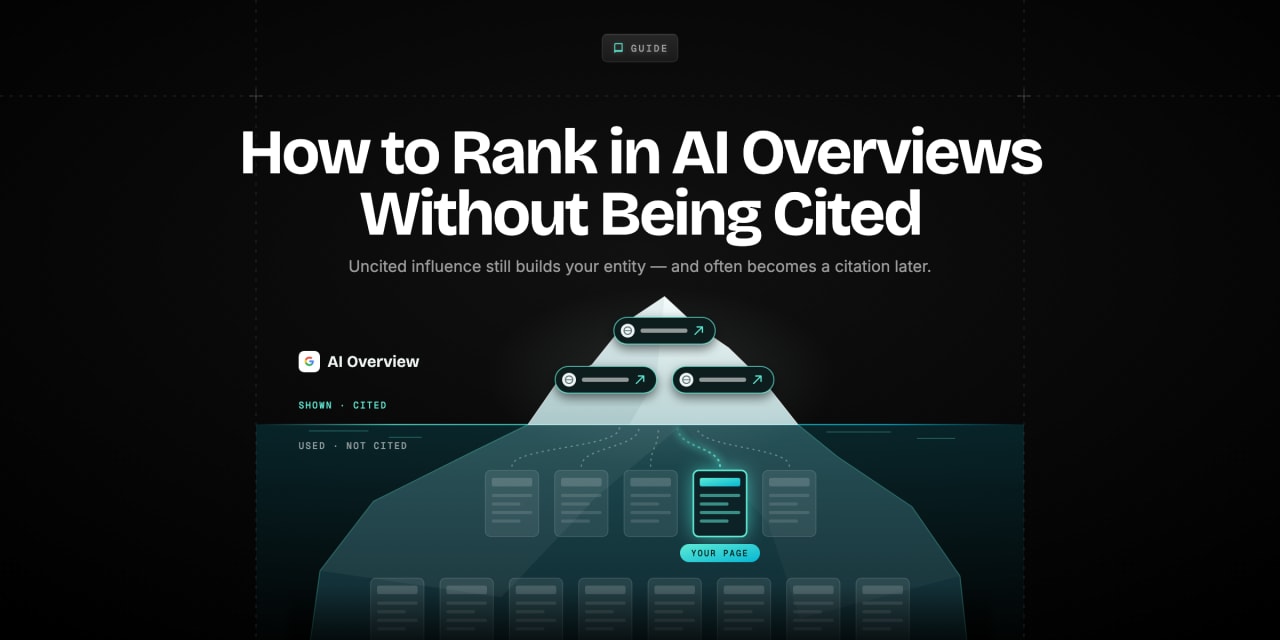
How to Rank in AI Overviews Without Being Cited
Your content can shape a Google AI Overview without your link showing as a citation. Here is how uncited influence works and how to use it.
Key Highlights
- To rank in AI Overviews without being cited means your content shapes the answer without your link appearing among the visible citation chips.
- The citations an AI Overview shows are a selective slice, not a full list of every source that informed the reply.
- Which sources get cited shifts with how the question is framed, so a citation is a moving target, not a fixed prize.
- Uncited influence still reinforces your brand and entity, and it often becomes a visible citation later.
- You earn uncited influence by owning specific, checkable facts and repeating consistent brand signals across the web.
- You can measure influence through brand-mention monitoring and prompt testing, even when no citation link appears.
Most advice about AI search assumes one goal: get the clickable citation. According to an audit of Google Gemini by researchers Peiying Zhu and Sidi Chang, which sources an engine cites depends heavily on how a question is framed. Their study of 1,357 grounding citations across 156 hotel queries found experiential questions drew 55.9% of citations from non-booking sources, against 30.8% for transactional ones, a 25 point swing driven by phrasing alone. The lesson travels well beyond hotels. What an AI Overview shows you is a curated, shifting slice of what actually shaped its answer.
That gap is where a lot of quiet frustration lives. You read an AI Overview, recognise your own facts or phrasing inside it, then scan the little source chips and your site is nowhere. It feels like being used without credit. Worse, you cannot tell whether you contributed at all, because the visible citations do not report everything the engine leaned on. Many marketers give up here, assuming that if they are not cited, they are simply not in the game.
This guide argues the opposite. Being uncited is not the same as being absent. Your pages can inform an answer, seed the entities an engine trusts, and set up a later citation, all without a chip today. Below we explain what ranking without being cited really means, why it happens, whether it is worth chasing, how to win that uncited influence on purpose, and how to turn it into the visible citation you actually want.
What does it mean to rank in AI Overviews without being cited?
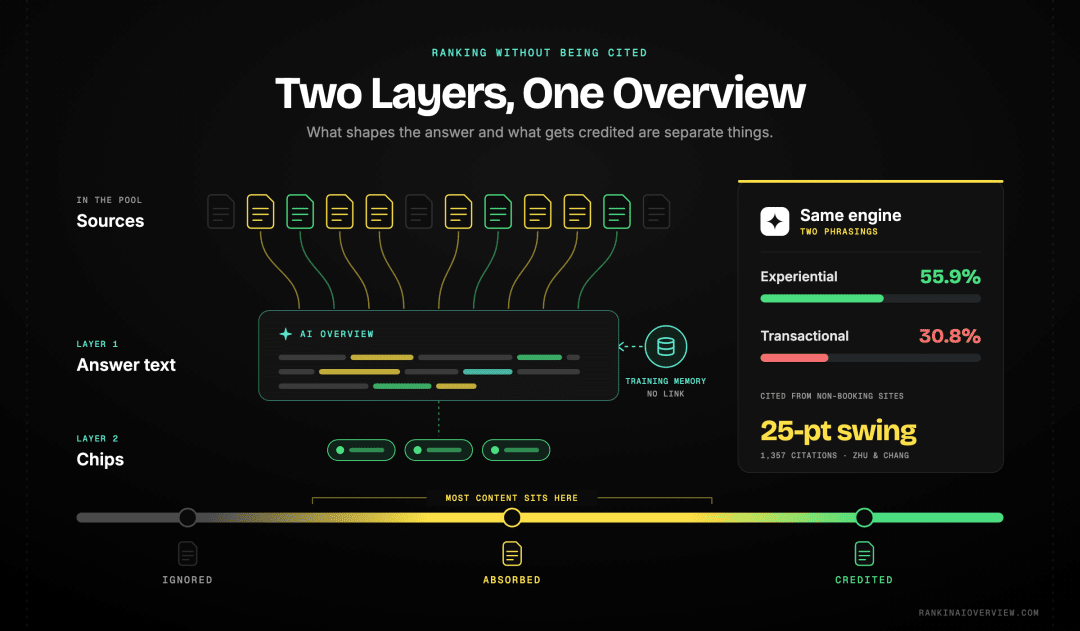
To rank in AI Overviews without being cited means your content contributes to the generated answer without your URL appearing in the displayed citations. The engine may absorb your facts, phrasing, or entity associations while crediting a different, more prominent source. You shaped the reply, but the visible chips do not name you.
This distinction confuses people because search trained us to equate visibility with a blue link. In AI answers, the answer text and the citation list are two separate layers. The text is a synthesis. The citations are a short, curated set the engine chose to surface. Plenty of material flows into the first layer without ever reaching the second.
Think of it as the difference between being read and being credited. A student can absorb ten books and formally cite three. The other seven still shaped the essay. AI Overviews behave similarly, drawing on far more than they display. Our own analysis of what actually gets cited in AI search shows how narrow that displayed set usually is.
Once you accept that split, a lot of confusing behaviour makes sense. It explains why your facts can appear without your name, why a rival with weaker content sometimes holds the chip, and why the same query can credit different sources on different days. None of that means your content failed. It means you are working the influence layer, which is where the durable gains start.
So "ranking" here is not a numbered position. It is the degree to which your content influences the answer a user reads. A citation is one signal of that influence, and the loudest one, but it is not the only place influence lives.
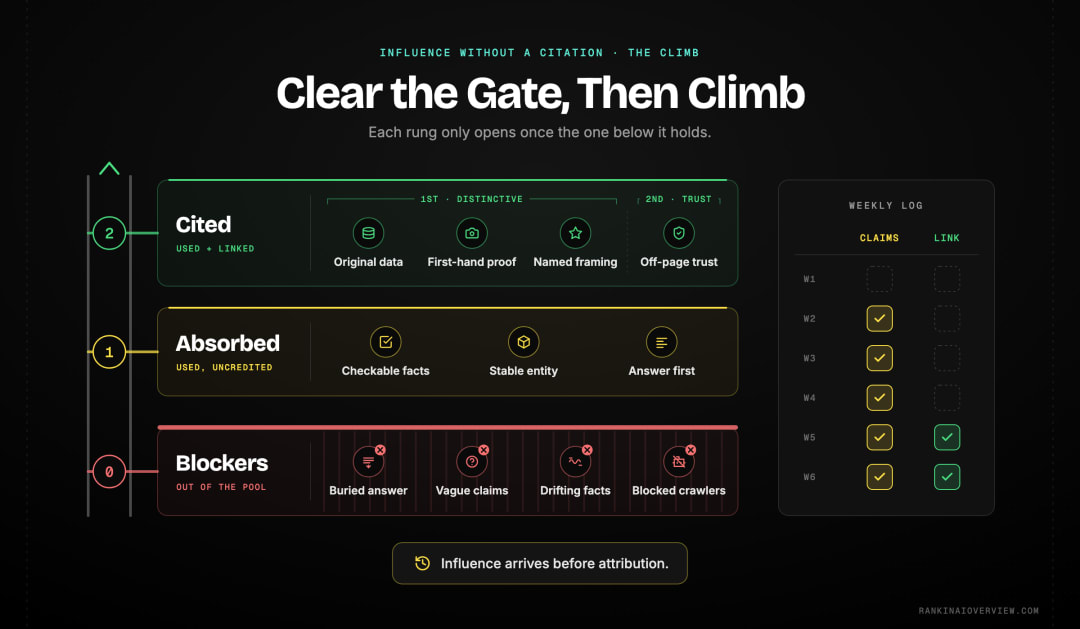
This reframing changes what success looks like. In classic search, you either hold a position or you do not, and the ranking is public. In AI answers, your contribution is a spectrum from ignored, to absorbed, to credited. Most useful content lives in the middle band for a while, absorbed but uncredited, before it earns the chip. Judging yourself only by the citation misses the progress happening one layer down.
Can your content appear in an AI Overview without a citation?
Yes. Your content can appear inside an AI Overview answer without a citation because the displayed sources are a selective sample, not a complete ledger. Engines summarise across many documents, then attach a handful of links. Facts, definitions, and framings routinely enter the answer while the page that supplied them goes uncredited.
The hotel audit above makes the selectivity concrete. If the same engine cites wildly different sources depending on whether a question sounds experiential or transactional, then the citation list clearly reflects choices, not a full accounting. A source that fits one framing is dropped for another, even when it could support both.
There is a second route in: parametric memory. Large models carry knowledge from training data, so an answer can restate something your site helped establish across the web long ago, with no live retrieval and no citation at all. This is why widely repeated brand facts show up in AI answers unlinked. It also explains why AI engines sometimes cite pages that do not rank on Google while ignoring pages that do.
"We document a systematic pattern we call the Intent-Source Divide." Peiying Zhu and Sidi Chang, authors, "The End of Rented Discovery: How AI Search Redistributes Power Between Hotels and Intermediaries". Source: arXiv
The practical takeaway is freeing. You do not need to win a citation to be in the room. You need your content to be the clearest available version of a fact the engine wants to state.
Why do AI Overviews use content without citing it?
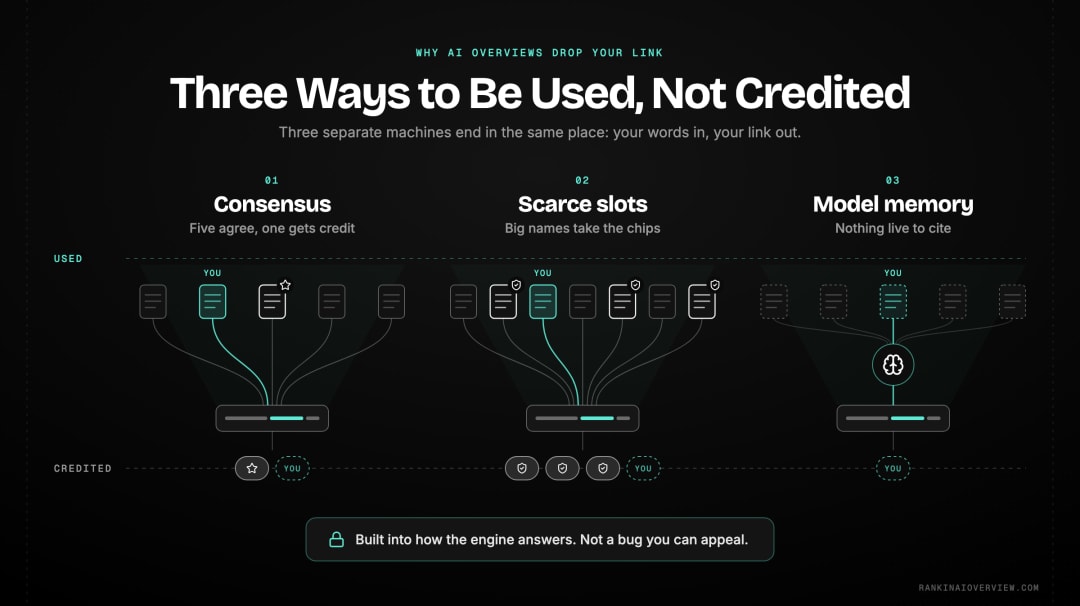
AI Overviews use content without citing it because of how the answer is built. The system retrieves a broad candidate pool, synthesises across it, then displays only a few sources for space and readability. Absorption is wide. Attribution is narrow. That mismatch is structural, not a bug you can appeal.
The answer is a synthesis, not a quotation
An AI Overview blends many sources into one fluent paragraph. When five pages agree on a fact, the engine states the fact once and may cite the single most authoritative page, or none. The other four contributed real signal and get no chip. Consensus makes your individual link easy to omit even when your content was part of the consensus.
Citation slots are scarce and chosen
Engines show a small number of sources. That budget forces selection, and selection favours recognisable, high-trust domains. A newer site can supply the exact sentence used and still lose the slot to a household name. Understanding how Google picks its AI Overview sources shows how much curation sits behind those few links.
Parametric knowledge needs no citation
When an answer comes from training data rather than live retrieval, there is nothing to cite. The model simply knows the fact. If your brand facts are consistent and repeated across the web, they become part of that stored knowledge and surface unlinked. This is uncited influence at its most durable.
Also read: Why your website ranks on page 1 but not in AI Overviews
Which AI engines use content without citing it most?
AI engines differ sharply in how often they credit sources. Perplexity cites heavily and openly, so uncited influence is rarer there. ChatGPT answers many prompts from training data with no link, so uncited influence dominates. Google AI Overviews and Gemini sit in between, showing few chips over a wide absorbed pool.
Knowing the mix helps you aim your effort. Where an engine cites little, your goal is to be part of the stored knowledge it draws on, which is a long game of consistent, repeated presence. Where an engine cites a lot, your goal is to be the specific, fetchable page it can point to right now.
Retrieval-heavy engines reward fetchable pages
Perplexity runs a live search on almost every query and shows its working. To benefit, your page must be crawlable, fast, and clearly structured, so the engine can fetch it and quote it. Here, being uncited usually means you were not retrieved, so the fix is technical and structural rather than reputational.
Training-heavy engines reward repeated presence
ChatGPT answers a large share of prompts without any live search, drawing on what it already learned. You cannot get a citation from stored knowledge, but you can shape that knowledge by making your brand facts consistent and widely repeated. Uncited influence is the only kind available here, and it is worth a great deal.
Overview engines reward both at once
Google AI Overviews blend retrieval and stored knowledge, then display a short source list. That means both paths matter, and both forms of uncited influence apply. A page can inform the summary through live retrieval or through prior repetition, and often loses the visible chip either way. Reading how often ChatGPT actually cites its sources shows just how uneven crediting is across engines.
Is ranking without being cited actually worth it?
Ranking without being cited is worth it as a stepping stone, not a destination. Uncited influence reinforces your brand and entity, shapes how AI describes your category, and frequently converts into a visible citation over time. It is genuine value. It is simply harder to click and harder to count than a named source link.
Be honest about the limits. An uncited mention sends no direct referral traffic. It is not a clean line in a report. If your only goal this quarter is trackable clicks, uncited influence will feel unsatisfying. That frustration is fair, and you should still pursue the citation as the end state.
But dismissing uncited influence is a mistake. Every time an engine states your fact, your framing, or your brand association, it strengthens the model's confidence in you as a source. That accumulated trust is exactly what earns the citation later. Influence today is how citations are seeded tomorrow.
There is also a defensive angle. If your competitor owns the framing an engine repeats, that framing is working against you in every answer, cited or not. Winning the uncited layer is partly about making sure the version of the truth AI restates is yours, not theirs. For the wider trade-off between influence and clicks, see our take on measuring AI search visibility.
Picture a simple case. You publish a clear definition of a niche term, and within weeks AI Overviews start using your exact wording, but they credit a larger site that copied the idea later. That stings, yet your definition is now the standard the engine repeats. The larger site holds the chip, but you set the frame. Over time, as your original page gathers mentions and trust, the credit often migrates back to the source that said it first. Influence bought the position that the citation eventually fills.
How do you get your content into AI answers without a citation?
You get into AI answers without a citation by being the clearest, most corroborated source of specific, checkable claims. Engines absorb content they can extract cleanly and trust quickly. Own precise facts, repeat consistent brand signals across the web, and structure pages so a complete answer is easy to lift.
The tactics below all serve one aim: make your version of a fact the easiest one for a model to state confidently.
Own specific, checkable facts
Vague content gets averaged into the consensus and forgotten. Precise, verifiable claims get absorbed because they are useful and safe to repeat. State exact figures, clear definitions, and concrete steps. A page that says "response times fell to 1.2 seconds" is more absorbable than one that says "response times improved."
- Publish specific numbers, dates, and named examples rather than generalities.
- Define terms cleanly so your definition becomes the reusable one.
- Make each claim self-contained, so it survives being lifted out of context.
Reinforce your entity everywhere
Parametric influence comes from repetition across the web, not from one page. Keep your brand name, category, and core facts consistent on your site, your profiles, and third-party mentions. Consistency is what lets a model store you as a known entity and restate you without a live source. Reputation, not keyword density, is what builds that stored association.
Treat your core facts like a fixed record. Decide the exact wording of your category, your headline numbers, and your one-line description, then repeat it everywhere without drift. When a model sees the same claim phrased the same way across many places, it stores that claim with confidence and reuses it freely. Contradictory versions cancel each other out and leave you unstored.
Structure pages so the answer leads
Bury the answer and an engine skips it. Lead with a direct, complete response to the exact question, then expand. A tight opening answer of 40 to 60 words is the unit most likely to be absorbed, whether or not it earns a chip. Clean headings, short paragraphs, and one idea per block all raise extraction odds.
Write each answer so it can stand alone. If a passage only makes sense after reading the paragraph before it, the engine cannot lift it cleanly, and it moves on to a source it can. Repeat the subject inside the answer rather than relying on "it" or "this". A self-contained block is portable, and portable blocks are the ones that end up inside AI answers. Match your headings to the exact phrasing people use when they ask, so the engine can map the question to your answer without guessing.
How do you turn uncited influence into visible citations?
You turn uncited influence into visible citations by giving the engine a reason to credit you specifically. Original data, first-hand detail, and a quotable framing make your page the natural source to name, not one of many interchangeable ones. Off-page trust then makes the engine comfortable displaying your link.
The move from uncited to cited is a move from interchangeable to distinctive. Consensus facts are easy to absorb and easy to omit, because any source could have supplied them. A citation appears when only you can supply the claim.
- Publish original data. A statistic, survey, or test result that exists nowhere else forces attribution, because there is no alternative source to cite.
- Add first-hand specifics. Real examples, screenshots, and named outcomes are hard to average away and easy to credit.
- Offer a distinctive framing. A named model or a memorable phrase becomes attached to you, so restating it invites a citation.
- Build off-page presence. Being mentioned in roundups and directories teaches the engine your brand exists, which raises the odds it will display your link when it uses your content.
That last point connects the on-page and off-page halves. Retrieval-based engines can only cite pages they can fetch and trust, and training-based answers only credit brands they already recognise. Both improve when your presence extends beyond your own domain. The result is a page that is not just absorbed but named.
The order of operations matters here. Distinctiveness comes first, because a page that says something only you can say gives the engine a reason to attribute. Trust comes second, because off-page presence gives the engine confidence to show your link rather than a safer name. Do them in that sequence. A distinctive page with no external presence gets absorbed silently, and a trusted page with nothing unique to say gets skipped for a bigger brand. You need both to convert.
What mistakes stop your content being used at all?
The worst outcome is neither cited nor absorbed. Some pages influence nothing because they are vague, hard to extract, or inconsistent about the brand. Fixing these mistakes is the price of entry, before any conversation about citations begins.
Most invisibility traces back to a handful of avoidable errors. Each one makes your content easy for an engine to skip during synthesis.
- Hiding the answer. If the reply to the question is buried three paragraphs down, the engine lifts a competitor's cleaner opening instead. Lead with the answer.
- Writing in generalities. Content with no specific figures, names, or dates gets averaged into the consensus and forgotten. Precision is what gets absorbed.
- Inconsistent brand facts. If your name, category, or key numbers differ across pages, the model cannot store you as a stable entity, so it restates a rival instead.
- Blocking the crawlers. Retrieval engines cannot use a page they cannot fetch. A blocked path or a slow, script-heavy page removes you from the pool entirely.
- Chasing formatting tricks. Schema and keyword density do little on their own. Substance and structure move the needle, surface tweaks rarely do.
Clear these first. A page that is precise, well structured, consistent, and fetchable is one that engines can actually use, cited or not. Only then does the finer work of earning the visible chip make sense.
How do you tell if you are influencing AI answers without being cited?
You tell whether you are influencing AI answers by monitoring for your facts, phrasing, and brand mentions inside answers, not just for your citation links. Run repeated prompts across engines, watch for your specific claims appearing unlinked, and track brand mentions over time. Influence shows up as your language in the answer, even with no chip.
Because AI answers vary run to run, a single check proves little. Test the same questions on a fixed cadence and read the trend. If your defined stat or your exact definition keeps surfacing, you are influencing the layer that matters, regardless of attribution. A dedicated AI visibility tool from Rank in AI Overview is being built to make that signal easier to see, and our guides already explain the metrics to watch. Pair the qualitative read with brand-mention volume and share of voice for a fuller picture.
Set up a small, fixed prompt set that mirrors how real users ask about your category. Run it weekly across the main engines and log two things: whether your link appears, and whether your specific claims appear without it. The second column is your uncited influence. When that column fills in before the citation column, you are on the right track, because influence almost always arrives first. Watching both columns move together tells you the conversion from absorbed to credited is working.
Conclusion
Ranking in AI Overviews without being cited is not a consolation prize. It is the layer beneath every visible citation, where your facts, framing, and brand associations quietly shape what AI tells the world. The displayed chips are a narrow, shifting slice of that influence, chosen for trust and space, not a full account of what the engine used.
So play both layers. Win uncited influence by owning specific claims, repeating consistent signals, and structuring answers to be lifted. Then convert it with original data, first-hand detail, and off-page presence that make you the source worth naming. Rank in AI Overview publishes in-depth research on how AI engines choose and credit sources, and is building an AI visibility tool that is coming soon. Get your free AI visibility audit to see where your content already appears, cited or not.
Frequently asked questions
Does a Google AI Overview show all of its sources?+
No. An AI Overview displays only a small, selected set of sources. The answer is synthesised from a much wider pool, and many pages that inform the reply never appear in the visible citation list at all.
Is being cited better than being uncited in AI answers?+
Being cited is better because it is clickable and trackable. But uncited influence still shapes the answer, reinforces your brand, and often becomes a citation later. Treat uncited influence as a stepping stone, not a failure to fix immediately.
Can a new website influence AI Overviews without backlinks?+
Yes, to a degree. A new site can supply clear, specific facts that get absorbed into answers. Earning the visible citation is harder without trust signals, so influence usually comes before attribution for younger domains.
Do AI Overviews pull from training data or live search?+
Both. Some answers come from live retrieval, which can produce citations. Others draw on training data, which produces no citation because there is nothing live to link. Consistent, repeated brand facts feed the training-data path.
How many sources does an AI Overview actually use?+
It absorbs many and displays few. The retrieval pool behind an answer is typically far larger than the handful of chips shown. The gap between what is used and what is credited is exactly where uncited influence sits.
Does uncited influence help SEO at all?+
Yes, indirectly. Uncited influence builds entity recognition and brand association that AI engines store and reuse. Over time that recognition supports both visible citations and traditional rankings, even though it sends no direct click on its own.
Explore with AI
Share this


