Rankability Review 2026: The Right Tool for Agencies?
What Rankability does across AI search, pricing by website capacity, strengths and weaknesses, so you can decide if it fits client work.

Key Highlights
- Rankability is an agency-first AI visibility and SEO platform for tracking, improving, and reporting client visibility across AI search.
- It covers ChatGPT, Claude, Gemini, Perplexity, Grok and Google AI Overviews, with track, research, create, audit and promote tools in one place.
- Every plan includes unlimited clients and users; you pay by website capacity, from $199 to $799 a month billed annually.
- Serena, its AI strategy assistant, and white-label reporting are built around agency workflows.
- Strengths are the unlimited-seat agency model, the all-in-one toolkit, and client reporting; limits are no clear free trial and annual-only pricing.
- It suits agencies managing many clients, less so a single brand wanting a simple tracker for itself.
Agencies live and die by the reports they send clients, so the reliability of a measurement matters as much as the number itself. According to a study of citation checking by Taewan Goo and colleagues, on identical outputs the measured unsupported-citation rate ranged from about 3% to about 18% depending only on the verifier's strictness, and different checkers disagreed on what to flag. If the way you measure changes the answer, then a shared, consistent method is essential before you report anything to a client. That is the discipline an agency platform has to bring to work that a client is paying for.
Rankability is built for exactly that audience. It is not a general tracker that agencies happen to use; it is designed from the ground up for teams managing AI visibility across many clients, with the reporting, seats, and workflow that implies. That focus shapes everything from its pricing to its feature set, and it is the lens through which the whole tool makes sense. Read as a general-purpose tracker, some of its choices look odd; read as an agency platform, they line up.
This Rankability review looks at what it does across AI search, how its agency-friendly pricing works, where it shines, and where it falls short. It also compares it directly to alternatives, so you can decide whether Rankability is the right platform for your client work or whether a different tool fits your agency better.
What is Rankability and what does it do?
Rankability is an AI visibility and SEO platform built for agencies to track, improve, and report their clients' visibility across AI search engines. It monitors presence across ChatGPT, Claude, Gemini, Perplexity, Grok and Google AI Overviews, then helps you optimise content and package results for clients.
The defining trait is its agency orientation. Where many tools bolt on client features as an afterthought, Rankability treats multi-client management as the core use case, with unlimited clients and users on every plan. For a team billing several accounts, that model removes the per-seat friction that makes other tools expensive to scale.
It also spans the full workflow rather than one slice of it. Rankability groups its capabilities into track, research, create, audit, and promote, plus an AI assistant called Serena, so an agency can measure visibility, plan content, and report outcomes in one platform. That breadth is what lets it replace a stack of separate tools, and it connects to proving value, a theme in our look at whether AI search visibility is generating revenue yet.
"We show it is not reliable, and that this matters." Taewan Goo, Junsik Kim, Kyulhee Han, GwonYul Jo, Jong-Soo Kim and Tae-Hyung Kim, authors, "Evaluating and Guarding Citation Faithfulness in Agentic Scientific Synthesis". Source: arXiv
What does Rankability track and what are its main features?
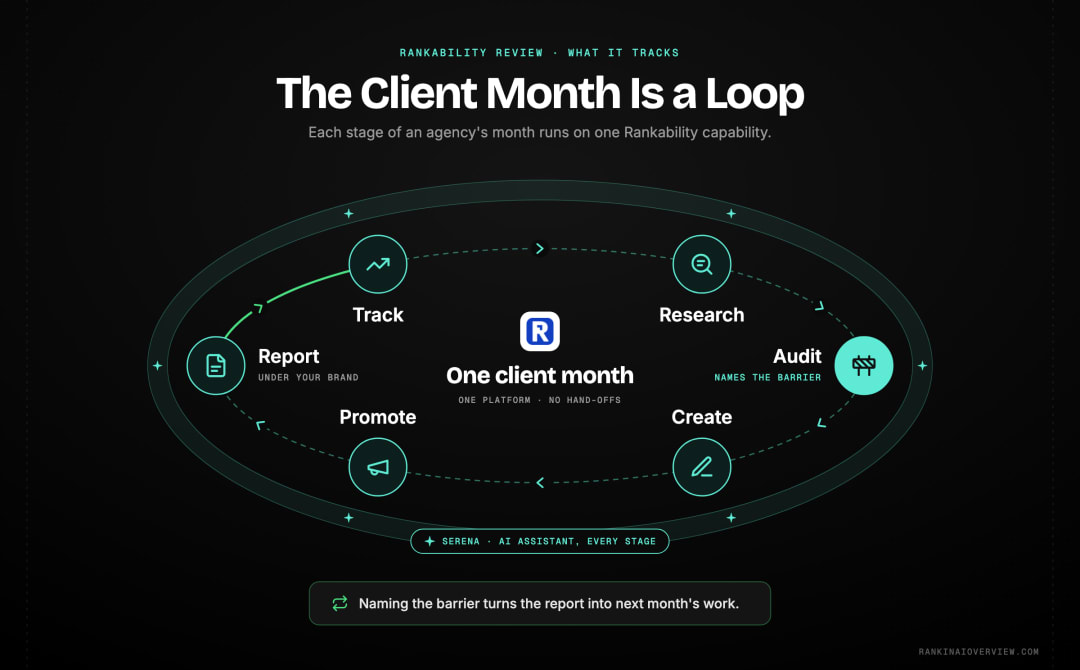
Rankability offers five core capabilities, track, research, create, audit and promote, plus Serena, its AI strategy assistant, and white-label reporting. The set is built to take an agency from measuring a client's AI visibility through to improving and reporting it. Each piece supports that end-to-end workflow.
The capabilities work together like this.
- Track: monitor a client's visibility across ChatGPT, Claude, Gemini, Perplexity, Grok and Google AI Overviews.
- Research: surface the prompts and topics that matter for a client's category.
- Create: optimise and automate content designed to influence AI answers.
- Audit: identify the barriers stopping a client from appearing in AI results.
- Promote: support the off-page and distribution side of visibility.
- Serena: an AI assistant that helps shape strategy and next steps.
The audit function is quietly important for agency work. Being told a client is invisible is only useful if you also learn why, and Rankability's audit is built to surface the specific barriers so you can act rather than guess. For an agency, that difference is the difference between a report a client shrugs at and a report that leads to the next piece of paid work, because a clear list of fixes is something a client will pay you to implement. That link from problem to fix is what turns a monitoring tool into something a client will pay for, and it pairs with understanding which metrics actually matter for AI visibility.
Serena and white-label reporting round out the agency fit. An AI assistant that suggests strategy lowers the expertise barrier for junior staff, while white-label reports let you present the work under your own brand, which matters when the deliverable is what the client sees.
How well does Rankability fit an agency workflow?
Rankability fits agency workflow closely because it is built around managing and reporting many clients, not tracking one brand. Unlimited seats, white-label reports, and an end-to-end toolkit map directly onto how agencies operate. That alignment is the main reason to pick it over a general tracker.
Consider a typical agency month. You onboard a new client, audit where they stand in AI answers, plan and create content to close the gaps, then report progress in a branded deliverable. Rankability is organised to support that whole arc in one place, from the initial audit through to the client-facing report, rather than forcing you to hand off between separate tools. That continuity saves time and reduces the errors that creep in when data moves between systems.
The unlimited-user model matters more than it first appears. Agencies bring in freelancers, rotate staff across accounts, and add people as they grow, and a per-seat tool makes each of those moves a cost decision. With seats unlimited, you can give everyone who needs access their own login without watching the bill climb, which suits the messy reality of agency staffing. A worked example of this kind of client outcome is our case study on getting a client's site cited in AI Overviews, which shows the audit-to-result path Rankability is designed to support.
How much does Rankability cost?
Rankability prices by website capacity across three plans, from Growth at $199 a month to Agency at $799, all billed annually and all including unlimited clients and users. The tiers differ mainly in how many websites you can manage, not in features, so you scale by client volume rather than by unlocking capabilities. Every plan carries the full toolkit.
Its pricing is set out here.
| Plan | Price (monthly, billed annually) | Websites | Clients and users | Features |
|---|---|---|---|---|
| Growth | $199 | 2 | Unlimited | Full toolkit |
| Scale | $399 | 5 | Unlimited | Full toolkit |
| Agency | $799 | 15 | Unlimited | Full toolkit |
The model is unusually clean for agency work. Because clients and users are unlimited on every tier, and all features are included throughout, your only real decision is how many websites you need to manage. That predictability makes budgeting simple as you add accounts, and it avoids the per-seat costs that punish growing teams elsewhere, so the tool gets cheaper per client the more clients you run. The main caveats are that pricing is billed annually and no free trial is advertised, so evaluating it may mean a demo or a commitment rather than a quick self-serve test. Being clear on what ranking even means in AI search helps you judge whether the toolkit justifies that.
What does Rankability do well?
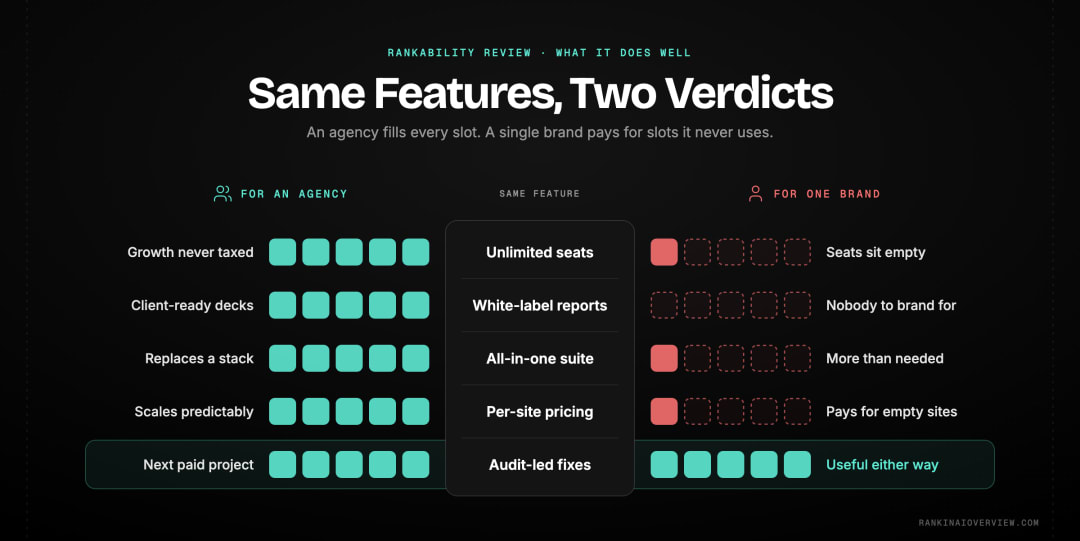
Rankability's strengths are its unlimited-seat agency model, its all-in-one toolkit, its client reporting, and its focus on why a site is or is not visible. Few tools are this deliberately built for agencies rather than adapted for them. For a team managing many clients, that focus removes friction that generalist tools create.
The unlimited clients and users model is the standout. Agencies grow by adding accounts and staff, and a tool that charges per seat quietly taxes that growth. Rankability's flat, website-based pricing means scaling your team or client roster does not inflate the bill, which is a genuine structural advantage for an agency.
- All-in-one workflow: track, research, create, audit and promote in one platform, replacing several separate tools.
- White-label reporting: present AI visibility work under your own brand, which matters for client-facing deliverables.
- Serena assistant: lowers the expertise bar so more of your team can act on the data.
- Audit-led: surfaces the reasons behind invisibility, not just the fact of it.
The strong ratings and agency logos reinforce the positioning. When a tool advertises high scores across review sites and a roster of agency customers, it signals that peers in the same business have found it worth the investment, which lowers the risk of trying it.
The claimed outcomes speak to the same buyer. Figures like higher margins and hours saved each month are exactly the language an agency owner thinks in, because the tool has to pay for itself in either billable efficiency or client results. Whether any single number holds for your team depends on your workflow, but the framing shows Rankability understands that an agency buys a tool to make money or save time, not simply to see a dashboard. That commercial focus, rather than a longer feature list, is what tends to win agency budgets.
Where does Rankability fall short?
Rankability's weaknesses are the lack of an advertised free trial, annual-only billing, and a narrower fit for single brands. Its agency focus is a strength for agencies and a mismatch for a lone business wanting a simple tracker. The model that suits a multi-client team can feel heavy for a single site.
The absence of a clear free trial is the most practical drawback. Tools that let you test before paying lower the risk of a wrong choice, and an annual commitment without an obvious trial raises the stakes of the decision. You may need a demo to evaluate it properly, which adds friction compared with self-serve rivals that let you sign up and start the same afternoon.
The single-brand fit is the other caveat. A business tracking only its own visibility does not need unlimited clients or white-label reports, so much of what makes Rankability valuable to agencies is wasted on it. And, as with every tool here, its AI metrics inherit the run-to-run variability of AI answers, so no platform delivers perfectly stable numbers, which is worth remembering before treating any single score as settled. This is a category-wide truth rather than a Rankability flaw, and it is why whether AI rank tracker tools actually work depends on reading trends over time rather than any single reading. For an agency, the practical answer is to report direction and progress across several checks, not a one-off number that a client could see move the next day.
How does Rankability compare to alternatives?
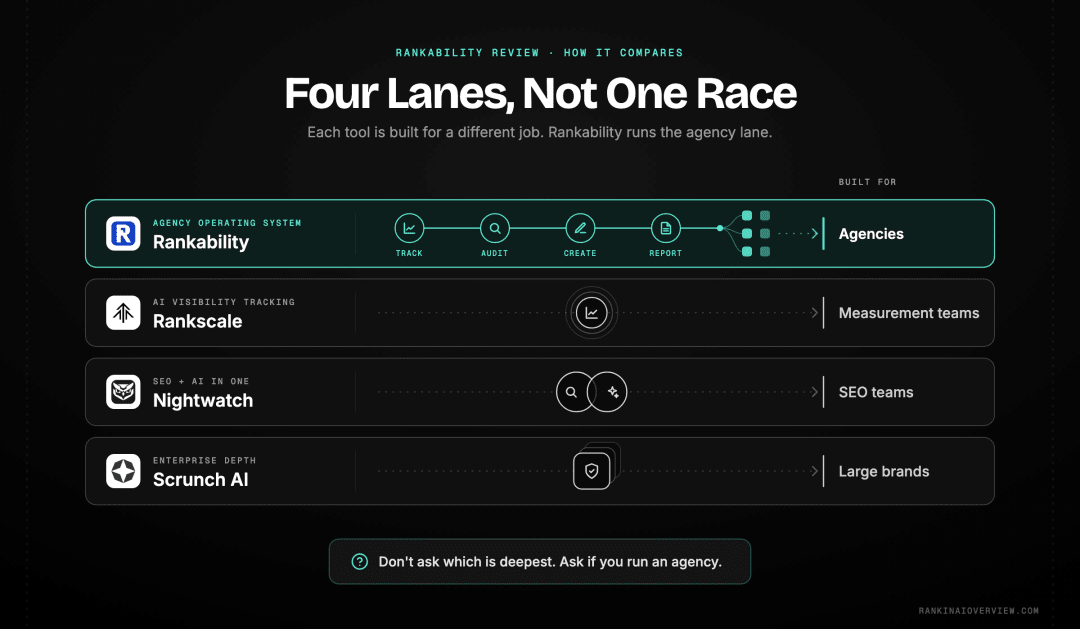
Rankability sits firmly in the agency lane, more client-and-reporting focused than general trackers and more workflow-complete than single-purpose tools. Its trade-off against rivals is an unlimited-seat, all-in-one agency model versus tools built for brands or for pure tracking depth. Whether it wins depends on whether you run an agency.
Here is where it lands against common alternatives.
| Tool | Positioning | Best for |
|---|---|---|
| Rankability | Agency-first, all-in-one, unlimited seats | Agencies managing many clients |
| Rankscale | AI-visibility tracking, mid-market | Teams focused on tracking |
| Nightwatch | Unified SEO plus AI | SEO teams wanting both |
| Scrunch AI | Enterprise depth and security | Large brands and agencies |
Against tracking-focused tools like Rankscale, Rankability adds content creation, auditing, and agency reporting, which matters if you deliver work for clients rather than just measure. Against enterprise platforms like Scrunch AI, it is more affordable and agency-tuned, though it offers less enterprise-grade depth and security for very large deployments. Our roundup of the best AI rank trackers sets the full field in context for a side-by-side view.
The honest framing is that Rankability is not competing to be the deepest tracker or the most enterprise-secure platform. It is competing to be the tool an agency runs its AI visibility service on, and by that measure the unlimited seats, white-label reporting, and end-to-end workflow are hard to beat. A brand comparing pure tracking features might rate it lower than a specialist, but a brand is not who it is for. Judge it as an agency operating system rather than a single-purpose tracker, and its choices make sense.
Who should use Rankability, and who should choose a different tool?
Rankability suits digital marketing agencies managing AI visibility across many clients, and it is less suited to a single brand wanting a simple tracker for itself. If you bill multiple accounts and need reporting, unlimited seats, and an end-to-end workflow, it is a strong fit. If you only track your own site, it is more platform than you need.
Choose Rankability if you run an agency and value the flat, website-based pricing, the white-label reporting, and the all-in-one toolkit. Its unlimited clients and users model rewards exactly the growth an agency is trying to achieve, and its audit-led approach helps you show clients not just where they stand but what to do next. For a growing agency, the predictability of paying by website rather than by seat can matter more than any individual feature, because it means your tooling cost does not spike every time you win a client or hire a person.
Look elsewhere if you are a single business tracking one site, want a free trial before committing, or prefer monthly billing over an annual commitment. A self-serve tracker will be simpler and cheaper for one brand, and a tool with a no-card trial lowers the risk of evaluating it before any money changes hands. As always, the best choice is the one that matches how you actually work, and whether or not you run an agency is the single deciding factor here.
Conclusion
Rankability is one of the most deliberately agency-focused AI visibility platforms in 2026, pairing an all-in-one track, research, create, audit and promote workflow with unlimited clients and users, white-label reporting, and the Serena assistant. Its flat, website-based pricing rewards the growth agencies chase, and its audit-led approach gives client-facing teams something concrete to act on. The trade-offs are annual billing, no clear free trial, and a narrower fit for single brands.
For agencies, it earns a firm place on the shortlist, and a demo is the natural way to test the fit before committing to an annual plan. Rank in AI Overview studies how answer engines choose and credit their sources, with a citation-tracking tool on the way. Book a free AI visibility audit to see how the engines describe your clients today, whichever platform you choose.
Frequently asked questions
Is Rankability worth it?+
For agencies managing AI visibility across many clients, Rankability is worth evaluating. Its unlimited-seat model, all-in-one toolkit, and white-label reporting justify the price for client work. For a single brand tracking only itself, a simpler self-serve tracker is usually better value.
Does Rankability offer a free trial?+
Rankability does not clearly advertise a self-serve free trial, and its plans are billed annually. Evaluating it may require a demo or a commitment rather than a quick test. This is a notable difference from rivals that offer no-card trials before you pay.
How much does Rankability cost?+
Rankability costs $199 a month for Growth, $399 for Scale, and $799 for Agency, all billed annually. Plans differ by website capacity, from 2 to 15 sites, while clients, users, and features are unlimited across every tier. You scale by client volume, not by unlocking features.
Which AI engines does Rankability track?+
Rankability tracks visibility across ChatGPT, Claude, Gemini, Perplexity, Grok and Google AI Overviews. This covers the major AI engines most clients care about, letting an agency report a client's presence across the specific answers their audience is most likely to see.
Is Rankability good for agencies?+
Yes. Rankability is built for agencies, with unlimited clients and users on every plan, white-label reporting, an all-in-one workflow, and the Serena AI assistant. Its website-based pricing scales with client volume rather than seats, which suits how agencies actually grow.
Can a single business use Rankability?+
It can, but it is usually overkill. A single brand does not need unlimited client seats or white-label reports, so much of Rankability's value goes unused. A business tracking only its own AI visibility is generally better served by a simpler, cheaper self-serve tool.
Explore with AI
Share this


