How to Measure AI Search Visibility: 6 Metrics That Actually Matter Beyond Rankings
There is no standard framework for measuring AI search visibility so we built one. Here are the 6 metrics that give you a real picture of your AI search presence, with tools for each.

Key Highlights
-
Measure AI search visibility with 6 core metrics: AI citation frequency, share of voice in AI responses, branded search volume growth, mention sentiment score, prompt universe coverage, and AI-referred traffic quality
-
AI SEO metrics differ from traditional SEO metrics because AI outputs are non-deterministic. The same prompt produces different answers. Consistency across multiple runs is required for statistical validity
-
How to track ChatGPT mentions: run each target prompt 20 times and calculate the citation rate as a percentage rather than a binary yes/no. Single-run checks produce misleading data
-
How to track ChatGPT mentions alongside Perplexity and Google AI Overviews: use the same prompt set across all three platforms weekly and log results in one spreadsheet per platform
-
GEO measurement framework requires three cadences: monthly for citation frequency and share of voice, quarterly for sentiment and prompt coverage, annually for pipeline and revenue attribution
-
AI citation tracking for marketers is achievable at zero cost using manual prompt testing in ChatGPT, Perplexity, and Google AI Overviews. Free tools produce meaningful baseline data for up to 30 target prompts weekly
-
AI citation tracking for marketers at scale (over 50 prompts) justifies a paid tool. The time cost of manual tracking beyond 30 prompts exceeds the subscription cost of most mid-market tools
-
Share of voice formula: (Your brand citations / total category citations) x 100. A brand with 400 citations in a category generating 2,000 total citations holds 20% share of voice
-
AI-referred traffic converts at measurably higher rates than standard organic. Users who arrive after reading an AI-generated answer are further along in the decision journey
Everyone is talking about AI search visibility. Almost nobody has a consistent way to measure it. Back in February 2024, Gartner predicted that traditional search volume would drop 25% by 2026 due to AI chatbots and virtual agents — a shift now playing out in real time. The channel is significant enough to demand serious measurement. Yet most marketing teams track AI visibility through a mix of ad hoc prompt tests, intuition, and the occasional screenshot. That is not a measurement framework. It is noise management.
Without a structured way to measure AI search visibility, you cannot improve your position, cannot report progress to stakeholders, and cannot justify the investment in AI-specific content and entity building. The absence of measurement is the real barrier to taking AI visibility seriously as a strategic channel. You cannot act on data you are not collecting.
This guide gives you the six metrics that produce an accurate, actionable picture of your AI search presence. For each metric, you will get a plain-language definition, the calculation formula, the free and paid tools to track it, and the reporting cadence that works for practitioners who already have full workloads. By the end, you will have a complete GEO measurement framework ready to implement.
Why Is AI Search Visibility So Hard to Measure?

Three specific properties of AI search make it harder to measure than traditional search. AI outputs are non-deterministic: the same prompt produces different answers on different runs, making single-point measurements unreliable. There is no unified data source equivalent to Google Search Console. And the relationship between AI citation and business outcome is indirect, running through brand awareness and branded search rather than direct click-through.
Non-determinism is the most important measurement challenge to understand. When you measure AI SEO metrics, you are measuring a probabilistic system rather than a deterministic ranking. A page that ranks position two on Google holds that position consistently. A brand cited in 60% of relevant ChatGPT responses is visible 60% of the time and absent 40% of the time, in an unpredictable order. A single prompt test tells you nothing about your actual citation rate. How to track ChatGPT mentions effectively begins with accepting this probabilistic nature and building a frequency-based measurement approach.
Running any given prompt once and logging whether your brand appears produces data that is statistically equivalent to flipping a coin. Running it twenty times and calculating your citation rate produces a meaningful percentage. That is the core principle of how to track ChatGPT mentions: rate over time, not binary snapshot. Each prompt needs a minimum of 20 runs before the resulting citation percentage becomes statistically useful for tracking trends and comparing against competitors.
The absence of a unified data source is the second challenge. Google Search Console gives you impression and click data for every query Google has processed for your site. No equivalent platform exists for ChatGPT or Perplexity. You must either build a manual testing system, subscribe to a dedicated AI visibility tool, or accept that your measurement will be incomplete. All three options are valid depending on your budget, team size, and measurement requirements.
What Are the 6 Metrics That Actually Matter?
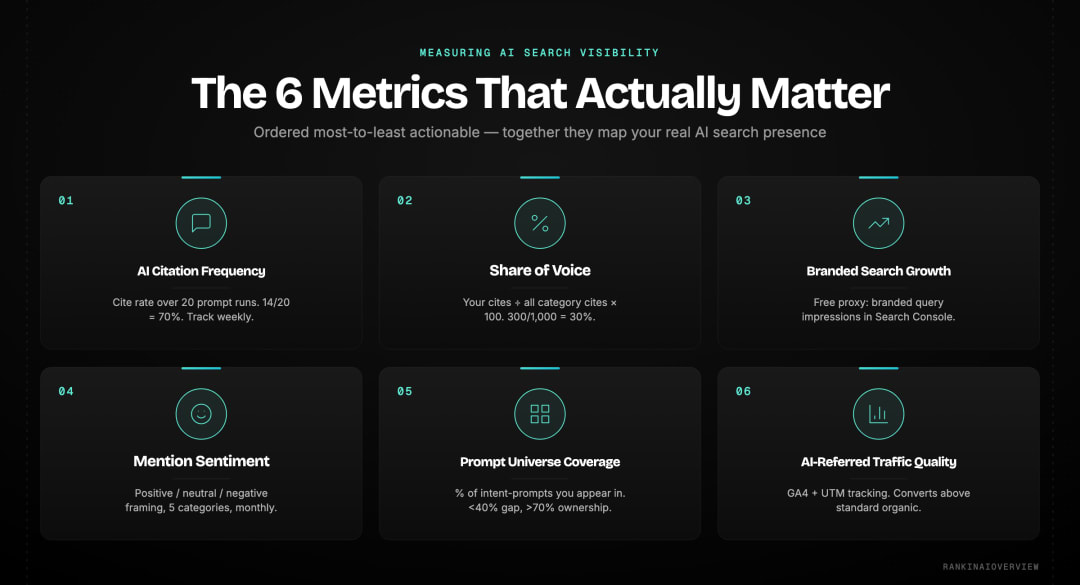
The six metrics below are ordered from most to least immediately actionable. Citation frequency and share of voice are the starting point for any AI SEO metrics programme because they are the most directly connected to the optimisation actions that improve your position. Branded search volume and sentiment are secondary metrics that validate whether your citation improvements are producing business impact. Prompt coverage and AI-referred traffic complete the picture at scale.
Metric 1: AI Citation Frequency
AI citation frequency measures how often your URL or brand name is cited as a source in AI-generated responses across your target prompt set. It is the most fundamental way to measure AI search visibility because it tells you whether AI engines are treating your content as trustworthy enough to reference.
Calculation: Run each target prompt 20 times across your chosen AI platform. Count how many of those 20 runs include a citation or mention of your brand. Express as a percentage. A brand cited in 14 out of 20 runs has a citation frequency of 70% for that prompt. Average across your full prompt set for an overall score. Track weekly. An increasing citation frequency indicates your optimisation is working. This is the foundation of AI citation tracking for marketers: a consistent, comparable number that moves with your strategy.
Free tracking method: Build a spreadsheet with your 20 to 30 most important prompts. Run each once weekly in ChatGPT and Perplexity and log whether your brand appears. After four weekly runs per prompt you have a rolling citation rate, and it sharpens every week as runs accumulate toward the 20-run standard. This is a 30 to 45 minute weekly process that produces meaningful baseline data for a small prompt set; running every prompt 20 times in one sitting is the part a paid tool automates. For AI citation tracking for marketers at scale (over 50 prompts), manual tracking becomes unmanageable and a paid tool is justified.
Metric 2: Share of Voice in AI Responses
Share of voice in AI responses measures your brand mentions versus competitors across a defined prompt set. It tells you not just whether you are cited but whether you are cited more or less than the brands you are competing against for buyer attention.
Calculation: (Your brand citations / total citations for all tracked brands in that category) x 100. If your brand generates 300 citations and your top three competitors generate 700 combined across the same prompt set, your share of voice is 30%. This number is more meaningful than raw citation count because it contextualises your position relative to the competitive conversation AI engines are generating about your category.
Share of voice is the AI SEO metric that most directly translates into executive-level reporting. A CFO cannot easily evaluate what a citation frequency of 65% means in isolation. A share of voice of 30% against competitors at 40%, 20%, and 10% communicates your competitive position in a format that maps directly to how market share is discussed in the rest of the business. This metric is the bridge between AI visibility measurement and business strategy.
Metric 3: Branded Search Volume Growth
Branded search volume growth is the downstream proxy for AI citation impact. When AI engines cite your brand across informational and category queries, some proportion of users who encounter those citations follow up with a branded Google search. That branded search is trackable in Google Search Console without any additional tool investment. It is the most accessible leading indicator that your AI visibility improvements are translating into real brand awareness.
Measurement: Filter your Google Search Console data by queries containing your brand name. Track the month-over-month impression count for branded queries. An increasing trend in branded impressions over a period where AI citation frequency is also increasing confirms the causal chain: AI mentions are creating awareness that converts to branded search intent. A flat or declining branded impression trend alongside improving citation frequency indicates that the citations are not reaching buyers at the scale your prompt testing suggests.
This metric requires no additional tools beyond what most teams already have. It is the free GEO measurement framework entry point that any team can start tracking today. Branded search volume is also the metric that most non-technical stakeholders find most intuitive as a proxy for brand health, making it the foundation of any executive-facing AI visibility report.
Metric 4: Mention Sentiment Score
Mention sentiment measures whether your brand is being described positively, neutrally, or negatively in AI-generated answers. Appearing in AI responses is not automatically a positive outcome. A brand described as "expensive compared to alternatives" or "lacks enterprise-level support" in a ChatGPT recommendation answer is receiving visibility that may actively damage its consideration rate among buyers.
Measurement: For each prompt run in your citation frequency tracking, note not just whether your brand appears but how it is described. Log the specific language AI engines use about your brand across five categories: category leader language ("best option for"), comparative language ("comparable to but cheaper than"), qualified language ("good for small teams but..."), neutral mention (name only with no descriptor), and negative qualifier ("notable limitation is..."). Track the proportion of mentions in each category monthly.
Sentiment tracking catches problems that citation frequency alone misses. A brand with 65% citation frequency and 40% qualified or negative language is being consistently recommended with caveats that reduce its conversion probability. The optimisation response is different from a brand with low citation frequency: it requires addressing the specific concerns AI engines are surfacing rather than simply increasing content volume or off-site entity signals.
Metric 5: Prompt Universe Coverage
Prompt universe coverage measures how many of your target queries trigger AI responses that include your brand. It tracks the breadth of your AI visibility rather than its depth. A brand with high citation frequency for five prompts but zero coverage for forty other relevant queries has a narrow AI presence that leaves a large portion of buyer research invisible to it.
Calculation: Divide your target prompt set into high-intent (specific comparison and recommendation queries), mid-intent (category research queries), and awareness-level queries. For each tier, calculate the percentage of prompts where your brand appears at least once across twenty runs. High-intent prompt coverage below 40% indicates a significant competitive gap. High-intent prompt coverage above 70% indicates strong category ownership in AI search.
Prompt universe coverage is the metric that most directly informs content strategy decisions. The same principle applies as in how to track ChatGPT mentions: you cannot act on data you are not collecting. If your brand appears in high-intent prompts but not in mid-intent category research queries, you need more educational content. If you have good mid-intent coverage but poor high-intent coverage, your comparison and recommendation content needs investment.
Metric 6: AI-Referred Traffic Quality
AI-referred traffic quality measures the conversion rate and engagement metrics of users who arrive at your site via AI-cited links. This metric requires Google Analytics 4 and UTM parameter tracking on any links that appear in AI citations. It is the most technically complex of the six metrics to implement, but it provides the clearest connection between AI visibility and business outcome.
AI-referred traffic converts at higher rates than standard organic traffic because users who arrive via an AI citation have already read a synthesised answer about your brand and are seeking additional information rather than beginning their research. This higher-intent entry point produces longer session durations, lower bounce rates, and higher conversion rates than most other traffic sources. Documenting this quality difference is the most effective argument for investing in AI visibility optimisation.
Implementation: Create a UTM tracking system that tags AI-cited URLs with a source parameter identifying each AI platform. When your URL appears as a citation in a ChatGPT or Perplexity answer, users who click that link carry the UTM tag into your analytics. Build a GA4 segment for this traffic source and compare its engagement and conversion metrics against your organic and direct traffic benchmarks monthly.
“ Citation share is the new click share. Track how often you are cited versus competitors on your key category topics. Branded search growth in Google Search Console is my proxy for AI-driven awareness. It is the most trackable signal and the one that actually moves the client conversation forward. Marketing practitioner r/AskMarketing community, Reddit 2026 Source: Reddit: How Are You Measuring AI Search Visibility Beyond Rankings?
What Is the Reporting Framework and Cadence?
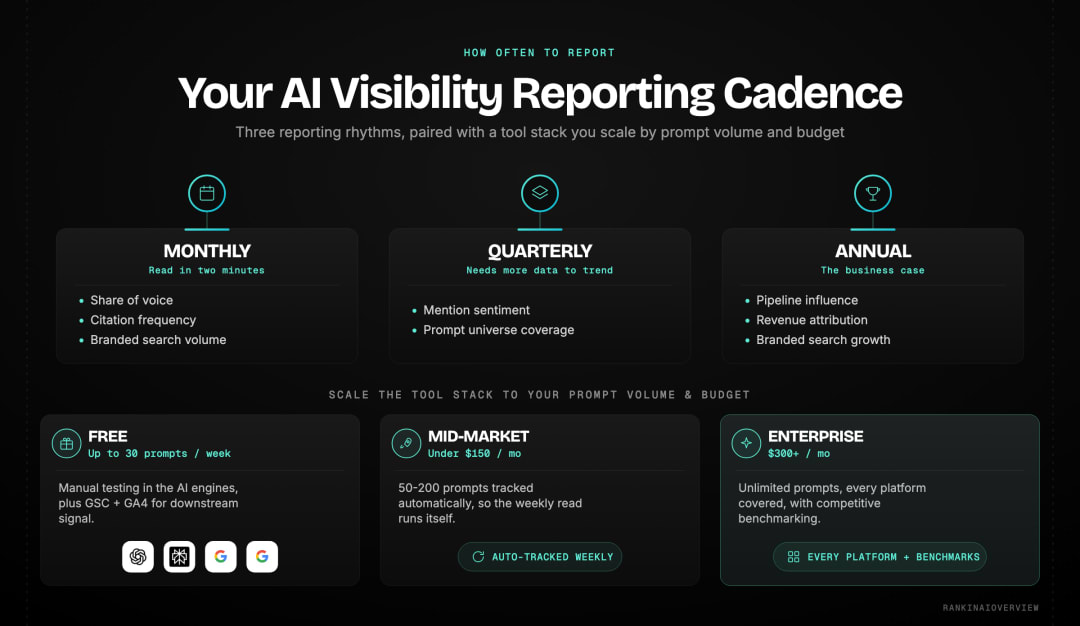
AI search visibility reporting works best across three cadences. Monthly reporting covers the metrics that change frequently enough to require regular attention and action: citation frequency, share of voice, and branded search volume. Quarterly reporting covers the metrics that require more data before trends are meaningful: sentiment score and prompt universe coverage. Annual reporting connects the measurement framework to business outcomes: pipeline influence and revenue attribution.
Monthly reporting structure: Lead with a single share of voice number comparing your brand to your top two to three competitors across your full prompt set. Follow with citation frequency trends over the last four weeks. Close with branded search volume growth from Google Search Console. The monthly report should be readable in two minutes and produce one or two clear optimisation actions for the following month.
Quarterly reporting structure: Add a sentiment analysis summary showing the proportion of mentions with positive, neutral, and negative qualifiers compared to the previous quarter. Add a prompt universe coverage update showing which query tiers you have gained or lost coverage in. The quarterly report produces the content and entity strategy decisions: which topics need more content investment, which categories have sentiment problems to address.
Annual reporting structure: Connect AI visibility improvements to business outcomes. Use the AI-referred traffic quality data from GA4 to document conversion rate differences between AI-referred and standard organic traffic. Use branded search volume growth to estimate the brand awareness contribution of AI citations. Calculate the share of qualified pipeline that was influenced by AI-mediated brand awareness. This annual view is what converts AI visibility from a vanity metric into a board-level strategic discussion.
How Do the Tools Compare for Each Metric?
The right tool choice depends on prompt set size, budget, and reporting requirements. The free stack covers up to 30 prompts per week with manual effort. The mid-market stack (under $150 per month) covers 50 to 200 prompts automatically. The enterprise stack ($300 per month and above) covers unlimited prompts across all major AI platforms with competitive benchmarking.
If you are weighing the dedicated trackers named below, we reviewed and ranked them in depth in our best AI rank trackers roundup.
| Metric | Free Option | Mid-Market Tool | Enterprise Tool | Difficulty |
|---|---|---|---|---|
| AI Citation Frequency | Manual: 20 runs per prompt in ChatGPT and Perplexity, logged in spreadsheet | Rankscale ($20/mo), Otterly AI ($29/mo) | Profound ($499/mo), SE Ranking AI Tracker | Low (free) / Low (paid) |
| Share of Voice in AI | Manual calculation from citation frequency spreadsheet with competitor columns | Peec AI ($95/mo), Rankscale with competitor tracking | Profound, Semrush AI Toolkit | Medium (free) / Low (paid) |
| Branded Search Volume | Google Search Console (free). Filter for branded queries | Ahrefs or Semrush for trend analysis | Same tools at enterprise scale | Low. GSC is free and sufficient |
| Mention Sentiment | Manual: log sentiment category for each citation during prompt testing | Profound has sentiment analysis built in | Profound or Semrush AI Toolkit | Medium (free) / Low (paid) |
| Prompt Universe Coverage | Manual spreadsheet with yes/no coverage per prompt per week | Rankscale or Peec AI automated coverage reporting | Profound with custom prompt libraries | High (free) / Low (paid) |
| AI-Referred Traffic Quality | GA4 with UTM parameters (free if already using GA4) | GA4 plus any UTM management tool | GA4 with Semrush or custom attribution model | High. Requires UTM setup and GA4 configuration |
Conclusion
Measuring your own presence is one thing; benchmarking against rivals is another — see how SEO benchmarking differs from AI visibility benchmarking.
You cannot improve what you cannot measure. Start with citation frequency and share of voice. They are the most actionable AI SEO metrics for understanding your current position and directing your optimisation effort. Layer in branded search volume as the free downstream proxy that connects AI mentions to real brand awareness. Add sentiment and prompt coverage as your measurement sophistication grows.
Build a consistent monthly cadence using the free stack until your prompt universe exceeds thirty queries, then invest in a dedicated AI citation tracking tool. Connect the measurement framework to business outcomes annually. The practitioners who build this reporting infrastructure in 2026 will have twelve months of baseline data when AI search visibility becomes a standard board-level conversation. RANK IN AI OVERVIEW covers how AI engines evaluate and cite content across all major platforms in depth across its content library.
Frequently asked questions
Can I track AI visibility without paid tools?+
Yes, for prompt sets up to 30 queries. Build a spreadsheet with your target prompts, run each one weekly across ChatGPT and Perplexity, and log whether your brand appears and with what sentiment. After a month of accumulated runs, calculate citation frequency as a percentage and share of voice against two to three named competitors. Add branded search volume from Google Search Console. This free GEO measurement framework produces meaningful baseline data for any team starting out. It becomes impractical above 30 prompts due to time cost, which is the threshold at which a paid tool becomes justified.
How do I report AI visibility to a CEO or board?+
Lead with share of voice as a competitive metric, not citation frequency as an absolute number. A CEO can interpret "we are cited in 34% of buyer research queries in our category versus our competitor at 51%" immediately. They cannot easily interpret "our citation frequency is 0.68 across 40 prompts." Follow with branded search volume growth as the downstream business signal. Close with AI-referred traffic conversion rate versus standard organic to show quality difference. Three numbers, all in comparative or trend format, that connect to brand position and business outcome.
What is a good benchmark for AI citation frequency?+
Benchmarks vary significantly by industry and competitive density. In B2B SaaS, category leaders generate roughly 8 times more AI citations than bottom performers in the same space. A citation frequency of 20 to 40% across your target prompt set is a reasonable starting goal for a brand with moderate market awareness and good content structure. Above 60% citation frequency indicates strong category authority in AI search. Below 10% indicates either weak entity recognition, poor content structure, or missing off-site corroboration. The most useful benchmark is not an absolute number but your own trend: growing citation frequency over four consecutive months is the signal that your optimisation is working.
Explore with AI
Share this


