Best Chrome Extensions for AI SEO and Citation Tracking in 2026
A practical, up-to-date comparison of tools for tracking AI Overview citations, including Google's new June 2026 Search Console reports and what's free.

Key Highlights
-
Google launched dedicated AI Overview and AI Mode impression reports inside Search Console on June 3, 2026, replacing the old guesswork-based workaround.
-
Most tools marketed as Chrome extensions for AI citation tracking are actually full web dashboards, not browser extensions.
-
Ahrefs's base Rank Tracker plan now flags AI Overview appearances automatically, separately from its far more expensive Brand Radar add-on.
-
The right tool depends heavily on scale: a solo site, a growing SMB, an agency and an enterprise each need a different setup.
-
Citation and brand mention are different things, and most budget tools only reliably measure one of the two.
Marketers lack reliable browser-based tools to track real-time AI citation and visibility without expensive platforms, and that gap has been real for two years. The most important update to this picture just happened: as of June 3, 2026, Google Search Console finally launched dedicated performance reports isolating impressions from AI Overviews, AI Mode and Discover's generative AI features, separate from the bundled “Web” totals it used before.
That single change makes a lot of older advice on this topic outdated overnight, including workaround methods built specifically because Search Console didn't separate this data. This guide reflects what's actually true today, not what was true even a few months ago.
Beyond that update, this piece checks every commonly recommended tool against what it genuinely is, gives a decision framework by scale, and flags the mistakes that waste the most time when first setting up AI citation tracking.
What changed in Search Console on June 3, 2026?
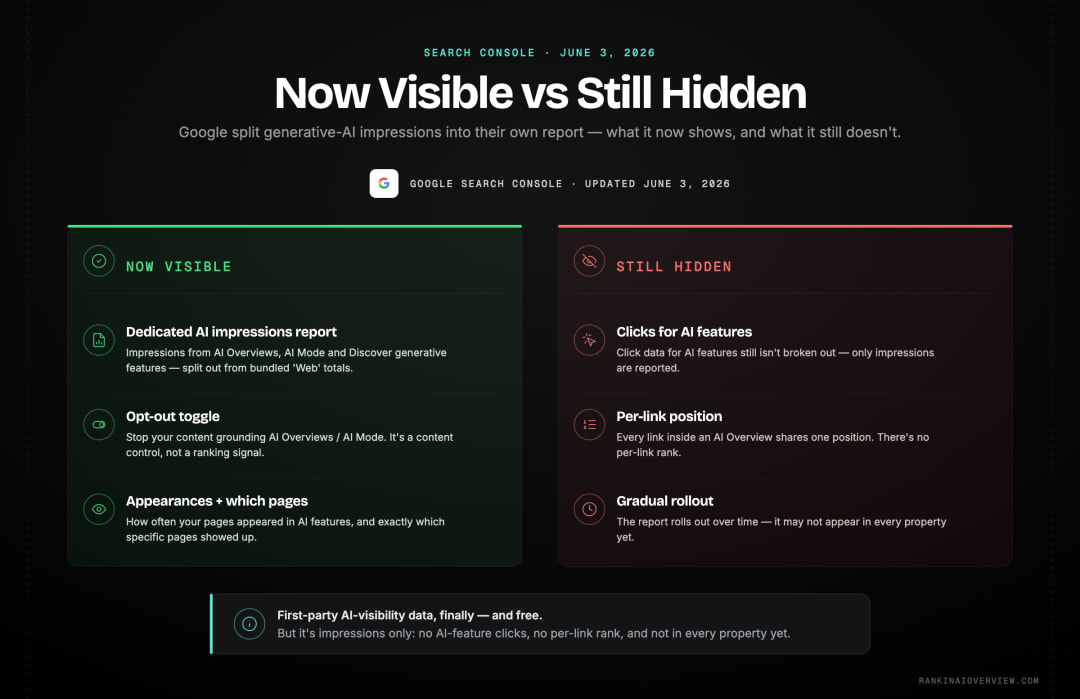
Google added two things at once: a dedicated report showing impressions from generative AI features, and a separate toggle letting site owners opt their content out of grounding those features entirely. Both are described in Google's own announcement.
The new report shows two things clearly for the first time: how often your pages appeared in generative AI features, and which specific pages appeared. It does not show clicks, and Google has been explicit that all links inside a single AI Overview share one position, so per-link ranking inside an AI answer still isn't a number worth optimising toward.
The rollout is gradual, starting with a subset of properties, so it may not appear in every account immediately. Worth checking directly: open Search Console, go to the Performance report, and look for a generative AI features view alongside the standard Search results view.
This data wasn't new on June 3; it was already counted inside the old bundled Web totals. What's new is the ability to see it separately, which makes most of the manual workaround spreadsheets built over the past two years unnecessary going forward.
Google paired the visibility report with something else worth noting: a toggle letting site owners opt out of having their content ground AI Overviews and AI Mode entirely. Google has said this control isn't used as a ranking signal for regular search results, but it's a real decision point for sites weighing AI visibility against any concerns about how their content gets summarised.
Why do you need a Chrome extension for AI SEO?
A Chrome extension for AI SEO matters because checking AI citation status manually, query by query, across multiple AI platforms, is slow and doesn't scale past a handful of target terms.
Standard SEO Chrome extensions like SEOquake or the Ahrefs toolbar show traditional ranking and backlink metrics on top of any page, but none of them were built to detect whether the page in front of you was cited inside an AI Overview, ChatGPT answer, or Perplexity response.
The need is genuine even with Search Console's new report. That report only covers Google's own AI features. A marketer also wanting visibility into ChatGPT, Perplexity, Gemini or Copilot citations still has nowhere official to look, which is exactly the gap third-party tools are trying to fill.
Scale matters here too. A marketer managing twenty target queries across three AI platforms is looking at sixty individual manual checks just to get a single snapshot, before any tracking over time. That's the gap a real browser extension would close, if one existed in full, and the reason paid platforms still find a market despite the recent free improvements.
What should a good AI SEO Chrome extension do?
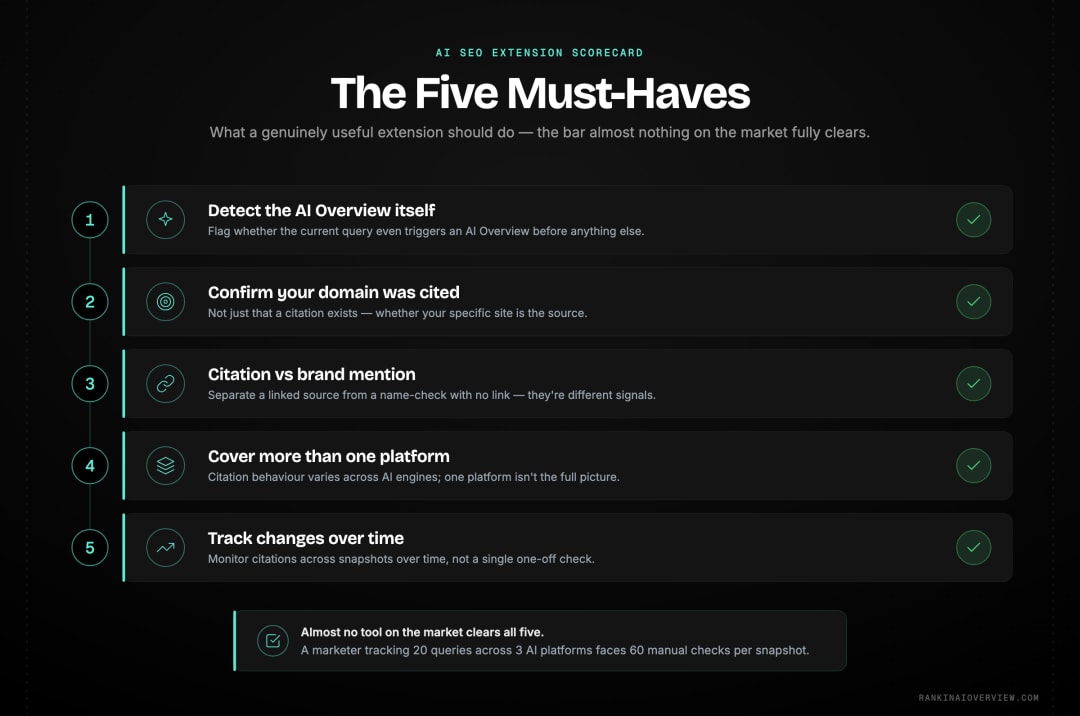
A genuinely useful AI SEO Chrome extension should detect AI Overview presence on the current query, show whether your domain was cited, and do the same across at least one other AI platform beyond Google.
-
Flag whether the current search query triggers an AI Overview at all.
-
Show whether your domain, specifically, was cited in that answer.
-
Distinguish a citation (a linked source) from a brand mention (named but not linked).
-
Cover more than one AI platform, since citation behaviour varies between them.
-
Track changes over time, not just a single snapshot per check.
That citation-versus-mention distinction matters more than most tool marketing admits. RANK IN AI OVERVIEW's research on trust versus rankings found that a page can be cited as a source without ever being named in the answer text, which a basic mention-only tracker would miss entirely.
Almost nothing on the market checks every one of these boxes inside an actual browser extension. Most current options check two or three, then route the rest of the work to a paid web dashboard.
Best Chrome extensions for tracking AI citations
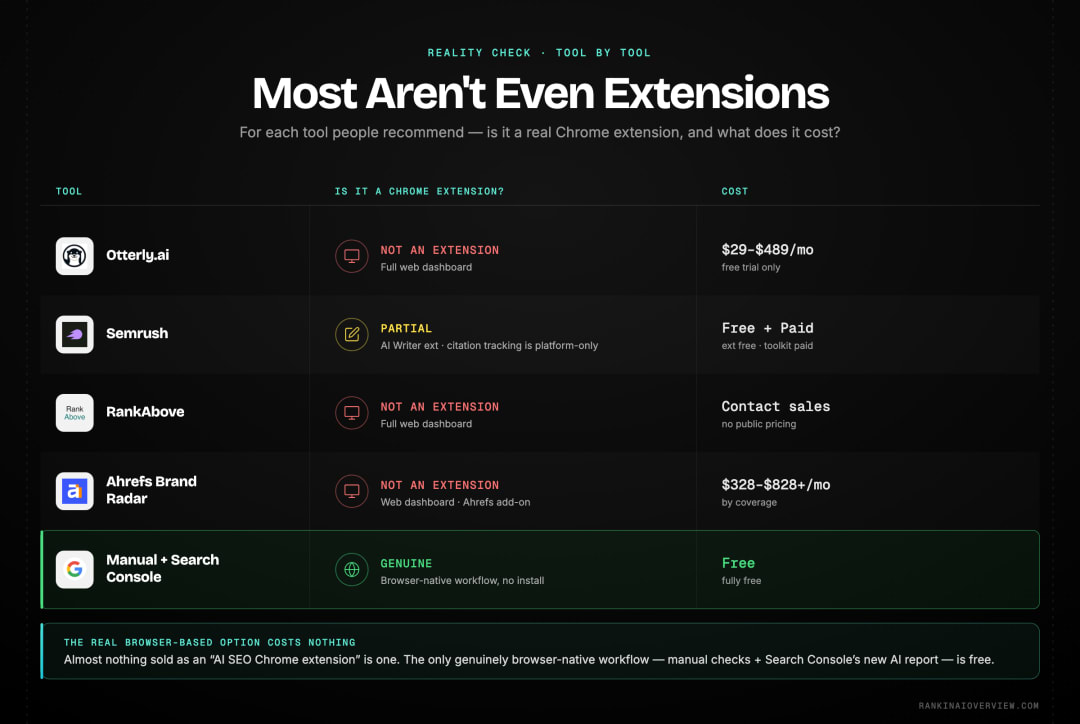
Here's an honest look at the options that come up most often in marketer discussions, including which are genuinely browser extensions and which are full platforms.
Is Otterly.ai actually a Chrome extension?
Not in the way it's often described. Otterly.ai is a web-based AI search monitoring platform, accessed through a dashboard rather than a browser extension. It tracks citations and brand mentions across Google AI Overviews, AI Mode, ChatGPT, Perplexity, Gemini and Microsoft Copilot.
Pricing runs from a $29/month Lite tier covering a small number of prompts up to a $489/month Premium tier, with AI Mode and Gemini coverage sold as add-ons on the lower tiers. There's a free trial, but no permanently free tier, and the platform charges per prompt, per engine, which adds up quickly past a small tracking list.
What does Semrush's AI toolkit actually cover?
Two different things get conflated under this name. Semrush does publish a real Chrome extension, an AI writing and editing tool that checks grammar, tone and readability on any page. It does not track AI Overview citations.
Citation and AI visibility tracking lives inside Semrush's full platform, sold as part of its AI Visibility Toolkit, accessed through a browser tab rather than an installed extension. A free account allows a limited number of daily lookups; full access requires a paid plan.
Does RankAbove have a browser extension?
No standalone extension was found for RankAbove at the time of writing. It operates as a web dashboard that runs structured brand queries across ChatGPT, Gemini, Perplexity, Claude, Grok and Google AI Overviews roughly every 24 hours, flagging inaccurate brand representation alongside citation tracking.
Its core pitch leans on speed of correction rather than browser convenience: catching when an AI platform misstates a brand's pricing or features and pushing a fix live the same day through CMS integrations, rather than surfacing data passively while someone browses.
Is Ahrefs Brand Radar worth it for citation tracking?
Only at a specific scale. Brand Radar requires an active Ahrefs subscription (from $129/month) plus its own add-on, priced at $199/month per AI platform or $699/month bundled across six platforms, putting full coverage at roughly $828/month.
That buys a genuinely large dataset, draws on over 300 million search-backed prompts, and adds YouTube, Reddit and TikTok mention tracking that dedicated AI visibility tools don't typically cover. But it's priced for Ahrefs power users with budget to spare, not for someone just trying to answer “am I getting cited anywhere.”
There's a cheaper, easily missed option inside the same platform: Ahrefs' Rank Tracker now flags AI Overview appearances on tracked keywords automatically, included in every base plan without the Brand Radar add-on. For Google-specific tracking on a budget, that flag alone covers a meaningful chunk of what Brand Radar charges hundreds extra for.
The trade-off is scope, not accuracy. The base Rank Tracker flag tells you whether an AI Overview appeared and whether you're in it for a tracked keyword. It doesn't break down share of voice against competitors, doesn't extend to ChatGPT or Perplexity, and doesn't touch YouTube or Reddit the way Brand Radar does. Most solo sites and small teams never need that wider scope in the first place.
Manual testing with built-in Google tools
With the June 2026 update, this option got noticeably stronger. Search a target query in an incognito window to see whether an AI Overview appears and who's cited, then cross-check Google Search Console's new generative AI performance report for impressions and which pages appeared over time.
This approach doesn't scale to hundreds of prompts, and it still can't show clicks or cross-platform data beyond Google. But for the handful of queries that matter most to a given site, it's now genuinely more capable than it was a few weeks ago.
One practical habit worth adopting alongside the new report: keep a simple log of which queries were checked, when, and what was found. The dedicated report shows current and recent state well, but it doesn't replace a running record of how a specific set of priority queries has moved over months.
| Tool | Is it actually a Chrome extension? | Cost |
|---|---|---|
| Otterly.ai | Web dashboard, not an extension | $29–$489/month, free trial only |
| Semrush | AI Writer extension exists; tracking is platform-only | Free extension; AI Visibility Toolkit needs a paid plan |
| RankAbove | Web dashboard, not an extension | Not publicly listed; contact-based |
| Ahrefs Brand Radar | Web dashboard, Ahrefs add-on | $328–$828+/month depending on coverage |
| Manual + Search Console | Genuine browser-based workflow, fully free | Free |
Which option actually fits your situation?
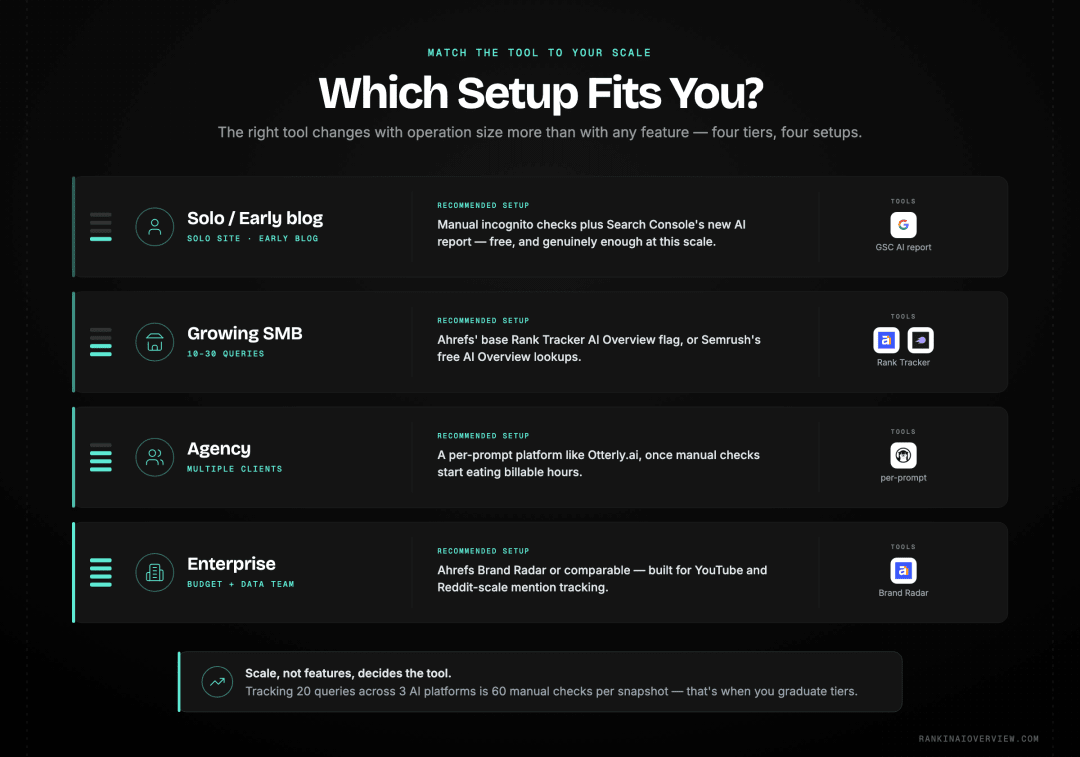
Scale changes the right answer here more than any feature comparison does. A framework, roughly matched to where most marketers sit:
-
Solo site or early-stage blog: manual incognito checks plus Search Console's new generative AI report. Free, sufficient, and not worth paying past this stage yet.
-
Growing SMB tracking 10–30 queries: Ahrefs's base Rank Tracker AI Overview flag, or Semrush's limited free lookups, before committing to a dedicated platform.
-
Agency managing several client accounts: a per-prompt platform like Otterly.ai becomes worth the cost once manual checking starts eating billable hours across multiple clients.
-
Enterprise brand with budget and an in-house data team: Ahrefs Brand Radar or a comparable enterprise platform, where the added YouTube/Reddit coverage and scale justify the price.
Most marketers overpay by skipping straight to the agency-tier tool before confirming the free tier actually falls short for their specific tracking volume.
A useful gut check before paying for anything: spend one week running the free combination on the actual queries that matter most. If that week surfaces gaps the free tools genuinely can't close, mismatched cross-platform coverage, too many queries to check by hand, the paid option becomes an easy decision rather than a guess.
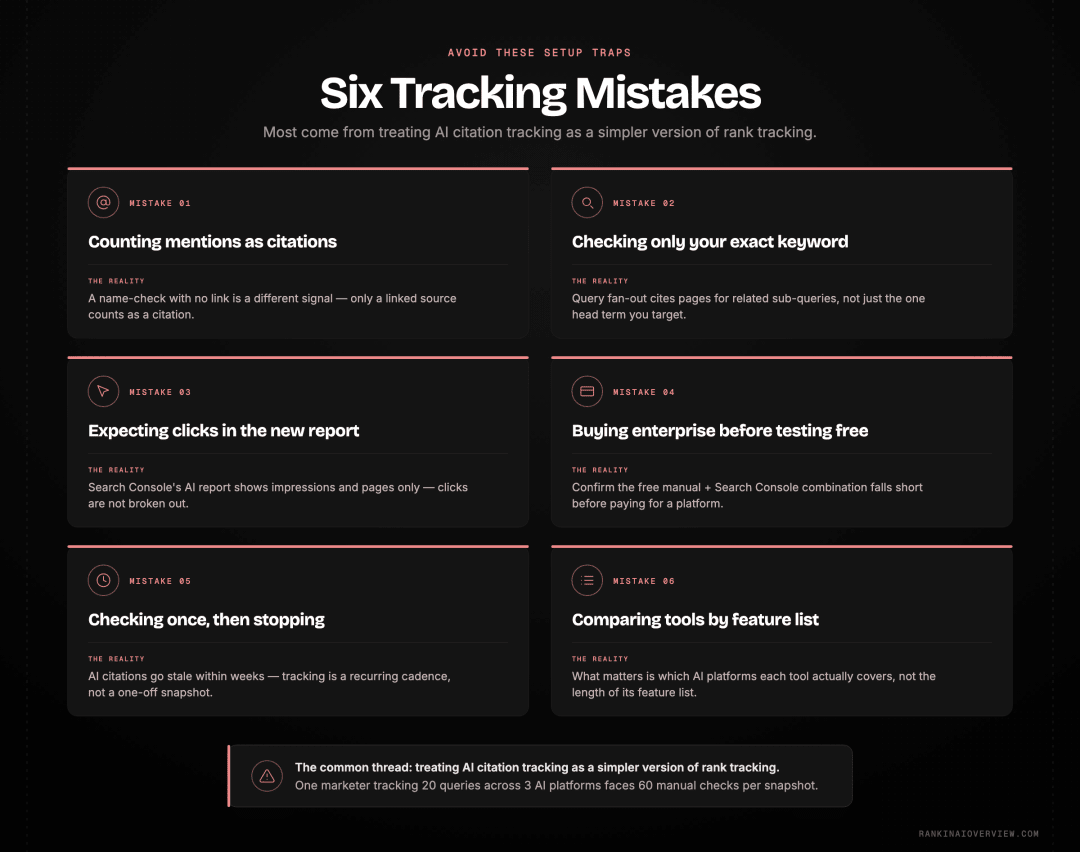
Common mistakes when setting up AI citation tracking
-
Treating a brand mention as a citation. A name-check with no link is not the same signal as being cited as a source, and conflating the two overstates real visibility.
-
Checking only the exact target keyword. Query fan-out means an AI Overview can cite a page for a related sub-query that never shows up if only the main keyword is checked.
-
Assuming Search Console's new report shows clicks. It currently shows impressions and pages only; click data for AI features still isn't broken out.
-
Buying an enterprise platform before confirming the free combination is actually insufficient for the tracked query volume.
-
Checking once and stopping. AI Overview citations shift faster than traditional rankings, so a single snapshot goes stale within weeks.
-
Comparing tools by feature list alone rather than by which AI platforms they actually cover, since coverage gaps matter more than extra dashboard widgets.
Most of these mistakes share a root cause: treating AI citation tracking as a simpler version of traditional rank tracking, when several of its basic mechanics genuinely work differently.
What free options exist for AI visibility tracking?
The strongest genuinely free option as of June 2026 is Google Search Console's new generative AI performance report, combined with manual incognito checks for cross-platform visibility. Both are official, permanent, and need no subscription.
Paid platforms occasionally offer a limited free allowance rather than a real free tier: Semrush allows a small number of daily lookups on a free account, and Otterly.ai offers a time-limited free trial rather than an ongoing free plan.
For a solo marketer or small site checking a handful of target queries weekly, the free combination is genuinely sufficient now in a way it wasn't a few months ago. Paid platforms earn their cost mainly at volume and cross-platform breadth, not at the basic “am I cited at all” question.
Agencies should still expect to pay for something eventually. The free combination doesn't get easier to run across ten client accounts the way a per-prompt platform does, even with the improved Search Console report in the mix.
Are Chrome extensions enough to manage AI SEO?
Not on their own, but the gap has narrowed. GEO-specific browser tooling is still genuinely thin, and most of what's marketed as an AI SEO Chrome extension is either a companion feature inside a larger paid platform or a traditional SEO extension with no AI citation awareness at all.
That doesn't make extensions useless. SEOquake and the Ahrefs toolbar are still genuinely useful for the traditional ranking signals that still influence AI Overview eligibility in the first place. They simply don't close the citation-tracking gap this article is about, and Search Console's update only closes part of it.
A realistic setup for most teams right now: Google's new report and manual checks for day-to-day Google-specific monitoring, with a paid platform layered in once cross-platform tracking needs to scale past what one person can check by hand each week. RANK IN AI OVERVIEW's breakdown of what ‘ranking’ means in AI search is worth reading alongside any tool's output, since ranking and citation data measure two different things even when a dashboard presents them side by side.
Expect this category to keep moving faster than most SEO tooling has historically moved. Search Console's update is the clearest sign yet that the platforms themselves, not just third-party vendors, are now treating AI citation visibility as a reporting gap worth closing officially, and it's unlikely to be the last such update this year.
Conclusion
The picture changed mid-2026 more than most coverage of this topic has caught up with. Search Console's new generative AI report closes a real gap for Google-specific tracking, and Ahrefs's base-plan AI Overview flag quietly does the same for budget-conscious teams who don't need Brand Radar's full scope.
Cross-platform tracking across ChatGPT, Perplexity and the rest still has no free, official equivalent, which is exactly where the paid platforms in this guide continue to earn their cost. Match the tool to the actual tracking volume rather than the most-recommended name, and revisit this list periodically, since this is one of the faster-moving corners of SEO tooling right now.
If there's one habit worth carrying forward from this guide, it's checking what a tool or feature actually does before adopting the name people use for it casually. Otterly.ai isn't a Chrome extension. Brand Radar isn't the same product as Rank Tracker's AI flag. Getting these distinctions right is most of what separates an efficient setup from a wasted subscription.
For ongoing coverage as this tooling category matures, RANK IN AI OVERVIEW covers this space across its content library.
Frequently asked questions
Does Search Console now show AI Overview clicks?+
No. The June 2026 update shows impressions and which pages appeared in generative AI features. Click data specific to AI features still isn't broken out separately from standard search clicks.
Does [Otterly.ai](https://otterly.ai/) have a Chrome extension?+
No standalone Chrome extension was found for this platform at the time of writing. It operates as a web-based dashboard, despite sometimes being described informally as a browser extension in marketer discussions.
Is there a completely free Chrome extension for tracking AI Overview citations?+
Not yet a dedicated browser extension. The strongest free option is Search Console's new generative AI performance report combined with manual incognito searches.
Can traditional SEO extensions like SEOquake show AI Overview data?+
No. These extensions were built for classic ranking, backlink and on-page metrics. They don't currently detect or report AI Overview citation status.
How often should I check AI citation status?+
Weekly is a reasonable cadence for actively tracked queries. AI Overview citations can change faster than traditional rankings, so monthly checks risk missing meaningful shifts between reviews.
Explore with AI
Share this