Competitive SEO Benchmarking vs AI Visibility Benchmarking: What's Actually Different
Competitive SEO benchmarking and AI visibility benchmarking measure different things. See the metrics, tools and timing that separate the two.

Key Highlights
-
Competitive SEO benchmarking compares rankings, traffic and domain authority across a gradient of search results.
-
AI visibility benchmarking measures whether a brand is mentioned at all inside AI-generated answers, which is a near-binary outcome.
-
A brand can sit on page one of Google and still be completely absent from ChatGPT, Perplexity or Google AI Overviews.
-
AI visibility benchmarking often tracks a different competitor set than SEO benchmarking, because AI platforms surface brands using different signals.
-
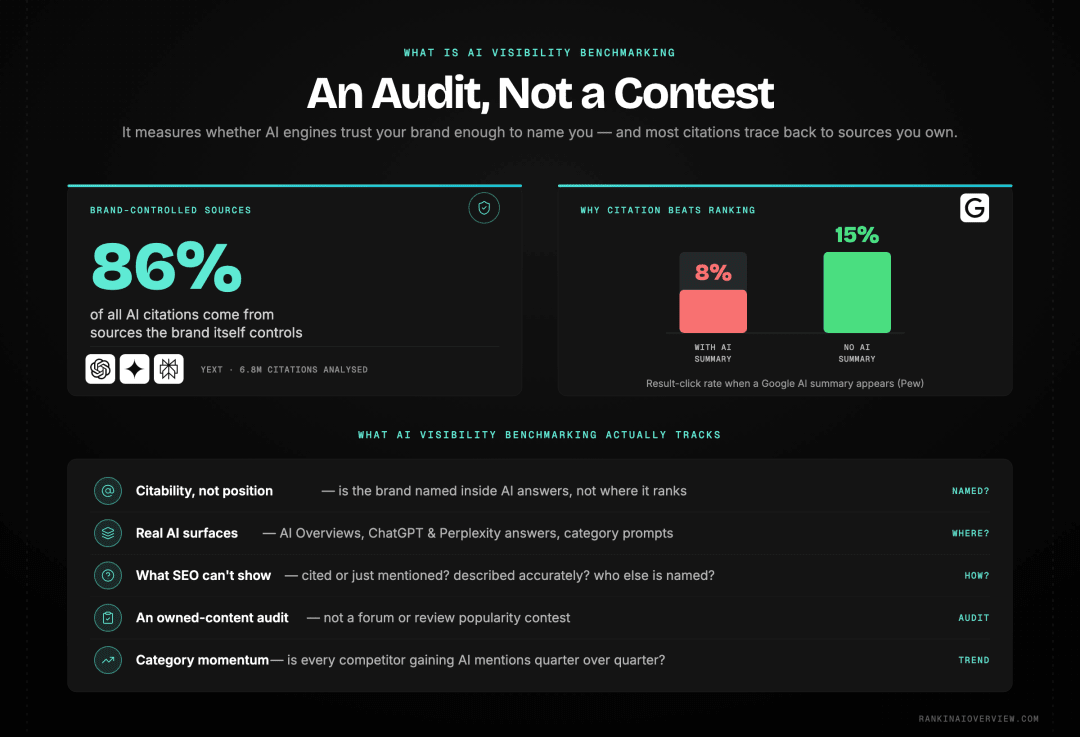
Pew Research Center found that search pages showing an AI summary produce a result click only 8% of the time, against 15% without one.
-
Tools such as the Semrush AI Visibility Toolkit, Ahrefs Brand Radar and Conductor track AI mentions and citations the way rank trackers track positions.
-
Running both benchmarks side by side reveals visibility gaps that neither one shows on its own.
Open most SEO dashboards this month and the story looks fine: stable rankings, steady traffic, the same familiar competitor set. According to Pew Research Center, search pages that show an AI summary produce a result click only 8% of the time, against 15% when no summary appears. That one number explains how a healthy rank tracker can sit right next to a brand that is quietly disappearing from how people actually find answers.
If competitive SEO benchmarking vs AI visibility benchmarking feels confusing right now, that confusion is fair. Marketers spent years treating “visibility” as a single number: position one, position three, page one or nothing. A second, parallel scoreboard has now appeared, one where a brand can be the clear winner on Google and the invisible option inside ChatGPT. Nobody handed teams a clean playbook for tracking both scoreboards at once.
This guide separates the two disciplines clearly. It covers what competitive SEO benchmarking measures, what AI visibility benchmarking measures instead, where the two genuinely overlap, and which competitors and tools matter for each one. The aim is a simple, usable answer: when to run an SEO benchmark, when to run an AI visibility benchmark, and why most brands now need to run both on a recurring schedule.
What Is Competitive SEO Benchmarking?
Competitive SEO benchmarking compares a brand's organic search performance, rankings, traffic, click-through rate and domain authority, against direct competitors on Google. It uses tools such as Google Search Console and rank trackers to measure findability: how often a brand's pages appear in a traditional list of search results, and where.
A useful SEO benchmark goes beyond a single rank number. It usually covers keyword rankings and average position across a target keyword set, organic clicks and impressions, click-through rate by query, indexed pages and crawlability, metadata and heading structure, page speed, and backlink profile relative to named competitors. The point is diagnostic: which queries earn impressions but fail to convert into clicks, which pages target the wrong search intent, and which fixes will move revenue rather than vanity traffic.
Competitive SEO benchmarking has a clear, decades-old rulebook. Position three beats position five. More backlinks from authoritative domains tend to outrank fewer. Every brand in the comparison set shows up on the same scoreboard, a search engine results page with ten or more visible slots, so the competition is gradual rather than winner-take-all.
This is also why SEO benchmarking produces a familiar kind of report: a spreadsheet of keyword positions tracked weekly, a list of technical issues ranked by impact, and a backlink gap analysis against two or three named rivals. The format has barely changed in over a decade, because the underlying mechanic, a ranked list of links, has barely changed either. That stability is exactly what makes it a poor proxy for a newer surface that does not work the same way.
What Is AI Visibility Benchmarking?
AI visibility benchmarking measures how often, and how prominently, a brand is mentioned or cited inside AI-generated answers from platforms such as ChatGPT, Perplexity, Google AI Overviews and Gemini. Instead of tracking a ranking position, it tracks citability: whether AI systems treat a brand as a trustworthy source worth naming.
This benchmark looks at a different set of surfaces: AI Overviews sitting above standard search results, conversational answers inside ChatGPT or Perplexity, and recommendation-style responses to category or comparison prompts. A proper AI visibility benchmark answers questions an SEO report cannot: does the brand appear for the prompts that matter, is it cited as a source or only mentioned in passing, is the AI-generated description of the product accurate, and which competitors are being named instead. There is no ranked list to climb here, which is why ranking means something different in AI search than it does on Google.
Yext's analysis of 6.8 million AI citations across ChatGPT, Gemini and Perplexity found that 86% of citations came from sources brands already control, such as their own websites and listings, rather than forums or review sites. That single finding (Yext Research) reframes AI visibility benchmarking as something closer to an audit of owned content than a popularity contest.
“ AI generates answers based on a person's real-world location and context Christian J. Ward Chief Data Officer, Yext Yext Research, October 2025
AI visibility benchmarking also surfaces something a rank tracker cannot: market-level momentum. If every competitor in a category is gaining AI mentions quarter over quarter, the category is maturing fast and the cost of waiting keeps rising. If AI visibility across the whole category is still thin, that is a first-mover signal worth acting on before competitors catch up. Either reading only becomes visible once a brand benchmarks its own AI presence against the category, not just against its own historical numbers.
How Do the Two Benchmarking Methods Actually Differ?
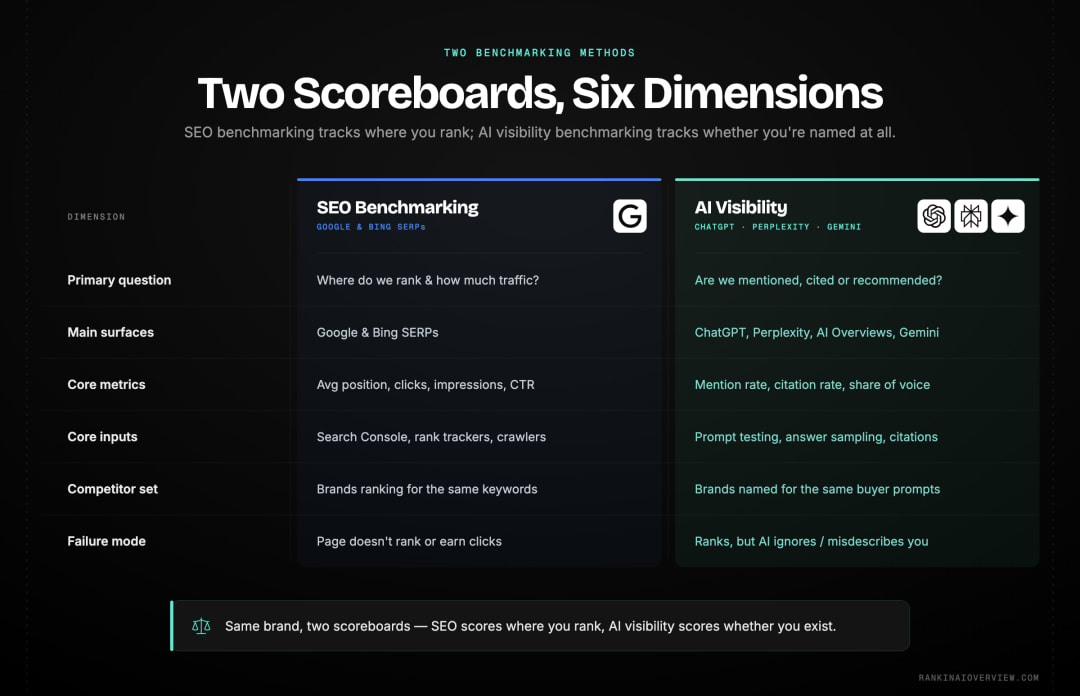
The core split is binary visibility versus a gradient ranking, single-engine dominance versus a fragmented multi-platform landscape, and clean attribution versus messy attribution. SEO benchmarking asks where a brand ranks. AI visibility benchmarking asks whether a brand is referenced at all inside a generated answer.
Binary Visibility vs Gradient Rankings
A Google results page can show ten, twenty or more ranked links, so a brand at position eight still earns some visibility and some clicks. AI platforms behave differently. A typical AI Overview or chat answer names somewhere between three and six brands for a given prompt, and everyone left out of that short list gets nothing. AI visibility benchmarking treats this gap as the headline metric: not a position number, but a mentioned-or-absent outcome across a defined set of prompts. That also changes what a small movement in the data means: a one-point gain in average rank is incremental, while a single new citation across a popular prompt cluster can represent a meaningful share of a category conversation. AI search is probabilistic rather than positional, and benchmarking it with a ranking mindset misses that distinction entirely.
Multi-Platform Competition vs Single-Engine Dominance
Traditional SEO benchmarking is built around one dominant engine, with Bing and other search engines playing a distant secondary role. AI search has no single dominant engine. A brand can be well cited on Perplexity, rarely mentioned by ChatGPT, and absent from Google AI Overviews, all at the same time, because each platform weighs sources, recency and entity signals differently. A competitive AI visibility benchmark has to run the same prompt set across every major engine, or it is only measuring one slice of the picture. Skipping a platform because it currently sends little traffic is a common shortcut, and it is also how teams miss the early signs of a shift, since usage and citation behaviour on any individual AI platform can move quickly as models and products change.
Clean Attribution vs Messy Attribution
Google Search Console and standard analytics platforms pass referrer data cleanly, so an SEO benchmark can tie a specific keyword to a specific click with confidence. AI-referred traffic is messier: referrers strip out frequently, mobile apps lose attribution entirely, and a meaningful share of AI-influenced visits get misclassified as direct traffic in analytics tools. Anyone running an AI visibility benchmark needs to expect noisier numbers and build in cross-checks rather than trusting one dashboard. In practice, that means pairing platform-level mention and citation data with a manual look at branded search volume and direct traffic trends, since a spike in either can be the clearest sign that an AI answer sent someone looking for a brand by name.
Can a Brand Rank Well on Google but Be Invisible in AI Answers?

Yes. A page can rank first on Google and still be ignored by AI systems if its answer is buried deep in the copy, its claims are generic, or its supporting proof is thin. Ranking measures relevance to a search query; AI visibility measures whether a system trusts the content enough to cite it as a source.
This happens for a few repeatable reasons, and most of them have nothing to do with ranking position. Established brands with strong domain authority are often the ones most surprised by this gap, since years of ranking well never had to account for how an AI system extracts and trusts a page.
-
The answer is buried. A 2,000-word guide might rank well, but if the direct answer sits 1,500 words deep under a vague subheading, an AI system has nothing clean to extract.
-
The claims are generic. Phrases like “save time” or “streamline workflows” could describe hundreds of competitors, so the model has nothing distinctive to summarize or cite.
-
The proof is hidden. A brand's strongest evidence, named case studies, specific metrics, third-party documentation, often lives in a sales deck or gated PDF instead of a crawlable public page.
-
A competitor is simply easier to explain. They may not be a better product, just a clearer one, with more consistent naming and more direct comparison pages for a model to lean on.
What Happened When a Market Leader Had Zero AI Citations?
Fortinet, a global cybersecurity vendor serving more than 700,000 customers and holding roughly half of the global firewall market, found it held only a 0.6% citation share across AI platforms despite strong traditional rankings, according to a GEO case study published by LeadWalnut. After restructuring key pages with direct-answer sections, comparison tables and FAQ content built for extraction, the brand moved into featured citation positions across ChatGPT and Google AI Overviews within weeks. The case shows that traditional market leadership and AI visibility are measured, and won, separately. For a page-by-page version of this fix, the five most common reasons a page ranks on Google but stays invisible in AI are a useful starting checklist.
What Competitor Set Should Each Benchmark Compare Against?
SEO benchmarking should compare against direct competitors, search competitors and content publishers who outrank a brand for commercial keywords. AI visibility benchmarking needs a fourth group: AI-visible competitors, brands that consistently appear in AI-generated answers for a category even when they do not rank first on Google.
A competitive SEO benchmark that only tracks direct sales rivals misses most of the real competition. It should also include search competitors, any page outranking a brand for valuable commercial queries, and content competitors, the review sites, directories and publishers who often own the educational content in a given space. Comparing against all three groups shows where traffic is actually being lost, not just where a named rival happens to sit.
AI visibility benchmarking needs an additional, often overlapping but distinct group: AI-visible competitors. These are the brands an AI system names for category prompts, comparison prompts and problem-solving prompts, regardless of whether they rank on page one. A direct competitor with weak SEO can still dominate AI citations if their content is more structured and better sourced, while a strong organic competitor can be nearly silent inside AI answers if their public proof is thin. The evidence increasingly points to trust signals mattering more than ranking signals in this fourth group, which is why benchmarking against it is often the most revealing exercise in the whole process; it exposes a competitive set most SEO tools never surface.
An illustrative snapshot makes the gap concrete. The table below is not real data from any specific brand; it shows the kind of side-by-side view a benchmark report should produce once both disciplines are tracked together, using metrics that go beyond rankings.
| Benchmark Area | Your Brand | Competitor A | What It Signals |
|---|---|---|---|
| Google top-10 rankings (25 category keywords) | 9/25 | 16/25 | A traditional SEO visibility gap |
| AI mention rate (50 buyer prompts) | 14% | 46% | Competitor A dominates AI category discovery |
| AI citation rate (50 buyer prompts) | 5% | 24% | Your content is rarely treated as a primary source |
| Description accuracy in AI answers | Mixed | High | Your positioning likely reads as unclear to the model |
| Owned pages cited by AI | 1 | 7 | Your site lacks extractable, citable pages |
SEO benchmarking should track rankings, organic clicks, impressions, click-through rate and technical health. AI visibility benchmarking should track mention rate, citation rate, share of voice across platforms, position within the answer, and description accuracy. The two metric sets rarely move together, which is exactly why both need separate tracking.
| Category | SEO Benchmarking | AI Visibility Benchmarking |
|---|---|---|
| Primary question | Where do we rank, and how much traffic do we earn? | Are we mentioned, cited or recommended in AI answers? |
| Main surfaces | Google and Bing search results pages | ChatGPT, Perplexity, Google AI Overviews, Gemini |
| Core metrics | Average position, clicks, impressions, CTR | Mention rate, citation rate, share of voice, position in answer |
| Core inputs | Google Search Console, rank trackers, crawlers | Prompt testing, AI answer sampling, citation checks |
| Competitor set | Brands ranking for the same keywords | Brands named for the same buyer prompts, which can differ |
| Failure mode | Page does not rank or does not earn clicks | Page ranks, but AI systems ignore or misdescribe the brand |
Which Tools Help Run Each Type of Benchmark?
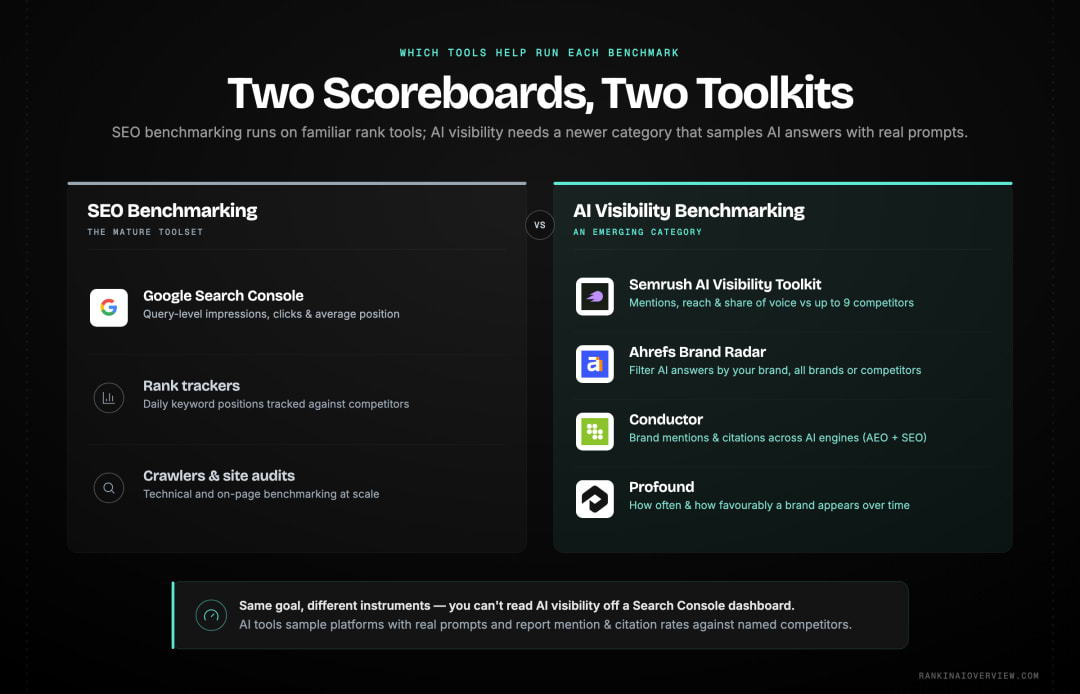
Google Search Console and traditional rank trackers remain the core tools for SEO benchmarking. AI visibility benchmarking relies on a newer category of tools, including the Semrush AI Visibility Toolkit, Ahrefs Brand Radar and Conductor, that sample AI platforms with real prompts and report mention and citation rates against named competitors.
SEO benchmarking tooling has not changed much in structure, even as the data it feeds into has gained new urgency. AI visibility tooling is younger and moves faster: most platforms in this category were built or substantially rebuilt within the past two years, and new entrants continue to launch as AI search adoption grows. A vendor-neutral comparison of the current AI rank trackers is a useful starting point before committing budget to any one platform. The list below covers the tool types most teams reach for first.
-
Google Search Console remains the foundation for SEO benchmarking: query-level impressions, clicks and average position.
-
Semrush AI Visibility Toolkit benchmarks brand mentions, audience reach and share of voice against up to nine chosen competitors across AI platforms.
-
Ahrefs Brand Radar filters AI answers by brand, all brands or competitor brands, useful for isolating where a category conversation happens.
-
Conductor tracks brand mentions and website citations across AI engines as part of a combined AEO and SEO workflow.
-
Profound focuses specifically on AI search visibility, tracking how often and how favourably a brand appears across major AI platforms over time.
None of these tools eliminate the need for judgment. A mention rate or citation count is a starting signal, not a finished strategy, and not every AI rank tracker measures what it claims to measure. The teams that get the most value from this tooling treat the numbers as a map of where to investigate next, not a final scoreboard to report and forget.
“ What's changing now is the level of discipline required Seth Besmertnik CEO and Co-Founder, Conductor Conductor 2026 AEO/GEO CMO Investment Report
When Should a Brand Run Each Type of Benchmark?
Run an SEO benchmark after a site migration, when traffic drops, or when impressions stay high while clicks go flat. Run an AI visibility benchmark after any positioning or product change, when competitors keep appearing in AI answers and the brand does not, or on a quarterly cadence in any fast-moving category.
A traditional SEO benchmark earns its place on a fixed, event-driven schedule. The signals are well understood: a migration or redesign that could have broken redirects, a sudden drop in organic traffic that needs a root cause, or a widening gap between impressions and clicks that points to weak titles or mismatched intent. None of this requires guesswork, since Google Search Console and standard rank trackers surface the relevant numbers automatically.
An AI visibility benchmark works on a different rhythm, because the underlying platforms change faster than search rankings do. A new product launch, a renamed feature, or a shift in target audience can change how AI systems describe a brand within weeks, long before that shift would show up in a quarterly SEO report. Running a lighter AI visibility check every quarter, and a full one after any major brand or product change, keeps the gap between the two benchmarks from growing unnoticed.
-
SEO benchmark triggers: after a migration or redesign, a sudden traffic drop, rising impressions with falling click-through rate, or before a major growth push.
-
AI visibility benchmark triggers: after a positioning, naming or product change, when AI tools describe the product inaccurately, or as a standing quarterly check in competitive categories.
-
Shared trigger: any time a brand benchmark report only shows half the picture, since SEO and AI visibility can move in opposite directions during the same quarter.
Conclusion
Competitive SEO benchmarking and AI visibility benchmarking measure two different layers of the same discovery journey. One tracks where a brand ranks; the other tracks whether a brand gets named at all once a search becomes an AI-generated answer. Treating them as interchangeable hides exactly the gap that matters most: a brand that looks healthy on a rank tracker while quietly losing the AI-generated conversation.
The practical move is to run both benchmarks on a recurring schedule, using the right competitor set and the right tools for each, rather than assuming one report tells the whole story. Treat SEO benchmarking as the measure of findability and AI visibility benchmarking as the measure of citability, and review both before deciding where the next quarter's content and technical budget should go. Ranking is no longer the only goal worth measuring in SEO, and treating AI visibility as a parallel goal, rather than an afterthought, is what separates brands that adapt early from those still reading a half-complete report. For deeper research on how AI engines evaluate brand authority and citability, RANK IN AI OVERVIEW covers this space across its content library.
Frequently asked questions
Is AI visibility benchmarking the same as SEO benchmarking?+
No. SEO benchmarking measures ranking position, traffic and clicks on search engines. AI visibility benchmarking measures whether a brand is mentioned or cited inside AI-generated answers, which is a separate, near-binary outcome that ranking data does not capture.
Why does my site rank well on Google but get no AI mentions?+
Ranking measures relevance to a query, not citability. A page can rank first while its answer is buried, its claims are generic, or its proof is missing from the public web, all of which make it harder for AI systems to extract and trust as a source.
How often should I run an AI visibility benchmark?+
Run one after any major product, positioning or naming change. For competitive categories, a quarterly check is a reasonable baseline, since AI platform behaviour and training data shift faster than traditional search rankings.
Which tools benchmark AI visibility against competitors?+
The Semrush AI Visibility Toolkit, Ahrefs Brand Radar and Conductor are widely used to benchmark AI mentions and citations against named competitors, each sampling AI platforms with defined prompt sets and reporting share of voice.
Do AI search competitors differ from my SEO competitors?+
Often, yes. AI platforms surface brands based on entity clarity, citable proof and structured content rather than ranking signals alone, so a brand can compete against a different set of names in AI answers than it does on a Google results page.
Is traditional SEO dead because of AI visibility?+
No. Crawlability, site speed and clear content remain prerequisites for any kind of visibility, including AI visibility. SEO benchmarking and AI visibility benchmarking are complementary disciplines, not competing replacements for one another.
Explore with AI
Share this