Which AI Writing Tools Actually Produce Content That Ranks in 2026? An Honest Comparison
Not all AI writing tools are equal when it comes to producing content that ranks on Google or gets cited by AI search engines. Here is an honest, experience-based comparison for 2026.

SummaryThe best AI writing tools help speed up research and drafting, but rankings still depend on human editing, experience, and trust signals. Claude performs best for depth, ChatGPT for speed, and Surfer AI for SEO optimisation, though no single tool wins in every area. Successful teams combine AI drafting with SEO scoring, first-hand insights, and strong E-E-A-T signals. In 2026, workflow quality matters far more than the AI tool itself.
Read moreShow less
The market is flooded with AI writing tools all promising to produce content that ranks on Google and gets cited in AI answers. According to ClearBrand's 2025 content marketing research, 90% of content writers now use AI to increase SEO performance. But most of them are burning budget on the wrong tools, or using the right tools the wrong way. This comparison is based on real usage data, practitioner community experience, and documented ranking outcomes. We cut through the vendor marketing and tell you what actually works.
The frustration is familiar. You purchase one of the best AI writing tools for SEO, run your brief through it, and receive an article that reads plausibly but ranks nowhere. Or you spend three hours editing raw AI output to get it to a publishable standard, wondering whether you saved any time at all. The AI writing tools comparison 2026 space is noisy, and the honest answers are buried under affiliate-heavy roundups.
This guide is different. We will explain why tool choice matters less than you think (but still matters), set out the four criteria that actually predict whether AI content ranks, compare the top tools against those criteria, and give you the workflow that produces consistently ranking-focused AI content regardless of which tool you choose. By the end, you will know exactly what to use and how to use it.
Why Does Tool Choice Matter Less Than Your Editing Workflow?
The uncomfortable truth: give five different AI writing tools the same brief and you get five articles with the same structure, the same talking points, and the same generic tone. The tools optimise for SERP signals but not for what makes a reader trust your content. Differentiation comes from what you add after generation, not from which model generated the draft. |
|---|
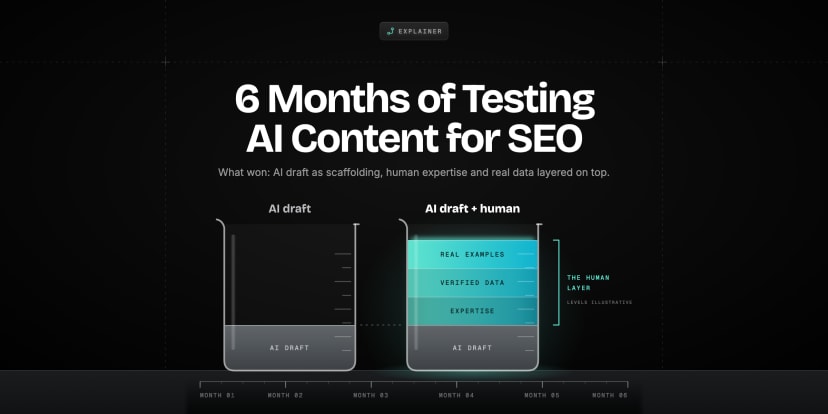
AI writing tools are accelerators, not authors. The model generates a structurally sound draft based on patterns it has seen at scale. That draft is useful. It saves hours of initial research and organisation. But it is built from existing content, not original thinking, proprietary data, or first-hand experience. Those signals are what Google's E-E-A-T framework rewards most heavily in 2026.
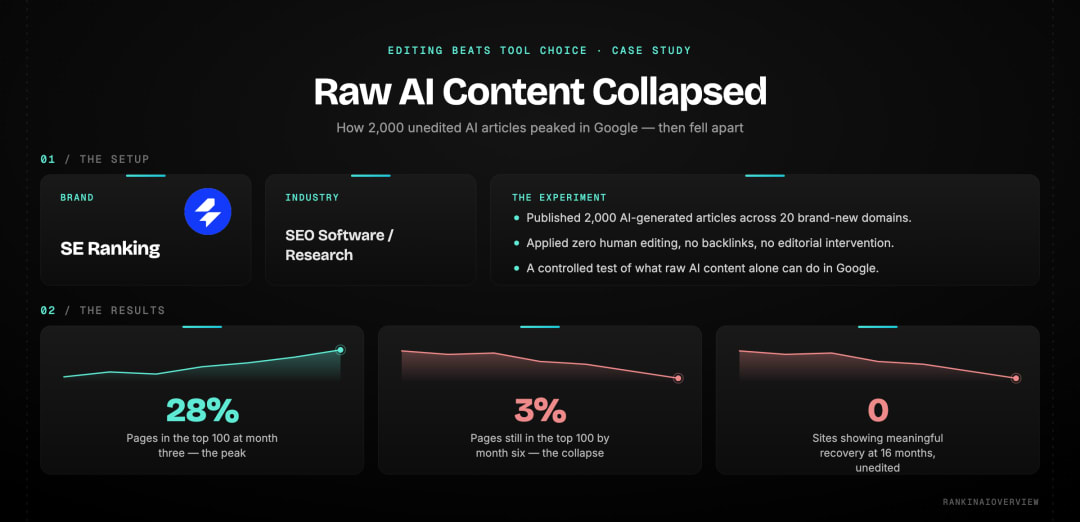
The practitioner community has converged on this point consistently. SE Ranking's 16-month AI content experiment published 2,000 AI-generated articles with no human editing on 20 new domains. Rankings peaked at 28% of pages in the top 100 at month three, then collapsed to 3% at month six. The content was structurally fine. What it lacked was the human layer that makes content trustworthy enough to hold a ranking.
This does not mean tools are interchangeable. A tool that generates a more topically complete draft, or one that integrates live SEO data, or one that makes it easier to add first-person context, produces a better starting point. A better starting point requires less editing to reach the standard that ranks. The tool is still the variable. It is just not the most important one.
What Are the 4 Criteria That Predict Ranking Success?

Not all AI writing tool comparisons measure the right things. Ranking-focused AI writing tools must be evaluated on four specific criteria: topical depth of the raw output, structural quality of headers and content flow, ease of adding first-person experience, and integration with live SEO data. Tools that score poorly on any of these produce drafts that require substantially more work to rank. |
|---|
Topical depth determines whether the AI output covers the full semantic territory of a query. A shallow draft covers the main points in the same way every competing article already does. A deep draft introduces adjacent concepts, addresses the underlying question behind the stated question, and covers the objections a reader would have. Topical depth is the variable that most separates the best AI writing tools for SEO from the field.
Structural quality includes whether the H2 and H3 hierarchy is logical, whether paragraphs are scannable, and whether the content flows from one idea to the next without padding. Poor structural quality requires rewriting rather than editing. A tool that requires rewriting is not an accelerator.
Ease of adding first-person experience means the draft has natural insertion points for case examples, original data, or direct practitioner observations. Some AI writing tools produce tightly woven arguments that are difficult to annotate without disrupting flow. Others produce modular sections that accept additional context naturally. The latter produces AI content that ranks far more reliably.
SEO data integration is what separates tools built for ranking from tools built for volume. A tool that pulls live SERP data and scores your content against actual top-ranking pages gives you a real-time feedback loop. Surfer SEO's content editor, which scores from 0 to 100 as you write, with 67+ correlating with strong ranking potential, is the benchmark for this category. Tools without this integration are writing in the dark.
How Do the Top AI Writing Tools Compare for SEO Performance?
This comparison evaluates five tools specifically for their ability to produce content that performs in search. The verdict: no single tool wins on all four criteria. The most effective setups combine two tools. ChatGPT vs Claude for SEO content is a genuine debate but the answer depends on the content type, not a universal ranking. |
|---|
Tool | Best For | Topical Depth | SEO Integration | Starting Price |
|---|---|---|---|---|
Claude (Anthropic) | Long-form, nuanced, research-heavy content | Excellent | None native | Free / Pro $20/month |
ChatGPT (GPT-4o) | Speed, iteration, versatile formats | Good | None native | Free / Plus $20/month |
Surfer AI | On-page optimised drafts with live SERP data | Good | Excellent | Essential $89/month |
Writesonic | Guided workflow for structured articles | Moderate | Good via integrations | From $16/month |
Eesel AI Blog Writer | Publish-ready content with citation building | Good | Moderate | From $20/month |
Claude: Best for Depth and Nuance
Claude produces longer, more nuanced drafts than most competing models and handles research-heavy topics with noticeably higher consistency. For content requiring genuine conceptual depth, such as technical explainers, strategic frameworks, and thought leadership pieces, Claude's output requires less structural rewriting than GPT-4o.
The limitation is clear. Claude has no native SEO data integration. It cannot tell you whether your draft is hitting the right keyword density or whether your headers match what the top-ranking competitors are using. This means Claude-generated drafts must be reviewed and scored through a separate SEO tool before publishing. The most common practitioner workflow pairs Claude with Surfer SEO for exactly this reason.
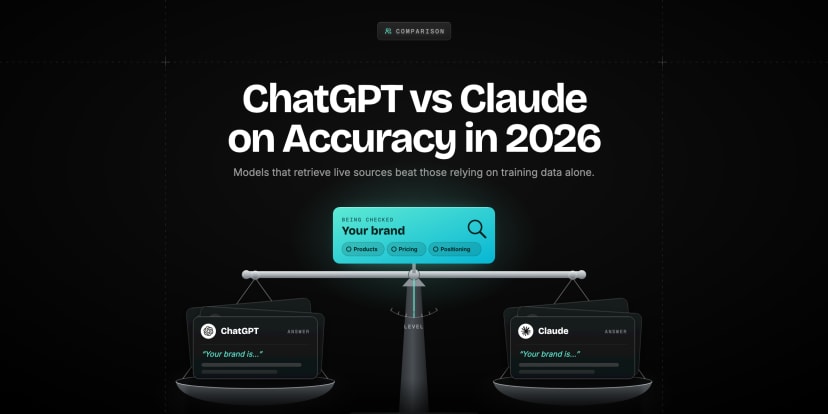
For ChatGPT vs Claude for SEO content specifically, Claude wins on nuance and Claude loses on iteration speed. A Claude draft typically requires one round of refinement. A ChatGPT draft is faster to generate and easier to iterate with follow-up prompts but often needs more depth added at the editing stage. ChatGPT vs Claude for SEO content is ultimately a workflow question, not a quality verdict.
ChatGPT (GPT-4o): Best for Speed and Versatility
ChatGPT remains the most widely used AI writing tool in content marketing workflows. GPT-4o's speed and versatility make it the default starting point for most teams. It handles format switching well, moving from article to outline to meta description to email in the same session. For high-volume content operations, this flexibility is genuinely valuable.
The core weakness for ranking-focused AI writing is that ChatGPT output needs heavier editing for E-E-A-T signals. The drafts are structurally sound but read generically without significant human annotation. In the ChatGPT vs Claude for SEO content debate, GPT-4o wins on speed but requires more post-editing to produce AI content that ranks. The solution most practitioners have settled on: ChatGPT for fast first drafts paired with Surfer SEO for on-page optimisation.
Surfer AI: Best for On-Page SEO Integration
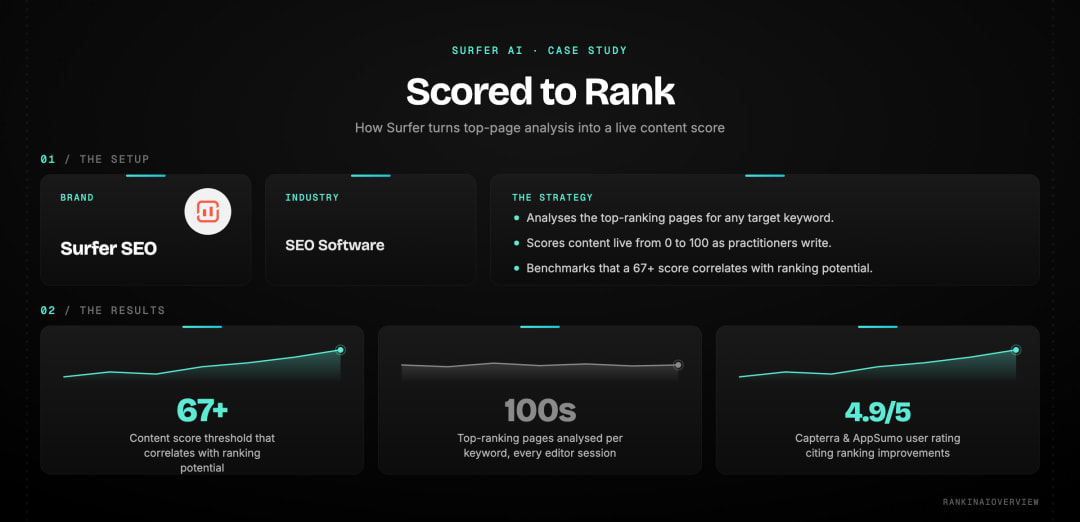
Surfer AI is not primarily a writing tool. It is a content optimisation platform with an AI writer attached. That distinction matters. The Content Editor analyses the top-ranking pages for your target keyword and provides a real-time score from 0 to 100 as you write. The score updates with every sentence, showing exactly which terms to include, what heading structure to follow, and what word count to target. This is ranking-focused AI writing at the most operational level.
Writesonic's integration with Ahrefs and Semrush gives it real keyword data grounding, but the live scoring as you write is what makes Surfer AI uniquely useful for teams who want the optimisation feedback loop embedded in their drafting process. The AI Growth plan at $219 per month includes unlimited AI-generated content, making it cost-effective for high-volume operations.
Writesonic: Best Guided Workflow
Writesonic takes a step-by-step approach to article generation that works particularly well for content teams with less editorial experience. The platform walks you through source selection, outlines a structure, and generates the article in stages. G2 users rate it 4.7 out of 5 across over 2,000 reviews, citing its time-saving automation and interface accessibility.
The limitation is output quality. Writesonic drafts require meaningful editing before publishing. The guidance layer is strong; the raw content requires a skilled editor to convert into AI content that ranks. For teams with a clear editorial process, the guided workflow is a strength. For teams expecting publish-ready output, Writesonic disappoints. It is best positioned as a structured starting engine rather than an end-to-end solution.
Eesel AI Blog Writer: Most Underrated
Eesel AI is the most underrepresented tool in AI writing tools comparison 2026 roundups. The blog writer produces publish-ready content including image suggestions and incorporates Reddit quotes as citation signals. This citation-building feature is specifically valuable for AI search visibility because Reddit mentions are among the most frequently cited off-site sources in AI-generated answers.
The tool is better suited to practitioners who understand GEO signals and want a tool that helps build the kind of external authority AI engines value, rather than just producing a draft that scores well in a traditional content editor. For teams building AI search visibility as well as Google rankings, Eesel AI deserves more attention than it currently receives in the market.
“ The best approach in 2026 is to use AI for the data-heavy, repetitive parts of SEO and keep human expertise at the centre. Tools that optimise for SERP signals but not for what makes a reader trust your content over the next result produce content that looks right but does not hold rankings. Nest Content AI SEO Tools Research, 2026 Source: Nest Content: AI SEO Tools 2026 |
|---|
What Is the Winning Workflow for AI Writing Tools That Rank?

The AI writing tools comparison 2026 data points to one consistent finding: the workflow matters more than any individual tool. The teams producing AI content that ranks consistently follow a six-step process. Steps one and two use AI. Steps three through six require human judgement. The tool is the starting engine. The human is the ranking signal. |
|---|
Step one is brief generation. Use an AI tool to create a topical outline, identify the primary and secondary keyword targets, and map the competitive landscape. ChatGPT handles this well with the right prompt. This step typically takes ten minutes and saves two hours of manual research.
Step two is the first draft. Generate the full article using your chosen AI writing tool. At this stage, aim for structural completeness rather than perfection. You want a draft that covers the full semantic territory of the topic, even if individual sections are thin or generic.
Step three is the experience layer. This is the most important step. Go through the draft and annotate every claim with first-person context: what you tested, what happened, what you concluded from direct experience. This is what Google's E-E-A-T framework actually rewards. No AI tool can do this for you.
Step four is the SEO review. Take the draft into Surfer SEO, Clearscope, or NeuronWriter and score it against the top-ranking competitors for your target keyword. Close the gaps that the score reveals. This step grounds your AI-assisted draft in real search data.
Step five is the E-E-A-T layer. Add the author bio, link to credentials, include citations from authoritative sources. If your article makes specific claims, link them to primary sources: research papers, government data, official documentation. This signals to both Google and AI engines that your content is trustworthy.
Step six is the final edit. Read the article out loud. Cut every sentence that does not advance the argument. Replace any phrase that sounds like it was written by an AI with the specific, direct language a human expert would use. AI content that ranks consistently is content that reads as though a knowledgeable human wrote it.
What Are the Red Flags of an AI Writing Tool That Will Not Help You Rank?
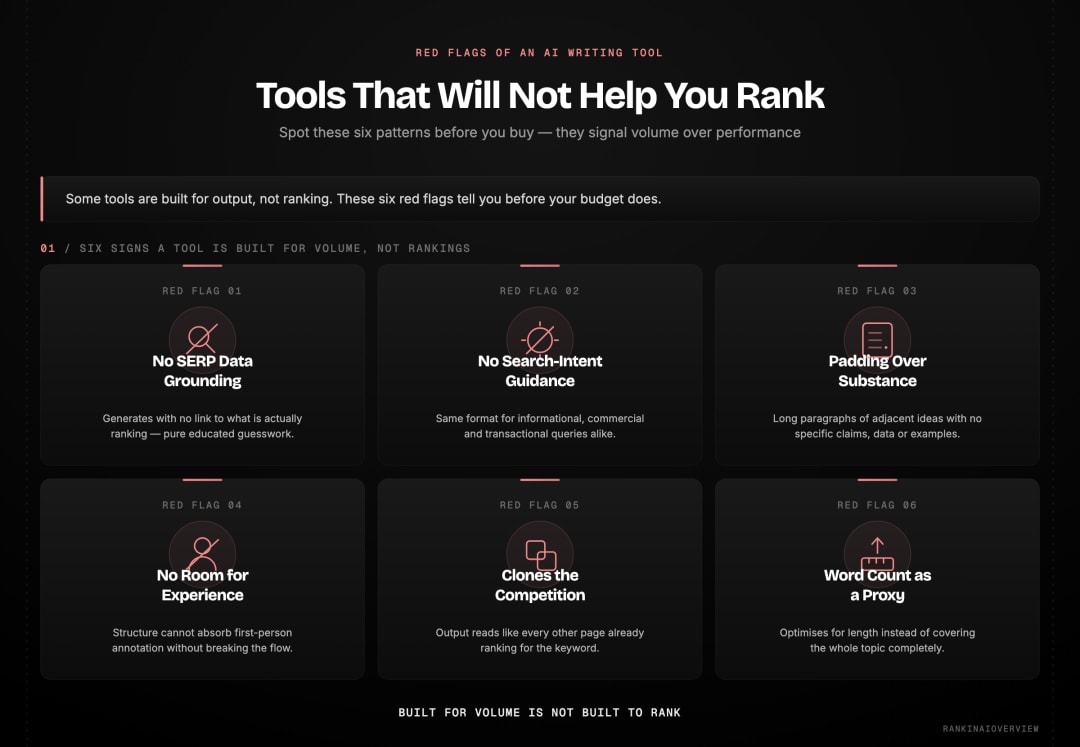
Not every AI writing tool deserves a place in a ranking-focused content workflow. Several patterns consistently signal that a tool is optimised for volume rather than performance. Identifying these before buying saves both money and the time spent producing content that fails to rank. |
|---|
No SERP data integration is the clearest red flag. Ranking-focused AI writing tools always connect to live search data. A tool that generates content without any grounding in what is currently ranking for your target keyword is producing educated guesswork. The output looks like content. It is not informed by the actual competitive landscape you are trying to penetrate.
No intent guidance is the second warning sign. The best AI writing tools for SEO distinguish between informational, commercial, and transactional intent and adjust structure and depth accordingly. A tool that generates the same format regardless of intent is not thinking about ranking, it is thinking about output.
-
Produces padding-heavy content: long paragraphs full of adjacent ideas but no specific claims, data, or examples
-
No mechanism for adding experience signals: structure does not accommodate first-person annotation without disrupting flow
-
Outputs identical structure to competitors: article reads like every other ranking page for the same keyword
-
No integration with SEO platforms: no native connection to Surfer SEO, Clearscope, or Semrush for scoring
-
Focuses on word count over topical completeness: optimises for length as a proxy for quality
Conclusion
Tool choice matters, but so does the underlying question of whether AI-generated content helps or hurts your rankings.
The best AI writing tools for SEO are the ones that fit your editing workflow. Prioritise tools that integrate real SERP data, support structured drafting, and leave room for your human expertise. Claude leads for depth. ChatGPT leads for speed. Surfer AI leads for on-page integration. No tool replaces the experience layer that makes AI content that ranks stick beyond three months. The ranking-focused AI writing tools category is growing fast. At RANK IN AI OVERVIEW, we track how this landscape evolves and what it means for content visibility in both Google and AI search. The tool is the starting engine. Your knowledge and editing are what make content rank.
Frequently asked questions
Can AI writing tools produce ranking content?+
Yes, but not without a human editing layer. [SE Ranking's 16-month experiment](https://seranking.com/blog/ai-content-experiment/) showed that AI-generated content can rank briefly on new domains without backlinks. But those rankings collapsed by month six without genuine expertise, original insight, and E-E-A-T signals added by human editors. The tool produces the draft. The human produces the ranking signals.
Which AI writing tool creates content that ranks best?+
No single tool produces the most ranking-focused AI content independently. The most consistent ranking results come from combining two tools: Claude or ChatGPT for the initial draft, and Surfer SEO or Clearscope for on-page optimisation scoring. Claude outperforms on depth and nuance. ChatGPT outperforms on iteration speed. Surfer SEO provides the data grounding that neither writing model offers natively.
Does Google penalise content written with AI tools?+
No. [Google's official guidance](https://developers.google.com/search/blog/2023/02/google-search-and-ai-content) is explicit: it evaluates content on quality, helpfulness, and trustworthiness, regardless of how it was produced. Using AI to generate content that serves users well is acceptable. Using AI to produce content at scale specifically to manipulate rankings violates spam policies. The distinction is quality and intent, not method.
Which AI tool is best for long-form SEO articles?+
Claude is the most consistent performer for long-form SEO articles requiring genuine depth and nuance. It maintains coherence over longer outputs and handles research-heavy topics with more specificity than GPT-4o. For long-form content that also needs on-page SEO optimisation built in, the Claude plus Surfer SEO combination is the workflow most experienced practitioners default to in 2026.
How much editing does AI content need before publishing?+
Raw AI output from any tool requires significant editing before it ranks reliably. Expect to add first-person experience, original data or examples, author credentials, inline citations to authoritative sources, and a final structural review. The editing workload is reduced by choosing a tool with stronger topical depth and SEO data integration at the draft stage. Budget a minimum of one to two hours of editing for every 2,000 words of AI-generated content if ranking is the goal.
Explore with AI
Share this