Why AI Search Does Not Have Rankings Like Google and What That Means for Your Strategy
AI search is probabilistic, not positional. Here is why AI search rankings explained differently changes everything about visibility, measurement, and content strategy in 2026.

SummaryMarketers chasing a "number one ranking" on ChatGPT are asking the wrong question. AI search generates probabilistic, ever-changing outputs, not fixed ranked lists. These systems retrieve candidate content, select relevant passages, and synthesise a natural language answer, so the real goal is retrieval eligibility. Success is measured by citation frequency and share of voice, not position.
Read moreShow less
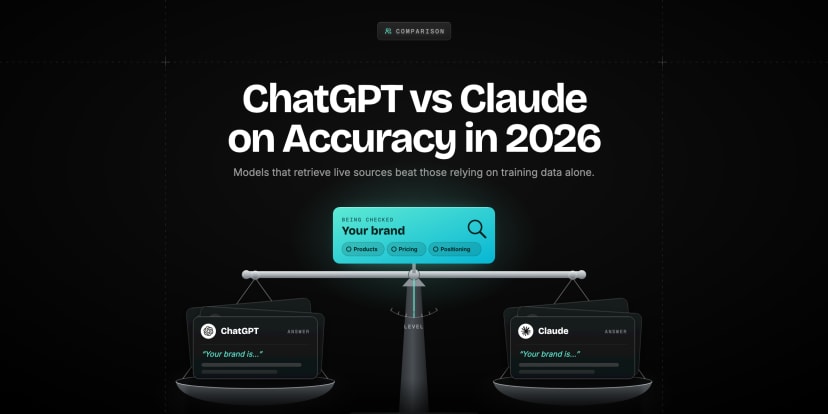
Marketers keep asking: how do I rank number one on ChatGPT? The question reveals a fundamental misunderstanding of how AI search works. ChatGPT does not have a ranked list. Neither does Perplexity, Claude, or Google AI Mode in the traditional sense. According to SE Ranking research from August 2025, when the same query is run three times in Google AI Mode, results overlap with themselves only 9.2% of the time. That single data point is the clearest possible demonstration of what AI search rankings explained actually means: there is no stable position, only probabilistic output.
The frustration this creates is real. You invest in AI search visibility, run your target queries in ChatGPT, get different results every session, and cannot tell whether your strategy is working or not. You try to apply Google ranking logic to AI search and the framework does not quite fit. You know the two systems are different but nobody has explained the difference in practical terms.
This guide does exactly that. We will explain how Google ranking works, how AI search actually works, why applying the old mental model to AI creates flawed strategies, and what a correct AI search vs traditional SEO framework looks like in practice. You will leave with a clear way to measure, report, and explain LLM search visibility without resorting to positions that do not exist.
How Does Google's Ranking System Actually Work?
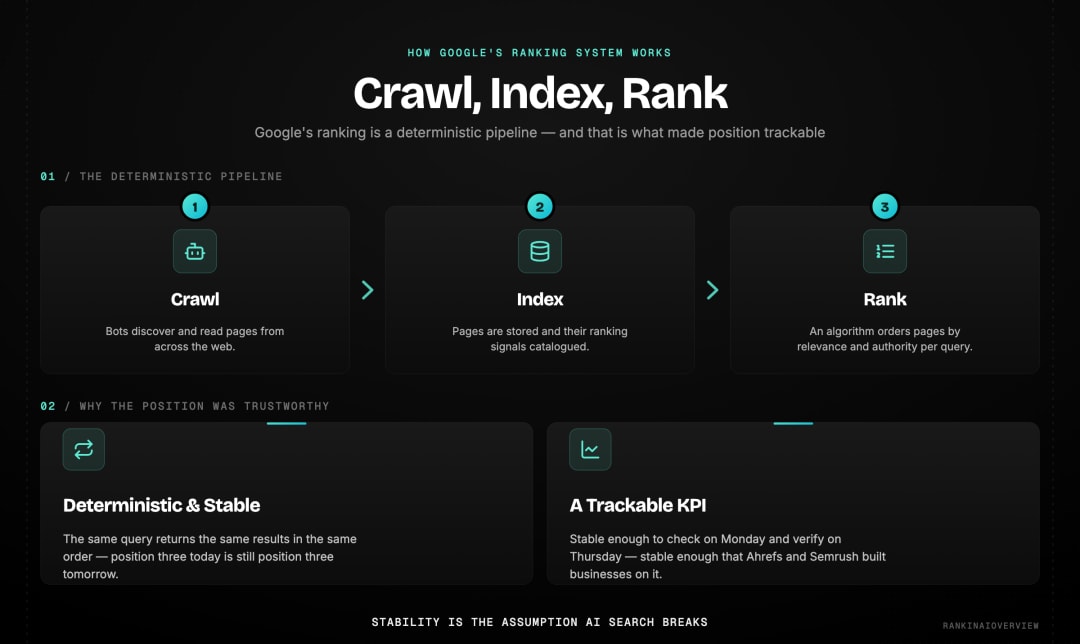
| Google ranking is deterministic. A crawl discovers pages, an index stores them, and a ranking algorithm orders them for a given query. The same query returns the same results in the same order with high consistency. That stability is what made rank tracking commercially viable for two decades. | | :---- |
When Google crawls a page, it reads content, evaluates signals including backlinks, technical health, and E-E-A-T factors, and assigns that page a position for relevant queries. A page in position three today will very likely be in position three tomorrow. Google's own Search documentation confirms this: ranking is based on stable signals evaluated consistently across runs.
This stability is what made AI search rankings explained as a concept confusing. For twenty years, ranking was a measurable, trackable fact. You could check your position on Monday, verify it on Thursday, and present it to a client on Friday. The number meant something precise.
That precision created an entire industry. Ahrefs and Semrush built their businesses on position tracking. Agencies built reporting workflows around monthly ranking reports. The metric worked because the underlying assumption of stability held. That assumption does not transfer to AI search.
How Does AI Search Work Differently From Google?
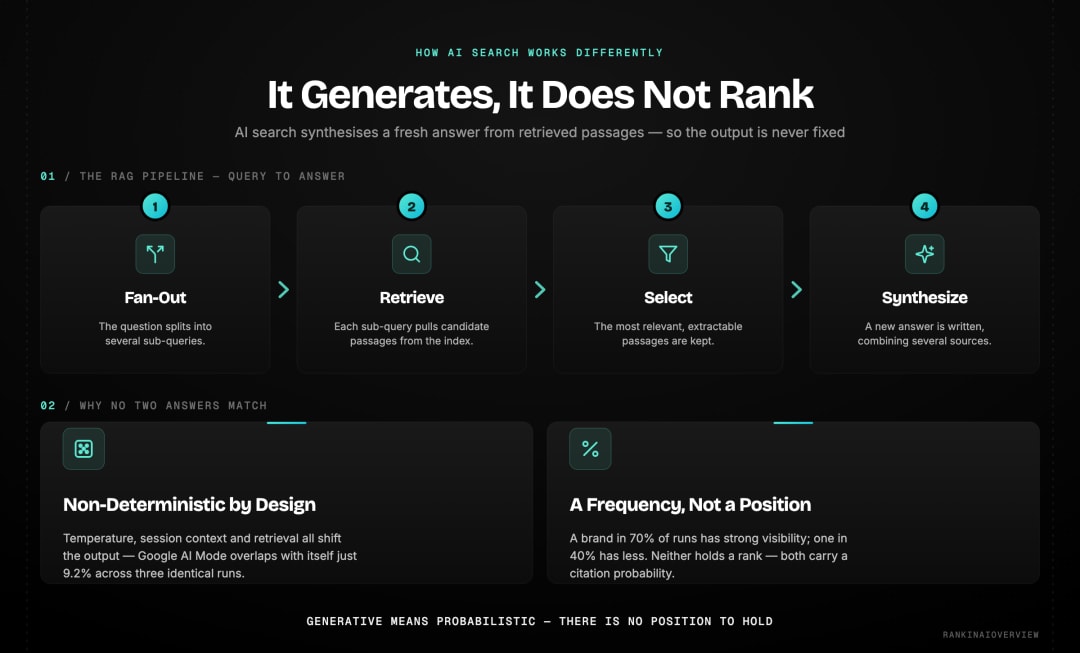
| AI search is generative, not retrieval-based. Instead of returning a ranked list of pages, it synthesises a new piece of text from retrieved content. This synthesis step introduces probability. The same prompt produces different outputs on different runs because the model is generating language, not looking up a fixed answer. | | :---- |
The RAG Pipeline From Query to Answer
Understanding how AI search works vs Google requires understanding Retrieval-Augmented Generation. When a user submits a query to an AI engine, the process unfolds in four stages.
First, query fan-out. The AI does not paste the full prompt into a search index. It breaks the question into multiple sub-queries and searches for each one separately. A question like "what is the best project management tool for remote teams?" might fan out into "project management tools 2026," "remote team software," and "best tools for distributed teams" as separate searches.
Second, retrieval. The AI searches its connected index and retrieves candidate passages from across the web. ChatGPT uses Bing's index. Perplexity uses its own crawler. Google AI Overviews use Google's own index. Each platform retrieves from a different source, which is why AI search rankings explained for one platform does not automatically apply to another.
Third, selection. From the retrieved candidates, the AI selects the most relevant and structurally extractable passages. This is where content format matters: a self-contained, direct-answer paragraph is far more extractable than one that requires surrounding context to make sense.
Fourth, synthesis. The AI generates a natural language answer that draws from multiple selected sources simultaneously. It does not copy and paste. It rewrites and combines. Your page might contribute one sentence to an answer or five. This is what RAG SEO explained looks like in practice: the goal is to be retrieved and selected, not to be ranked in a list.
Why the Same Prompt Returns Different Results Every Time
Large language models are non-deterministic by design. They generate outputs based on statistical probability, not fixed lookups. Temperature settings, session context, retrieval conditions, and even minor prompt variations all affect which output the model generates. SE Ranking's August 2025 research found that Google AI Mode had only 9.2% overlap with itself across three identical queries. Run the same question in the same session twice and you may get meaningfully different answers with different sources cited.
This is not a bug. It is how these systems are designed. The probabilistic nature of generative AI is what allows it to produce nuanced, contextual answers rather than identical copies of stored results. But it completely invalidates the concept of a stable ranking position. A brand that appears in 70% of runs for a given category query has strong LLM search visibility. A brand that appears in 40% has weaker visibility. Neither holds a position. Both have a citation probability.
How Google AI Mode Fits Into This
Google AI Mode is a hybrid. It uses Google's traditional ranking system to select retrieval candidates and then adds a synthesis layer on top. SE Ranking's analysis of AI Mode found that only 14% of URLs cited in AI Mode rank in the traditional Google top 10 for the same query. AI Mode draws from a wider pool than traditional ranking suggests, but traditional organic performance remains the eligibility foundation.
The practical implication: strong traditional SEO is still required as an entry point into AI Mode retrieval. But ranking in the top 10 does not guarantee citation. Content structure, semantic relevance, and entity clarity determine whether a page is selected from the retrieval pool. Understanding AI search vs traditional SEO here requires holding both truths simultaneously: you need organic performance to be eligible, and you need AI-specific signals to be cited.
| “ The future of search is bigger than Google. AI is transforming search into a cross-platform, multi-agent ecosystem where trust, clarity, and real value matter more than tactics or rankings. Aleyda Solis International SEO Consultant and Founder, Orainti Source: Advanced Web Ranking Expert Roundup, December 2025 | | :---- |
What Are the Strategic Implications of Dropping the Rankings Mental Model?
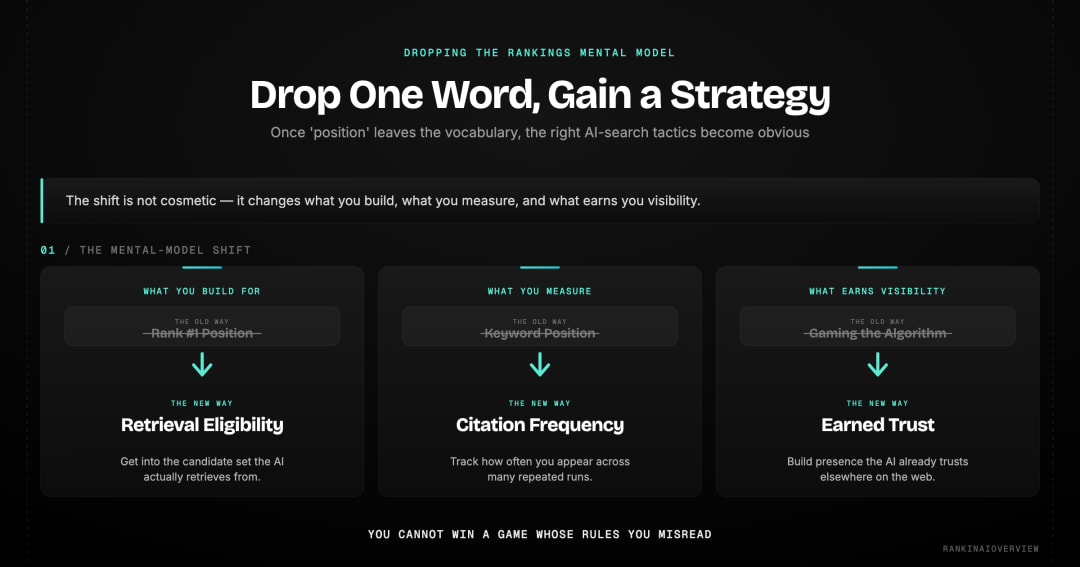
| Once you stop optimising for position and start optimising for retrieval eligibility and trust, the right tactics become obvious. The mental model shift is not cosmetic. It changes what you build, what you measure, and how you report success to clients and leadership. | | :---- |
Stop Optimising for Position. Start Optimising for Retrieval Eligibility.
The question is not "how do I rank number one on ChatGPT?" It is: "am I in the retrieval candidate set for the queries my buyers are asking?" These require different answers.
To be in the retrieval candidate set, your content needs to be crawlable by AI bots, semantically relevant to the sub-queries generated by fan-out, structured for passage-level extraction, and carrying E-E-A-T signals that tell the model this source is credible. None of these requirements involve position. All of them involve content quality and technical clarity.
A concrete example of how AI search works vs Google in practice: a startup with 20 well-structured articles on a specific niche topic can appear in Perplexity answers before it ranks in Google's top 10. Perplexity does not weight domain authority the same way Google does. It weights passage relevance and structural extractability. Understanding RAG SEO explained is what makes this possible to plan for.
Measure Citation Frequency, Not Position

AI search rankings explained as a concept requires replacing position with frequency. Run your 30 to 50 target queries at least 20 times each and measure how often your brand or URL appears. That frequency across many runs is your actual LLM search visibility score. According to Ahrefs research from October 2025, 28.3% of ChatGPT's most cited pages have zero organic visibility in Google. Frequency-based measurement captures this reality. Position-based measurement would show these pages as non-existent.
Weekly measurement across a stable prompt set smooths out the non-deterministic variation and shows real trend movement. Share of voice against your top three competitors gives the relative context that absolute mention rates alone cannot provide.
Trust Is the New Algorithm

AI engines are risk-averse in a way Google is not. Google will serve a new page if it matches keyword signals well enough. AI engines prefer sources they have seen consistently across trusted contexts. SE Ranking research from November 2025 found that domains with profiles on Trustpilot, G2, Capterra, and Yelp have 3x higher chances of being chosen as a source by ChatGPT than domains without such presence. Domains with substantial brand mentions on Quora and Reddit have roughly 4x higher citation probability.
This is what AI search vs traditional SEO means in terms of off-site strategy. For Google, you build backlinks to distribute PageRank. For AI engines, you build entity presence across trusted external contexts. The mechanism is different. The logic, earning trust from sources the system already respects, is the same.
What Does a Good AI Search Strategy Actually Look Like?

| A good AI search strategy builds in three layers simultaneously. Topical authority gets your content into the retrieval pool. Entity recognition gets the model to trust your brand. Off-site signals corroborate your authority externally. All three are required for consistent LLM search visibility over time. | | :---- |
Build topical authority through content clusters. A site that answers every meaningful angle of a topic consistently signals to AI engines that it is the reliable reference point on that subject. Understanding how AI search works vs Google at the architecture level changes content strategy: Google evaluates a page holistically, AI engines evaluate passages individually.
Build entity recognition through Wikipedia presence, Wikidata entries, consistent NAP across directories, and clear structured data on your own pages. This is RAG SEO explained at the brand level: an AI engine needs to resolve your brand name to a known entity before it retrieves your content with confidence. Ambiguity leads to exclusion. Clarity leads to citation.
Build off-site signals through genuine community participation. Contribute to Reddit discussions in your category. Answer questions on Quora with specific, data-backed responses. Earn reviews on platforms relevant to your market. These are the signals that tell AI systems your brand is genuinely authoritative, not just self-asserting authority through your own content.
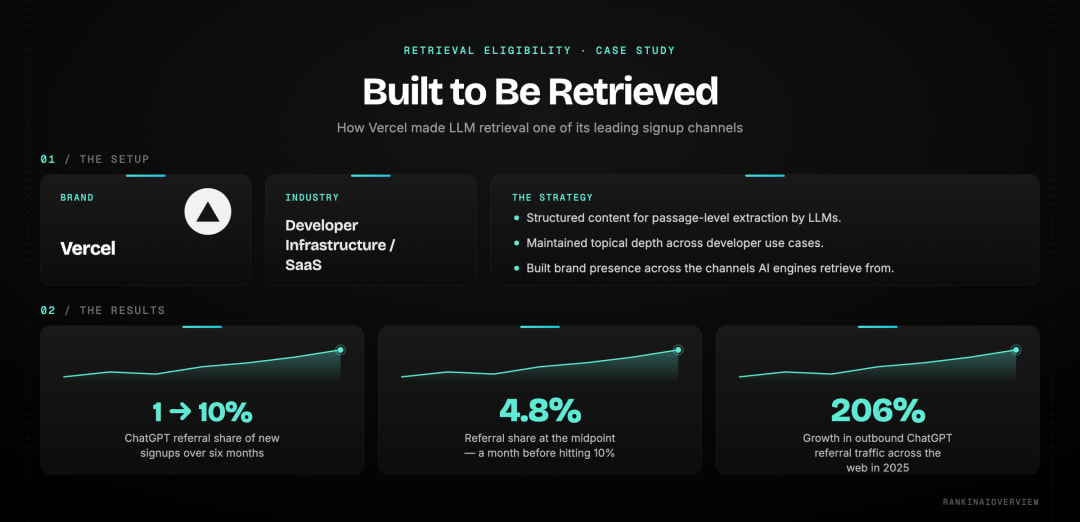
Measure citation frequency and share of voice weekly using tools like Profound, Peec AI, or SE Ranking. Pair this data with branded search volume from Google Search Console. Rising branded search is the downstream signal that confirms AI visibility is translating into real audience behaviour. Vercel documented that ChatGPT referrals grew from 1% to 10% of new signups in six months as their AI search strategy compounded. That kind of measurable downstream impact is what a well-executed LLM search visibility strategy produces.
If There Is No Ranking, Can You Still Be Cited Consistently?
_Individual AI answers vary from run to run, but citation share across many runs is far steadier than it looks. The volatility sits mostly in sources that are cited only now and then. Sources that are cited often behave like settled positions. Consistency is something a brand earns, not something the platform hands out._
The 9.2% overlap figure describes single answers. It does not describe what happens when you track the same sources week after week. Rand Fishkin at SparkToro ran 2,961 prompts across ChatGPT, Claude and Google AI with 600 volunteers submitting identical queries. Fewer than 1 in 100 runs returned the same list of brands, and fewer than 1 in 1,000 returned the same list in the same order. That is the answer-level picture: no position exists. See the full methodology.
“ _Any tool that gives a 'ranking position in AI' is full of baloney._ Rand Fishkin CEO and Co-founder, SparkToro Source: [Near Memo Podcast, February 2026](https://www.nearmedia.co/ep-244-ai-visibility-vs-google-rankings-rand-fishkin-on-the-future-of-search-zero-click-brand-measurement/)
Zoom out to weekly citation share and the picture changes. BrightEdge's weekly citation tracking across ChatGPT, Gemini, Perplexity and Google AI Overviews found that 96.8% of cited domains saw no change at all from one week to the next. Among the small group that did move, 87% of the moves were losses.
Where the Volatility Actually Sits
BrightEdge's volatility analysis found that frequently cited domains see roughly 0.7% weekly volatility, while sporadically cited domains swing by 50% or more. That is a 70x gap, and it held on every platform tested. The same research found a rough threshold of around 50 citations. Below it, presence is fragile. Above it, presence behaves like a durable position. At the very top, roughly 99.4% of #1 and #2 mention positions held steady week over week.
When a source does drop, it rarely slides. It tends to go from cited to not cited in one cycle, with no warning. In September 2025, ChatGPT's share of citations pointing to Reddit fell from roughly 14% to under 1% within days, an event The Motley Fool covered as market-moving. The trigger was a change in how Google results were pulled for retrieval, not anything Reddit did.
The most common cause of lost consistency is closer to home: a publishing schedule that stops. Xponent21, a Richmond, Virginia agency, saw daily search impressions fall from around 70,000 to between 8,000 and 9,000 by March 2026 after it scaled back its own content program, a drop of roughly 90% in one quarter, according to the agency's own case study.
The practical rules that follow:
- Track a fixed set of 30 to 50 prompts week over week. A rotating set cannot separate a real shift from sampling noise.
- Treat one missing answer as noise. Treat the same prompt cluster missing across three weekly checks as a signal worth investigating.
- Check whether competitors moved at the same time. A category-wide drop points to a platform change, not a brand problem.
- Track more than one platform. ChatGPT, Perplexity, Gemini and Google AI Overviews each run their own citation logic, so one engine can be stable while another swings.
- Keep publishing on a steady cadence. It is the clearest documented driver of lost AI visibility that sits inside your control.
Which Metrics Replace Position Beyond Citation Frequency?
_Citation frequency tells you how often you appear. Four more measures tell you how much the answer relies on you, whether the model knows who you are, how you compare with competitors, and whether the mention helps or hurts. Together they describe AI visibility far better than any single number._
Share of Synthesis
Share of synthesis measures what share of a generated answer is actually drawn from your content. Your URL might be cited while contributing one sentence. Or your content might shape 40 percent of an answer without a citation link. Profound named and tracks this metric across ChatGPT, Perplexity, Google AI Overviews, Gemini, Copilot, Claude and Grok. Airbyte used it to find where its content was feeding AI answers, restructured those pages for direct-answer extraction, and saw ChatGPT visibility triple within one week. A $100K deal later closed from a ChatGPT referral.
Entity Presence
Entity presence asks whether AI models recognise your brand as a known entity, which is different from having your URL crawled. InSinkErator used Schema App's Entity Linking to connect its brand entities to Wikipedia, Wikidata and Google's Knowledge Graph. Clicks for non-branded queries rose 69 percent and AI-generated brand descriptions improved. The content had not changed. The entity clarity had.
Share of Voice
Share of voice is citation frequency measured against competitors. A 40 percent citation rate sounds strong until your main competitor sits at 70 percent. HubSpot shows why this matters more than traffic alone. From late 2024 to early 2025, its organic traffic fell 70 percent as AI Overviews absorbed clicks, yet its AI share of voice held at 35.3 percent and it stayed cited in nearly every AI answer for CRM and marketing software queries. Traffic dropped. AI presence did not.
Mention Sentiment
Mention sentiment tracks how you are framed. Appearing in 60 percent of category prompts looks healthy until you find that many of those mentions say something like "Brand X may suit small teams but lacks enterprise features." Research from Visiblie across 200 brands found the average brand gets endorsement framing in only 28 percent of the category prompts where it appears. Brands that traced cautious framing back to its source, such as a G2 review, a competitor comparison page or an old press article, and answered it directly lifted their endorsement rate by 15 percentage points within 90 days. Source: Visiblie AI Brand Sentiment Tracking.
Why Does Chasing an AI "Rank" Lead to the Wrong Tactics?
The ranking frame fails in three specific ways.
It sets expectations nobody can meet. Report a position number for AI search, watch it change the next week with no content change on your side, and credibility erodes. Teams then quit before the work has time to compound.
It points effort at the wrong prompts. Teams chasing a "rank" drift toward branded prompts where they already appear, rather than category prompts where real discovery happens. They count single-run appearances as wins instead of building frequency across many runs.
It treats a shared answer like a zero-sum list. An AI answer can cite several sources at once. Your content and a competitor's can both feed the same response. The goal is not to knock anyone off position one. It is to become a source the engine keeps wanting to include.
Do Google Rankings Still Matter If AI Search Has No Ranking?
_Yes, but for a different reason. Google rankings used to be the prize. Now they are mostly the ticket into the retrieval pool, plus a direct traffic driver for transactional, local and branded searches. For informational queries, their value as a traffic source is shrinking while their value as an AI eligibility signal is growing._
Rankings as the Eligibility Filter
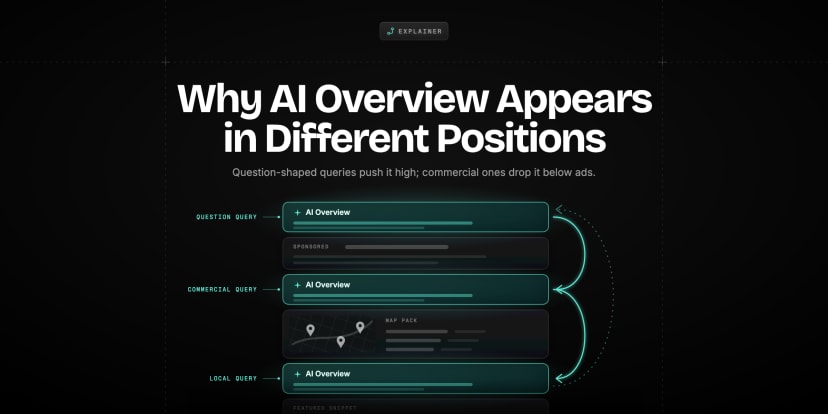
Approximately 97% of AI Overview citations come from pages ranking in Google's top 20, because AI Overviews pull from the same index that powers organic search. A page outside the top 20 is effectively excluded from AI Overview citation however well it is structured. Let rankings slide and you lose AI Overview eligibility at the same moment. That is why the right move is to demote rankings from goal to health metric, not to drop them.
The Value of a Ranking Depends on the Query
For informational queries, the search results page is increasingly the destination. Organic click-through for position one drops by up to 58% when an AI Overview appears. Transactional and local queries behave differently. AI cannot complete a checkout, confirm stock, or tell you a clinic has a Saturday slot, so users still click. AI Overviews appear on around 4% of e-commerce queries compared with 39% of informational ones. Branded queries also still click, because the searcher is already looking for you.
Google Is Not the Only Gateway
Perplexity runs its own crawler and index, so a page with no meaningful Google ranking can still be cited there. ChatGPT Search leans on Bing's index, which correlates with Google but is not the same. Only 11% of domains are cited by both ChatGPT and Perplexity. Google ranking is necessary for Google AI Overviews, but it is neither necessary nor sufficient for Perplexity. Off-site presence on the platforms AI engines already trust fills that gap: Reddit is the top-cited domain on Perplexity, and YouTube transcripts are cited frequently by ChatGPT.
| Old Model | New Model | What Changes |
|---|---|---|
| Rank = traffic | Rank = retrieval eligibility | Rankings still matter, but traffic is not their main job for informational content |
| Position 1 = win | Citation in AI = win | A position 5 page cited in AI Overviews can outperform a position 1 page that is not |
| Click-through rate = success | Citation frequency + branded search = success | Measure AI citation alongside organic traffic |
| Link building = authority | Entity signals + links = authority | Off-site trust signals now sit alongside backlinks |
Where Has AI Visibility Already Overtaken Rankings?
_The shift is uneven. Research-heavy categories feel it first because buyers form their shortlist inside an AI answer before they ever search Google. Categories that need a purchase, a location or real-time information still run mainly through Google._
| Industry | Google Ranking Impact | AI Search Impact | Priority Action |
|---|---|---|---|
| B2B SaaS and Technology | Moderate. Clicks eroding for informational queries | High. Buyers research via ChatGPT before visiting vendor sites | Build AI visibility now. Off-site entity building is urgent |
| E-commerce | Low. Product queries still click-dominant | Low. AI does not complete purchases or show inventory | Keep Google SEO primary. Watch comparison queries |
| Local Services | Low. Maps and local pack still click-driven | Growing but secondary | Prioritise Google Business Profile and local SEO |
| Content and Media | High. Informational queries heavily AI-intercepted | High. Definitions and how-tos resolved on the page | Shift toward commercial content. Build AI citation for informational pieces |
| Professional Services | Moderate. Category research moving to AI | High. Practitioners discovered in AI answers first | Build off-site presence, author authority and PR coverage |
| Financial Services | Moderate. Research queries increasingly AI-mediated | High. AI orients the buyer before a branded Google search | Win AI citation for category queries, Google for transactional |
The long-term signal is generational. 37% of consumers now start research in AI tools rather than Google, and the share is higher among users under 35. As that group moves into buying roles, more commercial research will begin inside an AI answer. The pattern already looks like this for research-heavy buyers: AI is the top of the funnel, Google is the middle and bottom. A user sees your brand in an answer, absorbs the name, and searches for you later.
“ _In 2026, personalisation stops being a feature and becomes the operating system. There is no Position 1 anymore. There is only intent and relevance, and the brands that understand this will outperform those still chasing a static rank number._ Mike King CEO, iPullRank Source: [Search Engine Land, January 2026](https://searchengineland.com/ai-search-visibility-seo-predictions-2026-468042)
How Should You Restructure SEO Reporting Without Positions?
_Report in three tiers. Business outcomes go at the top because they are what SEO serves. Visibility measures sit in the middle because they predict those outcomes. Health checks, including rankings, sit at the bottom because they tell your team when something needs investigating._
| Tier | Metric | Review Frequency | Who Reviews It |
|---|---|---|---|
| 1: Business outcomes | Organic revenue or leads, conversion rate by source | Monthly, year over year | Client and practitioner |
| 2: Visibility | AI citation frequency, share of voice in AI | Weekly, shared monthly | Practitioner |
| 2: Visibility | Branded search growth, organic CTR by query type | Monthly | Client and practitioner |
| 3: Health | Keyword rankings (top 20 to 50), Core Web Vitals, indexed pages | Monthly | Practitioner only |
Rankings still earn their place in tier three. A sharp drop is one of the clearest early warnings of a technical issue, a penalty or a competitor surge, often before it shows in traffic. They just stop being the headline.
A free diagnostic shows where rankings have lost their click value. In Google Search Console, take your top 20 queries and compare impressions with click-through rate over 12 months. Queries with steady or rising impressions and falling click-through are the ones where AI Overviews are intercepting your traffic. Those pages need AI citation work, not more ranking work.
Move clients to this stack in three steps over three months:
- Add a short "AI Search Visibility Update" to the existing report: AI Overview citations for your top ten keywords, whether the brand appeared in ChatGPT or Perplexity for three to five category queries, and the branded search trend.
- Reorder the report so business outcomes lead, visibility follows, and rankings move to a site health section.
- Explain the new role of rankings in one sentence: they are monitored as an AI eligibility signal and an early warning system, not reported as the main success measure, because click-through from top positions now depends on whether an AI Overview is present.
“ _The problem is clients still want to see rankings. Educating them is the hard part. I now report on organic traffic, AI mentions, branded search growth, and conversion. Rankings are number four._ SEO practitioner r/AISEOInsider community, Reddit 2026 Source: [Reddit: Are Rankings Still What Matters in SEO?](https://www.reddit.com/r/AISEOInsider/comments/1s4q6y1/are_rankings_still_what_matters_in_seo/)
How Do You Explain This Shift to Clients and Stakeholders?
| The most effective analogy is PR versus a leaderboard. Google ranking is like a leaderboard: your position is visible, stable, and directly competitive. AI search visibility is like PR: your brand appears across trusted editorial contexts, the frequency and quality of those appearances compounds over time, and you cannot reduce it to a single number. | | :---- |
When a client asks "where do we rank in ChatGPT?", the honest answer is that there is no position. There is a citation rate. You can report: "Your brand appeared in 43% of the 50 most relevant queries run in ChatGPT this week, compared to your top competitor at 28%." That is meaningful, comparable, and trend-trackable. A single rank number is not.
Reframe the conversation around business outcomes rather than platform mechanics. Instead of explaining AI search rankings explained in technical terms, connect it to what the client already cares about. Show them that AI-referred traffic converts at higher rates than organic because users are pre-qualified by the AI answer before they arrive. Show them that branded search volume is rising as AI mentions increase. These are outcomes they understand without needing to understand probabilistic retrieval.
| Old Metric | New Metric | What It Measures |
|---|---|---|
| Keyword ranking position | Citation frequency | How often your brand or URL appears across repeated AI prompts |
| Share of top 10 keywords | Share of voice in AI | Your brand mentions vs competitors for a target query set |
| Organic traffic volume | AI referral conversion rate | Quality of visitors arriving from AI-driven discovery |
| Domain authority | Entity recognition score | Whether AI systems recognise your brand as a known, trusted entity |
| Featured snippet capture | Share of synthesis | What proportion of a generated answer is drawn from your content |
Managing expectations around volatility is the final piece. How AI search works vs Google becomes clearest here: Google results are stable enough to report weekly. AI results require trend data across multiple weeks before conclusions are reliable. Set that expectation at the start of any AI visibility programme and you protect your credibility when a single week shows an unexpected dip.
Conclusion
The mental model shift is the strategy. AI search rankings explained is not just an academic distinction. It changes what you build, what you measure, and how you report success. Once you stop thinking about AI search in terms of positions, the right tactics become obvious.
Build topical authority to enter the retrieval pool. Build entity recognition to be trusted by AI systems. Build off-site signals to corroborate your authority externally. Measure citation frequency and share of voice weekly, not individual ranking positions that change with every run. Report against business outcomes, branded search growth, and conversion rates from AI referral traffic.
AI search vs traditional SEO is not a choice between two competing strategies. It is one strategy executed with a different goal. Traditional SEO earns retrieval eligibility. AI-specific optimisation earns citation from that eligible pool. LLM search visibility is what compounds when both are executed consistently over time. For deeper research on how AI engines evaluate brand authority and what drives citation decisions, RANK IN AI OVERVIEW covers this space across its content library.
Frequently asked questions
How does RAG work in SEO?+
RAG stands for Retrieval-Augmented Generation. In SEO terms, it means AI engines search a live web index for relevant content before generating a response, rather than relying solely on training data. Your content needs to be crawlable, semantically relevant, and structurally extractable to be retrieved. [Princeton and Georgia Tech research](https://arxiv.org/abs/2311.09735) found that structured content with specific statistics and clear formatting improves citation probability by 30 to 40 percent over unoptimised content.
How do LLMs retrieve information?+
LLMs retrieve information through a multi-step process. They first expand the user query into multiple sub-queries through fan-out. They then search their connected index for relevant passages from each sub-query. Candidate passages are scored for relevance, authority, and extractability. Selected passages are fed into the generation model, which synthesises a response citing the original sources. [Ahrefs' April 2026 research](https://www.position.digital/blog/ai-seo-statistics/) found that 88% of URLs cited by ChatGPT are retrieved directly from search, not from training data alone.
If there are no rankings how do I know if my AI strategy is working?+
Measure citation frequency, not position. Run your 30 to 50 target queries at least 20 times each, weekly, and track how often your brand or URL appears across those runs. Compare against your top three competitors for share of voice. Pair this with branded search volume in Google Search Console. Rising branded search correlates with improving AI citation and is the clearest downstream signal that your strategy is working.
Does Google's organic ranking still matter for AI Mode?+
Yes, but not in the way most people assume. Traditional Google rankings determine retrieval eligibility: if your page is not in Google's index, it cannot be retrieved by Google AI Mode. But ranking in the top 10 does not guarantee citation. [SE Ranking's AI Mode analysis](https://www.position.digital/blog/ai-seo-statistics/) found that only 14% of AI Mode citations come from pages ranking in the traditional top 10. Strong organic performance is the entry ticket, not the winning condition.
What is the best tool to track AI search visibility?+
The right tool depends on your scale and goals. [Profound](https://www.tryprofound.com) is the most comprehensive for enterprise AI visibility monitoring across ChatGPT, Perplexity, Gemini, and Copilot. [SE Ranking](https://seranking.com) is the best option for agencies that want traditional and AI tracking in one platform. [Peec AI](https://peec.ai) and [Otterly AI](https://otterly.ai) offer accessible mid-market options. For teams not ready to invest in paid tools, manual tracking in ChatGPT and Perplexity across 20 to 30 runs per query weekly is a legitimate starting point. For deeper research on how these tools compare, RANK IN AI OVERVIEW covers this space in detail.
What is share of synthesis in AI search?+
Share of synthesis measures how much of an AI-generated answer is actually drawn from your content, not just whether your URL is cited. A citation might reflect one borrowed sentence, while an uncited page might shape a large part of the answer. [Profound](https://www.tryprofound.com) tracks it across ChatGPT, Perplexity, Google AI Overviews, Gemini, Copilot, Claude and Grok. It is the most direct measure of how much AI engines rely on you.
Should I stop tracking keyword rankings entirely?+
No. Keep monitoring your top 20 to 50 keyword positions monthly as a health check. A sharp drop is still one of the clearest early warnings of a technical issue or penalty, and around 97% of AI Overview citations come from Google's top 20, so rankings also tell you whether you are eligible to be cited. Just stop making them the headline metric in client and leadership reports.
How do I see where AI Overviews are taking my clicks?+
Use [Google Search Console](https://search.google.com/search-console/about). Take your top 20 queries and compare impressions with click-through rate over 12 months. Queries with steady or rising impressions but falling click-through are the ones where AI Overviews are answering the question on the results page. Those pages need AI citation work, such as answer-first formatting and entity clarity, rather than more ranking work.
Which industries are most affected by AI search?+
B2B SaaS, professional services, financial services and content publishers feel it most, because buyers do their research inside AI answers before visiting any site. E-commerce, local services and news remain mainly Google-driven, because they need a purchase, a nearby provider or real-time information. AI Overviews appear on around 4% of e-commerce queries compared with 39% of informational ones.
Will Google rankings eventually become obsolete?+
No, for two reasons. Google rankings decide eligibility for Google AI Overviews, the largest AI search surface by user volume, so losing rankings means losing AI Overview citations at the same time. And purchase-intent and local queries still run mainly through Google clicks. Rankings will matter less as a standalone success metric, but they remain the foundation that AI visibility is built on.
Should I invest in SEO or GEO first?+
Invest in SEO first, then layer GEO on top. Without strong Google rankings you lose AI Overview eligibility at the same time, so the shared foundation comes first. Once technical health is solid, add the AI-specific layer: FAQPage schema, answer-first formatting on your top pages, off-site entity building on review platforms and communities, and weekly citation monitoring.
Why did my AI citations disappear overnight?+
AI citation losses are usually binary rather than gradual. A source is cited one week and gone the next, often because of a platform-side model or retrieval change rather than a drop in content quality. Check whether competitors in your category moved at the same time. If they did, it is probably a platform change. If only you dropped, look at your publishing cadence first.
Is AI search more volatile than Google rankings?+
Only at the edges. [BrightEdge](https://www.brightedge.com/resources/weekly-ai-search-insights/ai-search-engine-citation-volatility-70x-stability-gap) found frequently cited domains see about 0.7% weekly volatility, while sporadically cited domains swing by 50% or more. Roughly 99.4% of #1 and #2 mention positions hold week over week. Established sources are very stable. Newer sources can flip from cited to absent in a single update cycle.
Explore with AI
Share this