Do AI Rank Tracker Tools Actually Work? An Honest Review of What You Can and Can't Trust
AI rank tracker tools promise to show where your brand appears in ChatGPT and Perplexity. But how accurate are they? We break down what works and what is just noise.

SummaryAI rank tracking tools can reveal useful trends in brand mentions, citations, and share of voice across ChatGPT, Perplexity, and Google AI Overviews, but they cannot provide stable “rankings” because AI outputs are probabilistic and constantly changing. The most reliable platforms use multi-run aggregation and citation frequency analysis to measure long-term visibility trends rather than single-position rankings.
Read moreShow less
A new category of tools has emerged promising to track your brand's position inside ChatGPT, Perplexity, and Google AI Overviews. According to a Gartner press release, traditional search engine volume is projected to drop 25% as AI chatbots become substitute answer engines. That prediction has put intense pressure on marketing teams to track ChatGPT rankings alongside traditional organic positions. Some SEOs swear by these tools. Others dismiss them as measuring noise. This guide gives you the honest breakdown.
The frustration in the SEO community is real and growing. You invest in one of the best AI SEO tracking tool options on the market, run your prompts, and get numbers that look different every week. Your client asks what their rank is in ChatGPT and you are not sure how to answer honestly. The market is full of platforms making bold promises about AI visibility monitoring, and it is not always clear what they are actually measuring versus what they are selling.
This article cuts through the noise. We explain the fundamental measurement problem with AI rank tracker tools, break down what reliable metrics actually look like, review the platforms worth your attention in 2026, and show you how to use this data intelligently without overpromising results to clients or stakeholders.
Do AI Rank Tracker Tools Actually Work? The Honest Answer
Yes, with a specific and important qualification. The best AI rank tracker tools work when you use them to measure citation frequency trends over time across a stable prompt set. They do not work if you expect them to produce a stable rank number equivalent to a Google position. AI outputs are probabilistic. A brand cited in 65% of prompt runs this week and 58% next week has not necessarily changed its visibility. The variation is partly noise. The only meaningful signal is sustained directional movement over four or more weeks. |
The category is genuinely useful when applied correctly. Teams that use share of voice trends as their primary metric, run prompts weekly rather than daily, and treat month-over-month movement as the meaningful signal are getting real value from this ai rank tracking software. Teams that interpret week-to-week fluctuations as strategic signals or present single-run snapshots as "AI rankings" to clients are creating problems for themselves.
The single most important question to ask any vendor before subscribing: how many times do you run each prompt per reporting cycle? A tool that runs each prompt once is giving you a sample of one from a probability distribution. That sample could be representative or it could be an outlier. Tools that run each prompt twenty, fifty, or a hundred times and average the results are giving you statistically meaningful citation frequency data. This methodology difference explains why two tools tracking the same brand can produce results that look completely incomparable.
The category is two to three years old. Methodological standards are still being established. The practitioners who get the most value from these tools are the ones who understand the limitations going in, use share of voice as their primary KPI, and resist the temptation to report week-to-week fluctuations as meaningful strategic intelligence.
Why Is AI Rank Tracking Fundamentally Different From Traditional SEO?

Traditional rank tracking is built on the assumption that search results are deterministic: the same query produces the same results consistently enough to measure and track over time. AI search violates that assumption at the architecture level. Large language models produce probabilistic outputs that vary between runs based on temperature settings, session context, and retrieval conditions. There is no fixed position to track. There is only a citation frequency to measure across many samples.
Traditional rank tracking works because Google search results are largely deterministic. The same query, run from the same location at approximately the same time, produces the same results. Every rank tracking tool ever built is built on that assumption of consistency. Google's index is stable enough that a position measured Monday will be the same position measured Thursday. That stability is what makes rank tracking as a discipline possible.
AI search engines violate this assumption by design. Research published at arXiv by Princeton and Georgia Tech found that AI citation behaviour is driven by structural and authority signals, but the specific output generated varies with every inference. You can run the exact same prompt twice in the same minute inside the same session and receive two meaningfully different responses with different brands mentioned. This is not a bug. It is a core property of probabilistic language generation.
The implication: a single measurement from any AI rank tracking tool is almost meaningless on its own. What matters is aggregated data across many runs, many prompts, and multiple time windows. LLM rank tracking accuracy improves dramatically when tools run the same prompt dozens of times and report an average citation frequency, rather than presenting a single result as a definitive position. This is the methodological standard that separates credible tools from platforms generating impressive-looking dashboards from insufficient data.
“ In a world where you can easily create fake content with AI, accurate answers and trustworthy sources become even more essential. Aravind Srinivas CEO and Co-founder, Perplexity AI Source: Fortune, August 2025 |
|---|
What Should an AI Rank Tracking Tool Actually Measure?
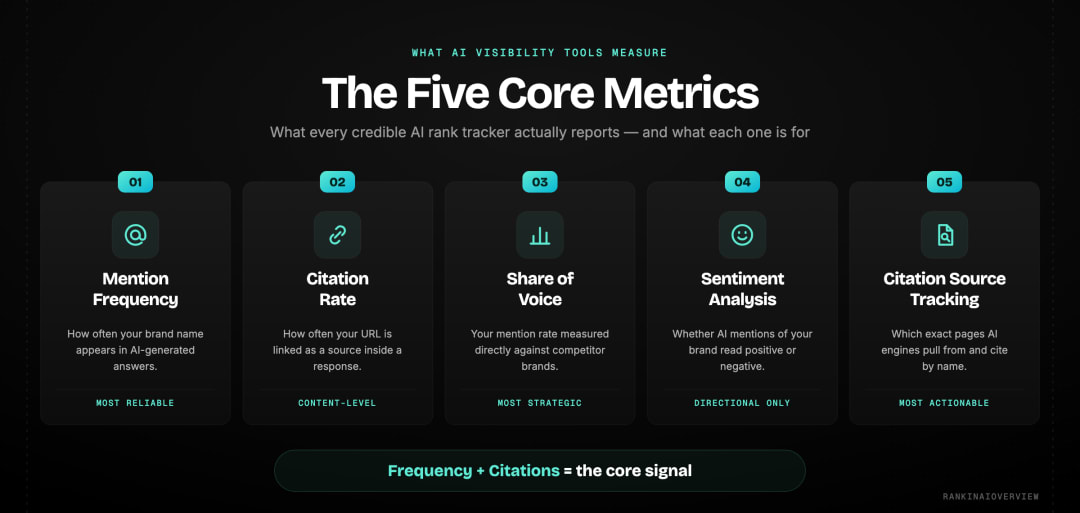
The five core metrics across serious AI visibility monitoring platforms are: brand mention frequency, citation rate, share of voice, sentiment, and citation source tracking. These five are not equally reliable or actionable. Brand mention frequency and citation rate are the most reliable because they do not require additional inference beyond detection. Share of voice is the most strategically useful. Sentiment and citation source tracking add value but require more methodological caution.
Brand Mention Frequency
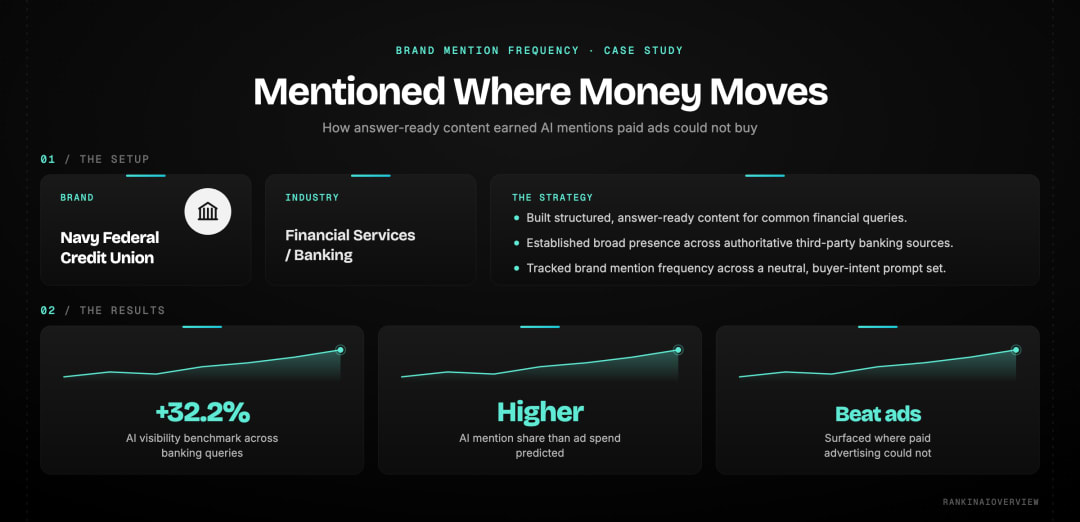
Brand mention frequency tracks how often your brand name appears in AI-generated answers across a defined prompt set. It is the most reliable metric available because it does not require inferring position or rank. The tool simply counts how often your brand is mentioned across many prompt runs and reports an average rate over time. Always verify how many prompt iterations a tool runs before a mention frequency is calculated. Tools that run a prompt once and report a rate are giving you noise. Tools that run each prompt 20 or more times are giving you a statistically meaningful measure.
Citation Rate
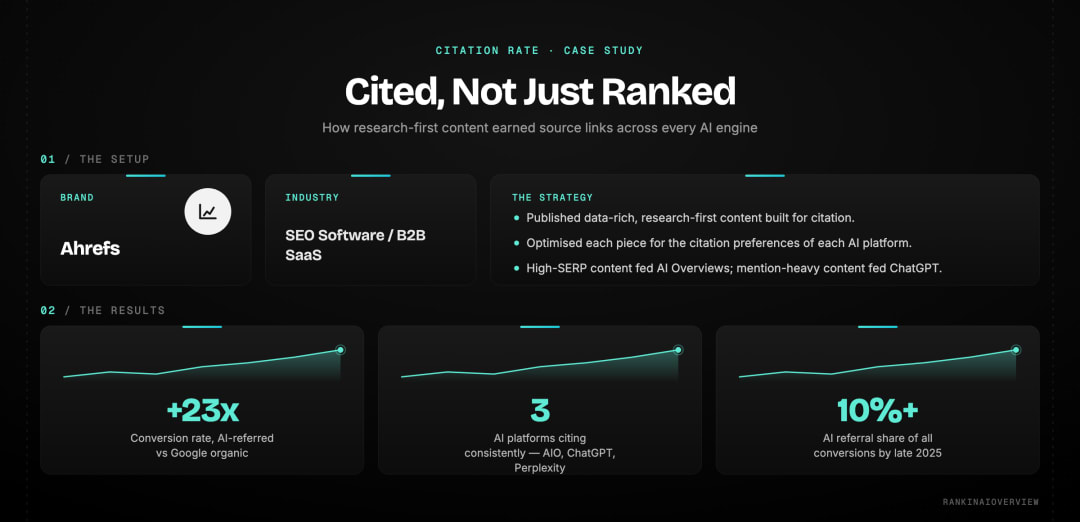
Citation rate measures how often your URL is included as a source link in an AI-generated response. This is most relevant for Perplexity and Google AI Overviews, both of which surface source links consistently. A high citation rate means AI engines are actively referencing specific content on your site, not just mentioning your brand name from training data. Citation rate also reveals which specific pages are being cited, making it the most actionable metric for content strategy decisions. If page A is cited and page B is not, you have a direct signal about where your content optimisation is working.
Share of Voice

Share of voice compares your brand mention frequency against competitor brands across the same prompt set. This is the most strategically useful AI rank tracking metric because it gives context. An absolute mention frequency of 40% sounds strong until you see a competitor at 75%. Share of voice is also the metric that holds up best over time because it smooths out non-deterministic AI variation. Even when individual mention frequencies fluctuate week to week, relative share of voice shifts more gradually and in response to real changes in authority or brand presence.
Sentiment Analysis
Some platforms analyse whether AI-generated mentions of your brand are positive, neutral, or negative. This is directionally useful for brand reputation monitoring but introduces a second layer of approximation on top of already probabilistic AI outputs. Treat sentiment scores as directional indicators only, and act on them only when consistent across a large number of prompt runs over multiple weeks.
Citation Source Tracking
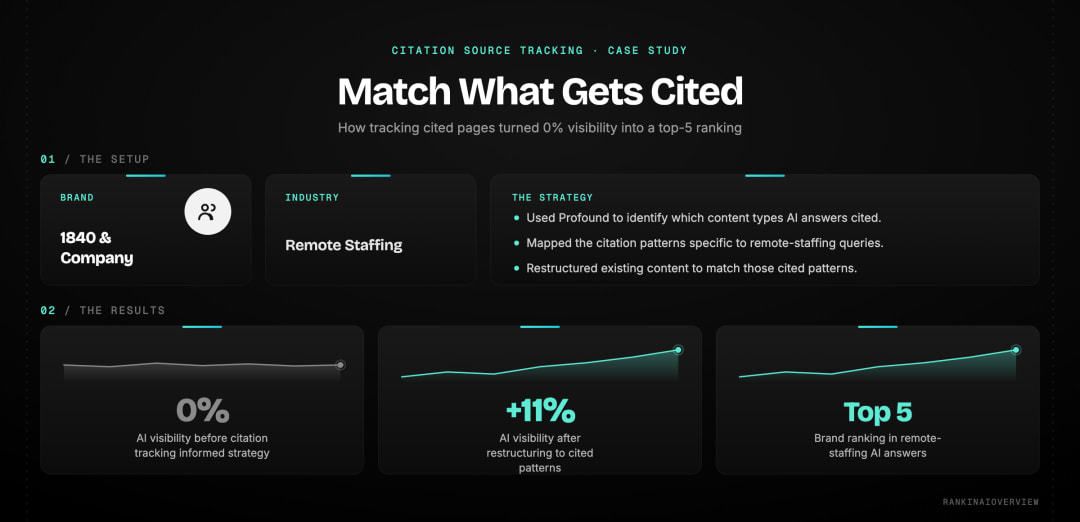
Citation source tracking identifies which specific pages on your site AI engines are referencing. This is operationally the most powerful metric: if you know exactly which pages are being cited for which query categories, you can deliberately replicate those content signals across pages that are not yet being cited. It turns AI visibility monitoring from a reporting exercise into a content optimisation feedback loop. Not all tools offer this feature. Prioritise it when comparing platforms.
Which Is the Best AI Rank Tracker Tool in 2026? 9 Platforms Reviewed
Nine platforms reviewed below, covering the full range from budget-entry to enterprise. The comparison table shows which AI platforms each tool tracks, whether a free plan is available, and starting price. The mini-reviews below cover what each tool does well, who it is best for, and its honest limitation. |
Tool | Tracks AI Overviews | Tracks ChatGPT | Tracks Perplexity | Free Plan | Starting Price |
|---|---|---|---|---|---|
Profound | ✓ | ✓ | ✓ | ✕ | $99/month |
SE Ranking AI Tracker | ✓ | ✓ | ✓ | ✕ | Add-on to existing plan |
Otterly.ai | ✓ | ✓ | ✓ | ✕ | $29/month |
Semrush AI Toolkit | ✓ | Limited | ✕ | ✓ (limited) | $139/month |
BrandWell | ✕ | ✓ | ✓ | ✓ (limited) | $39/month |
Advanced Web Ranking | ✓ | ✕ | ✕ | ✕ | $49/month |
Rankscale | ✓ | ✓ | ✓ | ✕ | Contact for pricing |
Peec AI | ✓ | ✓ | ✓ | ✕ | $95/month |
Ahrefs Brand Radar | ✓ | ✓ | ✓ | ✕ | $199/month (add-on) |
Profound: Best for Enterprise AI Visibility Monitoring
Profound offers the widest platform coverage of any ai rank tracking tool in this category, spanning ChatGPT, Perplexity, Google AI Overviews, Gemini, Microsoft Copilot, Claude, Grok, and DeepSeek. Its share of synthesis metric is the most sophisticated measure of AI citation currently available and is the primary reason enterprise teams choose it over competitors. Starting at $99 per month, Profound is best suited to teams with established prompt libraries of at least 50 queries.
-
What it tracks: brand mentions, citations, share of voice, sentiment, and citation sources across 8 AI platforms
-
How it works: runs multiple iterations per prompt and aggregates results for statistically reliable scores
-
Best for: enterprise teams where AI visibility monitoring is a core strategic initiative
-
Honest limitation: cost scales quickly for large prompt libraries. At full enterprise volume, Profound is a significant line item
SE Ranking AI Tracker: Best for Agencies
SE Ranking added AI visibility tracking as an integrated module inside a full SEO platform. For agencies already managing traditional rank tracking and keyword research inside SE Ranking, adding AI monitoring without switching to a separate tool is the most operationally efficient path. The platform covers AI Overviews, ChatGPT, and Perplexity alongside organic rank monitoring.
-
What it tracks: AI Overviews citation frequency, ChatGPT and Perplexity brand mentions, traditional organic rank in the same dashboard
-
How it works: API-based monitoring with configurable prompt sets, cross-channel reporting
-
Best for: agencies running both traditional SEO and AI visibility monitoring for the same clients
-
Honest limitation: AI tracking is an add-on module. Teams using SE Ranking only for AI monitoring are overpaying relative to dedicated tools
Otterly.ai: Best Budget Entry Point
For teams new to AI visibility monitoring who want to test the category before committing to enterprise pricing, Otterly.ai is the most accessible starting point at $29 per month. Its technical approach distinguishes it: rather than querying AI models through APIs, Otterly monitors AI search platforms as live interfaces. That means it captures what real users actually see inside ChatGPT, Perplexity, and Google AI Overviews, including citation links and source URLs, rather than what the raw API returns.
-
What it tracks: brand mentions and citation URLs across ChatGPT, Perplexity, and AI Overviews via live UI monitoring
-
How it works: UI-level monitoring rather than API access, capturing real user experience including personalisation layers
-
Best for: smaller teams with focused prompt sets of 20 to 50 queries testing AI visibility before scaling investment
-
Honest limitation: UI-level monitoring is more resource-intensive than API-based tracking, placing limits on prompt volume at lower price tiers
Semrush AI Toolkit: Best for Existing Semrush Users
Semrush has integrated an AI Overviews tracking feature into its core platform, making it the natural ai rank tracking software choice for teams already invested in Semrush for keyword research, backlink analysis, and site auditing. The AI Overviews monitoring module tracks whether your pages appear in AI-generated answers and at what frequency across your target queries.
-
What it tracks: Google AI Overviews specifically, with limited ChatGPT visibility data
-
How it works: integrated into Semrush's existing keyword and ranking infrastructure with AI Overview filtering
-
Best for: existing Semrush users who want Google AI Overviews monitoring without a separate tool subscription
-
Honest limitation: AI Overviews tracking is the strength. Independent AI platform tracking for ChatGPT and Perplexity is significantly more limited than dedicated tools. Not the choice for Perplexity or ChatGPT-focused monitoring
BrandWell: Best for Brand Monitoring Alongside Content
BrandWell is primarily known as an AI content intelligence platform but includes AI visibility monitoring features that track brand mentions and citations across ChatGPT and Perplexity. For content teams that want brand monitoring integrated with their content production workflow, BrandWell provides a pragmatic combined solution. A limited free plan is available, making it accessible for initial testing.
-
What it tracks: brand mentions and sentiment across ChatGPT and Perplexity. Does not currently track Google AI Overviews
-
How it works: API-based brand mention monitoring with sentiment analysis and mention frequency reporting
-
Best for: content marketing teams who want AI visibility monitoring embedded in their content workflow rather than in a separate analytics tool
-
Honest limitation: does not track Google AI Overviews. Coverage is narrower than dedicated AI rank tracking platforms. Best as a supplementary tool rather than a primary AI visibility monitoring solution
Advanced Web Ranking: Best Rank Tracking Tool for AI Mode
Advanced Web Ranking is a traditional rank tracking tool that has added Google AI Overviews monitoring, making it a practical rank tracking tool ai mode option for teams using AWR as their primary SEO reporting platform. For agencies managing traditional rank tracking at scale who want to add AI Overviews coverage without switching tools, AWR provides the lowest-friction path.
-
What it tracks: Google AI Overviews monitoring alongside traditional Google, Bing, and Yahoo rank tracking. Does not track ChatGPT or Perplexity
-
How it works: integrates AI Overviews detection into existing rank tracking infrastructure starting at $49/month
-
Best for: traditional SEO agencies adding AI Mode and AI Overviews tracking to an existing AWR workflow. Strong choice as a rank tracking tool ai mode for teams already using AWR
-
Teams already using Advanced Web Ranking for traditional rank tracking and needing a rank tracking tool ai mode upgrade can add AI Overviews monitoring without switching platforms
-
Advanced Web Ranking is the most affordable rank tracking tool ai mode entry point at 49 dollars per month for teams that only need AIO alongside standard rank tracking
-
Honest limitation: AI Overviews only. No ChatGPT or Perplexity tracking. Teams needing full AI platform coverage will need a supplementary dedicated tool
Rankscale: Best for Citation Detection Accuracy
Among practitioners who evaluate AI rank tracker tools specifically for citation detection reliability, Rankscale is consistently cited as one of the strongest performers. The platform is more focused than broader visibility suites, prioritising precise citation detection over wide-ranging share of voice reporting. For teams whose primary question is which specific pages are being cited and how often, Rankscale tends to deliver the most granular and reliable answer.
-
What it tracks: citation detection at URL level across ChatGPT, Perplexity, Gemini, and Google AI Overviews
-
How it works: focused specifically on citation accuracy rather than broad share of voice reporting
-
Best for: teams whose primary intelligence need is knowing exactly which pages are being cited in AI responses
-
Honest limitation: pricing not publicly listed, suggesting enterprise positioning. Request a trial and verify methodology before committing
Peec AI: Best for Mid-Market Share of Voice
Launched in 2025, Peec AI quickly gained traction among mid-market marketing teams for its clean share of voice reporting across ChatGPT, Perplexity, Google AI Overviews, Claude, and Gemini. At $95 per month, Peec AI sits in a practical middle ground between the budget entry point of Otterly.ai and the enterprise sophistication of Profound. Its interface is focused and accessible, making it a good fit for content teams who want actionable AI visibility data without needing a dedicated analytics specialist to interpret it.
-
What it tracks: share of voice, brand mention frequency, and competitor benchmarking across 5 AI platforms
-
How it works: automated prompt runs with weekly reporting, regional breakdown capabilities
-
Best for: mid-market teams that need share of voice data competitive benchmarking at a practical price point
-
Honest limitation: less deep on citation source tracking than Rankscale or Profound. Better for strategic reporting than content-level optimisation decisions
Ahrefs Brand Radar: Best for Teams Already Inside Ahrefs
Ahrefs entered AI visibility monitoring with Brand Radar, which tracks mentions and citations across six AI indexes including Google AI Overviews, AI Mode, ChatGPT, Perplexity, Gemini, and Copilot. For teams already using Ahrefs for keyword research and backlink analysis, Brand Radar provides the most operationally seamless path to adding AI citation tracking. Its database scale is a genuine advantage for identifying which prompts drive AI citation across a given category.
-
What it tracks: mentions and citations across 6 AI indexes. Largest prompt database of any tool in this comparison
-
How it works: requires an Ahrefs base plan plus per-AI-index add-on pricing
-
Best for: teams already inside the Ahrefs ecosystem who want AI visibility monitoring without a separate tool
-
Honest limitation: documented accuracy concerns in independent testing (one reviewer found a 97% gap between Ahrefs Brand Radar and manual verification). Pricing adds up to over EUR 770/month for full coverage. Verify accuracy against manual testing before relying on for client reporting
“ We must respond by developing new metrics to measure AI search success that focus on conversions and revenue, brand visibility, share of search, competitive positioning, and brand demand. Single rank numbers are not the answer in a non-deterministic system. Lily Ray VP of SEO Strategy and Research, Amsive Source: Substack, January 2026 |
Why Does LLM Rank Tracking Accuracy Vary So Much Between Tools?
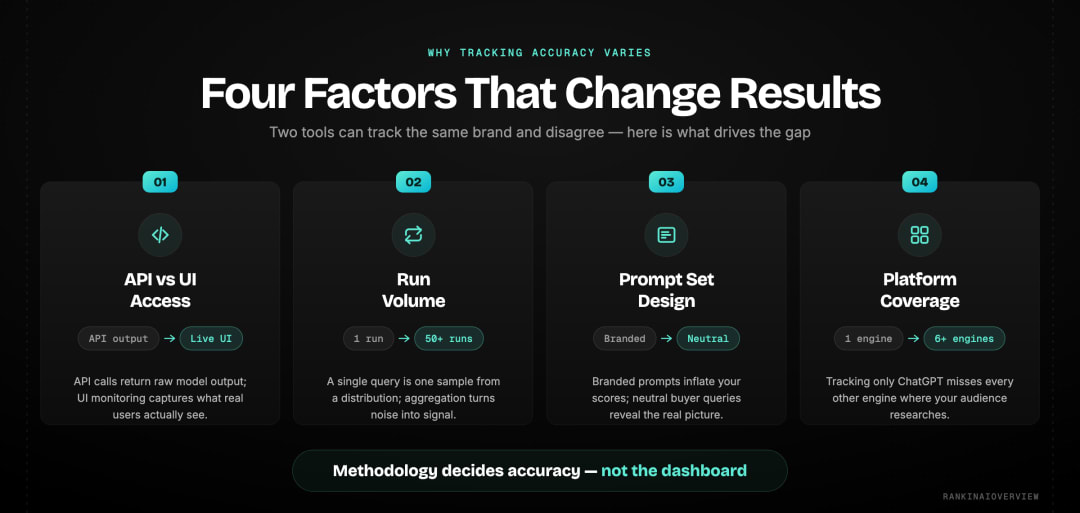
Two tools can track the same brand across the same queries and return results that look completely different. This is not because one tool is broken. It is because the industry lacks standardized methodology, and the technical decisions each platform makes have enormous consequences for data quality.
API Access Versus UI-Level Monitoring
Most AI rank tracker tools send prompts directly to AI model APIs. Some, including Otterly AI, monitor AI search platforms as live interfaces the same way a real user would. These two approaches produce meaningfully different data. API-based tracking may return results that differ from what a live user sees because AI search platforms often add retrieval layers, personalization, and ranking logic on top of the base model. UI-level monitoring captures what real users actually experience, which is the more meaningful signal for most marketing purposes but is technically harder to do at scale.
Single Run Versus Multi-Run Aggregation
This is the most consequential methodology difference between platforms. A tool that queries a model once per prompt and reports the result is capturing a single sample from a probability distribution. That sample could be representative or it could be an outlier. There is no way to know from a single observation. Tools that run each prompt twenty, fifty, or one hundred times and aggregate the results produce a statistically meaningful citation frequency. LLM rank tracking accuracy is directly proportional to sample size. When comparing platforms, ask specifically how many times each prompt is queried per reporting cycle before you trust the output.
Prompt Set Design
The prompts a tool uses to evaluate AI visibility have an enormous effect on the results it reports. A prompt set that uses branded terms or category terms that already favor your brand will inflate your apparent share of voice. A prompt set that uses neutral, buyer-intent queries will give you a more realistic picture. Most AI rank tracker tools let you define your own prompt library, which gives you control over this variable. But some platforms offer pre-built prompt sets that may be poorly designed for your specific market. Always review the actual prompts being used before interpreting any AI visibility monitoring data as meaningful.
Coverage Across AI Platforms
Different tools cover different combinations of AI engines. Some track only ChatGPT. Others cover ChatGPT, Perplexity, Google AI Overviews, Gemini, Copilot, Claude, and Grok. The best tools to track AI answers cover the platforms where your specific audience is actually conducting research. For most B2B and SaaS brands, ChatGPT and Perplexity represent the majority of AI search behavior worth tracking. For consumer brands, Google AI Overviews matters more. Coverage decisions should follow your audience's actual platform usage, not vendor marketing.
What Can AI Rank Tracker Tools Not Tell You?

Being clear about the limitations of even the best AI SEO tracking tool is as important as knowing what it does well. The marketing materials for most tools in this category do not spend much time on the following constraints.
-
They cannot give you a stable rank number. AI outputs are probabilistic. Any tool presenting a single position number is representing a snapshot of a probability distribution as something more stable than it actually is. The honest metric is always citation frequency across many runs, not a rank.
-
They cannot guarantee tomorrow will match today. Prompt wording changes outputs. Model updates shift behavior. Training data refreshes alter what a model knows. A brand cited consistently this week may appear less next week with no change to your content.
-
They cannot prove causation. If your citation rate improves after a content change, AI rank tracker tools can confirm the correlation in the data. They cannot confirm your content change caused the improvement. Other factors, including model updates and competitor behavior, are always in play simultaneously.
-
Prompt engineering affects results more than most vendors acknowledge. The way a prompt is phrased significantly changes which brands appear in responses. A prompt set that uses terms favoring your category will inflate your apparent AI visibility monitoring metrics.
-
LLM rank tracking accuracy is limited when tools rely on a single API call per prompt. Single-run data is statistically unreliable. Always verify how many iterations a tool runs per prompt before trusting any metric it produces.
-
Training data lag is a real constraint. Some models, particularly those relying primarily on parametric memory rather than live retrieval, have training cutoffs that mean recently published content may not influence responses for months. Work done today may not show measurable impact in training-data-based responses for a significant period.
“ We must respond by developing new metrics to measure AI search success that focus on conversions and revenue, brand visibility, share of search, competitive positioning, and brand demand. Lily Ray VP of SEO Strategy and Research, Amsive Source: Substack, January 2026 |
|---|
How Do You Build an AI Visibility Monitoring Stack That Actually Works?
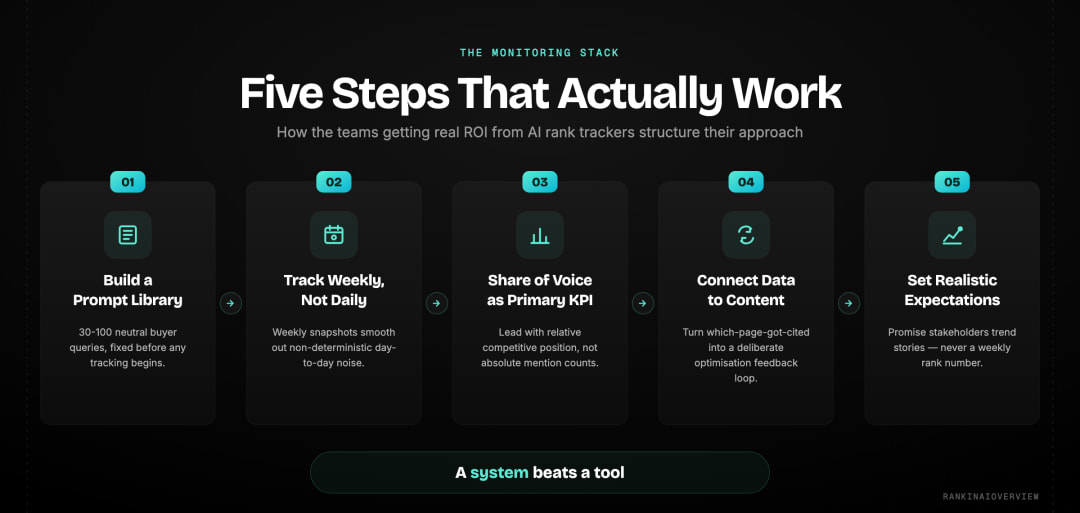
AI rank tracker tools are genuinely valuable when applied with the right methodology. The teams getting real ROI from these tools share a few practices in common. Here is how to structure your approach.
Build a Stable Prompt Library Before You Start Tracking
The quality of your AI visibility monitoring data depends entirely on the quality of your prompt library. Start by identifying 30 to 100 queries that reflect what your target buyers actually ask when researching a purchase decision. Use neutral, category-level language rather than branded terms. Avoid prompts that obviously favor your brand or product category. Use tools like Google's People Also Ask, Reddit threads, Quora, and your own search query data from Google Search Console to surface the language real buyers use.
A prompt set built around genuine buyer questions will give you AI citation data that reflects how your brand actually shows up in the moments that matter. A prompt set built around branded terms will give you inflated numbers that do not translate to real discovery. This single decision has more impact on data quality than which AI rank tracker tool you choose.
Track Weekly, Not Daily
Daily reports create noise rather than insight when you are working with non-deterministic AI outputs. The natural variation in AI-generated responses means day-to-day fluctuations are often artifacts of probability rather than signals of real change. Weekly snapshots across a stable prompt library smooth out that variation and let you see genuine trend movement. Set up weekly runs in whichever AI rank tracker tool you are using, and resist the temptation to interpret single-day spikes or drops as meaningful until the trend holds across several consecutive weeks. Combine this data with branded search trends from Google Search Console to see whether AI citation improvements are translating into real downstream behavior.
Use Share of Voice as Your Primary KPI, Not Mention Frequency
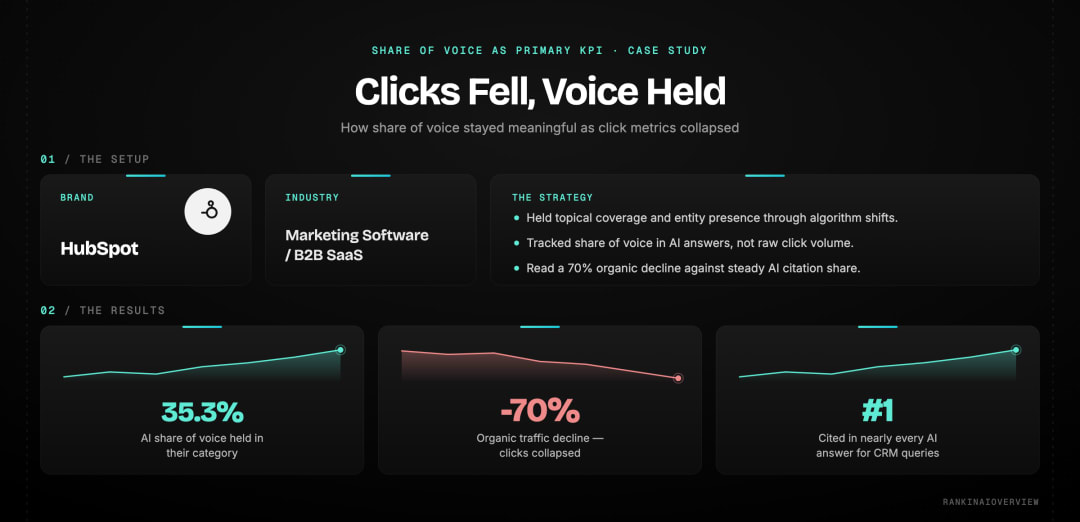
Absolute mention frequency is hard to interpret without context. A brand mention frequency of 35% sounds strong until you discover a competitor is at 70%. Share of voice gives you the context that makes the data meaningful. When reporting AI visibility monitoring results to clients or leadership, lead with share of voice trends over time rather than absolute citation counts. Show the direction of movement and the competitive position, not just a number in isolation.
Connect AI Citation Data to Content Decisions

The most valuable use of best tools to track AI answers is not reporting. It is feedback. When you know which specific pages are being cited by ChatGPT, Perplexity, or Google AI Overviews in response to your target queries, you have a direct signal about what content structure and format AI engines reward in your category. Replicate those signals deliberately across pages that are not yet being cited. This turns AI rank tracker tools from a measurement instrument into an optimization feedback loop.
Set Realistic Expectations With Stakeholders
Share of voice trends and citation frequency movements are meaningful signals that can inform strategy over time. A single rank number reported week to week is not. The best AI SEO tracking tool in your stack is the one that helps you tell a trend story over a quarter, not the one that produces the most impressive-looking dashboard in the first week. Set that expectation early with clients and leadership, and you will avoid the credibility damage that comes from over-promising what AI visibility monitoring can deliver.
Conclusion
For a worked example of judging one vendor end to end, see our honest AI Rank Lab review.
Vendor claims run ahead of the evidence here, so it is worth separating what genuinely affects AI visibility from the hype.
AI rank tracker tools are genuinely useful when applied with the right methodology and genuinely misleading when applied without it. The best ai rank tracker for your team is the one that runs multiple prompt iterations, reports share of voice and citation frequency trends rather than stable rank numbers, and connects citation data to content decisions rather than treating visibility monitoring as a reporting exercise.
For enterprise AI visibility monitoring at full platform coverage, Profound leads. SE Ranking makes most sense for agencies already inside that platform. Otterly.ai is the right budget starting point. Semrush AI Toolkit serves existing Semrush users for Google AI Overviews monitoring. BrandWell offers a useful AI visibility component for content teams. Advanced Web Ranking is the strongest rank tracking tool ai mode option for agencies adding AIO coverage to existing workflows. Peec AI and Rankscale fill important mid-market gaps in share of voice reporting and citation accuracy. Ahrefs Brand Radar adds coverage for teams inside the Ahrefs ecosystem but warrants accuracy verification before client-facing use.
The honest conclusion: this ai rank tracking software category is real, useful, and worth investing in. Use it to measure trends, not to report positions. RANK IN AI OVERVIEW covers how AI engines evaluate brand authority and what drives citation decisions in depth across its content library.
Frequently asked questions
How do AI SEO tracking tools measure visibility?+
AI SEO tracking tools send predefined prompts to AI engines and analyze the generated responses. They count brand mentions, detect citation links, and run multiple iterations of each prompt to average out non-deterministic variation. The output is a citation frequency score or share of voice metric rather than a fixed position number.
Are AI ranking tools trustworthy?+
Some are, and some are not. The dividing line is methodology. Tools that run multiple prompt iterations per query and report aggregated scores are methodologically sound. Tools that report a single rank number from a single prompt run are presenting probabilistic output as something more stable than it actually is. Before trusting any AI rank tracker tool, ask how many times it runs each prompt before calculating a metric.
Is AI rank tracking worth the investment for small businesses?+
For most small businesses, manual testing in ChatGPT and Perplexity once a week covers the essentials at no cost. Paid AI rank tracker tools become worth the investment when you have 30 or more consistent queries to track, need competitor share of voice data, or are reporting AI visibility monitoring results to clients regularly. Start manual, then scale to a paid platform when the volume justifies it.
How often should I run AI visibility reports?+
Weekly is the practical standard for most teams. Daily reports generate noise from non-deterministic AI variation without adding meaningful insight. Monthly reports miss important trend movement. A weekly cadence across a stable prompt set gives you reliable trend data without overwhelming your reporting workflow or your clients.
What is the difference between AI rank tracking and traditional rank tracking?+
Traditional rank tracking measures a page's consistent position for a specific query in a deterministic search index. AI rank tracking measures citation frequency across many probabilistic AI outputs for a given prompt. There is no fixed position in AI search results. The meaningful equivalent is how often your brand or URL appears across a large sample of AI-generated responses for your target queries.
Which is the best AI rank tracker 2026 option for agencies managing multiple clients?+
For agencies, the best AI rank tracker 2026 choices typically come down to [SE Ranking](https://seranking.com) for teams already using it as their core SEO platform, or [Peec AI](https://peec.ai) for dedicated AI visibility monitoring at a mid-market price point. Both support multi-client reporting structures. The choice should follow which platform your team can operationalize consistently, since the best AI SEO tracking tool is always the one your team will actually use and interpret correctly, not the one with the most features on paper.
What is the difference between tracking AI Overviews and tracking ChatGPT?+
Google AI Overviews are embedded in Google search results pages and pull primarily from Google's existing search index. Tracking AI Overview citation requires either Google Search Console data or a tool that specifically monitors Google SERPs for AI Overview appearances. Tracking ChatGPT requires querying the ChatGPT API or interface directly with target prompts and logging brand appearance frequency. The two systems use different retrieval mechanisms and cite different sources, so a brand can have strong AI Overview presence with weak ChatGPT presence, or vice versa.
Explore with AI
Share this