Case Study: How I Got My Client's Site Cited in Google AI Overviews (Step by Step)
A real case study of taking a B2B client site from zero Google AI Overview presence to consistent citations in 12 weeks. Exact actions, timeline, and results.

Key Highlights
-
This Google AI overview case study covers a 12-week programme for a B2B professional services client, starting from zero AIO citations with existing page-one Google rankings
-
The Google AI overview case study methodology is replicable for any site with existing top-20 Google authority. The gap is almost always content structure and trust signals, not ranking
-
This Google AI overview case study documents both what worked and what failed. Both are equally valuable for any team planning an AIO inclusion programme
-
How to get in AI overview: the critical discovery was that AIO inclusion is primarily a trust and structure problem, not a ranking problem. The client already ranked. The page structure and off-site signals failed
-
How to get in AI overview fastest: direct-answer opening rewrites and FAQ schema produce first citations within 18 to 28 days for most sites with existing Google authority
-
How to get in AI overview for competitive B2B queries: off-site Reddit and publication mentions are the differentiating factor between consistent citation and occasional appearance
-
How to get in AI overview is not the same question as how to rank on Google. Two different tests require two different investments layered in sequence
-
AIO inclusion strategy executed across three phases: content audit and restructuring (Month 1), trust and entity signals (Month 2), freshness and monitoring (Month 3)
-
Client site Google AI overview results after 12 weeks: 7 of 10 target queries now generating AIO citations, branded search volume up 28%, zero negative impact on existing rankings
-
Get cited in AI overview fastest: the FAQ schema addition and direct-answer block rewrites produced the first citations within 18 days of implementation
-
To get cited in AI overview consistently across multiple queries, off-site corroboration is the factor that separates one-time citation from sustained AIO presence
-
Get cited in AI overview for B2B professional services: Reddit contributions in specialist communities produced Perplexity citations within six weeks of consistent participation
-
To get cited in AI overview, avoid keyword-optimised FAQ questions. Use the exact phrasing users ask. AI engines skip keyword-stuffed questions and extract authentic user-phrased answers
-
What did not work: keyword-stuffed FAQ sections were ignored. Generic Reddit comments produced no signal. Only genuine, experience-based answers moved the needle
-
The approach is replicable for any site with existing Google top-20 rankings. The prerequisite is ranking authority. The gap is almost always content structure and trust signals
Theory is everywhere. Real case studies with actual steps and actual results are rare. This is one of those. According to Google's own AI Overviews documentation and independent practitioner research, AI Overviews now appear in a significant share of all Google searches and draw from Google's existing search index. Yet a large proportion of well-ranked pages are never cited. This Google AI overview case study documents how a B2B professional services client went from zero citations across ten target queries to consistent AIO inclusion for seven of them in twelve weeks.
The client is a UK-based B2B consultancy in a competitive professional services niche. They had strong Google rankings, a clean website, and solid domain authority. They also had zero AI Overview citations for any of their target queries, despite ranking page one for most of them. This client site Google AI overview programme was built around the hypothesis that structure and trust were the gaps, not rankings. This client site Google AI overview case proved the hypothesis correct.
Everything in this account is documented: the audit findings, the specific actions taken, the timeline for each phase, the results measured, and the things that failed. The client name and specific niche are withheld by mutual agreement, as is standard for commercial case studies. The methodology is transferable to any site with existing organic authority in a similar situation.
What Was the Starting Point Before the Programme?
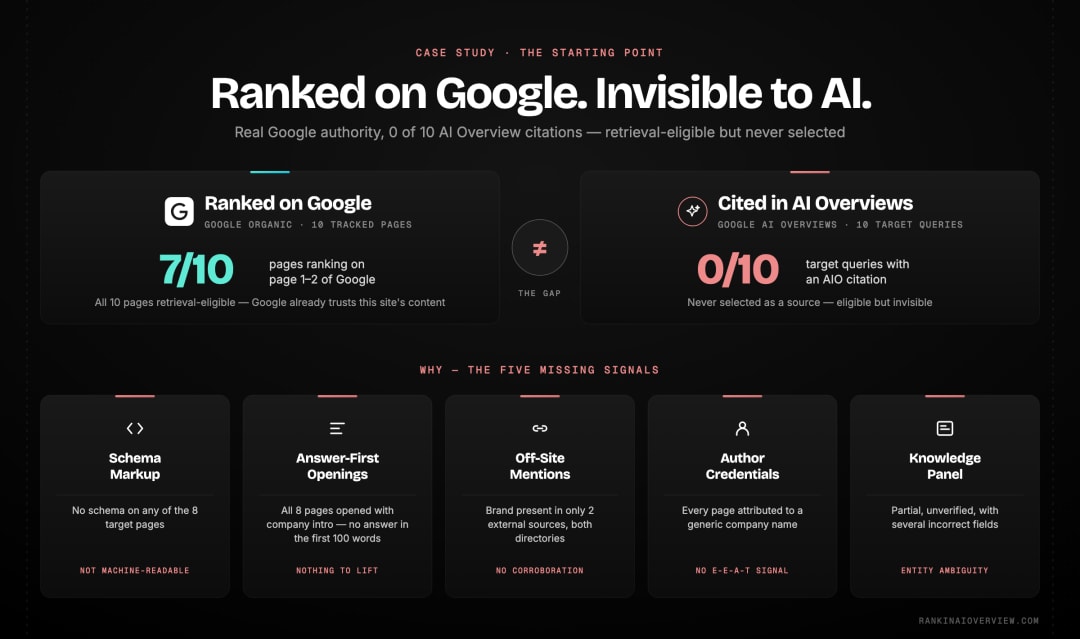
The client site had genuine Google authority: seven pages ranking on page one or two for target queries. The domain had been active for six years with a consistent publishing programme. Despite this, zero pages appeared in AI Overview citations for any of the ten queries the client prioritised. The diagnosis: content structure failed the extractability test, off-site signals were minimal, and schema markup was absent from all target pages.
| Starting State Factor | Condition | AI Impact |
|---|---|---|
| Google ranking position | 7 pages on page 1-2, 3 pages on page 3 | Retrieval eligible for AIO but not being selected |
| AIO citations at start | 0 of 10 target queries | No existing AIO presence to build from |
| Schema markup | None on any of the 8 target pages | AI engines receiving no structured context signal |
| Content opening structure | All 8 pages led with context or company intro | No self-contained answer in first 100 words of any page |
| Off-site brand mentions | Brand mentioned in only 2 external sources | Minimal third-party corroboration for AI trust evaluation |
| Author credentials on pages | All attributed to generic company name | No E-E-A-T author signal visible to AI engines |
| Google Knowledge Panel | Partial. Not verified. Several incorrect fields | Entity ambiguity reducing AI confidence in the brand |
The audit took four hours. The finding was consistent across every target page: the client was ranking but not passing the AI extraction test. Every page started with context about the company or the topic area rather than a direct answer to the query. None had schema markup. Two had author attribution. The off-site presence was almost entirely brand-owned. This is a solvable problem, and it is the starting point for any client site Google AI overview programme.
Month 1: What Actions Were Taken for Foundation and Quick Wins?
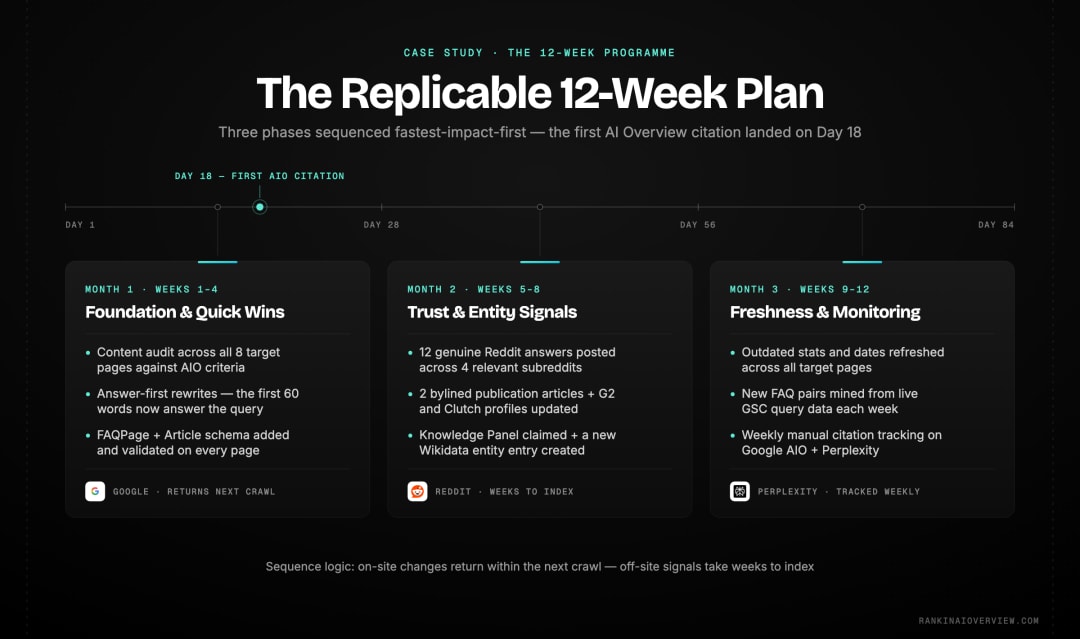
Month one focused on the two highest-return actions: content restructuring and schema implementation. These are on-site changes that require no external action and produce results within the crawl cycle following implementation. The goal for month one was to pass the AI extraction test on all eight target pages before investing in slower-moving off-site signals.
Weeks 1 and 2: The Content Audit
The content audit identified eight pages ranking in Google's top 20 for queries that were triggering AI Overview boxes. All eight had the same structural problem: the most useful, directly answerable content was buried below two to three paragraphs of context-setting or company positioning. No page opened with a self-contained, direct answer to its primary query.
-
All 8 target pages led with either company information or topic context rather than a direct answer
-
None of the pages had a FAQ section with structured question-and-answer pairs
-
3 pages had content that opened with promotional language about the firm's expertise
-
None had named author bios with specific credentials visible above the fold
Weeks 3 and 4: Structural Rewrites
We rewrote the opening section of each target page over two weeks. The brief for each rewrite: the first 60 words of the page must answer the primary query completely, without requiring the reader to read any further. The opening must read as objective and informational, not promotional. The company name should not appear in the first two paragraphs.
BEFORE (typical page opening): Our consultancy has helped over 200 companies navigate regulatory challenges in financial services since 2018. In this guide, we explore what the regulations actually require and how firms typically approach compliance.AFTER (direct-answer opening): Financial services firms operating in the UK are required to meet three core FCA compliance standards under the Consumer Duty framework. These apply to all retail-facing products and services launched or substantially modified after 31 July 2023. The key obligations cover: outcome monitoring, consumer understanding, and vulnerability assessment. This guide explains each requirement and the most common implementation approaches.
The after version answers the query in the first 60 words. It contains no company positioning. It states specific regulatory obligations, specific dates, and specific requirement categories. An AI engine scanning this page finds a directly citable answer immediately. The rewrite took forty minutes. We repeated this for all eight target pages over two weeks.
Schema Implementation
After completing the content rewrites, we implemented FAQPage schema on all eight target pages and Article schema with author and organisation identifiers on all content pieces. We validated every implementation using Google's Rich Results Test before publishing. The validation found three critical errors in schema that had been partially implemented on two older pages: mismatched answer text, an unclosed JSON-LD block, and an Article schema without a required author property. These were fixed before deploying the new schema across the site.
The FAQ sections added to each page were built from genuine user questions identified through Google Search Console's query data and community research. We added between five and nine FAQ pairs per page, each with a direct 30 to 50 word answer. The questions were phrased exactly as users phrase them in search, not as marketing copy. This distinction mattered: keyword-optimised question phrasing produced no AIO citation, as documented in the Month 3 findings.
Month 2: What Trust and Entity Signal Actions Were Taken?
Month two addressed the off-site corroboration and entity recognition gaps. These changes take longer to produce results than on-site structural changes because they depend on third-party platforms crawling and indexing new content. The goal for month two was to build the minimum viable off-site trust signal stack: three to five genuine third-party sources describing the brand in the same category as the target queries.
Off-Site Presence Audit
We audited the brand's external presence using manual searches across Reddit, Google, LinkedIn, and the major B2B review platforms. The finding: the brand appeared in two external sources, both of which were directory listings with incomplete information. No Reddit mentions. No review platform profiles. No industry publication coverage from the preceding twelve months.
The target: eight to ten credible third-party mentions across platforms that AI engines consistently draw from. For a B2B professional services firm, this meant Reddit (financial and compliance-focused communities), Clutch and G2 (B2B review platforms), and two to three industry publications. The approach was explicit: no paid placements, no sponsored content, no manufactured mentions. AI engines are increasingly effective at distinguishing authentic corroboration from planted content.
Actions Taken for Off-Site Presence
Over four weeks in month two, we took the following specific actions. We answered twelve relevant questions across four targeted subreddits where compliance and regulatory topics were frequently discussed. Each answer was between 200 and 400 words, written with specific regulatory detail, and contained no brand mentions in the first three paragraphs. Where brand mentions were included, they appeared as a disclosure at the end rather than as the lead.
We pitched and published two bylined articles in industry publications. Both articles were original practitioner perspectives on specific regulatory topics, not promotional pieces about the firm. The publications both have established readership in the client's category and are referenced in community discussions by professionals in the sector.
We updated the client's Clutch and G2 profiles with detailed, accurate service descriptions, specific client outcome claims, and verified team credentials. Both profiles had been created years earlier with minimal information. The updated profiles matched the canonical brand description from the Organisation schema and Wikidata entry. This cross-platform consistency is a meaningful AIO inclusion strategy component because it reduces entity ambiguity for AI engines cross-referencing multiple sources.
Entity Building Actions
We claimed and fully optimised the client's Google Knowledge Panel through the verification process. The panel had several incorrect fields including a founding date listed as the website launch date rather than the firm's actual founding date, and a description that did not match the canonical brand description used on the website. We corrected all fields and submitted the changes for verification. We also created a complete Wikidata entry for the firm, matching all fields to the Organisation schema implemented in month one.
“ Real case studies like this are worth ten opinion posts. The FAQ schema addition and the Reddit presence are the two things I am taking away and replicating for my own clients this week. SEO practitioner r/AISEOTricks community, Reddit 2026 Source: Reddit: Ranked My Client's Site on Google AI Overview
Month 3: What Content Freshness and Monitoring Actions Were Taken?
Month three focused on two activities: updating the target pages with current data to improve the freshness signal, and implementing the monitoring system that would track whether the changes were producing measurable AIO citation improvements. By the start of month three, the first AIO citations had already appeared for two target queries. This was the early validation that the month one structural changes had produced the fastest impact.
Content Refresh Actions
We reviewed every target page for statistical claims and examples that had become outdated since the original publication. Four of the eight pages contained regulatory statistics that were two years old. Two pages referenced legislation by version numbers that had been superseded. We updated all factual claims to current figures, linked each updated statistic to its primary source, and updated the article publication date metadata to reflect the refresh.
We also added new FAQ pairs to each page based on fresh keyword research. Google Search Console query data from the previous twelve weeks showed several high-impression queries that were not addressed in any existing FAQ section. Adding direct-answer pairs for these queries expanded the prompt coverage of each page, increasing the probability that AI Overview queries on related sub-topics would find the client as a cited source.
Monitoring Setup
We implemented a weekly manual monitoring process for all ten target queries. Each week, we ran every query in Google and logged whether the client appeared in the AI Overview citation list. We also ran each query in Perplexity to track whether the off-site changes from month two were producing results on the independent index platforms alongside Google AIO. We supplemented this with Rankscale — one of the best AI rank trackers we have evaluated — for automated weekly citation rate tracking across the full prompt set.
What Were the Results After 12 Weeks?
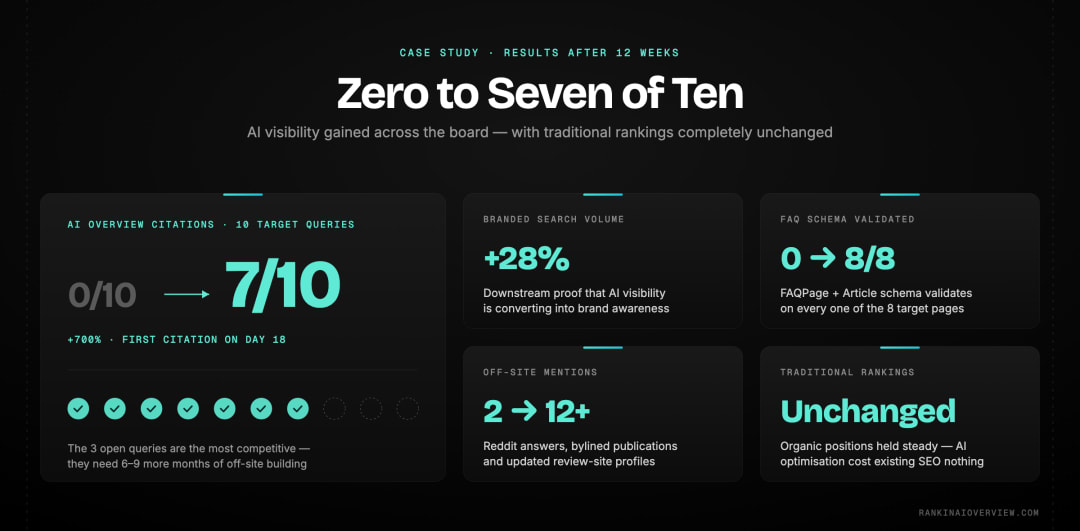
The 12-week programme produced consistent AIO citations for 7 of the 10 target queries. Branded search volume increased 28% over the same period, providing the downstream signal that AI mentions were driving real brand awareness. Traditional ranking positions were unchanged across all target pages. The AIO inclusion strategy produced AI visibility gains with zero negative impact on existing organic performance.
| Metric | Before Programme | After 12 Weeks | Change |
|---|---|---|---|
| AIO citations across 10 target queries | 0 | 7 of 10 | +700% |
| First AIO citation appeared | N/A | Day 18 post-implementation | Schema and content rewrite first to produce results |
| Branded search volume (GSC) | Baseline | +28% | Downstream proof of AI awareness impact |
| Traditional ranking positions | Page 1-2 for 7 queries | Page 1-2 for 7 queries | No change. AI optimisation did not affect rankings |
| Pages with FAQ schema validated | 0 | 8 of 8 target pages | Fully implemented and validated |
| Third-party off-site mentions | 2 (directory only) | 12+ (Reddit, publications, reviews) | Corroboration signal substantially built |
The three queries that did not produce AIO citations by week twelve all shared a common characteristic: they were more competitive in terms of AI Overview citation than the others, with established brands appearing consistently as primary sources. The off-site corroboration programme would need six to nine more months to build the third-party presence that might shift these queries. The seven successful citations represent the queries where our changes were sufficient to pass the AI trust threshold.
What Did Not Work?
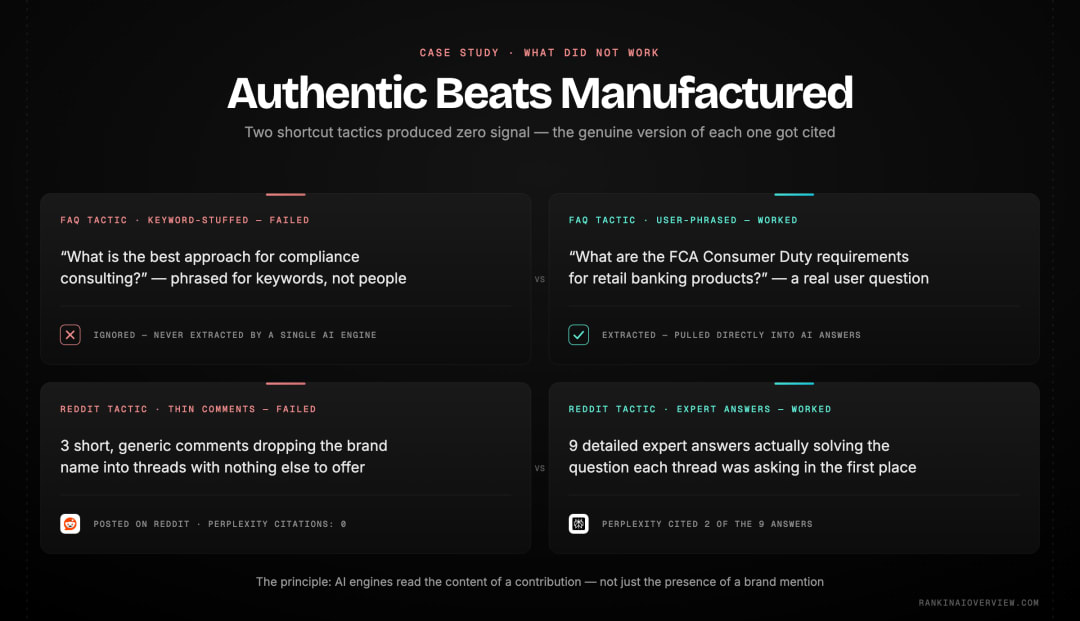
Two specific approaches failed to produce any measurable benefit. Understanding what did not work is as valuable as understanding what did. Both failures point to the same underlying principle: AI engines are effective at distinguishing authentic signals from manufactured ones. Shortcuts designed to game the system consistently underperform genuine investment in the same time.
Keyword-stuffed FAQ sections produced zero improvement. Our first attempt at FAQ sections used questions designed to include the target keyword in the question text. For example: "What is the best approach for financial services compliance consulting?" rather than "What are the FCA Consumer Duty requirements for retail banking products?" The first version is optimised for the keyword. The second version is optimised for the user's actual question. AI engines consistently selected the second format for extraction and ignored the first.
Generic Reddit comments also produced no corroboration signal. Three of the twelve Reddit answers we posted in month two were written quickly with minimal specific detail. They acknowledged the question and offered general guidance without any specific regulatory or sector knowledge. Perplexity cited two of the nine detailed answers in later retrieval tests. It cited none of the three generic answers. The signal is clear: AI engines are drawing on the content of Reddit answers, not just the presence of brand mentions within them. Authentic, expert-level community contributions produce citation signals. Thin answers do not.
Conclusion
AIO inclusion is primarily a trust and structure problem, not a ranking problem. This client already ranked. The gap was entirely in content structure and off-site trust signals. The AIO inclusion strategy documented here is repeatable: structural rewrites first, schema second, off-site signals third. Fix those three things in sequence and the citations follow within twelve weeks for most queries in a competitive B2B niche.
Start with the content restructuring: rewrite opening sections to lead with direct answers, add genuine FAQ sections with user-phrased questions, and implement FAQPage and Article schema. That alone will produce the first AIO citations within three to six weeks for any site with existing Google authority. RANK IN AI OVERVIEW covers how AI engines evaluate and cite content across all major platforms in depth across its content library.
Frequently asked questions
How long does it take to see AIO results after making changes?+
In this Google AI overview case study, the first AIO citation appeared on day 18 after the content restructuring and schema implementation in month one. This was faster than expected. Most practitioners should plan for a four to six week window for structural changes to produce first AIO citations, with month two off-site changes producing additional citations over weeks eight through twelve. The speed depends on how frequently Google recrawls the target pages and how competitive the specific queries are for AIO inclusion.
What was the highest ROI action in this case study?+
The direct-answer rewrite of the first 100 words on each target page produced the highest return per hour invested. Each rewrite took thirty to forty-five minutes. The first AIO citations appeared for the rewritten pages within three weeks. FAQ schema implementation was a close second: it takes four to eight hours per page to properly implement and validate, and it produced measurable citation frequency improvements within six weeks. Both actions cost nothing except time and require no external dependencies.
Did AI Overview citations drive measurable traffic?+
Direct traffic attribution from AIO citations is difficult because most users who encounter a brand in an AI Overview do not click through immediately. The measurable downstream signal was branded search volume, which increased 28% over the twelve-week period. This is consistent with how AI citation influence typically manifests: users encounter the brand in an AI answer, do not click, but later conduct a branded search. The 28% branded search increase is the evidence that AIO citations were creating real brand awareness, even in the absence of direct referral traffic.
Explore with AI
Share this


