Is Google Ranking Becoming Less Important? What AI Search Is Changing About SEO
AI search alternatives are growing fast. Is Google ranking genuinely less important in 2026, or are the obituaries for traditional SEO premature? Here is the honest, data-backed answer.
Key Highlights
-
Is Google ranking still important in 2026? Yes, but its role depends heavily on query type. For informational queries, AI Overviews intercept traffic. For transactional and local, Google ranking still drives clicks
-
Google vs AI search traffic: Google still processes over 8.5 billion daily queries. AI search is growing fast but has not replaced Google's volume
-
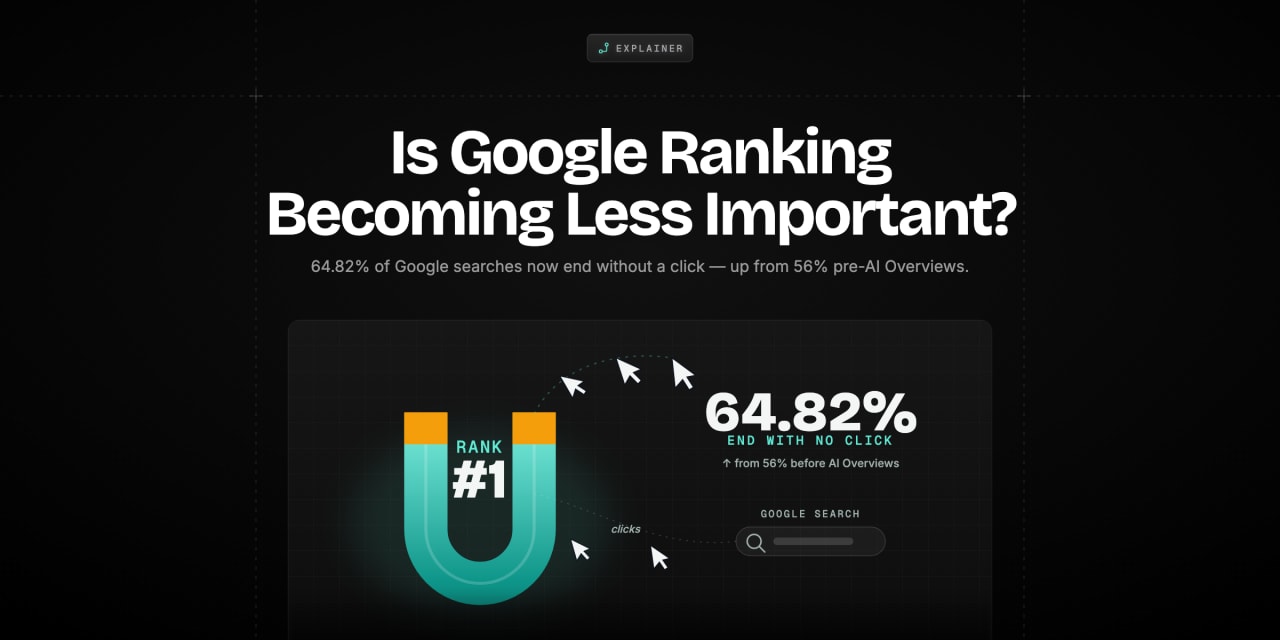
Zero click search 2026: 64.82% of all Google searches now end without a click, up from 56% before AI Overviews launched
-
Future of Google SEO: rankings become the eligibility prerequisite for AI citation, not the traffic-generation mechanism they used to be
-
AI search replacing Google entirely is not the 2026 story. The 2026 story is AI search capturing an increasing share of the attention that used to flow through traditional blue links
-
The answer is industry-specific: B2B SaaS and content publishers face the sharpest impact. E-commerce and local services remain Google-dominant
-
The three-year projection: AI-first becomes the default for informational search while Google maintains dominance for intent-to-act queries through at least 2028
Every few years, someone declares SEO dead. This time, the catalyst is real. According to Gartner's February 2024 press release, traditional search engine volume was projected to drop 25% by 2026 due to AI chatbots and virtual agents. Is Google ranking still important against that backdrop? The answer is more nuanced than any single data point suggests, and it depends almost entirely on which industry you are in, which queries you are targeting, and which definition of "important" you are using.
The anxiety is understandable. AI Overviews now intercept up to 47% of all Google queries. Zero click search 2026 data shows 64.82% of US Google searches ending without a click. ChatGPT fields billions of prompts every day. Users under 35 are starting research journeys in Perplexity and ChatGPT rather than Google. The evidence of structural change is real and it is measurable.
But the data also shows that 97% of Google AI Overview citations still come from Google's own top 20 results. Transactional and local queries still drive clicks at high rates even when AI Overviews are present. Google has not lost. It is adapting. This guide gives you the complete, balanced picture of what is actually changing about Google vs AI search traffic in 2026 and what it means for your strategy.
What Is the Evidence That Google Ranking Is Losing Importance?
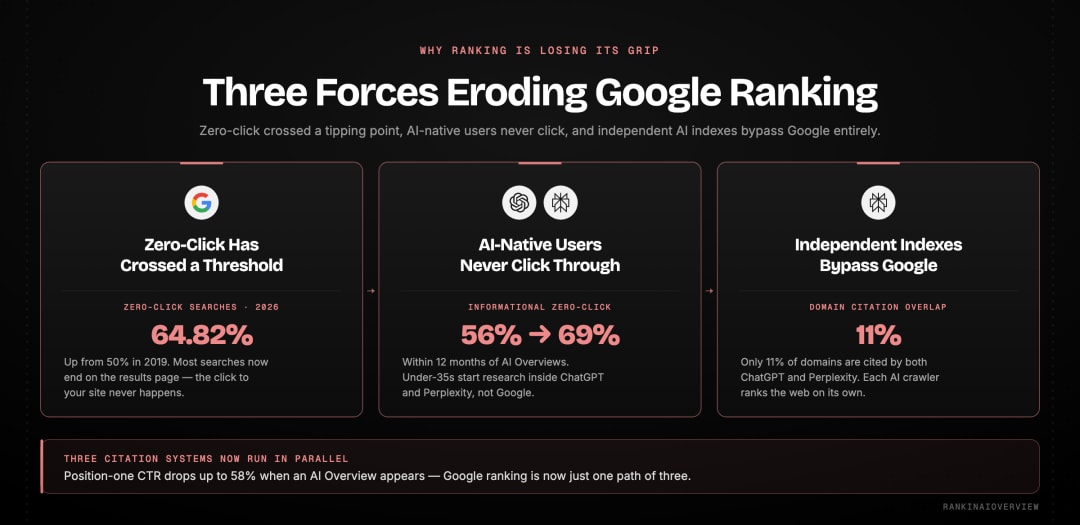
Three specific trends show genuine erosion in Google ranking's value as a traffic driver. Zero-click rates have crossed 64% and are rising. AI-native user behaviour is shifting search intent away from Google for research queries. Independent AI indexes like Perplexity create citation pathways that bypass Google ranking entirely. The erosion is real. It is concentrated in specific query types rather than universal.
Zero-Click Search Has Passed a Structural Tipping Point
Zero click search 2026 is not a new concern but it has crossed a threshold that changes strategic calculations. The rate has climbed steadily from 50% in 2019 to 64.82% in 2026. The increase accelerated sharply after Google AI Overviews launched at scale: the zero-click rate grew from 56% to 69% for informational query categories within twelve months of the AI Overview rollout.
The practical consequence is that ranking position one for an informational query no longer reliably delivers the traffic it did in 2022. Organic click-through rates for position one drop by up to 58% when an AI Overview appears for the same query. A page holding position one for a definition or how-to query is receiving a fraction of the clicks it would have generated two years ago. The ranking has not moved. The traffic it generates has.
Bain and Company research found that 80% of consumers now rely on zero-click results in at least 40% of their searches. The behaviour pattern is not limited to tech-savvy early adopters. It reflects a structural shift in how users interact with search results pages. When Google's search documentation describes the goal of providing users with the best answer to their query, the mechanism for delivering that answer has changed. The answer is increasingly on the search results page itself rather than behind a click.
AI-Native Users Are Growing and Their Behaviour Compounds
Users under 35 are adopting AI search tools as their default research starting point at measurably higher rates than older cohorts. When this group starts a research journey in ChatGPT or Perplexity rather than Google, the click that would have come to your ranked page never happens. The Google ranking is intact. The user who would have generated that click has never arrived at the search results page.
This demographic shift compounds over time. As users under 35 become the dominant purchasing and professional decision-making cohort over the next five years, the share of research behaviour that routes through AI search rather than traditional Google will increase. This is the structural argument for AI search replacing Google for informational queries as a long-term projection rather than a 2026 reality. EMARKETER's 2026 forecast projects that 31.3% of the US population will use generative AI search tools in 2026. That is not a majority. But the growth trajectory makes it a strategic priority today.
Independent AI Indexes Create Citation Pathways Outside Google
The future of Google SEO question has a structural complication that the zero-click data does not fully capture. Perplexity maintains its own independent crawler and index. A page with no significant Google ranking can appear in Perplexity answers if its content is structurally strong and semantically relevant. This creates a citation pathway that exists entirely outside Google's ranking algorithm. For brands building AI search visibility, Perplexity's independent index means that Google ranking is not the only gateway to AI-mediated brand awareness.
Research consistently finds that only 11% of domains are cited by both ChatGPT and Perplexity, and that the overlap between Google AI Overviews and other AI platforms is even lower. Three distinct citation systems are operating in parallel. Google ranking is necessary for Google AI Overviews. It is neither necessary nor sufficient for Perplexity citation. It matters for ChatGPT Search because ChatGPT uses Bing's index, but Bing ranking and Google ranking, while correlated, are not identical. Google ranking is becoming one important signal among several rather than the universal prerequisite it once was.
What Is the Evidence That Google Ranking Still Matters Enormously?

Three specific mechanisms preserve Google ranking's importance in 2026 despite the zero-click trend. AI Overview citations still draw almost exclusively from Google's top 20. Transactional and local queries still produce clicks at high rates because AI cannot complete purchases or provide proximity services. And Google is actively adapting through AI Mode, which makes ranking the input variable for its own AI synthesis layer.
97% of AI Overview Citations Come From Google's Top 20
Is Google ranking still important for the biggest AI feature in the world by user volume? Yes, structurally and unavoidably. Google AI Overviews reach over two billion monthly users and pull from the same index that powers traditional organic search. Approximately 97% of AI Overview citations come from pages ranking in Google's top 20. A page not ranking in Google's top 20 is effectively excluded from AI Overview citation regardless of how well-structured its content is.
This makes Google ranking the prerequisite for the AI feature with the highest reach in the world. Teams that abandon Google SEO investment lose AI Overview eligibility at the same moment. The channels share a single foundational infrastructure that cannot be optimised independently. Future of Google SEO is therefore not a question of whether rankings matter but of what they are primarily valued for: they are the ticket to AI Overview citation, not the direct source of traffic they used to be.
Transactional and Local Queries Still Drive Clicks
Google vs AI search traffic looks very different depending on query type. For informational queries, AI Overviews intercept a large share of users before they click. For transactional and local queries, the click-through rate remains high because AI cannot complete a purchase, guarantee a product's availability, or confirm that a local business is open right now. These completion requirements force users through the click regardless of what the AI Overview says above the fold.
E-commerce, local services, professional services booking, and software trials all require a destination page. The click to that destination happens even when an AI Overview provides introductory context. For brands in these categories, is Google ranking still important? The answer is straightforwardly yes. The transactional and local query categories are precisely where Google ranking still converts to revenue with the same reliability it always has.
Google Is Adapting, Not Dying
The most important context for evaluating AI search replacing Google is that Google is not standing still. Google's AI Mode combines traditional search with an AI synthesis layer that operates on top of Google's ranking algorithm rather than instead of it. AI Mode ranks pages using Google's existing signals and then generates a synthesised answer from the retrieved results. From the user's perspective, it is an AI experience. From the infrastructure perspective, it is Google ranking with an additional presentation layer.
Google is the largest AI search surface by user volume. It is investing more in AI search than any competitor. It has the most comprehensive web index, the strongest local data, and the most complete commercial intent data. AI search replacing Google entirely is not a plausible near-term scenario. Google becoming an AI search engine that uses rankings as its retrieval mechanism is exactly what is already happening.
“ Google is not losing. It is adapting. AI Mode is Google ranking, just with a synthesis layer on top. The distribution of attention is shifting, and SEOs need to fish where the fish are going. SEO community practitioner r/aeo, Reddit community discussion, 2026 Source: Reddit: Is Ranking on Google Becoming Less Important Now?
How Does This Play Out Differently by Industry?
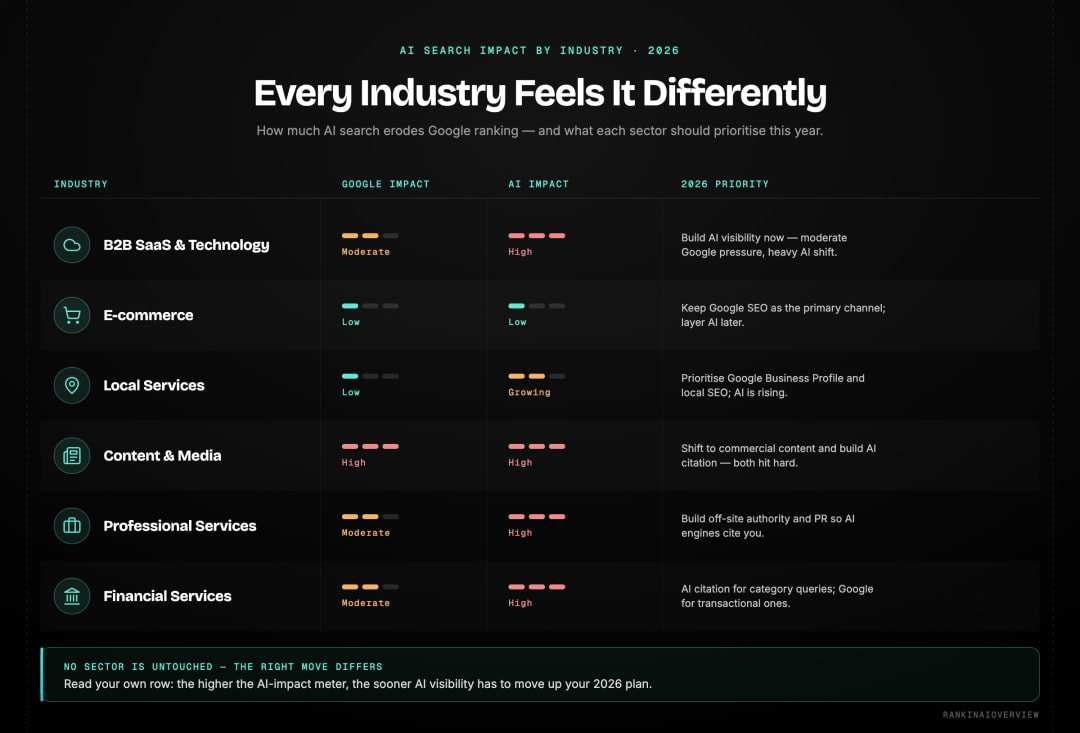
The impact of AI search on Google ranking importance is not uniform across industries. The variation by sector is the most practically useful dimension of this analysis for any team making resource allocation decisions. Understanding where your industry sits in this spectrum determines whether the correct response is urgency, parallel investment, or continued focus on traditional SEO.
| Industry | Google Ranking Impact | AI Search Impact | Priority Action in 2026 |
|---|---|---|---|
| B2B SaaS and Technology | Moderate. Clicks eroding for informational queries | High. Buyers research via ChatGPT before visiting vendor sites | Build AI visibility now. Off-site entity building is urgent |
| E-commerce | Low impact. Product queries still click-dominant | Low. AI does not complete purchases or show inventory | Maintain Google SEO as primary. Monitor AI for comparison queries |
| Local Services | Low impact. Maps and local pack still click-driven | Growing. AI local recommendation rates rising but secondary | Prioritise GBP and local SEO. Begin AI monitoring |
| Content and Media | High impact. Informational queries heavily AI-intercepted | High. AI Overviews resolve definition and how-to queries on-page | Shift to commercial content. Build AI citation for informational pieces |
| Professional Services | Moderate. Discovery moving to AI for category research | High. Practitioners discovered via AI answers before Google search | Build off-site presence. Author authority and PR coverage critical |
| Financial Services | Moderate. Research queries increasingly AI-mediated | High. AI provides product orientation before branded Google search | Invest in AI citation for category queries. Google for transactional |
B2B SaaS is the category where AI search replacing Google is most advanced in practice. When a buyer researches project management software by asking ChatGPT for recommendations, the Google rankings of the tools being recommended are irrelevant to that particular discovery event. The buyer has already formed their consideration set before they conduct a Google search. Google vs AI search traffic for B2B SaaS brands is therefore a top-of-funnel displacement, not a full-funnel replacement.
Content and media publishers face the sharpest direct traffic impact. Sites that built their audiences on high-volume informational queries, definitions, how-to guides, and news summaries are experiencing the steepest CTR declines as AI Overviews resolve those queries on the search results page. For these publishers, zero click search 2026 is not a future projection but a present reality measurable in their Google Search Console data today.
What Does the Forward-Looking View Look Like for the Next Three Years?
The three-year projection is the most consequential dimension of this question for strategic planning. Current trends extended to 2028 suggest a clear bifurcation: AI-first becomes the dominant mode for informational search while Google maintains authority over transactional, local, and navigational queries. The window for building AI search visibility before competition intensifies is 2026 to 2027.
The most important trend to extend is AI-native user behaviour among under-35 cohorts. As this group ages into primary purchasing authority over the next three to five years, the share of commercial research that routes through AI search will increase significantly. Brands that have built AI citation authority by 2027 will have a compounding advantage that latecomers will find expensive to replicate.
The Princeton and Georgia Tech GEO research demonstrated that the citations AI engines prefer are drawn from sources with consistent presence across trusted third-party platforms: Reddit, G2, Wikipedia, and industry publications. Building that presence takes twelve to eighteen months of consistent effort. Teams that start in 2026 will have meaningful citation authority by 2027. Teams that wait until 2027 will be competing against an established field of early movers.
Google AI Mode is the most significant structural change in this timeline. As AI Mode expands beyond the US market, the traditional SERP will increasingly be presented as an AI synthesis with source citations rather than a list of ranked pages with click-through opportunities. Google ranking remains the retrieval input for AI Mode, but the output that users see changes the relationship between ranking and traffic fundamentally. Future of Google SEO in 2028 is an AI-mediated search experience where ranking is necessary but traffic is earned through citation quality rather than position alone.
How Do You Future-Proof Your Visibility Strategy Now?
Future-proofing in 2026 requires three simultaneous investments. First, maintain strong Google rankings because they are still your largest channel and your AI Overview eligibility mechanism. Second, build AI visibility infrastructure now while it is relatively cost-efficient. Third, diversify your citation sources into the platforms that AI engines already trust. These are parallel investments, not sequential choices.
Maintaining strong Google rankings is the non-negotiable baseline. Despite the zero-click trend and the AI search pressure, Google still processes billions of queries daily and delivers more referral traffic than any other single platform. A brand that abandons Google SEO investment loses AI Overview eligibility at the same moment. The correct response to declining click-through rates from rankings is not to stop ranking but to change what you measure as the outcome of ranking.
Building AI visibility infrastructure means two practical things. First, structure your highest-priority pages to lead with direct answers: rewrite the opening 150 words to provide a self-contained, extractable response to the page's primary query. Add FAQPage schema to every long-form article. Second, build off-site entity presence: contribute to relevant Reddit communities, establish review platform profiles, and pursue industry publication mentions. These signals are what AI engines use to corroborate your brand's authority independent of your Google rankings.
Diversifying citation sources into platforms AI engines already trust is the most underinvested strategic action available to most teams. Reddit is the top-cited domain on Perplexity. YouTube transcripts are cited frequently by ChatGPT. G2 and Capterra reviews are corroboration signals for enterprise software. LinkedIn articles build professional authority signals for service businesses. These platforms are AI citation channels that operate entirely independently of your Google ranking position, making them both a hedge against Google ranking volatility and an AI search visibility investment simultaneously.
Conclusion
Is Google ranking still important? Yes, as the eligibility layer for AI Overviews and as the primary channel for transactional and local intent. Is it becoming less important as the sole metric of search success? Also yes, for informational content and for audiences under 35. The future of Google SEO is not a binary of important or obsolete. It is a reframing: ranking earns retrieval eligibility, and AI citation earns brand visibility. Both outcomes matter. Neither is sufficient alone.
Build strong Google rankings as your foundation. Layer AI visibility infrastructure on top while the competitive field is still sparse. Diversify your citation sources into the platforms AI engines already trust. The brands that execute this dual strategy through 2026 and 2027 will enter 2028 with compounding advantages in both traditional search and AI-mediated discovery. RANK IN AI OVERVIEW covers how AI engines evaluate and cite content across all major platforms in depth across its content library.
Frequently asked questions
Is Google search dying?+
No. Google still processes over 8.5 billion daily queries, making it the dominant information discovery platform in the world by a wide margin. What is changing is not Google's volume but its conversion rate from query to click. For informational queries, more searches are resolving on the search results page without producing a click to an external site. Google is adapting by building AI Mode, which uses its ranking algorithm as the retrieval layer for an AI synthesis experience. Google is evolving rapidly, not dying.
How much traffic am I losing to AI search?+
The answer depends on your content type. For informational, definitional, and how-to content, click-through rates from top rankings have declined by 30 to 58% on queries where AI Overviews appear. For transactional and local queries, the decline is much smaller because AI cannot complete purchases or guarantee proximity. Check your Google Search Console data: filter for queries where impressions are stable but clicks are declining. Those are the queries where zero-click search is actively reducing your traffic despite maintaining rankings.
Should I be optimising for Perplexity?+
Yes, if your audience uses it for research. Perplexity has its own independent index and can cite pages with no meaningful Google ranking. The optimisation approach is different from Google SEO: focus on content extractability and off-site community presence rather than backlink acquisition. Submit your site to Bing Webmaster Tools since Perplexity uses multiple search APIs. Build Reddit presence in your category since Reddit is the top-cited domain on Perplexity. These investments serve Perplexity citation without duplicating your Google SEO work.
Explore with AI
Share this