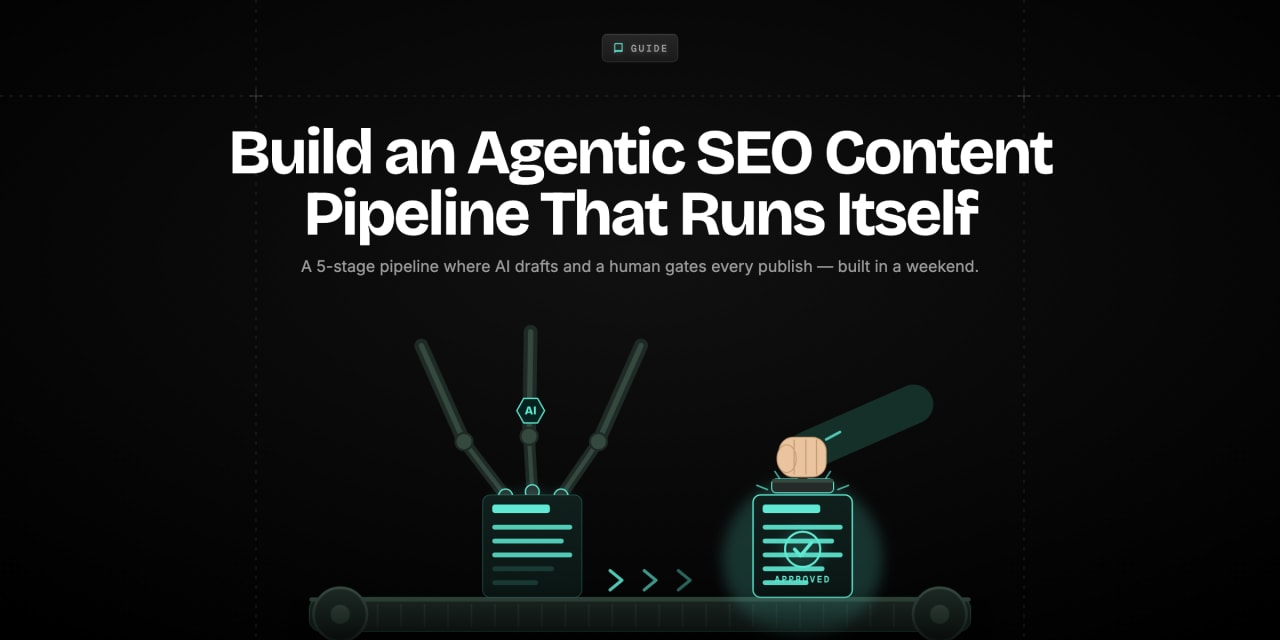
How to Build an Agentic SEO Content Pipeline
Build an agentic SEO content pipeline: automate discovery, briefs, and drafts step by step — with no-code and advanced build options.
Key Highlights
-
An agentic SEO workflow is a five-stage automated pipeline that handles opportunity discovery, brief generation, draft creation, SEO review, and human quality control without requiring manual intervention at every step
-
AI SEO automation pipeline reduces content ideation and drafting time by 60 to 80% while maintaining quality through mandatory human review at Stage 5. The bottleneck shifts from creation to quality control, which is exactly where human judgment adds the most value
-
Automated content creation SEO is achievable at two levels: a no-code version using Zapier and standard API connections that takes four to six hours to build, and an advanced version using n8n or Make that takes ten to fifteen hours
-
Automated content creation SEO that produces ranking results requires a five-stage pipeline, not just an AI writing tool. The opportunity discovery and brief generation stages are what give automated drafts their strategic direction
-
AI content workflow built with DataForSEO for opportunity discovery and Claude for brief and draft generation is the most commonly reported high-performance configuration in the agentic SEO practitioner community
-
The DataForSEO Claude workflow covers the full pipeline from keyword gap analysis to first draft in under 30 minutes per piece of content, compared to two to four hours for the equivalent manual process
-
The DataForSEO Claude workflow for opportunity discovery uses DataForSEO for keyword gap data and Claude for priority scoring, producing a weekly ranked opportunity list with reasoning for each recommendation
-
The DataForSEO Claude workflow for brief generation passes competitor URLs and keyword intent from DataForSEO to Claude, producing a structured H2/H3 outline, word count recommendation, and internal link targets in under two minutes
-
The full DataForSEO Claude workflow from keyword identification to publishable draft takes approximately 30 minutes of automated processing plus 30 to 60 minutes of human review for a 2,000 word piece
-
Human review at Stage 5 is non-negotiable. AI drafts require a named author, first-person experience signals, verified factual claims, and E-E-A-T compliance before publication. Skipping this produces content that neither ranks nor gets cited
-
Measuring pipeline performance requires tracking three metrics: content velocity (pieces per month), AI citation rate of pipeline-produced content, and organic traffic from pipeline content versus manually produced content
The most sophisticated content teams in 2026 are not just using AI to write faster. They have built automated pipelines that identify content opportunities, generate briefs, create drafts, and route them for human review with minimal manual intervention at each stage. This agentic SEO workflow guide is a practical build document, not a theoretical overview. By the end of this guide, you will have the architecture, tool selection, and step-by-step instructions to build a basic version of this pipeline over a weekend using no-code tools, or a more powerful version with n8n or Make if your team has technical capacity.
The community insight that shaped this guide: the bottleneck in an agentic SEO pipeline is never ideation or drafting. Those are the problems AI solves effectively. The bottleneck is always quality review. AI suggests and drafts, but a human must approve before anything reaches a live page. The teams that run these pipelines successfully treat human review as the premium layer that makes the automated content trustworthy, not as the cost of automation.
This guide covers the five-stage pipeline architecture, the no-code and advanced build options, the quality control process that prevents AI content from underperforming, and the measurement framework for assessing pipeline ROI. The specific tools mentioned are the ones the agentic SEO practitioner community reports as working reliably in 2026. Alternative tools exist for most stages, and the architecture is tool-agnostic.
What Does an Agentic SEO Content Workflow Actually Do?
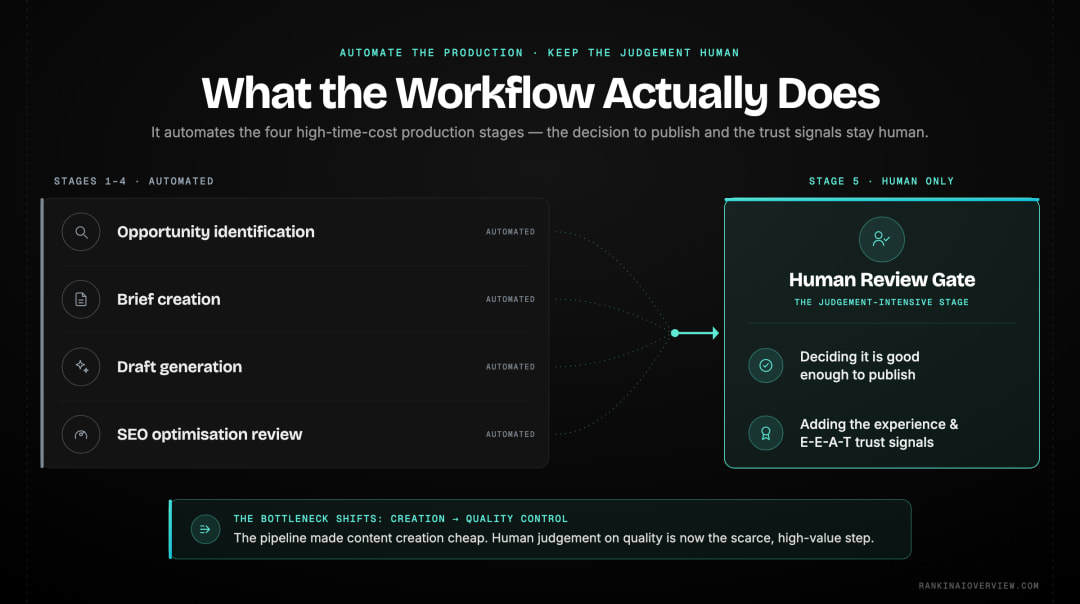
An agentic SEO workflow automates the four highest-time-cost stages of content production: opportunity identification, brief creation, draft generation, and SEO optimisation review. It does not automate the judgement-intensive stage: deciding whether the content is good enough to publish and adding the human expertise signals that make it trustworthy. The pipeline produces better inputs for human editors, faster, at higher volume than manual workflows allow.
The workflow monitors competitor content and keyword gaps continuously, surfacing new opportunities based on predefined criteria. When an opportunity meets the priority threshold, it triggers an automated brief generation step that pulls competitor URLs, target keyword data, and searcher intent signals into a structured brief. The brief triggers a draft generation step. The draft is run through an SEO review tool that scores it against the target keyword and flags structural gaps. The reviewed draft reaches a human editor with the AI analysis attached.
The result is that a human editor receives a prioritised content queue each week with researched briefs, quality drafts, and SEO gap analysis already completed. The editor's job is to add the experience layer, verify the factual claims, ensure E-E-A-T compliance, and approve for publication. This shift from creation to quality control is the change that makes AI SEO automation pipeline ROI positive. An AI SEO automation pipeline that produces volume without quality is a cost centre. One with a rigorous Stage 5 review is a growth engine.
What Is the 5-Stage Pipeline Architecture?
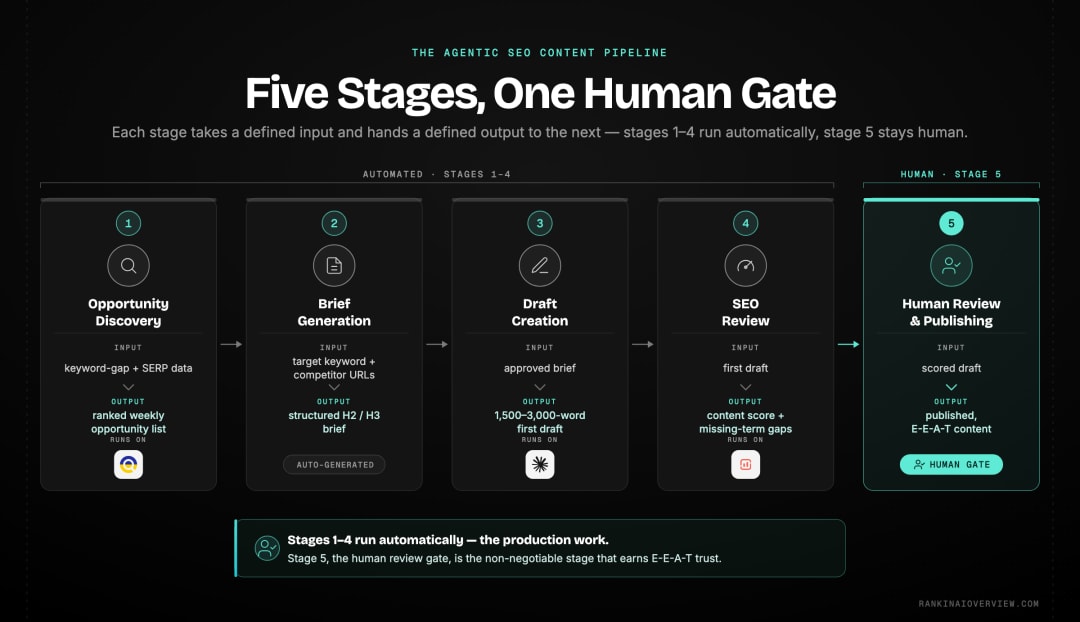
The five stages of the agentic SEO content pipeline are sequenced with clear inputs and outputs at each stage. Stage 1 produces a prioritised opportunity list. Stage 2 converts each opportunity into a structured content brief. Stage 3 converts each brief into a first draft. Stage 4 scores each draft and flags SEO gaps. Stage 5 is the human review and publishing stage. Each stage can be automated independently, allowing teams to start with one automated stage and add others over time.
Stage 1: Opportunity Discovery
Opportunity discovery is the stage that gives the pipeline its strategic direction. The goal is to surface content opportunities that meet specific predefined criteria: keyword gaps versus competitors, questions with high search volume and low competition, and topics where your topical authority cluster has incomplete coverage. DataForSEO is the most capable API tool for this stage because it provides keyword gap data, SERP analysis, and competitor content monitoring through a single API that feeds cleanly into automated workflows.
The DataForSEO Claude workflow for opportunity discovery: DataForSEO identifies keywords where competitors rank and you do not, with search volume above a defined threshold and keyword difficulty below a defined ceiling. This data is passed to Claude, which scores each opportunity against your topical cluster priorities and returns a ranked list with reasoning for each priority assignment. The output is a weekly opportunity report delivered to a Google Sheet or Notion database, ready for Stage 2 processing.
-
Weekly output: 10 to 20 prioritised content opportunities, ranked by estimated traffic potential and topical cluster fit
-
Human review required: weekly audit of priority rankings to ensure the scoring criteria reflect current content strategy
-
Approximate build time for this stage alone: 2 to 3 hours using Zapier connections to DataForSEO and Claude APIs
Stage 2: Brief Generation
Brief generation takes a target keyword and intent from Stage 1 and produces a full content brief automatically. The brief generation prompt feeds Claude three inputs: the target keyword and search intent, the top five ranking competitor URLs for that keyword (pulled by DataForSEO), and your site's content style guidelines. Claude returns a structured brief including the recommended H2 and H3 structure, target word count, FAQ question suggestions, internal link targets, and E-E-A-T requirements specific to the topic. The Claude API is particularly effective at this stage because its output follows complex structured prompts reliably and produces briefs that match practitioner-quality outputs with a well-designed system prompt.
The automated brief is not a final brief. A human editor reviews the Stage 2 output before it moves to Stage 3, checking that the recommended structure genuinely serves the search intent and that the internal link targets are accurate. This review takes five to ten minutes per brief. Without this review, briefs with structural errors produce drafts that require more work at Stage 5 than they saved at Stages 2 and 3.
Stage 3: Draft Creation
Draft creation is the stage most teams want to build first, but it is the one that benefits most from having Stages 1 and 2 already working. A draft created from a high-quality brief produced by the Stage 2 process is significantly closer to publishable quality than a draft created from a keyword alone. The brief provides the structural guardrails that prevent AI drafts from drifting into generic, unfocused content.
The automated content creation SEO draft stage inputs the Stage 2 brief into Claude with a system prompt that specifies the writing style, E-E-A-T requirements, and direct-answer structure. Claude returns a 1,500 to 3,000 word first draft following the brief structure. The draft always includes placeholders for first-person experience sections: "[ADD: specific experience with this tool or situation]" markers where the human editor must insert real experience rather than generic claims.
Stage 4: SEO Review
The SEO review stage scores the Stage 3 draft against the target keyword and flags specific gaps. The simplest implementation uses Surfer SEO or a similar content scoring tool to evaluate the draft against the SERP for the target keyword. The tool returns a content score, a list of missing or underrepresented terms, and structural suggestions. This scoring analysis is attached to the draft before it is routed to the human editor at Stage 5.
The SEO review stage can be automated fully for teams with Surfer SEO API access, or completed semi-manually (five to ten minutes per piece) by the human editor before their review. For teams in the early stages of building their AI content workflow, semi-manual SEO review is the appropriate starting point. Automating Stage 4 before Stages 1 through 3 are working reliably adds complexity without proportionate value.
Stage 5: Human Review and Publishing
Stage 5 is the non-negotiable human stage. Every draft that comes through the pipeline requires a human editor to add the experience layer, verify factual claims against primary sources, ensure E-E-A-T compliance, and apply the final edit before publishing. This is not an optional quality check. It is the stage that determines whether the pipeline produces content that ranks and gets cited, or content that produces neither result. Google's official guidance on AI-generated content confirms that the quality evaluation standard applies regardless of production method.
-
Experience layer addition: insert at least one specific, dated, first-person experience claim per article
-
Factual verification: check every statistic against the named primary source before publishing
-
E-E-A-T compliance check: confirm the named author is real and credible, author bio is present and specific, and all factual claims are verifiable
-
Tone consistency: ensure the draft matches your brand voice, which Claude's output will approximate but not perfectly replicate
-
Internal link verification: confirm every internal link target recommended in the brief is accurate and relevant
“ The bottleneck is always quality review. AI suggests and drafts, but a human must approve. The tech exists. The discipline to build guardrails around quality is the hard part. DataForSEO plus Claude for keyword clustering, brief generation, and draft is our current setup. Agentic SEO community practitioner r/Agentic_SEO community, Reddit 2026 Source: Reddit: Has Anyone Built a Workflow Where AI Suggests and Creates SEO Content?
How Do You Build the No-Code Version With Zapier?
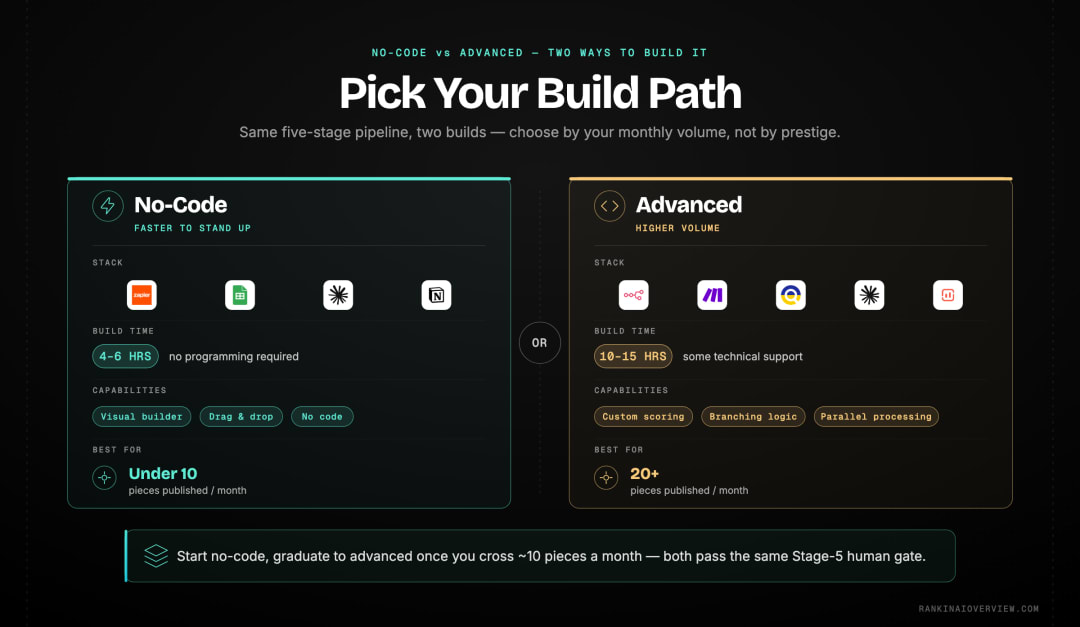
The no-code version connects four tools through Zapier: DataForSEO for opportunity data, Google Sheets as the data staging layer, the Claude or ChatGPT API for brief and draft generation, and Notion as the content management layer where humans review and approve content before publishing. Estimated build time is four to six hours. No programming knowledge is required.
Step 1: Set up your DataForSEO API connection in Zapier. Configure a weekly trigger that pulls keyword gap data for your domain versus your two or three primary competitors. Pipe the output into a Google Sheet with columns for keyword, monthly search volume, keyword difficulty, competitor ranking URL, and opportunity score.
Step 2: Set up a Zap that monitors the Google Sheet for new rows where opportunity score exceeds your defined threshold. When triggered, it passes the keyword and competitor URL to the Claude API with your brief generation prompt. The Claude output (structured content brief) is written to a new row in a Briefs Google Sheet and simultaneously creates a new page in Notion with the brief contents.
Step 3: Set up a second Zap that triggers when a Notion brief page is marked as "Brief Approved" by a human reviewer. This Zap passes the approved brief to Claude with your draft generation prompt and writes the resulting draft back into the same Notion page. The human editor then reviews the draft, adds their experience layer, and marks the page as "Ready to Publish."
Step 4: Set up a final Zap that either creates a draft post in your CMS (WordPress, Webflow, or Contentful) from the Notion page content when marked "Ready to Publish," or sends a notification to the publishing team with the Notion link for manual CMS entry. The full automated content creation SEO pipeline is now running.
How Do You Build the Advanced Version With n8n or Make?
The advanced version replaces Zapier with n8n (self-hosted) or Make (cloud-based) and adds API-level connections with DataForSEO, Claude, and Surfer SEO. This version is more powerful because it handles edge cases, custom scoring logic, multi-step approval workflows, and parallel processing. Estimated build time is ten to fifteen hours with some technical support. The primary advantage over the Zapier version is the ability to run custom code within the workflow and handle complex branching logic.
For teams with developers, n8n is the preferred advanced option because it is self-hosted, has no per-operation pricing at scale, and supports custom JavaScript code nodes that allow complex scoring logic, conditional routing, and multi-step API orchestration. The n8n workflow for this pipeline uses a DataForSEO node for keyword data, a custom scoring function node, a Claude node for brief generation, a Surfer SEO API node for content scoring, and a webhook node that triggers Stage 5 notifications to the human editor.
The most valuable advanced capability is parallel processing: the advanced version can run brief generation for multiple opportunities simultaneously rather than processing them sequentially. For content teams producing 20 or more pieces per month, this parallel processing capability reduces the pipeline cycle time from days to hours. For teams producing fewer than ten pieces per month, the Zapier no-code version is sufficient.
How Do You Control Quality in an Automated Pipeline?
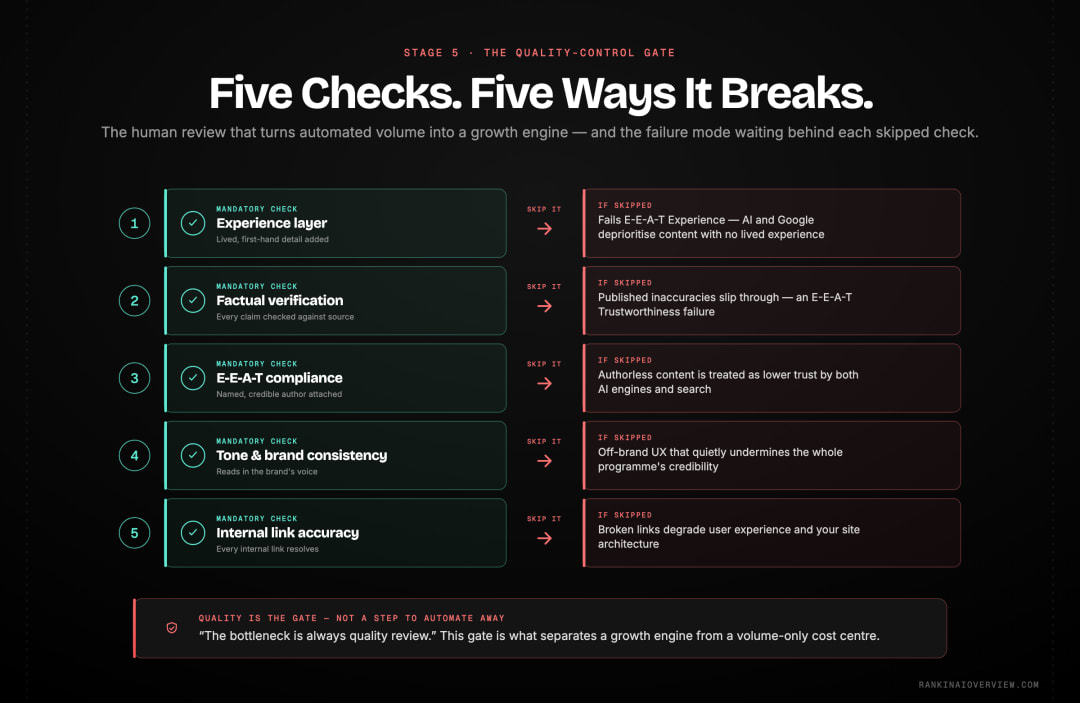
Quality control in an AI SEO automation pipeline requires four specific checks that must be completed at Stage 5 for every piece of content. These checks are not optional enhancements. They are the minimum required to ensure the pipeline produces content that ranks and gets cited rather than content that generates volume without performance. The specific failure modes that occur when these checks are skipped are documented below.
| Quality Check | What to Review | Failure Mode if Skipped | Time Required |
|---|---|---|---|
| Experience layer addition | Insert at least one specific dated first-person experience claim per article | Content fails E-E-A-T Experience dimension. AI and Google both deprioritise content without lived experience signals | 15 to 30 minutes |
| Factual verification | Check every statistic against the named primary source | Published inaccuracies damage brand credibility and produce E-E-A-T Trustworthiness failures | 10 to 20 minutes |
| E-E-A-T compliance | Confirm named author present, bio specific and credible, all claims verifiable | Content lacks author-level authority signals. Google and AI engines treat authorless content as lower trust | 5 minutes |
| Tone and brand consistency | Ensure output matches your brand voice guidelines | Off-brand content creates user experience inconsistency and undermines content programme credibility | 5 to 10 minutes |
| Internal link accuracy | Verify all internal link targets in the brief are accurate and still live | Broken or inaccurate internal links degrade user experience and site architecture quality | 5 minutes |
How Do You Measure the Pipeline's Performance?
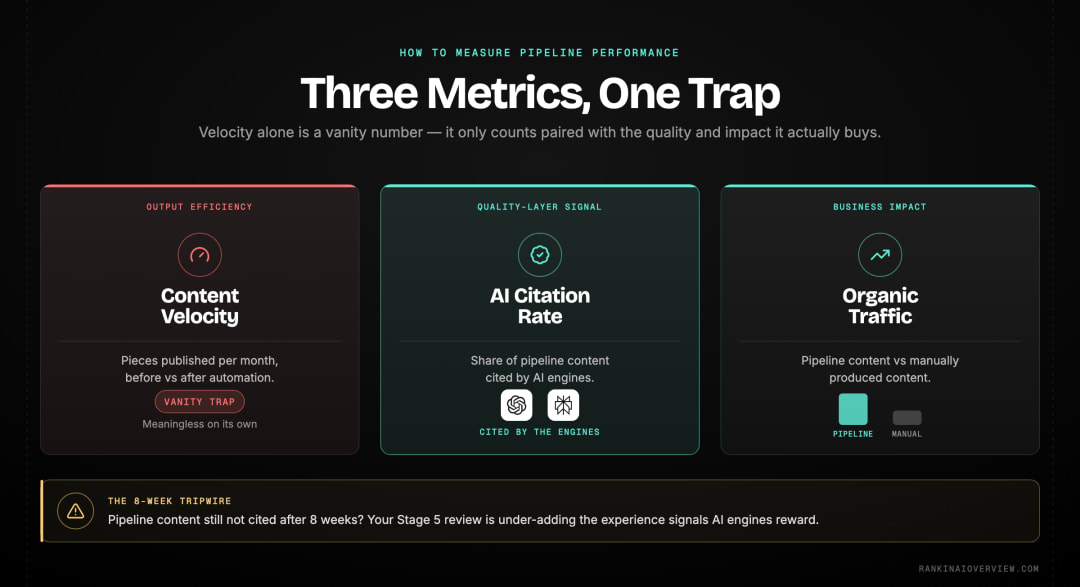
Three metrics give a complete picture of AI content workflow performance. Content velocity (pieces per month before and after) measures the pipeline's output efficiency. AI citation rate of pipeline-produced content measures whether the quality layer is working: if pipeline content is not being cited by AI engines, the human review stage is not adding sufficient E-E-A-T signals. Organic traffic from pipeline content versus manually produced content measures the business impact of the investment.
Content velocity is the easiest metric to improve and the least meaningful in isolation. A pipeline that produces fifty pieces per month of content that does not rank or get cited is a pipeline generating cost, not value. Measure content velocity alongside quality indicators from day one. The target is improving content velocity without reducing quality, not improving velocity at the expense of quality.
AI citation rate is the most relevant quality metric for an AI content workflow producing content for a site focused on AI search visibility. Run the target queries for pipeline-produced content through ChatGPT and Perplexity weekly. If pipeline content is not appearing in AI answers for its target queries after eight weeks, the Stage 5 quality review is not adding sufficient experience signals. Investigate the quality review checklist for the pieces that are not being cited.
Conclusion
The same agent-building mindset scales past content — see how one solopreneur built 6 AI agents to sell web services around the clock.
An agentic SEO content pipeline is one of the highest-leverage investments a content team can make in 2026. The no-code version is accessible to any marketer willing to invest four to six hours in the build. The advanced version requires ten to fifteen hours of technical investment but delivers compounding returns as volume scales. Start simple, validate the quality with real ranking and citation data, then scale the pipeline.
The bottleneck after building this pipeline will not be ideation or drafting. It will be human review, because the pipeline will produce more content than your team can review at the quality standard required. That is exactly the right bottleneck. It means your experienced writers and editors are spending their time on the judgement-intensive work that neither AI automation nor any other tool can replicate. RANK IN AI OVERVIEW covers how AI engines evaluate content quality and what drives citation across all major platforms in depth across its content library.
Frequently asked questions
Do I need coding skills to build an agentic SEO pipeline?+
No, for the no-code version. The Zapier-based pipeline described in this guide uses only Zapier's visual workflow builder, Google Sheets, and Notion. All three are accessible to non-technical marketers. The most technical step is configuring API connections in Zapier for DataForSEO and Claude, which requires following API documentation but not writing code. The advanced n8n or Make version does benefit from some technical support, particularly for custom scoring logic and CMS integrations. For most marketing teams, starting with the no-code Zapier version and upgrading to the advanced version only when the pipeline's volume and complexity justify it is the correct sequencing.
How much does a basic agentic SEO workflow cost to run monthly?+
The basic no-code version costs approximately USD 200 to 350 per month at moderate volume (10 to 20 pieces per month). This breaks down as: [DataForSEO](https://dataforseo.com) API at approximately USD 50 to 100 per month depending on query volume, Claude API at approximately USD 30 to 80 per month at moderate usage, Zapier Professional at USD 49 per month, and Surfer SEO at USD 89 per month for the basic plan. [Notion](https://www.notion.so) is free for most team sizes. At this cost, the pipeline needs to produce demonstrable ranking improvements on two to three pieces per month to reach positive ROI for most content teams.
Will Google penalise content produced by an AI workflow?+
No, when the Stage 5 quality review is applied correctly. [Google's official position](https://developers.google.com/search/blog/2023/02/google-search-and-ai-content) is that the test is content quality and helpfulness, not production method. Pipeline-produced content that passes the Stage 5 quality review, specifically that has a named human author, first-person experience signals, verified factual claims, and genuine E-E-A-T compliance, is evaluated by Google on the same quality standards as manually written content. Pipeline-produced content where Stage 5 is skipped or under-resourced will fail those quality standards and underperform accordingly.
Explore with AI
Share this