How to Optimize Content for AI Search: 8 Tactics That Actually Work in 2026
Stop guessing what AI search wants. Here are 8 concrete, practitioner-tested content optimisation tactics that improve your chances of being cited in AI answers in 2026\.
Key Highlights
-
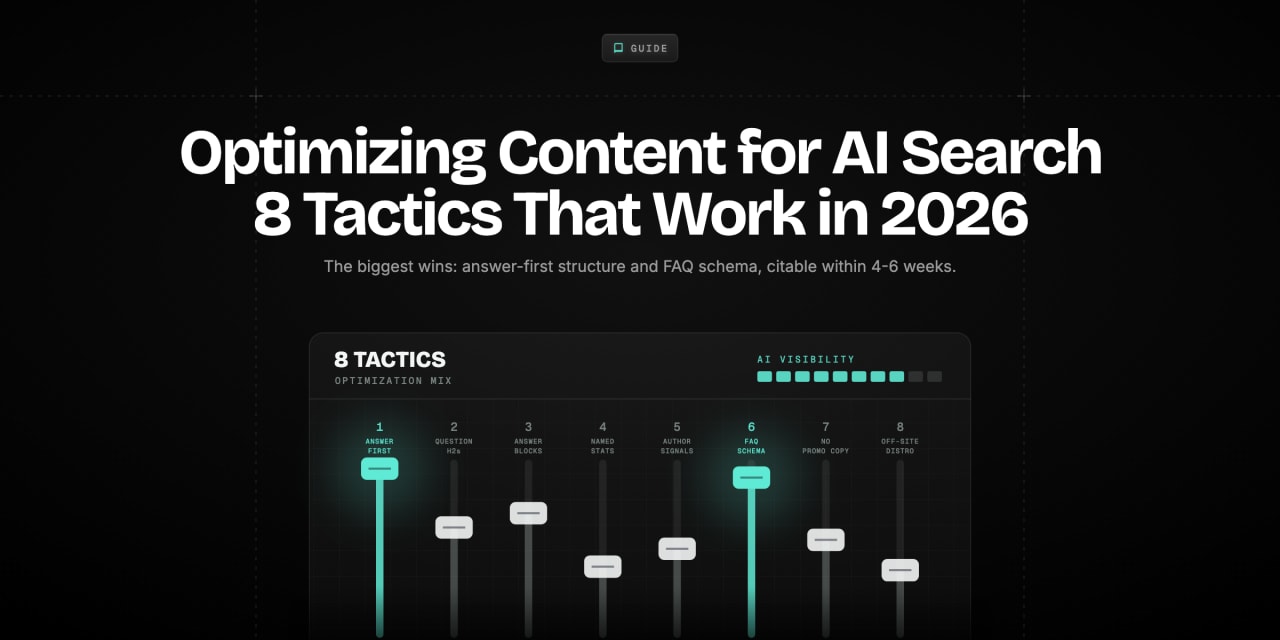
Optimize content for AI search using 8 specific, sequenced tactics. The fastest improvement comes from tactics 1 and 6: answer-first structure and FAQ schema. Both produce measurable citation improvements within four to six weeks
-
AI content optimization checklist: content structure comes first, author signals second, off-site distribution third. This sequence matters as much as the individual tactics
-
Content strategy for AI SEO centres on a single principle: AI engines extract passages, not pages. Every section must contain a self-contained, directly citable answer in its first 60 words
-
Content strategy for AI SEO is not a separate discipline from content strategy generally. It is content strategy with extraction as the primary design constraint rather than engagement
-
A content strategy for AI SEO that works in 2026 addresses structure first, trust signals second, and off-site corroboration third. Teams that reverse this order consistently underperform
-
The content strategy for AI SEO that produces the fastest results combines answer-first structure with FAQ schema. Both can be implemented on existing content without rebuilding from scratch
-
GEO content tactics that the community reports working consistently: question-format H2 headers, direct answer blocks, comprehensive FAQ sections with authentic user-phrased questions
-
GEO content tactics distinguish themselves from traditional SEO content tactics primarily at the structural level. The content itself does not need to change. The structure around it does
-
The most underused GEO content tactics are off-site: Reddit community contributions and Quora expert answers that create AI-discoverable citations independently of website ranking
-
How to write for AI search: be objective before you are persuasive, be specific before you are comprehensive, and be citable before you are engaging
-
How to write for AI search: every H2 section should open with a self-contained answer that makes sense without surrounding context. AI engines extract this passage first
-
How to write for AI search is not how to write for AI at the expense of readers. The structural changes that serve AI extraction consistently improve readability for human scanners too
-
How to write for AI search starts with the question: if someone extracted only the first 60 words of this section, would they have a complete and useful answer? If not, rewrite the opening
-
The principles of how to write for AI search map directly onto the principles of clear, authoritative technical writing. Both reward directness, specificity, and verifiable claims
-
Practitioners who restructured their top pages to answer one question per section report AIO citation rates doubling within the first month of implementation
-
The 8 tactics are ordered by implementation effort and speed of return. Tactics 1 through 3 require only content editing. Tactics 4 through 8 require progressively more investment and time
"Optimise for AI search" sounds simple until you try to act on it. What does it actually mean to write content for ChatGPT, Perplexity, or Google AI Overviews? According to Princeton and Georgia Tech's generative engine optimisation research that tested seven content interventions in controlled conditions, specific structural and sourcing changes produce measurably different improvements in AI citation probability. The research gives practitioners a verified starting point. This guide builds on that foundation with eight specific tactics, ordered by the speed of return they produce.
The vague advice to "write helpful content" and "build authority" is not wrong. It is just incomplete. To optimize content for AI search effectively, you need specific, sequenced actions, not general principles. Practitioners in digital marketing communities have been running their own content experiments and sharing what actually moves AI citation rates. The collective insight is clear: the tactics that work are structural and specific.
This guide gives you the eight tactics in sequence, with before-and-after examples for the ones where the formatting change is the most directly demonstrable. For each tactic, you get the implementation instruction, the reason it works, and where it fits in the priority order for a team with limited time. Work through them in the order presented and you will have a complete AI content optimization checklist for your most important pages.
What Is the Core Principle Behind Optimizing Content for AI Search?
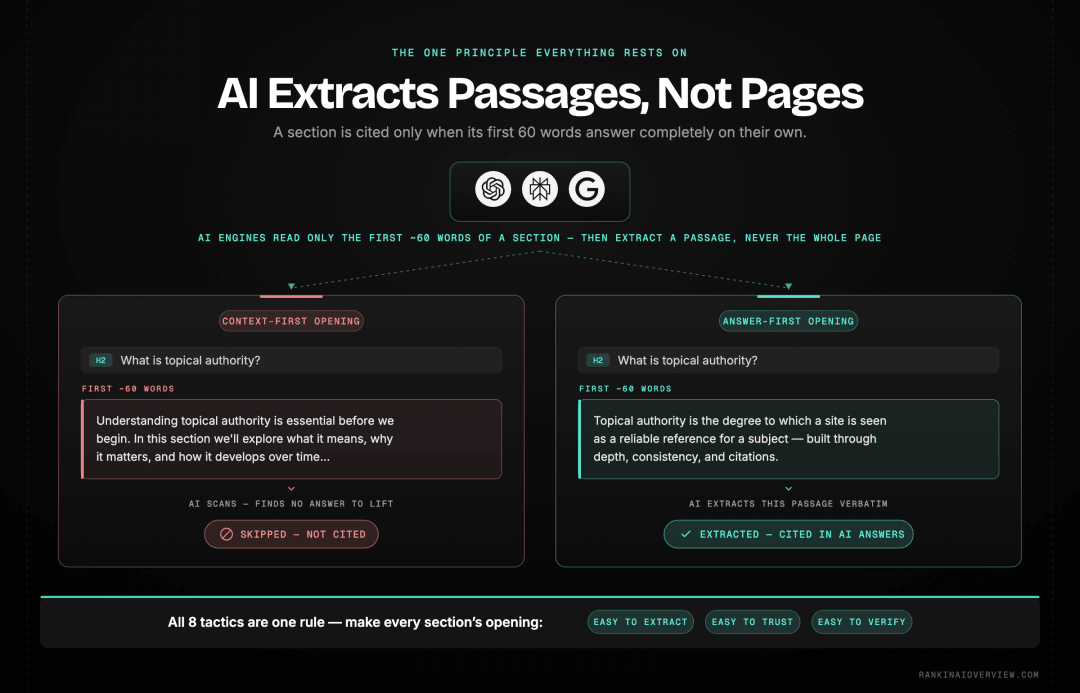
AI engines extract passages, not pages. When an AI system generates an answer, it retrieves specific self-contained passages from relevant pages and synthesises them into a response. This means every section of your content must function as an independent, directly citable unit. A section that only makes sense in the context of the sections around it cannot be extracted and cited. A section that contains a complete answer in its first 60 words can.
The implication of this extraction model is that traditional content writing conventions need to be reconsidered. Academic and journalistic writing conventions build context before delivering conclusions. They assume a reader who will read the entire piece. AI extraction works on the opposite assumption: identify the most directly answerable passage regardless of where it sits in the document and retrieve it without surrounding context.
GEO content tactics all derive from this single principle. Answer-first structure serves it directly. Question-format headers help AI engines match passages to queries. FAQ sections create pre-formatted extraction targets. Schema markup makes the structure machine-readable. Author experience signals build the trust that makes extraction safe. Off-site distribution creates the corroboration that validates the content. All eight tactics are implementations of the same core requirement: make your content easy to extract, easy to trust, and easy to verify.
Tactic 1: Lead With the Answer, Not the Context
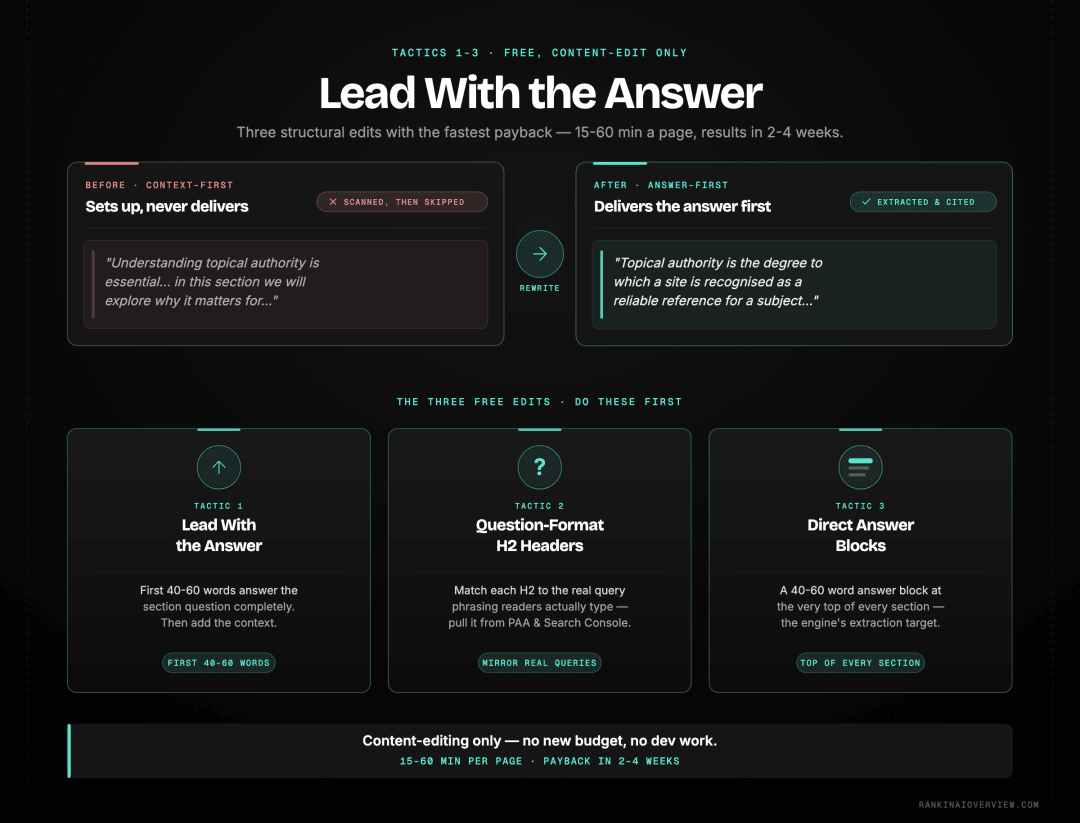
The single highest-impact change in any AI content optimization checklist is rewriting the opening of each section to lead with the direct answer. The first 40 to 60 words of every H2 section should answer the section question completely. Context, explanation, and qualification come after. AI engines scan for self-contained answer passages and extract them. If the answer is not in the opening, the passage is often skipped.
The implementation instruction: after writing your section heading, write the answer in two to three sentences before writing anything else. The test for whether you have achieved this: cover everything below the first two sentences and ask whether a reader would understand the answer. If yes, the opening passes the extraction test. If they need to read further to understand the answer, the opening fails.
BEFORE: Understanding topical authority is essential for any modern SEO strategy. In this section, we explore what it means, why it matters, and how the concept has evolved as AI search has become more prevalent across the search landscape.
AFTER: Topical authority is the degree to which a website is recognised as a reliable reference point for a specific subject area, measured by the depth and consistency of its published content on that topic. Sites with high topical authority on a subject are cited by AI engines more frequently than sites with isolated pieces on the same subject.
The before version sets up the answer without delivering it. The after version delivers the answer in the first two sentences. An AI engine extracting from the after version has a directly citable, self-contained passage immediately. An AI engine scanning the before version finds context-setting and moves to the next source.
Tactic 2: Use Questions as H2 Headers
Question-format H2 headers help AI engines match sections to conversational queries. When a user asks ChatGPT or Perplexity a question, the AI retrieval system looks for content where the heading matches or closely relates to the query. A section headed "What is topical authority in SEO?" is more directly matched to that query than a section headed "Understanding Topical Authority."
The implementation instruction: for every H2 in your content, convert statement headers to question headers. Use the exact phrasing your target audience uses in search. Check Google Search Console for the query phrasing that drives your current impressions, and check the People Also Ask section for each target query. These sources tell you the precise question language your audience uses.
-
Statement: "The Benefits of FAQ Schema Markup"
-
Question: "What Are the Benefits of FAQ Schema Markup for AI Visibility?"
-
Statement: "Off-Site Brand Signals for AI Citation"
-
Question: "Which Off-Site Platforms Help AI Engines Trust Your Brand?"
The question format also makes your content structure more navigable for users who are scanning for a specific answer. A reader who wants to know about schema markup can find that specific section immediately rather than reading through a descriptive heading that does not signal what the section answers. The format serves both AI extraction and human navigation simultaneously.
Tactic 3: Add Direct Answer Blocks to Every Section
A direct answer block is a 40 to 60 word summary at the top of each H2 section that answers the section question completely. It is the most universally applicable GEO content tactic because it works regardless of content type, industry, or platform. The answer block is what AI engines extract when they cite your content. Everything below it provides supporting detail for human readers.
The template: a bold or styled heading labelled "The short answer" or formatted as a styled box, followed by two to three sentences that answer the section question without qualification or context-setting. After the answer block, write the full section body as normal. The answer block should not repeat the section content. It should front-load the conclusion so that a reader or AI engine can extract the key point without reading the full section.
This template maps directly onto the answer box format used in this article: the styled blue-bordered boxes that appear after each H2 heading are examples of the direct answer block in practice. They are self-contained, directly extractable, and structured to make the section's key point immediately visible to both human scanners and AI extraction systems.
Tactic 4: Include Original Data or Named Statistics
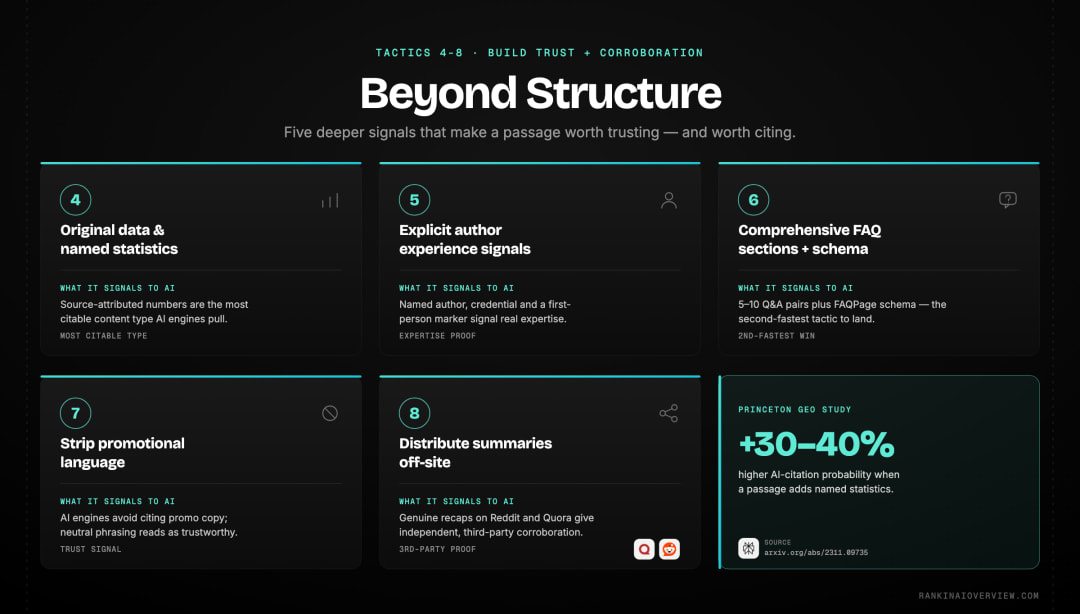
AI engines cite sources with specific, verifiable data points more frequently than sources with general claims. Original data from your own research is the most citable form of content because it cannot be found anywhere else. Named statistics from primary sources, with the source explicitly attributed in the text, are the next most citable. Generic claims without specific backing are the least likely to be extracted and cited.
The implementation for teams without original research: aggregate and contextualise primary-source data rather than simply citing it. A sentence like "Research from Princeton found X" is less citable than "Princeton's GEO research found that adding statistics improved AI citation probability by 30 to 40 percent, with citations and quotations producing the largest individual improvements." The second version provides context that makes the data directly useful in an AI-generated answer. Link statistics to their original source: .org and .gov pages, academic papers, and official documentation are the most trusted source types for AI citation purposes.
For teams that can produce original data: even small-scale original research produces highly citable content. A survey of fifty practitioners, a test across ten websites, or an analysis of your own client data produces primary source material that no competitor can replicate. Original data is the highest-effort, highest long-term value item in the AI content optimization checklist. It compounds over time as other publications cite your findings.
Tactic 5: Add Explicit Author Experience Signals
E-E-A-T for AI visibility operates most directly through the Experience dimension. A named author with verifiable credentials and explicit first-person experience signals builds the author-level trust that AI engines use to evaluate whether content is safe to cite. Anonymous content published by an unnamed editorial team consistently performs below named expert content in AI citation frequency.
The implementation instruction: add a named author bio to every content piece with three components. A name. A specific credential or role that establishes expertise in the subject. A sentence demonstrating direct experience: "I have tested forty AI visibility tools over eighteen months and the findings below reflect that direct comparison." Google's Search Quality Rater Guidelines define the Experience component of E-E-A-T specifically as demonstrated first-hand knowledge. The difference between "our team covers AI SEO" and "I ran this experiment on twelve client sites between January and June 2026" is the difference between implied expertise and demonstrated experience.
Within the body text, include at least one first-person experience marker per article: "In our testing," "When working with a B2B SaaS client on this specific challenge," "The most consistent result we observed across twelve implementations." These markers do not need to be dominant throughout the piece. One or two well-placed examples are sufficient to shift the E-E-A-T signal from generic to experiential.
“ I restructured 20 pages to answer one question per section. AIO pickups doubled within the first month. The answer-first structure is the single change that moved the needle fastest. Digital marketing practitioner r/DigitalMarketing community, Reddit 2026 Source: Reddit: How Are You Optimising Content for AI Search?
Tactic 6: Build Comprehensive FAQ Sections With Schema
FAQ sections are the most consistently cited content structure across AI platforms. Question-and-answer pairs are pre-formatted extraction units: the question identifies the query, the answer provides the citable passage. FAQPage schema makes this structure machine-readable, reducing the interpretive work AI engines must do to identify extractable content. This is the second-fastest tactic after answer-first structure in terms of speed to first AI citation.
The implementation instruction: add five to ten FAQ pairs to every long-form content piece. Source the questions from Google's People Also Ask section for your target keywords, from Google Search Console query data showing what users are actually searching, and from Perplexity's follow-up questions feature that surfaces what users ask after their initial query. Implement FAQPage schema on the section. Validate using Google's Rich Results Test before publishing.
The questions must use authentic user phrasing, not keyword-optimised marketing language. "What is the ROI of AI content optimization?" is authentic user phrasing. "How does AI content optimization drive business value and competitive advantage?" is marketing language. AI engines distinguish between these formats and consistently favour the authentic question format for extraction. Every FAQ answer should be 30 to 50 words: enough to be complete, short enough to be extractable as a self-contained passage.
Tactic 7: Restructure Content to Remove Promotional Language
AI engines actively avoid citing promotional content. Content that leads with benefit statements, feature claims, pricing references, or calls to action fails the objectivity filter that AI engines apply before deciding what is safe to cite. The fix is structural: move all promotional content to the end of the page or into a separate conversion-oriented section, and rewrite the informational sections to be genuinely objective and educational.
The audit instruction: read the first 300 words of each target page and flag every sentence that is primarily serving a commercial goal rather than an informational one. Common flags include: sentences starting with "We offer," "Our unique approach," or "No other solution." Pricing references in informational sections. Testimonials before information has been delivered. Feature benefit statements before the feature has been explained.
-
Flag: "Our AI visibility tool tracks every citation across the web in real time."
-
Rewrite: "AI visibility tracking platforms monitor citation frequency across ChatGPT, Perplexity, and Google AI Overviews by running automated prompt tests and logging results."
-
Flag: "We help brands dominate AI search with our proprietary methodology."
-
Rewrite: "Brands achieving consistent AI citation typically invest in four areas: content structure, entity signals, off-site presence, and schema implementation."
The rewritten versions are objective descriptions that serve a reader who wants information. The original versions serve a commercial goal. Both could theoretically appear on the same page, but the promotional versions should not appear in the informational sections where AI engines look for extractable content.
Tactic 8: Distribute Content Summaries Off-Site
Off-site content distribution on Reddit, Quora, and industry forums creates AI-discoverable citations that corroborate your website content from independent sources. AI engines, particularly Perplexity, cite Reddit and Quora content directly. A brand that distributes genuine expert summaries of its key insights across these platforms builds a corroboration layer that AI engines use to verify the trustworthiness of the brand-owned content on its website.
The implementation instruction: for each major content piece you publish, identify two or three relevant Reddit communities and Quora topics where the content addresses a genuine community question. Contribute a 200 to 400 word summary of the key insight from the piece as a standalone community answer, without reproducing the full article. The community contribution should be useful as a standalone answer. It can mention the full article as additional reading, but the contribution itself must deliver genuine value independent of the link.
The community contribution is not guest posting or link building in the traditional sense. It is building authentic presence in the communities that AI engines treat as trusted sources. Perplexity cites Reddit as one of its most frequently retrieved domains. ChatGPT's training data includes significant Reddit content. A brand that contributes genuine expertise to these communities is building AI citation signals that operate independently of its Google ranking.
What Is the Implementation Priority Order?
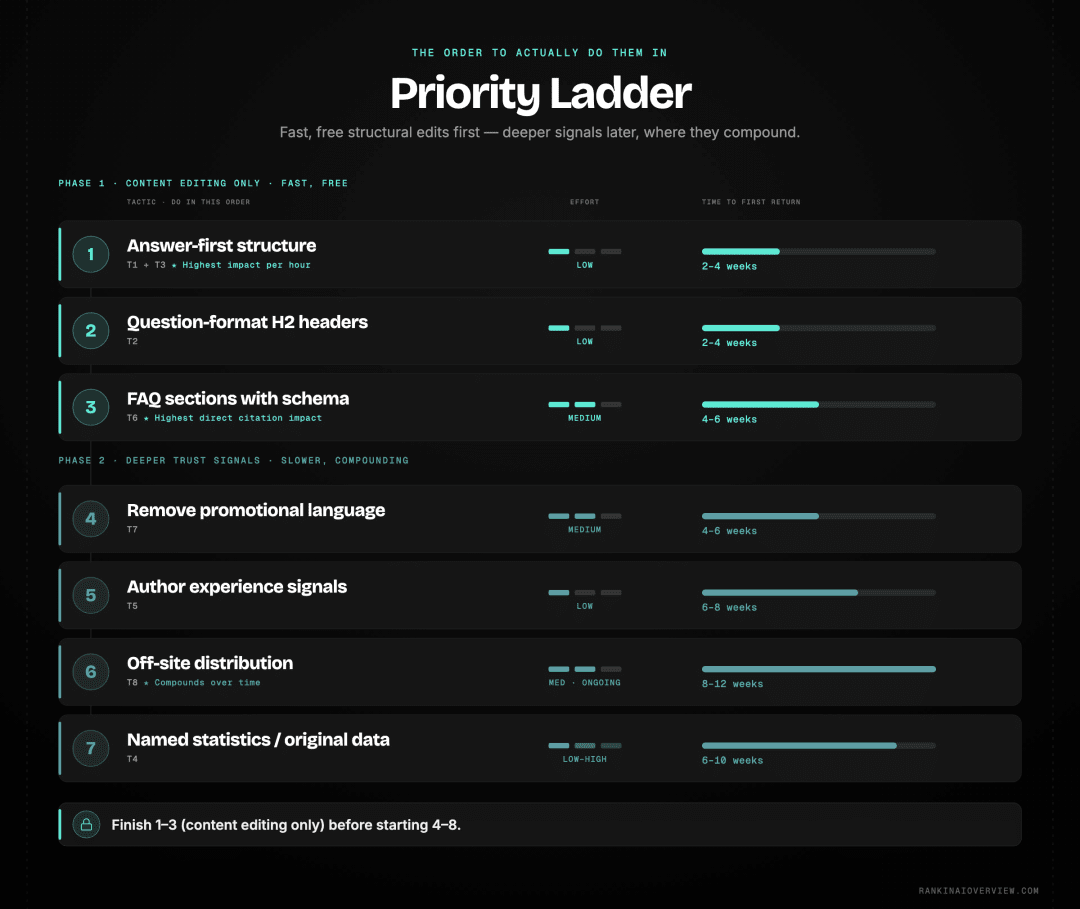
The eight tactics are ordered below by the speed of return and effort required. Complete tactics one through three before starting tactics four through eight. The first three require only content editing and produce the fastest measurable improvements. The later tactics require either more time investment or more external dependencies. Build the structural foundation first, then layer in the deeper signals.
| Priority | Tactic | Effort | Speed of Return | Best For |
|---|---|---|---|---|
| 1 | Answer-first structure (Tactic 1 and 3) | Low. 30-60 min per page | 2-4 weeks | All pages immediately. Highest impact per hour |
| 2 | Question-format H2 headers (Tactic 2) | Low. 15-30 min per page | 2-4 weeks | All pages. Quick win alongside Tactic 1 |
| 3 | FAQ sections with schema (Tactic 6) | Medium. 1-2 hours per page | 4-6 weeks | Long-form content. Highest direct citation impact |
| 4 | Remove promotional language (Tactic 7) | Medium. 45-90 min per page | 4-6 weeks | Pages with conversion-focused copy in opening sections |
| 5 | Author experience signals (Tactic 5) | Low. 20-30 min per page | 6-8 weeks | All published content. Requires real expertise to be effective |
| 6 | Off-site distribution (Tactic 8) | Medium. 2-3 hours per week ongoing | 8-12 weeks | Ongoing programme. Compounds over time |
| 7 | Named statistics (Tactic 4) | Low for third-party data. High for original research | 6-10 weeks | All content. Higher impact for content citing primary sources |
Conclusion
AI content optimisation is not mysterious. It is about making your content easy to extract, easy to trust, and easy to verify. Start with answer-first structure and question-format headers. Add FAQ sections with schema. Layer in author authority signals. Distribute content summaries off-site. Track your AI citation rate weekly using manual prompt testing and measure branded search volume monthly as the downstream signal that AI mentions are producing real brand awareness.
The eight tactics in this guide cover the complete how-to write for AI search framework. Apply them in priority order, starting with the structural changes that require the least effort and produce the fastest return. RANK IN AI OVERVIEW covers how AI engines evaluate and cite content across all major platforms in depth across its content library.
Frequently asked questions
How long does it take to see AI citation improvement after optimising content?+
For Perplexity, content structure improvements typically produce measurable citation improvements within two to four weeks because Perplexity crawls frequently. For Google AI Overviews, schema implementation and answer-first rewrites typically produce improvements within four to six weeks, depending on how frequently Google recrawls the target pages. The AIO case study documented earlier in this series saw the first citation on day 18 after implementing answer-first rewrites and FAQ schema simultaneously.
Does restructuring for AI hurt traditional Google rankings?+
No. [Google's official guidance on AI-generated content](https://developers.google.com/search/blog/2023/02/google-search-and-ai-content) confirms that helpful, well-structured content is what its systems reward regardless of production method or structural format. Answer-first structure improves featured snippet eligibility. Question-format headers improve match to conversational queries. FAQ schema enables rich results. All three of these changes improve Google ranking signals alongside AI citation probability. Practitioners consistently report zero negative ranking impact from AI content optimisation, with many reporting ranking improvements alongside AI citation improvements.
How many FAQ items should I include per post?+
Five to ten FAQ pairs per long-form article is the practical range. Fewer than five FAQ pairs produces a section that lacks enough coverage to serve users effectively. More than fifteen creates a FAQ section that is unwieldy and may dilute the signal quality by including questions that are only marginally relevant to the primary topic. The questions should be authentic user queries from People Also Ask, Google Search Console, and Perplexity follow-up suggestions. Each answer should be 30 to 50 words.
Explore with AI
Share this