How to Diagnose Why AI Is Not Citing Your Content
“Not getting cited by AI” is a symptom, not a diagnosis. Here is a repeatable workflow to find the failure mode behind each missing citation.

Key Highlights
- "We're not getting cited" is a symptom with several possible causes, and the fix for each is different, so guessing wastes effort on the wrong problem.
- In a 2026 study, a diagnostic system that first identified why a document failed to be cited, then applied targeted repairs, achieved over 40% relative improvement in citation rates while modifying only 5% of content, against 25% for generic rewriting.
- The productive unit of work is the failure mode: locate which stage of the citation pipeline a page fails at, then repair that stage rather than rewriting the whole page.
- Some pages cannot be fixed by on-page optimisation alone, and a good diagnosis tells you that too, so effort goes where it can actually move a result.
"We're not getting cited by AI" is a common complaint and a useless starting point. It is too vague to act on. Teams that stop there flail, trying random fixes and hoping something lands. The teams that make progress treat missing citations as a diagnosis problem rather than a mystery, and work it methodically until the actual cause surfaces for each page.
According to a 2026 study of citation failures in generative engines, a diagnostic system that first asks why a specific document is not cited and then applies targeted repairs achieved over 40% relative improvement in citation rates while modifying only 5% of the content, compared with 25% for baseline methods that apply generic rewriting rules uniformly. The lesson in those numbers is not that a particular tool is clever; it is that diagnosis beats blanket fixing. Knowing which thing is broken lets you change very little and gain a lot, while rewriting everything on a hunch changes a great deal and gains less. That is the entire case for treating missing citations as a diagnosis problem.
This guide gives teams a repeatable diagnostic workflow. It covers why systematic diagnosis beats guessing, what it means to find the failure mode rather than just the symptom, how to run the diagnosis step by step, the common failure modes you will find, how to repair without over-editing, and how to make diagnosis a habit. For the underlying method, our AI citation fix diagnostic is a close companion.
Why Do Teams Need a Systematic Diagnosis, Not Guesswork?
Because AI citation depends on several distinct factors, and the fix for each is different. A buried answer, a trust gap and an intent mismatch all produce the same symptom, invisibility, but demand different repairs. Without diagnosis you cannot tell which you have, so you change the wrong thing, see no result, and conclude AI visibility is a lottery when it is not.
The failure mode most teams fall into is treating "not cited" as one problem with one solution. They read an article about answer-first structure, restructure everything, and are baffled when half their pages still do not appear. The structural fix worked for the pages whose problem was structure and did nothing for the pages whose problem was thin trust or a mismatch with the query's intent. Effort went out; results came back uneven; and because nobody diagnosed first, nobody can say why. That randomness is not a property of AI search. It is a property of fixing without diagnosing.
A systematic approach also scales across a team in a way that intuition never does. When everyone follows the same diagnostic steps, findings are consistent and comparable, and fixes are prioritised by evidence rather than by whoever argued hardest in the meeting. One person's hunch about "we need more content" becomes a shared, inspectable finding: these twelve pages fail because the answer is buried, those five because the source is not trusted, these three because they answer a slightly different question than the one being asked. That is the difference between a content team that steadily earns citations and one that keeps relitigating the same guesses.
There is a cost argument too, and it is larger than it first appears. Every undiagnosed fix carries an opportunity cost: the hours spent rewriting a page whose problem was never its wording are hours not spent on the page you could actually have moved. Multiply that across a content backlog and a quarter disappears into work that was destined to fail, because it was aimed at the wrong cause from the start. Diagnosis is cheap relative to what it saves. Reading a cited competitor's page next to your own takes minutes; rebuilding a page on a false premise takes days and still leaves you invisible. Teams that resist diagnosis usually do so because it feels like a delay before the "real work," when it is the step that decides whether the real work is worth doing at all.
What Does It Mean to Diagnose the Failure Mode, Not Just the Symptom?
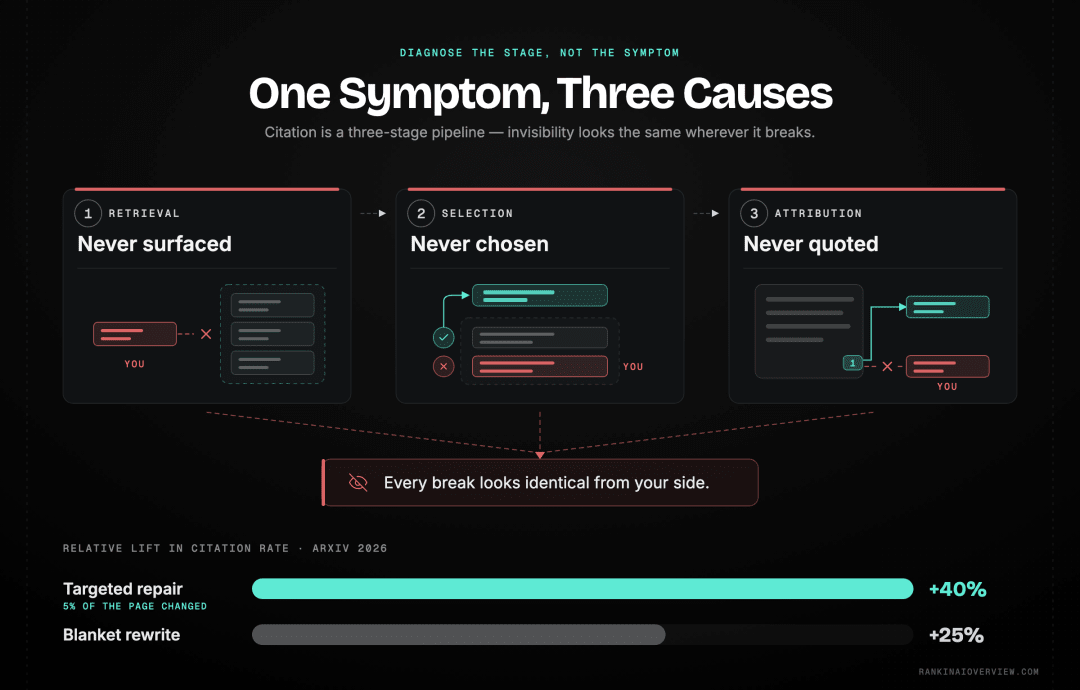
It means locating where in the citation process a page breaks, rather than just noting that it is absent. A page can be retrieved but not selected, selected but not quoted, or never retrieved at all. Each is a different failure at a different stage, and naming the stage is what tells you which repair could possibly work and which would be wasted.
This is the shift that separates real diagnosis from tidying. Being cited is not a single event; it is the end of a short pipeline. The engine has to retrieve your page as a candidate, judge it a good answer to the specific question, and then actually draw on it and attribute it in the response. A page can clear the first hurdle and fall at the second, or clear both and still not be the passage the engine quotes. The symptom, no citation, is identical in every case. The cause, and therefore the cure, is not. Diagnosing the failure mode means working out which hurdle your page is actually falling at.
"This paper introduces a diagnostic approach to GEO that asks why a document fails to be cited and intervenes accordingly."
Zhihua Tian and co-authors, citation-failure diagnostic study (2026)
The study that line comes from built the first taxonomy of citation failure modes spanning the stages of that pipeline, precisely because the generic alternative, applying the same rewriting rules to every page, fails to diagnose why any individual page is not cited. Its diagnostic system worked by identifying the specific failure, selecting a targeted repair for it, and iterating until citation was achieved, which is exactly the loop a team can run by hand. You do not need the automated system to adopt its logic: ask which stage a page fails at, fix that stage, re-check, repeat. The honest caveat the same study raises is that some pages face challenges optimisation alone cannot resolve, and generic rewriting can even harm long-tail content, which is itself a reason to diagnose before you touch anything. The broader disconnect between ranking and being cited, which sets up why these failure stages exist at all, is covered in our companion piece on why ranking well does not guarantee AI visibility.
How Do You Run a Citation Diagnosis Step by Step?
Run it prompt by prompt: list the queries you should be cited for, check who is cited today, compare your page against the cited sources at each pipeline stage, and record the specific failure mode for each gap. The comparison against what actually got cited is the step that turns a vague complaint into a precise, page-level cause you can act on.
A repeatable diagnostic workflow:
- List the buyer-intent prompts you should be cited for, in the words users actually use.
- Run each through the relevant AI engines and record which sources are cited.
- For prompts where you are absent, examine the sources that were cited instead.
- Compare them to your page at each stage: were you even retrievable, was your answer as direct, was the source as trusted, was it a closer match to the intent.
- Record the single most likely failure mode for each prompt as your fix list.
The comparison in step four is where the diagnosis actually happens, so it is worth doing carefully rather than at a glance. Read the cited source and your own page side by side and ask, in order: is there any sign the engine even considered my page, does the cited source state the answer more directly and self-containedly than mine, is it a more recognised or corroborated source, and does it match the precise question more exactly. The first "yes, they did this better" you hit is usually the failure mode, because the pipeline is sequential and the earliest failure is the one that matters. A page that is never retrieved cannot be helped by a clearer answer; a page that is retrieved but buries its answer will not be helped by more backlinks.
Order matters in that questioning because fixing a late-stage problem while an early-stage one is unresolved changes nothing. This is the mistake that makes diagnosis feel unreliable to teams that do it loosely: they spot that the cited source is more trusted, invest in trust, and see no movement, because the page was actually failing at retrieval a stage earlier and was never going to be selected regardless of its trust signals. Working the questions in pipeline order protects you from that. You are looking for the first broken link in the chain, not the most obvious difference, and the two are often not the same thing. Write down the single earliest failure for each prompt and resist the urge to list every way the cited page differs from yours, because most of those differences are downstream of the one that matters and will resolve, or become irrelevant, once the real failure is fixed.
Do this across a set of prompts and patterns emerge quickly. You will often find that many pages share a small number of failure modes, which is good news, because it means a handful of repair types will address most of your gaps. Running the comparison across many prompts is easier with tooling that records who is cited for each query and how often, and our guide to AI visibility metrics helps you turn those observations into numbers you can track over time rather than a one-off snapshot.
What Are the Common Failure Modes You Will Find?
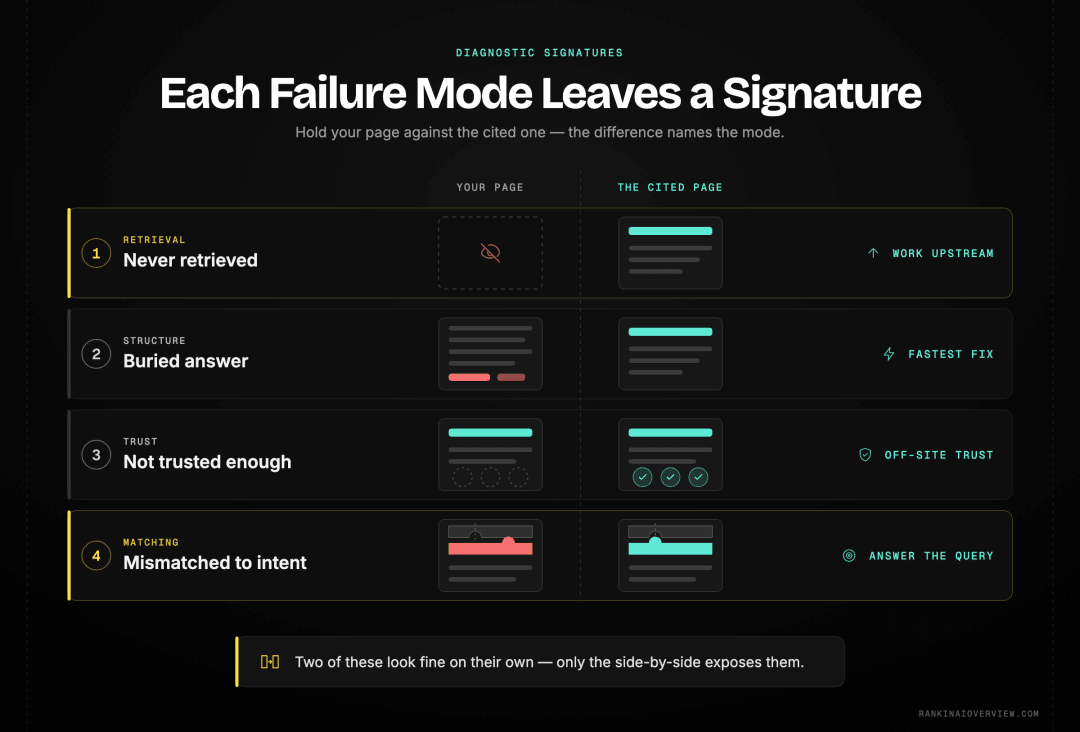
The usual failure modes are: never retrieved, retrieved but the answer is buried or not self-contained, retrieved but the source is not trusted enough, and retrieved but mismatched to the query's exact intent. Each maps to a different stage of the pipeline and shows a recognisable signature when you compare your page to the ones that were cited.
The failure modes and how they show up in diagnosis:
Never Retrieved
The engine never surfaced your page as a candidate, so nothing downstream could save it. In diagnosis this shows as your page being absent even when its content clearly covers the topic, often because the specific answer is not expressed in a way the engine can match to the query, or because the page is not recognised as relevant for that intent at all. This is the deepest failure and the one people most often misdiagnose, because it looks like every other kind of invisibility. The tell is that no amount of on-page polishing has ever moved it: if you have already sharpened the answer and strengthened the page and still see nothing, the problem is likely upstream, at retrieval, and the work belongs there instead, on relevance and recognition rather than wording.
Retrieved but the Answer Is Buried or Not Self-Contained
Your page was in the running, but its answer sits three screens down, is split across sections, or only makes sense with the surrounding article. The engine reached for a cleaner passage elsewhere. In diagnosis this is the clearest signature to spot: the cited source leads with a complete, standalone answer to the exact question and yours does not. It is also the fastest failure mode to repair.
Retrieved but Not Trusted Enough
Your page answered well, but a competing source carried stronger signals of credibility, more corroboration from independent sources, a more recognised entity behind it, so the engine preferred it in a close call. In diagnosis this shows when your content is genuinely comparable on clarity but the cited source is simply more established, which points to off-site trust work rather than on-page edits. Our guide to the trust signals AI recognises covers that work in detail.
Retrieved but Mismatched to Intent
Your page ranks for the topic but answers a slightly different question than the one being asked, so a more on-point source is cited instead. In diagnosis this shows when your content is strong but subtly off-target: it covers the area without stating the precise answer to the precise query, echoing why page-one pages miss AI Overviews. The repair is to answer the exact question directly, not to add more general coverage. This failure is easy to miss precisely because the page looks good: it is well written, thorough, and clearly relevant, so nothing jumps out as wrong. The mismatch only becomes visible when you hold your page against the specific question the engine was answering and notice that your page answers a neighbouring one. That is why the side-by-side comparison, rather than a review of your page in isolation, is what surfaces it.
How Do You Repair Without Over-Editing?
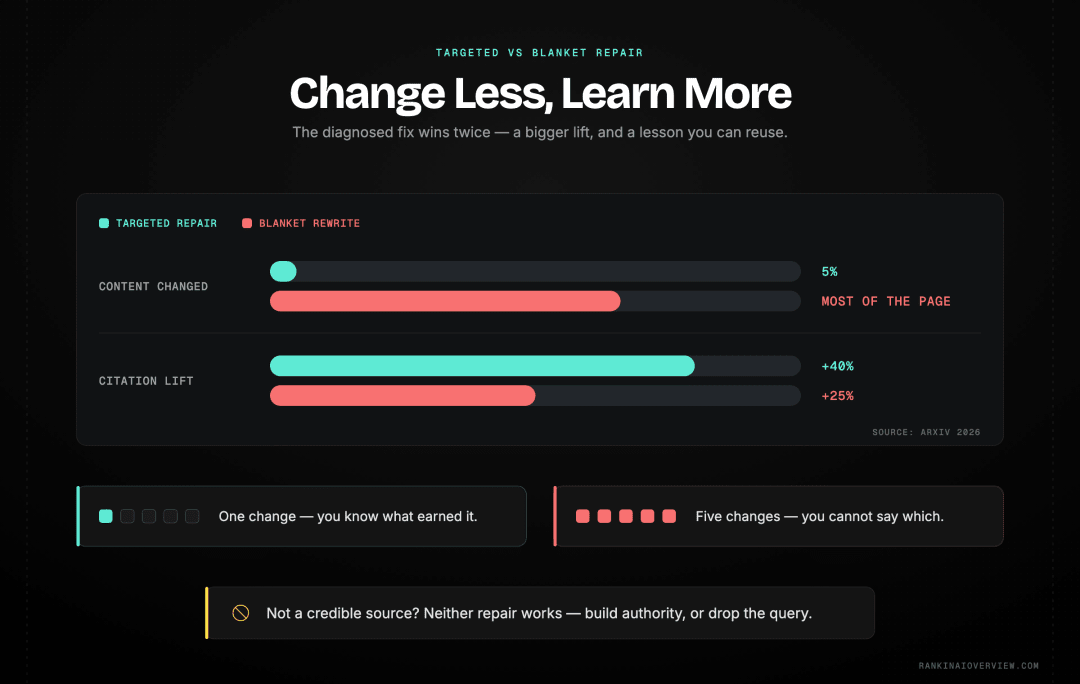
Repair the diagnosed failure mode and nothing else, then re-measure. The evidence is clear that targeted repair outperforms blanket rewriting: the study's diagnostic system gained over 40% in citation rate by changing only 5% of content, while generic rewriting changed far more for less, and could even harm weaker pages. Change the one thing you diagnosed, confirm it moved the result, then move on to the next page rather than the next edit on the same one.
This is the discipline most teams skip, and it costs them twice. Over-editing wastes effort, because you are rewriting parts of a page that were never the problem. Worse, it destroys your ability to learn, because when you change five things at once and the citation appears, you do not know which change earned it, so you cannot repeat the win on the next page. Changing only the diagnosed failure mode is not just cheaper; it is what turns each fix into a reusable lesson. When you know that surfacing the answer earned the citation on this page, you can apply that same targeted repair to every page with the same failure mode, with confidence rather than hope.
Sequence the repairs by speed and value. The buried-answer and intent-mismatch failures are usually fast, because they are about the shape and precision of what you already have, so fix those first on your highest-intent prompts to bank early wins and prove the process. Trust failures are slower, because credibility is earned off-site over time rather than edited on-page, so schedule that work deliberately rather than expecting it to pay off in a week. And accept the study's harder finding: some pages face challenges that optimisation alone cannot resolve. When diagnosis keeps returning "this page is simply not a credible source for this query," the honest answer may be to build the underlying authority first, or to decide the query is not worth chasing, rather than to keep rewriting a page that was never going to be cited. Knowing when to stop is part of a good diagnosis, and it is a judgement generic rewriting tools cannot make for you, because they never asked why the page was failing in the first place.
How Do You Build Diagnosis Into Your Content Process?
Make the citation check routine rather than a one-time panic. Run it on a schedule, treat each diagnosed failure mode as a task with an owner and a re-measure date, and review the results as a team. Folding diagnosis into your regular content review keeps new gaps surfacing early and keeps AI visibility improving as your content and the models both change.
The teams that sustain AI visibility do not diagnose once and declare victory. They fold the check into their normal content review, so that when a new page underperforms or an old citation slips, the gap surfaces early and gets assigned like any other piece of work. This matters because AI answers are not static: models update, competitors optimise, and a page that is cited today can quietly drop tomorrow. A routine diagnosis catches those regressions while they are still cheap to fix, instead of months later when someone notices traffic has fallen. It also builds a record over time, so that patterns become visible across the whole content library rather than one page at a time. When you can see that most of your never-retrieved failures cluster in one topic area, or that intent mismatches keep appearing on a particular kind of query, you can fix the process that produces them, not just the individual pages, which is the point at which diagnosis stops being maintenance and starts preventing the failures altogether.
Pair the routine with clear ownership and honest measurement. Each diagnosed gap needs an owner, a specific repair, and a date to re-check, or it lingers in a report and never gets fixed. And because citation results fluctuate from run to run and take a recrawl to show, the re-check should compare a stable before-and-after across several runs rather than reacting to a single result. That operational discipline, diagnose, assign, repair the one thing, re-measure properly, is what separates teams that steadily earn citations from those that keep asking, quarter after quarter, why AI is not citing them.
Conclusion
"We're not getting cited by AI" is not a diagnosis; it is a symptom, and several very different problems produce it. The teams that improve treat missing citations as a systematic investigation: identify the prompts, compare against the sources that were cited, and locate the specific stage of the pipeline where each page fails. That turns a vague, demoralising complaint into a concrete, page-level fix list.
From there, the winning move is restraint: repair the one failure mode you diagnosed, confirm it moved the result, and reuse that lesson on every page with the same problem, rather than rewriting everything and learning nothing. Build the check into your routine, give each gap an owner, and accept that a few pages need deeper work than editing can provide. A repeatable diagnostic workflow is what separates teams that guess from teams that steadily earn more citations, one diagnosed failure at a time, and it gets faster with every page because the same failure modes keep recurring and the same targeted repairs keep working.
Want a head start on your diagnosis? Run a free AI-visibility audit with Rank in AI Overview and see exactly which prompts you are missing and why.
Frequently asked questions
How do I find out why AI is not citing my content?+
Run a per-prompt diagnosis: list the queries you should win, check who is cited today, and compare your page against the cited sources at each stage of the citation pipeline. The earliest stage where the cited source clearly did better is your failure mode and your fix.
What are the most common reasons content is not cited by AI?+
The page is never retrieved, is retrieved but buries its answer, is retrieved but not trusted enough, or is retrieved but answers a slightly different question than the one asked. Each is a different failure at a different stage and needs a different repair, which is exactly why diagnosing the stage first matters more than reaching for a standard fix.
How do teams diagnose AI citation problems at scale?+
By following one consistent workflow across many prompts, comparing cited sources to their own pages and recording the failure mode for each, ideally supported by tools that show competitor citations. Consistency makes findings comparable and lets a team prioritise repairs by evidence.
What should I fix first to earn AI citations?+
Fix the buried-answer and intent-mismatch failures on your highest-intent prompts first, because they are fast and common. Change only the specific diagnosed problem, re-check the result, then tackle the slower trust work. Avoid rewriting whole pages, which wastes effort and hides which change worked.
How do I know if a citation fix actually worked?+
Re-run the same target prompts after the change has been recrawled and check whether you now appear among the cited sources. Compare a stable picture across several runs rather than a single check, since citation results fluctuate before they settle, and a lone before-and-after can easily catch two different rolls of the dice.
How often should teams run a citation diagnosis?+
Fold it into your regular content review, monthly for most teams, so new gaps and slipped citations surface early. Making diagnosis a routine habit rather than a one-time response keeps AI visibility improving as your content and the underlying models change.
Explore with AI
Share this


