Why Do Pages Rank in Search but Not Get Cited by AI?
A page can rank on Google and still be missing from the AI answer above it. Here is why ranking and citation are decided separately.

Key Highlights
- Ranking and AI citation are not the same contest. Ranking decides which pages are listed. Citation decides which passage gets lifted into a synthesised answer, and the two are settled at different stages of a generative search pipeline.
- A 2026 study comparing Google organic search with five generative search systems found that 27% of the domains Google's AI Overviews consult do not appear anywhere in the top 100 organic results, and that AI Overview links overlap the top 10 organic results less than half the time.
- Ranked pages lose citations for concrete reasons: the answer is buried, the passage is not self-contained, trust or freshness signals lag a competitor, or the content does not match the exact question. None of these is fixed by adding markup.
- What actually earns a citation is being the clearest, most self-contained, most trustworthy answer to a specific question, backed by earned signals the model already associates with your brand.
- Converting a page that already ranks is often faster than building a new one, because the authority the model needs is partly in place. The work is making the answer extractable and trusted.
You optimised the page. You earned the links. You reached the top of the results. And then the AI answer sitting above those results quoted someone else. For anyone who spent a decade treating the number-one position as the finish line, this is the strangest part of AI search: winning the ranking no longer guarantees you are in the answer. According to a 2026 study comparing Google organic search with five generative search systems from Google, OpenAI and Perplexity, 27% of the web domains that Google's AI Overviews consult do not appear anywhere in the top 100 organic results, and the links AI Overviews cite overlap with the top 10 organic results less than half the time. The ranked list and the cited answer are drawn from substantially different pools.
That single finding dissolves the apparent contradiction. Ranking and citation feel like the same thing because for twenty years they were: the page that ranked was the page that got the click. In AI search they have split into two separate decisions. Ranking still asks whether your page is relevant and authoritative enough to be retrieved. Citation asks a narrower question, whether one specific passage on your page is the clearest and most trustworthy answer to the exact thing a person asked. A page can pass the first test comfortably and fail the second, and that is precisely what produces the gap you are staring at.
This guide is the map for that gap. It explains why ranking and citation reward different things, what it actually takes to earn a citation once you understand the difference, the specific reasons a ranked page gets skipped, whether the gap behaves the same across every AI engine, how to convert a page that already ranks into one that gets cited, and how to measure whether any of it is working. If you have ever asked why a lower-ranked competitor keeps showing up in the answer instead of you, the pieces that follow are the reason, and the fix.
Why Do Ranking and AI Citation Reward Different Things?
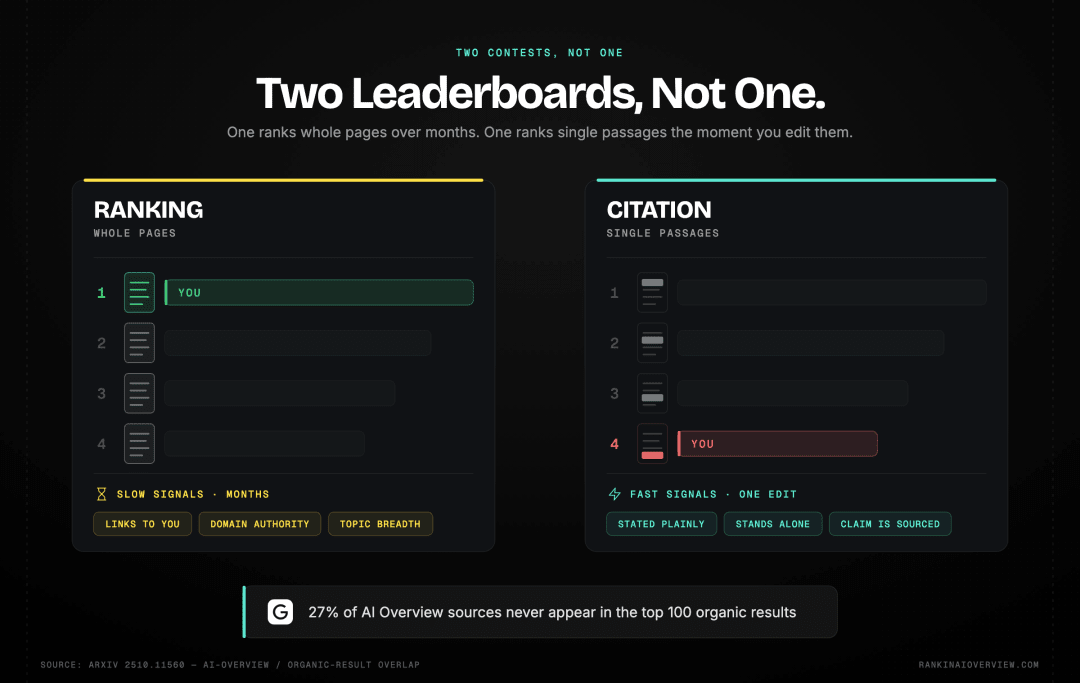
Ranking and citation reward different things because they are settled at different stages. Ranking is a page-level judgement about whether your whole page deserves to be retrieved. Citation is a passage-level judgement about whether one chunk of your text is the cleanest answer to a specific question. A page can win the first and lose the second.
Traditional search ends at retrieval. The engine assembles a ranked list, and the person chooses from it. Generative search treats retrieval as only the opening stage. After a set of candidate documents is pulled, the system reranks them, then a model reads across the survivors and decides which passages to synthesise into an answer and which sources to attribute. Your ranking influences whether you enter that pipeline at all, but it has almost no say over what happens at the later stages, where the citation is actually awarded.
This is why the gap is structural rather than accidental. The signals that win a page-level ranking contest, accumulated authority, link equity, overall topical relevance, are real and slow-moving. The signals that win a passage-level citation contest, a direct answer stated up front, a self-contained explanation, a trust cue the model recognises for that exact claim, are local to the passage and can be present or absent regardless of how well the page ranks. Two different contests, two different sets of winning moves. A page that never learned the second set will keep losing citations no matter how high it climbs.
It helps to stop picturing one leaderboard and start picturing two. On the first, your page competes against every other page for a position. On the second, one paragraph of your page competes against one paragraph of everyone else's for a sentence in the answer. You can dominate the first leaderboard and not even place on the second, and the reader only ever sees the second.
There is a further wrinkle that makes the split easy to miss. The two contests use overlapping but non-identical evidence. Ranking leans heavily on cross-page signals that build slowly, the links pointing at you, the authority of your domain, the breadth of your coverage on a topic. Citation leans on within-passage signals that can change the moment you edit a paragraph, whether the answer is stated plainly, whether it stands alone, whether the specific claim carries a source the model trusts. Because the slow signals and the fast signals live in different places, you can pour months into the first and see your rankings climb while your citation rate does not move at all. Nothing is broken. You have simply been feeding the contest you were already winning.
What Does It Actually Take to Earn an AI Citation?
Earning a citation takes being the clearest, most self-contained, most trustworthy answer to a specific question. The model is not rewarding the best page overall. It is lifting the passage it can extract cleanly, verify quickly and attribute confidently. Substance and clarity win the passage, not markup or ranking.
Flip the problem around and the requirements become concrete. A passage that gets cited almost always does four things at once. It answers the exact question directly, usually in its opening sentence, so the model does not have to hunt or infer. It stands on its own, meaning a reader who saw only that paragraph would still understand it, because the model frequently lifts it away from the surrounding page. It carries a recognisable trust signal for the claim it makes, a named source, a figure, a date, an author the engine already associates with the topic. And it matches the intent behind the question rather than merely the keywords in it.
Notice what is absent from that list. There is no mention of schema, structured-data markup or a particular tag. A great deal of older optimisation advice fixated on exactly those things, and that is the mistake. Markup helps a machine parse your page, but it does not make a weak passage into the clearest answer, and the evidence that formatting-only changes move citations is thin. What moves citations is the substance the passage carries and how directly it is expressed. Treat structure as a way of surfacing a genuinely good answer, not as a trick that manufactures one. A model can parse a hundred perfectly tagged pages and still quote the one that simply said the thing most clearly.
The reassuring consequence is that the raw material is usually already on your ranked pages. A page ranks because it covers the topic well. Buried inside that coverage is very often the exact answer the model wants, written a little too indirectly, placed a little too far down, or missing the one trust cue that would let the engine attribute it with confidence. Earning the citation is frequently less about writing something new and more about promoting what is already there into an extractable, self-contained, trusted form. That is also why the question people often ask, "what makes some sites show up in AI answers at all", has the same answer as this one: they are the sites whose passages meet these conditions consistently.
Consistency is the word that does the quiet work there. A single well-formed passage might win a single citation, but the pages that show up again and again are the ones where this discipline runs through every section, so that whichever slice of the topic a person asks about, the matching passage is ready to be lifted. That is what separates a page that occasionally gets quoted from a page an engine returns to as a reliable source. The model is, in effect, learning that your content answers cleanly, and it rewards that reliability with repeat citations across related questions. You are not chasing one answer box. You are building a page the engine can quote from wherever it looks.
"Existing approaches remain largely impractical under realistic conditions and often degrade performance in retrieval and reranking."
Sunghwan Kim and co-authors, SAGEO Arena study (2026)
Why Does a Page That Ranks Still Fail to Get Cited?
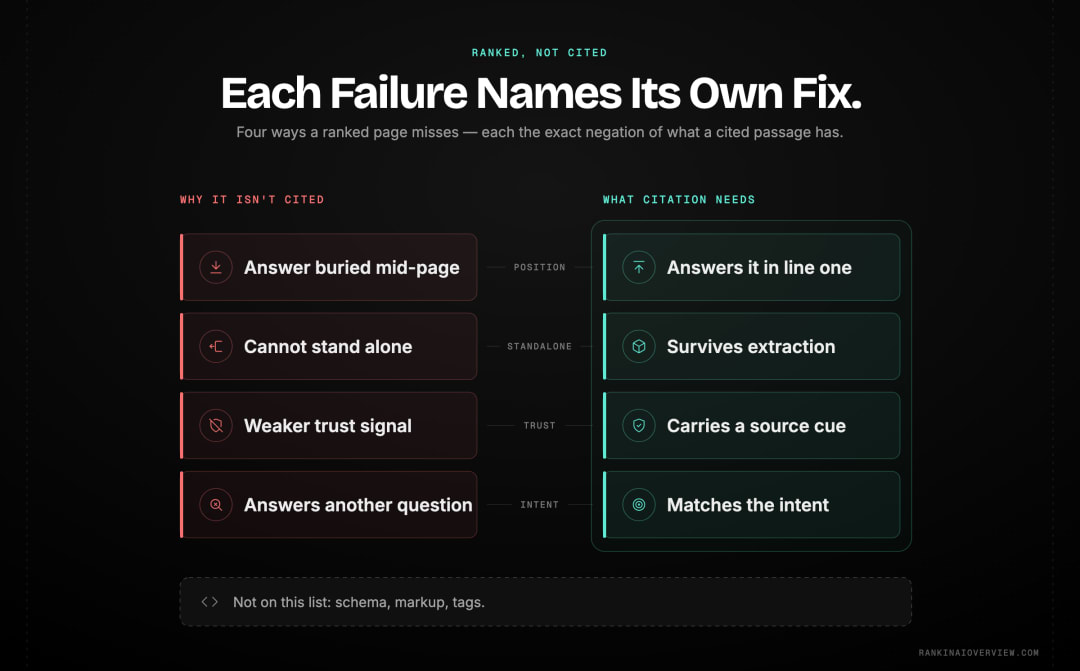
A ranked page fails to get cited when its answer is buried, its passage is not self-contained, its trust or freshness signals lag a competitor, or it does not match the precise question. Each failure blocks the model from extracting a clean, verifiable answer, so it turns to a page that does not.
The buried answer. This is the most common cause and the easiest to fix. The page contains the right answer, but it arrives in the fourth paragraph, after context, caveats and a preamble. The model extracting a passage tends to reward the page that states the answer first, even one ranked below you. Everything you needed was on the page. It was simply in the wrong place.
The passage that cannot stand alone. AI answers lift text out of its surroundings. A sentence that depends on the paragraph above it ("as noted, this figure doubled") becomes unusable once separated. Passages that carry their own context, naming the subject and the claim in full, survive extraction. Ones that lean on the rest of the page do not, however well the page ranks.
Lagging trust or freshness. When two pages both answer the question, the model leans toward the one with the stronger or fresher signal for that specific claim, a clearer source, a more recent date, an author or brand it more readily associates with the subject. A competitor ranked below you can carry a better trust signal on the exact passage and take the citation on that basis alone, particularly on fast-moving topics.
Intent mismatch. A page can rank for a query's keywords without answering the question the person actually asked. If someone wants to know whether something is safe and your page ranks by explaining how it works, a more on-point page earns the citation regardless of position. Ranking rewards topical relevance. Citation rewards answering the specific question, and those are not always the same page.
The pattern underneath all four is consistent: ranking got you into the room, and then something about the passage, its placement, its independence, its trust cue or its aim, stopped the model from choosing it. For a focused walkthrough of finding which of these is hurting a given URL, our guide on diagnosing why a page ranks on Google but not in AI works through it fix by fix.
Does the Ranking-Citation Gap Show Up Across Every AI Engine?
Yes, the gap appears on every engine, but the cause shifts. Google AI Overviews build partly on organic rankings, so among retrieved pages the citation is decided by clarity and trust. ChatGPT and Perplexity run their own retrieval, where your Google ranking may barely factor into the decision at all.
On Google's AI Overviews, your ranking still does something. It helps determine whether your page is in the candidate pool the overview draws from. But being in the pool is the start, not the end. Once several ranked pages qualify, the passage-level contest decides which one is quoted, which is why a page can rank on the first results page and still be absent from the overview above it. The gap here is about winning extraction and trust among pages that already qualified, a point our piece on why a number-one ranking does not guarantee AI visibility examines in depth.
On engines with independent retrieval, the gap can be far wider, because your Google position is not a direct input. A page can sit at the top of Google and never be cited by Perplexity, which assembles its own sources against its own signals. This is the same phenomenon documented in the research above, where cited domains routinely sit outside the traditional ranked list entirely. It is also why our explanation of why AI engines cite pages that do not rank on Google matters: optimising purely for one engine's ranking leaves every other engine's citation to chance. Thinking across engines, rather than defending a single position, is the shift that the gap forces.
The practical upshot is that "am I cited" is not one question but several, and the answer can differ sharply between engines for the very same page. You might be quoted confidently by Google's overview, ignored by Perplexity, and cited by ChatGPT only when the question is phrased a particular way. Each engine is running its own pipeline over its own corpus with its own trust signals, so a page tuned to satisfy all of them tends to share a common core, a direct answer, a self-contained passage, a verifiable claim, rather than a Google-specific trick. That common core is the reason the fixes in the next section work across the board instead of on one engine at a time. Optimise the passage, not the platform, and the gains travel.
How Do You Turn a Page That Ranks Into One That Gets Cited?
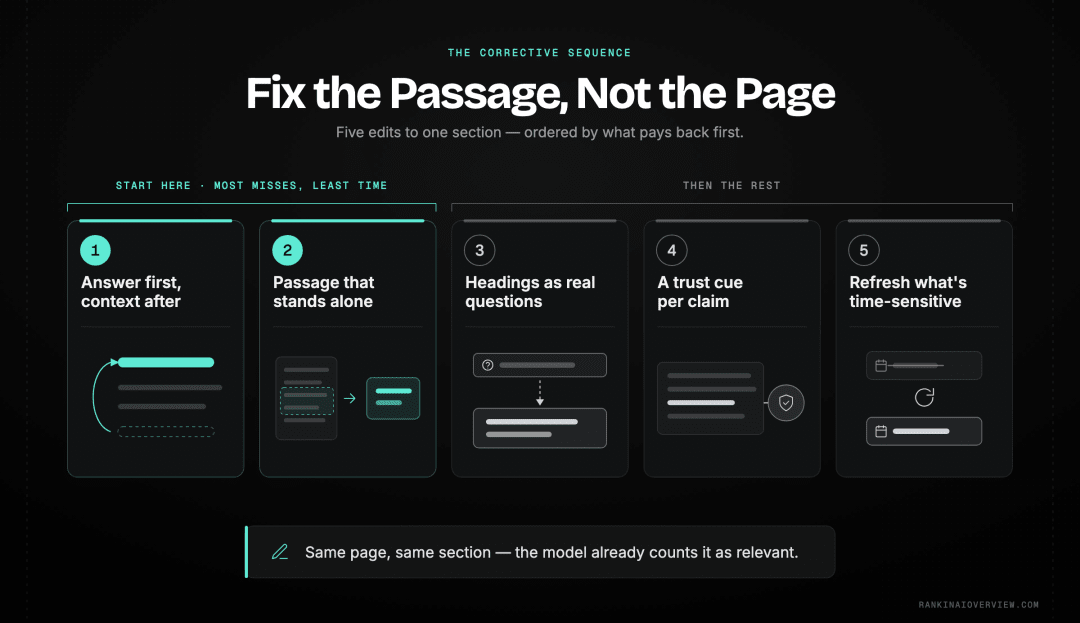
Turn a ranked page into a cited one by rebuilding its passages for extraction and trust. Lead each section with the direct answer, make every key passage self-contained, attach a clear source or date to each claim, and align the content with the exact question. You are converting relevance into a quotable answer.
Work in this order, because it moves the most citations for the least effort:
- Promote the answer to the top of each section. Find the sentence that directly answers the section's question and move it to the first line, ahead of the context. This alone resolves the single most common cause of missed citations.
- Make each passage stand on its own. Rewrite key sentences so they name their subject and claim in full, with no dependence on the paragraph before. Assume the model will read that passage in isolation, because it often will.
- Phrase headings as the real questions. Match your section headings to how people actually ask, so the model can map the question to your answer without inference. This is about intent alignment, not decoration.
- Attach a trust cue to each claim. Add the named source, the figure, the date or the author that lets an engine verify and attribute the passage confidently. A claim the model cannot source is a claim it is reluctant to quote.
- Refresh anything time-sensitive. Update stale statistics, years and examples so a freshness-weighting engine does not prefer a newer competitor on an evolving topic.
Start with the buried-answer fix and the self-contained rewrite, since together they address most misses and take the least time. The advantage you hold over a brand-new page is real: because these pages already rank, the model already treats them as relevant and partly authoritative, so a passage-level fix can flip them into citation faster than a new URL could earn its way in from nothing. You are not starting over. You are finishing a job the ranking left incomplete.
How Do You Measure Whether You Are Closing the Gap?
Measure the gap page by page. For each ranked page that should be cited, record whether AI engines cite it today, apply your fixes, then re-check the same questions after recrawling. If citations rise on pages whose rankings held steady, your extraction and trust work is the reason. Track it against competitors over time.
Begin with a baseline, because without one you cannot separate a real improvement from normal AI-answer fluctuation. List the pages that already rank well and should, on merit, be winning citations. For each, note the questions it ought to answer and whether any engine currently cites it for them. That snapshot is your before. It is worth capturing across more than one engine, since the same page can be cited by one and ignored by another, and the gap you are closing may be engine-specific.
Then apply the passage-level fixes, allow time for the engines to recrawl, and re-run the same checks. Resist the urge to judge a single re-check, because AI answers wobble from one run to the next even when nothing on your page has changed. Look instead at the direction of travel across several checks and several queries, so a genuine gain is not mistaken for noise and a lucky citation is not mistaken for a fix. Watch ranking and citation together rather than in isolation. A page that holds its position and gains citations is the clean signal that you have genuinely closed the gap rather than simply reshuffled it. For how this sits inside a wider measurement discipline, our guide on SEO benchmarking versus AI visibility benchmarking sets out the metrics that matter and the ones that only look reassuring. Measured this way, closing the gap stops being guesswork and becomes a loop you can run deliberately, page by page, until the pages that rank are the pages that get quoted.
Conclusion
The gap between ranking and AI citation is not a glitch or a contradiction. It is the visible edge of a deeper change: retrieval and citation, once the same decision, are now settled at different stages by different rules. Ranking asks whether your page belongs in the pool. Citation asks whether one of your passages is the clearest, most trustworthy answer to a precise question. You can win the first and lose the second, and the reader only ever sees the second.
The way through is not to rank harder. It is to finish the job your ranking started, by promoting your answers to the top, making your passages stand alone, attaching real trust cues to your claims, and matching the exact question, so that the pages already earning positions start earning the citations that positions no longer guarantee. The raw material is usually already there. It just needs to be made quotable.
If you want to see which of your ranked pages are missing citations, and the specific reason each one is being skipped, Rank in AI Overview offers a free AI-visibility audit that baselines your pages and points to the fixes that will move them.
Frequently asked questions
Why does my page rank on Google but not get cited by AI?+
Because ranking and citation are decided separately. Ranking retrieves your page for being relevant and authoritative. Citation lifts one passage for being the clearest, most self-contained, most trustworthy answer to a specific question, which a buried or dependent passage fails to be.
Can a page be cited by AI without ranking well?+
Yes, and it happens often. Research shows a large share of AI-cited domains sit outside the top organic results entirely. Engines with their own retrieval select passages on their own signals, so a page can be cited without ranking, and rank without being cited.
Why does AI quote a lower-ranked competitor instead of me?+
Usually because their passage answers the exact question more directly, stands on its own better, or carries a stronger trust or freshness signal for that claim. Those passage-level qualities can outweigh your higher ranking position when the model chooses what to quote.
Does adding schema markup make my page get cited?+
Not on its own. Markup helps a machine parse your page, but it does not turn a weak or buried passage into the clearest answer, and evidence that formatting-only changes lift citations is weak. Substance, directness and trust signals are what move the needle.
Is the ranking-citation gap the same on every AI engine?+
No. On Google AI Overviews your ranking helps you qualify, then clarity and trust decide among qualified pages. On engines with independent retrieval, such as Perplexity, your Google ranking may barely factor in, so the gap can be much wider there.
How long does it take a fixed page to start getting cited?+
It varies by engine and recrawl speed, but ranked pages often convert faster than new ones. Because the model already treats them as relevant and authoritative, a passage-level fix can flip them into citation once the engine recrawls and re-evaluates the page.
Explore with AI
Share this


