How to Rank Your Website in Both GEO and Google AI Overviews: A Complete 2026 Guide
GEO and AIO are related but different. Here is how to optimise for both Generative Engine Optimization and Google AI Overviews with one coherent strategy in 2026.
SummaryGEO, AIO, and AEO are different labels for the same shift in search: optimizing content to be cited by AI-powered answer engines. Success comes from combining strong SEO foundations, answer-first content, schema markup, and trusted brand signals.
Instead of separate strategies, businesses should follow a unified approach that improves visibility across Google AI Overviews, ChatGPT, Perplexity, and other AI search platforms simultaneously.
Read moreShow less
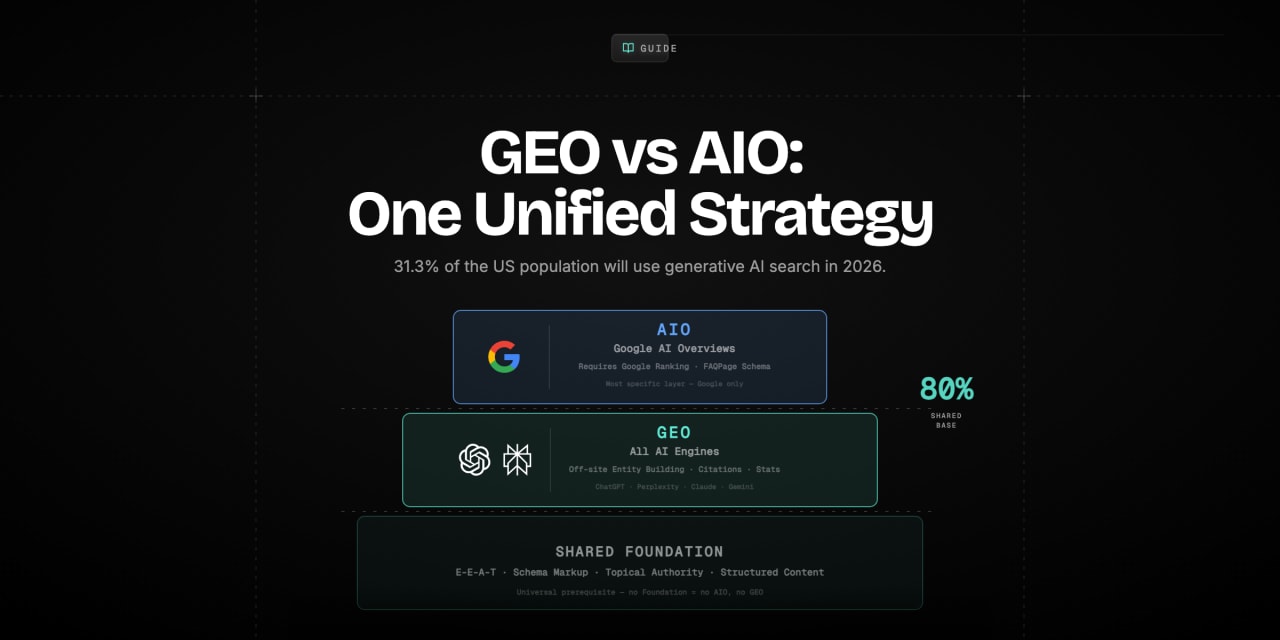
GEO. AIO. AEO. LLMO. The acronym explosion in AI search is real, and for most marketers, genuinely confusing. According to EMARKETER's 2026 forecast on GEO and AEO, 31.3% of the US population will use generative AI search tools in 2026\\. That is a mainstream audience, not an early adopter niche. Yet most guides covering GEO vs AIO optimization are written for practitioners who already understand the distinctions. This guide is written for everyone else.
The confusion is understandable. GEO, AIO, AEO, and LLMO are used interchangeably in some articles and treated as entirely separate disciplines in others. The practical consequence is that beginners either try to run separate strategies for each acronym (which doubles the workload unnecessarily) or ignore the distinctions entirely (which means missing the platform-specific tactics that actually move the needle).
This guide gives you a clear explanation of each term, the shared foundation that serves all AI search platforms simultaneously, the specific tactics that differ by platform, and the six-step strategy that covers how to rank in AIO and GEO without duplicating effort. By the end of this guide, the acronyms will make sense and the strategy will be actionable.
What Is the Difference Between GEO, AIO, and AEO?
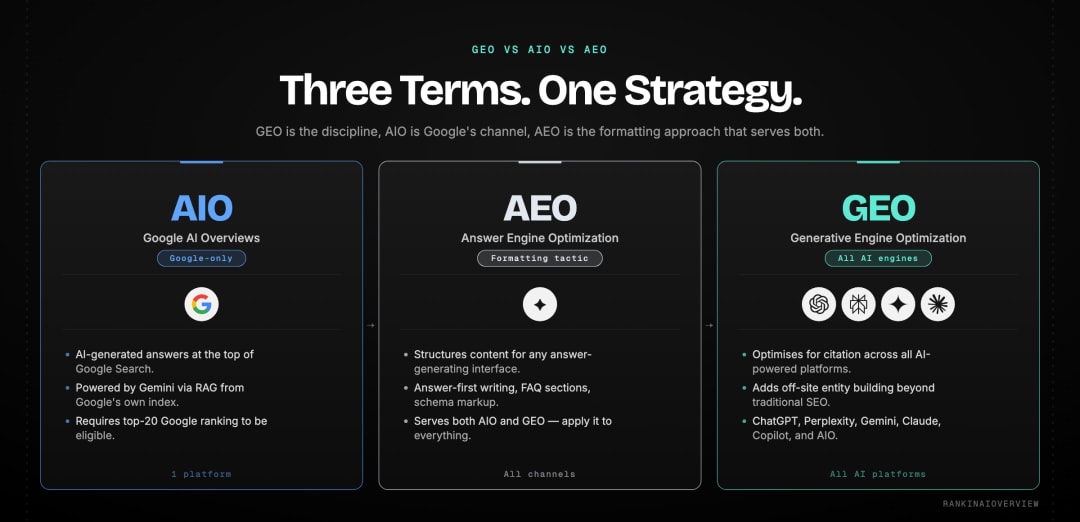
GEO is the broad discipline covering optimisation for all AI-powered search engines including ChatGPT, Perplexity, Gemini, and Google AI Overviews. AIO refers specifically to Google's AI Overviews feature. AEO sits between them, focusing on any system that generates direct answers rather than ranked lists. Understanding which term describes which channel is the starting point for any GEO SEO strategy. |
|---|
What Are Google AI Overviews?
Google AI Overviews (AIO) are the AI-generated summary answers that appear at the top of Google's search results pages. Google confirmed in its official AI Overviews documentation that AI Overviews reached two billion monthly users by mid-2024 and have since expanded across 53 languages and more than 40 markets. They are powered by Google's own Gemini model and pull from the same index that powers traditional organic search through a Retrieval-Augmented Generation process.
The defining characteristic of AIO is that it is Google-native. It lives inside the Google search results page. It retrieves from Google's own index. This means optimising for AIO is closely related to optimising for traditional Google SEO, with specific additional requirements around content structure and schema markup. A page not indexed by Google cannot appear in AIO. A page not ranking in the top 20 of Google is unlikely to be cited, since approximately 97% of AIO citations come from Google's top 20 results.
What Is Generative Engine Optimization?
Generative Engine Optimization (GEO) is the broader discipline of optimising content and brand presence so that AI-powered platforms cite, recommend, or mention a brand when users ask questions. The term was coined in original research from Princeton, Georgia Tech, and the Allen Institute for AI. GEO covers ChatGPT, Perplexity, Gemini, Microsoft Copilot, Claude, and any other AI system that generates answers from retrieved content. It includes Google AI Overviews as one of many platforms, but is not limited to Google.
The generative engine optimization beginner distinction to understand: GEO evaluates trust and entity signals across the entire web, not just the Google index. As a generative engine optimization beginner, the most important mental shift is from "how do I rank" to "how do I become trustworthy across the sources AI engines already trust." That is the question GEO is designed to answer.
Where Does AEO Fit In?
Answer Engine Optimization (AEO) is the practice of structuring content to appear in any answer-generating interface: featured snippets, voice assistants, AI Overviews, and AI chatbots. It is a tactical approach rather than a channel-specific discipline. AEO content formatting, specifically answer-first structure, FAQ sections, and direct-answer blocks, serves both GEO and AIO simultaneously. Practitioners who invest in AEO are making their content more extractable for any system that generates answers from retrieved content, regardless of which platform that system is built on.
For the generative engine optimization beginner, the practical summary is this. SEO is the foundation that makes your content discoverable. AEO is the formatting approach that makes it extractable. GEO is the broader visibility discipline that includes off-site signals, entity building, and community presence. AIO is the Google-specific target within the GEO landscape. You do not need four separate strategies. You need one strategy that addresses each dimension in the right sequence.
What Shared Foundation Serves Both GEO and AIO?

Approximately 80% of what serves Google AI Overviews also serves generative engine optimization across other platforms. This shared foundation is the most efficient investment a beginner can make because it produces returns across all AI search channels simultaneously. The foundation has four components: direct-answer structured content, E-E-A-T signals, schema markup, and topical authority. |
|---|
Direct-answer structured content is the most immediately impactful change for any team starting with GEO vs AIO optimization work. Every H2 section should open with a self-contained, direct answer to the question the section heading poses. That answer should be 40 to 60 words long and should make sense when extracted without surrounding context. This is because AI engines extract answers at the passage level. A page that buries its core answer in paragraph three of a long section is harder to extract than a page that leads with the answer and expands below it.
E-E-A-T signals are the trust foundation that AI engines and Google both evaluate. Google's Search Quality Rater Guidelines define Experience, Expertise, Authoritativeness, and Trustworthiness as the primary framework for evaluating content quality. AI engines apply the same framework when deciding what is safe to cite. Named authors with verifiable credentials, inline citations to primary sources, and content that demonstrates first-hand experience with the subject all build E-E-A-T signals that serve both channels simultaneously.
Schema markup is the structural bridge between GEO and AIO. Schema.org's FAQPage specification and Article schema make content parseable by both Google's AI Overview retrieval system and by the structured data understanding layer that AI engines use to identify content types. Implementing FAQPage schema on every long-form article and Article schema on every blog post takes less than an hour per page and produces consistent citation eligibility improvements for both channels.
Topical authority is the depth and breadth of your content cluster on a given subject. A site that publishes thirty interconnected articles covering every dimension of a topic signals to both Google and independent AI engines that it is the reliable reference point in its category. This is how to rank in AIO and GEO through content strategy: build the cluster before trying to optimise individual articles. AI engines encounter a topically authoritative site across many related queries, which compounds its citation probability across all of them.
Where Do GEO and AIO Diverge?
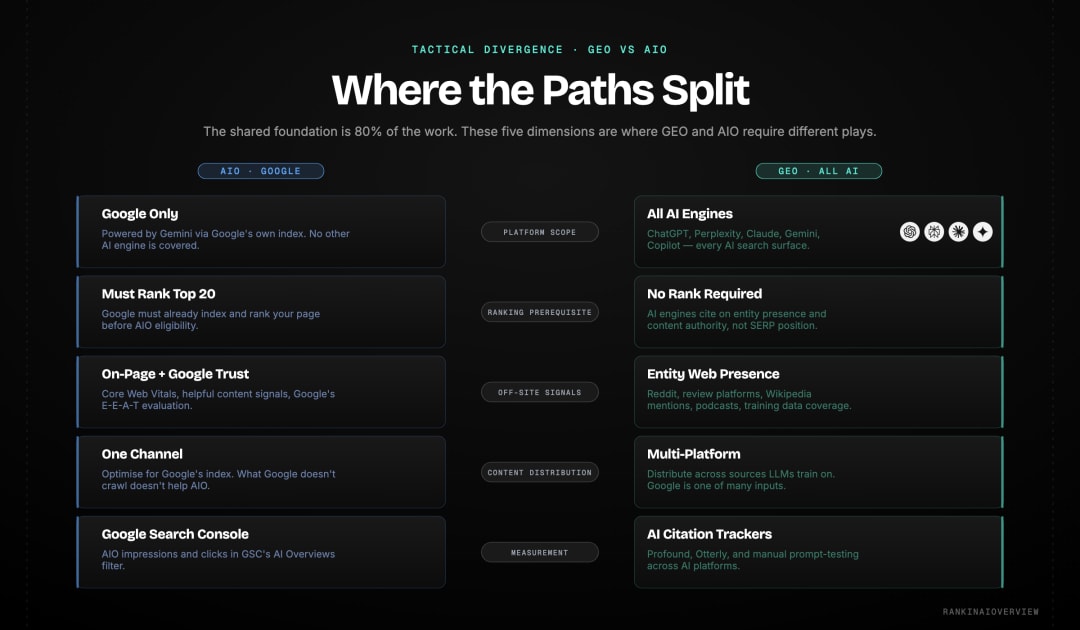
GEO vs AIO optimization diverges on two specific dimensions: retrieval eligibility requirements and off-site signal weighting. AIO requires Google ranking as a prerequisite. GEO across ChatGPT and Perplexity does not. AIO weights traditional Google ranking signals more heavily. Broader GEO weights off-site entity signals more heavily. The platform-specific tactics in this section are layered on top of the shared foundation, not instead of it. |
|---|
Optimising for AIO Specifically
The single most important specific requirement for Google AI Overviews is Google organic ranking. A page not ranking in Google's top 20 for the relevant query is not eligible for AIO citation. This makes traditional SEO investment, specifically technical health, backlink authority, and on-page keyword relevance, a prerequisite rather than an optional element for AIO performance.
-
Ensure your page ranks in Google's top 20 for the target query before investing in AIO-specific content optimisation
-
Implement FAQPage schema: AIO extraction favours pages with explicitly structured question-and-answer pairs
-
Prioritise content freshness: Google's retrieval layer for AIO weights recently updated content more heavily than for traditional ranking
-
Use HowTo schema for instructional content: AI Overviews extract procedural steps effectively when HowTo markup is implemented
-
Add breadcrumb schema to show topical hierarchy: AIO favours pages that fit clearly into a defined topic structure
Optimising for GEO Broadly
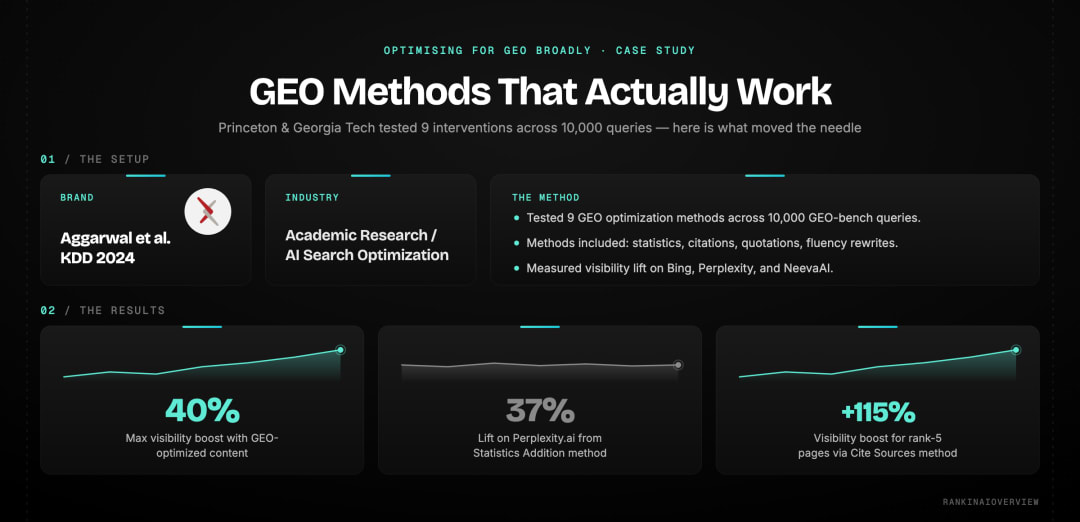
For GEO across Perplexity and ChatGPT, the platform-specific requirements differ from AIO significantly. Perplexity maintains its own independent crawler and index. A page with no meaningful Google ranking can appear in Perplexity answers if it is structurally strong and semantically relevant. This makes Perplexity the most accessible AI citation channel for new sites or sites with limited domain authority.
-
Build Reddit presence: Reddit is the top-cited domain on Perplexity. Genuine contributions in relevant communities produce GEO citations independently of your website ranking
-
Establish review platform profiles: G2, Capterra, Trustpilot, and relevant industry directories create the third-party corroboration that AI engines use to validate brand credibility
-
Submit to Bing Webmaster Tools: ChatGPT Search uses Bing's index as its primary live retrieval source. Sites that have not submitted to Bing are invisible to ChatGPT's live search layer
-
Build entity recognition: Wikipedia eligibility, Wikidata entries, and consistent brand name and description across all platforms tell AI engines that your brand is a verified entity in its category
-
Seek industry publication mentions: citations in recognised industry publications build the third-party authority signal that AI engines weight more heavily than brand-owned content
“ GEO methods can significantly increase a website's visibility in AI-generated responses. The research tested seven specific interventions and found that authoritative citation-style content, statistical data inclusion, and quotation integration produced the most consistent visibility improvements across AI platforms. Aggarwal, M. et al. Princeton University, Georgia Tech, Allen Institute for AI. Original GEO research, NeurIPS 2024 Source: arXiv: Generative Engine Optimization (2311.09735) |
|---|
What Is the Six-Step Unified Strategy for GEO and AIO?

The six steps below are sequenced deliberately. Each step builds the foundation for the next. Teams that start at step three or four without completing steps one and two consistently underperform compared to teams that work through the sequence. The order is not arbitrary. It reflects the dependency structure of how AI engines evaluate and retrieve content. |
|---|
Step 1: Rank on Google. Technical SEO, backlink authority, and keyword-optimised content are the prerequisites for AIO citation and the eligibility baseline for Google's broader search index, which ChatGPT and Gemini also use. A site with poor technical health or thin authority cannot achieve consistent AI citation regardless of how well its content is structured. Fix the technical foundation before optimising anything else.
Step 2: Structure every page for direct extraction. Rewrite the opening 150 words of your most important pages to lead with a direct, self-contained answer to the page's primary query. Add a FAQ section with 5 to 10 questions and answers to every long-form piece. Princeton's GEO research found that adding statistics, quotations, and clear formatting increased AI citation probability by 30 to 40 percent. This step serves both GEO and AIO simultaneously, producing the highest return on time invested of any single optimisation action.
Step 3: Implement schema markup systematically. Add FAQPage schema to every long-form article. Add Article schema with author and organisation markup to every content piece. Add HowTo schema to instructional content. Validate every implementation using Google's Rich Results Test. This step requires two to four hours per piece the first time and dramatically reduces the time AI systems spend interpreting unstructured content.
Step 4: Build entity recognition. Get your brand into Google's Knowledge Graph by completing your Google Business Profile, claiming your Google Knowledge Panel, and ensuring your brand information is consistent across all external platforms. Build Wikipedia eligibility where relevant for your organisation. Add Person and Organisation schema to your site. These steps tell AI engines that your brand is a verified entity with a known identity, not an unknown source.
Step 5: Build off-site community presence. This is the GEO SEO strategy step that goes furthest beyond traditional SEO. Contribute genuine, specific answers to relevant Reddit threads in your category. Respond to Quora questions with direct, useful answers. Build profiles on G2, Capterra, or the review platforms relevant to your market. Seek mentions in industry newsletters and publications. These activities produce AI citation signals that compound over three to six months and cannot be shortcut.
Step 6: Track each channel separately using platform-appropriate tools. For AIO, use Google Search Console to monitor AI Overview impressions and SE Ranking's AI tracking product for AI Overview citation frequency. For broader GEO, use Rankscale or Peec AI to track citations across ChatGPT and Perplexity. Monitor branded search volume monthly as the downstream proxy that confirms AI mentions are producing brand awareness.
What Tools Do You Need to Track GEO and AIO Performance?
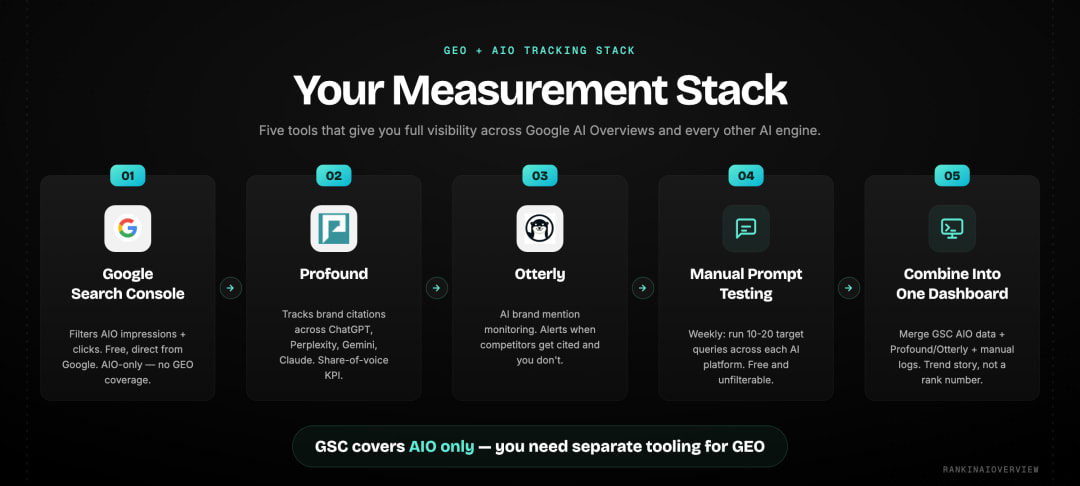
No single tool tracks all AI citation channels simultaneously with sufficient accuracy. The practical tool stack combines Google-native monitoring for AIO with a dedicated AI visibility tool for broader GEO coverage. Branded search volume from Google Search Console serves as the universal downstream proxy that connects AI citation activity to measurable business impact. |
|---|
Channel | Primary Tracking Tool | Secondary Tool | What to Measure |
|---|---|---|---|
Google AI Overviews | Google Search Console (AI Overview impressions filter) | SE Ranking AI Tracker | Impression count, citation frequency, query coverage |
Perplexity | Rankscale or Peec AI | Manual testing (20 runs per query) | Citation frequency, share of voice vs competitors |
ChatGPT Search | Rankscale or Profound | Bing Webmaster Tools (crawl verification) | Citation frequency, URL citation rate |
All platforms combined | Google Search Console (branded search) | GA4 AI referral segment | Branded search volume growth as downstream proxy |
For teams just starting with how to rank in AIO and GEO tracking, the free monitoring stack is entirely viable. Google Search Console tracks AIO performance at no cost with the AI Overviews impressions filter. Manual testing in ChatGPT and Perplexity across twenty to thirty target queries weekly, logged in a simple spreadsheet, provides baseline GEO citation data. Branded search volume in Google Search Console shows the downstream trend. This free stack is sufficient until your prompt set exceeds fifty queries or you need competitive share of voice data.
Conclusion
GEO and AIO are complementary, not competing. The GEO vs AIO optimization question is a false binary: the shared foundation of quality content, schema markup, E-E-A-T signals, and topical authority serves both channels simultaneously. The platform-specific tactics, Google ranking for AIO and off-site entity building for broader GEO, layer on top of that foundation.
Start with Step 1 and work through the six-step sequence. The GEO SEO strategy that consistently succeeds is one that treats rank in GEO and AI overviews as a layered outcome of one integrated programme, not a parallel playbook. For more in-depth research on how AI engines evaluate and cite content across all major platforms, RANK IN AI OVERVIEW covers this space in detail across its content library.
Optimizing for GEO pays off on two surfaces at once — here is how to rank on Google and in AI answers together.
For the AI Overviews side in depth, work through how to rank in Google AI Overviews step by step.
To see this strategy applied end to end, read the 12-week case study of getting a client cited in Google AI Overviews.
Frequently asked questions
Is GEO the same as AEO?+
GEO and AEO overlap significantly but have different scope. AEO focuses on any interface that generates direct answers, including featured snippets, voice assistants, and AI chatbots. GEO specifically covers AI-powered generative platforms that synthesise answers from retrieved web content. In practice, the content formatting tactics for both are nearly identical: answer-first structure, FAQ sections, schema markup. The main distinction is that GEO adds an off-site entity building dimension that AEO does not emphasise as strongly.
Can I optimise for GEO without a strong Google ranking?+
Yes, for Perplexity specifically. Perplexity has its own independent crawler and does not require strong Google rankings for citation eligibility. For Google AI Overviews, a top-20 Google ranking is effectively a prerequisite. For ChatGPT, Bing indexing matters more than Google ranking. The practical implication: a new site can start building Perplexity GEO citations through off-site entity building and structured content before it achieves strong Google rankings, while working on both simultaneously.
What is the fastest way to appear in Google AI Overviews?+
The fastest single change is adding FAQPage schema to your highest-traffic pages that already rank in Google's top 10 for informational queries. If you already rank in the top 10, the ranking prerequisite is met. Adding FAQ schema makes your content explicitly extractable for AI Overview generation and typically shows measurable AIO citation improvements within four to six weeks. After schema, rewriting your opening paragraphs to lead with direct 40 to 60 word answers produces the next-fastest improvement.
Explore with AI
Share this