How to Rank in Google AI Overviews: A Data-Backed Action Plan
Learn how to rank in Google AI Overviews using real citation research, query fan-out data and a step-by-step optimisation framework for 2026.
Key Highlights
-
Search rankings and AI Overview citations overlap, but the link is moderate, not guaranteed.
-
Google confirms AI Overviews and AI Mode use query fan-out to generate sub-queries before citing sources.
-
A page must be indexed and snippet-eligible before it can ever appear in an AI Overview.
-
Ranking does not always lead to a brand mention. Citation and mention are different outcomes.
-
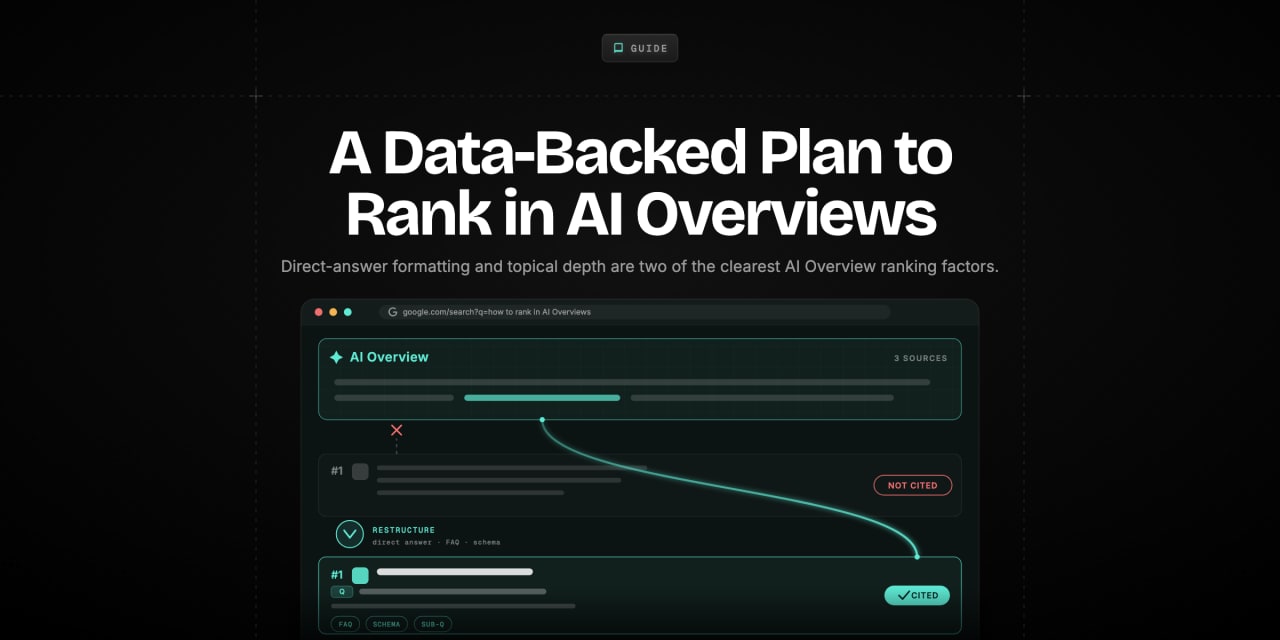
Direct-answer formatting and topical depth are two of the clearest AI Overview ranking factors.
-
Tracking AI Overview visibility needs different metrics to traditional rank tracking.
-
A step-by-step framework helps move a page from ranked-but-ignored to consistently cited.
Many SEOs check their rankings, see strong positions, and still find their pages missing from Google's AI Overviews. According to Google Search Central's AI features documentation, a page must be indexed and eligible to show with a snippet before it can ever appear as a supporting link in an AI Overview.
That gap is frustrating. The SEO work is done, rankings look fine, and the AI Overview still cites someone else. It feels like the rules changed overnight, even though the page hasn't moved at all. Many teams respond by chasing more keywords, when the real issue is usually structural.
This guide breaks down what actually links search rankings to AI Overview citations, explains query fan-out in plain terms, and gives a practical framework for how to rank in Google AI Overviews rather than just guessing at it. It also covers what to track once a page starts getting cited, since rankings and citations behave differently over time.
What Is a Google AI Overview and How Does It Choose Its Sources?
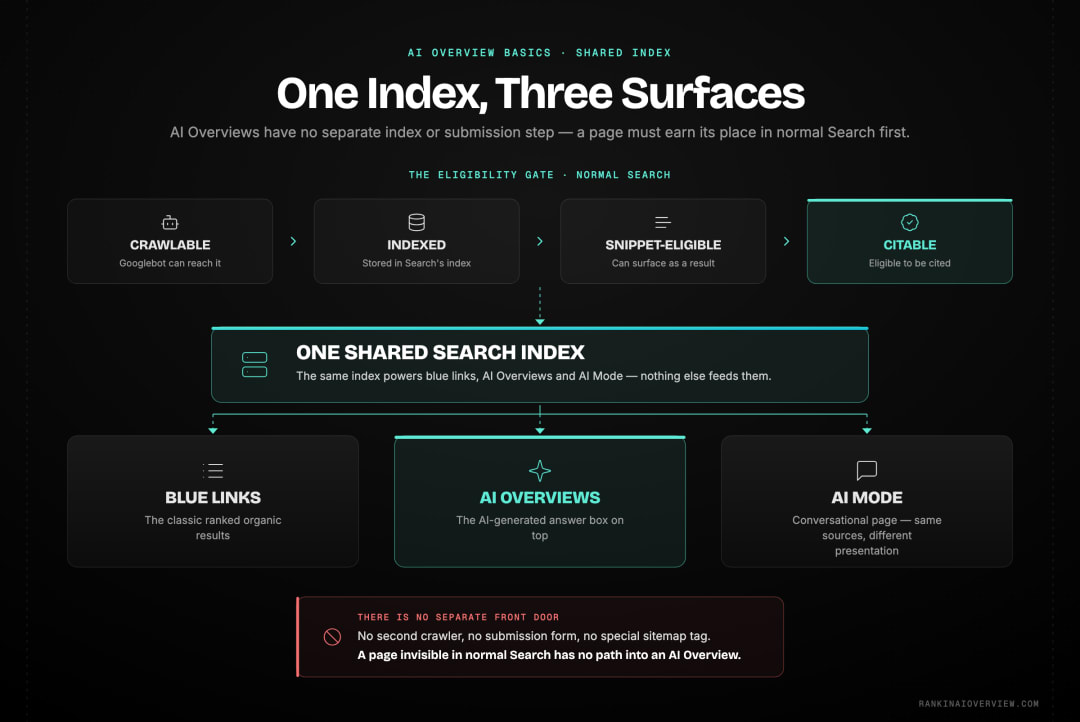
A Google AI Overview is an AI-generated summary shown above standard search results. It pulls supporting links from pages already indexed and eligible to appear with a snippet in Google Search. There is no separate index or submission process for AI Overviews.
Google states plainly that there are no additional requirements to appear in AI Overviews or AI Mode, beyond meeting the normal Search eligibility bar.
This means ranking in Google AI Overviews starts with ordinary technical SEO. Crawlable pages, clean indexing and snippet eligibility come first. AI Mode runs on the same underlying mechanism, so the same foundation applies to both features.
Is there a separate index for AI Overviews?
No. AI Overviews and AI Mode draw from the same Search index that powers every other Google result. There is no second crawler, no separate submission form, and no special sitemap tag that pushes a page into AI Overview eligibility ahead of anything else.
Practically, that means a page invisible in normal search results has no path into an AI Overview either. Fixing crawl errors, removing accidental noindex tags, and confirming a clean canonical setup remain the first checks before anything else on this list, well before considering any AI-specific formatting changes.
AI Mode differs from a standard AI Overview mainly in presentation, not in source selection. AI Mode opens a fuller, conversational results page rather than a short summary above the usual listings, but it draws on the same eligibility rules and the same underlying index described above.
How Closely Are Search Rankings and AI Overview Citations Linked?
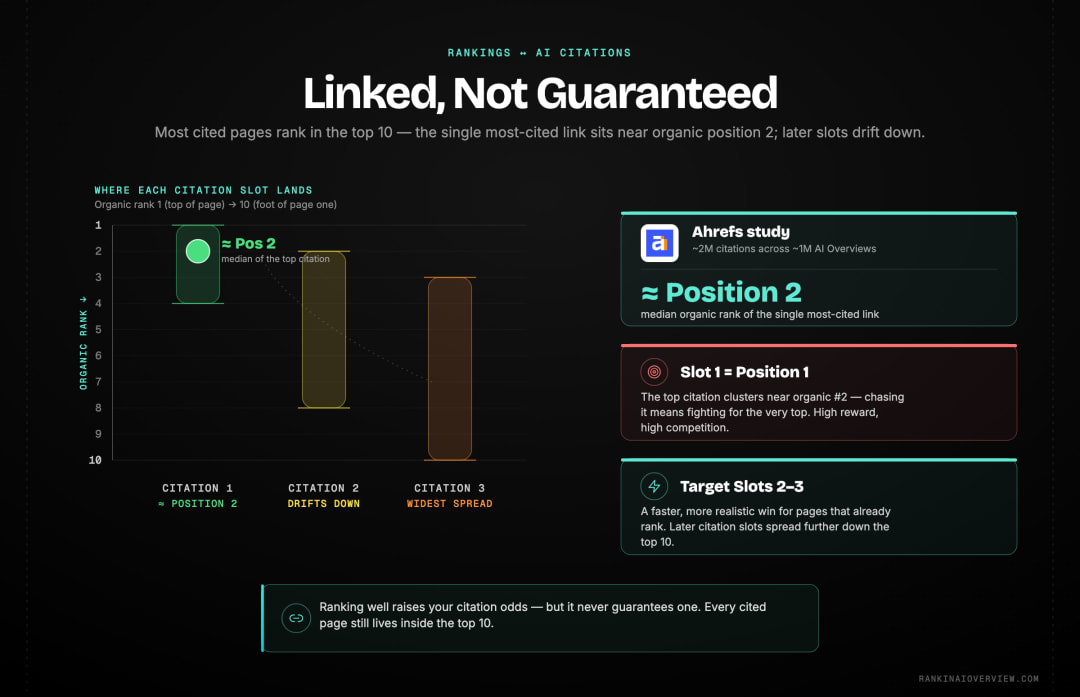
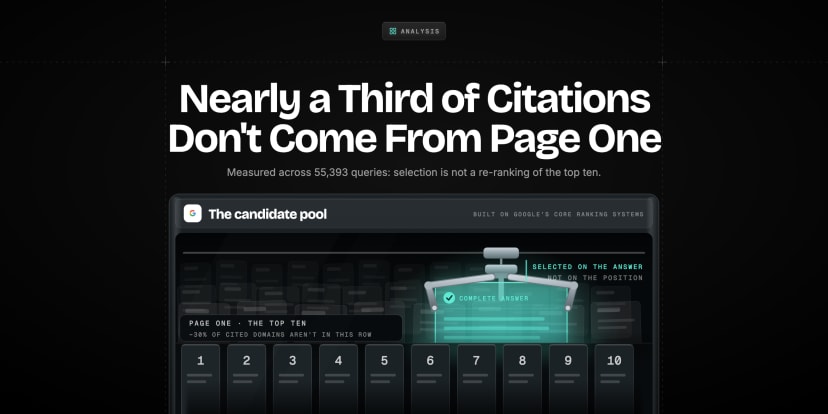
Search rankings and AI Overview citations overlap significantly, but the relationship is moderate rather than guaranteed. Most cited pages also rank well organically, yet ranking first does not guarantee a citation in the AI Overview itself.
Analysts at Ahrefs studied close to two million citations pulled from one million AI Overviews and found that most cited pages ranked inside the top ten organic results, with a smaller share ranking further down and a notable minority not appearing in the top 100 at all.
A follow-up study using a refined methodology, covering over four million AI Overview URLs, found a lower overlap figure than the original analysis. That shift shows the relationship is real, but it moves as measurement improves and as Google's systems change.
The same body of research found that the single most-cited link inside an AI Overview tends to rank near the very top of organic search, with a typical median position of around two. Subsequent citations within the same AI Overview spread further down the rankings, with much wider variation by the time a third source is cited.
That spread matters for strategy. Chasing the single top spot in an AI Overview behaves like chasing position one in classic search: high reward, high competition. Targeting the second or third citation slot is often a more realistic, faster win for a page that already ranks respectably but not at the very top.
For newer domains without much accumulated authority, this usually means the practical path runs through traditional rankings first. A page sitting on page five or six of Google rarely appears in an AI Overview citation, regardless of how well it is structured, simply because it has not cleared the underlying ranking bar yet.
"That chance is a coin flip at best."
— Si Quan Ong Senior Content Marketer, Ahrefs (source)
The takeaway: ranking well raises the odds of a citation considerably. It does not, on its own, secure one.
What Is Query Fan-Out and Why Does It Matter for Ranking in Google AI Overviews?
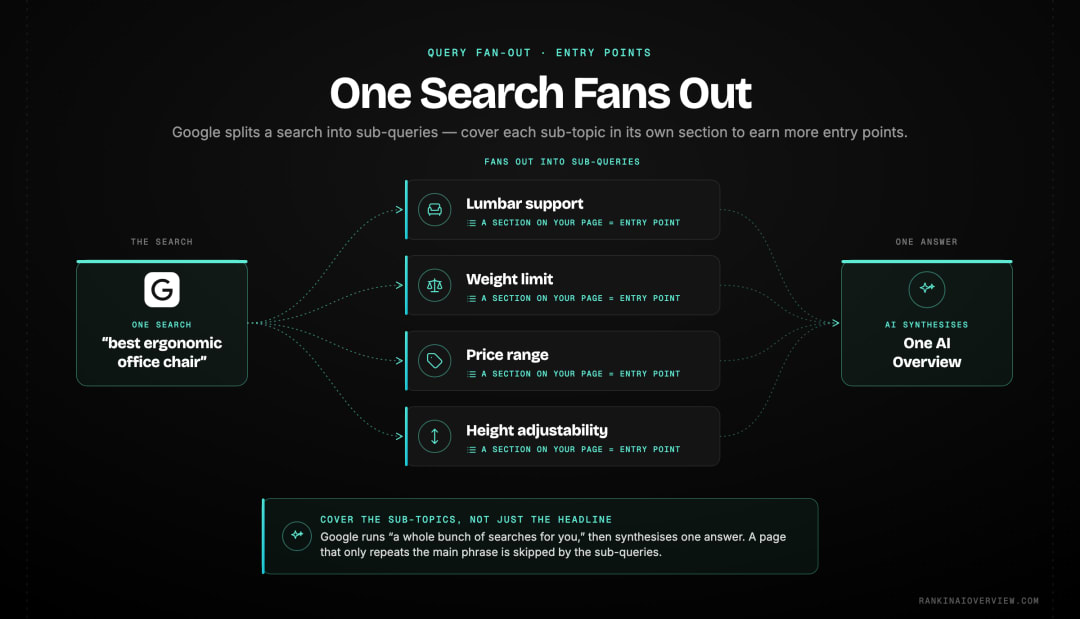
Query fan-out is the technique behind Google's AI features, splitting one search into several related sub-queries before generating a response. Google confirms both AI Overviews and AI Mode use this method to gather sources across subtopics, rather than answering only the literal query typed.
This is why “I rank in blue links but not in AI Overviews” is a flawed comparison. Google's John Mueller has described the process as Google running "a whole bunch of searches for you" behind the scenes, reported by Search Engine Land, before synthesising the results into one answer.
For content, that means covering the sub-questions around a topic matters as much as the headline keyword. A page that only answers one phrasing of a query is easy for fan-out queries to skip over entirely.
What does query fan-out look like in practice?
Imagine someone searches for the best ergonomic office chair. Behind that single search, Google's AI features may run related sub-queries covering lumbar support, weight limits, price ranges and chair height adjustability.
A product page that only repeats the phrase “ergonomic office chair” without addressing those specific sub-topics is unlikely to surface in any of the fan-out sub-queries, even if it ranks well for the main keyword itself. A page that answers each sub-topic in its own short section has far more entry points into the same AI Overview.
Researchers have also tested whether pages cited from beyond page one simply rank for more, longer, fan-out-style keywords. The pattern did not hold cleanly: pages cited from outside the top ten actually ranked for fewer total keywords on average, not more, suggesting freshness, formatting and other signals play a larger role than raw keyword volume alone.
What Ranking Factors Actually Influence AI Overview Citations?
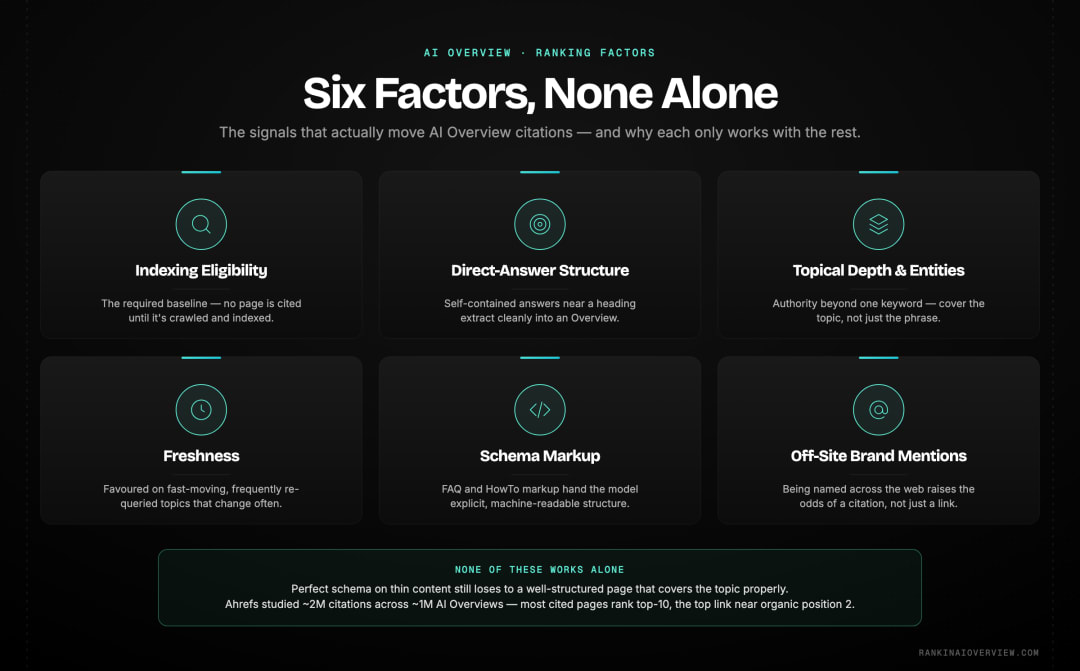
Six AI Overview ranking factors matter most: indexing eligibility, direct-answer structure, topical depth, freshness, schema markup, and brand mentions earned away from your own site. None of these factors works in isolation; a page with perfect schema but thin content rarely outperforms a well-structured page covering the topic properly.
Here is how those AI Overview ranking factors break down in practice:
| Ranking factor | Why it matters for AI Overview citation |
|---|---|
| Indexing & snippet eligibility | Required baseline. Without it, a page cannot be cited at all. |
| Direct-answer structure | Self-contained answers near a heading are easier for the model to extract cleanly. |
| Topical depth & entity signals | Shows authority on the subject beyond a single keyword phrase. |
| Freshness | Recently updated pages are favoured for fast-moving, frequently re-queried topics. |
| Schema markup | FAQ and HowTo schema give the model explicit structure to parse. |
| Brand mentions across the web | Independent of your own site, these raise the odds of being named, not just cited. |
How much does freshness actually matter?
Freshness matters more for topics that change quickly, such as pricing, product availability or anything tied to a current event, than for stable reference content. A well-established explainer page does not need weekly edits to stay citable.
What tends to help across both fast-moving and stable topics is a visible update date, paired with at least one genuinely new data point, example or figure each time the page is revised. Cosmetic edits with no new information rarely move the needle on their own.
What counts as a strong entity signal?
An entity signal is anything that helps an AI system confirm what a brand is, what it does, and how it relates to a topic, independent of the brand's own claims about itself. Consistent naming across an official website, business listings and third-party profiles is the simplest version of this.
A site that publishes a handful of pages naming a topic once each sends a weaker entity signal than a site that covers the same topic from several angles, consistently, over time. Depth compounds, since each additional well-structured page reinforces the same topical association for both traditional rankings and AI citation models. RANK IN AI OVERVIEW's guide to building a GEO and AI Overview content cluster walks through this process step by step.
Ranking and citation are not the same as being named, either. Research led by SEO analyst Kevin Indig, using the Semrush AI Visibility Toolkit, found that a majority of AI citations across major engines are what he calls “ghost citations”, where the source link appears but the brand is never mentioned in the answer text itself. Roughly six in ten citations in that dataset fell into this category.
The same research found this behaviour differs sharply by platform. Gemini named the brand in the answer text 83.7% of the time but only cited it as a formal source 21.4% of the time. ChatGPT showed the reverse pattern: an 87% citation rate against a 20.7% mention rate, behaving more like an academic paper with footnotes than a direct recommendation.
Why does direct-answer structure matter so much?
AI features assemble an answer by lifting short, self-contained statements rather than reading a full page top to bottom. A sentence that states a fact clearly, with the subject and the brand named inside it, survives that lifting process intact.
A vague sentence that relies on the previous paragraph for context usually does not. This is also why FAQ-style sections, with a question heading followed immediately by a tight answer, tend to perform well as AI Overview sources. Trust signals matter here too; RANK IN AI OVERVIEW's research on trust versus rankings covers this in more depth.
"Good SEO is good GEO."
— Danny Sullivan Director, Google Search (former Search Liaison) (source)
How Can You Optimise a Page to Rank in Google AI Overviews?
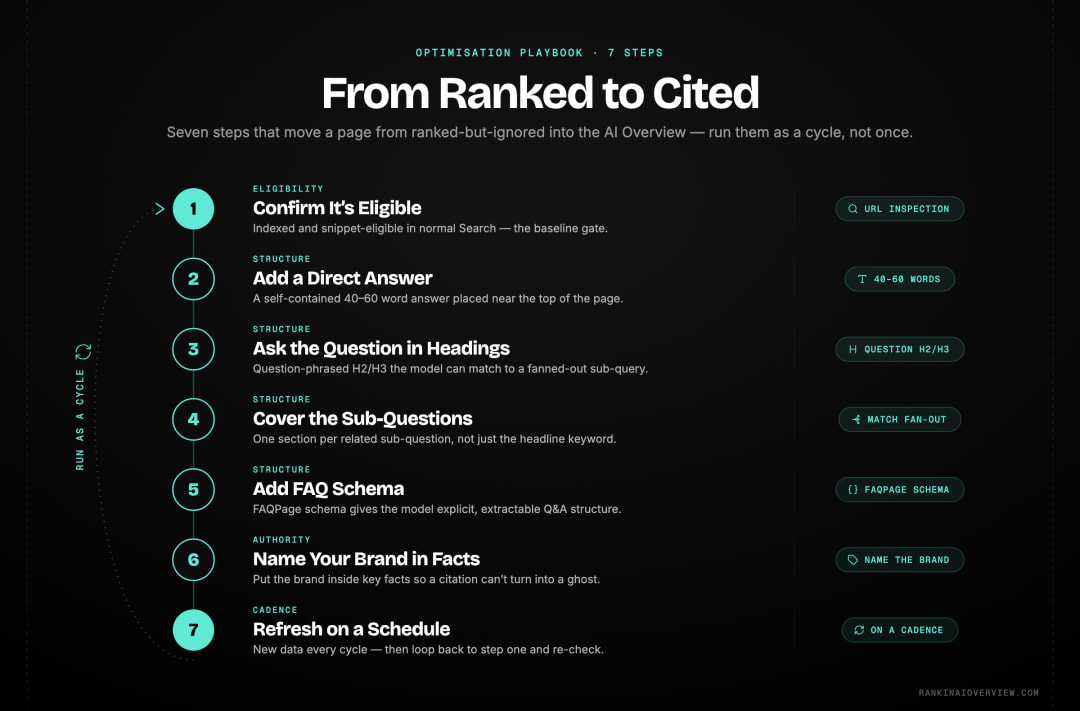
Optimising for AI Overviews is mostly disciplined SEO with a sharper focus on extractable answers. The steps below cover the practical actions that move a page from ranked-but-ignored to cited.
-
Confirm the page is indexed and snippet-eligible using Search Console's URL Inspection tool, since neither feature works without this baseline.
-
Add a short, self-contained 40 to 60 word answer near the top of the page, written so it makes sense without any surrounding context.
-
Use clear H2 and H3 headings phrased as questions, matching how people actually search rather than internal department or product names.
-
Cover related sub-questions on the same page to match likely fan-out queries, instead of splitting each sub-topic into a separate thin page.
-
Add FAQPage schema to question-and-answer sections so the structure is machine-readable, not only visually clear to a human reader.
-
Mention the brand name inside key facts and answers, not only in bylines or footers, to reduce the chance of a ghost citation.
-
Refresh the page on a set schedule and add new data, examples or figures where possible, since freshness is one of the clearer AI Overview ranking factors.
How long does it take to see results?
Newly published or substantially restructured content can start generating AI citations within days, according to monitoring data shared by several SEO research teams, far faster than typical timelines for traditional ranking improvements.
That speed cuts both ways. Citations can appear quickly once a page meets the eligibility bar, but they can also disappear quickly if a competitor publishes a clearer, more recently updated answer to the same sub-question. Treat AI Overview visibility as something to monitor continuously, not a box to tick once.
Treat the seven steps above as a cycle rather than a one-off checklist. Re-run the eligibility check after every major site change, revisit the answer block whenever new data becomes available, and re-test the FAQ schema whenever the page's headings are restructured.
What Do Real AI Citation Studies Reveal About the Path to Visibility?
Independent research across millions of citations points to one consistent pattern: brands win citations from sources they already control, not from forums or third-party reviews as often as assumed.
Research from Yext, covering 6.8 million AI citations across ChatGPT, Gemini and Perplexity, found that 86% of citations came from sources brands already manage, such as their own websites and business listings. Once location context and query intent were applied, forums like Reddit accounted for a much smaller share of citations than common assumption suggests.
Other analyses point the same way: brands with stronger web mentions away from their own domain earn meaningfully more AI citations than those relying on site authority alone. Entity-level signals, not just page-level SEO metrics, increasingly decide who gets named.
Does industry or content type change the pattern?
Yes. Listicle-style content, structured as ranked comparisons rather than single-product pages, accounts for a disproportionately large share of AI citations across the studies reviewed for this guide. Plain corporate or product-only pages without that comparative structure are cited far less often, even when they rank well.
Industry also shifts where citations come from. Retail and finance brands tend to draw a larger share of citations from their own owned websites, while healthcare-related queries lean more heavily on third-party directories and listings rather than brand-owned pages. Local businesses face a related but distinct set of challenges, covered in RANK IN AI OVERVIEW's local SEO guide for AI search.
Platform choice changes the picture too. One industry analysis found only a small single-digit overlap between ChatGPT's cited sources and Google's top ten organic results for the same queries, with a meaningful share of ChatGPT's most-cited pages showing no organic visibility in Google search at all. That gap suggests a page built only around Google ranking signals may still be invisible to other AI platforms entirely.
Fully sourced, named case studies in this space are still rare, since most agencies and brands treat AI citation data as commercially sensitive. The clearest, most consistently repeated finding across the available public research is the one already covered: rank well, structure for direct answers, and earn mentions away from your own site.
How Do You Track Your Rankings in Google AI Overviews Over Time?
Standard rank trackers were not built for this. Google Search Console does not currently separate AI Overview citations from ordinary impressions, so tracking AI Overview ranking factors over time needs a dedicated approach alongside it.
Tools such as Ahrefs's Brand Radar, and the Semrush AI Visibility Toolkit mentioned earlier, are built specifically to separate citation rate from brand mention rate across AI platforms, which is the distinction that matters most once a page starts ranking.
Can Google Analytics track AI Overview traffic directly?
Not by default. AI referral traffic typically arrives grouped under generic referral sources rather than a dedicated AI channel. A custom channel group or exploration report, filtered on the source and medium fields for known AI domains, is usually needed to separate it out from ordinary referral traffic.
Once that segmentation is in place, the engagement and conversion behaviour of AI-referred visitors can be compared against standard organic traffic. Several published analyses report that AI-referred visitors convert at a notably higher rate than average organic traffic, which is a strong reason to track the segment separately rather than let it blend into general referral numbers.
Set a simple cadence: review citation rate and brand mention rate monthly, alongside the usual ranking report, rather than as a separate annual exercise. AI citation behaviour shifts faster than traditional rankings, so a longer review cycle risks missing changes early enough to act on them.
For deeper research on how AI search engines evaluate ranking and citation signals over time, RANK IN AI OVERVIEW covers this space across its content library.
Conclusion
Overviews are one surface; for the full split, read how to rank on Google and in AI answers.
Ranking in Google AI Overviews starts with the same fundamentals that have always mattered: indexing, relevance and authority. Query fan-out adds a layer on top, rewarding pages that answer related sub-questions clearly rather than just the headline keyword.
Citation is not the same as being named, so brand mentions earned across the web matter as much as the page itself. Track rankings and AI Overview visibility separately, since the two do not always move in lockstep.
None of this requires abandoning existing SEO work. It requires sharpening it: clearer answers, broader sub-topic coverage, and consistent presence beyond the website itself. Teams that treat AI Overview visibility as an extension of SEO, rather than a separate discipline, tend to adapt faster than teams that try to build a parallel strategy from scratch.
For deeper research on how AI search engines evaluate brand authority and AI Overview ranking factors, RANK IN AI OVERVIEW covers this space across its content library.
Frequently asked questions
Does ranking on Google mean you'll appear in AI answers?+
Not always. Ranking improves the odds, since most AI Overview citations come from pages that already rank well, but the relationship is moderate. A high rank raises the chance of citation; it does not guarantee one.
Why does Google AI Overview ignore my site even when I rank on page 1?+
Query fan-out is often the reason. Google's AI features run several related sub-queries behind the scenes, so a page can rank for the main query yet miss every fan-out sub-query the AI Overview actually cites.
Do AI citations replace backlinks?+
No. Backlinks still support traditional rankings, which still feed AI Overview eligibility. Citations add a separate layer on top, rewarding clear sub-question answers rather than replacing the value of earned links.
Why do some pages rank in search but still fail to earn AI citations?+
Usually because the page isn't structured for direct extraction. Long, unstructured paragraphs are harder for an AI model to lift cleanly than a short, self-contained answer placed near a clear heading.
How can my website rank better on Google AIO?+
Start with standard SEO fundamentals, then add direct-answer sections, question-based headings and FAQ schema. Cover sub-questions around the topic, not only the main keyword, since fan-out queries reward broader coverage.
Is SEO dead or evolving in 2026?+
It's evolving, not dying. AI Overviews and AI Mode draw from the same Search index as traditional results, so indexing, relevance and authority remain the foundation for AI visibility too.
What is citation rate and how is it calculated in AI search monitoring?+
Citation rate is the percentage of tracked prompts or queries where a brand's page appears as a cited source in an AI-generated answer. It is usually calculated separately for each AI platform, since citation behaviour varies widely between them.
What signals does AI trust when recommending a brand?+
AI systems weigh consistency across independent sources heavily. Brands mentioned positively across several non-affiliated sites are more likely to be recommended than brands only described on their own website, regardless of how well that website ranks.
How can teams diagnose why their content is not being cited by AI?+
Start by checking the basics covered earlier: indexing status, snippet eligibility and whether the page actually ranks for the target query at all. If those pass, review the page for self-contained answers, since structure is the most common gap once eligibility is confirmed.
Explore with AI
Share this