How to Get Your Images Into AI Search Results When Your Page Already Ranks on Google
Your page ranks on Google but your images are not appearing in AI visual results. Here is the specific technical fix covering alt text, ImageObject schema, and image indexing.

Key Highlights
-
Image SEO for AI search is separate from page ranking SEO. Your page can hold position one on Google while your images are entirely absent from AI visual results because the two systems evaluate different signals
-
Images in AI overview and AI visual results depend on three specific technical layers: descriptive alt text, ImageObject schema markup, and verified Google Image Search indexing. All three must pass before AI engines can confidently cite your images
-
Images in AI overview are drawn from Google's image index. A page that ranks in organic search does not automatically have its images eligible for images in AI overview. Image indexing must be separately verified
-
Getting images in AI overview requires passing three evaluations: Google Image Search indexing, E-E-A-T quality signals for the page, and specific image-level structured data that identifies the visual content unambiguously
-
Images in AI overview favour original, data-rich visuals over stock photography because AI engines prefer to cite unique visual content that provides information unavailable from any other source
-
Image schema markup SEO through ImageObject schema is the single highest-impact fix for most sites. It provides AI engines with machine-readable context that alt text alone cannot deliver
-
Image schema markup SEO is implemented as JSON-LD structured data with five required fields: name, description, url, contentUrl, and author
-
Image schema markup SEO is a one-time implementation per image that compounds in value as the image is crawled and indexed by AI engines with the structured context it needs to cite confidently
-
Image schema markup SEO that validates correctly through Google's Rich Results Test produces measurable AI visual results improvements within four to eight weeks of implementation
-
Image schema markup SEO for a page with ten images can be implemented in two to three hours and produces both traditional image search and AI visual results benefits simultaneously
-
AI image results optimization starts with a five-point diagnostic: alt text quality, ImageObject schema presence, file naming conventions, Google Image Search indexing status, and robots.txt image crawl access
-
AI image results optimization is a technical programme with a clear sequence: fix the five issues in the order they are presented in this guide and you will have covered all the technical barriers to AI image citation
-
AI image results optimization improves traditional Google Image Search performance simultaneously, making every hour invested in this programme produce dual-channel returns
-
Get images in AI search by following the fix sequence: descriptive alt text first, ImageObject schema second, descriptive file names third, visible captions fourth, Google Image Search indexing verification fifth
-
To get images in AI search through Google AI Overviews specifically, Google Image Search indexing is the non-negotiable prerequisite. Verify this before implementing any other fix
-
Get images in AI search on Perplexity by ensuring your images are crawlable by Perplexity's own bot and have descriptive alt text and file names that identify the image content independently
-
The fastest way to get images in AI search is the alt text rewrite: descriptive alt text on existing indexed images can produce AI visual results improvements within two to four weeks of implementation
-
Original custom images, specifically charts, infographics, and data visualisations, are cited by AI engines at higher rates than stock photography because they provide unique visual information that other sources reference
-
All five fixes for image AI visibility improve traditional Google Image Search performance simultaneously, making this a dual-benefit optimisation programme with no trade-offs
You have worked hard to get your page ranking on Google. Position one or two for your target keywords. And yet, when AI search engines generate visual answers or image-rich overviews, your images are absent. The page is right there in the organic results, but the images are not appearing in AI visual results. According to Google's image SEO documentation, image discovery and ranking in Google's image index is a separate process from page ranking. AI visual results add a third layer on top. Getting images into AI search results requires passing three distinct technical evaluations that are entirely independent of your page's organic ranking signals.
This is a solvable technical problem with a documented fix sequence. The most common cause is missing or generic alt text: AI engines need descriptive, specific alt text to understand what an image depicts. The second most common cause is absent ImageObject schema markup: without structured data, AI systems must infer image context from surrounding text, which is less reliable and produces lower citation confidence. The third is images not verified in Google Image Search, which is a prerequisite for AI Overview image inclusion.
This guide gives you the complete fix sequence, in priority order, with specific implementation examples for each step. Work through the five fixes in the order they are presented and you will have corrected all the technical barriers between your existing ranked pages and consistent image appearances in AI visual results.
Why Is Image AI Visibility Separate From Page Ranking?
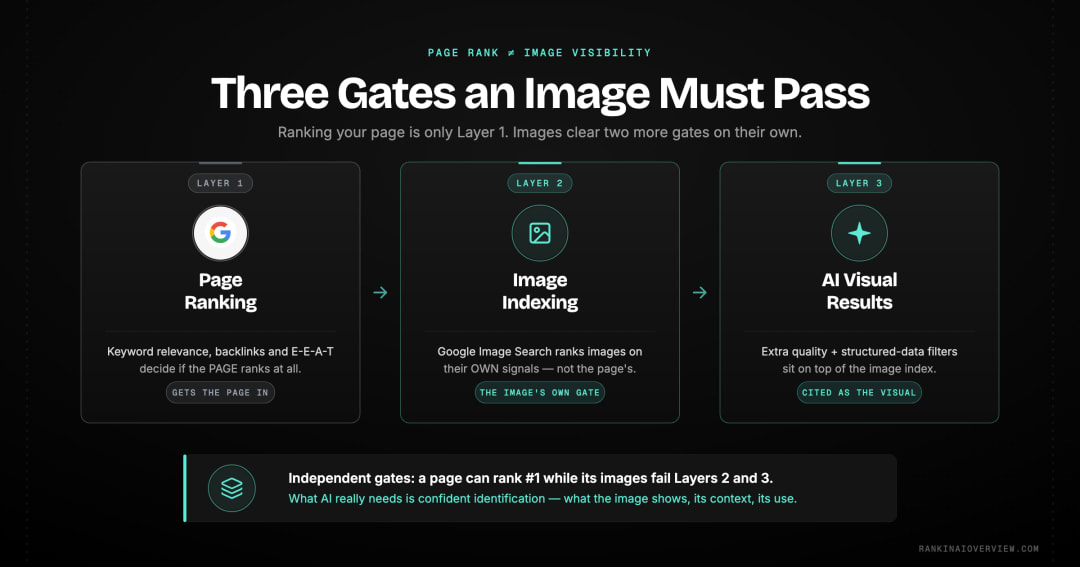
AI engines process images through a different evaluation pathway than text content. Your page ranks because Google evaluated your content for keyword relevance, backlink authority, and E-E-A-T signals. Your images appear in AI visual results because AI engines evaluated your image-specific signals: alt text descriptiveness, ImageObject schema context, file naming, Google Image Search indexing status, and caption quality. These two evaluations are independent. A page with excellent text signals and poor image signals will rank well but produce no AI image citations.
Google Image Search and Google AI visual results are also different systems. Google Image Search indexes and ranks images based on their own signals independently of the page they live on. Google AI Overviews that include visual components draw from Google's image index but apply additional quality filters. An image must first pass Google Image Search indexing, then meet the image quality standards that AI visual results require. A page can rank at position one while its images fail at either or both of these separate evaluations.
The AI engine's core requirement for image citation is confident identification: the AI system must be able to determine with certainty what the image depicts, what context it relates to, and whether it is the most useful visual for the query being answered. Structured data through ImageObject schema is the most reliable way to provide this confident identification. Without it, AI engines must infer image context from surrounding text, which is both less accurate and less likely to produce consistent image citations.
What Are the 5 Most Common Reasons Images Are Not Appearing in AI Results?
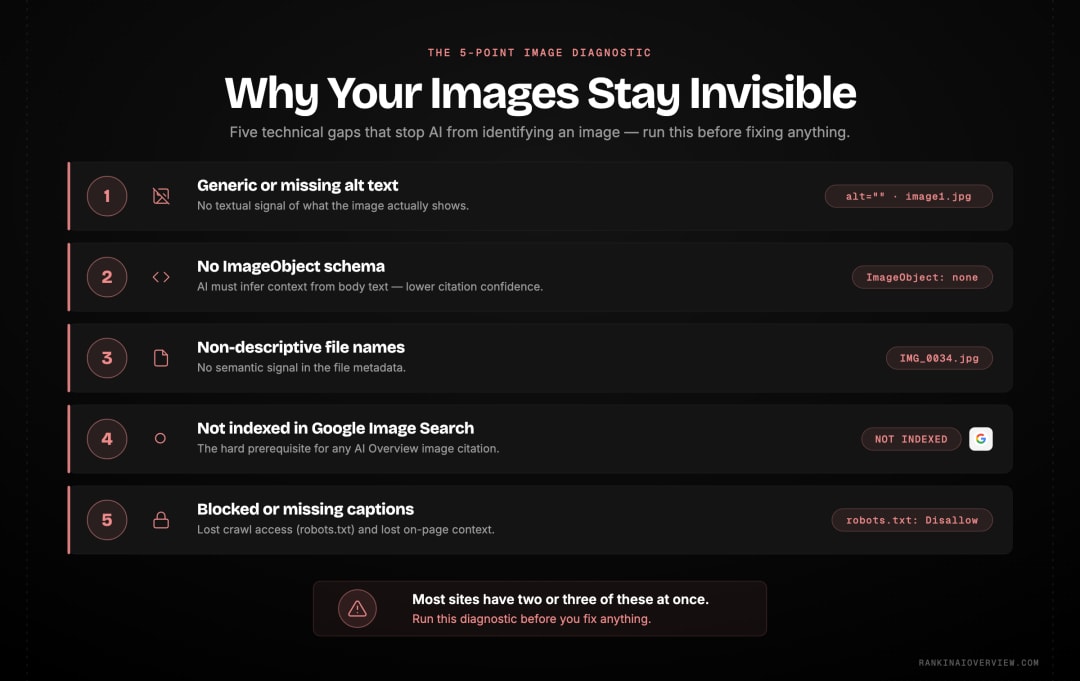
The five reasons form a diagnostic checklist. Each one represents a specific technical gap that prevents AI engines from confidently identifying, understanding, and citing an image. Most sites with image AI visibility gaps have two or three of these issues simultaneously. Running through the diagnostic before implementing any fixes identifies which issues require the most urgent attention.
Reason 1: Generic or Missing Alt Text
Generic alt text such as "image1.jpg," "photo," "figure," or an empty alt attribute leaves AI engines with no textual information about what the image depicts. Alt text is the primary signal AI engines use to understand image content. Without specific, descriptive alt text, the image is invisible to AI citation systems regardless of how well it ranks in Google Image Search.
Reason 2: No ImageObject Schema Markup
ImageObject schema is machine-readable structured data that tells AI engines precisely what an image depicts, who created it, what it is a part of, and where it is hosted. Without this schema, AI engines must infer all of this context from surrounding text and file metadata. The inference is less reliable and produces lower citation confidence, which reduces image AI visibility even when the image is technically well-indexed.
Reason 3: Non-Descriptive File Names
File names like IMG_0034.jpg, stock-photo-12345.jpg, or unnamed.png provide no semantic signal to AI systems reading file metadata. AI engines read file names as an additional content signal alongside alt text and schema. Descriptive file names that include the subject matter and relevant context contribute to confident image identification.
Reason 4: Images Not Indexed in Google Image Search
AI Overview image citations draw from Google's image index. An image that is not indexed in Google Image Search cannot appear in AI visual results regardless of how well its alt text and schema are implemented. This is the prerequisite that must be verified before any other fix is meaningful for AI Overview image appearance.
Reason 5: Images Blocked or Missing Captions
Images blocked by robots.txt cannot be crawled or indexed. Images without visible page captions miss an additional semantic context signal that AI engines read alongside alt text and schema. Both gaps reduce image AI visibility confidence and can prevent citation even when other signals are correct.
Fix 1: How Do You Write Descriptive Alt Text for Every Image?
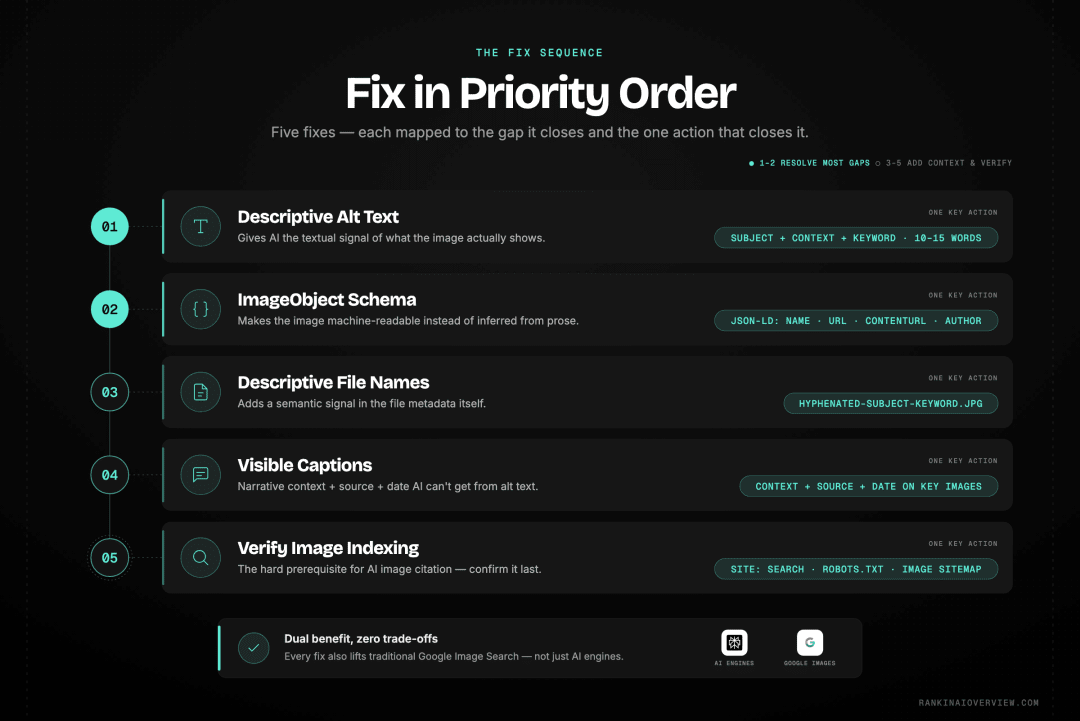
Descriptive alt text follows a three-part formula: subject, context, and relevant keyword. The subject is what or who is in the image. The context is what situation or action the image depicts. The relevant keyword is the topic the image illustrates on the page. Alt text should be 10 to 15 words, specific enough that someone who cannot see the image knows exactly what it shows, and natural enough to read as a description rather than a keyword string.
The alt text test: close your eyes and ask whether the alt text alone would let you accurately picture the image. Generic alt text like "chart" fails this test. Specific alt text like "bar chart showing AI citation frequency by platform for B2B SaaS brands in 2026" passes it. This is the foundation of image SEO for AI search: every image must be identifiable from its alt text alone, without requiring the surrounding page content for context.
BEFORE (fails AI citation test): alt="image" / alt="photo.jpg" / alt="" / alt="SEO"
AFTER (passes AI citation test): alt="AI search visibility metrics dashboard showing citation frequency, share of voice, and branded search volume trends for a B2B SaaS brand over twelve weeks"
The alt text formula applied: Subject (AI search visibility metrics dashboard) + Context (showing citation frequency, share of voice, and branded search volume trends) + Relevant keyword (for a B2B SaaS brand) + Specificity marker (over twelve weeks). This format gives AI engines a complete, citable description of the image content. Apply this formula to every image on your highest-traffic pages before addressing any other image AI visibility fix.
Fix 2: How Do You Implement ImageObject Schema Markup?
ImageObject schema is implemented as JSON-LD structured data in the head section of the page or inline in the page body. The required fields are name, description, url, contentUrl, and author. Optional but recommended fields include datePublished, caption, and isPartOf (linking the image to its parent Article schema). Validate every implementation using Google's Rich Results Test before publishing.
ImageObject schema is defined by Schema.org's ImageObject specification and is the structured data type specifically designed to make images machine-readable for AI engines and search systems. Without it, AI engines must reverse-engineer image context from alt text and surrounding content. With it, you are providing a direct, unambiguous description of what the image is, what it depicts, who produced it, and where it lives.
ImageObject schema JSON-LD example: { "@context": "https://schema.org", "@type": "ImageObject", "name": "AI citation frequency dashboard", "description": "Bar chart showing AI search citation frequency by platform across ChatGPT, Perplexity, and Google AI Overviews for a B2B SaaS brand measured over 12 weeks in 2026", "url": "https://yoursite.com/blog/ai-visibility-metrics/", "contentUrl": "https://yoursite.com/images/ai-citation-dashboard.jpg", "author": { "@type": "Organization", "name": "Your Brand Name" }, "datePublished": "2026-05-01", "caption": "Weekly AI citation tracking showing 35% improvement over twelve weeks following content restructuring", "isPartOf": { "@type": "WebPage", "@id": "https://yoursite.com/blog/ai-visibility-metrics/" } }
Add this JSON-LD block for every key image on each target page. Place it in the page's head section or immediately after the image in the body. Validate with Google's Rich Results Test before publishing. The most common implementation errors are mismatched contentUrl and the image's actual hosted URL, and missing the author field. Both produce validation failures that prevent AI engines from trusting the schema data.
“ AI needs descriptive alt text to understand and cite images. Generic alt text will not cut it. Add structured data through ImageObject schema to every key image. AI processes images differently from text and your page rank does not transfer to image citations. Technical SEO practitioner r/WebsiteSEO community, Reddit 2026 Source: Reddit: I Rank Page 1 but My Images Aren't in the AI Image Results
Fix 3: How Do You Optimise Image File Names?
File names are an additional semantic signal that AI engines and image search systems read alongside alt text and schema. A descriptive file name reinforces the alt text description and gives AI engines a third consistent data point for image identification. The file naming convention is the same as the alt text formula: subject, context, relevant keyword, all separated by hyphens, no underscores, no generic camera-generated names.
File names that fail AI image identification: IMG_0034.jpg / photo-1.jpg / stock-photo-business.jpg / unnamed.png / screenshot.jpg
File names that support AI image identification: ai-citation-frequency-dashboard-b2b-saas-2026.jpg / perplexity-citation-rate-comparison-chart.jpg / google-ai-overview-coverage-by-query-type.jpg
The practical process: when saving or uploading any image to your CMS, rename it before upload using the descriptive file naming convention. For existing images already uploaded with generic names, the renaming process requires updating the file, updating any references in the page HTML, and updating the contentUrl in the ImageObject schema. This is a one-time correction that prevents the need for repeated fixes going forward.
Fix 4: How Do You Add Visible Captions to Key Images?
Captions are the most human-readable image context signal and one of the most underused for image SEO for AI search. AI engines read captions as supplementary semantic context that confirms and extends what alt text and schema describe. A caption can include narrative context, source attribution, and related keywords that would be unnatural in alt text format. Add captions to every image that is integral to the content argument on the page, not to purely decorative images.
The distinction between alt text and caption function: alt text describes what the image shows for screen readers and AI identification. A caption explains why the image is there and what it means in the context of the surrounding content. "Weekly AI citation tracking showing 35% improvement over twelve weeks following content restructuring and schema implementation" is a caption that provides narrative context AI cannot infer from alt text alone.
Caption best practices for image AI visibility: include one specific data point or finding when captioning charts and infographics. Include the source and date for any data-driven images. Include the specific context for photographs: "Screenshot from Google Search Console AI Overview impressions filter, May 2026" gives AI engines a complete contextual description that confirms the image's role in the article. Captions of 15 to 25 words achieve the right balance between specificity and brevity.
Fix 5: How Do You Verify Images Are Indexed in Google Image Search?
Google Image Search indexing is the prerequisite for AI Overview image citation. An image not in Google's image index cannot appear in AI visual results regardless of how well its alt text and schema are implemented. Verifying image indexing takes three minutes and identifies whether the prerequisite is met before investing in other fixes.
Verification method: Go to Google Images and search for "site:yoursite.com [image topic]". If your images appear, they are indexed. If not, check three potential blockers: (1) Your robots.txt file. Verify the Googlebot-Image user agent is not blocked. The line "Disallow: /" in a Googlebot-Image section blocks all image crawling. (2) The X-Robots-Tag header for image files. An "noindex" directive in HTTP headers prevents image indexing even if the page is fully indexed. (3) Whether you have submitted an XML image sitemap via Google Search Console. An image sitemap accelerates discovery and indexing, particularly for images that are loaded via JavaScript or are not embedded directly in HTML.
If images are not indexed after verifying these three blockers, submit an image sitemap. The image sitemap format extends a standard XML sitemap with image-specific fields including image location, title, caption, and geographic location. Submit the image sitemap through Google Search Console's sitemap submission tool. Allow four to six weeks for Google to crawl and index newly submitted images before measuring AI visual results impact.
How Do You Use Images to Drive AI Citation More Broadly?
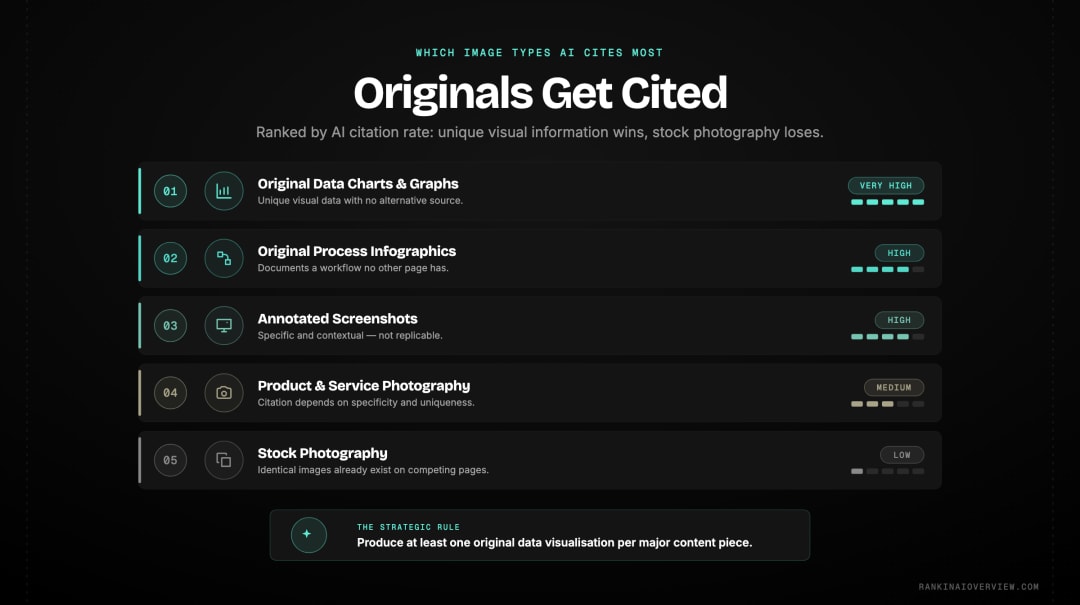
Beyond correcting technical gaps, original custom images produce higher AI citation rates than stock photography. AI engines prefer to cite unique visual content that provides information not available elsewhere. Charts, infographics, and data visualisations produced from original research or primary data are cited at substantially higher rates because they are the only source for that specific visual information. Other sites that embed or reference your original visuals also build citation signals for your images.
The AI image results optimization principle at the strategic level: produce at least one original data visualisation per major content piece. A chart showing your own research findings, a comparison table built from primary data, or an infographic summarising a process you have documented firsthand all produce images that AI engines must cite if they want to reference that specific visual information. Stock photography can be replaced by any competing page. Original data visualisations cannot.
| Image Type | AI Citation Rate | Why | Implementation |
|---|---|---|---|
| Original data charts and graphs | Very High. Unique visual information with no alternative source | AI engines cite the source of unique data | Create from your own research, surveys, or data analyses |
| Original process infographics | High. Illustrates a specific workflow no other page has documented | Provides visual context that text alone cannot replicate | Build from your own documented processes and experience |
| Annotated screenshots | High. Specific, contextual, not replicable | Shows real tools, real interfaces, real data | Use for tutorial and how-to content. Annotate with arrows and labels |
| Product or service photography | Medium. Depends on specificity and uniqueness | Relevant for commercial queries where users want to see the product | Invest in original photography rather than stock images |
| Stock photography | Low. Identical images exist on many competing pages | AI prefers unique visual content to generic illustration | Use only where no original alternative is feasible |
Conclusion
Image AI visibility is a technical problem with clear technical solutions. Start with descriptive alt text and ImageObject schema: these two changes resolve the majority of image AI citation gaps and produce improvements within four to eight weeks of correct implementation. Add descriptive file names, visible captions, and Google Image Search indexing verification to complete the technical baseline.
For strategic image AI results optimization beyond the technical baseline, invest in original data visualisations that AI engines must cite because no competing source has the same image. This produces AI image citation signals that compound over time as other sites reference your original visual content. RANK IN AI OVERVIEW covers how AI engines evaluate and cite content including visual content across all major platforms in depth across its content library.
Frequently asked questions
Does image optimisation affect my regular Google ranking?+
Yes, positively. All five fixes in this guide improve traditional Google Image Search performance alongside AI visual results. Descriptive alt text improves accessibility and Google Image Search indexing. ImageObject schema enables image-specific rich results. Descriptive file names improve image crawl quality signals. Visible captions improve on-page content quality. Google Image Search indexing is a prerequisite for both traditional image search visibility and AI visual results. The [Google Images documentation](https://developers.google.com/search/docs/appearance/google-images) confirms that all of these signals improve image search performance, making this optimisation programme a dual-benefit investment with no trade-offs between traditional and AI image search.
How long does it take for image schema to impact AI visual results?+
Four to eight weeks is the typical timeline for ImageObject schema implementation to produce measurable AI visual results improvements. Google needs to crawl the updated schema, process the structured data, and update its image index accordingly before AI Overview visual components can draw on the new signals. For images that were previously not indexed in Google Image Search, add four to six weeks for indexing before the schema timeline begins. Validate schema implementation immediately after publishing using Google's Rich Results Test to avoid delays caused by schema errors.
Should I use WebP format for AI search compatibility?+
WebP format is recommended for Core Web Vitals performance and modern browser compatibility, but it does not directly affect AI search image citation eligibility. AI engines evaluate image citation potential through alt text, schema, file metadata, and page context, not image format. Use WebP where your CMS and browser support allow it for performance benefits, but do not prioritise format conversion over the five fixes in this guide. Alt text and ImageObject schema produce orders of magnitude more AI image citation improvement than format optimisation for most sites.
Explore with AI
Share this