Best GEO Tools for Tracking AI Search Visibility in 2026
The best GEO tools for tracking AI search visibility in 2026, compared by depth, price and fit, so you can measure how often AI answers cite your brand.

Key Highlights
- GEO tools measure how often AI answers mention and cite your brand, turning scattered responses into a share-of-voice trend.
- Small and niche brands appear in far fewer AI answers than household names, so measuring the gap is the first step to closing it.
- The best GEO tools range from enterprise platforms to affordable monitors, so match the tool to your scale and budget.
- Prioritise citation-URL capture, multi-engine coverage and competitor data over a long feature list.
- Start by measuring where you stand, then use the trend to guide the content changes that lift your citations.
- RANK IN AI OVERVIEW researches how AI answers choose sources, runs a free AI visibility audit, and has a scoring tool on the way.
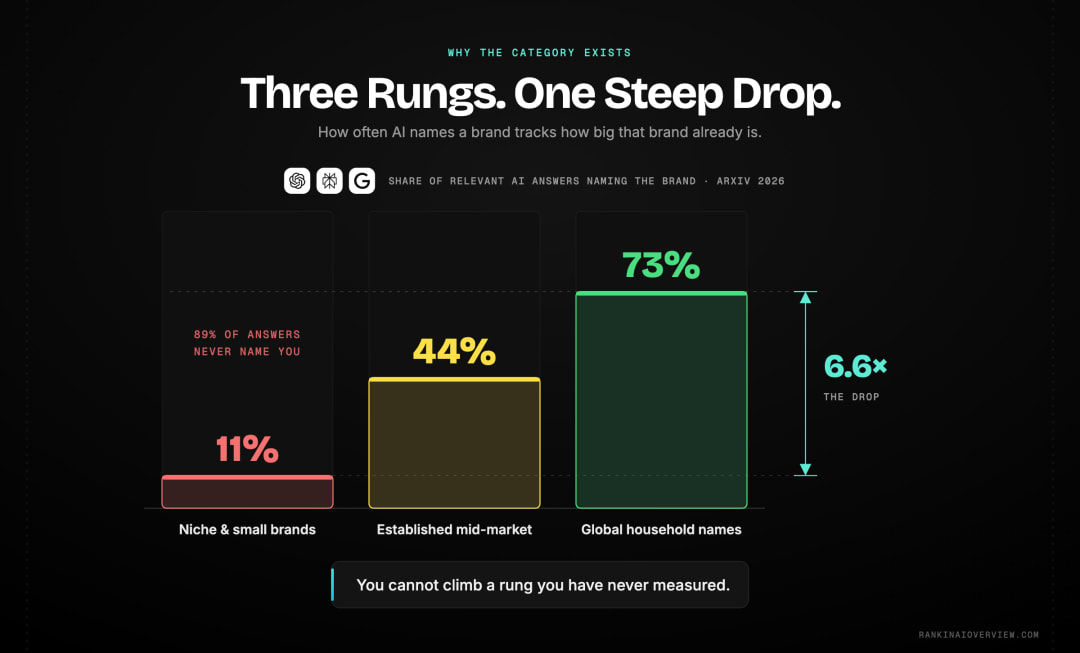
Generative engine optimisation lives or dies on one question: when AI answers a query in your category, does it name you? The uncomfortable truth is that most brands do not know, and the odds are not evenly spread. According to an arXiv study measuring brand visibility across AI search engines, global household names appear in 73% of relevant AI answers, established mid-market brands in 44%, and niche or small brands in just 11%. If you are not a household name, invisibility is the default, and you cannot fix what you cannot see.
That is precisely the job GEO tools do. They run prompts through engines like ChatGPT, Perplexity and Google AI Overviews, record whether you are mentioned or cited, and track how that changes over time. Without one, you are guessing about a channel where your buyers increasingly form their first impression of you. With the wrong one, you drown in vanity numbers that never translate into action.
This guide compares the best GEO tools of 2026, grouped by scale: enterprise platforms, mid-market analytics, affordable monitors and citation specialists. For each you get a clear read on what it does and who it suits, then a table and a simple way to choose. The goal is to help you measure what matters, then act on it.
What Are GEO Tools and Why Do You Need One?
GEO tools are platforms that measure your visibility inside AI-generated answers, tracking mentions, citations and share of voice across engines. You need one because AI answers now shape buying decisions, and a traditional rank tracker cannot see whether those answers include you.
This matters because an AI answer is not a fixed list of ten links. It is generated fresh each time, personalised to the user, and often built from several sources at once, so a single check tells you almost nothing reliable. A GEO tool turns that noise into a trend, showing whether your presence is rising or falling across many prompts and engines over time.
The brand-stature gap makes the case sharper. If small brands appear in only a fraction of the answers that name household names, then measuring your position on that ladder is the first step to climbing it. Our guide to what ranking really means in AI search explains why share of voice, not a fixed position, is the metric these tools are built around.
There is also a competitive dimension you cannot ignore. Your rivals are either measuring their AI visibility or they are not, and the ones who are will spot and close their gaps faster. A GEO tool is not only a mirror for your own presence; it is a window onto which competitors AI already trusts in your category, and how that pecking order is shifting month by month. That competitive intelligence is often the most actionable thing a GEO tool gives you, because it tells you exactly who to overtake and on which questions.
What Should a GEO Tool Do?
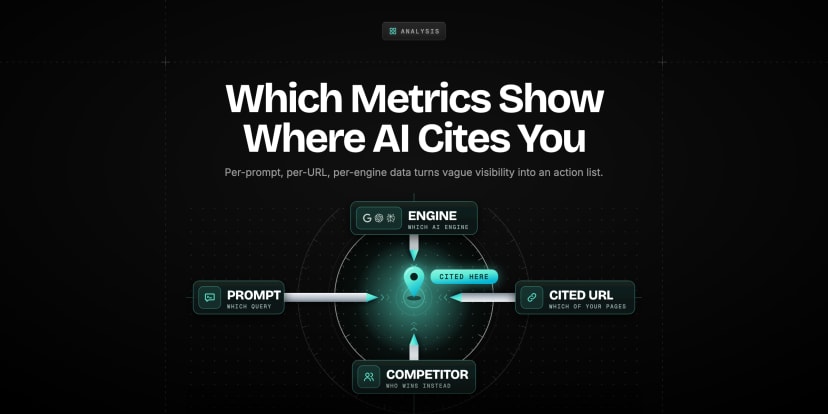
A GEO tool should capture the exact citation URLs engines display, cover the AI engines your buyers use, compare you against rivals, and refresh often enough to reveal trends. The best tools separate a passing mention from a genuine source citation, since the two carry very different value.
Beyond the basics, the strongest GEO tools help you understand not just whether you appear, but why. That means surfacing which pages get cited and how you are framed, so measurement points toward action. Kevin Indig, who has analysed thousands of AI citations, is blunt about where that action should focus.
"Classic SEO metrics don't matter nearly as much for AI chatbot mentions and citations. The best thing you can do for content optimisation is to aim for depth, comprehensiveness, and readability." Kevin Indig, growth advisor and author of the Growth Memo newsletter. Source: Kevin Indig, Growth Memo
His finding reframes what a GEO tool is really for. If depth and readability drive citations more than backlinks or keyword counts, then the tool that helps you most is the one that ties visibility to the content signals you can actually change. Keep that in mind as you read the options below.
What Are the Best GEO Tools in 2026?
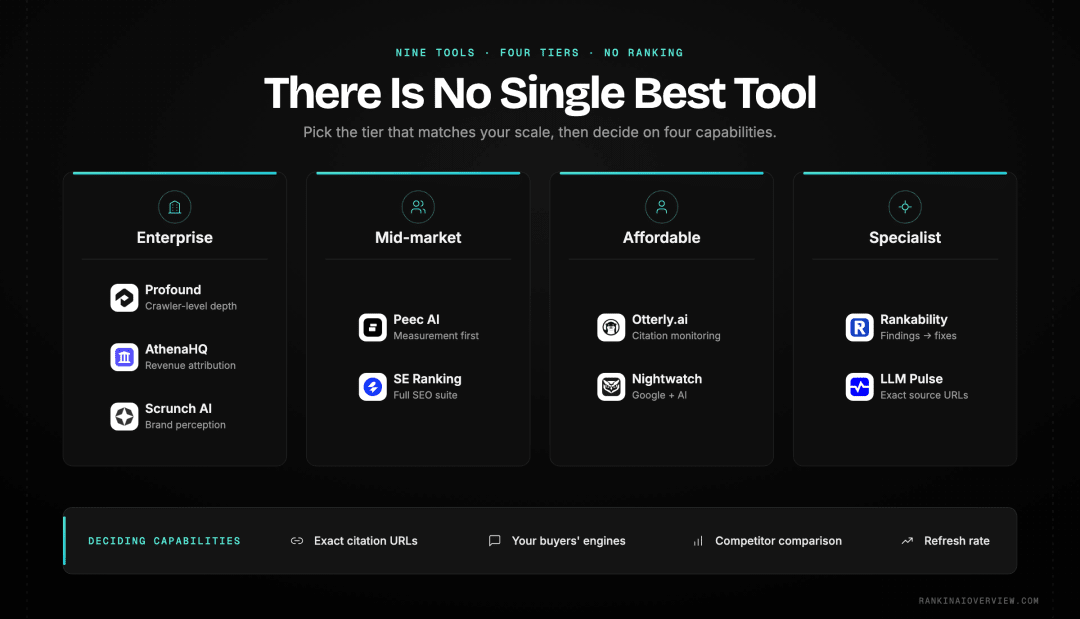
The best GEO tools in 2026 are Profound, AthenaHQ, Peec AI, Scrunch AI, SE Ranking, Nightwatch, Rankability, Otterly.ai and LLM Pulse. They span enterprise platforms, mid-market analytics, affordable monitors and citation specialists, so the right one depends on your scale and budget.
Reading them by tier makes the choice manageable rather than overwhelming.
Enterprise Platforms
For large brands running a formal AI visibility programme, these go deepest.
Profound runs structured prompts across engines daily and adds crawler-level insight few tools match, making it the enterprise benchmark. Its depth suits organisations with the budget and the need, though it is more than a small team requires.
AthenaHQ stands out by tying AI visibility to revenue through analytics integrations and adding regional breakdowns. It fits commercial brands that need citations expressed in sales terms, at a premium price to match.
Scrunch AI focuses on how AI systems interpret your brand and how to steer that perception, which suits enterprises wanting structured control rather than a scoreboard.
Mid-Market Analytics
For growing teams that want depth without enterprise cost, these hit the sweet spot.
Peec AI tracks visibility, position and sentiment across major engines with transparent, self-serve pricing. It is a strong mid-market choice, best for teams comfortable acting on their own insight, since it centres on measurement rather than fixes.
SE Ranking folds a GEO toolkit into a full SEO suite and offers a free trial, keeping rankings and AI answers in one login. Its AI features run shallower than a specialist, but the convenience and trial appeal to many teams.
Affordable Monitors and Combined Trackers
For smaller budgets or teams that want AI beside their Google positions, these keep things accessible.
Otterly.ai offers entry-level citation monitoring across engines at a low starting price, a sensible first tool for brands new to GEO. Its analytics are lighter, which is a fair trade for the accessibility.
Nightwatch adds LLM tracking to a traditional rank tracker, so you report on Google and AI together affordably. It suits teams that value combined coverage over deep AI analytics.
Citation Specialists
For teams whose single most important question is which pages get cited, a specialist earns its place.
Rankability pairs GEO tracking with content optimisation, so findings flow into the work that closes gaps, which suits agencies that want to act. LLM Pulse narrows in on citation intelligence, recording the exact source URLs engines display at an affordable price, ideal for citation-first teams.
Also read: The best AI rank trackers of 2026, compared in detail
Which GEO Tool Is Best for Your Team Size?
The best GEO tool depends on team size and budget. Enterprises get most from Profound or AthenaHQ, mid-market teams from Peec or SE Ranking, smaller brands from Otterly or Nightwatch, and citation-focused teams from Rankability or LLM Pulse.
Matching the tool to your stage prevents both overspending and underpowering. A solo consultant does not need enterprise analytics, and a Fortune 500 team will quickly outgrow an entry-level monitor. The goal is proportional coverage, not the most features.
The deciding factor within each tier is usually whether you want to act on findings or simply measure them. Teams that will optimise content themselves are well served by a pure analytics tool, while teams that want the fix built in should lean toward an optimisation-oriented option. Our guide to the AI visibility metrics that matter helps you decide which signals your tier actually needs to report.
Agencies sit in a category of their own here. Because they report to multiple clients, they benefit most from tools that offer clean, shareable reporting and can track many brands without the price ballooning per account. A specialist that captures citation URLs and competitor share, presented in a report a client can read, often beats a heavier platform whose depth never makes it into the deliverable. For an agency, the tool that wins is frequently the one that turns raw AI answers into a story a client understands, not the one with the longest feature list.
How Do the Best GEO Tools Compare?
The GEO tools compare best by tier and focus. Enterprise platforms lead on depth, mid-market tools balance depth and cost, affordable monitors keep it cheap, and specialists concentrate on citations or optimisation. There is no single winner, only a best fit.
| Tool | Tier | Standout focus |
|---|---|---|
| Profound | Enterprise | Deepest analytics and crawler insight |
| AthenaHQ | Enterprise | Revenue attribution and geo data |
| Scrunch AI | Enterprise | Brand-interpretation control |
| Peec AI | Mid-market | Self-serve analytics and sentiment |
| SE Ranking | Mid-market | SEO plus AI, with a free trial |
| Otterly.ai | Affordable | Entry-level citation monitoring |
| Nightwatch | Affordable | Combined Google and AI tracking |
| Rankability | Specialist | Tracking plus optimisation |
| LLM Pulse | Specialist | Exact citation-URL focus |
Confirm current pricing, trials and engine coverage on each vendor's site, since the category moves fast. Then trial one or two on your own prompts, because a GEO tool only proves its worth on your data, not on a demo.
How Do You Choose a GEO Tool?
Choose a GEO tool by matching your tier and priority, then shortlisting two and testing them on real prompts. Prioritise citation-URL capture, multi-engine coverage and competitor data, and favour tools that point measurement toward the content changes that lift citations.
A short process beats endless comparison. Decide your budget tier, name whether you value depth, breadth, price or optimisation most, and pick two tools that fit both. Then run identical buyer prompts through each over a couple of weeks and compare what they surface.
Judge the finalists on decisions, not dashboards. The tool that shows you which specific pages earn citations, on which engines, and whether that share is climbing will always beat a flashier interface that reports less of substance. Our honest assessment of whether AI rank tracker tools actually work is a useful gut check before you commit.
How Do You Turn GEO Data Into Higher Citations?
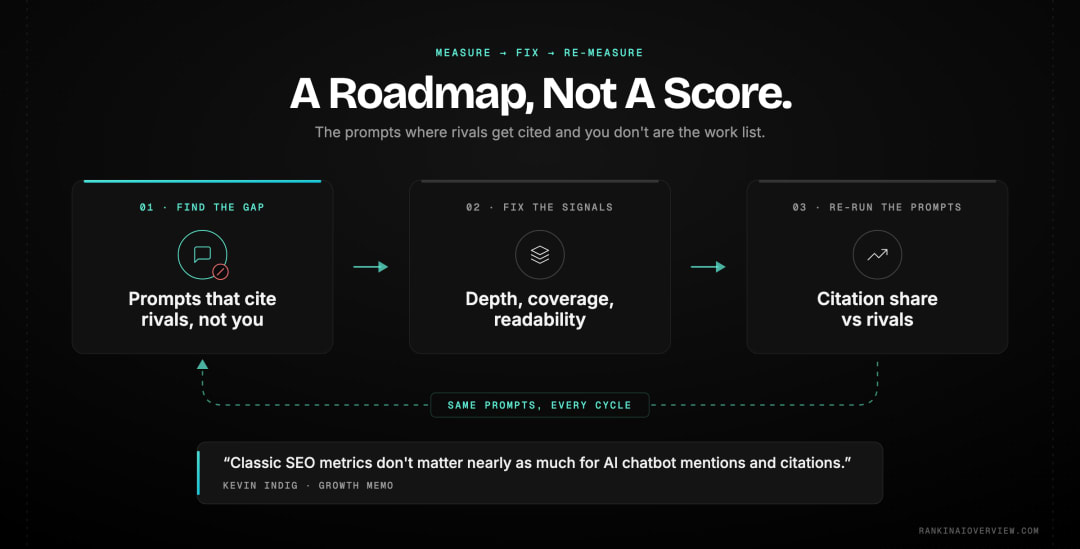
You turn GEO data into higher citations by using the tool to find the prompts where you are absent, then improving the depth, structure and readability of the content behind them. Measurement points to the gap; content changes close it, and re-measuring confirms the gain.
The sequence is what makes it work. First, let the tool show you which buyer questions cite rivals and not you. Those prompts are your roadmap, because they mark the exact places where AI has judged a competitor the better source. Guessing at improvements without this data usually means polishing pages that were already fine.
Then act on the signals that actually move citations. The research is consistent that depth, comprehensiveness and readability matter more than classic ranking factors for AI mentions, so lead each page with a clear answer, cover the topic thoroughly, and make the writing easy to parse. A GEO tool that captures the exact cited URLs helps here, because it shows which format and depth AI already rewards in your niche.
Finally, close the loop. Re-run the same prompts after your changes and watch whether your citation share rises against competitors. This measure-fix-remeasure rhythm is the whole point of owning a GEO tool, and it is what separates teams that steadily climb the brand-stature ladder from those that measure endlessly while their share stays flat.
What Are the Limits of GEO Tools?
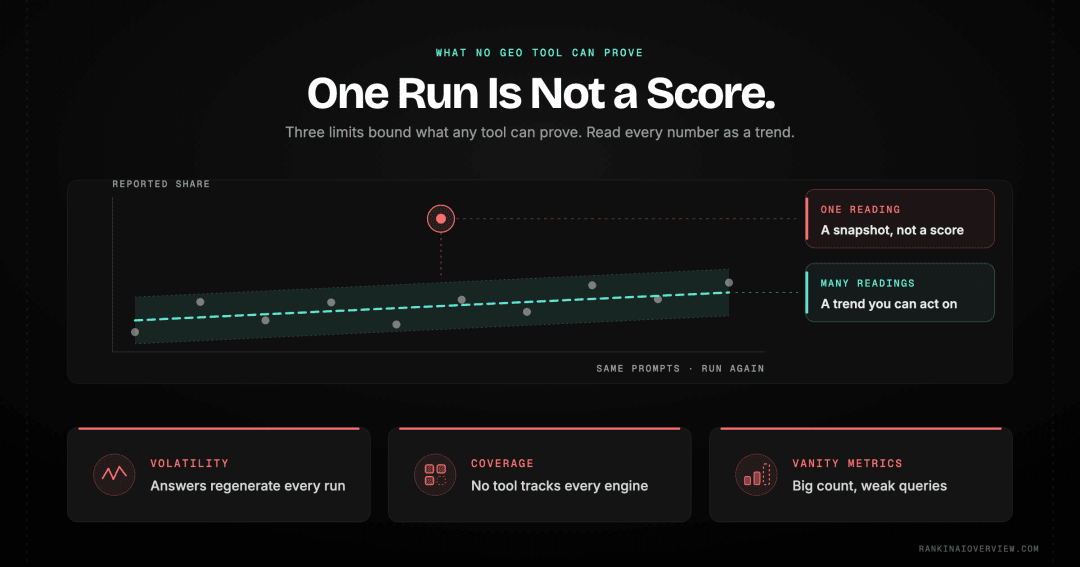
The main limits of GEO tools are the volatility of AI answers, incomplete engine coverage, and the risk of vanity metrics. No tool eliminates the noise of non-deterministic answers, so treat every reading as a trend rather than a fixed truth.
Volatility is the first limit. Because answers regenerate and personalise, even the best GEO tool reports a moving target, which is why share of voice across many prompts is more trustworthy than any single result. A tool that presents one run as a definitive score is overstating its own certainty.
Coverage is the second limit. Engines rise and fall in popularity, and no tool tracks every one perfectly, so confirm that your chosen tool covers the specific engines your buyers use rather than assuming full coverage. The third limit is the temptation of vanity metrics, where a big appearance count hides weak performance on the queries that matter. Weight your attention toward high-intent prompts, and judge the tool on whether it helps you act, not just admire a number. Comparing AI visibility against traditional search in SEO versus AI visibility benchmarking helps set realistic expectations for what any GEO tool can prove.
Also read: What ranking really means in AI search, and why share of voice is the metric
Conclusion
GEO tools exist because AI answers now decide which brands buyers even consider, and the odds favour the already-famous. If household names appear in most relevant answers while smaller brands appear in a fraction, then measuring your place on that ladder is the first move toward climbing it. A GEO tool turns that invisible gap into a number you can manage.
Match the tool to your scale. Enterprises get most from Profound or AthenaHQ, mid-market teams from Peec or SE Ranking, smaller brands from Otterly or Nightwatch, and citation-focused teams from Rankability or LLM Pulse. Shortlist two, trial them on your own prompts, and judge by the decisions they enable.
RANK IN AI OVERVIEW studies how AI answers pick the brands they cite, publishes that research openly, and is putting the final touches on an AI visibility tool arriving soon.
Before you commit to any GEO tool, see exactly where your brand stands: take your free AI visibility audit.
Frequently asked questions
What is a GEO tool?+
A GEO tool measures your visibility inside AI-generated answers, tracking how often engines like ChatGPT, Perplexity and Google AI Overviews mention or cite your brand. The best ones report share of voice and citations over time, not a single position.
Why do I need a GEO tool?+
Because AI answers now shape buying decisions, and traditional rank trackers cannot see whether those answers include you. Small brands appear in far fewer AI answers than household names, so measuring the gap is the first step to closing it.
What should the best GEO tool track?+
It should track mentions, exact citation URLs, share of voice against competitors, and how these change over time across the AI engines your buyers use. Separating a passing mention from a genuine citation matters most.
Are there affordable GEO tools?+
Yes. Otterly.ai and LLM Pulse offer affordable citation monitoring, and Nightwatch bundles AI tracking with rankings cheaply. Each suits smaller teams that want GEO coverage without an enterprise price.
How much do GEO tools cost?+
Prices range widely, from affordable entry monitors to premium enterprise platforms. Cost usually scales with the number of prompts, engines and analytics depth, so match your spend to how central AI visibility is to your work.
Do GEO tools help me improve, not just measure?+
Some do. Tools like Rankability pair measurement with content optimisation, while pure analytics tools focus on the score. If you want the fix built in, choose an optimisation-oriented tool rather than a monitor alone.
Explore with AI
Share this