Why AI Engines Are Citing Pages That Don't Rank on Google (And What It Means for SEO)
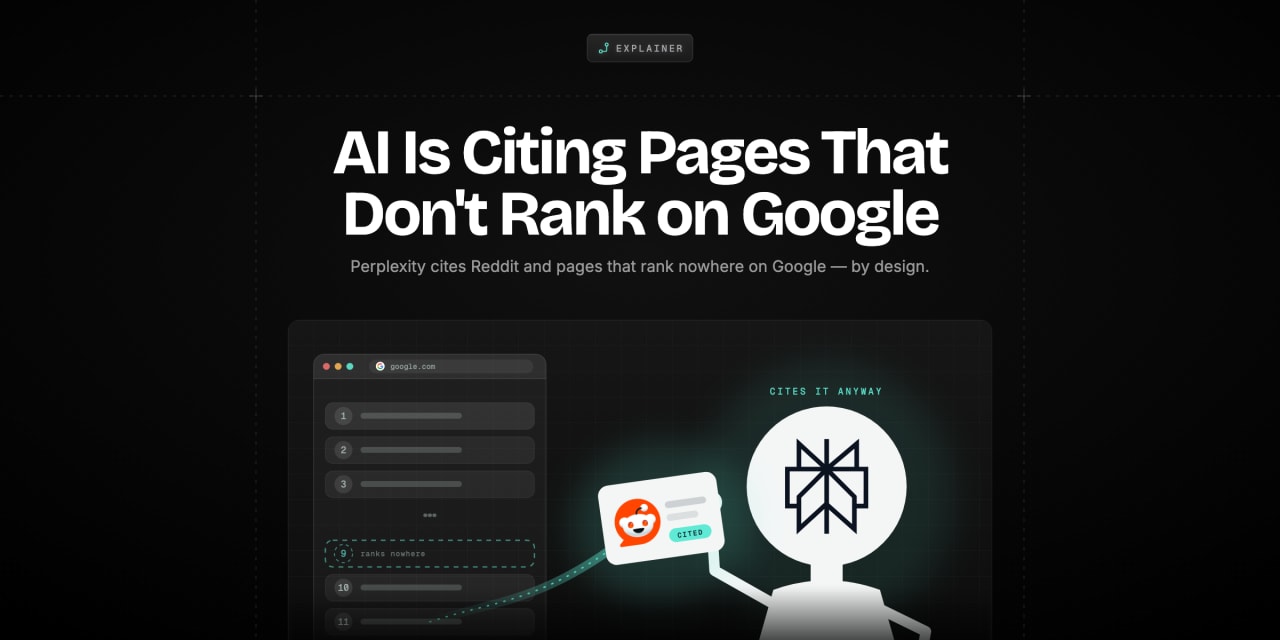
AI engines like Perplexity are citing pages that rank nowhere on Google. Here is why it is happening, what it means for your content strategy, and how to take deliberate advantage of it.
Key Highlights
-
AI cites pages not on Google consistently, particularly Perplexity. This is not a glitch. It is a structural property of how Perplexity builds its citation index independently of Google's ranking algorithm
-
The Perplexity independent index uses its own crawler to evaluate content quality, freshness, and relevance directly. Google ranking is neither a prerequisite nor a strong predictor of Perplexity citation
-
AI search vs Google rankings diverge most sharply on Reddit and UGC content. Reddit posts that rank nowhere on Google for their topic are cited constantly in Perplexity answers because Reddit is in Perplexity's own trusted source layer
-
Non-Google AI citations are most accessible for new sites. A well-structured, expert page on a new domain can appear in Perplexity within weeks of publication without building any backlink authority
-
Rank in AI without Google is platform-dependent: possible significantly for Perplexity, harder for Google AI Overviews (which requires Google top-20 ranking), and partial for ChatGPT (which relies on Bing's index)
-
This finding opens a new first-mover opportunity for content strategy: publishing high-quality content on Reddit and Quora drives AI citations independently of any Google ranking
-
The most durable AI visibility strategy builds both tracks: Google ranking for scale and stability in AI Overviews, and off-site community presence for Perplexity coverage that does not require domain authority
The SEO community is used to a simple truth: if you do not rank on Google, you do not get found. AI search is breaking that rule. Practitioners are increasingly observing Perplexity citing pages that have no meaningful Google ranking, minimal domain authority, and barely any backlinks alongside pages from domain authority 80 sites that rank at position one. The observation is consistent across different practitioners in different industries. AI cites pages not on Google, and it is not an anomaly. It is a structural property of how Perplexity builds its citation layer independently of Google's ranking algorithm.
This observation has significant strategic implications. If AI citation is at least partially decoupled from Google ranking, then the traditional SEO playbook, the one that says build authority, build backlinks, rank higher, is not the only path to AI search visibility. The fact that AI cites pages not on Google means a new path exists: build the signals that AI engines evaluate independently, specifically content quality, platform trust, and entity recognition, and achieve AI citations without first winning the Google ranking competition.
This guide explains why it is happening, what the mechanism is for each major AI platform, what determines AI citation outside of Google rankings, and how to take deliberate advantage of the opportunity. According to Princeton and Georgia Tech's generative engine optimisation research that founded the GEO discipline, AI citation probability responds to specific content signals. Many of those signals are independent of Google ranking position. Understanding which ones produces a genuine strategic advantage for brands willing to invest in them.
What Are Practitioners Actually Observing?
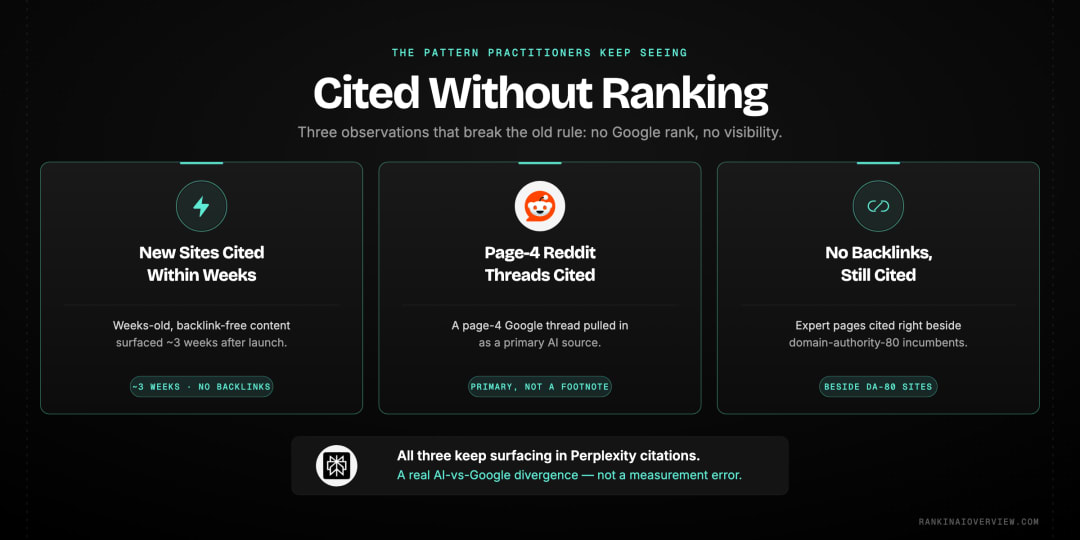
Three specific patterns have generated consistent community discussion. New sites with weeks-old content appear in Perplexity answers. Reddit posts with zero meaningful Google ranking for their topics are cited as primary sources in AI-generated answers. Pages with no backlinks are cited alongside domain authority 80 sites for the same query. All three patterns have the same structural explanation: AI search vs Google rankings is a genuine divergence, not a measurement error.
The new site observation is the most commercially significant. An SEO practitioner who launched a new domain and published twelve well-structured articles on a specific software category topic reported seeing Perplexity citations within three weeks of launch, without any link building and with no Google ranking for any target query. The Google authority signals that would be required to appear in Google search results, specifically domain authority built through backlink acquisition, were entirely absent. The Perplexity citations were present.
The Reddit observation is the most structurally revealing. Reddit posts that discuss specific products, compare alternatives, or answer category questions are cited in Perplexity answers for those same questions, even though those Reddit posts rank nowhere near position one on Google. AI search vs Google rankings diverges most sharply here: a Reddit thread with 47 substantive comments may rank on page four of Google for the relevant keyword but appear as a primary source in Perplexity answers about which tools to consider. The platform trust that makes Reddit valuable as a citation source for Perplexity is entirely separate from the domain authority signals that would make it rank well on Google.
The no-backlink page observation is the most counterintuitive from a traditional SEO perspective. A page with specific, expert-level content and direct-answer structure but with zero inbound links is being cited alongside heavily linked pages. This suggests that Perplexity's citation evaluation places significant weight on content quality and structure signals that can be achieved without link acquisition. Non-Google AI citations are available to pages that meet Perplexity's quality criteria regardless of whether they have met Google's authority criteria.
Why Do AI Engines Not Fully Mirror Google's Rankings?
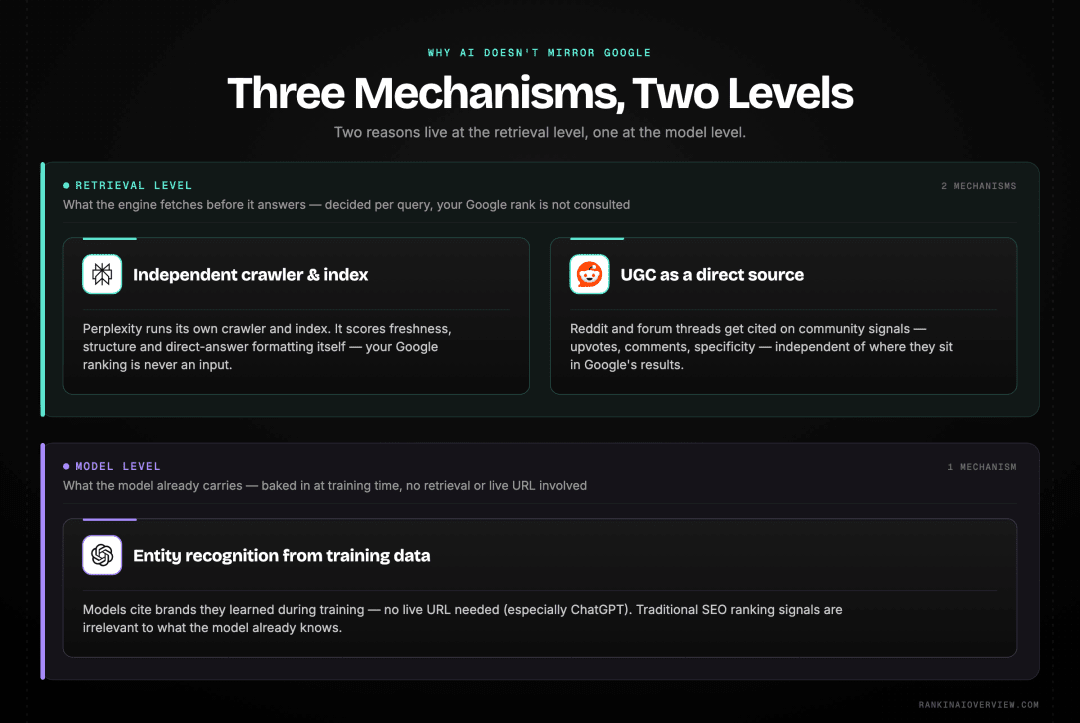
Three distinct mechanisms explain why AI engines, particularly Perplexity, cite pages that Google does not rank highly. First, Perplexity operates its own independent crawler and index, meaning Google ranking is not an input into its retrieval decisions. Second, Reddit and other UGC platforms are evaluated directly on platform trust rather than Google ranking signals. Third, entity recognition from AI training data allows brands to be cited based on what AI models learned during training, independently of any URL ranking.
Perplexity's Independent Crawler
The Perplexity independent index is the most structurally important explanation for non-Google AI citations. Perplexity operates its own web crawler, separate from Google's Googlebot. This crawler evaluates pages based on Perplexity's own quality signals: content freshness, structural clarity, direct-answer formatting, and topical relevance to the queries Perplexity processes. Google ranking is not an input into this evaluation. A page that is not indexed by Google at all can be indexed by Perplexity's crawler and cited in Perplexity answers if it meets Perplexity's quality criteria.
The practical implication is that the traditional SEO prerequisite, build Google ranking authority first, then expect search visibility, does not apply to Perplexity in the same way it applies to Google AI Overviews. Perplexity evaluates your content on its own merits, independently of what Google thinks of your domain. A new site with well-structured, expert content on a specific topic can rank in AI without Google by meeting Perplexity's independent quality criteria.
Content signals that Perplexity weights heavily, based on practitioner observation and the Princeton GEO research findings: direct-answer opening structure that provides a self-contained answer in the first 60 words, specific named data points and statistics, first-person experience language, and topical focus on a specific subject rather than broad generalist content. These are the same signals that improve Google ranking and AI Overview citation, but they are independently evaluated by Perplexity's own crawler rather than via Google's ranking output.
Reddit and UGC as Direct AI Sources
Reddit is in Perplexity's own trusted source layer independently of Google. Perplexity evaluates Reddit content based on the platform's community corroboration signals: upvote count, number of comments, specificity of the discussion, and community engagement level. A Reddit thread with 200 upvotes and 47 substantive comments about software tool comparisons has strong platform trust signals for Perplexity regardless of how that thread ranks on Google.
This is the mechanism that explains why practitioners see Reddit posts cited in Perplexity for queries where those posts rank on page four of Google. The AI search vs Google rankings divergence for Reddit content is structural: Perplexity is not using Google's ranking signal for Reddit content. It is using its own trust evaluation of the Reddit community's signals. Community volume, engagement quality, and post recency are the signals that matter for Reddit's Perplexity citation probability, not Google's assessment of the post's keyword relevance or backlink profile.
Entity Recognition as a Training Data Citation
The third mechanism is different from the first two because it operates at the model level rather than the retrieval level. AI models are trained on large text corpora that include Wikipedia, news publications, and community platforms. During training, the model builds entity knowledge: understanding of what specific brands, products, and organisations are and what categories they operate in. A brand that appeared frequently in those training corpora is an entity the model knows, and the model may recommend or describe that brand based on training data rather than real-time retrieval.
This explains the most puzzling non-Google AI citation pattern: brands mentioned without a specific URL citation. A ChatGPT response that recommends a specific brand by name without citing a URL may be drawing on training data rather than live retrieval. The brand is being cited based on what the model learned during training, not based on what it retrieved from a current web search. For this mechanism, traditional SEO signals are entirely irrelevant. The brand's presence in the training data is what determines the citation.
“ I've seen new domains get cited in AI within weeks of launch. Perplexity has its own crawler and index. It doesn't fully depend on Google's ranking signals. Reddit posts with zero SEO value are getting cited in Perplexity constantly. The game has changed. SEO practitioner r/seogrowth community, Reddit 2026 Source: Reddit: AI Cites Pages Not on Google, Perplexity Independent Index
What Determines AI Citation Outside of Google Rankings?
Five signals determine Perplexity citation independently of Google ranking. Content quality and directness: can AI extract a self-contained answer from the first 60 words? Platform trust: is the content on a platform Perplexity treats as independently reliable? Brand entity recognition: does the AI engine know the brand from training data? Off-site corroboration: do independent sources confirm the brand's category and credibility? Content freshness: has the content been updated recently enough to be relevant?
-
Content extractability: pages that open every section with a self-contained direct answer are cited more frequently by Perplexity than pages that bury the answer after context-setting paragraphs
-
Platform trust: Reddit, Quora, and review platforms are evaluated directly by Perplexity based on community engagement signals, independently of Google ranking
-
Brand entity recognition: brands known to AI models from training data may be recommended without requiring a specific ranked URL, particularly in ChatGPT
-
Off-site corroboration: multiple independent mentions of a brand across trusted platforms build citation confidence for Perplexity's retrieval system
-
Content freshness: Perplexity weights recently published and updated content more heavily for time-sensitive queries because it prioritises giving users current information
The most significant finding for content strategy is that content extractability is the primary determinant of Perplexity citation for brand-owned pages without established Google authority. A new domain can achieve Perplexity citations within weeks by publishing pages that meet the extractability criteria: direct-answer openings, specific named data, and clear structural organisation. This is the fastest legitimate path to AI visibility available for brands that cannot yet compete in Google's authority-based ranking competition.
Can You Build AI Visibility Without Google Rankings?

The answer is platform-dependent. For Perplexity, yes significantly: the Perplexity independent index evaluates content on its own quality criteria. For Google AI Overviews, no: approximately 97% of citations come from Google's top 20, making Google ranking a prerequisite. For ChatGPT, partially: ChatGPT Search uses Bing's index for live retrieval, and training data citations are independent of any ranking. The most accessible non-Google AI citation path for new or low-authority sites is Perplexity, followed by community content on Reddit and Quora.
| AI Platform | Google Ranking Required? | Alternative Citation Path | Speed for New Sites |
|---|---|---|---|
| Google AI Overviews | Yes. Approximately 97% of citations from top 20 | None available. Google ranking is the prerequisite | Slow. Must first achieve Google top-20 ranking |
| Perplexity | No. Independent index and crawler | High-quality content meeting extractability criteria. Reddit and community presence | Fast. Citations possible within weeks of publication |
| ChatGPT (live search) | No, but Bing ranking helps | Submit to Bing Webmaster Tools. Entity recognition from training data | Medium. Bing indexing required but domain authority less critical than Google |
| ChatGPT (parametric) | No. Training data citations | Brand presence in training corpora: Wikipedia, news publications, major platforms | Slow. Depends on training data refresh cycles |
| Gemini | Partially. Favours Google-indexed content | Google Business Profile and entity recognition help | Medium. Favours established indexed content |
What Are the Practical Implications for Your Content Strategy?
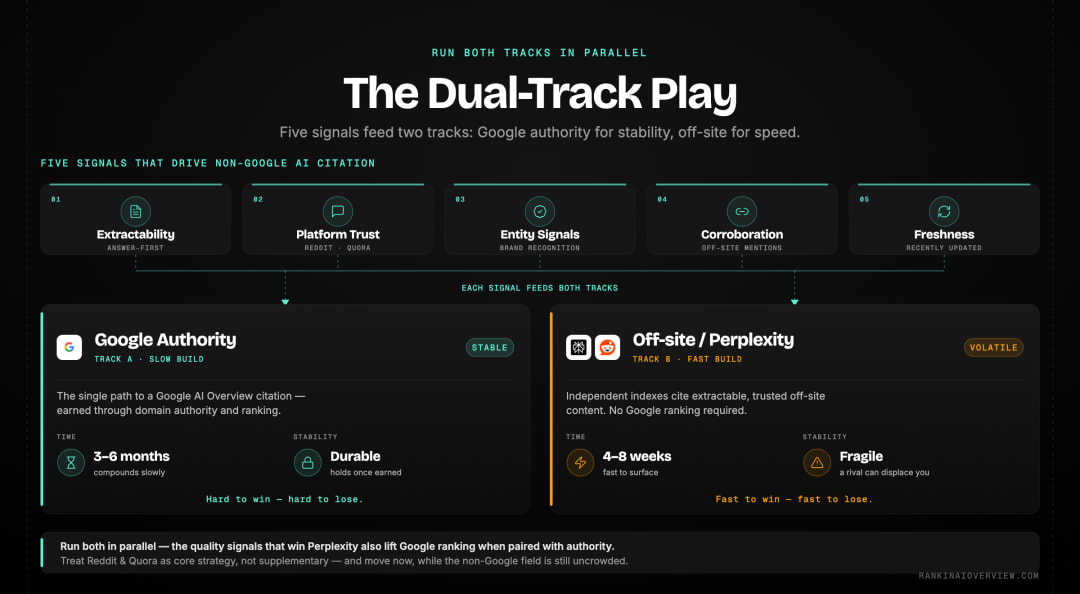
Three specific content strategy changes follow directly from the non-Google AI citation finding. First, Reddit and Quora community content should be treated as part of core content strategy, not a supplementary activity, because it drives AI citations independently of Google ranking. Second, new sites can prioritise Perplexity citation as an early visibility goal before Google authority is established. Third, the traditional content strategy sequencing of "rank first, then expect visibility" needs to be updated to run the two tracks in parallel.
The most immediately actionable implication is the Reddit strategy. Publishing high-quality, experience-specific content in relevant Reddit communities drives Perplexity citations regardless of Google ranking. A brand that contributes genuine expert answers to two or three relevant subreddits twice per week is building Perplexity citation signals in parallel with any Google SEO investment. These are not substitute strategies. They are parallel tracks that serve different AI platforms through different mechanisms.
For new sites specifically, this finding changes the strategic sequencing. The traditional advice, build domain authority through link acquisition before expecting search visibility, applies to Google and Google AI Overviews. For Perplexity, it does not apply in the same way. A new site that publishes ten to fifteen high-quality, directly structured articles on a specific topic and submits to Bing Webmaster Tools for ChatGPT Search indexing can achieve measurable AI citation within four to eight weeks without any backlink building. This is not a substitute for building Google authority. It is a parallel first-mover opportunity that produces brand visibility before Google authority is established.
The off-site content strategy implication extends beyond Reddit. Any platform that Perplexity treats as a trusted source, which includes Quora, G2, Clutch, Trustpilot, and industry-specific forums, is a viable AI citation channel for brands without established Google rankings. Building genuine presence on these platforms is not purely a link building exercise. It is building direct citation pathways to Perplexity that bypass Google's authority requirements entirely.
How Stable Are Non-Google AI Citations Over Time?
Non-Google AI citations are less stable than citations from Google-ranked pages. The stability difference reflects the underlying architecture: Google rankings persist as long as authority signals are maintained and no competitor displaces them. Perplexity citations depend on the Perplexity independent index's current crawl, which refreshes frequently and can be influenced by new content from competitors. Building Google rankings alongside off-site signals creates the most durable AI visibility because it serves both Google AI Overviews and Perplexity simultaneously.
The volatility risk for non-Google AI citations is real and should inform how brands weight their investment. A brand that achieves Perplexity citation through high-quality content and Reddit presence has built a useful visibility layer, but it has not built the stable authority that comes from Google top-20 ranking. A competitor that publishes higher-quality content on the same topic can displace the citation within weeks. A competitor that achieves Google top-20 ranking for the same query will also achieve AI Overview citation, which the non-Google-ranked brand cannot access at all.
The sustainable strategy is dual-track. Invest in Google ranking as the authority foundation that provides stable, long-term AI Overview citation eligibility. Run the off-site Perplexity and community track in parallel to achieve faster initial visibility and diversify citation sources beyond Google. The two tracks reinforce each other: the content quality signals that earn Perplexity citations also serve Google's ranking algorithm when combined with domain authority from backlink building.
Conclusion
The discovery that AI engines cite non-ranked content is one of the most strategically significant findings in modern SEO. It opens a new path to visibility, particularly via the Perplexity independent index and through Reddit and community platforms, that exists independently of Google's domain authority and backlink requirements.
The opportunity is real and time-limited. The competitive field for non-Google AI citations is currently less developed than the field for Google rankings. New sites and low-authority brands that invest in direct-answer content quality and community platform presence can achieve AI search visibility faster than the traditional SEO timeline allows. Build both tracks: Google ranking for scale and stability in AI Overviews, and off-site community presence to rank in AI without Google for Perplexity. The ability to rank in AI without Google is a first-mover advantage that closes as the competitive field develops. RANK IN AI OVERVIEW covers how AI engines evaluate and cite content across all major platforms in depth across its content library.
Frequently asked questions
Can a new site appear in Perplexity without Google ranking?+
Yes. Perplexity's independent crawler evaluates pages based on its own quality criteria rather than Google's ranking signals. A new site with well-structured, expert content on a specific topic can appear in Perplexity citations within weeks of publication without domain authority or backlinks. The prerequisites for Perplexity citation are: content that passes the direct-answer extraction test (self-contained answer in the first 60 words of each section), clear topical focus, specific named data points, and submission of the site to Perplexity's crawler by ensuring it is not blocked in robots.txt. Submit the site to [Bing Webmaster Tools](https://www.bing.com/webmasters) simultaneously for ChatGPT Search indexing.
Does appearing in AI without Google ranking have any SEO value?+
Indirectly, yes. AI citations from Perplexity and ChatGPT drive branded search volume in Google as users who encounter your brand in an AI answer later search for it directly on Google. Rising branded search volume is a positive signal that can contribute to Google ranking over time. AI citations also expose your brand to buyers earlier in their research journey than Google ranking might, which produces awareness before the authority to rank is established. The direct SEO value is limited: AI citation from Perplexity does not produce a backlink and does not directly improve Google ranking.
What types of content get cited in AI without ranking on Google?+
Three content types produce non-Google AI citations most reliably. First, direct-answer structured content on new or low-authority domains: pages that open with a 40 to 60 word self-contained answer to the primary query and use question-format H2 headers are cited by Perplexity independently of domain authority. Second, Reddit and community forum posts: experience-specific, detailed posts with community engagement signals are cited by Perplexity as primary sources regardless of their Google ranking. Third, Quora answers with specific credentials: practitioner-level answers with named experience credentials are cited by both ChatGPT and Perplexity independently of the answerer's website authority.
Explore with AI
Share this


