We Tested 124 Searches: Ranking and AI Citation Are Separate
We tested 124 searches, 15 local businesses and our own site in ChatGPT and Google AI Overviews. Ranking and AI citation behaved like separate systems.

SummaryOur August 2026 tests show that ranking on Google doesn't guarantee AI citations. Specific, quotable facts on dedicated pages win AI visibility.
Read moreShow less
Key Highlights
-
This is first-party data. Every figure below comes from tests we ran ourselves in August 2026, with the date, sample size and caveat stated next to it.
-
Our own site was cited by ChatGPT on 0 of 6 topics where it ranks well, including one page sitting #1 on Google for the exact question.
-
ChatGPT named 8 of 15 local Indian businesses we tested. Three of those 8 did not appear in Google's results for the matching search at all.
-
87 of 124 local and service searches across India, the UAE and Qatar triggered a Google AI Overview. That is 70%.
-
A regulatory consultancy was the first cited source in an AI Overview while ranking nowhere in Google's top 20.
-
When AI Overviews quoted a clinic's equipment, that exact equipment name was written out on the clinic's own page. Generic service copy was never pulled.
-
Samples are small in places and the data is a snapshot, not a trend. We say so in every section, and a re-run is scheduled.
When an AI assistant recommends a business, it is making a referral, and the quality of that referral depends on what the engine can retrieve. According to a September 2026 audit by Hazem Ibrahim and Yasir Zaki, only 4% of an open-weight model's recommended doctors matched a real clinician in the queried city without web search. With search switched on, 64 to 71% of recommendations matched a real provider.
That finding raises the question every business owner now asks us. If the engine is searching the web, surely it is searching Google, and surely ranking well on Google is enough? We kept hearing confident answers in both directions and very little data. Most published studies come from tracking vendors, cover US brands, and summarise other people's numbers.
So we ran our own tests and logged every result. This page sets out what we found across our own site, 15 local businesses and 124 commercial searches in three countries. You get each finding with its sample size and its weak spots, a plain reading of what it means for your site, and a method you can repeat on your own brand this week.
What Did We Test, and How?
We ran three sets of checks in August 2026. ChatGPT was tested by hand, typing each prompt into a logged-in account. Google results and AI Overviews were pulled through a SERP API so the result pages could be read in full. Every check was recorded with its query, engine, date and outcome.
Which samples went into this study?
Test set | Engine | Date | Sample | Main caveat |
Our own site, 6 topics | ChatGPT | 10 to 11 Aug 2026 | 6 topics, one site | Very small sample |
Local Indian businesses | ChatGPT and Google | 10 Aug 2026 | 15 businesses | Small sample, mostly healthcare |
Local and service searches | Google AI Overviews | 22 Aug 2026 | 124 searches, 3 countries | Commercial local queries only |
Compliance service searches | Google AI Overviews | 22 Aug 2026 | 34 searches | One client's keyword set |
Clinic equipment quotes | Google AI Overviews | 22 Aug 2026 | 3 clinics | Pattern, not a rate |
Who are the businesses in the sample?
The local sample leans heavily on Indian healthcare: hospitals in Kolkata and Siliguri, and specialists in Thane across dermatology, orthopaedics and hair restoration. It also includes study abroad consultants, an interior design studio, a tour operator, an education provider and two B2B manufacturers of industrial machinery.
These are real client and portfolio sites. We have anonymised every one of them. Where a competitor is a large public brand, we name it, because it is simply what the search result showed.
Why does the sample look like this?
It is the work we do every week. That is a weakness and a strength. It is a convenience sample, not a random one, so treat the percentages as indicators rather than market rates. But almost no published research covers local businesses outside the US and Western Europe, and that is exactly where this data sits.
What did we exclude?
We left branded queries out of every claim. Asking ChatGPT about a business by name tells you nothing about whether it would recommend that business to a stranger. We also kept large national brands out of the local claims, because they win for reasons a local clinic cannot copy.
Does Ranking #1 on Google Get You Cited by ChatGPT?
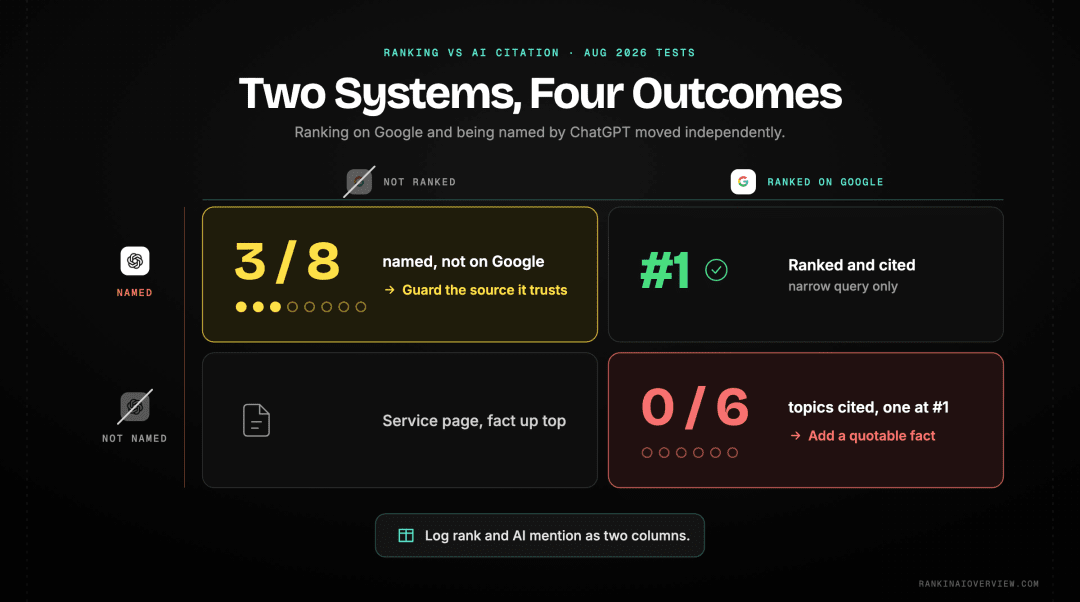
No, not in our test. Across six topics where our own site ranks well, ChatGPT cited us zero times. One page sits #1 on Google for its exact question, and ChatGPT answered that question from OpenAI's own help documentation instead. Re-phrasing every prompt casually changed nothing.
What exactly happened on the six topics?
We picked six questions our articles were written to answer. Each article held a strong organic position for its target question. We asked ChatGPT each question in the plain form a searcher would type it.
None of the six answers cited our site. On the question where we sit at #1, the answer was built from OpenAI's help pages. A competitor did not beat us on merit. Our page simply was not part of the answer.
Was the prompt phrasing the problem?
That was our first suspicion. SEO people write prompts that look like keywords, and real users do not type like that. So we re-ran all six in loose, conversational phrasing, the way a person types into a chat box.
The result did not move. Zero for six, twice. Both rounds ran on one logged-in personal account, so personalisation could play a part, and we flag that rather than hide it.
What did get cited?
One piece of ours has been cited by ChatGPT. It was the article carrying a specific number, a figure on how often ChatGPT triggers a live web search. It appeared alongside Semrush.
Our explainers, the pieces with better structure and more careful writing, got nothing. Not fewer citations. None.
What should you take from a sample of six?
Six topics on one site is not a rate, and we will not quote it as one. What it does show is a mechanism. A top organic position did not place our page inside the answer, and better writing did not either. A quotable fact did.
That matches the wider pattern we cover in our piece on why a page 1 ranking does not carry into AI Overviews. Ranking gets you into Google's list. Citation needs the engine to find a sentence worth lifting.
Do AI Engines Cite Businesses Google Does Not Rank?
Yes, repeatedly. Three of the eight local businesses ChatGPT named were absent from Google's results for the matching search. A regulatory consultancy was the first cited source in a Google AI Overview while ranking outside the organic top 20. Low organic rank did not block AI visibility.
What happened with the regulatory consultancy?
On 22 August 2026 we checked the query "bis qco advisory", a compliance service search in India. An Indian regulatory consultancy was the first source cited inside Google's AI Overview.
The same business did not rank anywhere in Google's top 20 organic results for that query. The AI Overview and the blue links underneath it were drawing on different evidence. This is one query, so read it as proof that it can happen, not as a measure of how often.
What happened with the Kolkata hospitals?
We asked ChatGPT for the best multispecialty hospitals in Kolkata. It named two hospitals from our sample.
Neither of them appeared in Google's results for the same search, where Apollo Hospitals held the top spot. A searcher using Google and a searcher using ChatGPT would have walked away with different shortlists.
Is this a pattern or a fluke?
Across the local sample, ChatGPT named eight businesses. Three of those eight did not show in Google's results for the matching search. The reverse also held. A tour operator ranking #3 on Google for its main search was not named by ChatGPT at all.
So the gap runs both ways. Ranking well did not guarantee a mention, and ranking badly did not prevent one. We explore the mechanism behind this in why AI engines cite pages that do not rank on Google.
"Whether an AI referral is trustworthy depends strongly on its retrieval configuration rather than on the underlying model alone, yet an answer produced without retrieval often carries no sign that its recommendations were never verified." Hazem Ibrahim and Yasir Zaki, authors of the local service markets audit. Source: arXiv, Understanding AI Provider Recommendations in Local Service Markets
That line explains a lot of what we saw. The engine answers from whatever it retrieved or remembered, and nothing in the answer tells you which. A local business can be named from sources that have little to do with its Google position.
Which Local Businesses Does ChatGPT Actually Name?
ChatGPT named 8 of the 15 local Indian businesses we tested on 10 August 2026. Most of the eight were clinics and hospitals with detailed service pages. Neither of the two B2B manufacturers was named. Detailed, specific pages showed up. Thin category pages did not.
How did we phrase those prompts?
Each prompt followed the shape a real buyer uses: "best [service] in [city]". We did not include business names. A business counted as named only if ChatGPT listed it unprompted in the answer.
Why did clinics do better than manufacturers?
The clinics and hospitals that were named tend to publish a page per treatment. Those pages list the procedure, the equipment and the specialist. That gives an engine concrete facts to match against a question like "best hair transplant clinic in Thane".
The two manufacturers sell industrial machines through a small brochure-style site. Their pages describe the product range in broad terms. Neither was named for its category search. Sample size matters here, since two is not a trend, but the contrast is sharp.
Is the slot even open?
This was the most useful thing the sweep taught us. On some questions the engine already has a confident answer, and no amount of page work will dislodge it.
On a search for the best hospitals for robotic knee replacement in Mumbai and Thane, the AI Overview named one of our clients and skipped a direct competitor that ranks well organically. That slot was open. On a search for the best laser marking machine brands in India, the answer listed only large manufacturers. Our client had no route in. That slot was closed.
The same client is #1 and cited on a narrower query about stamper machines. Same site, same content quality, different outcome. Whether the engine already likes an answer decides more than how good your page is.
How do you check whether a slot is open?
Ask the question in the engine before you write anything. If the answer names the same three national brands every time, the slot is closed for a small business. Go narrower. If the answer is vague, mixed or lists businesses of your size, the slot is open and worth the work.
Also read: A step by step diagnostic for pages that should be cited but are not
How Often Do Local Searches Trigger an AI Overview?
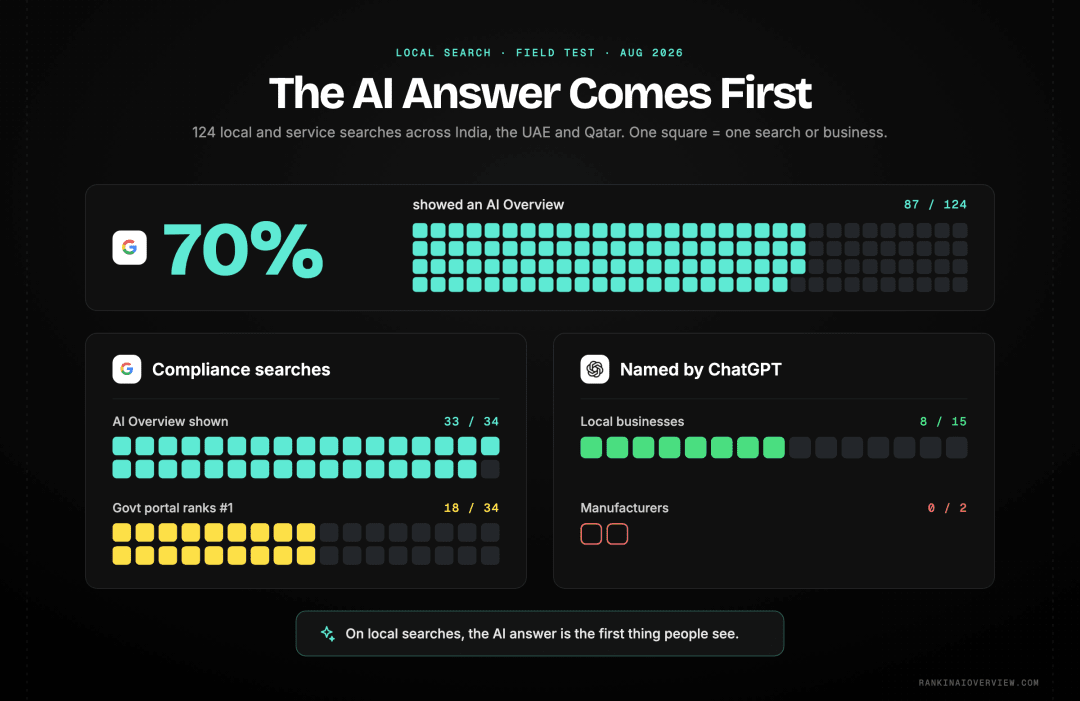
Often. On 22 August 2026, 87 of 124 local and service searches across India, the UAE and Qatar triggered a Google AI Overview. That is 70%. In a separate compliance set, 33 of 34 searches triggered one. For commercial local queries, the AI Overview is now the default view, not the exception.
What kind of searches were these?
These were commercial searches a buyer types before choosing a provider. Think "best dermatologist in [city]" or "study abroad consultant in [city]". They were not trivia questions or how-to queries, which trigger AI Overviews for different reasons.
Why does the 70% figure matter for local businesses?
Many local business owners still assume AI Overviews are for informational searches and leave the map pack alone. Our data says otherwise for the markets we tested. On seven in ten of these searches, the first thing a buyer saw was an AI summary that named, or failed to name, a business.
If your business is missing from that summary, ranking third in the organic list below it now does less work than it used to. The answer sits above you and the buyer may stop reading there.
What did the compliance searches show?
For one client in regulatory compliance services, we checked 34 searches. Thirty-three triggered an AI Overview. A government portal held the top organic result on 18 of the 34.
That pairing is the interesting part. The government portal owns the organic top spot because it is the official source. But the AI Overview still needs someone to explain the process, the timeline and the paperwork in plain language. The consultancies answering those process questions were the ones being cited.
How should you read these two figures together?
The 124-search set covers commercial local queries only, and the 34-search set is one client's keyword list. Neither is a national rate. Together they say that in the commercial categories we work in, an AI Overview appears on most searches. Plan for it as the norm.
What Kind of Sentence Gets Quoted?
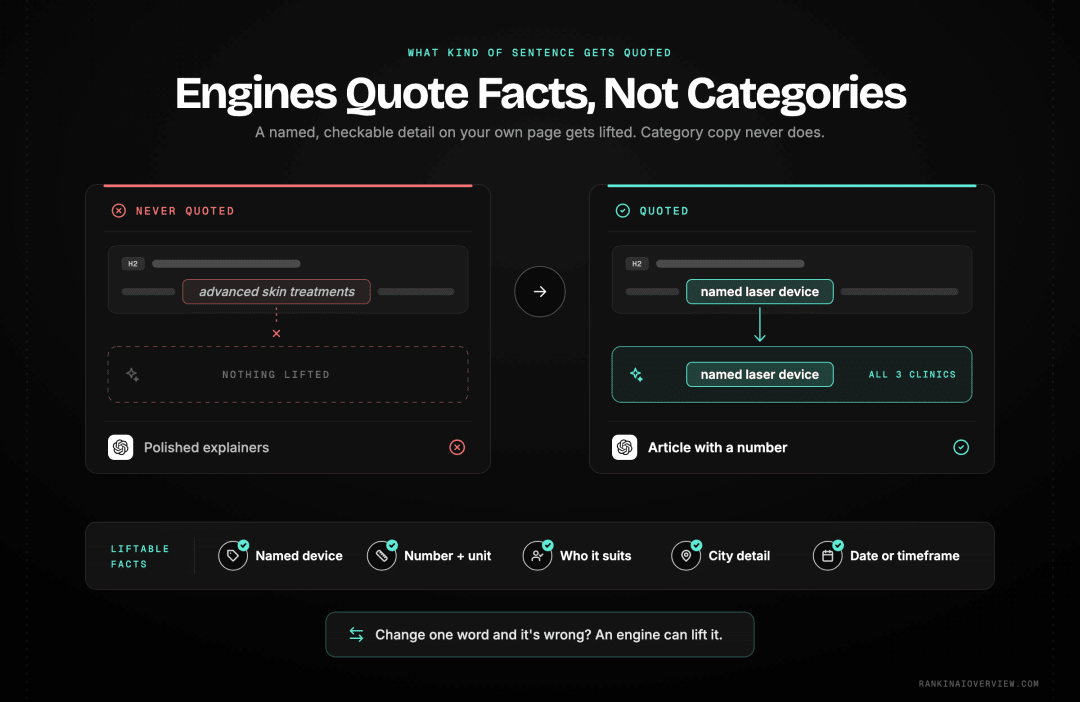
Specific ones. Every time Google's AI Overview quoted a clinic's equipment, such as a named laser device or a named surgical technique, that exact name was written on the clinic's own page. Generic service copy was never pulled. Engines lift concrete facts, not category language.
What did the clinic pattern look like?
We saw this across three clinics on 22 August 2026. When an AI Overview described a clinic, it repeated details the clinic had published itself. The name of a laser device listed on a treatments page. A named surgical technique on a procedure page.
Clinics that described themselves in broad terms, the "advanced skin treatments" style of copy, did not have that language repeated back. There was nothing specific to repeat.
Does the same pattern hold for our own site?
It does. The single article of ours ChatGPT cited was the one containing a hard number. Our better-written pieces without a specific figure were ignored.
Three clinics and one site is a small base. But two different engines, two different types of business and the same outcome make the pattern hard to dismiss. If a sentence would be wrong once you changed one word, it contains information an engine can lift.
What counts as a quotable fact?
-
A named device, method or product, written out in full
-
A number with a unit: a price range, a recovery time, a session count
-
A real constraint: who a treatment suits, who it does not
-
A location detail an engine can match to a city search
-
A date or a timeframe that makes the claim checkable
Where on the page should that fact sit?
Near the top of the relevant section, in a sentence that makes sense on its own. An engine lifting a line out of your page will not carry the paragraph around it. If the fact only makes sense after three sentences of build-up, it is less likely to travel.
How Much Should You Trust a Single Check?
Not much on its own. During the sweep we watched one site move from #3 to #8 between two API calls minutes apart. AI answers shift between runs too. Every figure on this page is a snapshot from August 2026, and we treat each single row as an indicator, never a verdict.
Why do results move so much?
Google personalises and tests result layouts constantly, and AI answers are generated fresh each time. Two people asking the same question in the same city can see different businesses. The same person asking twice can too.
That is why we report counts across a sample rather than any single result. One check tells you what happened once. Twenty checks start to tell you what tends to happen.
What are the known weak spots in this data?
-
Snapshot dates: the tests ran on 10 to 11 August and 22 August 2026 only, so they show a moment, not a trend.
-
Small samples: six topics, 15 businesses and three clinics are small numbers, and we say so beside each figure.
-
Personalisation: ChatGPT was tested on a logged-in personal account, which may shape answers.
-
Two engines: we tested ChatGPT and Google only, so we cannot say what Perplexity or Gemini would have named.
-
Mixed signal in early logs: our first tracking sheet recorded "found" without always splitting AI citation from organic rank, so we only quote figures where that split was clear.
Why publish it with those weak spots?
Because the alternative is publishing nothing and letting vendor summaries of US data stand in for markets they never tested. We would rather show a smaller, honest sample with its limits printed beside it. Our guide on whether you can rank consistently in AI search covers why repeated measurement matters more than any single check.
What happens next?
We are re-running the same query sets with citation and organic rank logged as separate fields from the start. The re-run will be published as a dated update to this page, so you can see what changed rather than read a fresh snapshot in isolation.
What Should a Business Do With These Findings?
Stop treating a Google ranking as proof of AI visibility. Check each engine directly, write specific facts an engine can quote, and pick questions where the answer slot is still open. Measure presence across repeated checks rather than chasing one position.
Should you stop doing SEO?
No. Google rankings still send traffic, and Google's own documentation on how its AI features use web content says there are no extra requirements to appear in them beyond normal search eligibility. Our data says ranking is not sufficient for AI visibility. It does not say ranking is useless.
What should you change on your pages first?
-
Write one quotable fact per key page. A named device, a figure, a real constraint. Put it early in the section.
-
Build one page per service. The named clinics had a page for each treatment. The ignored businesses had one broad product page.
-
Answer the process questions. The cited compliance consultancies explained how things work where the official portal did not.
-
Match the buyer's wording. "Best [service] in [city]" is how people ask. Make sure your page states the service and the city plainly.
How should you choose which questions to target?
Ask the engine first. If it names the same national brands on every run, go narrower: a specific treatment, a specific machine type, a specific neighbourhood. The stamper machine example shows a small business can own a narrow question even when the broad one is closed.
How should you report AI visibility to a client or a boss?
Report presence across a fixed set of prompts, checked more than once, rather than a single screenshot. Note which engine, which date and how the prompt was phrased. If you use a tracking tool, read our review of whether AI rank tracker tools actually work before trusting a single score.
How Can You Run the Same Test on Your Own Site?
Pick 10 to 20 questions your buyers ask, run each one in ChatGPT and on Google, and log four things per check: whether an AI answer appeared, whether you were named, where you rank organically, and the date. Repeat a week later. The gap between the two columns is your real picture.
Step 1: Choose your questions
Write questions the way a buyer types them, not the way an SEO tool lists keywords. Include the service and the city where it applies. Leave your brand name out.
Step 2: Run them in each engine
Use a logged-out or fresh browser session where you can, and note when you cannot. For Google, record whether an AI Overview appeared and which sources it cited. For ChatGPT, record whether it searched the web and which businesses it named.
Step 3: Log citation and rank separately
This is the step we got wrong early on. Keep "named in the AI answer" and "organic position" as two separate columns. Merging them into a single "found" field hides the exact gap you are trying to measure.
Step 4: Read the gaps
-
Ranked but not named: your page lacks a quotable fact, or the slot is closed.
-
Named but not ranked: an AI engine trusts a source about you that Google does not reward. Find it and keep it accurate.
-
Neither: start with a dedicated page for that service and a specific fact near the top.
Step 5: Repeat and compare
Run the same set again after one week, then monthly. A single run swings too much to act on. Three runs pointing the same way are worth acting on.
Conclusion
Our August 2026 tests point one way. A strong Google ranking did not place our own page inside ChatGPT's answer. Businesses outside Google's top results were named by AI engines anyway. And on most commercial local searches we checked, an AI Overview sat above every organic result.
The businesses that did get named had something in common. They published specific, checkable facts on dedicated pages, and they targeted questions where the engine had no settled favourite. That is something a small business can act on without a large budget.
The samples are small and the data is a snapshot, which is why we will re-run it and publish the change. Until then, the safest move is to test your own questions directly rather than assume your rankings tell the whole story.
RANK IN AI OVERVIEW runs its own tests on how AI engines choose which businesses to name, and its AI visibility tool is launching soon. Want to know whether ChatGPT and Google's AI Overview mention you today? Book your free AI visibility audit.
Frequently asked questions
Does ranking first on Google mean ChatGPT will cite you?+
No. In our test, a page ranking first on Google for its exact question was not cited by ChatGPT. The answer came from the platform's own documentation. Organic rank and AI citation behaved like separate systems.
How often do local searches show a Google AI Overview?+
In our August 2026 sample, 87 of 124 commercial local searches across India, the UAE and Qatar showed an AI Overview. That is about 70%. Treat it as an indicator for commercial local queries, not a national rate.
Can a business appear in AI answers without ranking on Google?+
Yes. In our tests, three of eight businesses named by ChatGPT were missing from Google's matching results. One consultancy was the first cited source in an AI Overview while ranking outside the top 20.
What content gets quoted in AI Overviews?+
Specific facts. Named equipment, named techniques, figures and clear constraints were quoted back from clinic pages. Broad marketing language was not repeated. Write at least one concrete, checkable claim on every important page.
How often should you check your AI visibility?+
Check a fixed question set weekly at first, then monthly. Single checks swing a lot, so look for results that repeat across several runs before changing pages. Log citation and organic rank as separate fields.
Explore with AI
Share this


