AI Search Engines Rank Reputation, Not Keywords: The New Growth Marketing Playbook
The era of keyword-first SEO is over for AI search. AI search reputation signals, reviews, mentions, and community presence are the new ranking factors. Here is the growth playbook.
![AI answer citing a brand with a [1] footnote, earned by five-star reviews and trusted-source mentions (Trustpilot, G2, Reddit, Wikipedia) — not keywords](https://res.cloudinary.com/dhyjitpgl/image/upload/f_auto,q_auto,c_limit,w_1280/v1781712846/gcms/hero_ksyskk.png)
Key Highlights
-
AI search reputation signals are the new ranking factors. AI engines ask whether a brand is safe to cite, and the answer comes from mentions, reviews, community presence, and source authority across the entire web
-
Brand reputation SEO 2026 is a different discipline from keyword SEO. Keywords determine what a page is about. Reputation determines whether an AI engine trusts the brand enough to cite it in an answer seen by millions
-
The reputation vs keywords AI question has a clear answer for AI-generated responses: reputation signals outperform keyword signals because AI engines evaluate corroboration across trusted sources, not keyword density
-
Reputation vs keywords AI comparison: keywords tell an algorithm what a page is about. Reputation tells an AI engine whether the brand behind that page is safe to cite in front of millions
-
The reputation vs keywords AI investment decision is sequential: build keyword ranking first for retrieval eligibility, then build reputation signals for citation authority
-
Reputation vs keywords AI is not an either/or choice. Traditional keyword SEO is the foundation. Reputation signals are the layer that determines citation selection from the retrieval pool
-
Understanding reputation vs keywords AI is the strategic reframe that changes everything about how growth marketing teams should allocate off-site investment in 2026
-
Google paid Reddit USD 60 million for content access. Perplexity cites Reddit as one of its top domains across all query categories. AI search brand mentions on community platforms are more valuable than most brands realise
-
AI search brand mentions differ from traditional backlinks: a Reddit mention with no link carries more AI citation weight than a low-authority blog backlink because AI engines weight platform trust over link equity
-
Building AI search brand mentions across Reddit, review platforms, and industry publications is the fastest path to AI citation frequency improvement for brands with existing Google authority
-
SEO is now PR, in the sense that the discipline of building brand mentions in trusted, independent sources has become the core off-site AI visibility investment
-
SEO is now PR in practice: the team building Reddit presence, managing reviews, and earning editorial mentions is doing more for AI visibility than the team acquiring generic backlinks
-
The convergence where SEO is now PR is most visible in the investment allocation of brands that have achieved strong AI citation rates: all of them have invested in PR-style off-site presence alongside technical SEO
-
The four dimensions of AI-relevant reputation: mention frequency, mention source authority, mention consistency, and mention sentiment. Negative or inconsistent mentions can actively reduce AI citation probability
-
Traditional SEO remains the retrieval eligibility layer. Reputation signals are the citation authority layer. Both are required. Neither is sufficient alone
Google paid Reddit USD 60 million for content access. Perplexity cites Reddit threads over brand websites. ChatGPT recommends brands it has encountered repeatedly in sources it trusts. The pattern is unmistakable, and it has a name: AI search reputation signals. AI search engines do not rank keywords. They rank reputations. The brands getting cited consistently in AI-generated answers are not the ones with the highest keyword density. They are the ones that independent, trusted sources have mentioned, reviewed, and discussed across the platforms that AI engines treat as reliable.
According to Gartner's February 2024 press release projecting a 25% drop in traditional search volume by 2026, the channel where AI citation matters is growing rapidly while the channel where keyword optimisation matters is under pressure. Growth marketers who have built keyword-first strategies are optimising for a channel in structural decline while underinvesting in the channel that is growing. This guide gives you the reframe and the playbook.
The reframe is conceptual before it is tactical. Brand reputation SEO 2026 is not a new set of tactical tools layered on top of keyword SEO. It is a different discipline applied to a different channel. You are building a reputation across the web that AI systems learn to trust when deciding what to cite in answers shown to millions of users. The playbook that follows is specific, actionable, and available to any brand regardless of size or existing domain authority.
Why Is Reputation Now the Primary AI Search Ranking Signal?
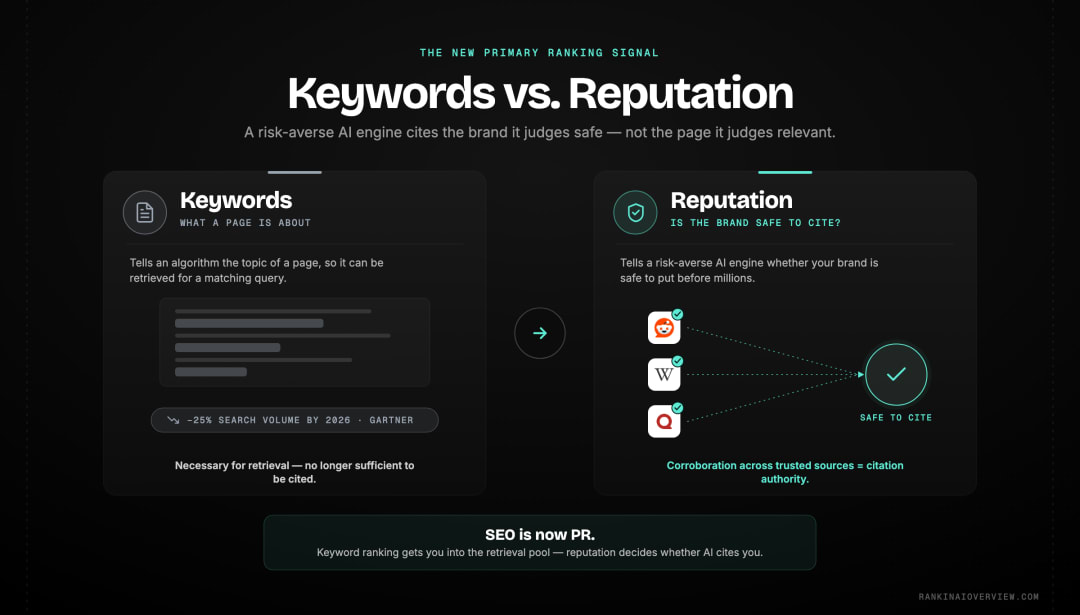
The core question AI engines ask before citing a source is: is this brand safe to cite in an answer I am generating for millions of users? Safe means trusted, verified, and corroborated by independent sources. A brand with strong keyword-optimised content but no independent mentions is not safe to cite. A brand with moderate content quality but consistent positive mentions across Reddit, review platforms, and industry publications is safe. AI search reputation signals answer the safety question. Keywords do not.
AI engines are risk-averse systems. When an AI generates a recommendation or factual claim, it stakes its credibility on that claim. If the claim is wrong or the recommended brand turns out to be untrustworthy, the user experience is damaged and the platform loses credibility. This risk profile makes AI engines conservative about which brands they cite. The conservative selection mechanism is corroboration: does this brand appear across multiple independent sources that I already treat as reliable?
This is why Google's Search Quality Rater Guidelines define Trustworthiness as a primary dimension of content quality. The same trust framework that Google's human raters apply to evaluate page quality is the framework AI engines apply when deciding what is safe to cite. Trust is built through corroboration, consistency, and verified identity. These are reputation signals, not keyword signals. The brands that understand this distinction are building the right kind of authority for the AI era. The brands still focused exclusively on keyword density and backlink acquisition are building authority for a previous era.
The PR-SEO convergence that practitioners have been discussing for years has now fully arrived in the AI era. The discipline of building brand mentions in trusted, independent sources, placing expert contributions in industry publications, managing review platform presence, and maintaining consistent brand positioning across community platforms is no longer PR strategy that complements SEO. It is the core off-site AI visibility investment. SEO is now PR in the sense that the off-site investment that most directly improves AI citation probability looks like what PR teams have always done: earn mentions in the places where trust is established.
What Are the 4 Dimensions of AI-Relevant Reputation?
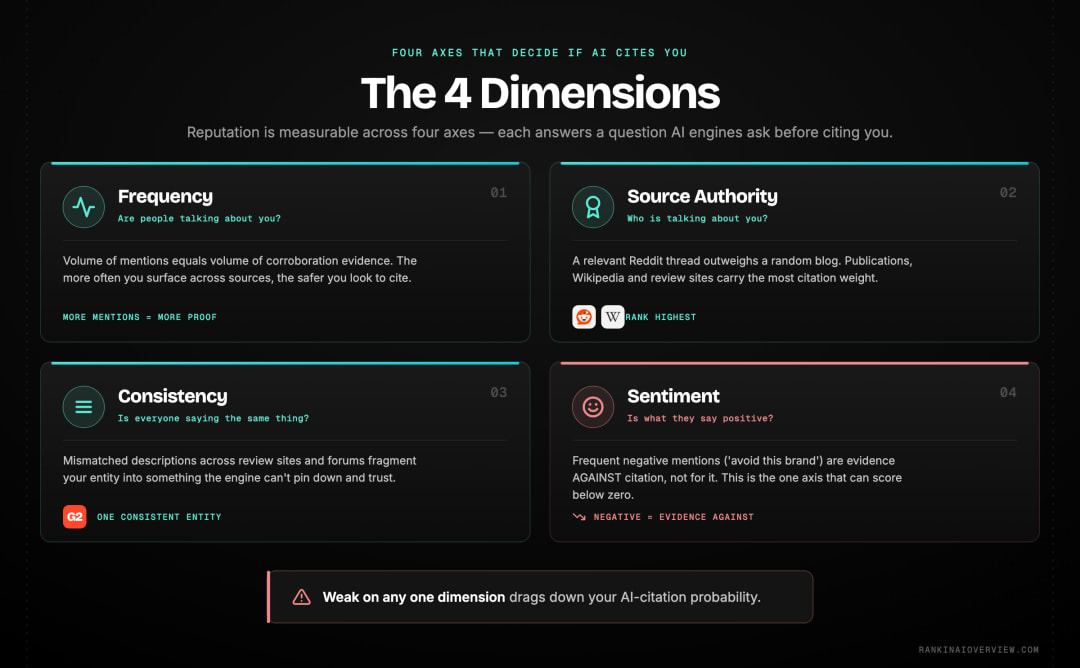
AI-relevant reputation is built across four measurable dimensions. Mention frequency is how often your brand is discussed across the platforms AI engines draw from. Mention source authority is the credibility of those platforms in AI training and retrieval systems. Mention consistency is how uniformly your brand is described across all sources. Mention sentiment is whether those descriptions are positive, neutral, or negative. Weak performance on any single dimension reduces AI citation probability.
Dimension 1: Mention Frequency. Are People Talking About You?
Mention frequency measures the volume of brand mentions across the platforms that AI engines draw from: Reddit, review platforms, industry publications, forums, and news. A brand with high mention frequency has given AI engines many data points to draw on when evaluating whether the brand is relevant to a given query. A brand with low mention frequency gives AI engines little to work with, which produces low citation confidence and low citation rates.
The practical implication for brand reputation SEO 2026 strategy: building genuine presence in community discussions is not a nice-to-have. It is a prerequisite for AI citation frequency. A brand that publishes excellent website content but participates in zero community discussions is a brand that AI engines encounter rarely, in only one type of source, with no independent corroboration. Mention frequency is the volume of corroboration evidence that AI engines can draw on when evaluating citation confidence.
Dimension 2: Mention Source Authority. Who Is Talking About You?
Not all brand mentions are equal. A brand mentioned in a Reddit thread in a relevant community carries more weight for AI citation than the same brand mentioned on a random blog. Mentions in industry publications, analyst reports, Wikipedia, and established review platforms carry more weight than mentions in low-authority directories. AI search brand mentions derive their value from the authority and independence of the source, not just the volume of mentions.
This is why Google paid USD 60 million for Reddit content access and why Perplexity treats Reddit as one of its most-cited domains. Reddit represents community-generated, independently corroborated, often experience-based information that AI engines treat as reliable because it is not produced by brands themselves. A brand mentioned positively by multiple Reddit users across multiple threads has earned independent corroboration in a source that AI engines weight heavily. That is more valuable for AI citation than ten additional blog posts on the brand's own website.
Dimension 3: Mention Consistency. Is Everyone Saying the Same Thing?
AI engines build entity knowledge by aggregating brand mentions across sources. If your brand is described differently across different platforms, the AI's entity model for your brand is fragmented and ambiguous. A brand described as "the leading project management tool for remote teams" on its own website, "a solid task management app" on Reddit, "a collaboration platform" on G2, and "a startup productivity tool" on Clutch has four different brand descriptions across four platforms. AI engines struggle to aggregate these into a coherent entity.
Consistent brand description across all external platforms is one of the highest-return, lowest-effort reputation improvements available. Audit every external profile where your brand appears: G2, Clutch, Capterra, LinkedIn, Crunchbase, industry directories. Ensure the description of what you do, who you serve, and what category you operate in is identical across all of them. This standardisation reduces entity ambiguity and increases the confidence with which AI engines can aggregate brand mentions into a coherent, citable entity.
Dimension 4: Mention Sentiment. Is What People Are Saying Positive?
Sentiment is the fourth dimension and the one brands most often discover has a problem after investing in the other three. AI engines do not just count brand mentions. They evaluate whether those mentions describe the brand positively, neutrally, or negatively. A brand with high mention frequency from a source authority perspective but with consistently negative sentiment in community discussions is accumulating evidence against citation rather than in favour of it. Being mentioned frequently in the context of "avoid this brand" or "we had a bad experience with X" produces an AI visibility penalty rather than a benefit.
Reputation management in the traditional PR sense, specifically monitoring and responding to negative coverage, now has direct AI citation implications. A brand with unaddressed negative reviews, critical coverage in industry publications, or a history of community criticism has built a reputation that AI engines will be reluctant to cite positively. Addressing this requires genuine improvement in customer experience and product quality, not just better content on your website.
What Is the Reputation-Building Playbook for AI Search?
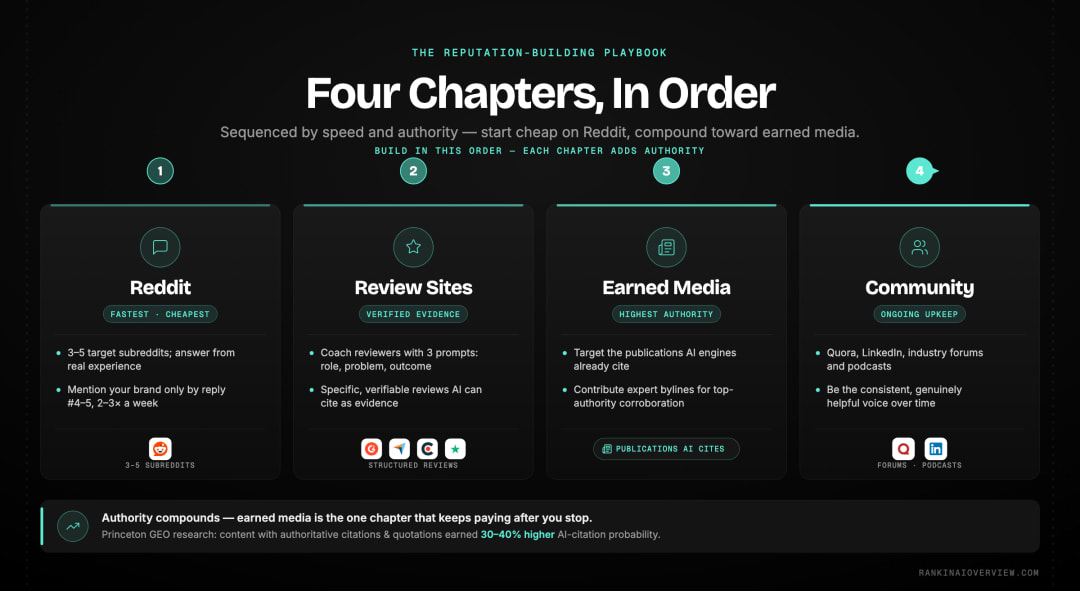
The four-chapter playbook below builds AI-relevant reputation in sequence. Reddit and community platforms first because they produce the fastest Perplexity citation signal and the lowest cost corroboration. Review platforms second because they provide the verified, structured third-party evidence that AI engines use as trust anchors. Earned media and PR third because they produce the highest-authority independent corroboration that compounds over time. Community participation fourth as the ongoing maintenance layer that sustains all three.
Chapter 1: Reddit Strategy
Reddit is the single most impactful platform for AI search reputation signals because it is both heavily cited by AI engines and practically accessible to any brand willing to invest genuine expertise. Analysis of Perplexity citation sources consistently places Reddit among its top domains across all query categories. Community reports indicate that approximately 68% of AI-generated answers reference Reddit content across major platforms. For a brand building AI citation signals from scratch, Reddit is the highest-return starting point.
The approach that works: identify three to five subreddits where your target buyers ask questions about your category. Contribute genuine, experience-based answers to existing questions. Do not start by mentioning your brand. Start by demonstrating that you understand the problem the community is discussing. After three to five genuine contributions where you have established credibility through helpfulness, brand mentions in relevant contexts are received as legitimate rather than promotional.
-
Contribution format: 200 to 400 words minimum. Specific, not generic. Experience-based language produces higher citation rates than general advice
-
Brand mention timing: in contribution number four or five, not contribution number one. Premature brand mentions produce community rejection rather than corroboration
-
Subreddit selection: the subreddits where your buyers research decisions, not the subreddits about your brand category from a practitioner perspective
-
Frequency: two to three genuine contributions per week sustains citation signal. Sporadic participation produces weaker signal than consistent contribution
Chapter 2: Review Platform Strategy
Review platforms provide the structured, verified third-party evidence that AI engines use as trust anchors. A brand with 50 detailed, experience-rich G2 reviews has built a corroboration layer that no amount of on-site content can replicate. For B2B brands, the primary platforms are G2, Capterra, and Clutch. For professional services, Clutch and Trustpilot. For consumer brands, Google Reviews, Yelp, and Trustpilot. The platform choice should follow where your buyers actually research your category, not where you have the easiest review acquisition path.
The quality of reviews matters as much as the quantity for AI citation purposes. AI engines extract specific claims from reviews: what the user's role was, what specific problem they were solving, what specific outcome they experienced. A review that says "great product, highly recommend" provides no specific claim for AI extraction. A review that says "as a compliance manager at a 200-person financial services firm, we reduced our regulatory reporting time by 40% using this tool" provides multiple specific, citable claims about use case, user type, and measured outcome.
The practical request strategy: when asking customers for reviews, give them a framework that helps them write specific reviews. Share three prompts: what was your role and use case? What specific problem were you solving? What specific outcome did you achieve? Customers who answer these three questions produce reviews that serve AI citation purposes. Customers left to write their own reviews predominantly write star ratings with brief sentiment phrases.
Chapter 3: Earned Media and PR
Earned media, specifically expert bylines in industry publications, analyst mentions, and news coverage, produces the highest-authority corroboration signal available for AI search reputation signals. Princeton and Georgia Tech's generative engine optimisation research found that content with authoritative citations and quotations produced 30 to 40 percent higher AI citation probability. The same principle applies in reverse: a brand that is quoted as an authoritative source in publications that AI engines already treat as reliable inherits some of that source authority for its own citations.
The publication targeting strategy for AI search reputation: identify which publications AI engines regularly cite when generating answers in your category. Test this manually by asking ChatGPT and Perplexity category-level questions and noting which publication names appear as sources in the generated answers. These publications are your primary targets for editorial contribution. Being cited in a publication that AI engines already cite compounds the effect by associating your brand with a trusted source in the AI's retrieval model.
The accessible entry point for most brands is contributed expert content. Industry publications accept bylined articles from credible practitioners on topics that serve their audience. A marketing director at a B2B SaaS company who contributes a specific, data-backed article to a relevant industry publication is building the exact kind of independent editorial coverage that AI engines weight most heavily as corroboration evidence.
Chapter 4: Community and Forum Participation
Beyond Reddit, the broader community presence layer includes Quora answers, LinkedIn community contributions, industry forum participation, and podcast appearances. Each platform represents a different dimension of community reputation building. Quora answers are frequently cited by both ChatGPT and Perplexity for knowledge and how-to queries. LinkedIn articles from subject-matter experts produce professional reputation signals. Industry forum participation builds category-specific authority in specialised communities that AI engines may reference for narrow query types.
The principle across all community platforms: be the consistent, helpful voice that AI engines learn to associate with your topic area. A brand that contributes genuine expertise to three or four community platforms over twelve months is more reliably cited than a brand that publishes excellent website content without community presence. The consistency signals stability. The helpfulness signals genuine expertise. Both of these are AI search reputation signals that build citation authority over time.
“ This is the core insight everyone is dancing around. SEO is becoming PR. The KPI shift is from keyword rank to share of voice in the conversations AI trusts. If you are not managing your brand's reputation across the web, you are not doing modern SEO. Growth marketing practitioner r/growthmarketing community, Reddit 2026 Source: Reddit: AI Search Engines Rank Reputation, Not Keywords
How Do You Measure Reputation Progress?
Four metrics provide a complete picture of reputation-building progress for AI search. Brand mention volume across key platforms shows whether the quantity of corroboration evidence is growing. Review platform presence shows whether structured third-party evidence is accumulating. AI citation rate shows whether the reputation investment is translating into measurable citation frequency improvements. Branded search volume in Google Search Console shows whether AI mentions are creating downstream brand awareness.
| Metric | What It Measures | Tool | Cadence |
|---|---|---|---|
| Brand mention volume | Volume of brand mentions across Reddit, publications, forums | Brandwatch, Mention.com, or manual Google Alerts | Monthly |
| Review platform presence | Number and quality of reviews on G2, Capterra, Clutch, Trustpilot | Manual audit of each platform | Quarterly |
| AI citation rate | How often your brand appears in AI-generated answers for target queries | Rankscale, Profound, or manual prompt testing in ChatGPT and Perplexity | Weekly |
| Branded search volume | Downstream brand awareness signal from AI-driven discovery | Google Search Console (filter for branded queries) | Monthly |
| Share of voice in AI | Your citation frequency vs competitors across the same prompt set | Peec AI, Profound, or competitive prompt testing | Monthly |
The most important signal to track is branded search volume growth in Google Search Console. This is the downstream proxy that connects AI reputation investment to real business impact. When AI engines cite your brand in answers to category queries, some proportion of users who encounter those citations will later conduct branded Google searches. Rising branded search volume over a period when you are actively building AI search reputation signals confirms that the investment is creating real brand awareness.
How Does Traditional SEO Fit Into the Reputation Framework?
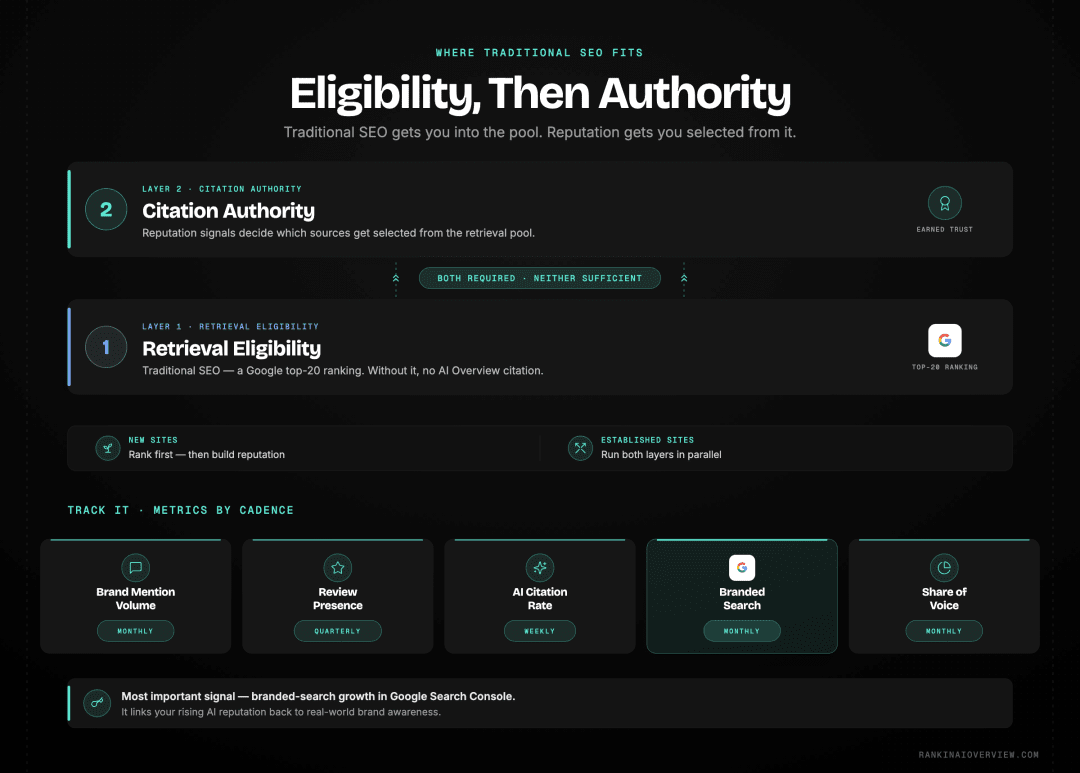
Traditional SEO remains the retrieval eligibility layer. Without Google top-20 ranking for the relevant queries, a page is not eligible for Google AI Overview citation regardless of how strong its reputation signals are. Reputation signals are the citation authority layer that determines whether a page is selected from the retrieval pool. Both layers are required. Reputation without ranking produces no AI Overview citations. Ranking without reputation produces retrieval eligibility but low citation selection probability.
The investment model in 2026 is sequential for new sites and parallel for established ones. New sites should build Google ranking first, then layer in reputation signals once retrieval eligibility is established. Established sites with existing Google authority should invest in both simultaneously. The reputation-building playbook in this guide is available in parallel with traditional SEO investment because the channels do not conflict. Reddit participation does not interfere with keyword optimisation. Review platform building does not conflict with technical SEO. Earned media helps both channels simultaneously.
The convergence is long-term. As AI search becomes a larger share of total search behaviour and as Google continues developing AI Mode and AI Overviews, the reputation signals that drive AI citation will increasingly also inform traditional ranking. Google's investment in understanding brand reputation through its Knowledge Graph, its entity recognition systems, and its E-E-A-T framework all point toward a future where reputation signals and ranking signals are less distinct than they are today. Building reputation now builds both.
Conclusion
The biggest shift in AI search is not technical. It is conceptual. You are no longer optimising a page for an algorithm that scores keyword relevance. You are building a reputation across the web that AI systems learn to trust and cite. Brand reputation SEO 2026 is the discipline of building that trust infrastructure in the places where AI engines look for corroboration: community platforms, review sites, industry publications, and expert forums.
Start with Reddit and review platforms: they are the fastest-return, lowest-cost reputation investments available. Build toward earned media contributions in industry publications: they produce the highest-authority corroboration signals that compound over time. Measure your AI citation rate weekly and branded search volume monthly. Reputation builds slowly and compounds reliably. The brands that start this investment in 2026 will have built a citation authority advantage that latecomers will find expensive and slow to replicate. RANK IN AI OVERVIEW covers how AI engines evaluate brand reputation and what drives citation across all major platforms in depth across its content library.
Frequently asked questions
How do I build AI-relevant reputation on a small budget?+
Reddit and Quora community participation are free and produce genuine AI search reputation signals. Two to three high-quality Reddit contributions per week across relevant subreddits costs only time and produces Perplexity citation signals within eight to twelve weeks. Review platform building requires customer outreach rather than paid placement and costs nothing if your product has satisfied users. Expert contribution to industry publications, while requiring writing time, is typically unpaid and produces high-authority corroboration. A brand with no budget but genuine expertise can build meaningful AI reputation signals through consistent community participation alone.
Does negative press affect AI search visibility?+
Yes, directly. AI engines absorb brand reputation from their training data and retrieval sources, which includes negative press, critical reviews, and community complaints alongside positive mentions. A brand with significant negative coverage in sources that AI engines trust will be cited less frequently and sometimes described with qualifiers or caveats in AI-generated answers even when the brand is cited. Addressing negative reputation requires genuine improvement in the underlying product or service experience, followed by sustained positive mention building that shifts the balance of evidence over time.
How long does reputation building take to affect AI citations?+
Reddit and community participation produces measurable Perplexity citation improvements within eight to twelve weeks of consistent contribution because Perplexity crawls Reddit frequently and updates its retrieval index accordingly. Review platform accumulation takes three to six months to reach a volume where AI engines have sufficient evidence to incorporate review platform signals into citation decisions. Earned media and PR placements produce citation signals over six to twelve months as the publications are indexed and the content is incorporated into AI training and retrieval data. Full reputation programme results are visible over a twelve to eighteen month horizon, though partial improvements are measurable at every stage.
Explore with AI
Share this