Is AI Rank Tracking Meaningful or Just a Vanity Metric?
AI rank tracking turns into vanity when the number is disconnected from outcomes. Here is how to tell a decision-grade signal from decoration.
Key Highlights
- AI rank tracking is not automatically meaningful or automatically vanity. Which number you choose, and whether it survives scrutiny, decides.
- The obvious vanity trap is a tracked number with no line to traffic, conversion, or awareness. The subtler one is a metric that looks rigorous but does not measure a stable thing.
- Research on attribution metrics shows scorers that look interchangeable are not: a metric best in one setting can collapse to chance in another, so a number can be precise and still invalid.
- A decision-grade metric passes two checks: it changes what you do, and it measures the same construct reliably when you move it to your own prompts.
- The remedy is validation, not more dashboards. Test that a metric tracks something real on your queries before you trust it, and never borrow a benchmark as a target.
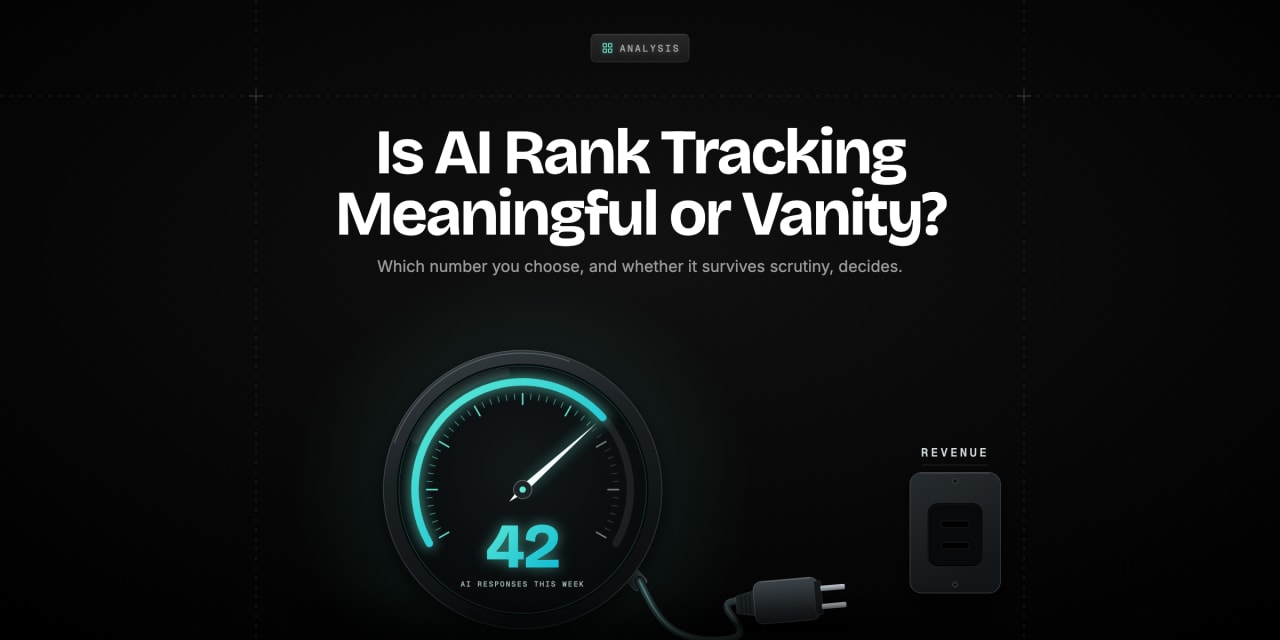
Every few weeks another tool promises to tell you how visible you are in AI search, and the dashboards are persuasive. "You appeared in 42 AI responses this week." The question that keeps surfacing in marketing meetings is fair and slightly weary: does that number mean anything, or is it the new follower count, a figure that looks like progress and changes nothing you do?
The scepticism is healthy, because marketing has a long history of metrics that felt important and moved nothing. Impressions, reach, raw ranking tallies. AI visibility risks joining that list if teams chase a figure with no thread back to the business, and plenty of new tools quietly encourage exactly that by leading with the number that photographs best rather than the one that informs a decision.
According to a 2026 audit of eight automatic attribution scorers across three evaluation constructs, none transferred reliably across datasets: a scorer that was best on short-claim questions, with an AUROC of 0.90, collapsed to 0.53, no better than chance, on long-form questions, and the per-dataset rankings actually inverted. That result matters here because it shows a metric can look rigorous and still fail to measure a stable thing once the setting changes. This guide takes the sceptic's question seriously. It separates AI tracking numbers that inform decisions from those that merely decorate a report, and it explains how to tell which is which before you build a strategy on one. For the wider frame, our guide to AI visibility metrics is the companion piece.
What Does AI Rank Tracking Actually Claim to Measure?
AI rank tracking measures whether and how often AI engines cite or mention your brand across a set of prompts. Because AI answers carry no fixed numbered positions, it reports presence, citation share, and competitor comparison over time rather than a tidy rank from one to ten. That is a real thing to observe, but a slippery one to interpret.
The first problem is that "rank" is a borrowed word that does not quite fit. In classic search there is a stable ordered list, and position one means something specific and repeatable. AI answers do not work that way, which is why the whole idea of a rank has to be reconstructed from proxies like how often you are cited and where you sit relative to rivals. Our explainer on why AI search does not have rankings like Google walks through why the old mental model transfers so poorly.
Because the metric is a reconstruction rather than a direct reading, its usefulness depends entirely on the context wrapped around it. "You appeared in AI responses" says nothing about the intent behind those queries or whether they lead anywhere. Presence without context is where the vanity risk starts, because an impressive headline count can sit on top of a total absence from the handful of queries that actually drive revenue. The number is real; the question is whether it is telling you anything you can act on.
This reconstructed quality is also why two tools can describe the same reality with different numbers and both be defensible. Each has made its own choices about what counts as an appearance, how to weight a citation against a passing mention, and how to collapse several engines into one figure. None of those choices is wrong, but they are choices, and they mean the label on the metric is doing a lot of quiet work. Before you can even ask whether a tracking number is vanity, you have to know precisely what its maker decided it would count, because a figure whose definition you cannot state is one you certainly cannot defend.
When Does a Tracked Number Become a Vanity Metric?
A tracked number becomes a vanity metric in two ways. The familiar one is disconnection: it has no thread to traffic, conversion, or branded search, so it moves without changing anything. The subtler one is invalidity: it looks rigorous but does not reliably measure the thing you believe it measures, so acting on it is guesswork dressed as data.
Most guidance covers only the first failure, and it is worth stating plainly. A citation tally that is never tied to a downstream outcome is a scoreboard, not intelligence. If the number rising does not change a single decision you make, it is decoration, however satisfying it looks in the weekly update. A quick way to expose it is to ask, for any metric on your dashboard, what you would do differently if it doubled or halved. If the honest answer is nothing, you have found a vanity metric regardless of how it is calculated. The fix for that failure is to connect the metric to something the business already values, a point our look at whether AI search visibility is generating revenue develops in full.
The second failure is the one this guide exists to surface, because almost nobody checks for it. A metric can be perfectly connected to outcomes in theory and still be a vanity metric if it does not measure a stable construct. Suppose your tool reports a citation-quality score that looks decision-grade, and you steer content by it. If that score would rank your pages completely differently under a slightly different scoring method, then the number you are trusting is an artefact of the tool, not a property of your visibility. It feels like signal and behaves like noise, which is the most expensive kind of vanity metric because it survives the usual sniff test.
It is worth being concrete about how this plays out, because it is easy to nod along and still get caught. Imagine two tracking tools looking at the identical set of your pages on the identical prompts. Tool A ranks page X as your strongest AI asset and page Y as weak; Tool B, using a different scoring method it does not disclose, ranks them the other way round. Both present a confident number to two decimal places. At most one of them can be right, and you have no way to tell which from the numbers alone. If you had only ever bought Tool A, you would have spent a quarter reinforcing page X and quietly starving page Y, entirely on the strength of a score that a different but equally reasonable method would have reversed. Nothing about Tool A's dashboard would have warned you. That is the invalidity trap in miniature, and it is why a rigorous-looking single score deserves less automatic trust than its precision invites.
Why Can a Metric That Looks Meaningful Still Mislead You?
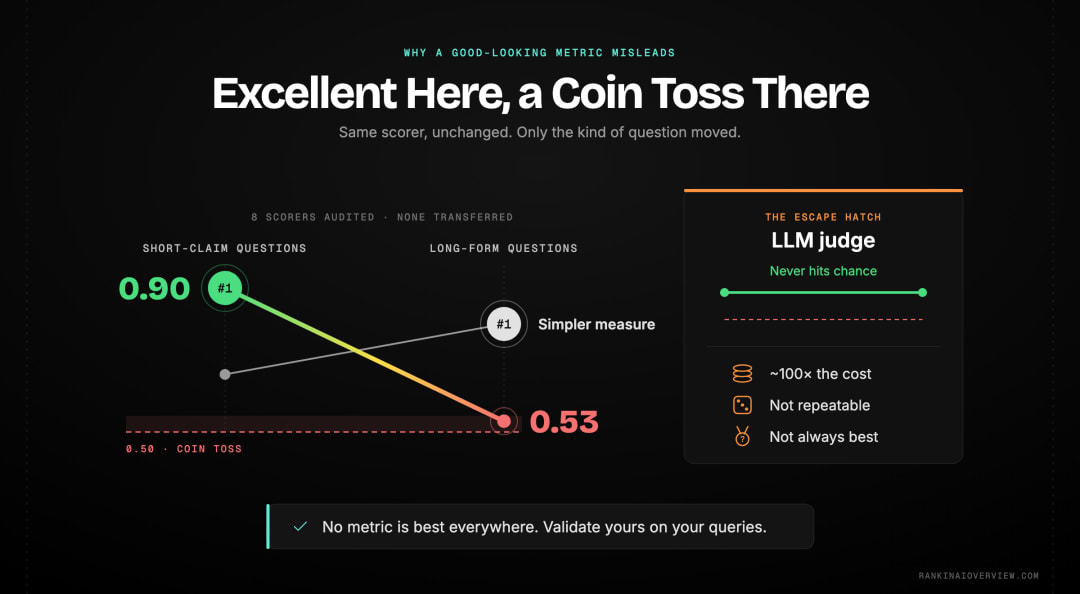
A metric can mislead because scorers that look interchangeable often are not. The attribution study behind this guide audited eight automatic scorers and asked whether any of them stayed close to the best one across every dataset. None did. The rankings inverted between settings, and a scorer that excelled on one kind of question dropped to chance on another.
This is the finding that should change how you read any AI tracking number. The researchers were testing whether the automatic metrics people use to judge whether an answer is properly attributed to its source hold up when you move them between datasets. They found a sharp instability. On short-claim questions one scorer was excellent; on long-form questions the same scorer was no better than a coin toss, while a different, simpler measure suddenly won. The team checked and confirmed this was not an artefact of answer length or truncation, it was the metric itself failing to generalise.
"Practice often treats automatic metrics for attribution in LLM retrieval-augmented generation as interchangeable."
Tianyu Ding and colleagues, Do LLM Attribution Metrics Transfer? Auditing Retrieval-Augmented Generation Evaluation Across Datasets and Constructs (arXiv, 2026)
The lesson generalises well beyond that academic setting. When a vendor reports a citation-quality or visibility score, that score is produced by some scoring method under the bonnet, and you usually cannot see it. If methods that look equivalent can rank the same content in opposite orders, then trusting a single black-box score without knowing whether it holds up on your kind of queries is a genuine risk. The study even quantified the cost of ignoring this: a naive rule of picking whichever scorer looks best on average failed badly when tested on a held-out dataset, doing worse than simply committing to one measure and validating it.
The researchers also checked the obvious escape hatch, and found it only relocates the problem. Handing the judging to a prompt-based large language model, rather than an automatic scorer, did avoid the chance-level collapses, but it was not uniformly the best option, cost roughly a hundred times more to run, and was non-deterministic, meaning it could return different judgements on repeated runs. In other words, there is no free lunch and no universal best metric waiting to be adopted. Every measure carries a validation burden; the only choice is whether you pay it deliberately or discover it after you have made decisions on a number that never held up. The practical takeaway is uncomfortable but freeing. A number being precise, and even being tied to outcomes, is not enough. You also have to know it measures a real and stable thing on the queries you care about, or you are optimising toward a mirage.
Which AI Tracking Numbers Are Actually Decision-Grade?
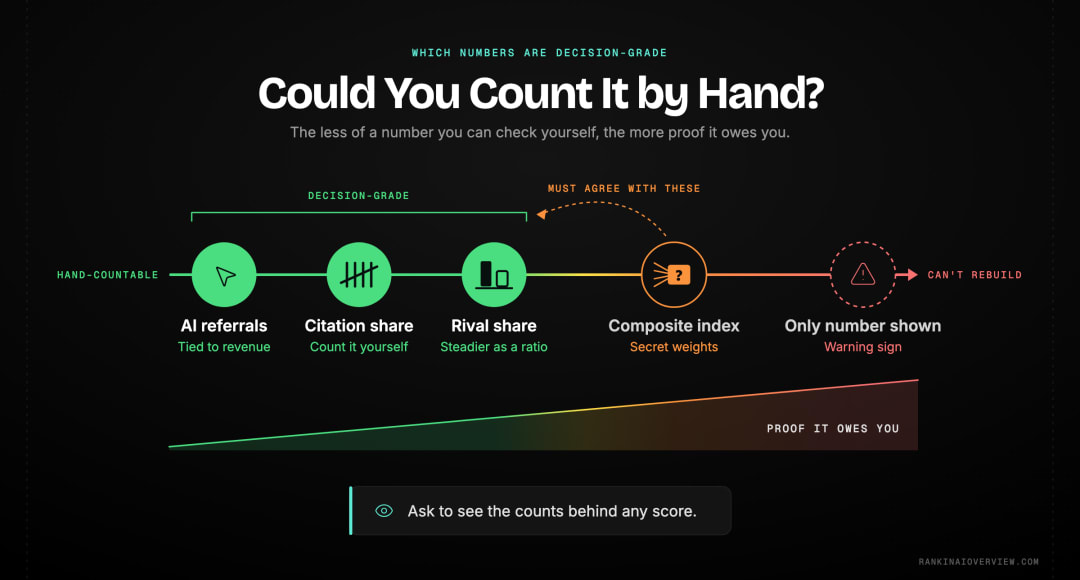
A decision-grade AI tracking number passes two tests together. It changes what you would do, and it measures the same underlying thing reliably when applied to your own prompts. Citation share on high-intent queries, competitor share on those same prompts, branded search growth, and AI referral traffic with its conversion rate are the metrics most likely to clear both bars.
These earn their place for the same reason: each connects to something the business already understands, and each can be defined concretely enough that you can check it is measuring what you think. Citation share on buying queries points straight at commercial visibility. Competitor share on identical prompts turns that into a relative reading that is far more stable than either figure alone. Branded search growth is a human proxy measured by mature, low-noise tools. AI referral traffic and its conversion rate tie the whole exercise to money, which is the least ambiguous test of all.
Notice what these have in common and what the vanity numbers lack. The decision-grade metrics are either directly observable business outcomes or simple, transparent ratios you can define and audit yourself. The metrics most prone to the invalidity trap are the opaque composite scores, the single "visibility index" that blends a dozen inputs through a formula you cannot inspect. That does not make composites useless, but it does mean they earn less trust by default, and they should never be the number you report upward without a plainer metric standing behind them. Our look at SEO metrics for 2026 makes a parallel case for preferring transparent measures over flattering composites.
There is a useful rule of thumb here: the further a metric sits from something you could count by hand, the more validation it owes you before you trust it. Anyone can, in principle, read a sample of answers and count on how many their page was cited, so citation share is auditable even when a tool automates it. Nobody can hand-check a proprietary index that fuses citation frequency, sentiment, prominence, and a half-dozen other signals with secret weights, so that index has to earn its trust through behaviour rather than transparency. The more a vendor leans on a single flagship number that cannot be reconstructed, the more sceptical you should be, and the more you should insist on a plainer companion metric you can actually verify. A composite that consistently agrees with your transparent measures is fine to keep as a convenient summary. A composite that is the only thing the tool will show you is a warning sign.
How Do You Validate That a Metric Is Worth Tracking?
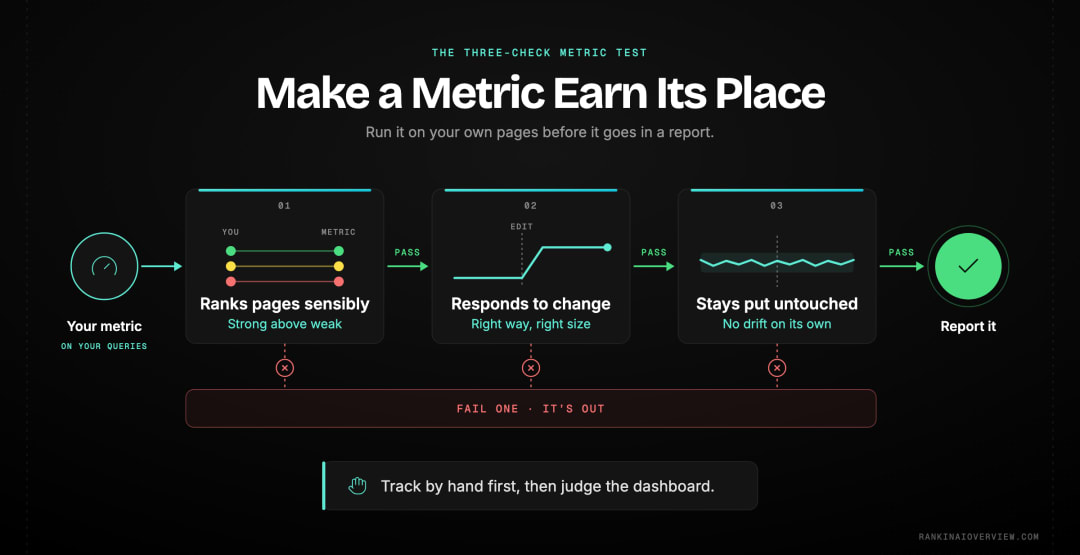
Validate a metric by testing that it measures something real and stable on your own prompts before you build decisions on it. Check that it moves when you would expect it to, that it agrees with a second independent measure, and that it does not swing wildly for reasons unrelated to your content. A metric that fails these checks is decoration, whatever its label.
The single most important habit is to stop treating metrics as interchangeable and stop borrowing them wholesale. A score that worked in someone else's case study was validated, if at all, on their queries, their category, and their engines. Lifting it as your key metric imports an assumption you have not tested. Instead, run a small validation on your own tracked set: does the metric rise when you genuinely improve a page, and hold steady when nothing has changed? If it cannot pass that basic test, it is not ready to steer anything.
A cheap cross-check is to hold two independent measures against each other. If your tool's citation-quality score and a simple, transparent citation share on the same prompts tell broadly the same story, your confidence in both rises. If they disagree sharply and persistently, at least one is not measuring what you think, and you have found a vanity metric before it cost you.
There is a simple sequence you can run once and repeat cheaply. Pick a handful of pages you know well, some genuinely strong on a topic and some weak, and check whether the metric ranks them the way your own judgement and your other data would. If it agrees, that is a point in its favour. Then change one page in a way you know should move the number, improving its depth or evidence, and confirm the metric responds in the right direction and roughly the right size. Finally, leave a page untouched across two periods and confirm the metric does not drift far on its own. A measure that ranks known pages sensibly, responds to real changes, and stays put when nothing happens has earned a place in your reporting. One that fails any of the three has not, no matter how confident its dashboard looks. This is the same discipline that separates a useful tool from a misleading one, which is why our assessment of whether AI rank tracker tools actually work keeps coming back to context and validation rather than the length of the feature list.
Should You Pay for a Dedicated AI Rank Tracker, Then?
Pay for a dedicated tool once manual checking cannot keep pace with your prompts, competitors, and markets, and only if the tool gives you trend and competitive context plus enough transparency to validate its numbers. For a very small brand tracking a few prompts, careful manual checks are often enough until scale justifies the spend.
The honest answer depends on stage and on transparency, not just on budget. If you track five prompts in one market, a spreadsheet and a weekly manual pass will do, and it has the advantage that you can see exactly what you are counting. Once you are tracking dozens of prompts across competitors and regions, manual work costs more in hours than a tool costs in money, and automation becomes rational. The pivot point is when the bookkeeping, not the insight, is eating your time.
There is a hidden benefit to starting manual, even if you expect to buy a tool later. Counting your own citations by hand for a few weeks teaches you what the metric actually feels like on your queries: how much it bounces between readings, which prompts are volatile, what a genuine improvement looks like against ordinary variation. That hard-won intuition is exactly what you need to validate a tool when you do buy one, because you will recognise immediately if its numbers disagree with what you have seen with your own eyes. Teams that skip straight to a paid dashboard often never build that intuition, which leaves them with no independent way to judge whether the tool is trustworthy. The manual phase is not just a cost-saving measure for the early days, it is the calibration that makes every automated number afterwards easier to trust or to challenge.
Whatever you choose, weight transparency as heavily as features. A tool that reports only appearances will march you straight into the first vanity trap, and a tool that reports opaque composite scores you cannot validate risks the second, subtler one. The tools worth paying for surface citation share, competitors, and trends in a way you can inspect and check against your own reading. Our roundup of the best AI rank trackers compares the options on exactly those terms, and a free AI-visibility audit from Rank in AI Overview is a low-commitment way to see whether tracking would reveal a real gap before you buy anything.
Conclusion
AI rank tracking is neither inherently a vanity metric nor automatically valuable. The number you choose, and whether it survives scrutiny, is what decides. There are two ways to end up with decoration: track a figure with no thread to traffic and revenue, or trust a rigorous-looking score that does not measure a stable thing. The first failure is well known. The second is quieter and more expensive, because a precise number that is not valid feels exactly like a real signal.
The way out is not another dashboard but a habit of validation. Prefer transparent ratios and real outcomes over opaque composites, test that a metric moves when it should on your own prompts, cross-check it against an independent measure, and never borrow a benchmark as a target. Do that, and AI tracking earns its keep as genuine competitive intelligence. Skip it, and you have built a more sophisticated follower count. The difference between the two is not the tool you buy or the size of your budget, it is whether you were willing to ask hard questions of your own numbers before you trusted them.
Want to see whether AI visibility tracking would reveal a real, validated gap for you rather than a flattering number? Rank in AI Overview offers a free AI-visibility audit that gives you a context-rich read you can actually check.
Frequently asked questions
Is AI rank tracking a vanity metric?+
It can be, in two ways. A tracked number with no link to traffic or conversion is vanity, and so is a rigorous-looking score that does not measure a stable construct. Tracked as validated citation share on high-intent queries and tied to outcomes, it is genuinely useful.
Why can a precise-looking metric still be misleading?+
Because precision is not validity. Research shows attribution scorers that look interchangeable can rank the same content in opposite orders across settings, so a number can be exact and still fail to measure the thing you believe it measures. Validity has to be tested, not assumed.
What makes an AI tracking number decision-grade?+
It passes two tests together: it changes what you would do, and it measures the same underlying thing reliably on your own prompts. Transparent ratios like citation share and real outcomes like referral conversion clear both bars more easily than opaque composite scores.
Should I trust a single visibility index score?+
Treat it with caution. A blended index produced by a formula you cannot inspect is the metric most exposed to the invalidity trap. Keep a plainer, transparent measure alongside it, and only trust the index when the two broadly agree on your prompts.
Do I need a paid AI rank tracking tool?+
Not always. A small brand tracking a few prompts can check manually and see exactly what it counts. A paid tool earns its cost once prompts, competitors, and markets outgrow manual work, provided it offers trend context and enough transparency to let you validate its numbers.
How do I stop a tracking metric becoming vanity?+
Validate it on your own prompts before trusting it, tie it to a business outcome, and cross-check it against a second independent measure. If a metric never changes a decision, or disagrees with a transparent measure of the same thing, it is decoration you should quietly retire rather than keep reporting.
Explore with AI
Share this