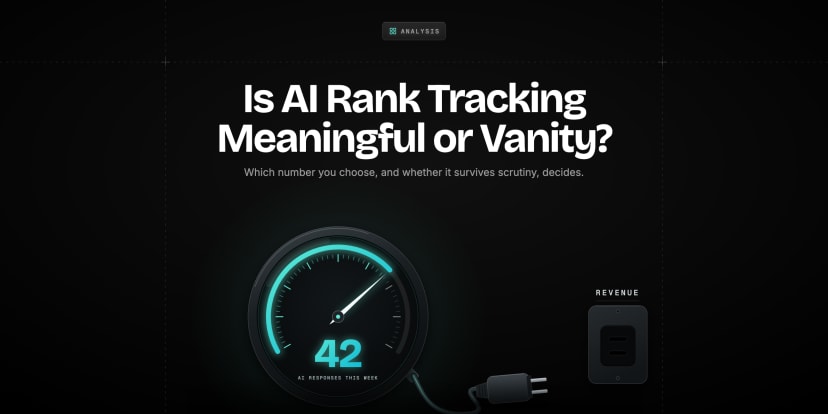
How to Track Your AI Overview Rankings Over Time
A practical routine for tracking Google AI Overview presence: what to measure instead of rank, what cadence to set, and how to read a real trend.

Key Highlights
- You track AI Overview presence over time by recording whether your pages are cited for a fixed set of queries, on a fixed schedule, and reading the direction of travel.
- There is no numbered rank to log, because AI Overviews have no stable positions. You track citation presence and share of voice against competitors instead.
- AI Overviews churn heavily between checks, so a single reading is unreliable. The whole method is built to separate a genuine trend from ordinary week-to-week noise.
- Lock your query set, your engines, and your cadence before you start. The moment any of them drifts, your trend stops being comparable and the effort is wasted.
- Tracking is only worth doing if you close the loop: fix the queries where you are absent or slipping, then re-measure to confirm the change was real.
Optimising for AI Overviews without tracking them is like training for a race with no clock. You make changes, you hope they landed, and you have no honest way to know. Tracking your AI Overview presence over time is what turns AI visibility from a series of hopeful guesses into something you can actually steer, and it is the difference between believing your work is paying off and being able to show it.
The complication is that AI Overviews behave nothing like the ranked blue links marketers spent two decades learning to track. There is no steady position to write down each week. Presence appears and disappears as Google adjusts its models, as pages change, and as competitors move, so the raw signal is noisy in a way classic rankings never were. Tracking has to be designed around that volatility from the start, or it will mislead you more often than it informs you.
According to a 2026 empirical study of measuring visibility in AI search, answers vary across runs, prompts, and time, which makes one-off observations unreliable and means a brand's visibility has to be characterised through repeated measurement rather than a single check. That finding is the foundation of everything below. This guide sets out a practical routine: what you are really tracking, how to set up a consistent cadence, how to read a genuine trend through the churn, how to act on it, and the mistakes that quietly ruin the data. For the optimisation side of the loop, our guide to ranking in Google AI Overviews is the natural companion.
What Are You Actually Tracking in AI Overviews?
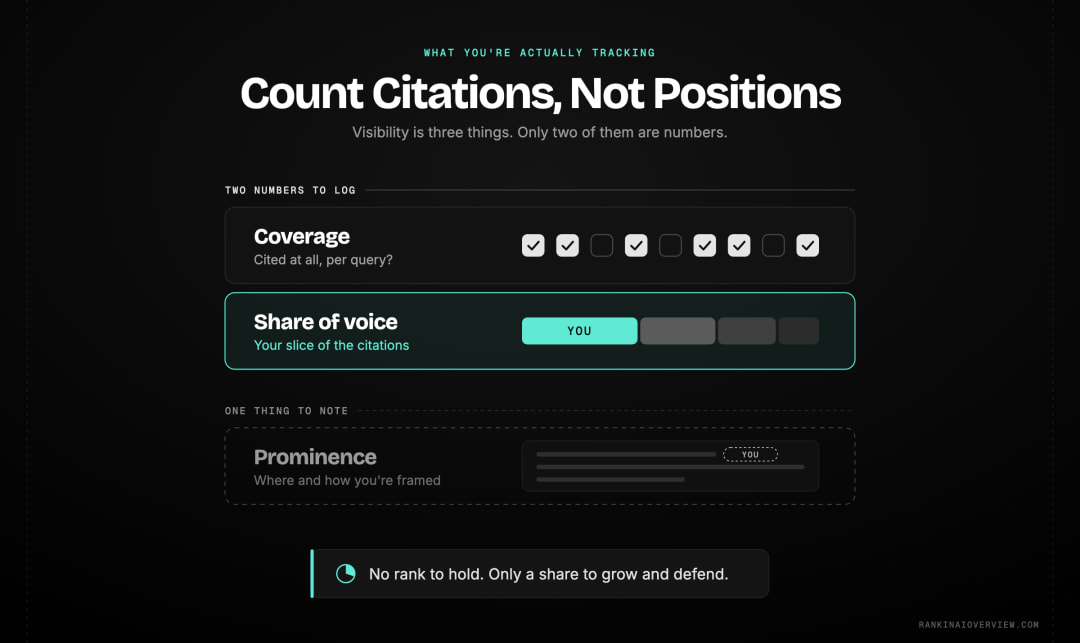
You are tracking whether your pages are cited as sources in Google's AI Overview for a defined set of target queries, and how that citation presence changes over time. Because Overviews carry no fixed positions, you record presence and share of voice against competitors rather than a numbered rank from one to ten.
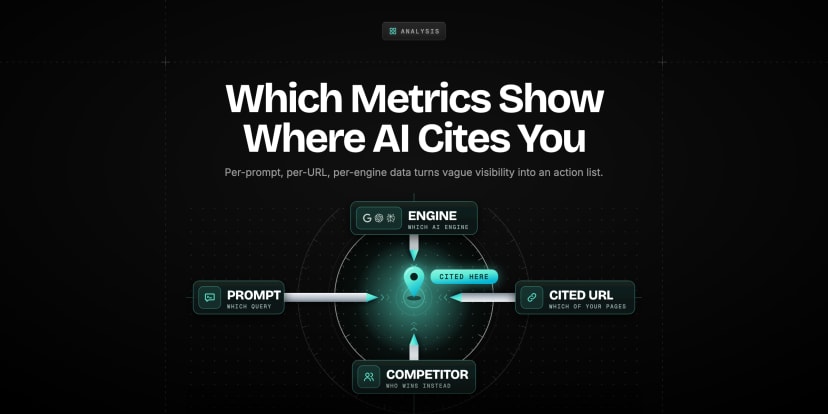
The unit of measurement is the citation, not the position. For each target query you note whether the Overview cited your page, which competitors it cited alongside or instead of you, and how that mix shifts from check to check. That is the raw material of AI Overview tracking, and it maps far better to how a searcher actually encounters you now, inside a synthesised answer, than any legacy rank would. Our explainer on why AI search does not have rankings like Google unpacks why the old positional mental model has to be set aside here.
This shift in unit is more than a technicality, because it changes what a good result even looks like. Under classic ranking you could reasonably aim to be position one and stay there, a stable and defensible goal. Under Overview tracking there is no equivalent summit to hold, only a share to grow and defend against constant reshuffling, so success is measured as a rising, resilient presence across your query set rather than a single trophy position. Teams that carry the old goal across unchanged tend to feel perpetually unsettled by the churn, because they are looking for a stability the medium simply does not offer. Accepting that presence is a moving quantity, and that the aim is a healthy trend rather than a fixed spot, is the mental adjustment that makes the whole routine bearable and useful.
Because an Overview is assembled from several sources and reshuffles frequently, presence is best understood as a share and a direction rather than a fixed slot. The goal is to be cited on more of your target queries, more consistently, over time, and to hold or grow that share as rivals compete for the same citations. Reading it that way also keeps you honest about what the Overview is doing under the bonnet, which our look at how Google picks sources for AI Overviews explores in more depth. Get the unit of measurement right and the rest of the routine follows; get it wrong, by chasing a phantom rank, and you will track a number that does not exist.
It helps to hold three distinct things apart, because teams often collapse them into a single vague sense of visibility. The first is coverage: on what fraction of your tracked queries does an Overview cite you at all. The second is share of voice: when you are cited, how much of the citation set is yours versus your rivals. The third is prominence: where in the Overview you appear and how you are framed, which is harder to quantify but matters for whether a searcher actually notices you. A tracking routine that follows coverage and share over time is the practical core, and prominence is a useful qualitative note to keep beside the numbers rather than a fourth metric to obsess over. Separating them stops you from celebrating a rise in coverage while your share of voice on the queries that matter is quietly shrinking.
There is also a decision to make about whether you track your absolute presence or your presence relative to competitors, and the honest answer is both, with more weight on the relative view. Your absolute coverage tells you how you are doing in isolation, but because the whole Overview churns, your absolute number carries a lot of noise that has nothing to do with you. Your share relative to the same competitors on the same queries, read at the same moment, cancels much of that shared movement and gives a steadier read on whether you are genuinely gaining or losing ground. When the two disagree, trust the relative one.
How Do You Set Up Consistent AI Overview Tracking?
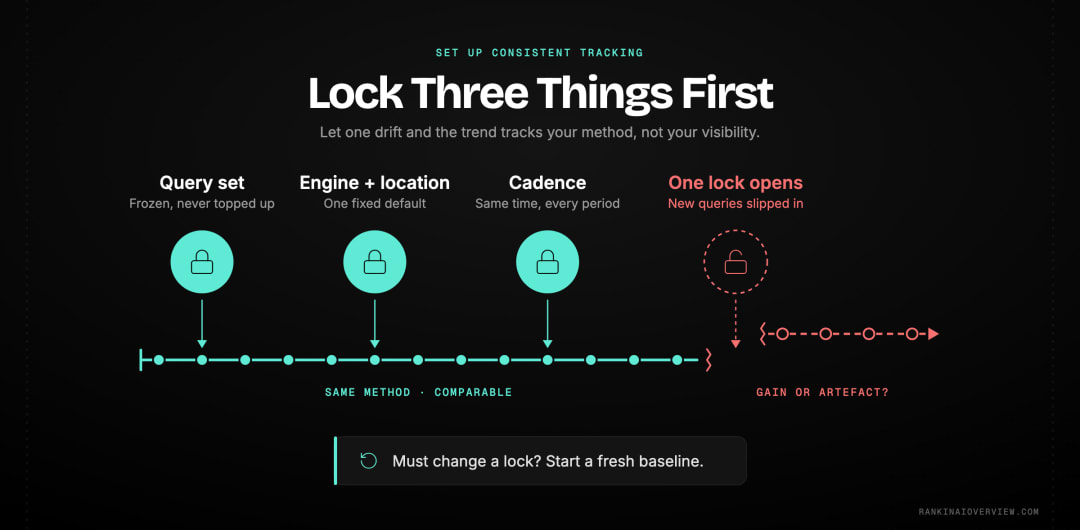
Set up tracking by fixing three things before you record a single reading: your target query set, the engines and locations you check, and your cadence. Then check whether the Overview cites you and your competitors for each query, and repeat on that exact schedule. Consistency in all three is what turns isolated checks into a comparable trend.
The setup is not complicated, but it rewards discipline:
- Select the buyer-intent queries you most want to be cited for, and freeze the list.
- For each, record whether the AI Overview cites your page today, and which competitors it cites.
- Note the location and settings you used, because Overviews vary by region and context.
- Repeat on a fixed cadence, weekly or monthly, at a similar time.
- Keep the method identical every period so each reading is a fair comparison with the last.
The single most damaging habit is quietly changing the setup between checks. Add or drop a few queries, switch the location, or shift the timing, and you have broken comparability without noticing, so a movement in the data reflects your change of method rather than any change in reality. Freeze the query set and the cadence early and resist every urge to reshuffle them, because a messy trend line is worse than none. If you must change the set, start a fresh baseline rather than pretending the new readings continue the old ones.
A few setup choices are worth settling deliberately, because they quietly shape every reading that follows. How many queries should you track? Enough to cover your important intent clusters but few enough that you can measure them faithfully every period, because a bloated list you check sporadically is worse than a focused one you check religiously. Which location and settings? Pick a representative default and hold it fixed, since Overviews personalise by region and context and a drifting location will masquerade as a real trend. And how will you log it? A simple record of query, date, cited-or-not, and competitors cited is enough to start, provided the format never changes, because a consistent humble spreadsheet beats an elaborate one you rebuild halfway through.
There is a further reason to lock the cadence, and it is the heart of why this spoke exists. Because AI answers shift across runs and time, a single check is not a measurement you can trust, so the routine has to lean on repetition to average out the noise. Where you can, taking more than one reading per period, even two or three checks a few hours apart, gives you a sense of how much the number naturally bounces, which is the yardstick you will later use to judge whether a week-on-week move is real. That is why tracking AI Overviews is inherently more work than logging classic ranks, and why manual checking gets heavy quickly. For consistent, automated tracking across many queries and competitors, a free AI-visibility audit from Rank in AI Overview will baseline your Overview presence, and our roundup of the best AI rank trackers compares the tools that automate the repetition for you.
How Do You Read an AI Overview Trend Through the Churn?
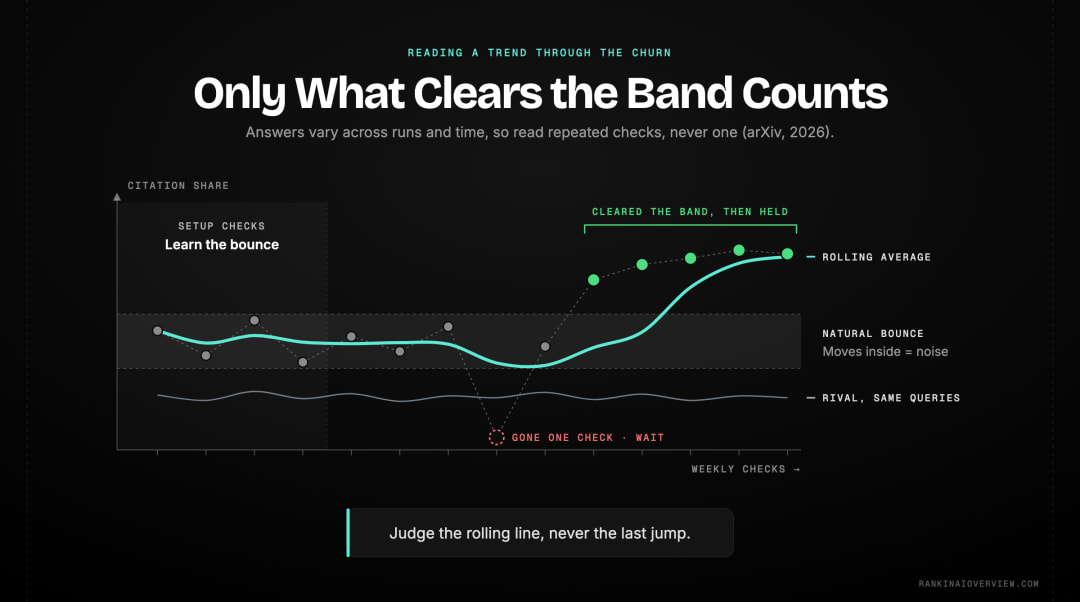
Read a trend by watching direction across several checks rather than reacting to any single one. Look at whether your citation share is climbing or slipping across a whole cluster of related queries, and always read it beside competitors. Because Overviews fluctuate so much between readings, sustained movement in one direction is the signal and a single-check swing is usually noise.
The volatility is not a flaw in your tracking, it is a property of the thing being tracked, and the empirical work is blunt about it: answers vary across runs, prompts, and time. A page cited this week and gone the next may reflect nothing more than the Overview resampling its sources, not a real loss of standing. The discipline is to zoom out. Three or four readings in the same direction mean something; one reading that breaks the pattern usually does not. Teams that react to every individual check end up chasing ghosts and rewriting pages that were never actually slipping.
Two habits sharpen the reading. First, read by cluster rather than by lone query, because movement shared across a whole topic tells a far clearer story than a single query wobbling on its own, which could be pure chance. Second, always place your trend next to your competitors' on the same queries. A dip that everyone shares points to a Google-side change and needs no panic; a dip that is yours alone is a genuine competitive signal worth acting on. The comparison also cancels a lot of shared noise, which makes the relative trend steadier and more trustworthy than your absolute presence taken in isolation.
A simple mental rule keeps you from being fooled by the churn. If you took a few readings during setup and saw your coverage bounce by, say, several points from one check to the next with nothing changing, then treat any week-on-week move smaller than that natural bounce as noise, and only take seriously a change that clears it and then persists. You do not need formal statistics to apply this; you need to know roughly how much your numbers wander on their own, and to hold new movements against that yardstick. It is also worth smoothing the picture by looking at a rolling view of the last several checks rather than the raw jump between the two most recent ones, because a rolling read dampens the single-check spikes that tempt teams into overreaction while still surfacing a genuine sustained direction.
The other discipline is to resist reading a story into a single dramatic reading. A page that vanishes from an Overview for one check is the most common false alarm in this whole exercise, and the correct first response is almost always to wait for the next reading rather than to rewrite the page. If it is genuinely slipping, the next checks will confirm it, and you will have lost nothing by being patient. If it was noise, your patience will have saved you a pointless edit and the risk of disturbing a page that was fine.
"Answers can vary across runs, prompts, and time, making one-off observations unreliable."
Julius Schulte and colleagues, Don't Measure Once: Measuring Visibility in AI Search (GEO) (arXiv, 2026)
How Do You Act on AI Overview Tracking Data?
Act on the data by working the queries where you are absent or losing share, then re-measuring to confirm the fix landed. Prioritise your high-intent queries, improve the clarity, structure, and trustworthiness of the pages behind them, and use the trend across subsequent checks to verify the change was real rather than another swing of the churn.
Tracking earns its keep only when it drives changes. Queries where the Overview never cites you are content opportunities, and the trend tells you which ones matter enough to work on first. Queries where a competitor is steadily gaining share on you are early warnings that your page needs strengthening before the gap widens. Read that way, the tracking data stops being a dashboard you glance at and becomes a prioritised worklist, ordered by where a citation is worth the most. Our guide to the AI visibility metrics that matter covers how to decide which of those trends deserve your effort.
It helps to sort what you find into three rough buckets, because each calls for a different response. There are queries where you are consistently cited, which you mostly leave alone and simply watch for erosion. There are queries where you are consistently absent, which are your build list, ordered by commercial intent so you invest first where a citation would be worth the most. And there are queries where your presence flickers in and out across checks, which are the genuinely interesting ones, because a flickering query is usually one where you are on the edge of the citation set and a modest improvement to the page can tip you firmly inside it. Prioritising the flickering, high-intent queries often gives the fastest return, since you are nudging something that is already close rather than trying to break into a query where you are nowhere. Without a trend over time you cannot even see which bucket a query is in, which is precisely why the longitudinal view matters more here than a one-off snapshot ever could.
Then close the loop deliberately, and give it time. After you change a page, do not judge the result on the very next check, because a single reading cannot separate your improvement from the ordinary noise. Watch several readings and look for a sustained lift in citation share on the affected queries. This measure, fix, re-measure cycle, run patiently, is what steadily grows Overview presence, and the patience is not optional: because the signal is noisy, confirming a win honestly takes more than one look. Whether the tooling you use makes this loop practical is exactly the question our assessment of whether AI rank tracker tools actually work sets out to answer.
What Mistakes Should You Avoid When Tracking AI Overviews?
The costly mistakes are inconsistent setup, overreacting to single checks, ignoring competitors, and never acting on the data. Each one quietly destroys either the comparability of your trend or your ability to turn it into improvement, leaving you with a tracking habit that consumes time and informs nothing.
Inconsistency is the most damaging, because it corrupts the data at the source. Change your query set, your location, or your cadence between checks and you can no longer tell a real gain from a measurement artefact, so the whole trend becomes untrustworthy. Lock the setup and track it faithfully, and if you genuinely must change it, restart the baseline honestly rather than splicing old and new readings into one misleading line.
Overreacting is the next trap, and it follows directly from the volatility. Because Overviews churn, a single drop can spook a team into changes that were never needed, wasting effort and sometimes disturbing a page that was performing fine. Read the trend across several checks before you touch anything. The mirror-image failure is watching without ever acting, which turns tracking into a passive scoreboard. The point of measuring over time is to intervene where the trend says it matters and then confirm the intervention worked, so a tracking routine with no follow-through is only half a system.
A subtler mistake is attributing every movement to your own actions. Because the Overview reshuffles for reasons entirely outside your control, a rise in your citation share might follow your content work or might simply be the system moving on its own, and it is dangerously easy to credit your last edit for a lift that had nothing to do with it. The guard against this is the competitor comparison and the re-measure loop together: if your share rose while rivals held flat, and the lift persisted across several checks after a specific change, you can reasonably claim the win; if everyone rose at once, the market moved, not your page. Being honest about which is which keeps you from building a strategy on a coincidence, and it is the difference between learning what actually works and merely collecting flattering stories about your own cleverness.
Conclusion
Tracking your AI Overview presence over time is what makes AI visibility something you can manage rather than merely hope about. You are not logging a fixed rank, because none exists. You are measuring whether your pages get cited for the queries you care about, how consistently, and how that share moves against competitors, and you are doing it repeatedly because a single reading of a volatile system cannot be trusted.
Fix your query set and cadence, read direction across several checks instead of reacting to each one, act on the queries where you are absent or slipping, then re-measure patiently to confirm the gain. Avoid the inconsistency and the overreaction that ruin most tracking efforts. AI Overviews are noisy by nature, but a disciplined, repeated measurement loop cuts through that noise and shows you, honestly, whether your work is moving the needle. The teams that win here are not the ones who check most anxiously, but the ones who measure most consistently and act only when the trend genuinely warrants it.
Want a consistent, repeated read on your AI Overview presence instead of a single uncertain snapshot? Rank in AI Overview offers a free AI-visibility audit that baselines your citation trend across queries, so your tracking starts from solid ground.
Frequently asked questions
Can you actually track AI Overview rankings?+
Not as numbered positions, because AI Overviews have no fixed ranks. You track presence instead: whether your pages are cited as sources for target queries, which competitors are cited, and how that citation share moves over time across several consistent checks.
How often should I track AI Overviews?+
Weekly or monthly, on a fixed cadence, so you can build a trend. Because answers vary across runs and time, a single reading is unreliable, and only repeated measurement on a steady schedule lets you tell sustained movement from ordinary noise.
Why does my AI Overview presence keep changing?+
Because Overviews are inherently volatile, reshuffling their sources as Google updates models, as pages change, and as competitors move. Much of the week-to-week change is noise rather than a real shift, which is why you read the trend across several checks, not any single one.
What exactly should I record for each query?+
Whether your page is cited, which competitors are cited alongside you, and the location and settings you used. Track citation presence and share of voice across clusters of related queries rather than trying to log a position that does not exist. Keep the recording format identical every period, because a change in how you log is as damaging to the trend as a change in what you measure.
How do I know a change I made actually worked?+
Do not judge it on the next single check. Watch several readings after the change and look for a sustained lift in citation share on the affected queries. A one-off improvement can be noise, whereas a consistent direction over multiple checks is a genuine result.
What is the biggest AI Overview tracking mistake?+
Inconsistency. Changing your query set, location, or cadence between checks destroys comparability, so real trends become invisible behind measurement artefacts. Lock the setup, track faithfully, and read trends across several readings before you act on them.
Explore with AI
Share this