Why Do Competitors Appear in AI Search but Not Me?
A rival gets cited in AI answers while you stay invisible. Their lead is usually moderate, engine-specific and mappable. Here is how to close it.

Key Highlights
- A competitor appearing in AI answers is a statement about fit for a specific question and engine, not proof they are a better business.
- In a 2026 study of AI recommendations, the top-recommended brand agreed across models only 41.6% of the time, so a rival that owns a category on one engine often does not hold it on another.
- Recommendation concentration was moderate rather than winner-takes-all, and 8% of categories had no clear leader at all, which means the ground is more open than an invisible brand assumes.
- The gap is diagnosable: map which engines and queries a competitor wins, work out why, and close that specific weakness rather than trying to out-build them everywhere.
Watching a competitor get cited in AI answers while you stay invisible is more than annoying. It reads as evidence that they have something you do not, at least in the model's eyes. The instinct is to assume they are simply better. Usually the real reason is narrower, more specific and far more fixable than that, which is genuinely good news once you can see it clearly. The gap between you and a cited competitor is rarely the broad, unbridgeable thing it feels like in the moment; more often it is a handful of specific queries, on a subset of engines, decided by a few concrete signals that you can name and address.
According to a 2026 study of 3,750 AI recommendation responses across 50 brands, five industries and three models, the top-recommended brand agreed across models only 41.6% of the time, and within a single category one brand displaced another asymmetrically by as much as 4.3 to 1. Read those two numbers together and the picture changes. A competitor who appears to own a category is often winning on one engine and losing on another, and the "ownership" that feels total is, in the aggregate, moderate rather than absolute. Their visibility is a specific, measurable position, not a permanent verdict on who is better.
This guide helps you diagnose why competitors appear and you do not, and what to do about it. It covers whether their citation means they are better, how concentrated AI recommendations really are, why a rival can win on one engine and vanish on another, what actually creates the gap, and how to find and close it. For the underlying workflow, our AI citation fix diagnostic is a close companion.
Does a Competitor Appearing in AI Search Mean They Are Better?
No. A competitor appearing in AI search means their content and signals fit what the engine rewards for that specific question, on that specific engine. The model is not ranking businesses by quality. It is choosing the source that most clearly, credibly and relevantly answers the query, and a weaker company can match those criteria more closely than you.
The confusion comes from reading a citation as a scoreboard. It feels like the AI has weighed the two companies and picked the winner. What it has actually done is pick, for one question, the source that best fit a set of criteria that have little to do with overall market strength: how directly the answer is stated, how credible and recognised the source is, and how well it matches the exact intent behind the query. Those criteria reward specific, buildable things, not general superiority.
So the reframing is worth making deliberately. A competitor's citation is not a judgement on your quality; it is a clue about what the engine rewarded and a map of where you fell short on that question. That turns a demoralising situation into an actionable one, because fit is something you can diagnose and build, even against a larger rival with a longer head start.
There is a further reason the "they are just better" reading misleads you: it points you at the wrong work. If you believe a competitor is winning because they are a superior company, the only response that makes sense is to try to become a superior company, which is slow, expensive and mostly beside the point. If you understand that they are winning a specific query because their answer fits it better, the response is concrete and cheap by comparison: fix that answer, on that query. The framing you choose determines whether the problem feels like an existential disadvantage or a to-do list. The same is true of the reverse assumption, that a ranked page automatically earns AI visibility. Our pillar view on why ranking well does not guarantee AI visibility explains why the two are separate achievements, and the competitor case is the same lesson seen from the other side of the fence.
How Concentrated Are AI Recommendations, Really?

Less than the panic suggests. In the same study, recommendation concentration was moderate rather than winner-takes-all, and 8% of category queries had no single leading brand at all. So while some competitors do dominate some queries, the broader pattern is not one rival owning everything, but a distribution with real openings for brands that fit specific questions well.
This matters because the emotional experience of being invisible is winner-takes-all even when the data is not. You see the competitor cited, you see yourself absent, and you conclude they own the space. The measured reality across categories was more moderate: the study set a threshold for genuine power-law dominance and found the average concentration sat well below it. Dominance existed, but it was the exception rather than the rule, and a meaningful share of categories had no clear owner for a well-fitted newcomer to claim.
"Within the scope studied, these results sit in tension with a strong winner-takes-all narrative around AI recommendation."
Dmitrij Zatuchin, brand category ownership study (2026)
That tension is the opening. If AI recommendation were truly winner-takes-all, an invisible brand would be right to despair, because displacing an entrenched leader would be close to impossible. Because it is not, the practical question shifts from "how do we beat the dominant brand everywhere" to "which specific queries and engines is a competitor actually winning, and which are genuinely open." One of those questions is demoralising and unanswerable; the other is a work plan.
It also changes how you read a single alarming result. When you run one query, see a competitor cited, and conclude the category is lost, you are generalising from a sample of one. The category-level picture assembled from thousands of responses looked far less concentrated than any single query would suggest, precisely because different queries within the same category often surface different brands. The competitor who dominates the one phrasing you happened to test may be absent from three neighbouring phrasings that matter just as much to buyers. Testing a spread of real queries, rather than the one that stung, is what reveals whether you face genuine dominance or just lost a single coin-toss.
The caveat to hold onto is that this is an exploratory study of a defined sample of brands, industries and models, each query repeated several times under a stability protocol, so the exact concentration figure is not a universal constant. The transferable finding is the shape of the thing: real but moderate concentration, with openings, not a sealed market. Treat the specific numbers as an illustration of the pattern, and the pattern as the thing you can rely on.
Why Does a Competitor Win on One Engine but Vanish on Another?

Because each engine builds its recommendations from its own sources and preferences. The study found the top-recommended brand agreed across models only 41.6% of the time, so a rival that leads on one engine frequently does not lead on another. Their apparent dominance is often engine-specific, which means your gap is too, and both can be mapped engine by engine.
This is one of the most useful findings for anyone who feels boxed out. If you have only checked one engine, you have seen one slice of a competitor's visibility and quietly assumed it holds everywhere. More than half the time, it does not. A competitor who owns the category on one assistant may be barely present on another, where a different source pool and different trust signals produce a different leader. Your invisibility on the engine you checked is not a verdict across all of AI search; it is one result on one system.
The strategic consequence is that "why do competitors appear and not me" has a different answer for each engine, and some of those answers are much easier to act on than others. You might be a long way behind a rival on the engine where they are entrenched, and a short, winnable distance behind on another where nobody has established ownership yet. Chasing the hardest engine first is a common and costly mistake. Our look at non-Google AI citations shows how differently these engines choose their sources, and why a single-engine view misleads you about where you actually stand.
The low cross-model agreement also tells you something about why a competitor leads where they do. If their advantage were built on being an objectively better answer, you would expect that advantage to travel: the best answer to a question should tend to win on every engine that reads it. It does not travel reliably, which points to the advantage being rooted in things each engine weights differently, its own preferred sources, the corroboration it happens to have indexed, the way it resolves your category to a set of candidate brands. Those are not fixed facts about your competitor; they are engine-specific conditions, and conditions can be changed by giving each engine more of what it looks for. A rival's lead on one assistant is therefore better understood as a snapshot of that engine's current inputs than as a durable moat around the category.
What Actually Creates the Gap Between You and a Cited Competitor?

The gap is usually earned recognition, a directly matched answer, genuine topical depth, or presence on the sources the engine trusts, not overall company size. The study also found displacement is asymmetric, with one brand substituting for another by up to 4.3 to 1, so the gap is often specific and directional rather than a general deficit.
The specific gaps that put a competitor in the answer instead of you:
Earned Recognition the Engine Can See
If a competitor is more consistently recognised across independent, third-party sources, the engine treats them as a safer thing to recommend. This is not about how much content you publish about yourself; it is about how much credible corroboration exists elsewhere. A brand that is talked about, referenced and validated by others reads as more citable than one that only talks about itself, however polished its own pages are. Strengthening those external trust signals is a direct competitive lever, as our guide to the trust signals AI recognises explains. This is also the gap that most rewards patience: earned recognition cannot be published on demand, but it accumulates, and once it exists it is far harder for a competitor to erode than a clever page is to copy.
A Directly Matched, Self-Contained Answer
If a competitor states the exact answer to the query cleanly near the top of a page, while yours is implied, buried or hedged, the engine lifts theirs. This is frequently the whole gap on a given query, and it is the fastest to close, because it is about the shape of your answer rather than the strength of your brand. A precise, standalone answer to the specific question can beat a bigger rival whose page never quite commits to the point. It is worth stressing that this is not won by adding markup or reformatting; controlled studies find formatting-only changes do little for whether a passage gets chosen. What wins is actually stating the answer, plainly and completely, where the engine can find it.
Genuine Topical Depth
Engines lean towards sources that demonstrate real, cohesive coverage of a subject rather than a thin, isolated page. If a competitor has built out a topic thoroughly, with the surrounding questions answered and the claims substantiated, they read as the authority on it, and the model reaches for them by default. Shallow coverage on your side cedes that ground even when your headline answer is fine, because the engine is judging not just the single passage but the credibility of the source behind it. Depth is a slower lever than surfacing an answer, but it compounds, and it is often what separates two otherwise similar pages. A competitor with a single strong page on a topic is beatable; a competitor who has answered the whole cluster of related questions credibly has built something the engine returns to across many queries, and matching that means covering the territory rather than winning one exchange.
Asymmetric Displacement in Your Category
The displacement finding is worth dwelling on, because it explains a pattern that feels unfair. Substitution between brands was often one-directional: an engine would recommend brand A in place of brand B far more often than the reverse, with the imbalance reaching more than four to one in some industries. That means a specific competitor may be absorbing your visibility on a specific set of queries, not because they beat everyone, but because the model treats them as the default stand-in for what you offer. Identifying the exact rival who displaces you, and the queries where it happens, turns a vague sense of being crowded out into a short, targeted list. It also tells you who to study: the brand that displaces you is, in effect, showing you the fit the engine currently prefers for those queries, which is a far more precise brief than "be better."
How Do You Find and Close the Gap?
Map it before you fix it. Run your key buyer queries through each engine, record which competitors are cited and how often, and note which engines and queries they win versus where the field is open. Then close the specific weakness on the highest-value gaps, sharpen the answer, deepen the topic, strengthen earned recognition, and re-measure to confirm your share is rising.
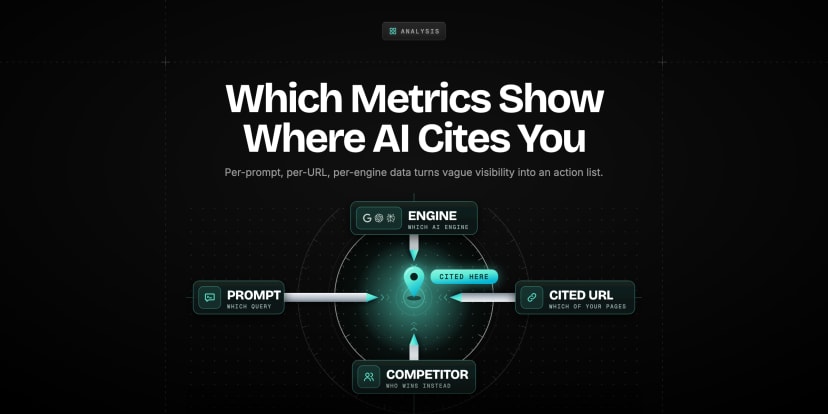
The mapping step is what separates targeted work from flailing. For each important query, you want to know three things: does a competitor win it, on which engines, and does that engine have a settled leader or an open field. The study's own metrics model this well. A share-of-mentions measure tells you how much of a category a rival owns; a no-clear-leader signal flags the categories where 8% of the time nobody is entrenched and a well-fitted page can move in quickly; and a displacement measure tells you which specific competitor is standing in for you. You do not need the academic apparatus to apply the logic: a spreadsheet of query, engine, cited competitor and frequency gives you the same map. Our guide to AI visibility metrics helps you turn that into numbers you can track.
Once the map exists, prioritise ruthlessly. The best first targets are high-value queries where a competitor's lead is narrow, or where an engine has no settled leader at all, because those are the fastest conversions from invisible to cited. The open categories deserve special attention: a query that no brand currently owns is a land grab where being the first to publish a genuinely clear, well-sourced answer can establish you as the default before a competitor thinks to compete for it. Those wins are cheaper and stickier than clawing a query back from an entrenched rival, and they are easy to miss if you only look at the queries where you are already losing. The worst first targets are the queries where a rival is deeply entrenched on their strongest engine, which is real work for a slow payoff. For each chosen gap, close the specific weakness the map revealed rather than making broad changes with no clear target: if the gap is a buried answer, surface it; if it is thin recognition, earn more third-party validation; if it is depth, build genuine coverage. Then re-run the same queries after the changes have been recrawled, and watch whether your share of citations rises relative to the competitor's. That re-measurement both proves the work and shows you the next gap to take.
A note on expectations while you do this work: progress shows up unevenly, and that is normal rather than a sign the approach is failing. Because engines disagree with each other and results vary from run to run, you will often win a query on one engine before another, or see a citation appear, disappear and settle back over successive checks. This is why a single re-check after a change is a poor test. Take a baseline across a few runs before you edit, make one focused change, then re-check across a few runs afterwards, so you are comparing stable pictures rather than two snapshots that each caught a different roll of the dice. Attribution is only trustworthy when you have controlled for that variability, and it is the difference between knowing a change worked and merely hoping it did.
Defending what you win is the same loop run continuously. Because a citation is not permanent and competitors keep optimising, monitor the queries you now own alongside the ones you are chasing, so that when a rival starts to reappear on a query you had taken, you can respond before you lose it. That ongoing diagnose-fix-measure cycle, rather than a single push, is what turns a one-off win into a durable position in AI answers, and it is the same discipline that keeps a hard-won citation from quietly slipping back to the competitor you took it from.
Conclusion
A competitor appearing in AI search while you do not is not proof they are better. It means their content and signals fit what the engine rewarded for specific questions, on specific engines. The data makes that reassuring rather than deflating: recommendation ownership is usually moderate, it disagrees across engines more often than not, and a real share of categories have no settled leader at all.
Find the queries and engines where a rival wins, work out the specific reason, and close that one gap before moving to the next, then re-measure and defend what you take. What looks like a competitor's advantage is really a map showing you exactly where to compete, and AI recommendation rewards the source that fits a question best, not the biggest name in the market. The rival you envy is not an immovable obstacle; they are the clearest available brief on what the engine currently wants, and once you read it that way, closing the gap becomes ordinary, repeatable work rather than a fight you assume you have already lost.
Want to see exactly where competitors are beating you in AI answers? Run a free AI-visibility audit with Rank in AI Overview and get a query-level competitive breakdown.
Frequently asked questions
Why do competitors show up in AI search and I do not?+
Because their content and signals fit what the engine rewards for specific questions: a clear answer, earned recognition, depth, and presence on trusted sources. It usually reflects specific, fixable gaps on particular queries and engines, not that they are a better business overall.
Does AI recommend the best company?+
No. It recommends the source that most clearly and credibly answers a specific question, which is not the same as the strongest business. Studies find recommendation ownership is moderate and varies by engine, so a weaker brand can win queries by fitting the criteria better.
Why does a rival win on one AI engine but not another?+
Because each engine draws on its own sources and preferences. Research found the top-recommended brand agreed across models only about 41.6% of the time, so a competitor's dominance is often engine-specific rather than universal, and your gap can be much smaller on some engines than others.
How do I find which queries competitors are winning?+
Run your key buyer queries through each engine and record which competitors are cited and how often. That reveals the specific queries and engines where they appear and you are absent, plus the openings where no brand has a settled lead yet, giving you a prioritised target list.
Is a competitor's AI visibility a permanent disadvantage?+
No. Recommendation concentration is usually moderate, not winner-takes-all, and openings exist. Once you diagnose why a competitor wins a query and close that specific gap, you can start appearing. Their current lead is a map for improvement, not a fixed outcome, and much of it can be closed one query at a time.
How do I keep a citation once I win it?+
Maintain the earned recognition, depth and clear answers that earned it, keep content current, and monitor the queries you now win. AI answers shift and rivals keep optimising, so ongoing attention defends the ground you gained from competitors trying to reclaim it.
Explore with AI
Share this