What Type of Blog Content Does AI Actually Want to Cite? A Content Marketer's Guide
Not all blog content gets cited by AI search engines. Here are the 5 content formats and writing patterns that consistently attract AI citations, with examples for each.

Key Highlights
-
Blog content for AI search needs to pass two tests: the extraction test (can AI pull a self-contained answer from this section?) and the trust test (does this brand demonstrate credible first-hand experience?)
-
What content does AI cite comes down to two properties: extractability (self-contained passages that make sense without surrounding context) and trust (evidence of first-hand expertise and independent corroboration)
-
Understanding what content does AI cite across different platforms is the foundation of any AI-ready content strategy. The five types in this guide cover the full spectrum of citation-optimised content formats
-
What content does AI cite most consistently: original data and research, comprehensive how-to guides, comparison and versus content, FAQ-format sections, and first-person experience writing
-
Content formats for AI overview differ by platform: Google AI Overviews strongly favour FAQ schema and structured how-to content. Perplexity favours community-verified information and comparison content. ChatGPT favours authoritative, well-sourced content with named credentials
-
The content formats for AI overview that work across all platforms are comparison content and FAQ sections. Both produce self-contained extraction targets regardless of which AI engine is retrieving
-
Content formats for AI overview are distinct from content formats for traditional SEO. The question-format H2 and answer-first structure that improves AI Overview citation also improves featured snippet eligibility
-
Investing in the right content formats for AI overview is the highest-return content strategy change available in 2026 because the same structural improvements serve both AI citation and traditional SEO simultaneously
-
Write content for GEO using the reference content principle: think encyclopedia entry, not blog post. Dense, specific, authoritative, and structured for passage-level extraction rather than linear reading
-
To write content for GEO that Perplexity cites: lead with a complete answer, use specific named statistics, and include first-person experience signals that demonstrate direct knowledge of the topic
-
Write content for GEO across all platforms by prioritising information density over engaging narrative. Every paragraph should contain at least one specific, verifiable claim
-
The most accessible way to write content for GEO is to audit your existing content against the five criteria in this guide and restructure rather than rebuild from scratch
-
AI-friendly content types share one property: every section must contain a self-contained, directly citable answer in its first 60 words that makes sense without surrounding context
-
Content formats to avoid: introductory listicles without substantive descriptions, promotional product content, vague tips without specific actions, and any format that buries the answer after a long preamble
-
The content audit framework at the end of this guide gives you a four-step process to update existing content for AI readiness without rebuilding from scratch
Content marketers are confronting an uncomfortable reality: they are producing content regularly, but AI is not citing it. Is it the topic? The format? The structure? The answer is almost always the format and structure. According to Princeton and Georgia Tech's generative engine optimisation research that tested seven specific content interventions in controlled conditions, structural changes, specifically adding statistics, quotations, and clear formatting, improved AI citation probability by 30 to 40 percent independently of topic or keyword relevance. What content does AI cite is therefore not primarily a question of what you write about. It is a question of how you write it.
The gap between AI-cited content and typical blog content is structural. AI engines extract passages, not pages. They look for self-contained answer blocks that can be synthesised into a response without requiring surrounding context. Most blog posts are written for linear human readers who will read from top to bottom. AI engines do not read linearly. They scan for extractable passages and move on if they do not find them quickly.
This guide gives you the five content types that AI engines consistently cite, explains the structural reason each type works, provides before-and-after examples for the most impactful formats, and closes with a four-step audit process to update your existing content. By the end, you will have a clear content brief format that produces blog content for AI search and for human readers simultaneously. Blog content for AI search is not harder to write. It is differently structured.
Why Does Most Blog Content Fail to Get Cited by AI?

Most blog content fails the AI citation test for three specific reasons. First, the extraction problem: content is structured for linear reading rather than passage-level extraction, so AI engines cannot find a self-contained answer without reading the whole section. Second, the promotional problem: content leads with benefit statements or company positioning rather than direct answers. Third, the structure problem: answers are buried after long introductions, making them invisible to AI engines that scan openings first.
The extraction problem is the most fixable. A section that opens with two paragraphs of context before delivering the answer is a section where AI engines find no extractable passage in the opening scan and move to the next source. The same section rewritten to deliver the answer in the first 60 words becomes immediately extractable. The total content of the section does not need to change. Only the sequence needs to change: answer first, context second.
The promotional problem is the most damaging. AI engines actively avoid citing pages that read as sales material. A blog post that opens with "our platform is the leading solution for X" or "why X company is the best choice for your team" has failed the objectivity filter before the AI engine has read a single substantive sentence. The fix requires removing commercial language from informational sections entirely, not just from the opening paragraph.
The structure problem compounds the other two. Long introductions, excessive scene-setting, and delayed answers all reduce AI citation probability by reducing the extractable content density of the page. A page where 30% of the content is substantive and directly answerable produces lower AI citation rates than a page where 80% of the content is substantive. Writing content for GEO means prioritising information density and extractability over the expansive, engaging intro style that human readers often appreciate.
What Are the 5 Content Types AI Engines Consistently Cite?
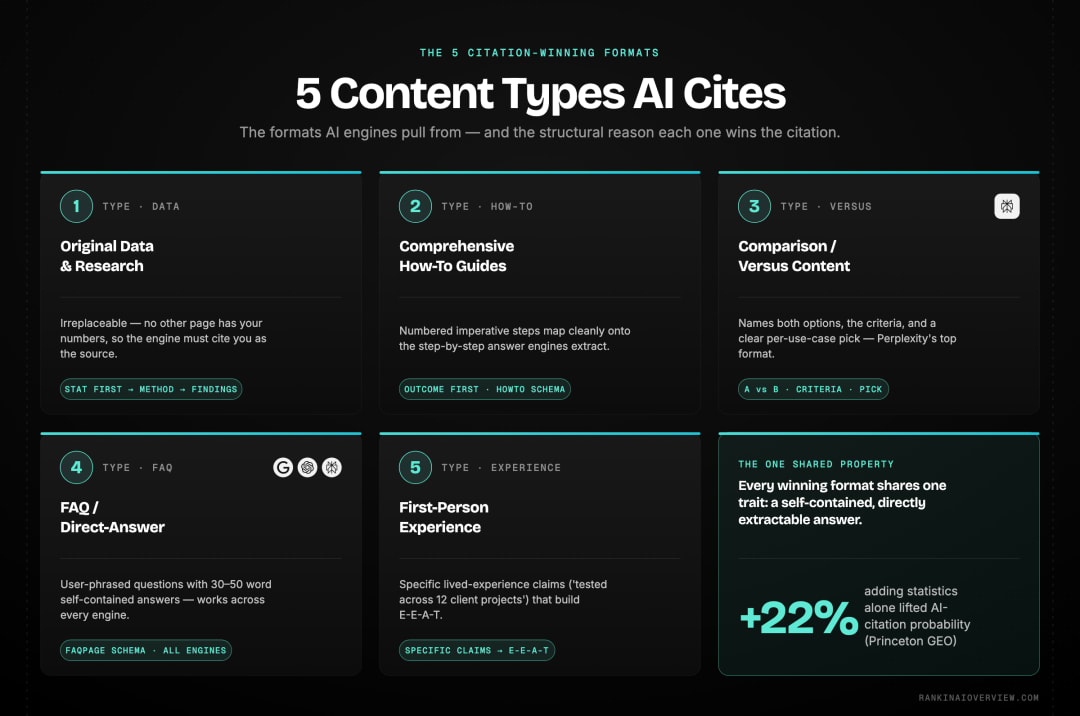
The five AI-friendly content types share one property: they contain self-contained, directly extractable answer passages that AI engines can retrieve and synthesise without surrounding context. Each type achieves this through a different structural mechanism. Understanding which mechanism applies to each type lets you implement the right format for any topic.
Type 1: Original Data and Research
Original data and research is the highest-citation content type available because it is the only type that cannot be found anywhere else. When AI engines generate answers that require data support, they specifically seek sources with unique, verifiable statistics. A brand that publishes the only study on how often B2B buyers use AI search before contacting a vendor owns that data point. Every AI-generated answer that needs to quantify that behaviour will cite the brand that owns the data.
The structural requirement for AI citation: state the headline statistic in the first sentence of the research section. Then give the methodology in two to three sentences. Then give the key findings. Princeton's GEO research specifically found that adding statistics improved AI citation probability by 22 percent as a standalone intervention. The specific format: "Research by [brand] found that X percent of [population] experience [finding] (methodology: survey of N respondents, date range, source)." That structure gives AI engines a directly citable claim with the attribution information needed to reference the source.
Original research structure that gets cited: A survey of 312 B2B content marketers conducted by [Brand] in Q1 2026 found that 67% of marketing teams publish content at least weekly but fewer than one in five have a documented strategy for measuring AI citation rates. The survey was conducted via email panel in January to February 2026. Respondents were content marketing practitioners at companies with more than 50 employees.
Type 2: Comprehensive How-To Guides
Step-by-step instructional content is among the most consistently cited blog content for AI search because it maps directly to how users ask process questions. A user asking "how do I implement FAQ schema on WordPress" expects a numbered sequence of specific steps. An AI engine generating an answer to that query looks for content that provides exactly that sequence, extractable without surrounding context.
The structural requirements: state the outcome in the first sentence ("Here is how to implement FAQPage schema in WordPress in five steps"). Number every step. Use imperative language for each step ("Open your WordPress admin panel" not "You should consider opening"). Include the expected result after key steps. Avoid explanation paragraphs between steps that break the extractable sequence. The entire how-to should be scannable by a reader who wants only the steps, not the surrounding explanation.
Implementing HowTo schema on step-by-step content makes the structure machine-readable, increasing AI extraction confidence further. This applies specifically to instructional content where there is a defined sequence of steps with defined outcomes. Validate any schema implementation with Google's Rich Results Test before publishing.
Type 3: Comparison and Versus Content
Comparison content is the most cited content type on Perplexity and among the highest-cited across all AI platforms because it answers a specific and common user intent: which of these two options is right for me? A user asking "Asana vs Monday.com: which is better for small teams?" has a clear decision to make. An AI engine answering that query extracts the comparison criteria and use-case recommendations from whichever content piece presents them most clearly.
The structural requirements for comparison content that AI cites: name both options in the first sentence with a clear context descriptor ("Asana and Monday.com are both project management tools, but they serve different team sizes and workflows"). List the comparison criteria explicitly. Provide a clear recommendation for each use case, not a hedged "it depends" conclusion without specifics. Close with an overall recommendation that states which option wins for the most common use case and why.
Comparison opening structure that gets cited: Asana and Monday.com are both project management tools. Asana leads for large teams needing workflow automation across complex projects. Monday.com leads for visual project tracking and teams that prioritise a customisable interface over deep automation. For teams under 20 people, Monday.com is the more accessible starting point. For enterprise teams with defined workflows, Asana scales more effectively.
This format serves both human readers and AI extraction because it delivers the comparison conclusion in the first paragraph. A human reader knows immediately whether to continue reading. An AI engine extracting a passage for a user asking "Asana vs Monday.com" has a directly citable, self-contained comparison summary in the first 80 words.
Type 4: FAQ and Direct-Answer Content
FAQ sections are the most universally applicable AI-friendly content format because they pre-structure content as question-answer pairs, which is precisely the format AI engines use to retrieve and synthesise answers. Every FAQ section is a collection of pre-packaged AI citation candidates. FAQPage schema makes this structure machine-readable for both Google AI Overviews and independent AI engines, labelling each question-answer pair as an explicitly extractable unit. This is the content format most directly aligned with how AI engines consume and synthesise content.
The structural requirements: use the exact question phrasing that users type, not marketing language versions of those questions. Keep answers to 30 to 50 words each: complete enough to be useful as a standalone answer, short enough to be extractable as a single passage. Do not link to other pages within FAQ answers. Do not use FAQ sections as navigation menus: each answer must be self-contained.
FAQ format that gets extracted vs FAQ format that gets skipped: CITED: "What is FAQPage schema?" FAQPage schema is structured data markup that labels question-and-answer pairs on a web page as explicitly extractable units, helping AI engines and Google identify and retrieve direct answers from your content. Implemented using JSON-LD and validated with Google's Rich Results Test.SKIPPED: "What is FAQPage schema?" For more information about FAQ schema, please visit our comprehensive guide to schema markup and structured data, where we cover all the major schema types and how to implement them.
Type 5: First-Person Experience Content
AI engines prioritise sources that demonstrate direct, lived experience with the subject they are writing about. Google's Search Quality Rater Guidelines define Experience as a primary dimension of quality: content that demonstrates first-hand knowledge of what it is describing. AI engines apply the same standard. A post that says "in my experience testing this tool across 12 client projects over 6 months" carries more citation weight than a post that says "this tool is widely used by marketing teams."
The structural implementation: include at least one specific experience claim per article. Use signal phrases that are concrete rather than vague: "after testing" rather than "based on research," "when I worked with a 50-person SaaS team" rather than "for growing teams," "the result was a 34% reduction in review time" rather than "results improved." Specific numbers, specific timeframes, specific roles, and specific contexts all build the experience signals that AI engines use to evaluate citation safety.
“ Original data and research: if you have a statistic no one else has, AI will cite you. First-person experience content: AI needs sources that claim lived experience. Be specific. Avoid fluff and filler. AI prefers dense, useful information. Think reference content, not blog posts. Content marketing practitioner r/content_marketing community, Reddit 2026 Source: Reddit: What Type of Blog Content Is AI Actually Looking For?
What Content Formats Do AI Engines Consistently Skip?
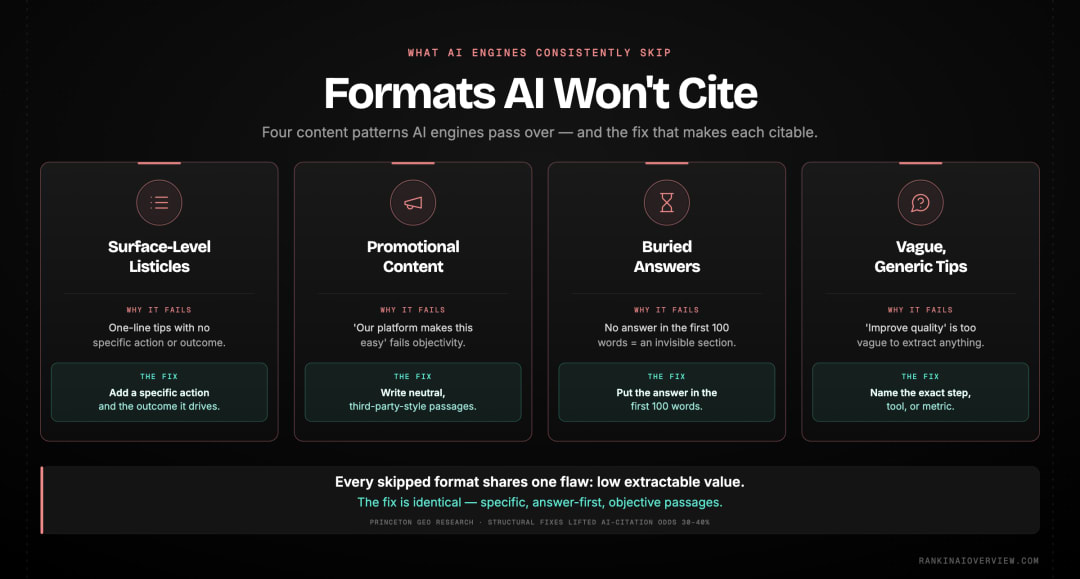
Four content formats are consistently skipped by AI engines regardless of topic quality or brand authority. Understanding why each format fails the AI citation test is as important as knowing which formats succeed. Each failure mode has a specific structural fix that can be applied to existing content without complete rewrites.
Avoid: Introductory listicles without substantive descriptions "10 tips for better email marketing" where each tip is a one-sentence statement with no specific action, measurable outcome, or context. AI engines extract tips that tell readers exactly what to do and what result to expect. Tips that say "be consistent" or "know your audience" provide no extractable value and are skipped.
Avoid: Promotional content in informational sections Any section that leads with what your product does or why your brand is the best choice. AI engines filter commercial intent signals from informational content. A page that opens an informational section with "our platform makes this easy" has failed the objectivity filter before the AI engine has found any citable content.
Avoid: Long introductions before answering the question Three or four paragraphs of context-setting, background information, or industry framing before delivering the answer the section heading promises. AI engines scan openings. If the first 100 words contain no directly answerable content, the section is effectively invisible.
Avoid: Vague tips without specific actions "Improve your content quality" or "focus on user experience" without a specific action, measurable outcome, and implementation instruction. AI-friendly content types are specific enough that a reader who follows the instruction knows exactly what to do and what to expect. Vague guidance fails the specificity test for extraction.
What Is the 4-Step Content Audit for AI Readiness?
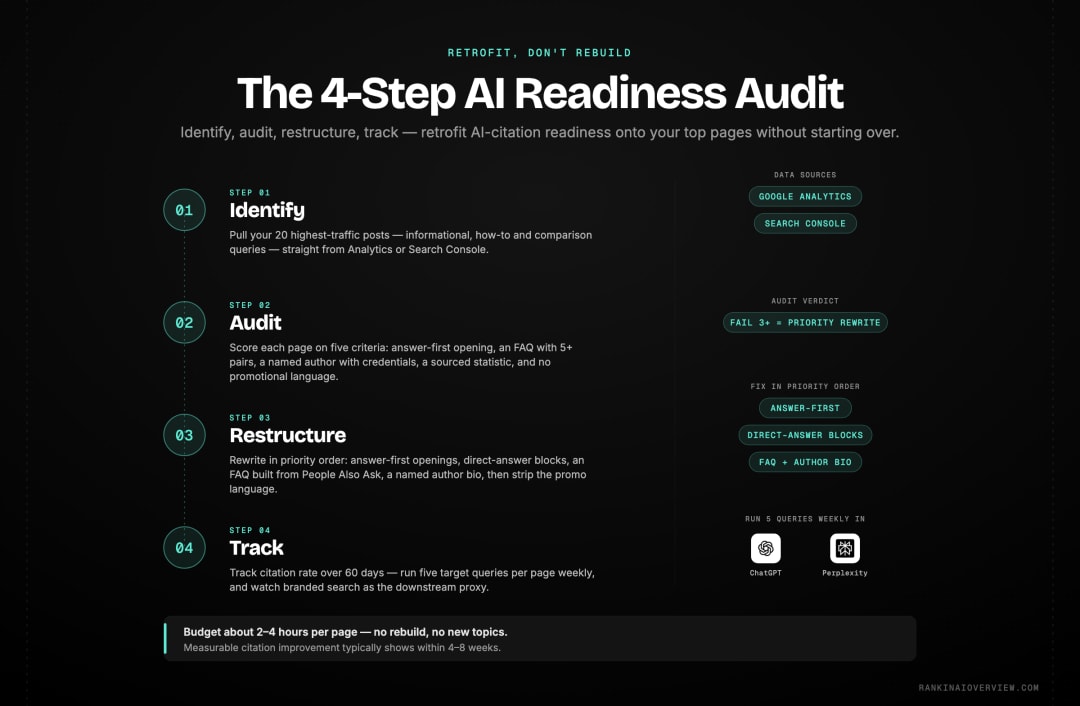
The four-step audit below applies to existing content rather than new content creation. Most teams have ten to thirty high-traffic pages that represent their best opportunity for AI citation improvement without starting from scratch. Applying these four steps to your highest-traffic existing pages takes two to four hours per page and typically produces measurable AI citation improvements within four to eight weeks.
Step 1: Identify your twenty highest-traffic posts using Google Analytics or Google Search Console. Filter for pages that receive informational query traffic, specifically pages ranking for questions, how-to queries, or comparison queries. These are the pages most likely to benefit from AI citation optimisation because they are already receiving traffic from the query types that trigger AI-generated answers.
Step 2: Audit each page against five specific criteria. Does each H2 section open with a self-contained answer in the first 60 words? Does the page have a FAQ section with at least five question-answer pairs? Does any author name appear with specific credentials? Is there at least one specific statistic with a named source? Does the page contain any promotional language in informational sections? Log a pass or fail for each criterion per page. Pages that fail three or more criteria are your highest-priority rewrites. Track AI citation rate weekly using manual prompt testing in ChatGPT and Perplexity before making changes to establish your baseline.
Step 3: Restructure each page in priority order. Rewrite openings to lead with the answer. Add direct-answer blocks at the start of each H2 section. Add a FAQ section with five to ten questions sourced from Google's People Also Ask and Google Search Console query data. Add a named author bio with specific credentials. Remove promotional language from informational sections. These changes can be made to existing content in one to two hours per page without requiring new research or new content creation.
Step 4: Track AI citation rate for each updated page over 60 days. Run the five target queries per page in ChatGPT and Perplexity five times each per week. Log whether the updated page appears in any of those runs. Calculate a weekly citation rate. After four weeks, you should see measurable improvement in citation frequency for pages where all five audit criteria are now passing. Use Google Search Console to monitor whether branded search volume is increasing as a downstream proxy for AI citation-driven brand awareness.
| Content Type | AI Citation Strength | Best For | Implementation Effort |
|---|---|---|---|
| Original data and research | Very High. Unique statistics are irreplaceable | Brands with research capabilities or proprietary data | High. Requires original research or data aggregation |
| Comparison and versus content | High. Answers clear decision intent on Perplexity and ChatGPT | Product categories with multiple competing options | Medium. Requires thorough research of compared options |
| Comprehensive how-to guides | High. Step sequences are highly extractable | Any instructional topic with a defined process | Medium. Requires accurate, tested step sequences |
| FAQ and direct-answer sections | High. Pre-formatted extraction targets for all AI platforms | Any topic where users ask specific questions | Low. Can be added to existing content in one to two hours |
| First-person experience content | Medium-High. Builds E-E-A-T trust signals that amplify other formats | Practitioner content, reviews, tool evaluations, case studies | Low. Requires adding specific experience language to existing content |
Conclusion
If you want the format-by-format view, here is which content types actually rank in AI search.
For the raw evidence behind these formats, see our breakdown of 500 analysed AI search citations.
AI does not want long blog posts. It wants clear answers wrapped in credible, specific, experience-based content. The five AI-friendly content types in this guide, original data, how-to guides, comparison content, FAQ sections, and first-person experience writing, all share the property that makes them citable: they contain self-contained, directly extractable answers in their opening passages.
Restructure your content to lead with answers, use comparison and FAQ formats deliberately, and add original data and first-person experience language wherever possible. These changes do not just improve AI citation rates. They make your blog content for AI search and for human readers simultaneously more useful. Apply the four-step audit to your twenty highest-traffic pages and you will have a measurable AI readiness improvement programme running within a week. RANK IN AI OVERVIEW covers how AI engines evaluate and cite content across all major platforms in depth across its content library.
Frequently asked questions
How long should a blog post be to get cited in AI?+
Length is not a direct AI citation factor. What matters is content density and extractability per section. A 1,200 word post that answers its primary query completely with a direct-answer opening, FAQ section, and specific data points will outperform a 4,000 word post that buries the answer after extensive scene-setting. The practical guidance: write until you have covered the topic completely with specific, verifiable information. Do not pad to hit a word count. Do not truncate content that has more to say. Length is a proxy for comprehensiveness, not a ranking factor in itself.
Does adding FAQ sections always improve AI citation?+
Yes, when implemented correctly, but not when implemented as a navigation menu or keyword list. FAQ sections improve AI citation when each question uses authentic user phrasing (from People Also Ask and [Google Search Console](https://search.google.com/search-console/about) query data), each answer is 30 to 50 words and self-contained, and [FAQPage schema](https://schema.org/FAQPage) is implemented and validated. FAQ sections that use keyword-optimised question phrasing instead of authentic user language, provide answers that require reading the rest of the article to make sense, or are not marked up with schema produce minimal AI citation improvement despite the apparent format compliance.
What is the most important content signal for Perplexity specifically?+
Community corroboration is the most distinctive Perplexity citation signal compared to other AI platforms. Perplexity cites Reddit as one of its top domains across all query categories and weights community-verified information particularly highly. For content to be cited on Perplexity, it benefits from having a community presence that corroborates the brand-owned content: Reddit discussions that mention or recommend the brand, Quora answers from practitioners that reference the content, and review platform profiles that independently confirm the brand's category positioning. The content format signals matter less for Perplexity than the off-site corroboration layer.
Explore with AI
Share this