What Type of Content Ranks in AI Search Results? The Complete Breakdown
Direct answers, comparisons, FAQs or original data: see which content formats actually get cited in AI Overviews, and which rarely do.

Key Highlights
-
AI search content requirements favour self-contained, extractable answer units over long narrative prose.
-
Direct-answer pages, how-to guides, comparison articles, FAQs and original data each get cited, for different reasons.
-
Academic research found adding statistics and citing sources improved AI visibility by up to 40%.
-
Content length itself has almost no measurable relationship with AI citation rates.
-
Walls of text, heavy hedging, and unstructured storytelling are the formats AI rarely cites.
-
Content creators are unsure which formats to prioritise, and the honest answer is: more than one.
Content creators are unsure which formats to prioritise when writing for AI search visibility, and most advice on the topic picks one favourite format and oversells it. The honest answer to what content ranks in AI search is less tidy: several different formats get cited regularly, each for a distinct, identifiable reason.
That reason traces back to how generative engines actually work. A peer-reviewed study from researchers at Princeton, Georgia Tech and the Allen Institute for AI, published at KDD 2024, formalised this as Generative Engine Optimization, or GEO, and tested which content changes actually move visibility inside AI-generated answers.
This piece works through what that research and follow-up industry analysis found about content type for AI overview ranking, organised by format, so the advice here is grounded in what's actually been measured rather than a single favourite tactic.
How does AI decide which content to cite in its answers?
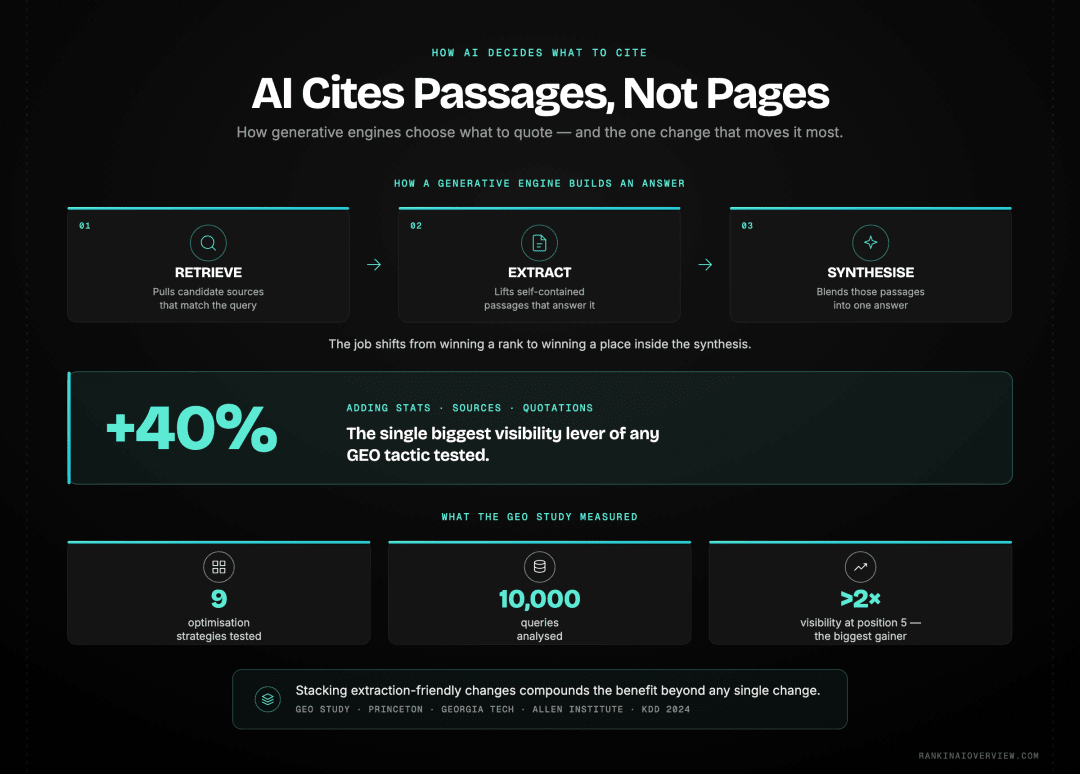
AI search tools decide what to cite by retrieving and extracting specific, self-contained passages that answer a query cleanly, rather than ranking whole pages the way classic search does.
The GEO research framed this directly: generative engines synthesise information from multiple sources and summarise it, which means a content creator's job shifts from winning a ranking position to winning a place inside that synthesis. The same study tested nine optimisation strategies across 10,000 queries and found some content changes moved visibility considerably more than others.
The clearest single finding: adding statistics, citing sources, and including quotations improved content visibility in generated responses by up to 40%, the largest gain of any tactic tested. Pages already ranking near position one saw little additional benefit, while pages around position five saw the largest gains, more than doubling their visibility.
That second detail is worth sitting with. The biggest opportunity isn't at the very top of search results, where content is often already well optimised by competitive pressure alone. It's in the middle of page one, where a page is good enough to rank but hasn't yet been restructured for extraction.
The same study also tested combinations of tactics rather than single changes in isolation, finding that stacking several extraction-friendly changes on one page compounded the benefit further than any single change applied alone. That matters for prioritisation: a page that only adds a statistic, without also tightening its structure, captures part of the available gain rather than all of it.
Combining tactics also explains why two pages with similar individual scores on word count, schema and freshness can still perform very differently in practice. The interaction between changes, not any single one, often decides whether a page clears the bar for extraction.
Which content formats appear most often in AI Overviews?
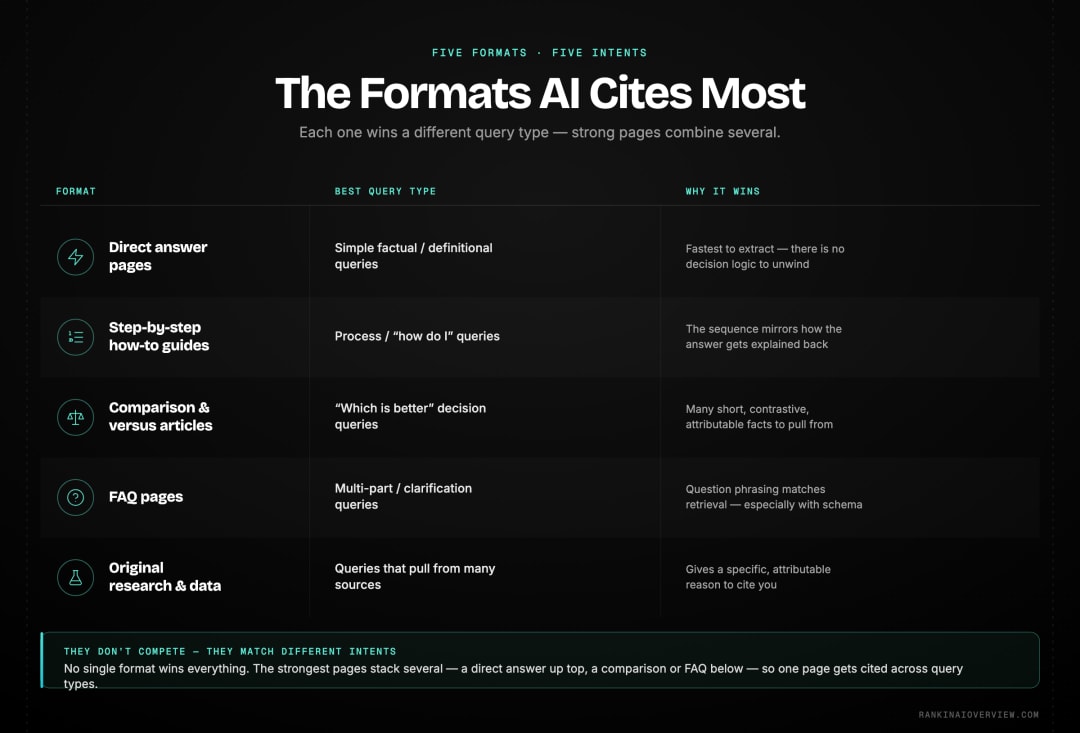
Five formats show up most consistently across independent research and practitioner testing: direct answer pages, step-by-step how-to guides, comparison articles, FAQ pages, and content built around original data.
Direct answer pages
Content that states the answer plainly in the first few sentences, before any context or scene-setting, is the easiest format for a retrieval system to lift cleanly. Walls of text rarely get cited, almost by definition, since there's no single self-contained passage for the system to pull.
This works at the page level and the section level. A page can open with a direct answer and still include detailed supporting sections afterward, provided each of those sections also leads with its own direct answer to whatever its heading asks.
The phrase “too contextual” describes this failure well: an introduction that spends three sentences building up to a point, rather than stating it, gives a retrieval system nothing clean to lift near the top of the page, even if the eventual point is exactly right.
Step-by-step how-to guides
Sequential, numbered content consistently appears in AI-generated answers, likely because the logical structure of a numbered list maps directly onto how a generative system explains a process back to a user.
HowTo-style content also benefits from a natural fit with schema markup, which gives the same numbered structure a machine-readable layer on top of what's already visually clear to a reader.
The sequence itself does some of the extraction work for the system. Step three depending logically on step two, and step two on step one, gives a generative system a built-in scaffold for explaining a process, rather than requiring it to infer structure from unstructured prose.
Comparison and versus articles
‘X vs Y’ style content performs well in citation data, plausibly because comparison naturally produces short, contrastive, fact-dense statements, exactly the kind of claim a generative system can lift and attribute with confidence.
This format has a practical advantage too: a well-built comparison page tends to surface several distinct extractable facts, side by side, rather than relying on a single core claim to carry the whole page's citation potential.
A comparison table reinforces this further. Each row is effectively its own self-contained claim, already separated from the others visually, which is close to the ideal shape for a system extracting one specific fact in response to one specific query.
FAQ pages
Question-and-answer formatted content, where a heading is phrased as a question and the line beneath it answers that question directly, is repeatedly identified as one of the most cited structures across AI search platforms.
Schema reinforces this rather than replacing it. Marking up a genuine FAQ section gives a generative system explicit confirmation of what's already structurally true on the page, which several independent studies associate with a meaningfully higher citation rate.
This is the same diagnostic worth running on any page that already ranks but never gets cited. RANK IN AI OVERVIEW's research on trust versus rankings found that even well-structured FAQ content gets skipped when the surrounding page carries no visible trust signals.
A genuinely useful FAQ section answers questions a reader would actually ask, in the order they'd actually ask them, rather than padding out a template with five generic questions added purely to qualify for schema. The second version is easy to spot and, in practice, easy for a generative system to deprioritise too.
Original research and data
Content built around statistics or findings that don't exist anywhere else gets cited more than content that restates publicly available information, since a generative system has a specific incentive to attribute claims it can't otherwise verify independently.
“ Good SEO is good GEO. Danny Sullivan Director, Google Search (former Search Liaison) Source: https://searchengineland.com/google-danny-sullivan-good-seo-good-geo-461464
That overlap is worth taking literally. None of the five formats above are exotic new inventions for AI search specifically; they're long-standing content formats that happen to map unusually well onto how generative systems extract and attribute information.
Original data also compounds well across a topic cluster rather than staying isolated to one page. RANK IN AI OVERVIEW's guide to building a GEO and AI Overview content cluster covers how to spread original research across several interlinked pages so each one reinforces the others' citation potential.
Lined up side by side, the five formats map onto different query types rather than competing for the same one:
| Format | Best matched query type | Why it wins there |
|---|---|---|
| Direct answer pages | Simple factual or definitional queries | Fastest to extract, no decision logic required |
| Step-by-step how-to guides | Process and “how do I” queries | Sequential structure mirrors how the answer gets explained back |
| Comparison and versus articles | Decision-making and “which is better” queries | Produces several short, contrastive, attributable facts |
| FAQ pages | Multi-part or clarification-heavy queries | Question phrasing matches retrieval directly, especially with schema |
| Original research and data | Queries where a system has many sources to choose between | Gives a specific, attributable reason to pick one source over another |
Matching format to query type is more useful than picking one universal favourite. A product page answering “what is X” benefits from a direct-answer opening regardless of whether the rest of the page is a comparison or a how-to.
In practice, most well-performing pages combine more than one format rather than picking a single one exclusively. A how-to guide that opens with a direct answer, includes a short comparison of tool options partway through, and closes with an FAQ section covers three of the five formats on a single page without contradicting any of them.
What content formats does AI rarely cite?
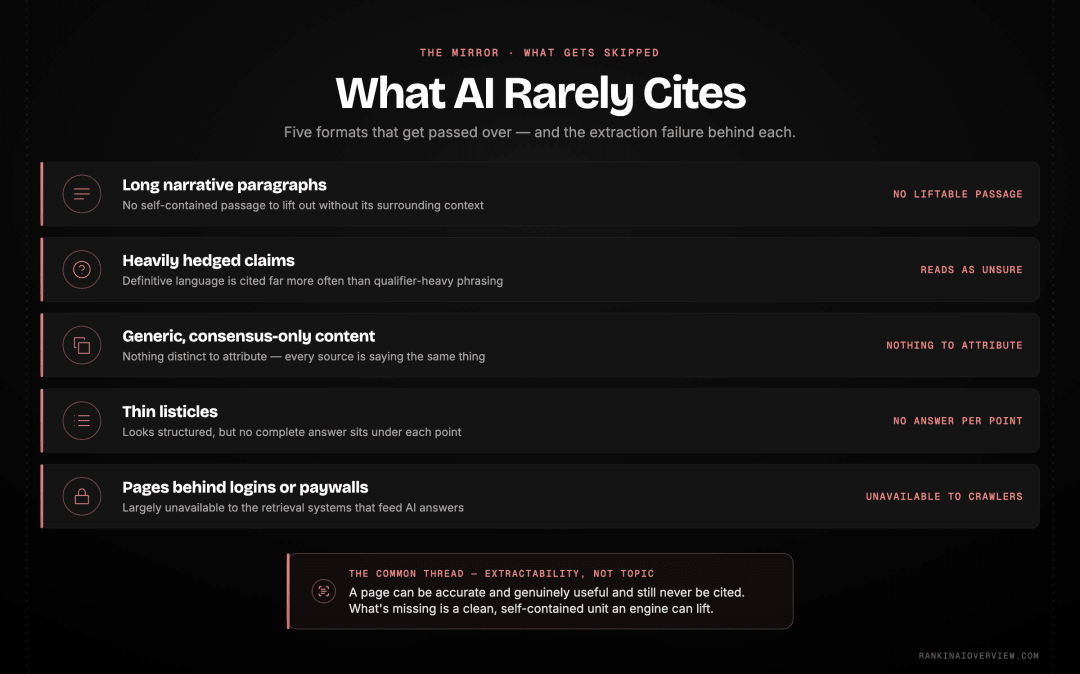
AI search tools rarely cite long, unstructured narrative prose, heavily hedged or qualifier-dense writing, and generic content that only restates widely available information without adding anything distinct.
| Format | Why it gets skipped |
|---|---|
| Long narrative paragraphs | No self-contained passage for a retrieval system to lift without surrounding context. |
| Heavily hedged claims | Definitive language is cited roughly twice as often as qualifier-heavy phrasing in published analysis. |
| Generic, consensus-only content | Nothing distinct to attribute; a generative system can answer the same query without citing it. |
| Thin listicles with no real content under each point | Looks structured, but each item still lacks a complete, extractable answer. |
| Pages behind logins or paywalls | Closed-access content is largely unavailable to retrieval systems in the first place. |
The common thread across this list isn't topic or industry; it's extractability. A page can be accurate, well-researched and genuinely useful to a human reader and still rarely get cited, if nothing on it forms a clean, standalone unit a system can lift with confidence.
Definitive phrasing matters more than it might seem. Published analysis comparing cited and non-cited passages found that cited text used clear, confident claims roughly twice as often as hedged, qualifier-heavy phrasing. “This may help in some cases” rarely gets extracted. “This reduces load time by 40%” often does.
Worth a specific callout: marketing copy built around tone rather than information, the kind written to sound persuasive rather than to answer a question, tends to fall into this same rarely-cited category even when it isn't technically a wall of text. Persuasive framing and extractable structure aren't the same property, and a page can have one without the other.
How should you structure a page to rank in AI results?
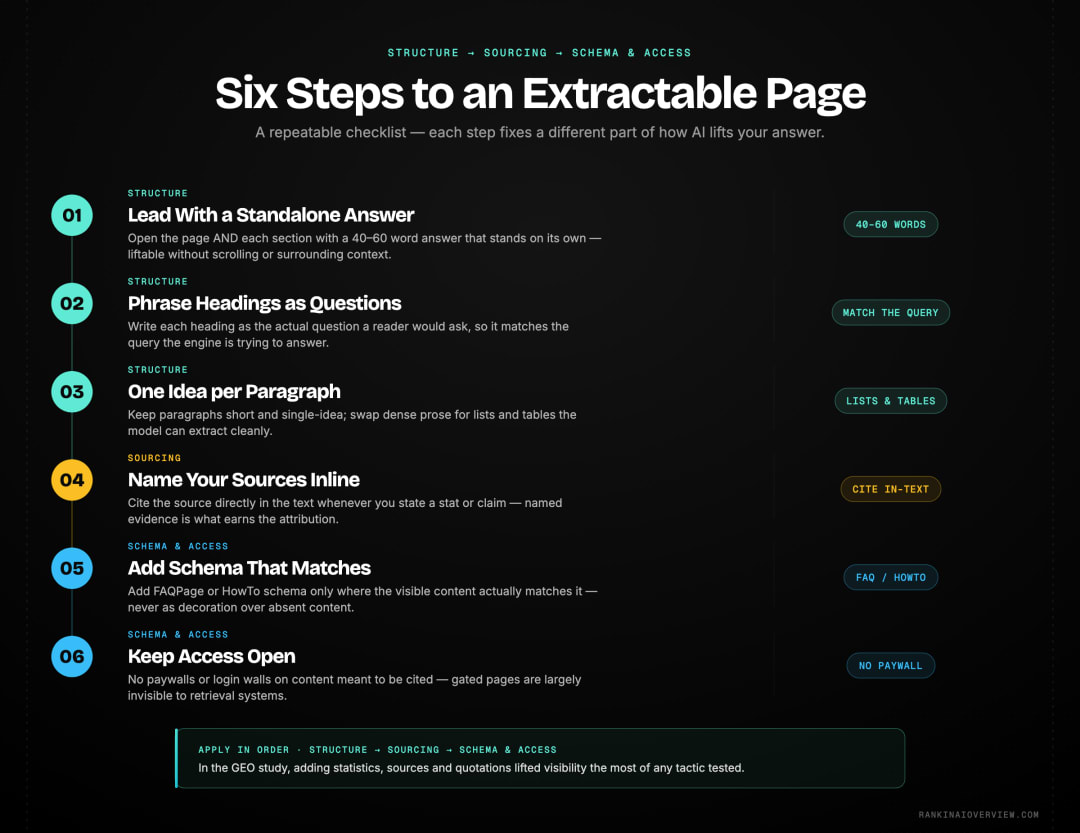
Structuring a page for AI search content clarity comes down to a short, repeatable set of habits applied consistently, rather than a single structural trick.
-
Open the page, and each major section, with a 40 to 60 word answer that makes sense with no other context.
-
Phrase headings as the actual question a reader would type or ask, not as a department or product label.
-
Use short paragraphs built around one idea each, with lists and tables wherever they replace dense prose.
-
Name sources directly in the text when citing a statistic or claim, rather than leaving it unattributed.
-
Add FAQPage or HowTo schema only where the visible content genuinely matches the structure being marked up.
-
Keep technical access open: no paywalls or login walls on content meant to be cited.
None of this requires rebuilding a site from scratch. Most existing pages can be retrofitted one section at a time, starting with whichever page already ranks well but has never appeared in an AI Overview for its target query.
Treat the list as a sequence rather than a single edit. A page that gets the opening answer right but still buries its sourcing three paragraphs down will only capture part of the available improvement. Each item addresses a different part of the extraction process, and skipping one weakens the rest.
A reasonable order to work through it: structure first, since nothing else matters if a passage isn't extractable at all; sourcing second, since attribution strengthens an already-extractable claim; schema and access last, since both confirm structure that should already exist rather than create it from nothing.
Does content length affect AI citation rates?
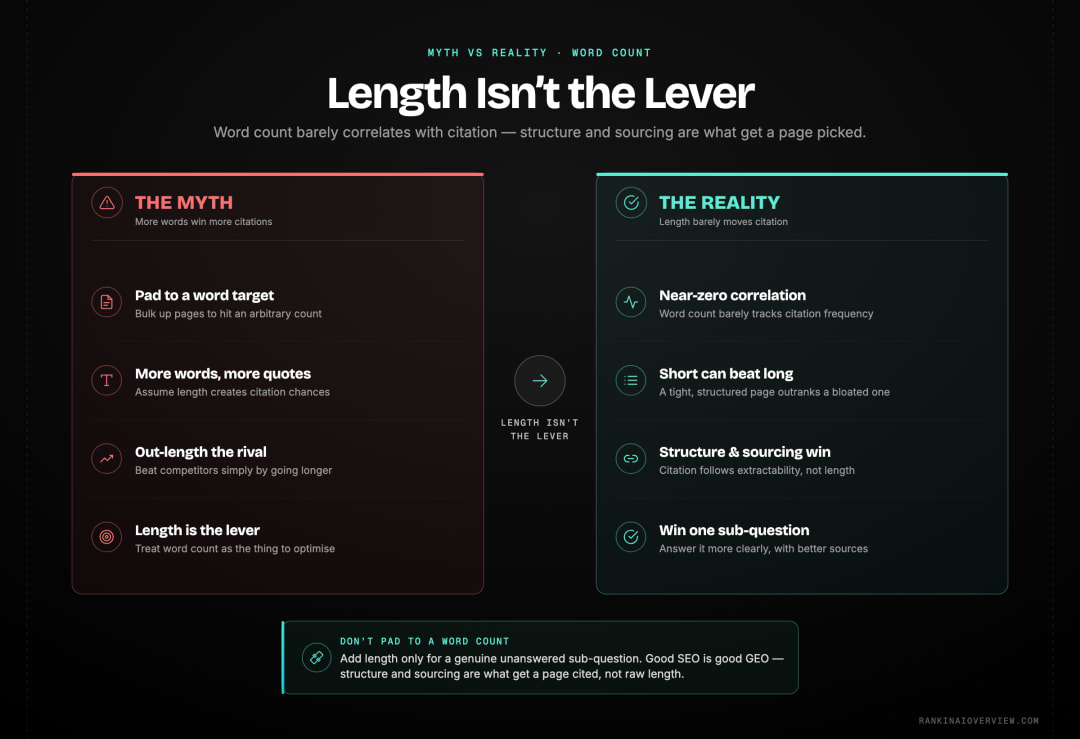
Content length itself has almost no measurable relationship with AI citation rates. An analysis of more than 560,000 AI Overviews found a near-zero correlation between word count and citation frequency, and over half of the cited pages studied were under 1,000 words.
This matches the position-based findings discussed earlier: citation tracks structure, sourcing and extractability far more reliably than raw length. A short, sharply structured page with named sources and a clear answer can outperform a much longer page that buries its strongest claim in paragraph six.
This is also why a page can rank well and still miss citation entirely, regardless of how long or short it is. RANK IN AI OVERVIEW's breakdown of what ‘ranking’ means in AI search covers why ranking position and citation likelihood are measured by different processes entirely.
The practical implication: don't pad a page to hit a target word count in the hope it reads as more authoritative. Add length only when there's a genuine sub-question still left unanswered, and keep every section self-contained regardless of how long the overall page runs.
This also reframes how to think about competing with longer, more established competitor pages. A newer or shorter page doesn't need to out-publish a 4,000-word competitor to earn a citation. It needs one section that answers a specific sub-question more clearly and with better sourcing than anything in that longer page.
Conclusion
There's no single winning content type for AI overview ranking. Direct answers, how-to guides, comparisons, FAQs and original data all get cited regularly, because each maps onto a different kind of extractable, attributable claim.
What unites all five is structure, not subject matter: short, self-contained passages, named sources, and claims stated plainly rather than hedged. Length, format labels and even domain authority all matter less than whether a given passage can be lifted cleanly and attributed with confidence.
Pick one underperforming page, apply the structure checklist to it alone, and re-check the target query after a few weeks before rolling the same changes out site-wide. That single test will reveal more about what works for a specific audience than any general format ranking ever could.
Revisit the format-to-query-type table periodically too. As more queries trigger AI Overviews and more competitors restructure their own content, the format that wins a given query type can shift, and a page built around last year's winning structure is worth re-checking rather than assumed permanently settled.
For ongoing research on which content formats earn AI Overview citations, RANK IN AI OVERVIEW covers this space across its content library.
Frequently asked questions
Is one content format better than all the others for AI citation?+
No single format dominates across every query type. Direct answers suit informational queries, comparisons suit decision-making queries, and how-to guides suit process queries. Matching format to query intent matters more than picking one universal favourite.
Do listicles get cited more than other formats?+
List-style content is cited frequently across multiple independent studies, largely because list items are naturally short, self-contained and easy to extract individually. That advantage comes from structure, not from the listicle label itself.
Does adding statistics really improve AI visibility that much?+
Peer-reviewed testing found statistics, citations and quotations were the single highest-impact content change tested, improving visibility in generated responses by up to 40%. No other single tactic in that study came close.
Can short content outperform long, comprehensive guides?+
Yes. Word count shows almost no correlation with citation likelihood. A short page with a clear, well-sourced answer regularly outperforms a longer page that doesn't structure its strongest claim for easy extraction.
Does original data always beat aggregated content?+
Usually, for queries where the AI has multiple sources to choose from. Aggregated content can still get cited when it's the clearest available explanation of a topic, but original data gives a system a specific, attributable reason to choose one source over another.
Can one page use more than one of these formats at once?+
Yes, and most strong-performing pages do. A page can open with a direct answer, include a comparison table mid-page, and close with an FAQ section, covering three formats without any of them undermining the others.
Explore with AI
Share this