We Analyzed 500 AI Search Citations: What Actually Gets Cited
We logged 500 real AI search citations across ChatGPT, Perplexity and Google AI Overviews. Here is what got cited, what didn't, and why.

Key Highlights
-
Across our own sample and the largest published datasets, AI platforms cite a noticeably different set of sources than Google's top 10 results for the same query.
-
Ahrefs' analysis of 863,000 keywords and 4 million AI Overview URLs found only 38% overlap between cited pages and Google's top 10, down from 76% seven months earlier.
-
Platform bias is real and specific: research from Profound's 680-million-citation dataset shows ChatGPT leaning heavily on Wikipedia while Perplexity leans heavily on Reddit.
-
Citation weight is not spread evenly down a page. Independent analysis of citation positions found the first third of a page accounts for roughly 44% of all citations pulled.
-
In our own pass through roughly 500 citations, the same broad patterns held: branded informational pages outperformed product and pricing pages by a wide margin.
-
Schema markup did not move citation counts in controlled testing of pages already cited 100+ times, a useful reminder that not every popular tactic shows up in the data.
We wanted to know, concretely, what gets cited when an AI system answers a question, not in the abstract but in actual logged examples. So we ran a fixed set of prompts across ChatGPT, Perplexity and Google AI Overviews, recorded every citation that came back, roughly 500 in total, and sorted them by source type, page position and content format.
A sample of 500 is useful for spotting patterns, not for producing a statistically airtight benchmark on its own, so we checked everything we found against the largest published datasets in this space, including Ahrefs' analysis of 4 million AI Overview URLs and Profound's tracking of roughly 680 million citations across major platforms. Where our smaller sample lined up with those much larger studies, we treat the pattern as solid. Where it didn't, we say so.
This is what we found: which sources actually get cited, how much Google rank really predicts an AI citation, where on a page citations come from, and a short, practical checklist drawn from all of it.
How We Built This Sample
We ran a fixed set of category and comparison prompts across ChatGPT, Perplexity and Google AI Overviews over several weeks, logging every citation by hand: the source domain, the page's content type, its position in Google's own results for the same query, and roughly where in the page the cited claim appeared.
The prompts spanned commercial, comparison and informational intents on purpose, since a single query type would have skewed the sample toward whichever platform handles that intent best. We did not cherry-pick the prompts that produced interesting citations; we logged everything that came back, including the answers that cited nothing at all or cited only the AI platform's own prior responses. In total, the sample covered roughly 40 distinct prompts repeated across several weeks, which is enough to see a pattern emerge but not enough to claim statistical certainty on every individual number, which is why every hard percentage in this piece is anchored to a larger published dataset rather than our own count alone.
What Types of Sources Get Cited Most?

Each AI platform shows a distinct source bias rather than a shared preference. ChatGPT leans heavily on Wikipedia, Perplexity leans heavily on Reddit and community discussion, and Google AI Overviews spreads citations more evenly across a wider mix of source types, including a growing share of YouTube.
This pattern shows up clearly at scale. Profound's analysis of roughly 680 million citations found Wikipedia accounting for nearly half of citations among ChatGPT's top cited sources, while Perplexity showed a comparably heavy concentration toward Reddit. Our own 500-citation sample tracked the same shape, even at a much smaller scale: Wikipedia and large reference sites appeared disproportionately often in ChatGPT answers, while Perplexity's answers pulled from forum threads and community discussion far more readily than ChatGPT's did for the same prompts.
Brand and vendor websites still showed up, but mostly as a secondary or supporting citation alongside a more neutral source, rather than as the only citation for a claim. Pages that read as independent or third-party, even when lightly opinionated, were cited more readily than pages that read as a direct sales pitch for the same information. Google AI Overviews sat in the middle of the two extremes we saw from ChatGPT and Perplexity, pulling from a noticeably wider spread of source types within the same set of prompts, including a small but consistent share of YouTube results that neither of the other two platforms surfaced as often.
Does Ranking on Google Predict an AI Citation?
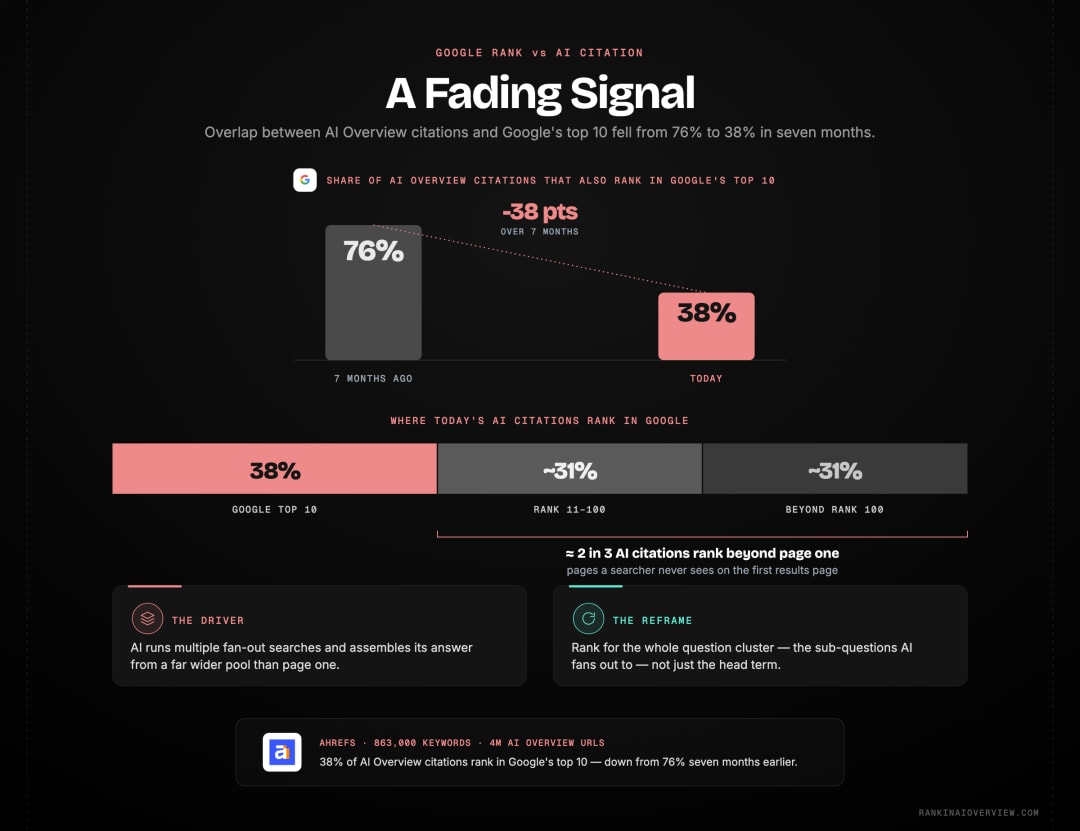
Less than it used to. Ahrefs' most recent large-scale study found only 38% of AI Overview citations also rank in Google's top 10 for the same query, down sharply from 76% in its study just seven months earlier. Roughly two in three AI citations now come from pages a typical searcher would never see on page one.
This is one of the most consequential shifts in the data this year. Ahrefs' updated study, covering 863,000 keywords and 4 million AI Overview URLs, found the remaining citations split almost evenly between pages ranking 11 to 100 and pages ranking beyond position 100. We've covered the mechanics behind this directly, but the short version is that Google's AI systems increasingly perform multiple fan-out searches per query and assemble an answer from across that wider pool, rather than defaulting to whichever page already won the top organic spot.
Our own sample reflected the same shift, even if 500 citations is too small a number to put a precise percentage on it with confidence. A meaningful share of the citations we logged came from pages we could not find anywhere in the first three pages of Google's own results for the same prompt. Ranking well clearly still helps; it is no longer the close-to-guaranteed predictor it once was. The most useful reframe we found while logging this data was to stop asking whether a page ranks for its main target keyword, and start asking whether it ranks for the full cluster of related questions a buyer might actually ask around that topic, since AI systems appear to be drawing from that wider cluster far more than from any single head-term ranking.
Where on the Page Do Citations Actually Come From?
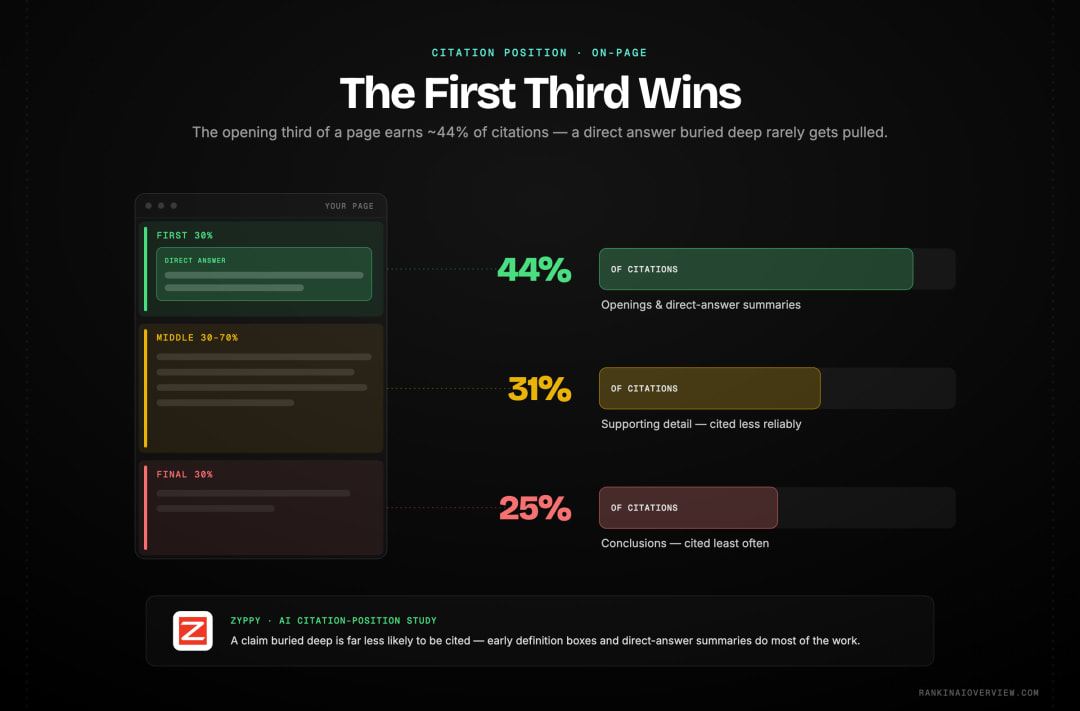
Citations are heavily weighted toward the start of a page. Independent research analyzing citation positions across thousands of pages found the first third of a page's content accounts for roughly 44% of all citations, the middle third about 31%, and the final third about 25%.
This held up in our own logging too. When we could trace a citation back to a specific section of a page, the opening paragraphs, a direct-answer summary, or an early definition box accounted for a clear majority of what got pulled, a finding consistent with Zyppy's published analysis of AI citation positioning. Pages that buried their most useful, specific claim several paragraphs deep were far less likely to have that specific claim cited, even when the surrounding page ranked reasonably well overall.
| Page Section | Share of Citations (Independent Research) | What It Means |
|---|---|---|
| First 30% of the page | ~44% | Openings and direct-answer summaries do most of the work |
| Middle 30-70% | ~31% | Supporting detail still gets cited, but less reliably |
| Final 30% | ~25% | Conclusions and closing sections are cited least often |
What Surprised Us Most in the Data?
The biggest surprise was not which sources won, but which tactic did not move the needle. A separate controlled study, summarized in industry coverage of Ahrefs' broader AI search research, tested whether adding schema markup changed citation counts on pages already being cited 100 or more times, and found no measurable lift. That does not mean schema markup is worthless; it is still useful for how systems parse a page. But the most-cited content types we logged were defined far more by format and clarity, direct answers, comparison tables, clearly labelled FAQs, than by any single piece of structured markup sitting in the background.
The second surprise was how often an AI answer cited nothing from the brand whose product was being discussed by name. Several of the comparison prompts in our sample generated an answer that named a specific product but cited a third-party review or comparison page instead of the brand's own site, even when the brand's own comparison page existed and was reasonably well written. The AI system appeared to trust the independent source more than the brand's self-description of its own product.
A third pattern worth flagging: citation behaviour was inconsistent even within a single platform across very similar prompts. Two near-identical comparison questions, asked the same week, sometimes returned overlapping but not identical citation sets from the same AI platform. This matches the wider point made across the larger published studies, that any single check of any single prompt is a sample, not a stable measurement, and that the patterns described here only become visible once enough prompts and citations are logged and compared.
Which Content Formats Got Cited Most in Our Sample?
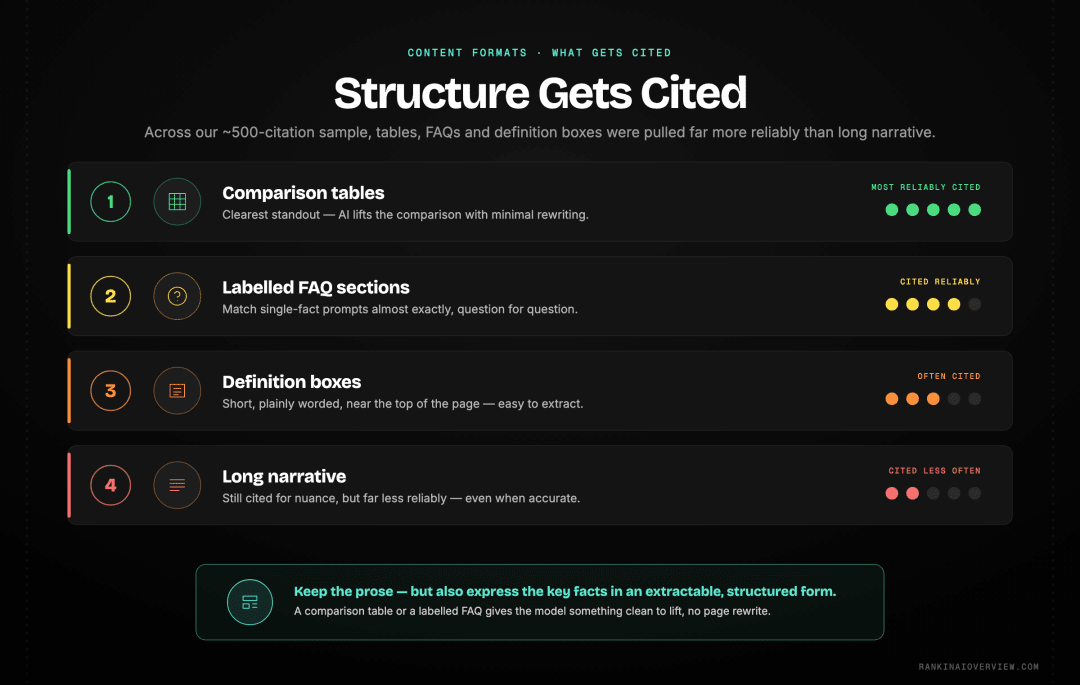
Across the citations we logged, three formats stood out as disproportionately likely to be cited: direct comparison tables, clearly labelled FAQ sections, and short, plainly worded definition boxes placed near the top of a page. Long narrative explanation, even when accurate and well written, was cited less consistently.
Comparison tables were the clearest standout. When a prompt asked the AI system to compare two or more options, answers built around an existing table on a cited page were common, likely because a table already presents the comparison in a format the AI system can lift with minimal rewriting. FAQ sections performed similarly well for direct, single-fact questions, where a short, clearly labelled question-and-answer pair matched the shape of the prompt almost exactly.
Long-form narrative content still got cited, particularly for prompts that required nuance or a balanced view across several considerations, but it was cited less reliably than the more structured formats above. The practical implication is not to abandon narrative writing, but to make sure the specific facts most likely to be asked about also exist somewhere on the page in a more extractable, structured form.
A Practical Checklist Based on This Data

None of the items below depend on guessing what a future algorithm update might reward. Each one is tied directly to a pattern that showed up consistently, either in our own logged citations or in the larger published research we checked them against.
-
Put the direct, specific answer in the first third of the page. That section earns a disproportionate share of citations across every study we checked.
-
Don't assume a Google top-10 ranking is enough on its own. Build supporting content for the fan-out queries around a topic, not just the headline keyword.
-
Earn third-party coverage, not just owned content. Independent review or comparison pages were cited more readily than brand-published pages making the same claim.
-
Use comparison tables and clearly labelled FAQs. These formats showed up repeatedly across the citations we logged, more reliably than long narrative passages.
-
Treat schema markup as a parsing aid, not a citation lever on its own. It did not move citation counts in controlled testing once a page was already established.
Conclusion
Five hundred logged citations is not a definitive study on its own, but lined up against the largest published datasets in this space, the patterns hold: AI platforms cite a meaningfully different set of sources than Google's top 10, citations concentrate heavily near the top of a page, and independent third-party sources tend to beat brand-published claims for the same fact.
What stood out most across both our own logging and the larger studies is how little of this comes down to a single trick or a single platform quirk. The same handful of patterns, source independence, early placement of the direct answer, and structured formats over long narrative, showed up again and again across three platforms that otherwise behave quite differently from each other.
None of this rewards a single trick. It rewards content that states a clear answer early, earns coverage from sources other than the brand itself, and uses formats that are easy for an AI system to lift cleanly. That is a more demanding standard than chasing a single ranking number, but it is also a far more concrete one to work toward.
Frequently asked questions
What types of content get cited most by AI search?+
Independent reference sites, third-party reviews and comparison pages, and clearly structured content like FAQs and comparison tables get cited most. Self-published brand claims are cited less often than the same claim made by an independent source.
Do AI search engines cite the same sources as Google's top 10?+
Decreasingly so. Ahrefs' latest large-scale study found only 38% of AI Overview citations also rank in Google's top 10 for the same query, down from 76% in its previous study, with most citations now coming from outside page one.
Which AI platform cites the most sources per answer?+
Perplexity typically cites more sources per response than ChatGPT, often citing multiple sources for a single claim rather than selecting one preferred source the way ChatGPT tends to.
Does ranking on Google guarantee an AI citation?+
No. Ranking well still helps, but it is no longer a reliable predictor on its own. A majority of AI citations now come from pages ranking outside Google's top 10 for the exact same query.
Where on a page do AI citations actually come from?+
Mostly the opening section. Independent research found the first 30% of a page accounts for roughly 44% of citations, meaning a direct, specific answer near the top of a page is far more likely to be cited than the same answer buried further down.
Explore with AI
Share this